Lexus SC300 / Lexus SC400. Manual - part 953
SERVICE HINTS FOR REFRIGERANT LEAK DETECTION
Page 2 of 3
B.
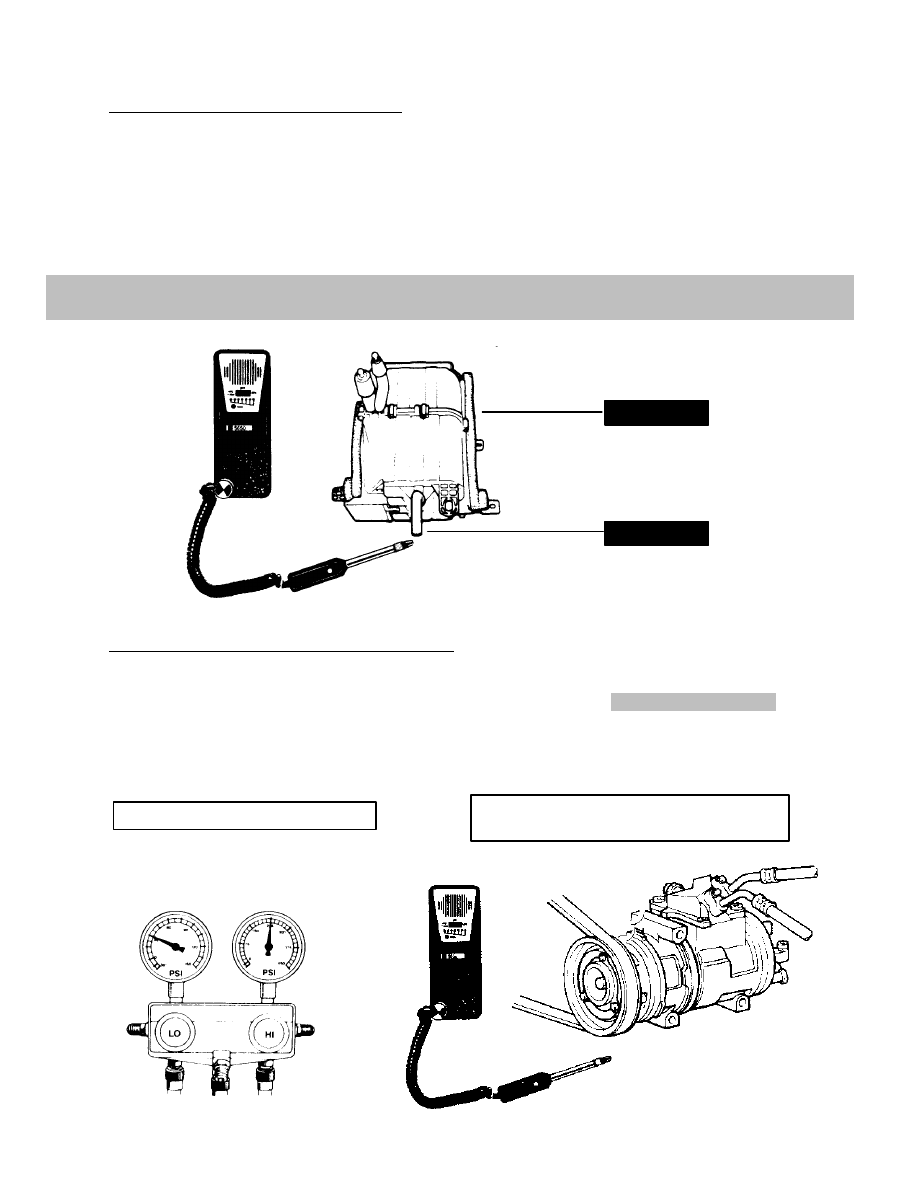
Checking for leakage at the evaporator: The evaporator drain hose provides an
excellent access point to check for refrigerant leakage from the evaporator. Be sure
to raise the vehicle on a lift so that the evaporator is as far as possible from any
petrochemical source that may be on the shop floor. When leak checking in this area,
turn the system off, pinch off the evaporator drain hose, and wait 10 to 15 minutes to
allow the refrigerant to accumulate in the evaporator case. When the system is ready
to check, release the drain hose and hold the leak detector wand about 1/4 inch below
the drain opening (see diagram).
NOTE:
Do not allow the leak detector tip to come in contact with water from the
evaporator.
C.
Checking for leakage at front compressor seal: Front compressor seal leaks are
probably the most difficult leaks to detect accurately. Special diagnostic procedures must be followed
for the best success. Make sure the system is fully charged. Operate the system with a pressure gauge
installed and assure that the system has correct system pressures. Shut off the engine. Begin the
leak check by placing the detector probe along the bottom half of the compressor clutch. Move the wand
slowly across the bottom of the compressor clutch. Be careful not to expose the detector wand tip to
any oil residue as this may cause a false leakage reading.
Evaporator
Drain Hose
Verify correct system pressure.
Move dectector wand slowly across the
bottom half of the compressor clutch.