Lexus ES300 (1997 year). Manual - part 134
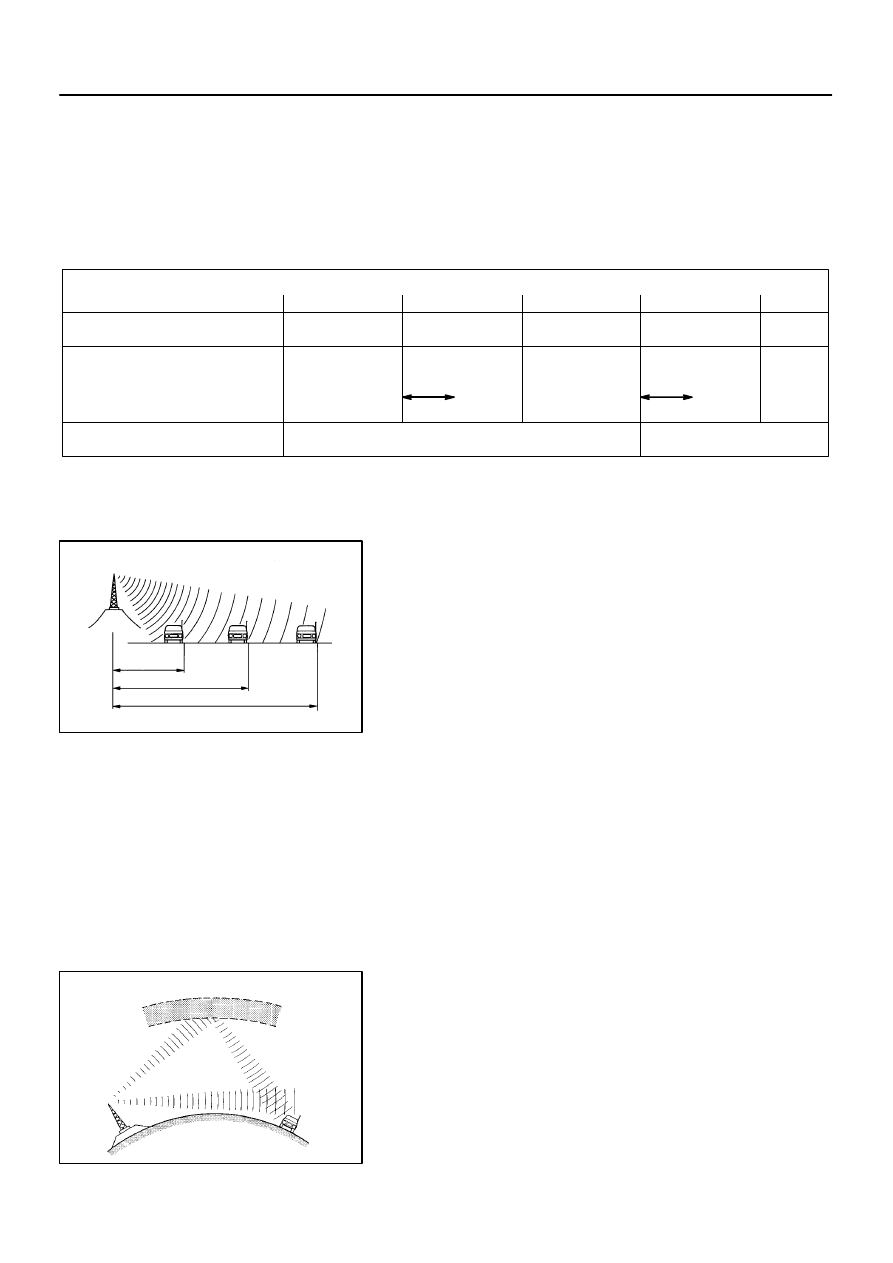
The radio wave bands used in radio broadcasting are as follows:
Frequency
Designation
Radio wave
Modulation method
LF: Low frequency MF: Medium Frequency HF: High Frequency VHF: Very High Frequency
Amplitude modulation
Frequency modulation
30 kHz
300 kHz
3 MHz
30 MHz
300 MHz
LF
MF
HF
VHF
AM
FM
BE060–01
BE2818
FM (Stereo)
FM (Monaural)
AM
BE2819
Fading
lonosphere
BE–142
–
BODY ELECTRICAL
AUDIO SYSTEM
1526
1997 LEXUS ES300 (RM511U)
AUDIO SYSTEM
DESCRIPTION
1.
RADIO WAVE BAND
2.
SERVICE AREA
There are great differences in the size of the service area for AM
and FM monaural. Sometimes FM stereo broadcasts cannot be
received even through AM can be received in very clearly.
Not only does FM stereo have the smallest service area, but it
also picks up static and other types of interference (”noise”)
easily.
3.
RECEPTION PROBLEMS
Besides the problem of static, there are also the problems
called ”fading”, ”multipath” and ”fade out”. These problems are
caused not by electrical noise but by the nature of the radio
waves themselves.
(a)
Fading
Besides electrical interference, AM broadcasts are also
susceptible to other types of interference, especially at
night. This is because AM radio waves bounce off the ion-
osphere at night. These radio waves then interfere with
the signals from the same transmitter that reach the ve-
hicle’s antenna directly. This type of interference is called
”fading”.