Jeep Compass (2022 year). Manual in english - page 20
 

  Index      Manuals     Jeep Compass (2022 year). Manual in english


Search            copyright infringement  


Content      ..     18      19      20     


Jeep Compass (2022 year). Manual in english - page 20


SERVICING AND MAINTENANCE

313

(Continued)

T

IRE

 R

OTATION

 R

ECOMMENDATIONS


The tires on the front and rear of your vehicle 

operate at different loads and perform different 

steering, handling, and braking functions. For 

these reasons, they wear at unequal rates.
These effects can be reduced by timely rotation of 

tires. The benefits of rotation are especially 

worthwhile with aggressive tread designs such as 

those on On/Off Road type tires. Rotation will 

increase tread life, help to maintain mud, snow, 

and wet traction levels, and contribute to a 

smooth, quiet ride.
For the proper maintenance intervals  

Ú

page 268

The reasons for any rapid or unusual wear should 

be corrected prior to rotation being performed.

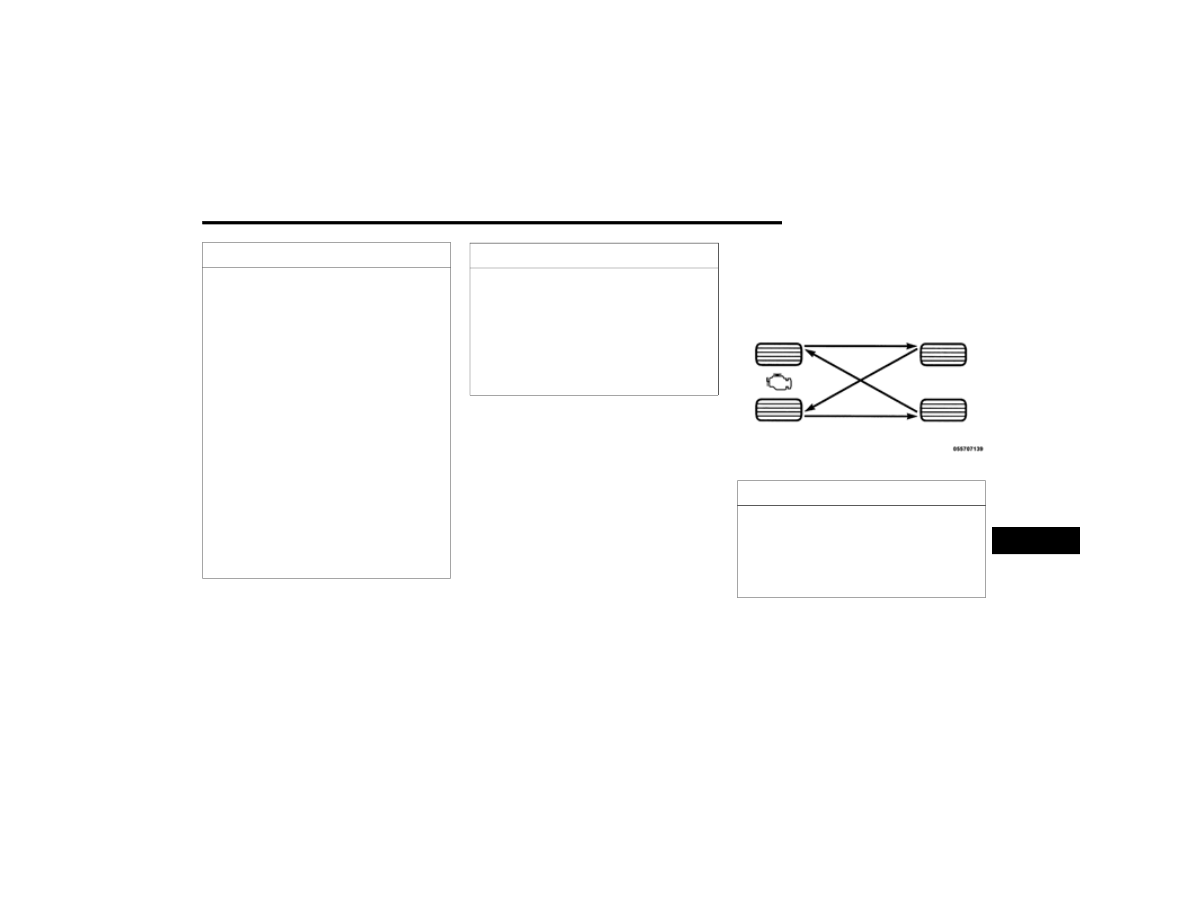
The suggested rotation method is the “forward 

cross” shown in the following diagram. This 

rotation pattern does not apply to some directional 

tires that must not be reversed.

Tire Rotation (Forward Cross)

CAUTION!

To avoid damage to your vehicle or tires, observe 

the following precautions:

Because of restricted traction device clearance 

between tires and other suspension compo

-

nents, it is important that only traction devices 

in good condition are used. Broken devices can 

cause serious damage. Stop the vehicle imme

-

diately if noise occurs that could indicate 

device breakage. Remove the damaged parts 

of the device before further use.

Install device as tightly as possible and then 

retighten after driving about ½ mile (0.8 km). 

Autosock traction devices do not require 

retightening.

Do not exceed 30 mph (48 km/h).

Drive cautiously and avoid severe turns and 

large bumps, especially with a loaded vehicle.

Do not drive for a prolonged period on dry 

pavement.

Observe the traction device manufacturer’s 

instructions on the method of installation, 

operating speed, and conditions for use. 

Always use the suggested operating speed of 

the device manufacturer’s if it is less than 

30 mph (48 km/h).

Do not use traction devices on a compact 

spare tire.

CAUTION!

CAUTION!

Proper operation of four-wheel drive vehicles 

depends on tires of equal size, type and 

circumference on each wheel. Any difference in 

tire size can cause damage to the power transfer 

unit. Tire rotation schedule should be followed to 

balance tire wear.

8

314

SERVICING AND MAINTENANCE


DEPARTMENT OF TRANSPORTATION 

UNIFORM TIRE QUALITY GRADES 

The following tire grading categories 

were established by the National 

Highway Traffic Safety Administration. 

The specific grade rating assigned by the 

tire's manufacturer in each category is 

shown on the sidewall of the tires on 

your vehicle.
All passenger vehicle tires must conform 

to Federal safety requirements in 

addition to these grades.

T

READWEAR

The Treadwear grade is a comparative 

rating, based on the wear rate of the tire 

when tested under controlled conditions 

on a specified government test course. 

For example, a tire graded 150 would 

wear one and one-half times as well on 

the government course as a tire graded 

100. The relative performance of tires 

depends upon the actual conditions of 

their use, however, and may depart 

significantly from the norm due to 

variations in driving habits, service 

practices, and differences in road 

characteristics and climate.

T

RACTION

 G

RADES

The Traction grades, from highest to 

lowest, are AA, A, B, and C. These grades 

represent the tire's ability to stop on wet 

pavement, as measured under 

controlled conditions on specified 

government test surfaces of asphalt and 

concrete. A tire marked C may have poor 

traction performance.

T

EMPERATURE

 G

RADES

The Temperature grades are A (the 

highest), B, and C, representing the tire's 

resistance to the generation of heat and 

its ability to dissipate heat, when tested 

under controlled conditions on a 

specified indoor laboratory test wheel.
Sustained high temperature can cause 

the material of the tire to degenerate 

and reduce tire life, and excessive 

temperature can lead to sudden tire 

failure. The grade C corresponds to a 

level of performance, which all 

passenger vehicle tires must meet 

under the Federal Motor Vehicle Safety 

Standard No. 109. Grades B and A 

represent higher levels of performance 

on the laboratory test wheel, than the 

minimum required by law.

WARNING!

The traction grade assigned to this tire is based 

on straight-ahead braking traction tests, and 

does not include acceleration, cornering, 

hydroplaning, or peak traction characteristics.

WARNING!

The temperature grade for this tire is 

established for a tire that is properly inflated and 

not overloaded. Excessive speed, underinflation, 

or excessive loading, either separately or in 

combination, can cause heat build-up and 

possible tire failure.

SERVICING AND MAINTENANCE

315

STORING THE VEHICLE

If you are storing your vehicle for more than three 

weeks, we recommend that you take the following 

steps to minimize the drain on your vehicle's 

battery:

Disconnect the negative cable from battery.

Any time you store your vehicle or keep it out of 

service (i.e., vacation) for two weeks or more, 

run the air conditioning system at idle for about 

five minutes in the fresh air and high blower 

setting. This will ensure adequate system lubri

-

cation to minimize the possibility of compressor 

damage when the system is started again.

NOTE:

When the vehicle has not been started or driven for 

at least 30 days, an “Extended Park Starting 

Procedure” is required to start the vehicle  

Ú

page 100.

BODYWORK

P

ROTECTION

 F

ROM

 A

TMOSPHERIC


A

GENTS


Vehicle body care requirements vary according to 

geographic locations and usage. Chemicals that 

make roads passable in snow and ice and those 

that are sprayed on trees and road surfaces during 

other seasons are highly corrosive to the metal in 

your vehicle. Outside parking, which exposes your 

vehicle to airborne contaminants, road surfaces on 

which the vehicle is operated, extreme hot or cold 

weather and other extreme conditions will have an 

adverse effect on paint, metal trim, and underbody 

protection.
The following maintenance recommendations will 

enable you to obtain maximum benefit from the 

corrosion resistance built into your vehicle.

What Causes Corrosion?

Corrosion is the result of deterioration or removal 

of paint and protective coatings from your vehicle.
The most common causes are:

Road salt, dirt and moisture accumulation.

Stone and gravel impact.

Insects, tree sap and tar.

Salt in the air near seacoast localities.

Atmospheric fallout/industrial pollutants.

B

ODY

 A

ND

 U

NDERBODY

 M

AINTENANCE

Wheel And Wheel Trim Care   

All wheels and wheel trim, especially aluminum 

and chrome plated wheels, should be cleaned 

regularly using mild (neutral Ph) soap and water to 

maintain their luster and to prevent corrosion. 

Wash wheels with the same soap solution 

recommended for the body of the vehicle and 

remember to always wash when the surfaces are 

not hot to the touch.
Your wheels are susceptible to deterioration 

caused by salt, sodium chloride, magnesium 

chloride, calcium chloride, etc., and other road 

chemicals used to melt ice or control dust on dirt 

roads. Use a soft cloth or sponge and mild soap to 

wipe away promptly. Do not use harsh chemicals or 

a stiff brush. They can damage the wheel’s 

protective coating that helps keep them from 

corroding and tarnishing.

CAUTION!

Before removal of the positive and negative 

terminals to the battery, wait at least a minute 

with ignition switch in the OFF position and close 

the driver’s door. When reconnecting the 

positive and negative terminals to the battery be 

sure the ignition switch is in the OFF position 

and the driver’s door is closed.

CAUTION!

Avoid products or automatic car washes that use 

acidic solutions or strong alkaline additives or 

harsh brushes. Many aftermarket wheel 

cleaners and automatic car washes may 

damage the wheel's protective finish. Such 

damage is not covered by the New Vehicle 

Limited Warranty. Only car wash soap, Mopar® 

Wheel Cleaner or equivalent is recommended.

8

316

SERVICING AND MAINTENANCE


When cleaning extremely dirty wheels including 

excessive brake dust, care must be taken in the 

selection of tire and wheel cleaning chemicals and 

equipment to prevent damage to the wheels. 

Mopar® Wheel Treatment, Mopar® Chrome 

Cleaner or their equivalent is recommended, or 

select a non-abrasive, non-acidic cleaner for 

aluminum or chrome wheels.

NOTE:

If you intend parking or storing your vehicle for an 

extended period after cleaning the wheels with 

wheel cleaner, drive your vehicle and apply the 

brakes to remove the water droplets from the 

brake components. This activity will remove the 

red rust on the brake rotors and prevent vehicle 

vibration when braking.

Dark Vapor Chrome, Black Satin Chrome, or Low 

Gloss Clear Coat Wheels

Cleaning Headlights 

Your vehicle is equipped with plastic headlights 

and fog lights that are lighter and less susceptible 

to stone breakage than glass headlights.
Plastic is not as scratch resistant as glass and 

therefore different lens cleaning procedures must 

be followed.
To minimize the possibility of scratching the lenses 

and reducing light output, avoid wiping with a dry 

cloth. To remove road dirt, wash with a mild soap 

solution followed by rinsing.
Do not use abrasive cleaning components, 

solvents, steel wool or other aggressive material to 

clean the lenses.

P

RESERVING

 T

HE

 B

ODYWORK

Washing  

Wash your vehicle regularly. Always wash your 

vehicle in the shade using Mopar® Car Wash, or 

a mild car wash soap, and rinse the panels 

completely with water.

If insects, tar, or other similar deposits have 

accumulated on your vehicle, use Mopar® 

Super Kleen Bug and Tar Remover to remove.

Use a high quality cleaner wax, such as Mopar® 

Cleaner Wax to remove road film, stains and to 

protect your paint finish. Use precautions to not 

scratch the paint.

Avoid using abrasive compounds and power 

buffing that may diminish the gloss or thin out 

the paint finish.

CAUTION!

Do not use scouring pads, steel wool, a bristle 

brush, metal polishes or oven cleaner. These 

products may damage the wheel's protective 

finish. Such damage is not covered by the New 

Vehicle Limited Warranty. Only car wash soap, 

Mopar® Wheel Cleaner or equivalent is 

recommended.

CAUTION!

If your vehicle is equipped with these specialty 

wheels, DO NOT USE wheel cleaners, abrasives, 

or polishing compounds. They will permanently 

damage this finish and such damage is not 

covered by the New Vehicle Limited Warranty. 

HAND WASH ONLY USING MILD SOAP AND 

WATER WITH A SOFT CLOTH. Used on a regular 

basis; this is all that is required to maintain this 

finish.

CAUTION!

Do not use abrasive or strong cleaning mate

-

rials such as steel wool or scouring powder 

that will scratch metal and painted surfaces.

Use of power washers exceeding 1,200 psi 

(8,274 kPa) can result in damage or removal 

of paint and decals.

SERVICING AND MAINTENANCE

317

Special Care

If you drive on salted or dusty roads or if you 

drive near the ocean, hose off the undercarriage 

at least once a month.

It is important that the drain holes in the lower 

edges of the doors, rocker panels, and trunk be 

kept clear and open.

If you detect any stone chips or scratches in the 

paint, touch them up immediately.

If your vehicle is damaged due to a collision or 

similar cause that destroys the paint and protec

-

tive coating, have your vehicle repaired as soon 

as possible.

If you carry special cargo such as chemicals, 

fertilizers, de-icer salt, etc., be sure that such 

materials are well packaged and sealed.

If a lot of driving is done on gravel roads, 

consider mud or stone shields behind each 

wheel.

Use Mopar® Touch Up Paint on scratches as 

soon as possible. An authorized dealer has 

touch up paint to match the color of your 

vehicle.

INTERIORS 

S

EATS

 A

ND

 F

ABRIC

 P

ARTS

Use Mopar® Total Clean to clean fabric upholstery 

and carpeting.

Stain Repel Fabric Cleaning Procedure — 

If Equipped

Stain Repel seats may be cleaned in the following 

manner:

Remove as much of the stain as possible by 

blotting with a clean, dry towel.

Blot any remaining stain with a clean, damp 

towel.

For tough stains, apply Mopar® Total Clean, or 

a mild soap solution to a clean, damp cloth and 

remove stain. Use a fresh, damp towel to 

remove soap residue.

For grease stains, apply Mopar® Multi-Purpose 

Cleaner to a clean, damp cloth and remove 

stain. Use a fresh, damp towel to remove soap 

residue.

Do not use any harsh solvents or any other form 

of protectants on Stain Repel products.

Seat Belt Maintenance

Do not bleach, dye or clean the belts with chemical 

solvents or abrasive cleaners. This will weaken the 

fabric.
If the belts need cleaning, use a mild soap solution 

or lukewarm water. Do not remove the belts from 

the vehicle to wash them. Dry with a soft cloth.
Sun damage can also weaken the fabric. Replace 

the belts if they appear frayed or worn or if the 

buckles do not work properly.

WARNING!

Do not use volatile solvents for cleaning 

purposes. Many are potentially flammable, and 

if used in closed areas they may cause 

respiratory harm.

WARNING!

A frayed or torn seat belt could rip apart in a 

collision and leave you with no protection. Inspect 

the seat belt system periodically, checking for 

cuts, frays, or loose parts. Damaged parts must 

be replaced immediately. Do not disassemble or 

modify the seat belt system. If your vehicle is 

involved in a collision, or if you have questions 

regarding seat belt or retractor conditions, take 

your vehicle to an authorized FCA dealer or 

authorized FCA Certified Collision Care Program 

facility for inspection.

8

318

SERVICING AND MAINTENANCE


P

LASTIC

 A

ND

 C

OATED

 P

ARTS

Use Mopar® Total Clean to clean vinyl upholstery.

Cleaning Plastic Instrument Cluster 

Lenses 

The lenses in front of the instruments in this 

vehicle are molded in clear plastic. When cleaning 

the lenses, care must be taken to avoid scratching 

the plastic.
Clean with a wet soft cloth. A mild soap solution 

may be used, but do not use high alcohol content 

or abrasive cleaners. If soap is used, wipe clean 

with a clean damp cloth. Dry with a soft cloth.

L

EATHER

 S

URFACES

Mopar® Total Clean is specifically recommended 

for leather upholstery.
Your leather upholstery can be best preserved by 

regular cleaning with a damp soft cloth. Small 

particles of dirt can act as an abrasive and damage 

the leather upholstery and should be removed 

promptly with a damp cloth. Stubborn soils can be 

removed easily with a soft cloth and Mopar® Total 

Clean. Care should be taken to avoid soaking your 

leather upholstery with any liquid. Please do not 

use polishes, oils, cleaning fluids, solvents, 

detergents, or ammonia-based cleaners to clean 

your leather upholstery.
NOTE:

If equipped with light colored leather, it tends to 

show any foreign material, dirt, and fabric dye 

transfer more so than darker colors. The leather is 

designed for easy cleaning, and the manufacturer 

recommends Mopar® total care leather cleaner 

applied on a cloth to clean the leather seats as 

needed.

G

LASS

 S

URFACES


All glass surfaces should be cleaned on a regular 

basis with Mopar® Glass Cleaner, or any 

commercial household-type glass cleaner. Never 

use an abrasive type cleaner. Use caution when 

cleaning the inside rear window equipped with 

electric defrosters or windows equipped with radio 

antennas. Do not use scrapers or other sharp 

instruments that may scratch the elements.
When cleaning the rear view mirror, spray cleaner 

on the towel or cloth that you are using. Do not 

spray cleaner directly on the mirror.

CAUTION!

Direct contact of air fresheners, insect repel

-

lents, suntan lotions, or hand sanitizers to the 

plastic, painted, or decorated surfaces of the 

interior may cause permanent damage. Wipe 

away immediately.

Damage caused by these type of products 

may not be covered by your New Vehicle 

Limited Warranty.

CAUTION!

Do not use Alcohol and Alcohol-based and/or 

Ketone based cleaning products to clean leather 

upholstery, as damage to the upholstery may 

result.

319

TECHNICAL SPECIFICATIONS

VEHICLE IDENTIFICATION NUMBER (VIN)

The VIN is found on the left front corner of the 

windshield and is visible from the outside of the 

vehicle.

Vehicle Identification Number

NOTE:

It is illegal to remove or alter the VIN.

BRAKE SYSTEM 

Your vehicle is equipped with power assisted 

brakes as standard equipment. In the event power 

assist is lost for any reason (for example, repeated 

brake applications with the engine off), the brakes 

will still function. However, the effort required to 

brake the vehicle will be much greater than that 

required with the power system operating.
If either of the two hydraulic systems lose normal 

capability, the remaining system will still function 

with some loss of overall braking effectiveness. 

This will be evident by increased pedal travel 

during application and greater pedal force 

required to slow or stop. In addition, if the 

malfunction is caused by an internal leak, as 

the brake fluid in the master cylinder drops, the 

Brake Warning Light will light.

WHEEL AND TIRE TORQUE SPECIFICATIONS  

Proper lug nut/bolt torque is very important to 

ensure that the wheel is properly mounted to the 

vehicle. Any time a wheel has been removed and 

reinstalled on the vehicle, the lug nuts/bolts 

should be torqued using a properly calibrated 

torque wrench using a six-sided (hex) deep wall 

socket.

T

ORQUE

 S

PECIFICATIONS

**Use only authorized dealer recommended lug 

nuts/bolts and clean or remove any dirt or oil 

before tightening.
Inspect the wheel mounting surface prior to 

mounting the tire and remove any corrosion or 

loose particles.

WARNING!

Driving a vehicle with the Brake Warning Light on 

is dangerous. A significant decrease in braking 

performance or vehicle stability during braking 

may occur. It will take you longer to stop the 

vehicle or will make your vehicle harder to 

control. You could have a collision. Have the 

vehicle checked immediately.

Lug Nut/Bolt 

Torque

**Lug Nut/

Bolt Size

Lug Nut/Bolt 

Socket Size

100 Ft-Lb 

(135 N·m)

M12 x 1.25

19 mm

9

320

TECHNICAL SPECIFICATIONS


Wheel Mounting Surface

Tighten the lug nuts/bolts in a star pattern until 

each nut/bolt has been tightened twice. Ensure 

that the socket is fully engaged on the lug nut/bolt 

(do not insert it halfway).

Torque Patterns

After 25 miles (40 km), check the lug nut/bolt 

torque to be sure that all the lug nuts/bolts are 

properly tightened.

FUEL REQUIREMENTS  

While operating on gasoline with the required 

octane number, hearing a light knocking sound 

from the engine is not a cause for concern. 

However, if the engine is heard making a heavy 

knocking sound, see a dealer immediately. Use of 

gasoline with a lower than recommended octane 

number can cause engine failure and may void or 

not be covered by the New Vehicle Limited 

Warranty.

2.4L E

NGINE

This engine is designed to meet all 

emission regulations and provide 

excellent fuel economy and performance 

when using high quality unleaded regular 

gasoline having a octane rating of 87 using the 

(R+M)/2 method. The use of premium gasoline is 

not recommended, as it will not provide any benefit 

over regular gasoline in these engines.

R

EFORMULATED

 G

ASOLINE


Many areas of the country require the use of 

cleaner-burning gasoline referred to as 

“reformulated gasoline”. Reformulated gasoline 

contains oxygenates and are specifically blended 

to reduce vehicle emissions and improve air 

quality.
The use of reformulated gasoline is recommended. 

Properly blended reformulated gasoline will 

provide improved performance and durability of 

engine and fuel system components.

WARNING!

To avoid the risk of forcing the vehicle off the 

jack, do not tighten the lug nuts/bolts fully until 

the vehicle has been lowered. Failure to follow 

this warning may result in personal injury.

TECHNICAL SPECIFICATIONS

321

G

ASOLINE

/O

XYGENATE

 B

LENDS


Some fuel suppliers blend unleaded gasoline with 

oxygenates such as ethanol.

Problems that result from using gasoline 

containing more than 15% ethanol (E-15) or 

gasoline containing methanol are not the 

responsibility of the manufacturer and may void 

the New Vehicle Limited Warranty.

E-85 U

SAGE

 I

N

 N

ON

-F

LEX

 F

UEL


V

EHICLES

Non-Flex Fuel Vehicles (FFV) are compatible with 

gasoline containing up to 15% ethanol (E-15). 

Gasoline with higher ethanol content may void the 

New Vehicle Limited Warranty.
If a Non-FFV vehicle is inadvertently fueled with 

E-85 fuel, the engine will have some or all of these 

symptoms:

Operate in a lean mode.

OBD II Malfunction Indicator Light on.

Poor engine performance.

Poor cold start and cold drivability.

Increased risk for fuel system component corro

-

sion.

CNG A

ND

 LP F

UEL

 S

YSTEM


M

ODIFICATIONS

Modifications that allow the engine to run on 

Compressed Natural Gas (CNG) or Liquid Propane 

(LP) may result in damage to the engine, 

emissions, and fuel system components. Problems 

that result from running CNG or LP are not the 

responsibility of the manufacturer and may void 

the New Vehicle Limited Warranty.

M

ETHYLCYCLOPENTADIENYL


M

ANGANESE

 T

RICARBONYL

 (MMT) I

N


G

ASOLINE

MMT is a manganese-containing metallic additive 

that is blended into some gasoline to increase 

octane. Gasoline blended with MMT provides no 

performance advantage beyond gasoline of the 

same octane number without MMT. Gasoline 

blended with MMT reduces spark plug life and 

reduces emissions system performance in some 

vehicles. The manufacturer recommends that 

gasoline without MMT be used in your vehicle. The 

MMT content of gasoline may not be indicated on 

the gasoline pump, therefore, you should ask the 

gasoline retailer whether or not his/her gasoline 

contains MMT. MMT is prohibited in Federal and 

California reformulated gasoline.

CAUTION!

DO NOT use E-85, gasoline containing methanol, 

or gasoline containing more than 15% ethanol 

(E-15). Use of these blends may result in starting 

and drivability problems, damage critical fuel 

system components, cause emissions to exceed 

the applicable standard, and/or cause the 

Malfunction Indicator Light to illuminate. Please 

observe pump labels as they should clearly 

communicate if a fuel contains greater than 

15% ethanol (E-15).

9

322

TECHNICAL SPECIFICATIONS


(Continued)

M

ATERIALS

 A

DDED

 T

O

 F

UEL


Besides using unleaded gasoline with the proper 

octane rating, gasolines that contain detergents, 

corrosion and stability additives are 

recommended. Using gasolines that have these 

additives will help improve fuel economy, reduce 

emissions, and maintain vehicle performance.

Designated TOP TIER Detergent Gasoline 

contains a higher level of detergents to 

further aide in minimizing engine and 

fuel system deposits. When available, 

the usage of TOP TIER Detergent gasoline is 

recommended. Visit 

www.toptiergas.com for a list 

of TOP TIER Detergent Gasoline Retailers.
Indiscriminate use of fuel system cleaning agents 

should be avoided. Many of these materials 

intended for gum and varnish removal may contain 

active solvents or similar ingredients. These can 

harm fuel system gasket and diaphragm materials.

F

UEL

 S

YSTEM

 C

AUTIONS

NOTE:

Intentional tampering with the emissions control 

system can result in civil penalties being assessed 

against you.

CAUTION!

Follow these guidelines to maintain your 

vehicle’s performance:

The use of leaded gasoline is prohibited by 

Federal law. Using leaded gasoline can impair 

engine performance and damage the emis

-

sions control system.

An out-of-tune engine or certain fuel or ignition 

malfunctions can cause the catalytic 

converter to overheat. If you notice a pungent 

burning odor or some light smoke, your engine 

may be out of tune or malfunctioning and may 

require immediate service. Contact an autho

-

rized dealer for service assistance.

The use of fuel additives, which are now being 

sold as octane enhancers, is not recom

-

mended. Most of these products contain high 

concentrations of methanol. Fuel system 

damage or vehicle performance problems 

resulting from the use of such fuels or addi

-

tives is not the responsibility of the manufac

-

turer and may void or not be covered under 

the New Vehicle Limited Warranty.

CAUTION!

TECHNICAL SPECIFICATIONS

323

FLUID CAPACITIES   

ENGINE FLUIDS AND LUBRICANTS  

US

Metric

Fuel (Approximate)
All Engines

13.5 Gallons

51 Liters

Engine Oil With Filter
2.4L Engine

5.5 Quarts

5.2 Liters

Cooling System*
2.4L Engine

6.8 Quarts

6.5 Liters

* Includes heater and coolant recovery bottle filled to MAX level.

Component

Fluid, Lubricant, or Genuine Part

Engine Coolant

We recommend using Mopar® Antifreeze/Coolant 10 Year/150,000 Miles 

(240,000 Kilometers) Formula OAT (Organic Additive Technology) meeting the 

requirements of the manufacturer Material Standard MS.90032.

Engine Oil

We recommend using Mopar® SAE 0W-20 Full Synthetic Engine Oil which 

meets the requirements of the manufacturer Material Standard MS-6395. 

Equivalent full synthetic SAE 0W-20 engine oil can be used but must have the 

API Starburst trademark  

Ú

page 273.

Engine Oil Filter

We recommend using a Mopar® Engine Oil Filter. If a Mopar® Engine Oil Filter 

is unavailable, only use filters that meet or exceed SAE/USCAR-36 Filter 

Performance Requirements.

Fuel Selection

87 Octane (R+M)/2 Method, 0-15% ethanol.

9

324

TECHNICAL SPECIFICATIONS


CHASSIS FLUIDS AND LUBRICANTS    

Component

Fluid, Lubricant, or Genuine Part

6-Speed Automatic Transmission (FWD Models) – If Equipped

Use only Mopar® AW-1 Automatic Transmission Fluid, or equivalent. 

Failure to use the correct fluid may affect the function or performance of 

your transmission.

9-Speed Automatic Transmission (4WD Models) – If Equipped

Use only Mopar® ZF 8 & 9 Speed ATF Automatic Transmission Fluid, or 

equivalent. Failure to use the correct fluid may affect the function or 

performance of your transmission.

Power Transfer Unit (PTU) – If Equipped

We recommend using Mopar® Front Axle/PTU Synthetic Axle Lubricant 

SAE 75W-90 (API GL-5).

Rear Differential (RDM) – If Equipped

We recommend using Mopar® Rear Axle/RDM Synthetic Axle Lubricant

SAE 75W-90 (API GL-5).

Brake Master Cylinder

We recommend using Mopar® DOT 3.

325

CUSTOMER ASSISTANCE

SUGGESTIONS FOR OBTAINING SERVICE 

FOR YOUR VEHICLE 

P

REPARE

 F

OR

 T

HE

 A

PPOINTMENT

All work to be performed may not be covered by the 

warranty. Discuss additional charges with the 

service manager. Keep a maintenance log of your 

vehicle's service history. This can often provide a 

clue to the current problem.

P

REPARE

 A L

IST

Make a written list of your vehicle's problems or the 

specific work you want done. If you've had an 

accident or work done that is not on your 

maintenance log, let the service advisor know.

B

E

 R

EASONABLE

 W

ITH

 R

EQUESTS

If you list a number of items and you must have 

your vehicle by the end of the day, discuss the 

situation with the service advisor and list the items 

in order of priority. At many authorized dealers, you 

may obtain a rental vehicle (additional charges 

may apply). If you need a rental, it is advisable to 

make these arrangements when you call for an 

appointment.

IF YOU NEED ASSISTANCE 

FCA US LLC and its authorized dealers are vitally 

interested in your satisfaction. We want you to be 

happy with our products and services.
Warranty service must be done by an authorized 

dealer. We strongly recommend that you take the 

vehicle to an authorized dealer. They know your 

vehicle the best, and are most concerned that you 

get prompt and high quality service. FCA US LLC’s 

authorized dealers have the facilities, 

factory-trained technicians, special tools, and the 

latest information to ensure the vehicle is fixed 

correctly and in a timely manner.
This is why you should always talk to an authorized 

dealer’s service manager first. If for some reason 

you are still not satisfied, talk to the general 

manager or owner of the authorized dealer. 

They want to know if you need assistance. If an 

authorized dealer is unable to resolve the concern, 

you may contact FCA US LLC's Customer 

Assistance center.

Any communication to FCA US LLC’s customer 

center should include the following information:

Owner's name and address

Owner's telephone number 

(home, mobile, and office)

Authorized dealer name

Vehicle Identification Number (VIN)

Vehicle delivery date and mileage

FCA US LLC C

USTOMER

 C

ENTER

P.O. Box 21–8004
Auburn Hills, MI 48321–8004
Phone: (877) 426-5337

FCA C

ANADA

 I

NC

. C

USTOMER

 C

ENTER

P.O. Box 1621
Windsor, Ontario N9A 4H6
Phone: (800) 465-2001 English / 

(800) 387-9983 French

10

326

CUSTOMER ASSISTANCE


M

EXICO

Av. Prolongacion Paseo de la Reforma, 1240
Sante Fe C.P. 05109
Mexico, D. F.
In Mexico City: (800) 505-1300
Outside Mexico City: +(52) 55 50817568

P

UERTO

 R

ICO

 A

ND

 US V

IRGIN

 I

SLANDS

FCA Caribbean LLC
P.O. Box 191857
San Juan, Puerto Rico, 00919-1857
Phone: (877) 426-5337
Fax: (787) 782-3345

C

USTOMER

 A

SSISTANCE

 F

OR

 T

HE


H

EARING

 O

R

 S

PEECH

 I

MPAIRED


(TDD/TTY)

To assist customers who have hearing difficulties, 

FCA US LLC has installed special Telecommu

-

nication Devices for the Deaf (TDD) equipment at 

its customer center. Any hearing or speech 

impaired customer, who has access to a TDD or a 

conventional teletypewriter (TTY) in the United 

States, can communicate with FCA US LLC by 

dialing 1-800-380-2479.

Canadian residents with hearing difficulties that 

require assistance can use the special needs relay 

service offered by Bell Canada. For TTY 

teletypewriter users, dial 711 and for Voice callers, 

dial 1-800-855-0511 to connect with a Bell Relay 

Service operator.

S

ERVICE

 C

ONTRACT


You may have purchased a service contract for a 

vehicle to help protect you from the high cost of 

unexpected repairs after FCA US LLC's New Vehicle 

Limited Warranty expires. The Mopar® Vehicle 

Protection plans are the ONLY vehicle extended 

protection plans authorized, endorsed and backed 

by FCA US LLC to provide additional protection 

beyond your vehicle’s warranty. If you purchased a 

Mopar® Vehicle Protection Plan, you will receive 

Plan Provisions and an Owner Identification Card in 

the mail within three weeks of the vehicle delivery 

date. If you have any questions about the service 

contract, call FCA US LLC’s Service Contract 

National Customer Hotline at 1-800-521-9922 

(Canadian residents, call (800) 465-2001

English / (800) 387-9983 French).

FCA US LLC is not responsible for any service 

contract you may have purchased from another 

manufacturer. If you require service after the

FCA US LLC New Vehicle Limited Warranty expires, 

please refer to the contract documents, and 

contact the person listed in those documents.
We appreciate that you have made a major 

investment when you purchased the vehicle. 

An authorized dealer has also made a major 

investment in facilities, tools, and training to 

assure that you are absolutely delighted with the 

ownership experience.

WARNING!

Engine exhaust (internal combustion engines 

only), some of its constituents, and certain 

vehicle components contain, or emit, chemicals 

known to the State of California to cause cancer 

and birth defects, or other reproductive harm. In 

addition, certain fluids contained in vehicles and 

certain products of component wear contain, or 

emit, chemicals known to the State of California 

to cause cancer and birth defects, or other 

reproductive harm.

CUSTOMER ASSISTANCE

327

WARRANTY INFORMATION

See the Warranty Information for the terms and 

provisions of FCA US LLC warranties applicable to 

this vehicle and market. Refer to 

www.mopar.com/om for further information.
See the Warranty Information for the terms and 

provisions of FCA Canada Inc. warranties 

applicable to this vehicle and market. Refer to 

www.owners.mopar.ca/en/ for further 

information.
Use this QR code to access your 

digital experience.

MOPAR® PARTS

Mopar® original equipment parts & accessories 

and factory filled fluids are available from an 

authorized dealer. They are recommended for your 

vehicle to keep it operating at its best and maintain 

its original condition.

REPORTING SAFETY DEFECTS 

I

N

 T

HE

 50 U

NITED

 S

TATES

 A

ND


W

ASHINGTON

, D.C.

If you believe that your vehicle has a 

defect that could cause a crash or cause 

injury or death, you should immediately 

inform the National Highway Traffic 

Safety Administration (NHTSA) in 

addition to notifying FCA US LLC.
If NHTSA receives similar complaints, it 

may open an investigation, and if it finds 

that a safety defect exists in a group of 

vehicles, it may order a recall and 

remedy campaign. However, NHTSA 

cannot become involved in individual 

problems between you, an authorized 

dealer, or FCA US LLC.
To contact NHTSA, you may call the Vehicle 

Safety Hotline toll free at 1-888-327-4236 

(TTY: 1-800-424-9153); or go to

http://www.safercar.gov; or write to: 

Administrator, NHTSA, 1200 New Jersey 

Avenue, SE., West Building, Washington, 

D.C. 20590. You can also obtain other 

information about motor vehicle safety 

from http://www.safercar.gov.

I

N

 C

ANADA

If you believe that your vehicle has a 

safety defect, you should contact the 

Customer Service Department 

immediately. Canadian customers who 

wish to report a safety defect to the 

Canadian government should contact 

Transport Canada, Motor Vehicle Defect 

Investigations and Recalls at 

1-800-333-0510 or go to 

wwwapps.tc.gc.ca/Saf-Sec-Sur/7/

PCDB-BDPP.

PUBLICATION ORDER FORMS 

To order the following manuals, you may use either 

the website or the phone numbers listed below.
Service Manuals
These comprehensive Service Manuals provide a 

complete working knowledge of the vehicle, 

system, and/or components and is written in 

straightforward language with illustrations, 

diagrams, and charts.

10

328

CUSTOMER ASSISTANCE


Diagnostic Procedure Manuals
Diagnostic Procedure Manuals are filled with 

diagrams, charts and detailed illustrations. These 

manuals make it easy to find and fix problems on 

computer-controlled vehicle systems and features. 

They show exactly how to find and correct 

problems, using step-by-step troubleshooting and 

drivability procedures, proven diagnostic tests and 

a complete list of all tools and equipment.
To order a hard copy of your Service or Diagnostic 

Procedure manuals, visit:
www.techauthority.com (US and Canada).
Owner's Manuals
These Owner's Manuals have been prepared with 

the assistance of service and engineering 

specialists to acquaint you with specific FCA 

vehicles.
To access your Owner's Information online, visit 

www.mopar.com/om (US) or 

www.owners.mopar.ca (Canada).
Or
Call Tech Authority toll free at:

1-800-890-4038 (US)

Owner's Manuals, Radio Manuals and Warranty 

Information Books can be ordered through 

Archway at:

1-800-387-1143 (Canada)

GENERAL INFORMATION

The following regulatory statement applies to all 

Radio Frequency (RF) devices equipped in this 

vehicle:
This device complies with Part 15 of the FCC Rules 

and with Innovation, Science and Economic 

Development Canada license-exempt RSS 

standard(s). Operation is subject to the following 

two conditions:
1. This device may not cause harmful 

interference, and

2. This device must accept any interference 

received, including interference that may 

cause undesired operation.

Le présent appareil est conforme aux CNR 

d`Innovation, Science and Economic Development 

applicables aux appareils radio exempts de 

licence. L'exploitation est autorisée aux deux 

conditions suivantes:
1. l'appareil ne doit pas produire de brouillage, 

et

2. l'utilisateur de l'appareil doit accepter tout 

brouillage radioélectrique subi, même si le 

brouillage est susceptible d'en compromettre 

le fonctionnement.

La operación de este equipo está sujeta a las 

siguientes dos condiciones:
1. es posible que este equipo o dispositivo no 

cause interferencia perjudicial y

2. este equipo o dispositivo debe aceptar 

cualquier interferencia, incluyendo la que 

pueda causar su operación no deseada.

NOTE:

Changes or modifications not expressly approved 

by the party responsible for compliance could void 

the user’s authority to operate the equipment.


Content      ..     18      19      20