Infiniti QX80 (2021 year). Manual in english - page 3
SSS0292
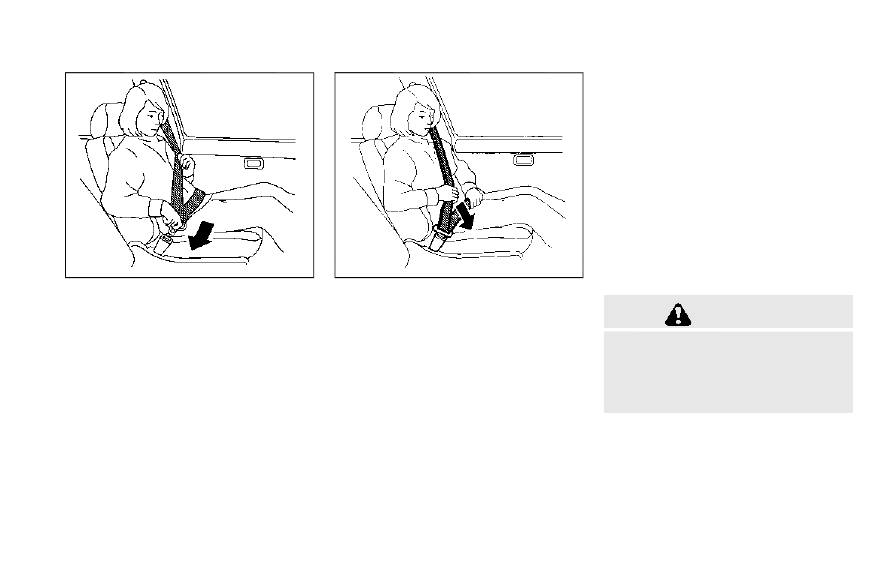
Fastening the seat belts
1. Adjust the seat. (See “Seats” (P.1-3).)
2. Slowly pull the seat belt out of the
retractor and insert the tongue into the
buckle until you hear and feel the latch
engage.
.
The retractor is designed to lock
during a sudden stop or on impact.
A slow pulling motion permits the
belt to move, and allows you some
freedom of movement in the seat.
.
If the seat belt cannot be pulled from
its fully retracted position, firmly pull
the belt and release it. Then smoothly
pull the belt out of the retractor.
SSS0290
3. Position the lap belt portion
low and
snug on the hips
as shown.
4. Pull the shoulder belt portion toward the
retractor to take up extra slack. Be sure
the shoulder belt is routed over your
shoulder and across your chest.
The three-point type seat belts have two
modes of operation:
.
Emergency Locking Retractor (ELR)
.
Automatic Locking Retractor (ALR)
The Emergency Locking Retractor (ELR)
mode allows the seat belt to extend and
retract to allow the driver and passengers
some freedom of movement in the seat. The
ELR locks the seat belt when the vehicle
slows down rapidly or during impacts.
The Automatic Locking Retractor (ALR)
mode (child restraint mode) locks the seat
belt for child restraint installation.
When the ALR mode is activated the seat
belt cannot be extended again until the seat
belt tongue is detached from the buckle and
fully retracted. The seat belt returns to the
ELR mode after the seat belt fully retracts.
For additional information, see “Child re-
straints” (P.1-31).
The ALR mode should be used only for child
restraint installation. During normal seat
belt use by an occupant, the ALR mode
should not be activated. If it is activated, it
may cause uncomfortable seat belt tension.
WARNING
When fastening the seat belts, be certain
that seatbacks are completely secured in
the latched position. If they are not
completely secured, passengers may be
injured in an accident or sudden stop.
Safety — seats, seat belts and supplemental restraint system
1-23