Hyundai Elantra Hybrid (2024 year). Manual in english - page 2
 

  Index      Manuals     Hyundai Elantra Hybrid (2024 year). Manual in english


Search            copyright infringement  


Content      ..      1      2      3      ..


Hyundai Elantra Hybrid (2024 year). Manual in english - page 2


2-3

02

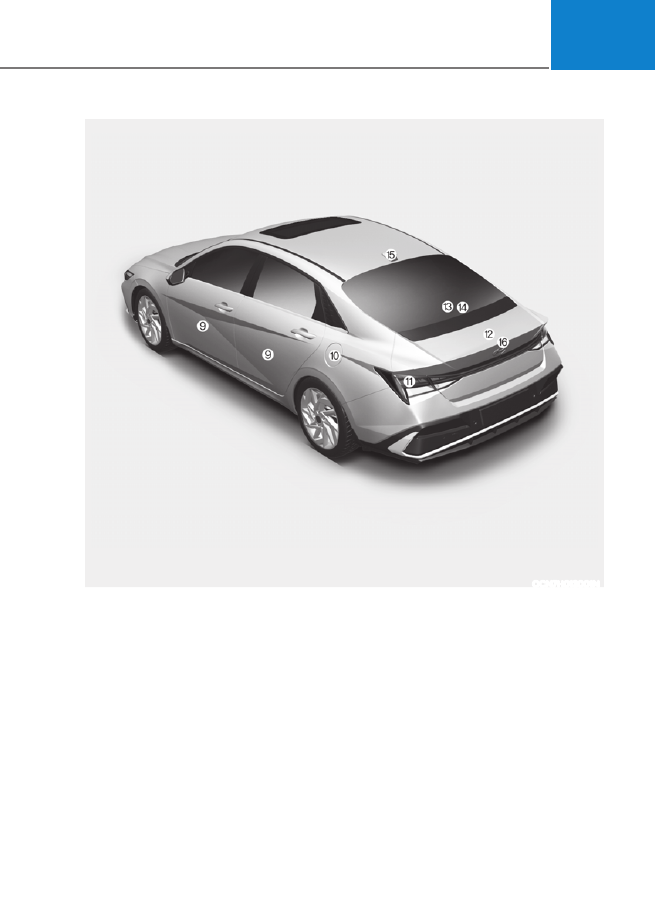
9.  Door ........................................................5-27
10. Fuel filler door .......................................5-66
11.  Rear combination lamp........................ 9-57
12. Trunk .......................................................5-61

13. Defroster / Glass antenna .......... 5-97/5-107
14. High mounted stop lamp .....................9-60
15. Antenna ................................................ 5-107
16. Rear view camera ................................7-106

The actual shape may differ from the illustration.

OCN7H013001N

EXTERIOR OVERVIEW (REAR VIEW)
2-4

Vehicle Information

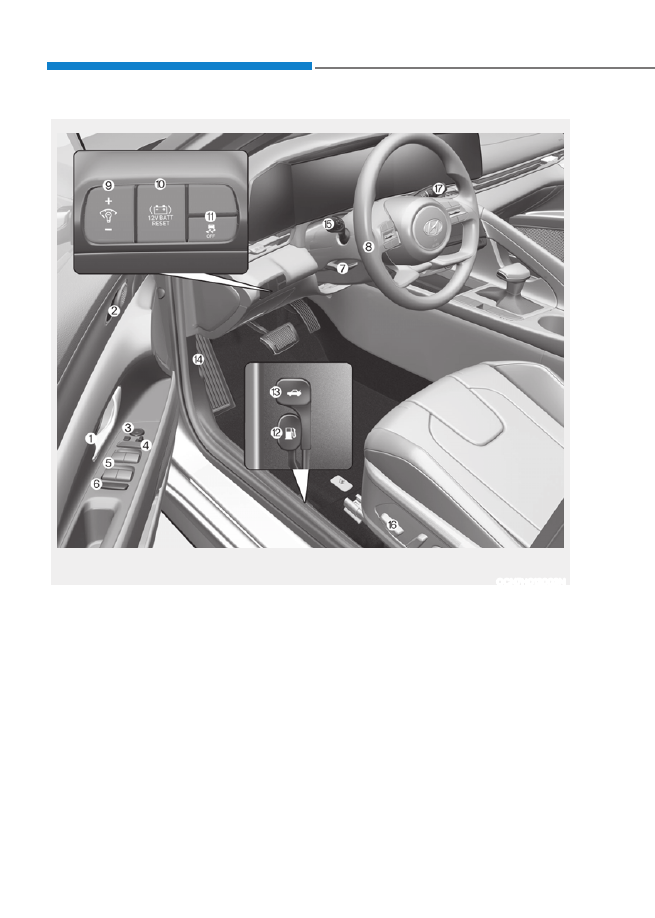
The actual shape may differ from the illustration.

OCN7H013003N

1.  Inside door handle ................................ 5-29
2.  Seat position memory system ............. 5-34
3.  Side view mirror control switch ...........5-49
4.  Central door lock switch ...................... 5-29
5.  Power window switches ...................... 5-50
6.  Power window lock button .................. 5-53
7.  Steering wheel tilt/telescopic lever .... 5-38
8.  Steering wheel .......................................5-37
9.  Instrument panel illumination control 

switch ...................................................... 4-5

10. 12 V battery reset button ........................8-4
11.  ESC OFF button .................................... 6-32
12. Fuel filler door release lever .................5-66
13. Trunk release lever .................................5-61
14. Hood release lever ................................ 5-59
15. Light control/ Turn signals ...................5-69
16. Seat adjusting switch ............................. 3-3
17.  Wiper/Washer switch ...........................5-80

INTERIOR OVERVIEW

2-5

02

The actual shape may differ from the illustration.

OCN7H013005N

1.  Instrument cluster .................................. 4-4
2.  Driver’s front air bag ............................. 3-38
3.  Engine Start/Stop button .......................6-8
4.  Key ignition switch ................................. 6-5
5.  Infotainment system ...........................5-109
6.  Hazard warning flasher switch .............. 8-2
7.  Climate control system ........................ 5-82

8.  Passenger’s front air bag ..................... 3-38
9.  Glove box ..............................................5-99
10. Dual clutch transmission ......................6-13
11.  Drive mode button ............................... 6-37
12. Parking/View button ........................... 7-107
13. Parking safety button ...........................7-125
14. Electronic parking brake switch .......... 6-23
15. AUTO HOLD button ...............................6-27

INSTRUMENT PANEL OVERVIEW

2-6

Vehicle Information

1.  Lighting control lever ...........................5-69
2.  Wiper and washer control lever...........5-80
3.  Voice recognition button ....................5-109
4.  Steering wheel audio controls ............5-108
5.  Bluetooth wireless technology hands-free 

button ...................................................5-109

6.  Cluster display control ......................... 4-26
7.  Driving Assist button .............................7-53
8.  Lane Driving Assist button ................... 7-96
9.  Vehicle Distance button ........................7-76

STEERING WHEEL CONTROL OVERVIEW

The actual shape may differ from the illustration. 

OCN7H013023

2-7

02

„

„

Gasoline 1.6 GDi HEV

The actual engine room in the vehicle may differ from the illustration.

OCN7H093001

ENGINE COMPARTMENT

1.  Engine coolant reservoir .......................9-19
2.  Engine coolant reservoir cap ............... 9-20
3.  Inverter coolant reservoir......................9-19
4.  Brake fluid reservoir ............................. 9-24
5.  Air cleaner ............................................. 9-26

6.  Engine oil dipstick .................................9-16
7.  Engine oil filler cap ................................9-16
8.  Windshield washer fluid reservoir ....... 9-26
9.  Fuse box ................................................9-46

Vehicle Information

2-8

DIMENSIONS

Items

in. (mm)

Overall length

183.1 (4,650)

Overall width

72 (1,825)

Overall height

56.0 (1,420)

Front tread

205/55 R16 

62.4 (1,585)

225/45 R17 

62.2 (1,579)

Rear tread

205/55 R16 

62.9 (1,599)

225/45 R17 

62.7 (1,593)

Wheelbase

107 (2,720)

ENGINE SPECIFICATION

Item

Gasoline 1.6 GDi HEV

Displacement

cu. in. (cc) 

96.42 (1,580)

Bore x Stroke 

in. (mm)

2.83 X 3.82 (72.0 X 97.0)

Firing order

1-3-4-2

No. of cylinders

4, in-line

02

2-9

BULB WATTAGE

Light bulb

Bulb type

Wattage

Front

Type A

Headlight (High/Low)

LED

LED

Daytime running light 

(DRL)/Position light

LED

LED

Turn signal light

PY21W

21W

Type B

Headlight (High/Low)

LED

LED

Daytime running light 

(DRL)/Position light/ 

Turn signal light

LED

LED

Side marker

Bulb type

W5W

5W

LED type

LED

LED

Turn signal light

PY21W

21W

Side repeater light (Outside mirror)

LED

LED

Rear

Type A

Stop light

P21W

21W

Tail light

W5W

5W

Type B

Stop light

P28

8W

Tail light

LED

LED

Type C

Stop light/Tail light

LED

LED

Side marker

Bulb type

W5W

5W

LED type

LED

LED

Turn signal light

PY21W

21W

License plate light

W5W

5W

Reverse light

W16W

16W

High mounted stop light

P21W

16W

Interior

Map lamp

W10W

10W

Room lamp

FESTOON

8W

Vanity mirror lamp

FESTOON

5W

Trunk room lamp

FESTOON

5W

Mood lamp

LED

LED

Vehicle Information

2-10

TIRES AND WHEELS

Item

Tire Size Wheel Size

Inflation pressure psi (kPa) Wheel lug nut torque 

kgf·m (lbf·ft, N·m)

Front

Rear

Full size tire

205/55 R16 

6.5Jx16 

33 (230)

33 (230)

11~13  

(79~94, 107~127)

225/45 R17 

7.0Jx17 

33 (230)

32 (220)

NOTICE

• 

It is permissible to add 3 psi to the standard tire pressure specification if colder 

temperatures are expected soon.
Tires typically lose 1psi (7kPa) for every 12°F temperature drop. If extreme 

temperature variations are expected, recheck your tire pressure as necessary to 

keep them properly inflated.

• 

Tire inflation pressures will vary with changes in elevation. If driving in areas of 

higher or lower elevation, be sure to check and adjust for proper tire inflation.

 CAUTION

• 

When replacing tires, use the same size originally supplied with the vehicle.
Using tires of a different size can damage the related parts or not work properly.

• 

When replacing tires, ALWAYS use the same size, type, construction and tread 

pattern supplied with the vehicle for all tires.

02

2-11

VOLUME AND WEIGHT

Items

Gasoline 1.6 GDi HEV

Gross vehicle weight

lbs. (kg)

4,079 (1,850)

Luggage volume 

cu ft (

)

16.7 (474)

AIR CONDITIONING SYSTEM

Item

Weight of Volume

Classification

Refrigerant

oz. (g)

17.6 ± 0.9  

(600 ± 25)

R-1234yf

Compressor lubricant

oz. (g)

3.4 ± 0.3  

(130 ± 10)

PAG (FD46XG)

Contact an authorized HYUNDAI dealer for more details.

Vehicle Information

2-12

RECOMMENDED LUBRICANTS AND CAPACITIES

To help achieve proper engine and powertrain performance and durability, use only 

lubricants of the proper quality. The correct lubricants also help promote engine 

efficiency that results in improved fuel economy.
These lubricants and fluids are recommended for use in your vehicle.

Lubricant

Volume

Classification

Engine oil 

*1

 (drain and refill)

4.02 US qt. (3.8 ℓ)

0W-20 API SN PLUS

Dual clutch transmission fluid

1.7~1.8 US qt.

(1.6~1.7 ℓ) 

API GL-4, SAE 70W, HK D DCTF 

TGO-10 PLUS (SK), SPIRAX 

S6 GHDE 70W DCTF PLUS 

(H.K.SHELL)

Engine coolant 

6.23 US qt. (5.9 ℓ)

Mixture of antifreeze and water 

(Phosphate-based Ethylene glycol 

coolant for aluminum radiator) 

Inverter coolant 

2.22 US qt. (2.1 ℓ)

Brake/clutch fluid  

As required 

DOT-4 *

2


Engine clutch actuator fluid 

As required

SAE J1704 DOT-4LV, FMVSS 116 

DOT-4, ISO4926 CLASS-6

Fuel

11. 09 US gal (42 ℓ)

Refer to “Fuel requirements” in 

the Foreword chapter. 

*1 : 

Refer to the recommended SAE viscosity numbers on the next page. 

*2 : 

To maintain the best braking performance and ABS/ESC performance, use genuine brake 

fluid that conform to specifications. (Standard : SAE J1704 DOT-4 LV, ISO4925 CLASS-6 

and FMVSS 116 DOT-4)

02

2-13

Recommended SAE Viscosity Number

NOTICE

• 

Always be sure to clean the area around any filler plug, drain plug, or dipstick 

before checking or draining any lubricant. This is especially important in dusty or 

sandy areas and when the vehicle is used on unpaved roads. Cleaning the plug 

and dipstick areas will prevent dirt and grit from entering the engine and other 

mechanisms that could be damaged. 

• 

Never add any additives to the engine oil. Engine oil additives can change the 

properties of engine oil and may cause serious engine failure.

Engine oil viscosity (thickness) has an effect on fuel economy and cold weather 

operating (engine start and engine oil flowability). Lower viscosity engine oils can 

provide better fuel economy and cold weather performance, however, higher viscosity 

engine oils are required for satisfactory lubrication in hot weather.
Using oils of any viscosity other than those recommended could result in engine 

damage.
When choosing an oil, consider the range of temperature your vehicle will be operated 

in before the next oil change. Proceed to select the recommended oil viscosity from 

the chart.

Temperature Range for SAE Viscosity Numbers

Temperature

°C

-30      -20      -10      0      10      20       30       40       50

(°F)

   -10     0     20    40    60     80      100     120

Engine Oil *

1

Gasoline 1.6 

GDi HEV

0W-20

*1 : 

Requires <API Latest(ILSAC Latest) or ACEA C5, Full synthetic> grade engine oil. If a 

lower grade engine oil(mineral oil including Semi-synthetic) is used, then the engine oil 

and oil filter must be replaced as indicated severe maintenance condition.

An engine oil displaying this American Petroleum Institute(API) 

Certification Mark conforms to the International Lubricant Specification 

Advisory Committee (ILSAC). It is recommended to only use engine oils 

that uphold this API Certification Mark.

Vehicle Information

2-14

VEHICLE IDENTIFICATION 

NUMBER (VIN)

„

„

VIN label

OCN7010010L

The VIN is also on a plate attached to the 

top of the dashboard. The number on 

the plate can easily be seen through the 

windshield from outside.

VEHICLE CERTIFICATION 

LABEL

OCN7010006

The vehicle certification label attached 

on the driver’s side center pillar gives the 

Vehicle Identification Number (VIN).

02

2-15

TIRE SPECIFICATION AND 

PRESSURE LABEL

OCN7010009L

The tires supplied on your new 

vehicle are chosen to provide the best 

performance for normal driving.
The tire label located on the driver’s 

side center pillar gives the tire pressures 

recommended for your vehicle.

ENGINE NUMBER

OCN7H010020

The engine number is stamped on the 

engine block as shown in the drawing.

OPEN SOURCE SOFTWARE 

NOTICE (FOR PLUG-IN 

HYBRID VEHICLE)

This vehicle contains software with open 

source licenses.
Open source software information 

including the source code, copyright 

notices and referred license terms may 

be obtained on the website 
https://www.hyundai.com/worldwide/

opensource

Hyundai Motor Company will provide 

the open source code to you in storage 

medium such as CD-ROM for minimum 

charge covering the cost of performing 

source distribution upon email request 

to opensource@hyundai.com within 

a period of 3 years from the date of 

product purchase.

Vehicle Information

2-16

CONSUMER INFORMATION

This consumer information has been prepared in accordance with regulations issued 

by the National Highway Traffic Safety Administration of the U.S. Department of 

Transportation.Your HYUNDAI dealer will help answer any questions you may have as 

you read this information.
HYUNDAI motor vehicles are designed and manufactured to meet or exceed all 

applicable safety standards.
For your safety, however, we strongly urge you to read and follow all directions in 

this Owner’s Manual, particularly the information under the headings “

NOTICE

”, 

CAUTION

” and “

WARNING

”.

If, after reading this manual, you have any questions regarding the operation of your 

vehicle, please contact the Hyundai Customer Care Center.

Hyundai Customer Care
P.O. Box 20850
Fountain Valley, CA 92728 
800-633-5151
consumeraffairs@hmausa.com

Hyundai’s Customer Care Center representatives are available Monday through Friday,
between the hours of 6:00 AM and 5:00 PM PST 
and Saturday between 6:30 AM and 3:00 PM PST (English).
For Customer Care Center assistance in Spanish or Korean, representatives are 

available Monday through Friday between 6:30 AM and 3:00 PM PST.

02

2-17

REPORTING SAFETY DEFECTS

If you believe that your vehicle has a defect which could cause a crash or 

could cause injury or death, you should immediately inform the National 

Highway Traffic Safety Administration (NHTSA) in addition to notifying 

HYUNDAI MOTOR AMERICA.

To contact NHTSA, you may call the Vehicle Safety Hotline toll-free at 1-888-

327-4236 (TTY: 1-800-424-9153);
go to http://www.safercar.gov;
download the SaferCar mobile application;
or write to: Administrator, NHTSA

1200 New Jersey Ave, SE,
West Building Washington, D.C. 20590.

You can also obtain other information about motor vehicle safety from  

http://www.safercar.gov.

If NHTSA receives similar complaints, it may open an investigation, and if it 

finds that a safety defect exists in a group of vehicles, it may order a recall and 

remedy campaign. However, NHTSA cannot become involved in individual 

problems between you, your dealer, or HYUNDAI MOTOR AMERICA.

Safety System

3. Seats & Safety System

3

Important Safety Precautions ....................................................................... 3-2

Always Wear Your Seat Belt ..................................................................................... 3-2

Restrain All Children ................................................................................................. 3-2

Airbag Hazards ......................................................................................................... 3-2

Driver Distraction ..................................................................................................... 3-2

Control Your Speed .................................................................................................. 3-2

Keep Your Vehicle in Safe Condition ....................................................................... 3-2

Seats ............................................................................................................... 3-3

Safety Precautions ...................................................................................................3-4

Front Seats ................................................................................................................ 3-5

Rear Seats ................................................................................................................3-10

Head Restraints ........................................................................................................3-11

Seat Warmers ..........................................................................................................3-15

Air Ventilation Seat .................................................................................................. 3-17

Seat Belts .......................................................................................................3-18

Seat Belt Safety Precautions ..................................................................................3-18

Seat Belt Warning Light ..........................................................................................3-19

Seat Belt Restraint System .....................................................................................3-19

Additional Seat Belt Safety Precautions ............................................................... 3-24

Care of Seat Belts ................................................................................................... 3-26

Child Restraint System (CRS) ...................................................................... 3-27

Children Always in the Rear ....................................................................................3-27

Selecting a Child Restraint System (CRS) ............................................................. 3-28

Installing a Child Restraint System (CRS) ............................................................. 3-29

Airbag - Advanced Supplemental Restraint System .................................3-36

Where are the Airbags? .......................................................................................... 3-38

How Does the Airbag System Operate? .................................................................3-41

What to Expect After an Airbag Inflates ...............................................................3-44

Occupant Classification System (OCS) .................................................................3-45

Why Didn’t My Airbag Go Off in a Collision? .........................................................3-51

SRS Care ................................................................................................................. 3-55

Additional Safety Precautions ...............................................................................3-56

Airbag Warning Labels ...........................................................................................3-56

This chapter provides you with important information about how to protect yourself and your 

passengers. It explains how to properly use your seats and seat belts, and how your airbags work. 

Additionally, this chapter explains how to properly restrain infants and children in your vehicle.

Seats & Safety System

3-2

You will find many safety precautions 

and recommendations throughout this 

section, and throughout this manual. 

The safety precautions in this section are 

among the most important.

Always Wear Your Seat Belt

A seat belt is your best protection in all 

types of accidents. Airbags are designed 

to supplement seat belts, not replace 

them. So even though your vehicle is 

equipped with airbags, ALWAYS make 

sure you and your passengers wear your 

seat belts, and wear them properly.

Restrain All Children

All children under age 13 should ride 

in your vehicle properly restrained in a 

rear seat, not the front seat. Infants and 

small children should be restrained in 

an appropriate child restraint. Larger 

children should use a booster seat with 

the lap/shoulder belt until they can use 

the seat belt properly without a booster 

seat.

Airbag Hazards

While airbags can save lives, they can 

also cause serious or fatal injuries to 

occupants who sit too close to them, or 

who are not properly restrained. Infants, 

young children, and shorter adults are at 

the greatest risk of being injured by an 

inflating airbag. Follow all instructions 

and warnings in this manual.

Driver Distraction

Driver distraction presents a serious and 

potentially deadly danger, especially for 

inexperienced drivers. Safety should be 

the first concern when behind the wheel, 

and drivers need to be aware of the wide 

array of potential distractions, such as 

drowsiness, reaching for objects, eating, 

personal grooming, other passengers, 

and using cellular phones.

Drivers can become distracted when 

they take their eyes and attention off 

the road or their hands off the wheel to 

focus on activities other than driving. To 

reduce your risk of distraction or getting 

into an accident:

• 

ALWAYS set up your mobile devices 

(for example, MP3 players, phones, 

navigation units, etc.) when your 

vehicle is parked or safely stopped.

• 

ONLY use your mobile device when 

allowed by laws and when conditions 

permit safe use. NEVER text or email 

while driving. Most states have laws 

prohibiting drivers from texting. Some 

states and cities also prohibit drivers 

from using handheld phones.

• 

NEVER let the use of a mobile device 

distract you from driving. You have a 

responsibility to your passengers and 

others on the road to always drive 

safely, with your hands on the wheel 

as well as your eyes and attention on 

the road.

Control Your Speed

Excessive speed is a major factor in crash 

injuries and deaths. Generally, the higher 

the speed, the greater the risk, but 

serious injuries can also occur at lower 

speeds. Never drive faster than is safe 

for current conditions, regardless of the 

maximum speed posted.

Keep Your Vehicle in Safe 

Condition

Having a tire blowout or a mechanical 

failure can be extremely hazardous. To 

reduce the possibility of such problems, 

check your tire pressures and condition 

frequently, and perform all regularly 

scheduled maintenance.

IMPORTANT SAFETY PRECAUTIONS

3-3

03

Driver’s seat

(1)  Forward and rearward
(2)  Seatback angle
(3)  Seat cushion height
(4)  Seat cushion angle
(5)  Lumbar support

Front passenger’s seat

(1)  Forward and rearward
(2)  Seatback angle

SEATS

OCN7030001

The actual layout of the vehicle may differ from the illustration.

„

„

Driver’s Side 

• Manual

„

„

Passenger’s Side


• Manual

• Power

Seats & Safety System

3-4

Safety Precautions

Adjusting the seats so that you are sitting 

in a safe, comfortable position plays an 

important role in driver and passenger 

safety together with the seat belts and 

airbags in an accident.

 WARNING

Do not use a cushion that reduces 

friction between the seat and the 

passenger. The passenger’s hips may 

slide under the lap portion of the seat 

belt during an accident or a sudden 

stop. Serious or fatal internal injuries 

could result because the seat belt 

cannot operate properly.

Airbags

You can take steps to reduce the risk 

of being injured by an inflating airbag. 

Sitting too close to an airbag greatly 

increases the risk of injury in the event 

the airbag inflates.
The National Highway Traffic Safety 

Administration (NHTSA) recommends 

that drivers allow at least 10 inches (25 

cm) between the center of the steering 

wheel and their chest.

 WARNING

To reduce the risk of serious injury or 

death from an inflating airbag, take the 

following precautions:

• 

Adjust the driver’s seat as far to the 

rear as possible while maintaining 

the ability to maintain full control of 

the vehicle.

• 

Adjust the front passenger seat as far 

to the rear as possible.

• 

Hold the steering wheel by the rim 

with your hands at the 9 o’clock and 

3 o’clock positions to minimize the 

risk of injuries to your hands and 

arms.

• 

NEVER place anything or anyone 

between the steering wheel and the 

airbag.

• 

Do not allow the front passenger to 

place feet or legs on the dashboard 

to minimize the risk of leg injuries.

Seat belts

Always fasten your seat belt before 

starting any trip.
At all times, passengers should sit 

upright and be properly restrained. 

Infants and small children must be 

restrained in appropriate child restraint 

systems. Adults and children who 

have outgrown a booster seat must be 

restrained using the seat belts.

 WARNING

Take the following precautions when 

adjusting your seat belt:

• 

NEVER use one seat belt for more 

than one occupant.

• 

Always position the seatback upright 

with the lap portion of the seat belt 

snug and low across the hips.

• 

NEVER allow children or small infants 

to ride on a passenger’s lap.

• 

Do not route the seat belt across your 

neck, across sharp edges, or reroute 

the shoulder strap away from your 

body.

• 

Do not allow the seat belt to become 

caught or jammed.

03

3-5

Front Seats

 WARNING

Take the following precautions when 

adjusting your seat:

• 

NEVER attempt to adjust the seat 

while the vehicle is moving. The seat 

could respond with unexpected 

movement and may cause loss 

of vehicle control resulting in an 

accident.

• 

Do not place anything under the 

front seats. Loose objects in the 

driver’s foot area could interfere 

with the operation of the foot pedals, 

causing an accident.

• 

Do not allow anything to interfere 

with the normal position and proper 

locking of the seatback.

• 

Do not place a cigarette lighter on 

the floor or seat. When you operate 

the seat, gas may exit out of the 

lighter causing a fire.

• 

Use extreme caution when picking 

up small objects trapped under the 

seats or between the seat and the 

center console. Your hands might be 

cut or injured by the sharp edges of 

the seat mechanism.

• 

If there are occupants in the rear 

seats, be careful while adjusting the 

front seat position.

• 

Make sure that the seat is locked in 

place after the adjustment. If not, 

the seat might move unexpectedly 

resulting in an accident.

 CAUTION

To prevent injury:

• 

Do not adjust your seat while 

wearing your seat belt. Moving the 

seat cushion forward may cause 

strong pressure on your abdomen.

• 

Do not allow your hands or fingers to 

get caught in the seat mechanisms 

while the seat is moving.

Manual adjustment (if equipped)

The front seat can be adjusted by using 

the levers located on the outside of 

the seat cushion. Before driving, adjust 

the seat to the proper position so that 

you can easily control the steering 

wheel, foot pedals and controls on the 

instrument panel.

OCN7030002

Forward and rearward adjustment

To move the seat forward or rearward:
1.  Pull up the seat slide adjustment lever 

and hold it.

2.  Slide the seat to the position you 

desire.

3.  Release the lever and make sure the 

seat is locked in place. Move forward 

and rearward without using the lever. 

If the seat moves, it is not locked 

properly.

Seats & Safety System

3-6

OCN7030003

Seatback angle

To recline the seatback:
1.  Lean forward slightly and lift up the 

seatback lever.

2.  Carefully lean back on the seat and 

adjust the seatback to the position 

you desire.

3.  Release the lever and make sure the 

seatback is locked in place. (The lever 

MUST return to its original position for 

the seatback to lock.)

Reclining seatback

Sitting in a reclined position when the 

vehicle is in motion can be dangerous. 

Even when buckled up, the protection 

of your restraint system (seat belts and 

airbags) is greatly reduced by reclining 

your seatback.

 WARNING

NEVER ride with a reclined seatback 

when the vehicle is moving.
Riding with a reclined seatback 

increases your chance of serious or fatal 

injuries in the event of a collision or 

sudden stop.
Drivers and passengers should ALWAYS 

sit well back in their seats, properly 

belted, and with the seatbacks upright.

Seat belts must be snug against your 

hips and chest to work properly. When 

the seatback is reclined, the shoulder 

belt cannot do its job because it will not 

be snug against your chest. Instead, 

it will be in front of you. During an 

accident, you could be thrown into the 

seat belt, causing neck or other injuries.
The more the seatback is reclined, 

the greater chance the passenger’s 

hips will slide under the lap belt or the 

passenger’s neck will strike the shoulder 

belt.

OCN7030004

Seat cushion height (for driver’s seat, if 

equipped)  

To change the height of the seat cushion:

• 

Push down on the lever several times, 

to lower the seat cushion.

• 

Pull up on the lever several times, to 

raise the seat cushion.

03

3-7

Power adjustment (if equipped) 

The front seat can be adjusted by using 

the control switches located on the 

outside of the seat cushion. Before 

driving, adjust the seat to the proper 

position so that you can easily control 

the steering wheel, foot pedals and 

controls on the instrument panel.

 WARNING

NEVER allow children in the vehicle 

unattended. The power seats are 

operable when the vehicle is turned off. 

NOTICE

To prevent damage to the seats: 

• 

Always stop adjusting the seats when 

the seat has moved as far forward or 

rearward as possible. 

• 

Do not adjust the seats for longer 

than necessary when the vehicle 

is turned off. This may result in 

unnecessary battery drain. 

• 

Do not operate two or more seats at 

the same time. This may result in an 

electrical malfunction. 

OCN7030005

Forward and rearward adjustment


To move the seat forward or rearward: 
1.  Push the control switch forward  or 

rearward. 

2.  Release the switch once the seat 

reaches the desired position.

OCN7030006

Seatback angle

To adjust the seatback:
1.  Rotate the top of control switch 

forward or rearward. 

2.  Release the switch once the seatback 

reaches the desired position.

Seats & Safety System

3-8

Reclining seatback 

Sitting in a reclined position when the 

vehicle is in motion can be dangerous. 

Even when buckled up, the protection 

of your restraint system (seat belts and 

airbags) is greatly reduced by reclining 

your seatback.

 WARNING

NEVER ride with a reclined seatback 

when the vehicle is moving. Riding 

with a reclined seatback increases your 

chance of serious or fatal injuries in 

the event of a collision or sudden stop. 

Driver and passengers should always 

sit well back in their seats with the 

seatbacks upright and should be belted 

properly. 

Seat belts must be snug against your hips 

and chest to work properly. When the 

seatback is reclined, the shoulder belt 

cannot do its job because it will not be 

snug against your chest. Instead, it will 

be in front of you. During an accident, 

you could be thrown into the seat belt, 

causing neck or other injuries. The more 

the seatback is reclined, the greater 

chance the passenger’s hips will slide 

under the lap belt or the passenger’s 

neck will strike the shoulder belt.

OCN7030007

Seat cushion tilt (1) (if equipped)

To change the angle of the front part of 

the seat cushion: Push the front portion 

of the control switch up to raise or 

down to lower the front part of the seat 

cushion. Release the switch once the 

seat reaches the desired position.

Seat cushion height (2) (if equipped)

To change the height of the seat cushion: 

Push the rear portion of the control 

switch up to raise or down to lower the 

height of the seat cushion. Release the 

switch once the seat reaches the desired 

position.

03

3-9

OCN7030008

Lumbar support  

(for driver’s seat, if equipped) 

The lumbar support can be adjusted 

by pressing the lumbar support switch. 

Press the front portion of the switch (1) 

to increase support or the rear portion of 

the switch (2) to decrease support.

Seatback pocket (if equipped)

OCN7030016N

The seatback pocket is provided on the 

back of the front seatbacks.

 WARNING

To prevent the Occupant Classification 

System from malfunctioning:
Do not hang onto the front passenger’s 

seatback.

 CAUTION

Do not put heavy or sharp objects in the 

seatback pockets. In an accident they 

could come loose from the pocket and 

injure occupants.

Seats & Safety System

3-10

Rear Seats

Folding the rear seat (if equipped)

The rear seatbacks can be folded to 

facilitate carrying long items or to 

increase the luggage capacity of the 

vehicle.

 WARNING

• 

Never allow passengers to sit on top 

of the folded down seatback while 

the vehicle is moving. This is not a 

proper seating position and no seat 

belts are available for use. This could 

result in serious injury or death in 

case of an accident or sudden stop.

• 

Objects carried on the folded down 

seatback should not extend higher 

than the top of the front seatbacks. 

This could allow cargo to slide 

forward and cause injury or damage 

during sudden stops.

To fold down the rear seatback:
1.  Set the front seatback to the upright 

position and if necessary, slide the 

front seat forward.

OCN7030019N

2.  Lower the rear head restraints to 

the lowest position by pushing and 

holding the release button and 

pushing down on the head restraint.

OCN7H030004

3.  Pull on the seatback folding lever 

located in the trunk.

„

„

Type A

OCN7030021

„

„

Type B

OCN7030021N

4.  Fold the seatback toward the front of 

the vehicle. 

5.  To use the rear seat, lift and pull the 

seatback rearward. Pull the seatback 

firmly until it clicks into place. Make 

sure the seatback is locked in place.

03

3-11

 WARNING

When returning the rear seatback from 

a folded to an upright position, hold the 

seatback and return it slowly. Ensure 

that the seatback is completely locked 

into its upright position by pushing on 

the top of the seatback. In an accident 

or sudden stop, an unlocked seatback 

could allow cargo to move forward with 

great force and enter the passenger 

compartment, which could result in 

serious injury or death.

 WARNING

Do not place objects in the rear seats, 

since they cannot be properly secured 

and may hit vehicle occupants in a 

collision causing serious injury or death.

 WARNING

Make sure the vehicle is off, the shift 

lever is in P (Park), and the parking 

brake is securely applied whenever 

loading or unloading cargo. Failure to 

take these steps may allow the vehicle 

to move if the shift lever is inadvertently 

moved to another position.

Armrest (if equipped)

OCN7030066L

The armrest is located in the center of 

the rear seat. Pull the armrest down from 

the seatback to use it.

Head Restraints

The vehicle’s front and rear seats 

have adjustable head restraints. The 

head restraints provide comfort for 

passengers, but more importantly they 

are designed to help protect passengers 

from whiplash and other neck and spinal 

injuries during an accident, especially in 

a rear impact collision.

 WARNING

To help reduce the risk of serious 

injury or death in an accident, take the 

following precautions when adjusting 

your head restraints:

• 

Always properly adjust the head 

restraints for all passengers BEFORE 

starting the vehicle.

• 

NEVER let anyone ride in a seat 

with the head restraints removed or 

reversed.

Seats & Safety System

3-12

OLF034072N

• 

Adjust the head restraints so the 

middle of the head restraint is at the 

same height as the height of the top 

of the eyes.

• 

NEVER adjust the head restraint 

position of the driver’s seat when the 

vehicle is in motion.

• 

Adjust the head restraint as close to 

the passenger’s head as possible. Do 

not use a seat cushion that holds the 

body away from the seatback.

• 

Make sure the head restraint locks 

into position after adjusting it.

NOTICE

To prevent damage, NEVER hit or pull 

on the head restraints.

 CAUTION

When there are no occupants in the 

rear seats, adjust the height of the head 

restraint to the lowest position. The 

rear seat head restraint can reduce the 

visibility of the rear area.

Front seat head restraints

OCN7030064L

Both the driver’s and passenger’s front 

seat are equipped with adjustable head 

restraints for the safety and comfort.

OCN7030010

Adjusting the height up and down

To raise the head restraint:
1.  Pull it up to the desired position (1).

To lower the head restraint:
1.  Push and hold the release button (2) 

on the head restraint support.

2.  Lower the head restraint to the 

desired position (3).

03

3-13

OCN7030009

Forward and rearward adjustment (if 

equipped)

The head restraint can be adjusted 

forward to 3 different positions by pulling 

the head restraint forward to the desired 

detent. To adjust the head restraint to 

it’s furthest rearwards position, pull it 

fully forward to the farthest position and 

release it. 

OLF034015

NOTICE

If you recline the seatback towards the 

front with the head restraint and seat 

cushion raised, the head restraint may 

come in contact with the sunvisor or 

other parts of the vehicle.

„

„

Type A

OCN7030012

„

„

Type B

OCN7030013

Removal/Reinstallation

To remove the head restraint:
1.  Recline the seatback (2) rearward 

using the seatback angle lever (1).

2.  Raise the head restraint as far as it can 

go.

3.  Press the head restraint release button 

(3) while pulling the head restraint up 

(4).

 WARNING

NEVER allow anyone to travel in a seat 

with the head restraint removed.

Seats & Safety System

3-14

„

„

Type A

OCN7030014

„

„

Type B

OCN7033015L

To reinstall the head restraint:
1.  Put the head restraint poles (2) into 

the holes while pressing the release 

button (1).

2.  Adjust the head restraint to the 

appropriate height.

3.  Adjust the seatback (4) forward using 

the seatback angle lever (3).

 WARNING

Always make sure the head retraint 

locks into position after reinstalling and 

adjusting it properly.

Rear seat head restraints

OCN7030065L

The rear seats are equipped with head 

restraints in all the seating positions for 

the passenger’s safety and comfort.

OCN7NL033017L

Adjusting the height up and down (if 

equipped)

To raise the head restraint:
1.  Pull it up to the desired position (1).

To lower the head restraint:
1.  Push and hold the release button (2) 

on the head restraint support.

2.  Lower the head restraint to the 

desired position (3).

03

3-15

Seat Warmers (if equipped)

Front seat warmers 

Seat warmers are provided to warm the 

seats during cold weather.

 WARNING

The seat warmers can cause a SERIOUS 

BURN, even at low temperatures and 

especially if used for long periods of 

time.
Passengers must be able to feel if the 

seat is becoming too warm so they can 

turn it off, if needed.
People who cannot detect temperature 

change or pain to the skin should 

use extreme caution, especially the 

following types of passengers:

• 

Infants, children, elderly or disabled 

persons, or hospital outpatients.

• 

People with sensitive skin or who 

burn easily.

• 

Fatigued individuals.

• 

Intoxicated individuals.

• 

People taking medication that can 

cause drowsiness or sleepiness.

 WARNING

NEVER place anything on the seat 

that insulates against heat when the 

seat warmer is in operation, such as a 

blanket or seat cushion. This may cause 

the seat warmer to overheat, causing a 

burn or damage to the seat.

NOTICE

To prevent damage to the seat warmers 

and seats:

• 

Never use a solvent such as paint 

thinner, benzene, alcohol or gasoline 

to clean the seats.

• 

Do not place heavy or sharp objects 

on seats equipped with seat 

warmers.

• 

Do not change the seat cover. It 

may damage the seat warmer or air 

ventilation system.

Seats & Safety System

3-16

„

„

Type A

OCN7033023

„

„

Type B

OCN7033024

While the engine is running, push either 

of the switches to warm the driver’s seat 

or front passenger’s seat.
During mild weather or under conditions 

where the operation of the seat warmer 

is not needed, keep the switches in the 

OFF position.

• 

Manual temperature control
Each time you push the switch, the 

temperature setting of the seat is 

changed as follows:


- Front seat

OFF

LOW (     )

HIGH (                  )

MEDIUM (            )

• 

Automatic temperature control
The seat warmer starts to 

automatically control the seat 

temperature in order to prevent 

low-temperature burns after being 

manually turned ON.

OFF 

↓ 30 MIN

60 MIN

LOW (     )

HIGH (                  )

MEDIUM (            )

You may manually press the switch to 

decrease seat temperature. However, it 

soon returns the automatic mode again.

• 

When pressing the switch for more 

than 1.5 seconds with the seat warmer 

operating, the seat warmer will turn 

OFF.

• 

The seat warmer defaults to the OFF 

position whenever the ignition switch 

is in the ON position. However, if the 

Auto Comfort Control function is ON, 

the driver’s seat warmer will turn on 

and off depending on the ambient 

temperature.

• 

Auto Comfort Control (for driver’s 

seat, if equipped)
The seat warmer automatically 

controls the seat temperature 

depending on the ambient 

temperature when the engine is 

running. If the seat warmer switch is 

pushed, the seat warmer will have to 

be controlled manually. To use this 

function, it must be activated from 

the Settings menu in the infotainment 

system screen.

 Information

The infotainment system may change after 

software updates. For more information, 

refer to the user’s manual provided in 

the infotainment system and the quick 

reference guide.

03

3-17

Air Ventilation Seat (if equipped)

Front air ventilation seat  

OCN7033026

The air ventilation seats are provided 

to cool the front seats by blowing air 

through small vent holes on the surface 

of the seat cushions and seatbacks.
When the operation of the air ventilation 

seat is not needed, keep the switches in 

the OFF position.
While the engine is running, push the 

switch to cool the driver’s seat or the 

front passenger’s seat.

• 

Each time you push the switch, the 

airflow changes as follows:

OFF

LOW (     )

HIGH (                  )

MEDIUM (            )

• 

When pressing the switch for 

more than 1.5 seconds with the 

air ventilation seat operating, the 

operation will turn OFF.

• 

The air ventilation seat defaults to the 

OFF position whenever the ignition 

switch is in the ON position. However, 

if the Auto Comfort Control function 

is ON, the driver’s air ventilation seat 

will turn on and off depending on the 

ambient temperature.

• 

Auto Comfort Control (for driver’s 

seat, if equipped)
The air ventilation seat automatically 

controls the seat temperature 

depending on the ambient 

temperature when the engine is 

running. If the air ventilation seat 

switch is pushed, the seat warmer 

will have to be controlled manually.To 

use this function, it must be activated 

from the Settings menu in the 

infotainment system screen.

 Information

The infotainment system may change after 

software updates. For more information, 

refer to the user’s manual provided in 

the infotainment system and the quick 

reference guide.

NOTICE

To prevent damage to the air ventilation 

seat:

• 

Use the air ventilation seat ONLY 

when the climate control system 

is on. Using the air ventilation seat 

for prolonged periods of time with 

the climate control system off could 

cause the air ventilation seat to 

malfunction.

• 

Never use a solvent such as paint 

thinner, benzene, alcohol or gasoline 

to clean the seats.

• 

Avoid spilling liquids on the surface 

of the front seats and seatbacks; 

this may cause the air vent holes 

to become blocked and not work 

properly.

• 

Do not place materials such as plastic 

bags or newspapers under the seats. 

They may block the air intake causing 

the air vents to not work properly.

• 

Do not change the seat covers. It may 

damage the air ventilation seat.

• 

If the air vents do not operate, restart 

the vehicle. If there is no change, 

have the vehicle inspected by an 

authorized HYUNDAI dealer.


Content      ..      1      2      3      ..