Hyundai Elantra (2023 year). Manual in english - page 10


  Index      Manuals     Hyundai Elantra (2023 year). Manual in english


Search            copyright infringement  


Content      ..     8      9      10      11     ..


Hyundai Elantra (2023 year). Manual in english - page 10


-------------------------------------------------------------------------------------------------------------------------------------------------------------
06
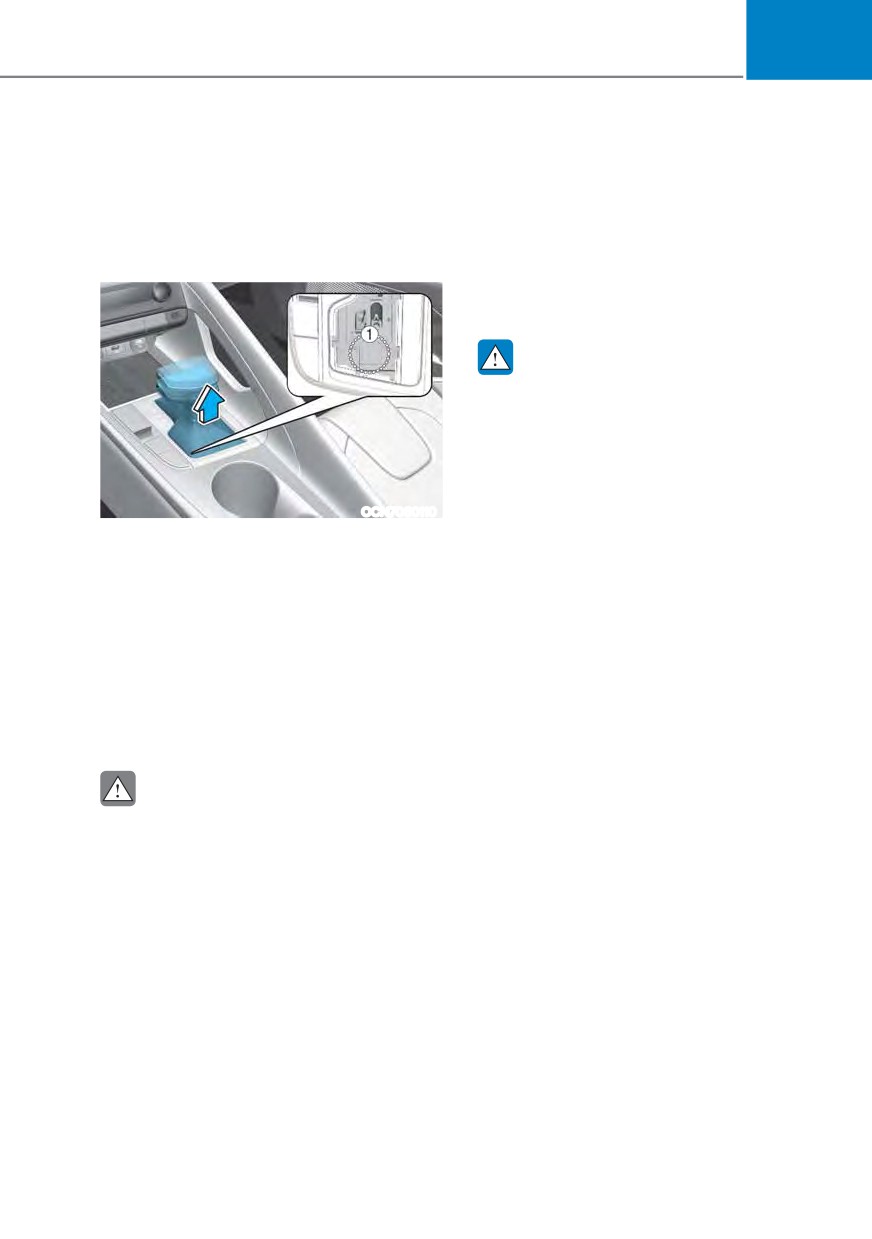
Shift-lock release
Parking
If the shift lever cannot be moved from
Always come to a complete stop and
the P (Park) position into R (Reverse)
continue to depress the brake pedal.
position with the brake pedal depressed,
Move the shift lever into the P (Park)
continue depressing the brake, and then
position, apply the parking brake, and
do the following:
place the ignition switch in the LOCK/
OFF position. Take the Key with you
when exiting the vehicle.
WARNING
ś
When you stay in the vehicle with
the engine running, be careful not
to depress the accelerator pedal for
a long period of time. The engine or
exhaust system may overheat and
start a fire.
OCN7060110
ś
The exhaust gas and the exhaust
1. Place the ignition switch in the LOCK/
system are very hot. Keep away from
OFF position.
the exhaust system components.
2. Apply the parking brake.
ś
Do not stop or park over flammable
materials, such as dry grass, paper
3. Carefully remove the shift lever boots.
or leaves. They may ignite and cause
4. Move the shift lever while holding
a fire.
the release button (1) with a tool (for
example, flathead screw-driver).
If you need to use the shift-lock release,
have the vehicle inspected by an
authorized HYUNDAI dealer immediately.
CAUTION
Be careful not to damage the trim
beside of the shift lever while removing
the shift lever boots.
Ignition key interlock system
(if equipped)
The ignition key cannot be removed
unless the shift lever is in the P (Park)
position.
6-21

-------------------------------------------------------------------------------------------------------------------------------------------------------------

Driving Your Vehicle
Good Driving Practices
ś Exercise extreme caution when
driving on a slippery surface. Be
ś
Never move the shift lever from P
especially careful when braking,
(Park) or N (Neutral) to any other
accelerating or shifting gears. On a
position with the accelerator pedal
slippery surface, an abrupt change
depressed.
in vehicle speed can cause the drive
ś
Never move the shift lever into P
wheels to lose traction and may cause
(Park) when the vehicle is in motion.
loss of vehicle control resulting in an
ś
Be sure the vehicle is completely
accident.
stopped before you attempt to shift
ś Optimum vehicle performance and
into R (Reverse) or D (Drive).
economy is obtained by smoothly
ś
Do not move the shift lever to N
depressing and releasing the
(Neutral) when driving. Doing so
accelerator.
may result in an accident because
of a loss of engine braking and the
WARNING
transmission could be damaged.
ś
When driving uphill or downhill,
To reduce the risk of SERIOUS INJURY
or DEATH:
always shift to D (Drive) for driving
forward or shift to R (Reverse) for
ś
ALWAYS wear your seat belt. In a
driving backwards, and check the
collision, an unbelted occupant
gear position indicated on the cluster
is significantly more likely to be
before driving. Driving in the opposite
seriously injured or killed than a
direction of the selected gear, can
properly belted occupant.
lead to a dangerous situation by
ś
Avoid high speeds when cornering or
shutting off the engine and affecting
turning.
the braking performance.
ś
Do not make quick steering wheel
ś
Do not drive with your foot resting
movements, such as sharp lane
on the brake pedal. Even light, but
changes or fast, sharp turns.
consistent pedal pressure can result
ś
The risk of rollover is greatly
in the brakes overheating, brake wear
increased if you lose control of your
and possibly even brake failure.
vehicle at highway speeds.
ś
Do not hold the vehicle on an incline
ś
Loss of control often occurs if two or
with the accelerator pedal. This can
more wheels drop off the roadway
cause the transmission to overheat.
and the driver over steers to reenter
Always use the brake pedal or parking
the roadway.
brake.
ś
In the event your vehicle leaves
ś
Always apply the parking brake when
the roadway, do not steer sharply.
leaving the vehicle. Do not depend on
Instead, slow down before pulling
placing the transmission in P (Park) to
back into the travel lanes.
keep the vehicle from moving.
ś
HYUNDAI recommends you follow all
posted speed limits.
6-22

-------------------------------------------------------------------------------------------------------------------------------------------------------------

06
'8$/ &/87&+ 75
$160,66,21 ǣ,) (48,33('Ǥ
„ Left-hand drive
„ Right-hand drive
OCN7N060008
OCN7N060008R
Depress the brake pedal and press the shift button while moving the shift lever.
Press the shift button while moving the shift lever.
The shift lever can freely operate.
Dual Clutch Transmission Operation
The dual clutch transmission has 7 forward speeds and one reverse speed.
The individual speeds are selected automatically in the D (Drive) position.
6-23

-------------------------------------------------------------------------------------------------------------------------------------------------------------

Driving Your Vehicle
ś
The dual clutch transmission can be
WARNING
thought of as an automatically shifting
To reduce the risk of serious injury or
manual transmission. It gives the
death:
driving feel of a manual transmission,
ś
ALWAYS check the surrounding
yet provides the ease of a fully
areas near your vehicle for people,
automatic transmission.
especially children, before shifting a
ś
When D (Drive) is selected, the
vehicle into D (Drive) or R (Reverse).
transmission will automatically
ś
Before leaving the driver’s seat,
shift through the gears similar to a
always make sure the shift lever
conventional automatic transmission.
is in the P (Park) position, then set
Unlike a traditional automatic
the parking brake, and place the
transmission, the gear shifting can
ignition switch in the LOCK/OFF
sometimes be felt and heard as the
position. Unexpected and sudden
actuators engage the clutches and the
vehicle movement can occur if these
gears are selected.
precautions are not followed.
ś
The dual clutch transmission adopts
ś
When using Manual Shift Mode, do
a dry-type dual clutch, which is
not use engine braking (shifting from
different from the torque converter of
a high gear to lower gear) rapidly on
the automatic transmission. It shows
slippery roads. The vehicle may slip
better acceleration performance
causing an accident.
and increased fuel efficiency while
driving but initial launch might be
ś
To avoid damage to your transaxle,
little bit slower than the automatic
do not try to accelerate in R (Reverse)
transmission.
or any forward gear position with the
brakes on.
As a result, gear shifts are sometimes
more noticeable than a conventional
ś
When stopped on slope, do not hold
automatic transmission and a light
the vehicle with accelerator pedal.
vibration during launching can be felt
Use the service brake or the parking
as the transmission speed. This is a
brake.
normal condition of the dual clutch
transmission.
ś
The dry-type clutch transfers torque
more directly and provides a direct
drive feeling which may feel different
from a conventional automatic
transmission. This may be more
noticeable when launching the vehicle
from a stop or when traveling at low,
stop-and-go vehicle speeds.
ś
When rapidly accelerating at a low
vehicle speed, the engine rpm may
increase highly depending on the
vehicle’s driving condition.
ś
For smooth launch uphill, press
down the accelerator pedal smoothly
depending on the current conditions.
6-24

-------------------------------------------------------------------------------------------------------------------------------------------------------------

06
ś
If you release your foot from the
LCD Display for Transmission
accelerator pedal at low vehicle
Temperature and Warning
speed, you may feel strong engine
Message
braking, which is similar to manual
DCT warning messages
transmission.
ś
When driving downhill, you may use
Sports Mode or press the paddle
shifters (if equipped) to downshift to
a lower gear in order to control your
speed without using the brake pedal
excessively.
ś
When you turn the engine on and off,
you may hear clicking sounds as the
system goes through a self-test. This
is a normal sound for the dual clutch
transmission.
OTLE055019
ś
During the first 1000 miles (1,500 km),
This warning message is displayed when
you may feel that the vehicle may not
vehicle is driven slowly on a grade and
be smooth when accelerating at low
the vehicle detects that the brake pedal
speed. During this break-in period, the
is not applied.
shift quality and performance of your
new vehicle is continuously optimized.
Steep grade
Driving up hills or on steep grades:
WARNING
ś To hold the vehicle on an incline use
Due to transmission failure, you may
the foot brake or the parking brake.
not continue to drive and the position
ś When in stop-and-go traffic on an
indicator (D, R) on the cluster will blink.
incline, keep some distance ahead
Contact an authorized HYUNDAI dealer
before moving the vehicle forward.
and have the system checked.
Then hold the vehicle on the incline
with the foot brake.
ś If the vehicle is held on a hill by
applying the accelerator pedal
or by creeping with brake pedal
disengaged, the clutch and
transmission may overheat which
can result in damage. At this time, a
warning message will appear on the
LCD display.
ś If the LCD warning is active, the foot
brake must be applied.
ś Ignoring the warnings can lead to
damage to the transmission.
6-25

-------------------------------------------------------------------------------------------------------------------------------------------------------------

Driving Your Vehicle
ś
If this occurs, pull over to a safe
location, stop the vehicle with the
engine running, apply the brakes and
shift the vehicle to P (Park), and allow
the transmission to cool.
ś
If you ignore this warning, the driving
condition may become worse.
You may experience abrupt shifts,
frequent shifts, or jerkiness. To return
to the normal driving condition, stop
the vehicle and apply the foot brake
OJS058139L
or shift into P (Park). Then allow the
Transmission high temperature
transmission to cool for a few minutes
with engine on, before driving off.
ś Under certain conditions, such as
repeated stop-and-go launches
ś
When possible, drive the vehicle
on steep grades, sudden take off
smoothly.
or acceleration, or other harsh
driving conditions, the transmission
clutch temperatures will increase
excessively. Finally the clutch in
transmission could be overheated.
ś When the clutch is overheated, the
safe protection mode engages and
the gear position indicator on the
cluster blinks with a chime. At this
time, “Transmission temperature is
high! Stop safely” warning message
will appear on the LCD display and
OJS058137L
OAD058176N
driving may not be smooth.
OAD058177N
6-26

-------------------------------------------------------------------------------------------------------------------------------------------------------------

06
Transmission overheated
Transmission ranges
ś If the vehicle continues to be driven
The indicator in the instrument cluster
and the clutch temperatures reach
displays the shift lever position when the
the maximum temperature limit, the
ignition switch is in the ON position.
"Transmission hot! Park with engine
On" warning will be displayed. When
P (Park)
this occurs the clutch is disabled
Always come to a complete stop before
until the clutch cools to normal
shifting into P (Park).
temperatures.
To shift from P (Park), you must depress
ś The warning will display a time to wait
firmly on the brake pedal and make sure
for the transmission to cool.
your foot is off the accelerator pedal.
ś If this occurs, pull over to a safe
If you have done all of the above and
location, stop the vehicle with the
still cannot shift the lever out of P
engine running, apply the brakes and
(Park), see "Shift-Lock Release" in this
shift the vehicle to P (Park), and allow
chapter.
the transmission to cool.
The shift lever must be in P (Park) before
ś When the message "Transmission
turning the engine off.
cooled down. Resume driving"
appears you can continue to drive
your vehicle.
WARNING
ś When possible, drive the vehicle
ś Shifting into P (Park) while the
smoothly.
vehicle is in motion may cause you to
If any of the warning messages in the
lose control of the vehicle.
LCD display continue to blink, for your
ś After the vehicle has stopped, always
safety, contact an authorized HYUNDAI
make sure the shift lever is in P
dealer and have the system checked.
(Park), apply the parking brake, and
turn the engine off.
ś Do not use the P (Park) position in
place of the parking brake.
6-27

-------------------------------------------------------------------------------------------------------------------------------------------------------------

Driving Your Vehicle
R (Reverse)
D (Drive)
Use this position to drive the vehicle
This is the normal driving position. The
backward.
transmission will automatically shift
through a 7-gear sequence, providing the
best fuel economy and power.
NOTICE
For extra power when passing another
Always come to a complete stop before
vehicle or driving uphill, depress the
shifting into or out of R (Reverse); you
accelerator fully. The transmission will
may damage the transaxle if you shift
automatically downshift to the next
into R (Reverse) while the vehicle is in
lower gear (or gears, as appropriate).
motion.
The DRIVE MODE switch, located on the
shift lever console, allows the driver to
N (Neutral)
switch from NORMAL mode to ECO or
The wheels and transaxle are not
SPORT mode (if equipped)
engaged.
For more information, refer to "Drive
Use N (Neutral) if you need to restart a
Mode Integrated Control System" later
stalled engine, or if it is necessary to stop
in this chapter.
with the engine ON. Shift into P (Park)
if you need to leave your vehicle for any
reason.
WARNING
Always depress the brake pedal when
ś Do not shift into gear unless your
you are shifting from N (Neutral) to
foot is firmly on the brake pedal.
another gear.
Shifting into gear when the engine
is running at high speed can cause
the vehicle to move very rapidly. You
may lose control of the vehicle and
cause accidents.
ś Do not drive with the shift lever in N
(Neutral). The engine brake will not
work and may lead to an accident.
NOTICE
Always make sure the vehicle is
stationary, at a complete stop, before
selecting D (Drive).
6-28

-------------------------------------------------------------------------------------------------------------------------------------------------------------

06
DS mode (Drive Sporty)
To shift into Ds mode, move the shift
lever from D (Drive) to the center of
the manual shift mode. The engine
and transmission control logic is
automatically optimized for sporty
driving.
In Ds mode, if you move the shift lever
to + (up) or (down), the gear will change
to manual shift mode. If the shift lever is
moved back into D (Drive), it will change
OCN7N060009
to D (Drive). The vehicle will perform
Manual shift mode
according to the mode selected from
drive mode (NORMAL, ECO, SPORT,
Whether the vehicle is stationary or
SMART).
in motion, sports mode is selected by
pushing the shift lever from the D (Drive)
position into the manual gate. To return
to D (Drive) range operation, push the
shift lever back into the main gate.
In manual shift mode, moving the shift
lever backwards and forwards will allow
you to select the desired range of gears
for the current driving conditions.
Up (+) : Push the lever forward once to
shift up one gear.
Down (-) : Pull the lever backwards
once to shift down one gear.
6-29

-------------------------------------------------------------------------------------------------------------------------------------------------------------

Driving Your Vehicle
Paddle Shifter (Manual Shift
Information
Mode) (if equipped)
ś
Only the seven forward gears can be
selected. To reverse or park the vehicle,
move the shift lever to the R (Reverse)
or P (Park) position as required.
ś
Downshifts are made automatically
when the vehicle slows down. When the
vehicle stops, 1st gear is automatically
selected.
ś
When the engine rpm approaches the
red zone the transmission will upshift
automatically.
ś
If the driver presses the lever to + (Up)
OCN7N060010
or - (Down) position, the transmission
The paddle shifter is available when the
may not make the requested gear
gears is in the D (Drive) position.
change if the next gear is outside of the
allowable engine rpm range. The driver
Pull the [+] or [-] paddle shifter once to
must execute upshifts in accordance
shift up or down one gear and the system
with road conditions, taking care to
changes from automatic shift mode to
keep the engine rpms below the red
manual shift mode.
zone.
To change back to the automatic shift
mode from manual shift mode, do one of
the following:
ś Gently depress the accelerator pedal
for more than 5 seconds (Except Sport
Mode).
ś Drive the vehicle under 6 mph (10
km/h).
ś Pull and hold the right side paddle
shifter.
Information
If the [+] and [-] paddle shifters are pulled
at the same time, gear shift may not occur.
6-30

-------------------------------------------------------------------------------------------------------------------------------------------------------------

06
Shift-lock system
Shift-lock release
For your safety, the dual clutch
If the shift lever cannot be moved from
transmission has a shift-lock system
the P (Park) position into R (Reverse)
which prevents shifting the transmission
position with the brake pedal depressed,
from P (Park) into R (Reverse) unless the
continue depressing the brake, and then
brake pedal is depressed.
do the following:
To shift the transmission from P (Park)
into R (Reverse):
1. Depress and hold the brake pedal.
2. Start the engine or place the ignition
switch in the ON position.
3. Move the shift lever.
OCN7N060011L
1. Place the ignition switch in the LOCK/
OFF position
2. Apply the parking brake.
3. Carefully remove the shift lever boots.
4. Move the shift lever while holding
the release button (1) with a tool (for
example, flathead screw-driver).
If you need to use the shift-lock release,
have the vehicle inspected by an
authorized HYUNDAI dealer immediately.
CAUTION
Be careful not to damage the trim
beside of the shift lever while removing
the shift lever boots.
Ignition key interlock system (if
equipped)
The ignition key cannot be removed
unless the shift lever is in the P (Park)
position.
6-31

-------------------------------------------------------------------------------------------------------------------------------------------------------------

Driving Your Vehicle
Parking
Good Driving Practices
Always come to a complete stop and
ś
Never move the shift lever from P
continue to depress the brake pedal.
(Park) or N (Neutral) to any other
Move the shift lever into the P (Park)
position with the accelerator pedal
position, apply the parking brake, and
depressed.
place the ignition switch in the LOCK/
ś
Never move the shift lever into P
OFF position. Take the Key with you
(Park) when the vehicle is in motion.
when exiting the vehicle.
Be sure the vehicle is completely
stopped before you attempt to shift
WARNING
into R (Reverse) or D (Drive).
ś
Do not move the shift lever to N
When you stay in the vehicle with
the engine running, be careful not to
(Neutral) when driving. Doing so
may result in an accident because
depress the accelerator pedal for a long
period of time. The engine or exhaust
of a loss of engine braking and the
transmission could be damaged.
system may overheat and start a fire.
ś
When driving uphill or downhill,
The exhaust gas and the exhaust system
are very hot. Keep away from the
always shift to D (Drive) for driving
forward or shift to R (Reverse) for
exhaust system components.
driving rearwards. After selecting
Do not stop or park over flammable
D (Drive) or R (Reverse), check the
materials, such as dry grass, paper or
gear position indicated on the cluster
leaves. They may ignite and cause a fire.
before driving. If the vehicle moves in
the opposite direction of the selected
gear, the engine may turn off and a
serious accident might occur due to
degraded brake performance.
ś
Do not drive with your foot resting
on the brake pedal. Even light, but
consistent pedal pressure can result
in the brakes overheating, brake wear
and possibly even brake failure.
ś
When driving in sports mode, slow
down before shifting to a lower gear.
Otherwise, the lower gear may not
be engaged if the engine rpms are
outside of the allowable range.
ś
Always apply the parking brake when
leaving the vehicle. Do not depend on
placing the transmission in P (Park) to
keep the vehicle from moving.
ś
Exercise extreme caution when
driving on a slippery surface. Be
especially careful when braking,
accelerating or shifting gears. On a
slippery surface, an abrupt change
in vehicle speed can cause the drive
wheels to lose traction and may cause
loss of vehicle control resulting in an
accident.
6-32

-------------------------------------------------------------------------------------------------------------------------------------------------------------

06
ś Optimum vehicle performance and
economy is obtained by smoothly
depressing and releasing the
accelerator.
WARNING
To reduce the risk of SERIOUS INJURY
or DEATH:
ś
ALWAYS wear your seatbelt. In a
collision, an unbelted occupant
is significantly more likely to be
seriously injured or killed than a
properly belted occupant.
ś
Avoid high speeds when cornering or
turning.
ś
Do not make quick steering wheel
movements, such as sharp lane
changes or fast, sharp turns.
ś
The risk of rollover is greatly
increased if you lose control of your
vehicle at highway speeds.
ś
Loss of control often occurs if two or
more wheels drop off the roadway
and the driver over steers to reenter
the roadway.
ś
In the event your vehicle leaves
the roadway, do not steer sharply.
Instead, slow down before pulling
back into the travel lanes.
ś
HYUNDAI recommends you follow all
posted speed limits.
WARNING
If your vehicle is stuck in snow, mud,
sand, etc., you may attempt to free the
vehicle by rocking it back and forth. Do
not attempt this procedure if people or
objects are anywhere near. Vehicle may
suddenly move forward or backward as
it becomes unstuck, causing injury or
damage to nearby people or objects.
6-33

-------------------------------------------------------------------------------------------------------------------------------------------------------------

Driving Your Vehicle
BRAKE SYSTEM
Power Brakes
ś
When descending down a long or
steep hill, move the gear shift button
Your vehicle has power-assisted brakes
to Manual Shift Mode and manually
that adjust automatically through normal
downshift to a lower gear in order
usage.
to control your speed without using
If the engine is not running or is turned
the brake pedal excessively. Applying
off while driving, the power assist for
the brakes continuously will cause
the brakes will not work. You can still
the brakes to overheat and could
stop your vehicle by applying greater
result in a temporary loss of braking
force to the brake pedal than typical.
performance.
The stopping distance, however, will be
ś
Wet brakes may impair the vehicle's
longer than with power brakes.
ability to safely slow down; the
When the engine is not running, the
vehicle may also pull to one side
reserve brake power is partially depleted
when the brakes are applied.
each time the brake pedal is applied.
Applying the brakes lightly will
Do not pump the brake pedal when the
indicate whether they have been
power assist has been interrupted.
affected in this way. Always test your
Only pump the brakes on slippery
brakes in this fashion after driving
surfaces if the power assist has been
through deep water. To dry the
interrupted to maintain steering control.
brakes, lightly tap the brake pedal to
Do not pump the brakes on slippery
heat up the brakes while maintaining
surfaces if the brakes are operating
a safe forward speed until brake
normally.
performance returns to normal.
Avoid driving at high speeds until the
brakes function correctly.
Information
ś When the brake pedal is
Disc Brakes Wear Indicator
depressed under certain
When your brake pads are worn and new
driving conditions or weather
pads are required, you will hear a high
conditions, you may temporarily hear
pitched warning sound from your front
a noise. This is normal and does not
or rear brakes. You may hear this sound
indicate a problem with your brakes.
come and go or it may occur whenever
ś While driving on a road with deicing
you depress the brake pedal.
chemicals, brake noise or abnormal tire
wear may occur due to deicing
NOTICE
chemicals. In a safe traffic condition,
additionally apply the brakes to remove
To avoid costly brake repairs, do not
deicing chemicals on the brake discs
continue to drive with worn brake pads.
and pads.
Information
WARNING
Always replace brake pads as complete
Take the following precautions:
front or rear axle sets.
ś Do not drive with your foot resting
on the brake pedal. This will create
abnormal high brake temperatures,
excessive brake lining and pad wear,
and increased stopping distances.
6-34

-------------------------------------------------------------------------------------------------------------------------------------------------------------

06
Parking Brake (if equipped)
Releasing the parking brake
Applying the parking brake
OCN7060010
OCN7080008
To release:
Always set the parking brake before
Firmly depress the brake pedal.
leaving the vehicle, to apply:
While pressing the release button (1),
Firmly depress the brake pedal.
slightly pull up on the parking brake lever
then lower the parking brake lever (2).
Pull up the parking brake lever as far as
possible.
WARNING
To reduce the risk of SERIOUS INJURY
or DEATH, do not operate the parking
brake while the vehicle is moving
except in an emergency situation. It
could damage the brake system and
lead to an accident.
6-35

-------------------------------------------------------------------------------------------------------------------------------------------------------------

Driving Your Vehicle
Check the Parking Brake
WARNING
Warning Light by placing
ś
Whenever leaving the vehicle or
the ignition switch to the
parking, always come to a complete
ON position (do not start the
stop and continue to depress the
engine).
brake pedal. Move the shift lever into
This light will be illuminated when the
the 1st gear (for manual transmission
parking brake is applied with the ignition
vehicle) or P (Park, for intelligent
switch in the START or ON position.
variable transmission vehicle)
Before driving, be sure the parking brake
position, then apply the parking
is released and the Brake Warning Light
brake, and place the ignition switch
is OFF.
in the LOCK/OFF position.
If the Parking Brake Warning Light
ś
Vehicles with the parking brake not
remains on after the parking brake is
fully engaged are at risk for moving
released while the engine is running,
inadvertently and causing injury to
there may be a malfunction in the
yourself or others.
brake system. Immediate attention is
ś
NEVER allow anyone who is
necessary.
unfamiliar with the vehicle to touch
If at all possible, cease driving the vehicle
the parking brake. If the parking
immediately. If that is not possible,
brake is released unintentionally,
use extreme caution while operating
serious injury may occur.
the vehicle and only continue to drive
ś
Only release the parking brake when
the vehicle until you can reach a safe
you are seated inside the vehicle
location.
with your foot firmly on the brake
pedal.
NOTICE
ś Do not apply the accelerator pedal
while the parking brake is engaged.
If you depress the accelerator pedal
with the parking brake engaged, a
warning will sound. Damage to the
parking brake may occur.
ś Driving with the parking brake on
can overheat the braking system and
cause premature wear or damage to
brake parts. Make sure the parking
brake is released and the Brake
Warning Light is off before driving.
6-36

-------------------------------------------------------------------------------------------------------------------------------------------------------------

06
Electronic Parking Brake (EPB)
Releasing the parking brake
(if equipped)
Applying the parking brake
OCN7060013
To release the EPB (Electronic Parking
OCN7060013
Brake), press the EPB switch in the
following condition:
To apply the EPB (Electronic Parking
Brake):
ś Place the ignition switch in the ON
position.
1. Depress the brake pedal.
ś Depress the brake pedal.
2. Pull up the EPB switch.
Make sure the Parking Brake Warning
Make sure the parking brake
Light goes off.
warning light comes on.
To release EPB (Electronic Parking Brake)
automatically:
WARNING
ś Intelligent variable transmission
To reduce the risk of SERIOUS INJURY
1. Start the engine.
or DEATH, do not operate the EPB
2. Close the driver’s door, engine hood
while the vehicle is moving except
and trunk.
in an emergency situation. It could
3. Depress the accelerator pedal while
damage the brake system and lead to
the shift lever is in R (Reverse) or D
an accident.
(Drive).
Make sure the Parking Brake Warning
light goes off.
6-37

-------------------------------------------------------------------------------------------------------------------------------------------------------------

Driving Your Vehicle
Warning messages
Information
ś For your safety, you can engage the
EPB even though the ignition switch
is in the OFF position, but you cannot
release it.
ś For your safety, depress the brake
pedal and release the parking brake
manually with the EPB switch when
you drive downhill or when backing up
the vehicle.
NOTICE
OCN7060151L
ś If the parking brake warning light
To release EPB, fasten seatbelt, close
is still on even though the EPB has
door, hood and trunk
been released, have the system be
ś If you try to drive with the EPB
checked by an authorized HYUNDAI
applied, a warning will sound and a
dealer.
message will appear.
ś Do not drive your vehicle with the
ś If the driver's seat belt is unfastened
EPB applied. It may cause excessive
and the engine hood or trunk is
brake pad and brake rotor wear.
opened, a warning will sound and a
message will appear.
EPB (Electronic Parking Brake) may be
ś If there is a problem with the vehicle,
automatically applied when:
a warning may sound and a message
may appear.
ś Requested by other systems
If the situation occurs, depress the brake
ś The driver turns the engine off while
pedal and release EPB by pressing the
Auto Hold is operating.
EPB switch.
ś The vehicle is parked on the slope and
the Engine Start/Stop button is in the
OFF position.
ś The Engine is turned off when the
driver tries to park but the vehicle still
moves a bit.
6-38

-------------------------------------------------------------------------------------------------------------------------------------------------------------

06
WARNING
ś Whenever leaving the vehicle or
parking, always come to a complete
stop and continue to depress the
brake pedal.
Shift the gear into the P (Park)
position, press the EPB switch, and
set the ignition switch to the OFF
position. Take the Key with you when
exiting the vehicle.
OCN7060152L
Vehicles not fully engaged in P (Park)
with the parking brake set are at risk
AUTO HOLD turning Off!
for moving inadvertently and causing
Press brake pedal
injury to yourself or others.
When the conversion from Auto Hold to
ś NEVER allow anyone who is
EPB is not working properly a warning
unfamiliar with the vehicle to touch
will sound and a message will appear.
the EPB switch. If the EPB is released
unintentionally, serious injury may
occur.
ś Only release the EPB when you are
seated inside the vehicle with your
foot firmly on the brake pedal.
NOTICE
ś
Do not apply the accelerator pedal
while the parking brake is engaged.
If you depress the accelerator pedal
with the EPB engaged, a warning will
OCN7060153L
sound and a message will appear.
Damage to the parking brake may
Parking brake automatically engaged
occur.
If the EPB is applied while Auto Hold is
ś
Driving with the parking brake on
activated, a warning will sound and a
can overheat the braking system and
message will appear.
cause premature wear or damage
to brake parts. Make sure the EPB
is released and the Parking Brake
Warning Light is off before driving.
Information
ś
A clicking sound may be heard while
operating or releasing the EPB. These
conditions are normal and indicate that
the EPB is functioning properly.
ś
When leaving your keys with a parking
attendant or assistant, make sure to
inform him/her how to operate the
EPB.
6-39

-------------------------------------------------------------------------------------------------------------------------------------------------------------

Driving Your Vehicle
EPB malfunction indicator
Parking brake warning light
Check the parking brake
warning light by placing the
ignition switch to the ON
position (do not start the
engine).
This light will be illuminated when the
parking brake is applied with the ignition
switch in the START or ON position.
If the parking brake warning light
remains on after the parking brake
is released while engine is running,
OCN7060015
there may be a malfunction in the
This warning light illuminates if the
brake system. Immediate attention is
ignition switch is set to the ON position
necessary.
and goes off in approximately 3 seconds
If at all possible, cease driving the vehicle
if the system is operating normally.
immediately. If that is not possible,
If the EPB malfunction indicator
use extreme caution while operating
remains on, comes on while driving, or
the vehicle and only continue to drive
does not come on when the ignition
the vehicle until you can reach a safe
switch is changed to the ON position,
location.
this indicates that the EPB may have
malfunctioned.
If this occurs, have the system checked
by an authorized HYUNDAI dealer.
The EPB malfunction indicator may
illuminate when the ESC indicator comes
on to indicate that the ESC is not working
properly, but it does not indicate a
malfunction of the EPB.
NOTICE
ś If the EPB warning light is still on,
have the system checked by an
authorized HYUNDAI dealer.
ś If the parking brake warning light
does not illuminate or blinks even
though the EPB switch was pulled
up, the EPB may not be applied.
ś If the parking brake warning light
blinks when the EPB warning light is
on, press the switch, and then pull it
up. Repeat this one more time. If the
EPB warning does not go off, have
the system checked by an authorized
HYUNDAI dealer.
6-40

-------------------------------------------------------------------------------------------------------------------------------------------------------------

06
Emergency braking
Auto Hold
If there is a problem with the brake
The Auto Hold maintains the vehicle in a
pedal while driving, emergency braking
standstill even though the brake pedal is
is possible by pulling up and holding
not depressed after the driver brings the
the EPB switch. Braking is possible only
vehicle to a complete stop by depressing
while you are holding the EPB switch.
the brake pedal.
However, braking distance will be longer
than normal.
Information
The Auto Hold On or Off setting is
WARNING
maintained when the vehicle is turned
Do not operate the parking brake while
off. When the vehicle is restarted the last
the vehicle is moving except in an
setting for Auto Hold is applied.
emergency situation. It could damage
the brake system and lead to a severe
To apply :
accident.
ś CLUSTER
Information
During emergency braking, the parking
brake warning light will illuminate to
indicate that the system is operating.
NOTICE
If you continuously notice a noise or
burning smell when the EPB is used
for emergency braking, have system
OCN7060016
checked by an authorized HYUNDAI
1. With the driver's door and engine
dealer.
hood closed, depress the brake
pedal and then press the [AUTO
When the EPB (Electronic Parking Brake)
HOLD] switch. The white AUTO HOLD
does not release
indicator will come on and the system
will be in the standby position.
If the EPB does not release normally,
contact an authorized HYUNDAI dealer
by loading the vehicle on a flatbed tow
truck and have the system checked.
6-41

-------------------------------------------------------------------------------------------------------------------------------------------------------------

Driving Your Vehicle
To cancel :
ś CLUSTER
OCN7060017
2. When you stop the vehicle
OCN7060018
completely by depressing the brake
1. Depress the brake pedal.
pedal, the Auto Hold maintains the
brake pressure to hold the vehicle
2. Press the [AUTO HOLD] switch.
stationary. The indicator changes from
The AUTO HOLD indicator will turn off.
white to green.
3. The vehicle will remain stationary
WARNING
even if you release the brake pedal.
To prevent, unexpected and sudden
4. If EPB is applied, Auto Hold will be
vehicle movement, ALWAYS press your
released.
foot on the brake pedal to cancel the
Auto Hold before you:
To release :
- Drive downhill.
If you press the accelerator pedal with
the gear in D (Drive), R (Reverse) or
- Drive the vehicle in R (Reverse).
Manual shift mode, the Auto Hold will be
- Park the vehicle.
released automatically and the vehicle
will start to move. The AUTO HOLD
indicator changes from green to white.
Information
ś The Auto Hold does not operate when:
WARNING
- The driver’s door is opened
When the AUTO HOLD is automatically
- The engine hood is opened in D
released by depressing the accelerator
(Driving) or N (Neutral)
pedal, always take a look around your
- The shift lever is in P (Park)
vehicle.
- The trunk is opened in R (Reverse)
Slowly depress the accelerator pedal
- The EPB is applied
for a smooth start.
- The vehicle stop more than 30
minutes.
6-42

-------------------------------------------------------------------------------------------------------------------------------------------------------------

06
ś
For your safety, the Auto Hold
Warning messages
automatically switches to EPB when:
- The driver’s door is opened in D
(Driving) or N(Neutral).
- The engine hood is opened.
- The trunk is opened in R (Reverse).
- The vehicle stops for more than 10
minutes
- The vehicle stands on a steep slope
- The vehicle moves several times
- The vehicle stops for more than 30
OCN7060153L
minutes accumulatively.
Parking brake automatically engaged
In these cases, the parking brake
warning light comes on, the AUTO
When the EPB is applied from Auto Hold,
HOLD indicator changes from green
a warning will sound and a message will
to white, and a warning sound and a
appear.
message will appear to inform you that
EPB has been automatically engaged.
Before driving off again, press foot
brake pedal, check the surrounding area
near your vehicle and release parking
brake manually with the EPB switch.
ś
While operating Auto Hold, you may
hear mechanical noise. However, it is
normal operating noise.
NOTICE
If the AUTO HOLD indicator changes
OCN7060152L
to yellow, the Auto Hold is not working
AUTO HOLD turning Off!
properly. Contact an authorized
Press brake pedal
HYUNDAI dealer.
When the conversion from Auto Hold to
EPB is not working properly a warning
WARNING
will sound and a message will appear.
When this message is displayed, the Auto
ś Depress the accelerator pedal slowly
Hold and EPB may not operate. For your
when you start the vehicle.
safety, depress the brake pedal.
ś For your safety, cancel the Auto Hold
when you drive downhill, back up the
vehicle or park the vehicle.
NOTICE
If there is a malfunction with the
driver's door or engine hood open
detection system, the Auto Hold may
not work properly.
Contact an authorized HYUNDAI dealer.
6-43

-------------------------------------------------------------------------------------------------------------------------------------------------------------

Driving Your Vehicle
Anti-lock Brake System (ABS)
WARNING
An Anti-Lock Braking System (ABS) or
an Electronic Stability Control (ESC)
system will not prevent accidents
due to improper or dangerous driving
maneuvers. Even though vehicle
control is improved during emergency
braking, always maintain a safe
distance between you and objects
OCN7060154L
ahead of you. Vehicle speeds should
Press brake pedal to deactivate AUTO
always be reduced during extreme
HOLD
road conditions. The braking distance
If you did not apply the brake pedal when
for cars equipped with ABS or ESC
you release the Auto Hold by pressing
may be longer than for those without
the [AUTO HOLD] switch, a warning will
these systems in the following road
sound and a message will appear.
conditions.
Drive your vehicle at reduced speeds
during the following conditions:
ś Rough, gravel or snow-covered
roads.
ś On roads where the road surface is
pitted or has different surface height.
ś Tire chains are installed on your
vehicle.
The safety features of an ABS or ESC
equipped vehicle should not be tested
by high speed driving or cornering. This
OCN7060155L
could endanger the safety of yourself or
AUTO HOLD conditions not met. Close
others.
door, hood and trunk
When you press the [AUTO HOLD]
ABS is an electronic braking system that
switch, if the driver's door and engine
helps prevent a braking skid. ABS allows
hood are not closed, a warning will
the driver to steer and brake at the same
sound and a message will appear on the
time.
cluster LCD display.
Press the [AUTO HOLD] switch after
closing the driver's door and hood.
6-44

-------------------------------------------------------------------------------------------------------------------------------------------------------------

06
Using ABS
WARNING
To obtain the maximum benefit from
If the ABS warning light (
) is on and
your ABS in an emergency situation,
stays on, you may have a problem with
do not attempt to modulate your brake
the ABS. Your power brakes will work
pressure and do not try to pump your
normally. To reduce the risk of serious
brakes. Depress your brake pedal as hard
injury or death, contact your HYUNDAI
as possible.
dealer as soon as possible.
When you apply your brakes under
conditions which may lock the wheels,
you may hear sounds from the brakes,
CAUTION
or feel a corresponding sensation in the
When you drive on a road having poor
brake pedal. This is normal and it means
traction, such as an icy road, and apply
your ABS is active.
your brakes continuously, the ABS will
ABS does not reduce the time or distance
be active continuously and the ABS
it takes to stop the vehicle.
warning light (
) may illuminate. Pull
your car over to a safe place and turn
Always maintain a safe distance from the
the engine off.
vehicle in front of you.
ABS will not prevent a skid that results
Restart the engine. If the ABS warning
light is off, then your ABS system is
from sudden changes in direction, such
as trying to take a corner too fast or
normal.
making a sudden lane change. Always
Otherwise, you may have a problem
drive at a safe speed for the road and
with your ABS system. Contact an
weather conditions.
authorized HYUNDAI dealer as soon as
ABS cannot prevent a loss of stability.
possible.
Always steer moderately when braking
hard. Severe or sharp steering wheel
Information
movement can still cause your vehicle to
veer into oncoming traffic or off the road.
When you jump start your vehicle because
of a drained battery, the ABS warning
light (
) may turn on at the same
On loose or uneven road surfaces,
time. This happens because of the low
operation of the anti-lock brake system
battery voltage. It does not mean your
may result in a longer stopping distance
ABS is malfunctioning. Have the battery
than for vehicles equipped with a
recharged before driving the vehicle.
conventional brake system.
The ABS warning light (
) will stay on
for several seconds after the ignition
switch is in the ON position. During
that time, the ABS will go through self-
diagnosis and the light will go off if
everything is normal. If the light stays on,
you may have a problem with your ABS.
Contact an authorized HYUNDAI dealer
as soon as possible.
6-45

-------------------------------------------------------------------------------------------------------------------------------------------------------------

Driving Your Vehicle
Electronic Stability Control (ESC)
ESC operation
(if equipped)
ESC ON condition
When the ignition switch is in the
ON position, the ESC and the ESC
OFF indicator lights illuminate for
approximately three seconds. After both
lights go off, the ESC is enabled.
When operating
When the ESC is in operation,
the ESC indicator light blinks:
OCN7060021
ś
When you apply your brakes under
conditions which may lock the wheels,
The Electronic Stability Control (ESC)
you may hear sounds from the brakes,
system helps to stabilize the vehicle
or feel a corresponding sensation in
during cornering maneuvers. ESC checks
the brake pedal. This is normal and it
where you are steering and where the
means your ESC is active.
vehicle is actually going. ESC applies
braking pressure to any one of the
ś
When the ESC activates, the engine
vehicle's brakes and intervenes in the
may not respond to the accelerator as
engine management system to assist the
it does under routine conditions.
driver with keeping the vehicle on the
ś
If the Cruise Control was in use when
intended path. It is not a substitute for
the ESC activates, the Cruise Control
safe driving practices. Always adjust your
automatically disengages. The Cruise
speed and driving to the road conditions.
Control can be reengaged when the
road conditions allow. See "Cruise
Control System" later in this chapter.
WARNING
(if equipped)
Never drive too fast for the road
ś
When moving out of the mud or
conditions or too quickly when
driving on a slippery road, the engine
cornering. The ESC system will not
RPM (revolutions per minute) may
prevent accidents.
not increase even if you press the
Excessive speed in turns, abrupt
accelerator pedal deeply. This is to
maneuvers, and hydroplaning on wet
maintain the stability and traction of
surfaces can result in severe accidents.
the vehicle and does not indicate a
problem.
6-46

-------------------------------------------------------------------------------------------------------------------------------------------------------------

06
ESC OFF condition
Indicator lights
To cancel ESC operation:
Ŷ ESC indicator light (blinks)
ś State 1
Press the ESC OFF button briefly. The
ESC OFF indicator light and message
"Traction Control disabled" will
illuminate. In this state, the traction
Ŷ ESC OFF indicator light (comes on)
control function of ESC (engine
management) is disabled, but the
brake control function of ESC (braking
management) still operates.
ś State 2
When the ignition switch is placed to
Press and hold the ESC OFF button
the ON position, the ESC indicator light
continuously for more than 3 seconds.
illuminates, then goes off if the ESC
The ESC OFF indicator light and message
system is operating normally.
"Traction and Stability Control disabled"
illuminates and a warning chime sounds.
The ESC indicator light blinks whenever
In this state, both the traction control
the ESC is operating.
function of ESC (engine management)
If ESC indicator light stays on, your
and the brake control function of ESC
vehicle may have a malfunction with
(braking management) are disabled.
the ESC system. When this warning light
If the ignition switch is placed to the
illuminates have your vehicle checked by
LOCK/OFF position when ESC is off, ESC
an authorized HYUNDAI dealer as soon
remains off. Upon restarting the engine,
as possible.
the ESC will automatically turn on again.
The ESC OFF indicator light comes on
when the ESC is turned off.
WARNING
When the ESC is blinking, this indicates
the ESC is active:
Drive slowly and NEVER attempt to
accelerate. NEVER turn the ESC off
while the ESC indicator light is blinking
or you may lose control of the vehicle
resulting in an accident.
NOTICE
Driving with wheels and tires with
different sizes may cause the ESC
system to malfunction. Before replacing
tires, make sure all four tires and wheels
are the same size. Never drive the
vehicle with different sized wheels and
tires installed.
6-47

-------------------------------------------------------------------------------------------------------------------------------------------------------------

Driving Your Vehicle
ESC OFF usage
WARNING
When Driving
Take the following precautions when
The ESC OFF mode should only be used
using the Vehicle Stability Management
briefly to help free the vehicle if stuck in
(VSM):
snow by temporarily stopping operation
ś ALWAYS check the speed and the
of the ESC to maintain wheel torque.
distance to the vehicle ahead. The
To turn ESC off while driving, press the
VSM is not a substitute for safe
ESC OFF button while driving on a flat
driving practices.
road surface.
ś Never drive too fast for the road
conditions. The VSM system will not
NOTICE
prevent accidents. Excessive speed
in bad weather, slippery and uneven
To prevent damage to the transmission:
roads can result in severe accidents.
ś Do not allow wheel(s) of one axle to
spin excessively while the ESC, ABS,
VSM operation
and parking brake warning lights
VSM ON condition
are displayed. The repairs would not
be covered by the vehicle warranty.
The VSM operates when:
Reduce engine power and do not
ś The Electronic Stability Control (ESC)
spin the wheel(s) excessively while
is on.
these lights are displayed.
ś Vehicle speed is approximately above
ś When operating the vehicle on
9 mph (15 km/h) on curve roads.
a dynamometer, make sure the
ś Vehicle speed is approximately above
ESC is turned off (ESC OFF light
12 mph (20 km/h) when the vehicle is
illuminated).
braking on rough roads.
Information
When operating
Turning the ESC off does not affect ABS
When you apply your brakes under
or standard brake system operation.
conditions which may activate the ESC,
you may hear sounds from the brakes,
Vehicle Stability Management
or feel a corresponding sensation in the
brake pedal. This is normal and it means
(VSM) (if equipped)
your VSM is active.
The Vehicle Stability Management (VSM)
is a function of the Electronic Stability
NOTICE
Control (ESC) system. It helps ensure the
vehicle stays stable when accelerating
The VSM does not operate when:
or braking suddenly on wet, slippery and
ś Driving on a banked road such as
rough roads where traction over the four
gradient or incline.
tires can suddenly become uneven.
ś Driving rearward.
ś ESC OFF indicator light is on.
ś EPS (Electric Power Steering)
warning light (
) is on or blinks.
6-48

-------------------------------------------------------------------------------------------------------------------------------------------------------------

06
Good Braking Practices
WARNING
If ESC indicator light (
) or EPS
WARNING
warning light (
) stays on or blinks,
your vehicle may have a malfunction
Whenever leaving the vehicle or
with the VSM system. When the
parking, always come to a complete
warning light illuminates, have your
stop and continue to depress the brake
vehicle checked by an authorized
pedal. Move the shift button into P
HYUNDAI dealer as soon as possible.
(Park) position, then apply the parking
brake, and place the ignition switch in
Driving with wheels and tires with
the LOCK/OFF position.
different sizes may cause the ESC system
Vehicles parked with the parking brake
to malfunction. Before replacing tires,
not applied or not fully engaged may
make sure all four tires and wheels are
roll inadvertently and may cause injury
the same size. Never drive the vehicle
to the driver and others. ALWAYS apply
with different sized tires and wheels
the parking brake before exiting the
installed.
vehicle.
Hill-Start Assist Control (HAC)
Wet brakes can be dangerous! The
(if equipped)
brakes may get wet if the vehicle is
driven through standing water or if it
The Hill-Start Assist Control (HAC)
is washed. Your vehicle will not stop as
helps prevent the vehicle from rolling
quickly if the brakes are wet. Wet brakes
backwards when starting a vehicle from
may cause the vehicle to pull to one side.
a stop on a hill. The system operates the
brakes automatically for approximately
To dry the brakes, apply the brakes
2 seconds and releases the brake after 2
lightly until the braking action returns to
seconds or when the accelerator pedal is
normal, taking care to keep the vehicle
depressed.
under control at all times. If the braking
action does not return to normal, stop
as soon as it is safe to do so and call
WARNING
an authorized HYUNDAI dealer for
assistance.
Always be ready to depress the
accelerator pedal when starting off on
DO NOT drive with your foot resting on
a incline. The HAC activates only for
the brake pedal. Even light, but constant
approximately 2 seconds.
pedal pressure can result in the brakes
overheating, brake wear, and possibly
even brake failure.
NOTICE
If a tire goes flat while you are driving,
ś The HAC does not operate when
apply the brakes gently and keep the
the shift button is in P (Park) or N
vehicle pointed straight ahead while you
(Neutral)
slow down. When you are moving slowly
ś The HAC activates even though the
enough for it to be safe to do so, pull off
ESC (Electronic Stability Control) is
the road and stop in a safe location.
off but does not activate when the
Keep your foot firmly on the brake pedal
ESC has malfunctioned.
when the vehicle is stopped to prevent
the vehicle from rolling forward.
6-49

-------------------------------------------------------------------------------------------------------------------------------------------------------------

Driving Your Vehicle
,6* ǣ,'/( 6723
$1' *2Ǥ 6<67(0 ǣ,) (48,33('Ǥ
The Idle Stop and Go (ISG) system
Information
automatically and temporarily shuts
down the engine when the vehicle is
If the ISG light (white) is turned on on the
stopped and idling to help improve
instrument cluster and does not meet the
fuel efficiency and reduce exhaust gas
ISG system operating conditions, the ISG
emissions. (for example, red stop light,
system is not activated.
stop sign, and traffic jam).
When the ISG light (yellow) is on
The engine is automatically started upon
while the ISG system meets operating
satisfying the starting conditions.
conditions, have the vehicle inspected by
an authorized HYUNDAI dealer.
The ISG system is always active, when
the engine is running.
Auto stop
To stop the engine in idle stop mode
Information
1. Decrease the vehicle speed to 0 mph.
When the engine is automatically started
2. Depress the brake pedal with the shift
by the ISG system, some warning lights
button in D (Drive) or N (Neutral).
(for example, ABS, ESC, ESC OFF, EPS,
and parking brake warning light) may
The auto stop indicator (
) illuminates
in green on the instrument cluster, when
illuminate for a few seconds due to the
low battery voltage. However, it does
the engine stops.
not indicate a malfunction with the ISG
system.
Information
The driving speed must reach at least 3
To Activate the ISG System
mph (5 km/h) after an idle stop to stop the
engine in idle stop mode again.
Prerequisite for activation
The ISG system operates in the following
In auto stop mode, when the driver
situations.
opens the hood, the ISG system will be
ś The driver's seatbelt is fastened
deactivated.
ś The driver's door and hood are closed
ś The brake vacuum pressure is
adequate
ś The battery sensor is activated and
the battery is sufficiently charged
ś Outside temperature is not too low or
too high
ś The vehicle is driven over a constant
speed and stops
ś The climate control system satisfies
the conditions
ś The vehicle is sufficiently warmed up
ś The incline is gradual
ś The steering wheel is turned less than
180 degrees and then the vehicle
stops
6-50

-------------------------------------------------------------------------------------------------------------------------------------------------------------

06
When the system is deactivated:
Auto start
To restart the engine in the auto stop
mode
Release the brake pedal.
- When Auto Hold is activated, if you
release the brake pedal, the engine will
be in the auto stop state. However, if
you depress the accelerator pedal, the
engine will start again.
The auto stop indicator (
) goes to
white on the instrument cluster, when
OCN7060021N
the engine is restarted.
The ISG OFF button indicator illuminates.
The engine is automatically restarted in
the following situations.
ś The brake vacuum pressure is low
ś The engine has stopped for about 5
minutes
ś The air conditioning is ON with the fan
speed set to the highest position
ś The front defroster is ON
ś The battery is weak
ś The cooling and heating performance
of the climate control system is
OCN7060157N
unsatisfactory
If the message "Auto Stop is Off. Shift
ś The vehicle is shifted to P (Park) when
to P or N and start engine manually"
Auto Hold is activated
appears on the LCD display with a beep
ś The door is opened or the seatbelt
sound, restart the vehicle manually by
is unfastened when Auto Hold is
depressing the brake pedal with the
activated
vehicle shifted to P (Park) or N (Neutral).
For your safety, restart the vehicle in the
ś The EPB switch is pressed when Auto
P (Park) position.
Hold is activated
The auto stop indicator (
) goes to
white on the instrument cluster, when
the engine is restarted.
6-51


Content      ..     8      9      10      11     ..