Hummer H3. Manual - part 864
 

  Index      Hummer     Hummer H3 - service repair manual 2006-2009 year


Search            


Content   ..  862  863  864  865   ..


Hummer H3. Manual - part 864


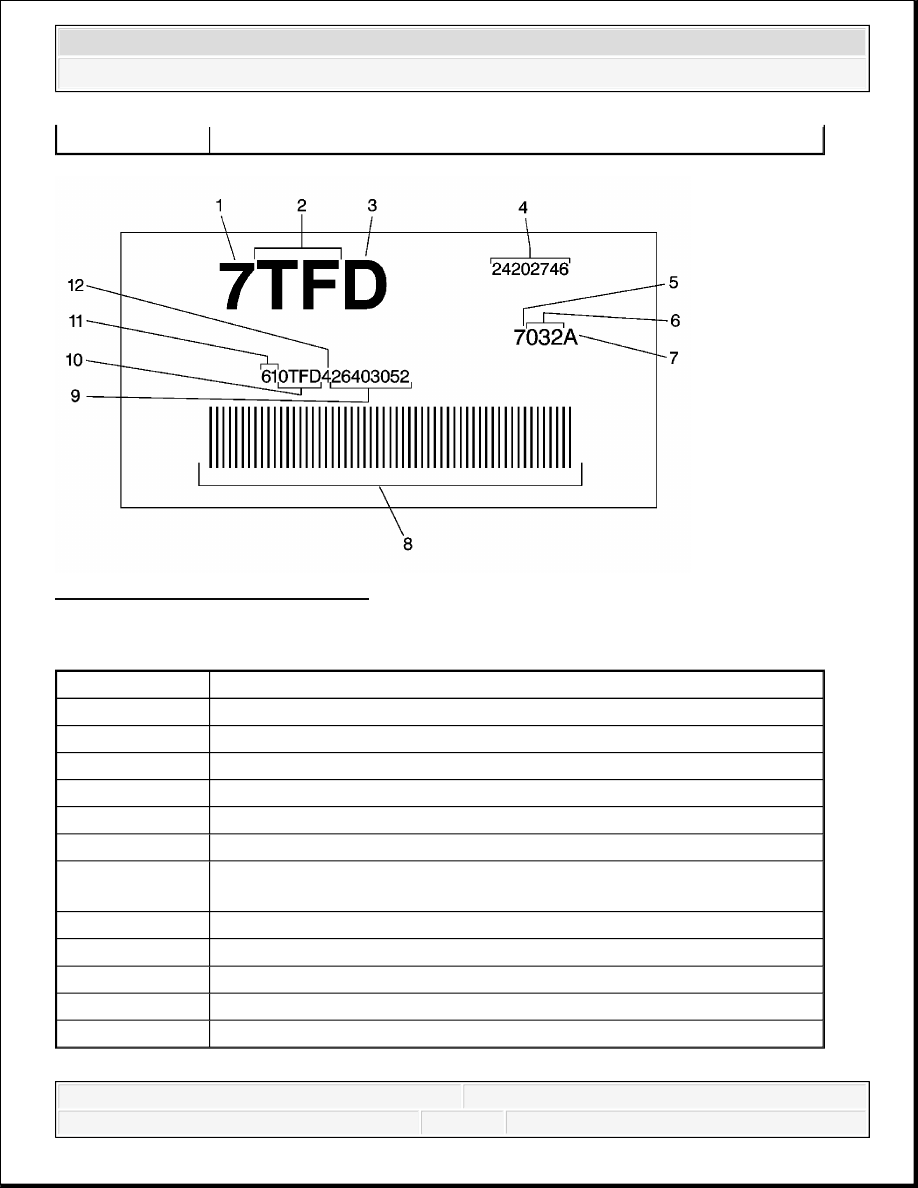
Fig. 476: Bar Code Label Contents 
Courtesy of GENERAL MOTORS CORP. 

Callouts For Fig. 476 

9

Case/Pan Frame Rail Area

Callout

Component Name

1

7 = 2007

2

Model

3

Hydra-Matic 4L60-E

4

Transmission Asm. as Shipped Number

5

7 = Model Year

6

Julian Date or Day of the Year

7

Letter After Julian Date Identifies the Plant Shift Build, See Shift Build 
Chart

8

Bar Code

9

Serial Number

10

Broadcast Code

11

Transmission ID

12

Build Location Y = Toledo, OH, 4 = Ramos Arizpe, Mexico


2007 Hummer H3 

2007 TRANSMISSION Automatic Transmission - 4L60-E/4L65-E/4L70-E - H3


Plant and Shift Build Chart 

TRANSMISSION COMPONENT AND SYSTEM DESCRIPTION 

The mechanical components of the 4L60-E are as follows: 


A torque converter with an electronically controlled capacity clutch (ECCC) 

This transmission is equipped with an ECCC. The pressure plate does not fully lock to the 
torque converter cover. Instead, the pressure plate maintains a small amount of slippage, 
about 20 RPM, in SECOND, THIRD and FOURTH gears, depending on the vehicle 
application. ECCC was developed to reduce the possibility of noise, vibration or chuggle 
caused by TCC apply. Typical apply speeds are 49-52 km/h (30-32 mph) in THIRD gear 
and 65-73 km/h (40-45 mph) in FOURTH gear. Full lockup is available at highway speeds 
on some applications. 


Torque converter assembly  


Servo assembly and 2-4 band assembly  


Reverse input clutch and housing  


Overrun clutch  


Forward clutch  


3-4 clutch  


Forward sprag clutch assembly  


Lo and reverse roller clutch assembly  


Lo and reverse clutch assembly  


Two planetary gear sets: Input and Reaction  


Oil pump assembly  


Control valve body assembly  

Plant

Build Line

1st Shift

2nd Shift

3rd Shift

Toledo, OH

ML1

J

W

X

ML2

A

C

Not Used

ML3

B

H

Not Used

ML4

S

L

V

ML5

K

E

Z

Ramos Arizpe, 

Mexico

1

A

-

-


2007 Hummer H3 

2007 TRANSMISSION Automatic Transmission - 4L60-E/4L65-E/4L70-E - H3


The electrical components of the 4L60-E are as follows: 


1-2 and 2-3 shift solenoid valves  


3-2 shift solenoid valve assembly  


Transmission pressure control (PC) solenoid  


Torque converter clutch (TCC) solenoid valve  


TCC pulse width modulation (PWM) solenoid valve  


Automatic transmission fluid pressure (TFP) manual valve position switch  


Automatic transmission fluid temperature (TFT) sensor  


Vehicle speed sensor assembly  

For more information, refer to Electronic Component Description

TRANSMISSION ADAPTIVE FUNCTIONS 

The 4L60-E transmission utilizes a line pressure control system during upshifts to compensate for 
the normal wear of transmission components. By adjusting the line pressure, the powertrain 
control module (PCM)/transmission control module (TCM) can maintain acceptable transmission 
shift times. This process is known as "adaptive learning" or "shift adapts" and is similar to the 
closed loop fuel control system used for the engine. 

In order for the PCM/TCM to perform a "shift adapt," it must first identify if an upshift is 
acceptable to analyze. For example, upshifts that occur during cycling of the A/C compressor or 
under extreme throttle changes could cause the PCM/TCM to incorrectly adjust line pressure. 
When an upshift is initiated, a number of contingencies, such as throttle position, transmission 
temperature and vehicle speed, are checked in order to determine if the actual shift time is valid 
to compare to a calibrated desired shift time. If all the contingencies are met during the entire 
shift, then the shift is considered valid and the adapt function may be utilized if necessary. 

Once an adaptable shift is identified, the PCM/TCM compares the actual shift time to the desired 
shift time and calculates the difference between them. This difference is known as the shift error. 
The actual shift time is determined from the time that the PCM/TCM commands the shift to the 
start of the engine RPM drop initiated by the shift. If the actual shift time is longer than the 
calibrated desired shift time, a soft feel or slow engagement, then the PCM/TCM decreases 
current to the pressure control (PC) solenoid in order to increase line pressure for the next, same, 
upshift under identical conditions. If the actual shift time is shorter than the calibrated desired 
shift time, a firm engagement, then the PCM/TCM increases current to the PC solenoid in order 
to decrease line pressure for the next, same, upshift under identical conditions. 


2007 Hummer H3 

2007 TRANSMISSION Automatic Transmission - 4L60-E/4L65-E/4L70-E - H3


The purpose of the adapt function is to automatically compensate the shift quality for the various 
vehicle shift control systems. It is a continuous process that will help to maintain optimal shift 
quality throughout the life of the vehicle. 

Clearing Transmission Adaptive Pressure (TAP) 

Transmission adaptive pressure (TAP) information is displayed and may be reset using a scan 
tool. 

The adapt function is a feature of the powertrain control module (PCM)/transmission control 
module (TCM) that either adds or subtracts line pressure from a calibrated base line pressure in 
order to compensate for normal transmission wear. The TAP information is divided into 13 units, 
called cells. The cells are numbered 4 through 14. Each cell represents a given torque range. TAP 
cell 4 is the lowest adaptable torque range and TAP cell 14 is the highest adaptable torque range. 
It is normal for TAP cell values to display zero or negative numbers. This indicates that the 
PCM/TCM has adjusted line pressure at or below the calibrated base line pressure. 

Updating TAP information is a learning function of the PCM/TCM designed to maintain 
acceptable shift times. It is not recommended that TAP information be reset unless one of the 
following repairs has been made: 


Transmission overhaul or replacement  


Repair or replacement of an apply or release component, clutch, band, piston, servo  


Repair or replacement of a component or assembly which directly affects line pressure  

Resetting the TAP values using a scan tool will erase all learned values in all cells. As a result, the 
PCM/TCM will need to relearn TAP values. Transmission performance may be affected as new 
TAPs are learned. Learning can only take place when the PCM/TCM has determined that an 
acceptable shift has occurred. The PCM/TCM must also relearn TAP values if it is replaced. 

ELECTRONIC COMPONENT DESCRIPTION 

1-2 and 2-3 Shift Solenoid Valves 


2007 Hummer H3 

2007 TRANSMISSION Automatic Transmission - 4L60-E/4L65-E/4L70-E - H3


Content   ..  862  863  864  865   ..