Honda Insight (2022 year). Manual in english - page 26
 

  Index      Manuals     Honda Insight (2022 year). Manual in english


Search            copyright infringement  


Content      ..     24      25      26      27     ..


Honda Insight (2022 year). Manual in english - page 26


413

uu

When Driving

u

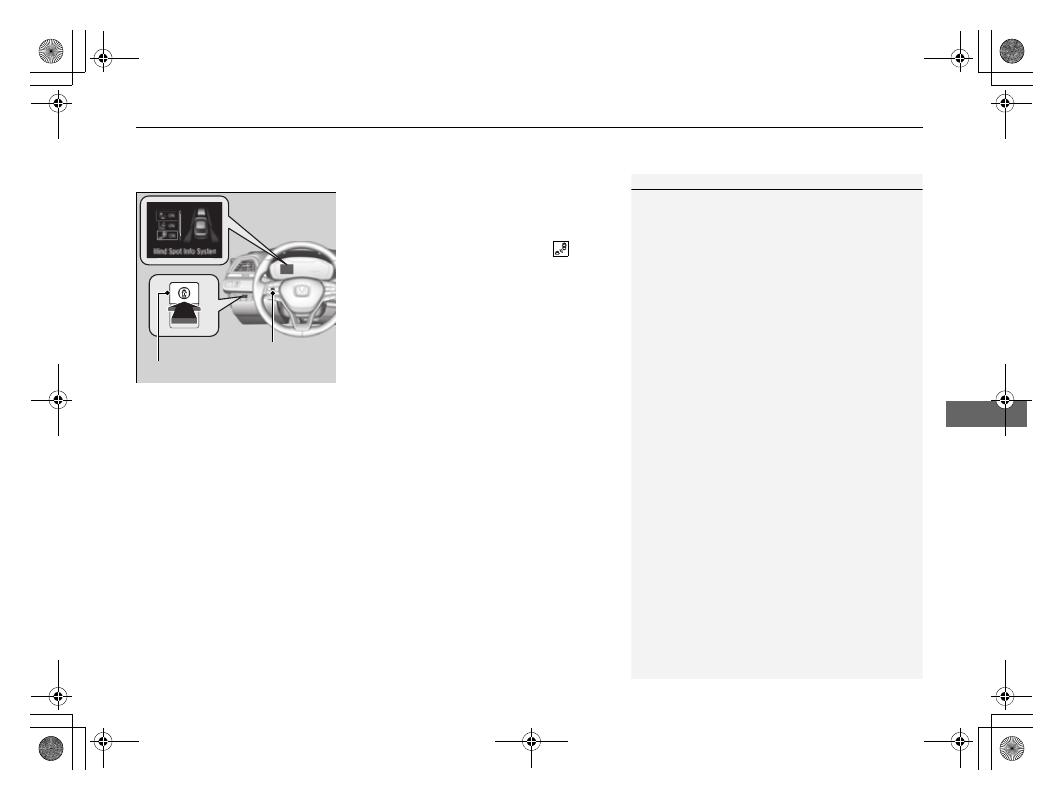
Blind spot information System

Driving

Blind spot information System On and Off

When you turn the blind spot information 
system on and off, do the following.

1.

Press the safety support switch.

2.

Roll the left selector wheel to the 

 symbol 

and push it.

u

The message appears on the driver 
information interface when the system 
turns on or off.

The blind spot information system is in the 
previously selected 

ON

 or 

OFF

 setting each 

time you start the engine.

1

Blind spot information System

For a proper blind spot information system operation:

Always keep the rear bumper corner area clean.

Do not cover the rear bumper corner area with 
labels or stickers of any kind.

Take your vehicle to a dealer if you need the rear 
bumper corner area or the radar sensors to be 
repaired, or the rear bumper corner area is strongly 
impacted.

Safety Support Switch

Left Selector Wheel

414

uu

When Driving

u

High Voltage Battery

Driving

High Voltage Battery

The High Voltage battery gradually discharges even if the vehicle is not in use. As a 
result, if your vehicle is parked for an extended period of time, the battery charge 
level will become low. Extended periods of time at a low state of charge will shorten 
battery life. To maintain the battery state of charge, drive your vehicle for more than 
30 minutes at least once every three months.
Extreme high temperatures can affect the battery life. You can minimize the effects 
by parking the vehicle in the shade during the summer.

1

High Voltage Battery

Be careful not to let the High Voltage battery drain 
too much. If the battery level becomes close to zero, 
it will make it impossible to start the power system.

415

Continued

Driving

Honda Sensing

®

Honda Sensing

®

 is a driver support system which employs the use of two distinctly 

different kinds of sensors: a radar sensor located in the front lower grille and a front 
sensor camera mounted to the interior side of the windshield, behind the rearview 
mirror.

Honda Sensing

®

 has following functions.

The functions which do not require switch operations to activate

Collision Mitigation Braking System

TM

 (CMBS

TM

2

 P. 418

Road Departure Mitigation (RDM) System 

2

 P. 454

Traffic Sign Recognition System 

2

 P. 459

The functions which require switch operations to activate

Adaptive Cruise Control (ACC) with Low Speed Follow 

2

 P. 428

Lane Keeping Assist System (LKAS) 

2

 P. 446

416

uu

Honda Sensing

®

u

Driving

MAIN Button

Press to activate standby mode for ACC with 
Low Speed Follow and LKAS. Or press to 
cancel these systems.

LKAS Button

Press to activate or cancel the LKAS.

RES/+/SET/− Button

Press 

RES/+

 to resume the ACC with Low 

Speed Follow or increase the vehicle speed.
Press 

SET/−

 to set the ACC with Low Speed 

Follow or decrease the vehicle speed.

Interval Button

Press the   (interval) button to change the 
ACC with Low Speed Follow following-
interval.

CANCEL Button

Press to cancel ACC with Low Speed Follow.

Operation Switches for the ACC with Low Speed Follow/

LKAS

MAIN

 button

Interval Button

CANCEL

 button

LKAS Button

RES/+

 Button

SET/−

 Button

417

uu

Honda Sensing

®

u

Driving

You can see the current state of ACC with 
Low Speed Follow and LKAS.

Driver Information Interface Content

a

Indicates that ACC with Low Speed Follow 
and LKAS are ready to be activated.

b

Indicates that LKAS is activated and 
whether or not traffic lane lines are 
detected.

c

Indicates whether or not ACC with Low 
Speed Follow detected the vehicle ahead.

d

Indicates that ACC with Low Speed Follow 
shows the set vehicle speed.

e

Indicates that ACC with Low Speed Follow 
shows the set vehicle interval.

418

uu

Honda Sensing

®

u

Collision Mitigation Braking System

TM

 (CMBS

TM

)

Driving

Collision Mitigation Braking System

TM

 (CMBS

TM

)

The system can assist you when it determines there is a possibility of your vehicle 
colliding with a vehicle or a pedestrian detected in front of your vehicle. The CMBS

TM


is designed to alert you when the potential for a collision is determined, as well as to 
reduce your vehicle speed to help minimize collision severity when a collision is 
deemed unavoidable.

1

Collision Mitigation Braking System

TM

 (CMBS

TM

)

Important Safety Reminder

The CMBS

TM

 is designed to reduce the severity of an 

unavoidable collision. It does not prevent a collision 
nor stop the vehicle automatically. It is still your 
responsibility to operate the brake pedal and steering 
wheel appropriately according to the driving 
conditions.

The CMBS

TM

 may not activate or may not detect a 

vehicle in front of your vehicle under certain 
conditions:

2

CMBS

TM

 Conditions and Limitations

 P. 423

You can read about handling information for the 
camera equipped with this system.

2

Front Sensor Camera

 P. 465

For directions on the proper handling of the radar 
sensor, refer to the following page.

2

Radar Sensor

 P. 467

When the CMBS

TM

 activates, it may automatically 

apply the brake. It will be canceled when your vehicle 
stops or a potential collision is not determined.

Continued

419

uu

Honda Sensing

®

u

Collision Mitigation Braking System

TM

 (CMBS

TM

)

Driving

How the system works

The radar sensor is at the 

lower part of the front 

bumper.

The camera is located 

behind the rearview 

mirror.

The system starts monitoring the roadway ahead when your vehicle speed is about 

3 mph (5 km/h) or above and will search for a vehicle in front of you.

When to use

The CMBS

TM

 activates when:

The speed difference between your vehicle and a vehicle or pedestrian detected in 

front of you becomes about 3 mph (5 km/h) and over with a chance of a collision.

Your vehicle speed is about 62 mph (100 km/h) or less and the system determines 

there is a chance of a collision with:

- Vehicles detected in front of you that are stationary, oncoming, or traveling in your 

same direction.
- A pedestrian who is detected in front of you.

Your vehicle speed is above 62 mph (100 km/h), and the system determines there 

is a chance of a collision with a vehicle detected in front of you traveling in your 

same direction.

1

Collision Mitigation Braking System

TM

 (CMBS

TM

)

The camera in the CMBS

TM

 is also designed to detect 

pedestrians.
However, this pedestrian detection feature may not 
activate or may not detect a pedestrian in front of 
your vehicle under certain conditions.
Refer to the ones indicating the pedestrian detection 
limitations from the list.

2

CMBS

TM

 Conditions and Limitations

 P. 423

420

uu

Honda Sensing

®

u

Collision Mitigation Braking System

TM

 (CMBS

TM

)

Driving

When the system activates

You can change the distance (

Long

/

Normal

/

Short

) between vehicles at which the 

system’s earliest collision alert will come on through audio/information screen 
setting options.

2

Customized Features

 P. 326

The system provides visual and audible alerts of a possible collision, and stops if the 

collision is avoided.

u

Take appropriate action to prevent a collision (apply the brakes, change 
lanes, etc.).

Beep

Visual Alerts

Audible Alert

421

uu

Honda Sensing

®

u

Collision Mitigation Braking System

TM

 (CMBS

TM

)

Continued

Driving

The system has three alert stages for a possible collision. However, depending on circumstances, the CMBS

TM

 may not go through all of 

the stages before initiating the last stage.

Collision Alert Stages

Distance between vehicles

CMBS

TM

The radar sensor detects a vehicle

Audible & Visual WARNINGS

Braking

Stage 

one

There is a risk of a collision with the 
vehicle ahead of you.

When in 

Long

, visual and audible alerts come 

on at a longer distance from a vehicle ahead 
than in 

Normal

 setting, and in 

Short

, at a 

shorter distance than in 

Normal

.

Stage 

two

The risk of a collision has increased, 
time to respond is reduced.

Visual and audible alerts.

Lightly 

applied

Stage 

three 

The CMBS

TM

 determines that a 

collision is unavoidable.

Forcefully 

applied

Your Vehicle

Vehicle 
Ahead

Normal

Short

Long

Your 
Vehicle

Vehicle 
Ahead

Your 
Vehicle

Vehicle 
Ahead

uu

Honda Sensing

®

u

Collision Mitigation Braking System

TM

 (CMBS

TM

)

422

Driving

When you turn the CMBS

TM

 on and off, do the 

following.

1.

Press the safety support switch.

2.

Roll the left selector wheel to the 


symbol and push it.

u

The message appears on the driver 
information interface when the system 
turns on or off.

The CMBS

TM

 is turned on every time you start 

the power system, even if you turned it off the 
last time you drove the vehicle.

CMBS

TM

 On and Off

1

Collision Mitigation Braking System

TM

 (CMBS

TM

)

The CMBS

TM

 may automatically shut off, and the 

safety support indicator (amber) will come and stay 
on under certain conditions:

2

CMBS

TM

 Conditions and Limitations

 P. 423

When the CMBS

TM

 is activated, it will continue to 

operate even if the accelerator pedal is partially 
depressed. However, it will be canceled if the 
accelerator pedal is deeply depressed.

The vehicle stability assist

TM

 (VSA

®

) system, vehicle 

stability assist

TM

 (VSA

®

) OFF, adaptive cruise control 

(ACC) with low speed follow, safety support and low 
tire pressure/TPMS indicators may come on in amber 
along with a message in the driver information 
interface when you set the power mode to ON after 
re-connecting the 12-volt battery.
Drive a short distance at more than 12 mph (20 km/h).
Each indicator should go off. If any do not, have your 
vehicle checked by a dealer.

Left Selector Wheel

Safety Support Switch

Continued

423

uu

Honda Sensing

®

u

Collision Mitigation Braking System

TM

 (CMBS

TM

)

Driving

The system may automatically shut off and the safety support indicator (amber) will 
come on under certain conditions. Some examples of these conditions are listed 
below. Other conditions may reduce some of the CMBS

TM

 functions.

2

Front Sensor Camera

 P. 465

Environmental conditions

Driving in bad weather (rain, fog, snow, etc.).

Sudden changes between light and dark, such as an entrance or exit of a tunnel.

There is little contrast between objects and the background.

Driving into low sunlight (e.g., at dawn or dusk).

Strong light is reflected onto the roadway.

Driving in the shadows of trees, buildings, etc.

Roadway objects or structures are misinterpreted as vehicles and pedestrians.

Reflections on the interior of the windshield.

Driving at night or in a dark place such as a tunnel (due to low-light conditions, 
pedestrians or other vehicles may not be detected).

Roadway conditions

Driving on a snowy or wet roadway (obscured lane marking, vehicle tracks, 
reflected lights, road spray, high contrast).

Driving on curvy, winding, or undulating roads.

The road is hilly or the vehicle is approaching the crest of a hill.

CMBS

TM

 Conditions and Limitations

1

Collision Mitigation Braking System

TM

 (CMBS

TM

)

Have your vehicle checked by a dealer if you find any 
unusual behavior of the system (e.g., the warning 
message appears too frequently).

424

uu

Honda Sensing

®

u

Collision Mitigation Braking System

TM

 (CMBS

TM

)

Driving

Vehicle conditions

Headlight lenses are dirty or the headlights are not properly adjusted.

The outside of the windshield is blocked by dirt, mud, leaves, wet snow, etc.

The inside of the windshield is fogged.

An abnormal tire or wheel condition (incorrect sizes, varied sizes or construction, 
improperly inflated, compact spare tire

*

, etc.).

When tire chains are installed.

The vehicle is tilted due to a heavy load or suspension modifications.

The camera temperature gets too high.

Driving with the parking brake applied.

When the radar sensor at the lower part of the front bumper gets dirty.

Driving at night or in a dark place (e.g., a tunnel) with the headlights off.

Detection limitations

A vehicle or pedestrian suddenly crosses in front of you.

The distance between your vehicle and the vehicle or pedestrian ahead of you is 
too short.

A vehicle cuts in front of you at a slow speed, and it brakes suddenly.

When you accelerate rapidly and approach the vehicle or pedestrian ahead of you 
at high speed.

The vehicle ahead of you is a motorcycle, bicycle, mobility scooter or other small 
vehicle.

When there are animals in front of your vehicle.

When you drive on a curved, winding or undulating road that makes it difficult for 
the sensor to properly detect a vehicle in front of you.

The speed difference between your vehicle and a vehicle or pedestrian in front of 
you is significantly large.

An oncoming vehicle suddenly comes in front of you.

Another vehicle suddenly comes in front of you at an intersection, etc.

Your vehicle abruptly crosses over in front of an oncoming vehicle.

When driving through a narrow iron bridge.

When the lead vehicle suddenly slows down.

* Not available on all models

425

uu

Honda Sensing

®

u

Collision Mitigation Braking System

TM

 (CMBS

TM

)

Continued

Driving

When there is a group of people in front of your vehicle walking together side by 
side.

Surrounding conditions or belongings of the pedestrian alter the pedestrian’s 
shape, preventing the system from recognizing that the person is a pedestrian.

When the pedestrian is shorter than about 3.3 feet (1 meter) or taller than about 
6.6 feet (2 meters) in height.

When a pedestrian blends in with the background.

When a pedestrian is bent over or squatting, or when their hands are raised or 
they are running.

When several pedestrians are walking ahead in a group.

When the camera cannot correctly identify that a pedestrian is present due to an 
unusual shape (holding luggage, body position, size).

Automatic shutoff

The CMBS

TM

 may automatically shut itself off and the safety support indicator 

(amber) comes and stays on when:

The temperature inside the system is high.

You drive off-road or on a mountain road, or curved and winding road for an 
extended period.

An abnormal tire condition is detected (wrong tire size, flat tire, etc.).

The camera behind the rearview mirror, or the area around the camera, including 
the windshield, gets dirty.

Once the conditions that caused the CMBS

TM

 to shut off improve or are addressed 

(e.g., cleaning), the system comes back on.

Limitations applicable to pedestrian detection only

uu

Honda Sensing

®

u

Collision Mitigation Braking System

TM

 (CMBS

TM

)

426

Driving

The CMBS

TM

 may activate even when you are aware of a vehicle ahead of you, or 

when there is no vehicle ahead. Some examples of this are:

When Passing

Your vehicle approaches another vehicle ahead of you and you change lanes to pass.

At an intersection

Your vehicle approaches or passes another vehicle that is making a left or right turn.

With Little Chance of a Collision

1

With Little Chance of a Collision

Do not paint, or apply any coverings or paint to radar 
sensor area. This can impact CMBS

TM

 operation.

427

uu

Honda Sensing

®

u

Collision Mitigation Braking System

TM

 (CMBS

TM

)

Driving

On a curve

When driving through curves, your vehicle comes to a point where an oncoming 
vehicle is right in front of you.

Through a low bridge at high speed

You drive under a low or narrow bridge at high speed.

Speed bumps, road work sites, train tracks, roadside objects, etc.

You drive over speed bumps, steel road plates, etc., or your vehicle approaches train 
tracks or roadside objects (such as a traffic sign and guard rail) on a curve or, when 
parking, stationary vehicles and walls.

428

uu

Honda Sensing

®

u

Adaptive Cruise Control (ACC) with Low Speed Follow

Driving

Adaptive Cruise Control (ACC) with Low Speed 
Follow

Helps maintain a constant vehicle speed and a set following interval behind a vehicle 
detected ahead of yours and, if the detected vehicle comes to a stop, can decelerate 
and stop your vehicle, without you having to keep your foot on the brake or the 
accelerator.
When ACC with Low Speed Follow slows your vehicle by applying the brakes, your 
vehicle’s brake lights will illuminate.

1

Adaptive Cruise Control (ACC) with Low Speed Follow

Important Reminder

As with any system, there are limits to ACC with Low 
Speed Follow. Use the brake pedal whenever 
necessary, and always keep a safe interval between 
your vehicle and other vehicles.

For directions on the proper handling of the radar 
sensor, refer to the following page.

2

Radar Sensor

 P. 467

3

WARNING

Improper use of ACC with Low Speed 
Follow can lead to a crash.

Use ACC with Low Speed Follow only when 
driving on expressways or freeways and in 
good road and weather conditions.

3

WARNING

ACC with Low Speed Follow has limited 
braking capability and may not stop your 
vehicle in time to avoid a collision with a 
vehicle that quickly stops in front of you.

Always be prepared to apply the brake 
pedal if the conditions require.

When to use

Vehicle speed for ACC with Low Speed Follow: 

A vehicle is detected ahead 

within ACC with Low Speed Follow range

 – ACC with Low Speed Follow 

operates at speeds up to 90 mph (145 km/h).

No vehicle is detected within ACC with Low Speed Follow range

 – ACC with 

Low Speed Follow operates at the speed of 25 mph (40 km/h) or above.

Shift position for ACC with Low Speed Follow: In 

(

D

.

The radar sensor is at the 

lower part of the front 

bumper.

The camera is 

located behind 

the rearview 

mirror.


Content      ..     24      25      26      27     ..