Ford F-150 (2024 year). Manual in english - page 2


  Index      Manuals     Ford F-150 (2024 year). Manual in english


Search            copyright infringement  


Content      ..      1      2      3      ..


Ford F-150 (2024 year). Manual in english - page 2


You cannot install a child restraint with
rigid LATCH attachments at the center
seating position. You can only use LATCH
compatible child restraints with
attachments on belt webbing at this
seating position provided that the child
restraint manufacturer's instructions
permit use with the anchor spacing stated.
Do not attach a child restraint to any lower
anchor if another child restraint is attached
to that anchor.

Each time you use the child restraint, check
that the seat is properly attached to the
lower anchors and tether anchor, if
applicable. Tug the child restraint from side
to side and forward and back where it is
secured to the vehicle. The seat should
move less than 1 in (2.5 cm).

If you did not properly anchor the child
restraint, the risk of a child being injured in
a crash greatly increases.

COMBINING THE SEATBELT AND

LOWER ANCHORS FOR
ATTACHING CHILD RESTRAINTS

When used in combination, you may attach
either the seatbelt or the LATCH lower
anchors first, provided a proper installation
is achieved. Attach the tether strap
afterward, if it is included with the child
restraint.

USING TETHER STRAPS

Many forward-facing child restraints
include a tether strap which extends from
the back of the child restraint and hooks
to an anchoring point called the top tether
anchor. Tether straps are available as an
accessory for many older child restraints.

Contact the manufacturer of your child
restraint for information about ordering a
tether strap, or to obtain a longer tether
strap if the tether strap on your child
restraint does not reach the appropriate
top tether anchor in the vehicle.

Attach the tether strap only to the
appropriate tether anchor. The tether strap
may not work properly if attached
somewhere other than the correct tether
anchor.

If you install a child restraint with rigid
LATCH attachments, do not tighten the
tether strap enough to lift the child
restraint off the vehicle seat cushion when
the child is seated in it. Keep the tether
strap just snug without lifting the front of
the child restraint. Keeping the child
restraint just touching the vehicle seat
gives the best protection in a severe crash.

Once you have installed the child restraint
using either the seatbelt, the lower anchors
of the LATCH system, or both, you can
attach the top tether strap.

ATTACHING THE FRONT SEAT
TETHER STRAP

Regular Cab

E175295

1.

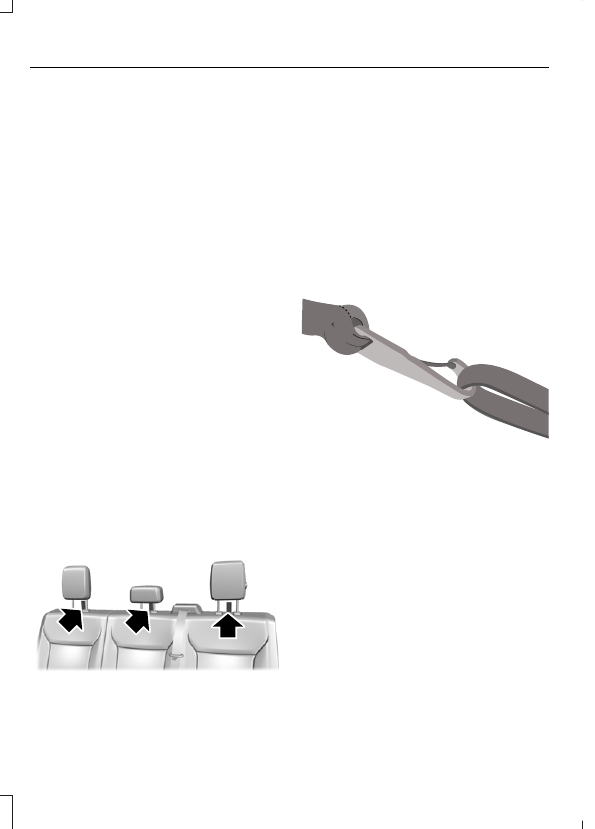
Route the child restraint tether strap
over the back of the seat and under the
head restraint.

61

Child Safety
Note:

For vehicles with adjustable head

restraints, route the tether strap under the
head restraint and between the head
restraint posts. Otherwise, route the tether
strap over the top of the seat backrest.

2. Locate the correct anchor for the

selected seating position. You may
need to pull the seat backrest forward
to access the tether anchors. Make sure
the seat is locked in the upright position
before installing the child restraint.

3. Clip the tether strap to the anchor.

4. Tighten the child restraint tether strap

according to the manufacturer's
instructions.

If you incorrectly clip the tether strap, the
child restraint may not be retained properly
in the event of a crash.

If you did not properly anchor the child
restraint, the risk of a child being injured in
a crash greatly increases.

If your child restraint system has a tether
strap, and the child restraint manufacturer
recommends its use, we also recommend
its use.

ATTACHING THE REAR SEAT
TETHER STRAP

 (If Equipped)

Crew Cab and Super Cab

E309318

There are three loops of webbing above
the back of the rear seat. Use these loops
as routing loops and anchor loops for up
to three child restraint tether straps.

For example, you can use the center loop
as a routing loop for a child restraint in the
center rear seat and as an anchoring loop
for child restraints installed in the
outermost rear seats.

Many tether straps cannot be tightened if
the tether strap is hooked to the loop
directly behind the child restraint.

To provide a tight tether strap:

E309384

1.

Route the vehicle tether loop between
the head restraint posts, then route the
child restraint tether strap through the
loop, forward of the head restraint.

2. Hook the strap to the vehicle tether

anchor loop in the adjacent seating
position. If using the driver side, pass
the strap behind the shoulder belt for
the center seat. Put the tether strap
through the routing loop. The head
restraint support post holds the child
restraint tightly, but the head restraint
post is not strong enough to hold the
child restraint during a crash.

3. Tighten the tether strap according to

the child restraint manufacturer's
instructions.

62

Child Safety

If you did not properly anchor the child
restraint, the risk of a child being injured in
a crash greatly increases.

If your child restraint system has a tether
strap, and the child restraint manufacturer
recommends its use, we also recommend
its use.

BOOSTER SEATS

Use a belt-positioning booster seat for
children who have outgrown or no longer
properly fit in a child restraint and meet
the following criteria.

Generally children who are less than
57 in (1.45 m) tall.

Are greater than age four (4) and less
than age twelve (12).

Are between 40 lb (18 kg) and 80 lb
(36 kg) and upward to 100 lb (45 kg).

Many state and provincial laws require that
children use approved booster seats until
they reach age eight, a height of 57 in
(1.45 m) tall, or 80 lb (36 kg).

Booster seats should be used until you can
answer yes to all of these questions when
seated without a booster seat:

E142595

Can the child sit all the way back
against their vehicle seat backrest with
knees bent comfortably at the edge of
the seat cushion?

Can the child sit without slouching?

Does the lap belt rest low across the
hips?

Is the shoulder belt centered on the
shoulder and chest?

Can the child stay seated like this for
the whole trip?

Always use booster seats in conjunction
with your vehicle lap and shoulder belt.

Types of Booster Seats

E68924

Backless booster seats

If your backless booster seat has a
removable shield, remove the shield.

If a vehicle seating position has a low seat
backrest or no head restraint, a backless
booster seat may place your child's head,
as measured at the tops of the ears, above
the top of the seat. In this case, move the
backless booster to another seating
position with a higher seat backrest or
head restraint and lap and shoulder belts,
or consider using a high-back booster seat.

63

Child Safety

E70710

High-back booster seats

If, with a backless booster seat, you cannot
find a seating position that adequately
supports your child's head, a high-back
booster seat would be a better choice.

Children and booster seats vary in size and
shape. Choose a booster that keeps the
lap belt low and snug across the hips,
never up across the stomach, and lets you
adjust the shoulder belt to cross the chest
and rest snugly near the center of the
shoulder.

The following drawings compare the ideal
fit to a shoulder belt uncomfortably close
to the neck and a shoulder belt that could
slip off the shoulder. The drawings also
show how the lap belt should be low and
snug across the child's hips.

E142596

E142597

64

Child Safety

If the booster seat slides on the vehicle
seat upon which it is being used, placing a
rubberized mesh sold as shelf or carpet
liner under the booster seat may improve
this condition. Do not use any item thicker
than this under the booster seat. Check
with the booster seat manufacturer's
instructions.

CHILD SAFETY LOCKS - CREW
CAB/SUPERCAB

WARNING: 

You cannot open the

rear doors from inside if you have put the
child safety locks on.

E238364

A child safety lock is on the rear edge of
each rear door.  You must switch the child
safety lock separately on each door.

Left-Hand Side

Turn the key clockwise to switch the child
lock on and counterclockwise to switch it
off.

Right-Hand Side

Turn the key counterclockwise to switch
the child lock on and clockwise to switch
it off.

Note:

To make sure the child safety lock is

on, pull the inside door handle twice to verify
the door does not open.

Note:

To open the rear doors from inside

the vehicle when the child lock is engaged,
roll down the rear window and use the
outside door handle. Or have someone
outside the vehicle open the door.

65

Child Safety

SEATBELT PRECAUTIONS

WARNING: 

Always drive and ride

with your seatback upright and the lap
belt snug and low across the hips.

WARNING: 

Children must always

be properly restrained.

WARNING: 

Do not allow a

passenger to hold a child on their lap
when your vehicle is moving. Failure to
follow this instruction could result in
personal injury or death in the event of a
sudden stop or crash.

WARNING: 

All occupants of your

vehicle, including the driver, should
always properly wear their seatbelts,
even when an airbag supplemental
restraint system is provided. Failure to
properly wear your seatbelt could
seriously increase the risk of injury or
death.

WARNING: 

It is extremely

dangerous to ride in a cargo area, inside
or outside of a vehicle. In a crash, people
riding in these areas are more likely to be
seriously injured or killed. Do not allow
people to ride in any area of your vehicle
that is not equipped with seats and
seatbelts. Make sure everyone in your
vehicle is in a seat and properly using a
seatbelt. Failure to follow this warning
could result in serious personal injury or
death.

WARNING: 

In a rollover crash, an

unbelted person is significantly more
likely to die than a person wearing a
seatbelt.

WARNING: 

Each seating position

in your vehicle has a specific seatbelt
assembly made up of one buckle and
one tongue designed to be used as a pair.
Use the shoulder belt on the outside
shoulder only. Never wear the shoulder
belt under the arm. Never use a single
seatbelt for more than one person.

WARNING: 

Even with advanced

restraints systems, properly restrain
children 12 and under in a rear seating
position. Failure to follow this could
seriously increase the risk of injury or
death.

WARNING: 

Seatbelts and seats

may be hot in a vehicle that is in the
sunshine. The hot seatbelts or seats may
burn a small child. Check seat covers and
buckles before you place a child
anywhere near them.

WARNING: 

If your vehicle is

involved in a crash, have the seatbelts
and associated components inspected
as soon as possible. Failure to follow this
instruction could result in personal injury
or death.

All seating positions in this vehicle have
seatbelts. All occupants of the vehicle
should properly wear their seatbelts, even
when an airbag supplemental restraint
system is provided.

The seatbelt system consists of:

Lap and shoulder seatbelts.

A shoulder seatbelt with automatic
locking mode, except driver seatbelt.

Height adjusters at the front outermost
seating positions.

Seatbelt pretensioners at the front
outermost and rear outermost seating
positions.

66

Seatbelts

E71880

A seatbelt warning light and
chime.

E67017

Crash sensors and monitoring
system with readiness indicator.

The seatbelt pretensioners are designed
to tighten the seatbelts when activated. In
frontal and near-frontal crashes, the
seatbelt pretensioners may be activated
alone or, if the crash is of sufficient severity,
together with the front airbags. In side
crashes and rollovers, the pretensioners
will be activated when the Safety Canopy
is activated.

FASTENING AND
UNFASTENING THE
SEATBELTS

WARNING: 

Always drive and ride

with your seatback upright and the lap
belt snug and low across the hips.

All seatbelts in your vehicle are a
three-point combination lap and shoulder
seatbelt.

E338014

B

A

Seatbelt tongue.

A

Seatbelt buckle.

B

1.

Pull the seatbelt out steadily.

Note:

It may lock if you pull it sharply or if

the vehicle is on a slope.

2. Insert the tongue into the buckle.

3. Pull the seatbelt tight to remove any

slack.

Unfastening the Seatbelts

1.

Press the red button on the buckle to
release the seatbelt.

2. Hold the seatbelt tongue and let it

retract completely and smoothly to its
stowed position.

Using the Seatbelt With Cinch
Tongue

This applies to the front center seating
position of Super Cab and Crew Cab.

67

Seatbelts

The cinch tongue slides up and down the
seatbelt webbing when you stow the
seatbelt or when you put the seatbelts on.
When you buckle the seatbelt, the cinch
tongue allows you to shorten the lap
portion, but pinches the webbing to keep
the lap portion from getting longer. The
cinch tongue is designed to slip during a
crash, so wear the shoulder belt properly
and do not allow any slack in either the lap
or shoulder portions.

While you are fastened in the seatbelt, the
seatbelt with a cinch tongue adjusts to
your movement. However, if you brake
hard, turn hard, or if your vehicle receives
an impact of 5 mph (8 km/h) or more, the
seatbelt locks and helps reduce your
forward movement.

SENSITIVE LOCKING MODE

WHAT IS SENSITIVE LOCKING
MODE

Sensitive locking mode is a seatbelt
retractor feature that allows shoulder belt
length adjustment according to your
movements and locking in response to
vehicle movement.

HOW DOES SENSITIVE LOCKING
MODE WORK

If the driver suddenly brakes, turns a corner
sharply, or the vehicle receives an impact
of about 5 mph (8 km/h) or more, the
seatbelts lock to help reduce forward
movement of the driver and passengers.

In addition, the seatbelt retractor locks if
you pull the seatbelt webbing out too
quickly. If the retractor locks, slowly lower
the height adjuster to allow the seatbelt
to retract.

If the retractor does not unlock, pull the
seatbelt out slowly then feed a small
length of webbing back toward the stowed
position.

AUTOMATIC LOCKING MODE

WHAT IS AUTOMATIC LOCKING
MODE

This feature keeps the seatbelts
pre-locked. The belt still retracts to remove
any slack in the shoulder belt.

WHEN TO USE AUTOMATIC
LOCKING MODE

Use this mode any time you install a child
restraint in a front or rear seating position.
Properly restrain children 12 years old and
under in a rear seat whenever possible. See

Child Safety

 (page 52).

Note:

Automatic locking mode is not

available on the driver seatbelt.

Note:

Vehicles with optional front seat

center may not have this function.

ENGAGING AUTOMATIC LOCKING
MODE

E142591

1.

Fasten the combination lap and
shoulder belt.

68

Seatbelts

2. Grasp the shoulder portion and pull

downward until you pull the entire belt
out.

3. Allow the belt to retract. As the belt

retracts, you will hear a clicking sound.
This indicates the seatbelt is now in the
automatic locking mode.

DISENGAGING AUTOMATIC
LOCKING MODE

Unbuckle the combination lap and
shoulder belt and allow it to retract
completely to disengage the automatic
locking mode and activate the vehicle
sensitive locking mode.

ADJUSTING THE SEATBELTS
DURING PREGNANCY

WARNING: 

Always ride and drive

with your seatback upright and properly
fasten your seatbelt. Fit the lap portion
of the seatbelt snugly and low across
the hips. Position the shoulder portion of
the seatbelt across your chest. Pregnant
women must follow this practice. See
the following figure.

E142590

Pregnant women should always wear their
seatbelt. Position the lap belt portion of a
combination lap and shoulder belt low
across the hips below the belly and worn
as tight as comfort allows. Position the
shoulder belt to cross the middle of the
shoulder and the center of the chest.

ADJUSTING THE SEATBELT
HEIGHT

WARNING: 

Position the seatbelt

height adjuster so that the seatbelt rests
across the middle of your shoulder.
Failure to adjust the seatbelt correctly
could reduce its effectiveness and
increase the risk of injury in a crash.

E145664

1.

Pull the button and slide the height
adjuster up or down.

2. Release the button and pull down on

the height adjuster to make sure it is
locked in place.

69

Seatbelts

ADJUSTING THE SEATBELT
LENGTH

E162708

1.

Pull some seatbelt webbing out of the
shoulder belt retractor.

2. While holding the webbing below the

tongue, grasp the metal tip of the
tongue so that it is parallel to the
webbing and slide the tongue up.

3. Provide enough lap belt length so that

the tongue can reach the buckle.

SEATBELT REMINDER

HOW DOES THE SEATBELT
REMINDER WORK

This feature supplements the seatbelt
warning function. It provides additional
reminders by sounding a tone and
illuminating the seatbelt warning light
when you are in the driver seat and an
occupant unfastens their seatbelt.

Then

If

The seatbelt reminder activates.

You switch your vehicle on and do not

fasten one of the front occupant seatbelts…

The seatbelt reminder activates, the seat-

belt warning light illuminates and a warning
tone sounds until you fasten your seatbelt.

You do not fasten your seatbelt before your

vehicle reaches at least 6 mph (9 km/h) ...

The seatbelt reminder becomes active

when a rear seat passenger fastens a

seatbelt.

Rear seats becomes occupied...

This feature also informs the driver that an
occupant unfastened their seatbelt.

E390115

70

Seatbelts

When the ignition is on, a warning
informs the driver about the status of
each seat, following each seat buckle
or unbuckle. You can acknowledge this,
or the system will time out after 60
seconds.

If a seatbelt is unfastened, a second
warning informs the driver about which
seatbelt was unfastened. A warning
remains until all occupied seatbelts are
fastened.

SEATBELT REMINDER

INDICATORS

A warning lamp illuminates if the ignition
is on, a front seat is occupied and the
seatbelt has not been fastened.

E71880

The warning lamp illuminates
until you fasten your seatbelt.

SEATBELT REMINDER AUDIBLE
WARNINGS

A warning tone sounds and the warning
lamp illuminates if you are not wearing
your seatbelt when your vehicle exceeds
a relatively low speed.

The warning tone sounds for a short period
of time or until you fasten your seatbelt.

SWITCHING THE SEATBELT
REMINDER ON AND OFF

WARNING: 

While the system

allows you to deactivate it, this system
is designed to improve your chances of
being safely belted and surviving an
accident. We recommend you leave the
system activated for yourself and others
who may use the vehicle.

Note:

The driver and front passenger

warnings switch off independently. When
you perform this procedure for one seating
position and the other seat is occupied,
buckle the other seat.

Read Steps 1 - 4 before proceeding with
the programming procedure.

Make sure that:

You set the parking brake.

You place the transmission in park (P).

The ignition is off.

You close all vehicle doors.

You unfasten the driver and front
passenger seatbelts.

1.

Switch the ignition to RUN.

2. Wait a short period of time until the

seatbelt warning tone switches off.
After Step 2, you must complete Step
3 within 30 seconds after you start your
vehicle.

3. For the seating position you are

switching off, fasten then unfasten the
seatbelt four times at a moderate
speed, ending in the unfastened state.
After each unfasten, the seatbelt
warning light switches on and off with
each fasten.

4. The seatbelt warning light flashes for

confirmation.

This switches the feature off for that
seating position if it is currently on.

This switches the feature on for that
seating position if it is currently off.

CHECKING THE SEATBELTS

Check the seatbelts and child restraints
periodically to make sure they work
properly and are not damaged. Make sure
there are no nicks, tears or cuts. Replace if
necessary.

71

Seatbelts

Check the following seatbelt assemblies
after a crash.

Retractors.

Buckles.

Front seatbelt buckle assemblies.

Shoulder belt height adjusters.

Shoulder belt guide on seat backrest.

Child restraint LATCH and tether
anchors.

Attaching hardware.

Read the child restraint manufacturer's
instructions for additional inspection and
maintenance information specific to the
child restraint.

We recommend that all seatbelt
assemblies in use in vehicles involved in a
crash be replaced. However, if the crash
was minor and an authorized dealer finds
that the belts do not show damage and
continue to operate properly, they do not
need to be replaced. Seatbelt assemblies
not in use during a crash should also be
checked and replaced if either damage or
improper operation is noted.

Properly care for seatbelts.  See 

Cleaning

Seatbelts

 (page 530).

SEATBELT EXTENSIONS

WARNING: 

Persons who fit into

the vehicle's seatbelt should not use an
extension. Unnecessary use could result
in serious personal injury in the event of
a crash.

WARNING: 

Only use extensions

provided free of charge by our dealers.
The dealer will provide an extension
designed specifically for this vehicle,
model year and seating position. The use
of an extension intended for another
vehicle, model year or seating position
may not offer you the full protection of
your vehicle's seatbelt restraint system.

WARNING: 

Never use seatbelt

extensions to install child restraints.

WARNING: 

Do not use extensions

to change the way the seatbelt fits
across the torso, over the lap or to make
the seatbelt buckle easier to reach.

If, because of body size or driving position,
it is not possible to properly fasten the
seatbelt over your lap and shoulder, an
extension that is compatible with the
seatbelts is available free of charge from
our dealers. Only use our seatbelt
extensions made by the original equipment
seatbelt manufacturer with our seatbelts.
Ask your authorized dealer if your extension
is compatible with your vehicle restraint
system.

72

Seatbelts

WHAT IS THE PERSONAL
SAFETY SYSTEM

An advanced safety system that protects
occupants in frontal crashes.

HOW DOES THE PERSONAL
SAFETY SYSTEM WORK

This system provides an improved level of
frontal crash protection to front seat
occupants and is designed to reduce the
risk of airbag-related injuries. The system
analyzes occupant conditions and crash
severity before activating the appropriate
safety devices. During a crash, the
restraints control module may deploy the
seatbelt pretensioners, and one or both
stages of the dual-stage airbags based on
crash severity and occupant conditions.

PERSONAL SAFETY SYSTEM
COMPONENTS

Driver and passenger dual-stage airbag
supplemental restraints.

Front seat outermost seatbelts with
pretensioners, energy management
retractors and seatbelt usage sensors.

Front passenger sensing system.

Passenger airbag off and on indicators.

Front crash severity sensors.

Restraints control module with impact
and safing sensors.

Restraint system warning light and
tone.

The electrical wiring for the airbags,
crash sensors, seatbelt pretensioners,
front seatbelt usage sensors, front
passenger sensing system and
indicator lights.

73

Personal Safety System™

HOW DO THE FRONT AIRBAGS
WORK

E151127

The driver and front passenger airbags
deploy during significant frontal and near
frontal crashes.

The driver and passenger front airbag
system consists of:

Driver and passenger airbag modules.

Front passenger sensing system.

Crash sensors and monitoring system
with readiness indicator.  See 

Crash

Sensors and Airbag Indicator

 (page

81).

The airbags are a supplemental restraint
system and are designed to work with the
seatbelts to help protect the driver and
right front passenger from certain upper
body injuries. Airbags do not inflate slowly;
there is a risk of injury from a deploying
airbag.

Note:

You will hear a loud bang and see a

cloud of harmless powdery residue if an
airbag deploys. This is normal.

The airbags inflate and deflate rapidly
upon activation.  After airbag deployment,
it is normal to notice a smoke-like, powdery
residue or smell the burnt propellant.  This
may consist of cornstarch, talcum powder
(to lubricate the bag) or sodium

compounds (for example, baking soda)
that result from the combustion process
that inflates the airbag.  Small amounts of
sodium hydroxide may be present which
may irritate the skin and eyes, but none of
the residue is toxic.

Contact with a deploying airbag may cause
abrasions or swelling. Temporary hearing
loss is also a possibility as a result of the
noise associated with a deploying airbag.

Because airbags must inflate rapidly and
with considerable force, there is the risk of
death or serious injuries such as fractures,
facial and eye injuries or internal injuries,
particularly to occupants who are not
properly restrained or are otherwise out of
position at the time of airbag deployment.
Thus, it is extremely important that
occupants be properly restrained as far
away from the airbag module as possible.

Routine maintenance of the airbags is not
required.

HOW DO THE SIDE AIRBAGS
WORK

WARNING: 

Do not place objects

or mount equipment on or near the
airbag cover, on the side of the front or
rear seatbacks, or in areas that may
come into contact with a deploying
airbag. Failure to follow these
instructions may increase the risk of
personal injury in the event of a crash.

WARNING: 

Accessory seat covers

not released by Ford Motor Company
could prevent the deployment of the
airbags and increase the risk of injuries
in a crash.

74

Airbags

WARNING: 

Do not lean your head

on the door. The side airbag could injure
you as it deploys from the side of the
seatback.

The side airbags are on the outermost side
of the seat backrests of the front seats. In
certain sideways crashes or rollovers, the
airbags will be inflated. The airbag was
designed to inflate between the door panel
and occupant to further enhance the
protection provided to occupants in side
impact crashes.

E152533

The system consists of the following:

A label or embossed side panel
indicating that side airbags are fitted
to your vehicle.

Side airbags inside the driver and front
passenger seat backrests.

Crash sensors and monitoring system
with readiness indicator.  See 

Crash

Sensors and Airbag Indicator

 (page

81).

HOW DO THE KNEE AIRBAGS
WORK

Driver and passenger knee airbags are
under or within the instrument panel.
During a crash, the restraints control
module may activate the driver and
passenger knee airbags (individually or
both) based on crash severity and
respective occupant conditions. Under
certain crash and occupant conditions, the
driver and passenger knee airbags may
deploy (individually or both) but the
corresponding front airbag may not
activate. It is important to be properly
seated and restrained to reduce the risk of
death or serious injury.

E67017

Make sure the knee airbags are
operating properly.  See 

Crash

Sensors and Airbag Indicator

(page 81).

HOW DOES THE SAFETY
CANOPY™ WORK

WARNING: 

Do not place objects

or mount equipment on or near the
headliner at the siderail that may come
into contact with a deploying curtain
airbag. Failure to follow these
instructions may increase the risk of
personal injury in the event of a crash.

WARNING: 

Do not lean your head

on the door. The curtain airbag could
injure you as it deploys from the
headliner.

WARNING: 

To reduce risk of injury,

do not obstruct or place objects in the
deployment path of the airbag.

75

Airbags

The Safety Canopy deploys during
significant side crashes or when a certain
likelihood of a rollover event is detected
by the rollover sensor. The Safety Canopy
is mounted to the roof side-rail sheet
metal, behind the headliner, above each
row of seats. In certain sideways crashes
or rollover events, the Safety Canopy will
be activated, regardless of which seats are
occupied. The Safety Canopy inflates
between the side window area and
occupants to further enhance protection
provided in side impact crashes and
rollover events.

E75004

The system consists of the following:

Safety Canopy curtain airbags above
the trim panels over the front and rear
side windows identified by a label or
wording on the headliner or roof-pillar
trim.

A flexible headliner which opens above
the side doors to allow air curtain
deployment

E67017

· Crash sensors and monitoring
system with a readiness
indicator.  See 

Crash Sensors

and Airbag Indicator

 (page 81).

Properly restrain children 12 years old and
under in the rear seats. The Safety Canopy
will not interfere with children restrained
using a properly installed child or booster
seat because it is designed to inflate
downward from the headliner above the
doors along the side window opening.

AIRBAG PRECAUTIONS

WARNING: 

Airbags do not inflate

slowly or gently, and the risk of injury
from a deploying airbag is the greatest
close to the trim covering the airbag
module.

WARNING: 

All occupants of your

vehicle, including the driver, should
always properly wear their seatbelts,
even when an airbag supplemental
restraint system is provided. Failure to
properly wear your seatbelt could
seriously increase the risk of injury or
death.

WARNING: 

Properly secure

children 12 years old and under in a rear
seating position whenever possible. If
you are unable to properly secure all
children in a rear seating position,
properly secure the largest child on the
front seat. If you must use a forward
facing child restraint on the front seat,
move the seat as far back as possible.
Failure to follow these instructions could
result in personal injury or death.

WARNING: 

Do not place your arms

on the airbag cover or through the
steering wheel. Failure to follow this
instruction could result in personal injury.

76

Airbags

WARNING: 

Keep the areas in front

of the airbags free from obstruction. Do
not affix anything to or over the airbag
covers. Objects could become projectiles
during airbag deployment. Failure to
follow this instruction could result in
personal injury or death.

WARNING: 

To reduce risk of injury,

do not obstruct or place objects in the
deployment path of the airbag.

WARNING: 

Do not place a

rearward facing child restraint in front of
an active airbag. Failure to follow this
instruction could result in personal injury
or death.

WARNING: 

Do not attempt to

service, repair, or modify the
supplementary restraint system or
associated components. Failure to
follow this instruction could result in
personal injury or death.

WARNING: 

Several airbag system

components get hot after inflation. To
reduce the risk of injury, do not touch
them after inflation.

WARNING: 

If a supplementary

restraint system component has
deployed, it will not function again. Have
the system and associated components
inspected as soon as possible. Failure to
follow this instruction could result in
personal injury or death.

PROPERLY ADJUSTING THE
DRIVER AND FRONT
PASSENGER SEATS

WARNING: 

National Highway

Traffic Safety Administration (NHTSA)
recommends a minimum distance of at
least 10 in (25 cm) between an
occupant's chest and the driver airbag
module.

To properly position yourself away from
the airbag:

Move your seat to the rear as far as you
can while still reaching the pedals
comfortably.

Recline the seat slightly one or two
degrees from the upright position.

After all occupants have adjusted their
seats and put on seatbelts, it is very
important that they continue to sit
properly. Properly seated occupants sit
upright, lean against the seat backrest, and
center themselves on the seat cushion,
with their feet comfortably extended on
the floor. Sitting improperly can increase
the chance of injury in a crash event. For
example, if an occupant slouches, lies
down, turns sideways, sits forward, leans
forward or sideways, or puts one or both
feet up, the chance of injury during a crash
greatly increases.

CHILDREN AND AIRBAGS

WARNING: 

Do not place a

rearward facing child restraint in front of
an active airbag. Failure to follow this
instruction could result in personal injury
or death.

77

Airbags

E142846

Children must always be properly
restrained. Accident statistics suggest that
children are safer when properly restrained
in the rear seating positions than in the
front seating position. Failure to follow
these instructions may increase the risk of
injury in a crash.

If two adults and a child occupy a vehicle
without rear seats, properly restrain the
child in the center front seat unless doing
so would interfere with driving your vehicle.
This provides lap and shoulder belt
protection for all occupants, and airbag
protection for the adults. A child or infant
properly restrained in the center front seat
should have a reduced risk to serious injury
from the airbags.

FRONT PASSENGER SENSING
SYSTEM

WHAT IS THE FRONT PASSENGER
SENSING SYSTEM

This system detects a properly seated
occupant and determines if the front
passenger airbag should be enabled.

HOW DOES THE FRONT
PASSENGER SENSING SYSTEM
WORK

The system uses a passenger airbag status
indicator which illuminates indicating that
the front passenger frontal airbag is either
enabled or disabled.

Note:

When you first switch the ignition on,

the passenger airbag status indicator off
and on lamps illuminate for a short period
to confirm they are functional.

E181984

The indicator lamps are in the overhead
console.

The front passenger sensing system is
designed to disable the front passenger
frontal airbag under these conditions:

The front passenger seat is
unoccupied.

The system determines an infant is
present in a child restraint.

A passenger takes their weight off of
the seat for a period of time.

If there is a problem with the airbag
system or the passenger sensing
system.

Even with this technology, parents are
strongly encouraged to always properly
restrain children in the rear seat.

78

Airbags

When the front passenger sensing
system disables the front passenger
frontal airbag, the passenger airbag
status indicator illuminates the off
lamp.

If you have installed the child restraint
and the passenger airbag status
indicator illuminates the on lamp,
switch your vehicle off, remove the
child restraint from your vehicle and
reinstall the restraint following the
child restraint manufacturer's
instructions.

The front passenger sensing system works
with sensors that are part of the front
passenger seat and seatbelt. The sensors
are designed to detect the presence of a
properly seated occupant and determine
if the front passenger frontal airbag should
be enabled.

When the front passenger sensing
system enables the front passenger
frontal airbag, the passenger airbag
status indicator illuminates the on
lamp.

If a person of adult size is sitting in the front
passenger seat, but the passenger airbag
status indicator off lamp is illuminated, it
is possible that the person is not sitting
properly in the seat. If this happens:

Switch your vehicle off and ask the
person to place the seat backrest in an
upright position.

Have the person sit upright in the seat,
centered on the seat cushion, with the
person's legs comfortably extended.

Restart your vehicle and have the
person remain in this position for about
two minutes. This allows the system
to detect that person and enable the
passenger frontal airbag.

If the indicator off lamp remains
illuminated even after this, you should
advise the person to ride in the rear
seat.

After all occupants have adjusted their
seats and put on seatbelts, it is very
important that they continue to sit upright,
leaning against the seat backrest, and
centered on the seat cushion, with their
feet comfortably extended on the floor.

Sitting improperly can increase the chance
of injury in a crash event. For example, if
an occupant slouches, lies down, turns
sideways, sits forward, leans forward or
sideways, or puts one or both feet up, the
chance of injury during a crash greatly
increases.

If you think that the state of the passenger
airbag status indicator lamp is incorrect,
check for the following:

Objects lodged underneath the seat.

Objects between the seat cushion and
the center console.

Objects hanging off the seat backrest.

Objects stowed in the seat backrest
map pocket.

Objects placed on the occupant's lap.

Cargo interference with the seat

Other passengers pushing or pulling on
the seat.

Rear passenger feet and knees resting
or pushing on the seat.

The listed conditions could cause the
weight of a properly seated occupant to
be incorrectly interpreted by the front
passenger sensing system. The person in
the front passenger seat could appear
heavier or lighter due to the conditions
listed.

E67017

Make sure the front passenger
sensing system is operating
properly.  See 

Crash Sensors

and Airbag Indicator

 (page 81).

If the airbag readiness light is on, do the
following:

79

Airbags

Pull your vehicle over.

Switch your vehicle off.

Check for any objects lodged
underneath the front passenger seat
or cargo interfering with the seat.

Remove the obstruction if found.

Restart your vehicle.

Wait at least two minutes and verify
that the airbag readiness light in the
instrument cluster is no longer
illuminated.

If the airbag readiness light in the
instrument cluster remains illuminated,
there may be a problem due to the
front passenger sensing system.

Do not attempt to repair or service the
system. Take your vehicle in for service
immediately.

If it is necessary to modify an advanced
front airbag system to accommodate a
person with disabilities, contact your
Customer Relationship Center.  See

Contacting Us

 (page 22).

FRONT PASSENGER SENSING
SYSTEM PRECAUTIONS

WARNING: 

Sitting improperly, out

of position or with the seatback reclined
too far can take weight off the seat
cushion and affect the decision of the
passenger sensing system, resulting in
serious injury or death in the event of a
crash. Always sit upright against your
seat back, with your feet on the floor.

WARNING: 

Any alteration or

modification to the front passenger seat
may affect the performance of the front
passenger sensing system. This could
seriously increase the risk of injury or
death.

WARNING: 

Do not place objects

under the front passenger seat or
between the seat and the center
console. Failure to follow this instruction
may interfere with the front passenger
seat sensing system and increase the
risk of injury or death in a crash.

WARNING: 

Check the passenger

airbag indicator lamp for proper airbag
status. Failure to follow this instruction
could result in personal injury or death.

FRONT PASSENGER SENSING SYSTEM INDICATORS

Passenger Airbag

Passenger Airbag Status

Indicator

Occupant

Disabled

OFF: Illuminated

Empty

ON: Not Illuminated

Disabled

OFF: Illuminated

Child

80

Airbags

Passenger Airbag

Passenger Airbag Status

Indicator

Occupant

ON: Not Illuminated

Enabled

OFF: Not Illuminated

Adult

ON: Illuminated

CRASH SENSORS AND
AIRBAG INDICATOR -
EXCLUDING: POLICE
RESPONDER

WARNING: 

Modifying or adding

equipment to the front of your vehicle
could affect the performance of the
airbag system, increasing the risk of
injury. This includes the hood, bumper
system, frame, front body structure, tow
hooks, hood pins, push bar and
snowplows.

Your vehicle has a collection of crash and
occupant sensors. These sensors provide
information to the restraints control
module which activates the following:

Front seatbelt pretensioners.

Driver airbag.

Passenger airbag.

Knee airbag(s).

Seat mounted side airbags.

Safety Canopy.

Based on the type of crash, the restraints
control module deploys the appropriate
safety devices.

The restraints control module also
monitors the readiness of the above safety
devices plus the crash and occupant
sensors. The readiness of the safety
system is indicated by a warning indicator
light in the instrument cluster or by a
backup tone if the warning light is not
working. Routine maintenance of the
airbag is not required.

A difficulty with the system is indicated by
one or more of the following:

E67017

The readiness light will not
illuminate immediately after you
switch the ignition on.

The readiness light either flashes or
stays on.

You hear a series of five tones. The
tone pattern repeats periodically until
the problem, the light or both are
repaired.

If any of these things happen, even
intermittently, have the supplemental
restraint system serviced immediately.
Unless serviced, the system may not
function properly in the event of a crash.

81

Airbags

The fact that the seatbelt pretensioners
or front airbags did not activate for both
front seat occupants in a crash does not
mean that something is wrong with the
system. Rather, it means the restraints
control module determined the accident
conditions (crash severity, seatbelt usage)
were not appropriate to activate these
safety devices.

The front airbags activate only in
frontal and near-frontal crashes. Front
airbags may activate in rollovers, side
impacts or rear impacts if the crash
causes sufficient frontal deceleration.

The seatbelt pretensioners activate in
frontal, near-frontal and side crashes,
and in rollovers.

The knee airbag(s) deploy based on
crash severity and occupant conditions.

The side airbags inflate in certain side
impact crashes or rollover events. Side
airbags may activate in other types of
crashes if the vehicle experiences
sufficient sideways motion or
deformation.

The Safety Canopy inflates in certain
side impact crashes or rollover events.
The Safety Canopy may activate in
other types of crashes if the vehicle
experiences sufficient sideways motion
or deformation, or a certain likelihood
of rollover.

CRASH SENSORS AND
AIRBAG INDICATOR - POLICE
RESPONDER

WARNING: 

Modifying or adding

equipment to the front of your vehicle
could affect the performance of the
airbag system, increasing the risk of
injury. This includes the hood, bumper
system, frame, front body structure, tow
hooks, hood pins, push bar and
snowplows.

Your vehicle has a collection of crash and
occupant sensors. These sensors provide
information to the restraints control
module which activates the following:

Front seatbelt pretensioners.

Driver airbag.

Passenger airbag.

Knee airbag(s).

Seat mounted side airbags.

Safety Canopy.

Based on the type of crash, the restraints
control module deploys the appropriate
safety devices.

The restraints control module also
monitors the readiness of the above safety
devices plus the crash and occupant
sensors. The readiness of the safety
system is indicated by a warning indicator
light in the instrument cluster or by a
backup tone if the warning light is not
working. Routine maintenance of the
airbag is not required.

A difficulty with the system is indicated by
one or more of the following:

82

Airbags

The readiness light either flashes or
stays on.

You hear a series of five tones. The
tone pattern repeats periodically until
the problem, the light or both are
repaired.

E67017

The readiness light will not illuminate
immediately after you switch the
ignition on.

If any of these things happen, even
intermittently, have the supplemental
restraint system serviced immediately.
Unless serviced, the system may not
function properly in the event of a crash.

The fact that the seatbelt pretensioners
or airbags did not activate for both front
seat occupants in a crash does not mean
that something is wrong with the system.
Rather, it means the restraints control
module determined the accident
conditions (crash severity, belt usage)
were not appropriate to activate these
safety devices.

The front airbags activate only in
frontal and near-frontal crashes, not
rollovers, side impacts or rear impacts,
unless the crash causes sufficient
frontal deceleration.

The seatbelt pretensioners activate in
frontal, near-frontal and side crashes
and in rollovers.

The side airbags inflate in certain side
impact crashes and in rollovers. Side
airbags may activate in other types of
crashes if the vehicle experiences
sufficient sideways motion or
deformation.

The knee airbag(s) may deploy based
on crash severity and occupant
conditions.

The Safety Canopy inflates in certain
side impact crashes or rollover events.
The Safety Canopy may activate in
other types of crashes if the vehicle
experiences sufficient sideways motion
or deformation, or a certain likelihood
of rollover.

Airbags and Police Equipment

WARNING: 

Do not place objects

or mount equipment on or near the
airbag cover, on the side of the front or
rear seatbacks, or in areas that may
come into contact with a deploying
airbag. Failure to follow these
instructions may increase the risk of
personal injury in the event of a crash.

WARNING: 

Keep the areas in front

of the airbags free from obstruction. Do
not affix anything to or over the airbag
covers. Objects could become projectiles
during airbag deployment. Failure to
follow this instruction could result in
personal injury or death.

Dual driver and passenger airbags, side
airbags and knee airbags affect the way
police equipment can be mounted in police
vehicles.

Any surfaces that could come into contact
with an airbag, once it has deployed, must
not damage the airbag or alter its
deployment path.

83

Airbags

Once the airbag has fully deployed, any
peripheral equipment surfaces that could
come into contact with the airbag, such as
when the airbag deflates with the loading
of an occupant, must not damage the
airbag or alter its deployment path. Sharp
edges, corners or protrusions could
damage the nylon airbag material and
reduce the effectiveness of the airbag.

Some approximate dimensions for airbags,
at full inflation, are provided. These
dimensions are somewhat flexible and
represent free form deployments without
the loading of occupants. The shaded
areas in Figures 8 through 10 represent
available police equipment mounting
zones. These zones are shown for police
vehicles with standard bucket seats. The
zone dimensions provided in Figures 8
through 10 are approximate and will vary
with the loading of occupants in the seats.

All airbag and equipment mounting zone
dimensions are approximate due to
different airbag deployment
characteristics.

Do not mount equipment between the side
of the front seat and the door trim that will
block deployment of the side airbag.

Do not mount equipment between the
seats and the body side as shown in Figure
7 that would prevent the side curtain airbag
from achieving occupant coverage.

Figure 1 - Driver and Passenger Airbag
Dimensions

E201575

9.5 in (240 mm) from the center
of the emblem.

1.

13.3 in (339 mm) from the center
of the airbag door.

2.

22.5 in (573 mm).

3.

Note:

Do not place objects between the

airbags due to airbag variability.

Figure 2 - Side View of the Driver Airbag
at Full Inflation

E201576

27.5 in (700 mm).

1.

84

Airbags

Figure 3 - Top View of the Driver and
Passenger Airbags at Full Inflation

E201577

Front passenger airbag - 25.8 in
(656 mm).

1.

Front driver airbag – 17 in (430
mm).

2.

Note:

Do not place objects between the

driver side steering wheel airbag and the
passenger side dash airbag.

Figure 4 -Top View of the Side Airbags
at Full Inflation - if equipped

E201578

From the outermost side of the
seat - 8 in (200 mm).

1.

Forward of the seat backrest -
15 in (380 mm).

2.

Figure 5 - Side View of the Side Airbag
at Full Inflation- if equipped

E201579

Up from the side airbag module
- 27.5 in (700 mm).

3.

Figure 6 - Side View of the Side Curtain
Dimension

E350301

1

Roof rail to 1 in (25 mm) below
the window sill.

1.

Note:

Do not place objects on the headliner

or on pillar trims A through C used to
conceal the airbag when stowed.

85

Airbags

Figure 7 - Front View of the Side Curtain
at Full Inflation

E301077

6 in (75 mm) from pillar trim (A
through C).

1.

Figure 8 - Equipment Mounting Zones

E201581

Area on top of the instrument
panel. The equipment must not
interfere with driver visibility.

1.

Airbag door must be kept clear
for deployment of the airbag.

2.

Area in front of the center
console from the bottom to the
top of the instrument panel.

3.

Area in front of the electronic
finish panel from the bottom to
the top of the instrument panel.

4.

86

Airbags

Figure 9 - Equipment Mounting Zones

E206315

Area on top of the instrument panel.

1.

Area in front of the center console from the tunnel up to the instrument panel.

2.

Prisoner screen, for reference only.

3.

10 in (254 mm).

4.

Area on tunnel between the seats.

5.

Height: 8.5 in (216 mm).

6.

12 in (305 mm).

7.

Area on the tunnel beneath the center console.

8.

Tunnel.

9.

Depth: 1.5 in (38 mm).

10.

87

Airbags

Figure 10 - Top View of the Equipment
Mounting Zones

E201583

Area on top of the instrument
panel. The equipment must not
interfere with driver visibility.

1.

Area on tunnel between the
seats.

2.

9 in (229 mm).

3.

DISPOSING OF AIRBAGS

Contact your authorized dealer as soon as
possible. Airbags must be disposed of by
qualified personnel.

88

Airbags

WHAT IS THE PEDESTRIAN
ALERT SYSTEM

Due to the quiet operation when the
electric motor is enabled, the system
creates a subtle sound to alert pedestrians.

The system is on when your vehicle is
running and not in park (P). Some sound
may be audible in the passenger
compartment.

89

Pedestrian Alert System - Hybrid Electric Vehicle (HEV)

WHAT IS 911 ASSIST

911 Assist is a SYNC system feature that
can call for help.

For more information, visit

www.owner.ford.com

.

HOW DOES 911 ASSIST WORK

If a crash deploys an airbag, excluding knee
airbags and rear inflatable seatbelts, or
activates the fuel pump shut-off, your
vehicle may be able to contact emergency
services by dialing 911 through a paired and
connected 

Bluetooth®

 enabled phone.

Not all crashes deploy an airbag or activate
the fuel pump shut-off. If a connected cell
phone sustains damage or loses its
connection to SYNC during a crash, SYNC
searches for and tries to connect to a
previously paired cell phone. SYNC then
attempts to call the emergency services.

Before making the call:

SYNC provides about 10 seconds to
cancel the call. If you fail to cancel the
call, SYNC attempts to dial 911.

SYNC says the following, or a similar
message: SYNC will attempt to call 911,
to cancel the call, press Cancel on your
screen or press and hold the phone
button on your steering wheel.

If you do not cancel the call and SYNC
makes a successful call a pre-recorded
message plays for the 911 operator. The
occupants in your vehicle are able to talk
with the operator. Be prepared to provide
your name, phone number and location
immediately because not all 911 systems
are capable of receiving this information
electronically.

During an emergency call the system
transmits vehicle data to the emergency
service.

EMERGENCY CALL
REQUIREMENTS

WARNING: 

Do not wait for 911

Assist to make an emergency call if you
can do it yourself. Dial emergency
services immediately to avoid delayed
response time which could increase the
risk of serious injury or death after a
crash. If you do not hear 911 Assist within
five seconds of the crash, the system or
phone may be damaged or
non-functional.

WARNING: 

Always place your

phone in a secure location in your vehicle
so it does not become a projectile or get
damaged in a crash. Failure to do so may
cause serious injury to someone or
damage the phone which could prevent
911 Assist from working properly.

WARNING: 

Unless the 911 Assist

setting is set on before a crash, the
system will not dial for help which could
delay response time, potentially
increasing the risk of serious injury or
death after a crash.

SYNC is powered and working properly
at the time of the incident and
throughout feature activation and use.

The 911 Assist feature must be set on
before the incident.

You must pair and connect a

Bluetooth®

 enabled and compatible

cell phone to SYNC.

A connected 

Bluetooth®

 enabled

phone must have the ability to make
and maintain an outgoing call at the
time of the incident.

90

911 Assist

A connected 

Bluetooth®

 enabled

phone must have adequate network
coverage, battery power and signal
strength.

The vehicle must have battery power
and be located in the U.S., Canada or
in a territory in which 911 is the
emergency number.

Note:

If any user sets 911 Assist to on or off,

that setting applies for all paired phones. If
911 Assist is off and the phone connected
to SYNC, an icon displays on the status bar.

Note:

Every phone operates differently.

While SYNC 911 Assist works with most
cellular phones, some may have trouble
using this feature.

EMERGENCY CALL
LIMITATIONS

The SYNC 911 Assist feature only operates
in the U.S., Canada or in a territory in which
911 is the emergency number. The following
are limitations of this feature:

Your cellular phone or 911 Assist
hardware sustains damage in a crash.

The vehicle's battery or the SYNC
system has no power.

The phone(s) thrown from your vehicle
are the ones paired and connected to
the system.

91

911 Assist

REMOTE CONTROL
LIMITATIONS

WARNING: 

Changes or

modifications not expressively approved
by the party responsible for compliance
could void the user's authority to operate
the equipment. The term "IC:" before the
radio certification number only signifies
that Industry Canada technical
specifications were met.

This device complies with Part 15 of the
FCC Rules and with Industry Canada
license-exempt RSS standard(s).
Operation is subject to the following two
conditions: (1) This device may not cause
harmful interference, and (2) This device
must accept any interference received,
including interference that may cause
undesired operation.

Make sure a valid remote control is within
3 ft (1 m) from the front door handles and
rear of vehicle.

The system may not function if:

The remote control remains stationary
for about a minute.

The vehicle battery has no charge.

The remote control battery has no
charge.

There is interference causing issues
with the remote control frequencies.

The remote control is too close to
metal objects or electronic devices, for
example keys or a cell phone.

USING THE REMOTE CONTROL
- POLICE RESPONDER

WARNING: 

Do not leave a key or

remote control unattended in the vehicle.
Children or pets could operate the power
windows, moonroof or other controls.
Failure to follow this instruction could
result in personal injury or death.

E203600

Note:

If there is a problem with the remote

entry system, make sure to take all remote
controls with you to an authorized dealer in
order to aid in troubleshooting the problem.

Unlock

E138629

Press the button to unlock all
doors.  See 

Unlocking and

Locking the Doors Using the

Remote Control

 (page 101).

92

Keys and Remote Controls


Content      ..      1      2      3      ..