Ford F-150 (2022 year). Manual in english - page 15
 

  Index      Manuals     Ford F-150 (2022 year). Manual in english


Search            copyright infringement  


Content      ..     13      14      15      16     ..


Ford F-150 (2022 year). Manual in english - page 15


SELECTING THE CORRECT FUEL -
GASOLINE

E161513

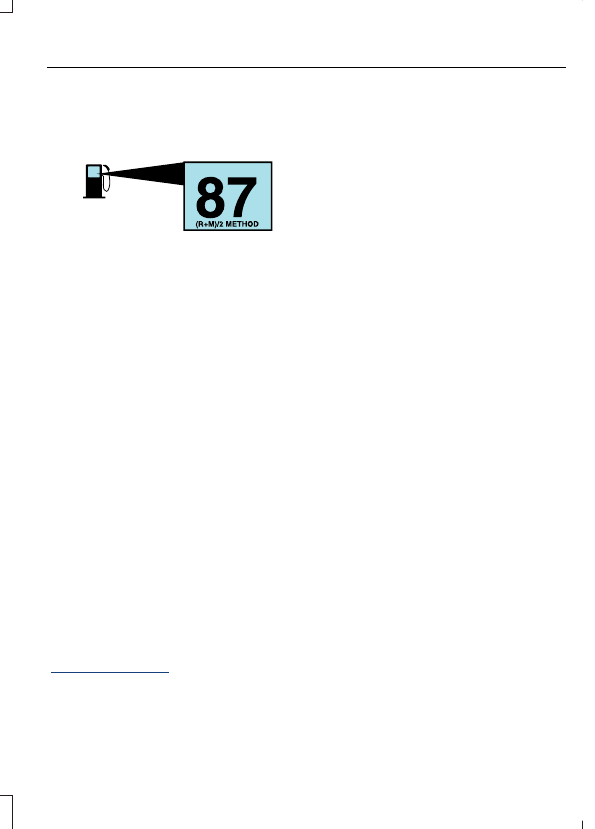
Your vehicle operates on regular unleaded
gasoline with a minimum pump (R+M)/2
octane rating of 87.

Some fuel stations, particularly those in
high altitude areas, offer fuels posted as
regular unleaded gasoline with an octane
rating below 87. The use of these fuels
could result in engine damage that will not
be covered by the vehicle Warranty.

For best overall vehicle and engine
performance, premium fuel with an octane
rating of 91 or higher is recommended. The
performance gained by using premium fuel
is most noticeable in hot weather as well
as other conditions, for example when
towing a trailer.  See 

Towing a Trailer

(page 403).

Do not be concerned if the engine
sometimes knocks lightly.  However, if the
engine knocks heavily while using fuel with
the recommended octane rating, contact
an authorized dealer to prevent any engine
damage.

We recommend Top Tier detergent
gasolines, where available to help minimize
engine deposits and maintain optimal
vehicle and engine performance.

For additional information, visit

www.toptiergas.com

.

Note:

Use of any fuel for which the vehicle

was not designed can impair the emission
control system, cause loss of vehicle
performance, and cause damage to the
engine which may not be covered by the
vehicle Warranty.

Do not use:

Diesel fuel.

Fuels containing kerosene or paraffin.

Fuel containing more than 15% ethanol
or E85 fuel.

Fuels containing methanol.

Fuels containing metallic-based
additives, including manganese-based
compounds.

Fuels containing the octane booster
additive, methylcyclopentadienyl
manganese tricarbonyl (MMT).

Leaded fuel, using leaded fuel is
prohibited by law.

The use of fuels with metallic compounds
such as methylcyclopentadienyl
manganese tricarbonyl, which is a
manganese-based fuel additive, will impair
engine performance and affect the
emission control system.

SWITCHING BETWEEN E85 AND

GASOLINE

We do not recommend repeatedly
alternating between E85 and gasoline. If
you switch from using E85 to gasoline, or
from gasoline to E85, add as much fuel as
possible, at least half a tank. Drive your
vehicle immediately for a minimum of 5 mi
(8 km) to allow it to adapt to the change
in ethanol concentration. If you use E85
exclusively, we recommend that you fill
the fuel tank with regular unleaded
gasoline at each scheduled oil change.

249

Fuel and Refueling

LOCATING THE FUEL FILLER
FUNNEL

Regular Cab

The fuel filler funnel is behind the
right-hand front seat.

Super Cab/Crew Cab

The fuel filler funnel is under the second
row right-hand rear seat.

RUNNING OUT OF FUEL

FILLING A PORTABLE FUEL
CONTAINER

WARNING: 

Flow of fuel through a

fuel pump nozzle can produce static
electricity. This can cause a fire if you are
filling an ungrounded fuel container.

Use the following guidelines to avoid
electrostatic charge build-up, which can
produce a spark, when filling an
ungrounded fuel container:

Only use an approved fuel container to
transfer fuel to your vehicle.  Place the
container on the ground when filling it.

Do not fill a fuel container when it is
inside your vehicle (including the cargo
area).

Keep the fuel pump nozzle in contact
with the fuel container when filling it.

Do not use a device that holds the fuel
pump nozzle lever in the fill position.

ADDING FUEL FROM A PORTABLE
FUEL CONTAINER

WARNING: 

Do not insert the nozzle

of a fuel container or an aftermarket
funnel into the fuel filler neck. This may
damage the fuel system filler neck or its
seal and cause fuel to run onto the
ground.

WARNING: 

Do not pry open the

fuel tank filler valve. This could damage
the fuel system. Failure to follow this
instruction could result in fire, personal
injury or death.

WARNING: 

Do not dispose of fuel

in the household refuse or the public
sewage system. Use an authorized waste
disposal facility.

When refueling the vehicle fuel tank from
a fuel container, use the fuel filler funnel
included with your vehicle.  See 

Locating

the Fuel Filler Funnel

 (page 250).

Note:

Do not use aftermarket funnels as

they may not work with the capless fuel
system and can damage it.

When refueling the vehicle fuel tank from
a fuel container, do the following:

1.

Fully open the fuel filler door.

250

Fuel and Refueling

E157452

2. Fully insert the fuel filler funnel into the

fuel filler inlet.

3. Add fuel to your vehicle from the fuel

container.

4. Remove the fuel filler funnel.

5. Fully close the fuel filler door.

6. Clean the fuel filler funnel and place it

back in your vehicle or correctly dispose
of it.

Note:

If your vehicle runs out of fuel add a

minimum of 1.3 gal (5 L) of fuel to restart
the engine.

Note:

You may need to switch the ignition

from off to on several times after refueling
to allow the fuel system to pump the fuel
from the tank to the engine. When
restarting, cranking time takes a few
seconds longer than normal.

Note:

Extra funnels can be purchased from

an authorized dealer if you choose to
dispose of the funnel.

REFUELING

REFUELING SYSTEM OVERVIEW

E267248

B

C

A

Fuel filler door.

A

Fuel filler inlet.

B

Fuel tank filler pipe.

C

REFUELING YOUR VEHICLE -
EXCLUDING: HYBRID ELECTRIC
VEHICLE (HEV)

WARNING: 

When refueling always

shut the engine off and never allow
sparks or open flames near the fuel tank
filler valve. Never smoke or use a cell
phone while refueling. Fuel vapor is
extremely hazardous under certain
conditions. Avoid inhaling excess fumes.

WARNING: 

Fuel vapor burns

violently and a fuel fire can cause severe
injuries.

WARNING: 

The fuel system may

be under pressure. If you hear a hissing
sound near the fuel filler inlet, do not
refuel until the sound stops. Otherwise,
fuel may spray out, which could cause
serious personal injury.

251

Fuel and Refueling

WARNING: 

Keep children away

from the fuel pump. Never let children
pump fuel.

WARNING: 

Do not pry open the

fuel tank filler valve. This could damage
the fuel system. Failure to follow this
instruction could result in fire, personal
injury or death.

WARNING: 

Stay outside your

vehicle and do not leave the fuel pump
unattended when refueling your vehicle.

WARNING: 

Do not remove the fuel

pump nozzle from its fully inserted
position when refueling.

WARNING: 

Stop refueling when

the fuel pump nozzle automatically
shuts off for the first time. Failure to
follow this will fill the expansion space
in the fuel tank and could lead to fuel
overflowing.

WARNING: 

Do not overfill the fuel

tank. The pressure in an overfilled tank
may cause leakage and lead to fuel spray
and fire.

WARNING: 

Wait at least five

seconds before removing the fuel pump
nozzle to allow any residual fuel to drain
into the fuel tank.

1.

Fully open the fuel filler door.

2. Select the correct fuel pump nozzle for

your vehicle.

E139202

3. Insert the fuel pump nozzle up to the

first notch.  Keep the fuel pump nozzle
resting on the fuel tank filler pipe.

E327438

4. Hold the fuel pump nozzle in position

A when refueling.  Holding the fuel
pump nozzle in position B can affect
the flow of fuel and shut off the fuel
pump nozzle before the fuel tank is full.

252

Fuel and Refueling

E358906

5. Operate the fuel pump nozzle within

the area shown.

E119081

6. When the pump shuts off, wait five

seconds, then raise the fuel pump
nozzle and slowly remove it.

7.

Fully close the fuel filler door.

Note:

 Do not attempt to start the engine

if you have filled the fuel tank with incorrect
fuel.  Incorrect fuel use could cause damage
not covered by the vehicle Warranty.  Have
your vehicle immediately checked.

REFUELING YOUR VEHICLE -
HYBRID ELECTRIC VEHICLE (HEV)

WARNING: 

When refueling always

shut the engine off and never allow
sparks or open flames near the fuel tank
filler valve. Never smoke or use a cell
phone while refueling. Fuel vapor is
extremely hazardous under certain
conditions. Avoid inhaling excess fumes.

WARNING: 

The fuel system may

be under pressure. If you hear a hissing
sound near the fuel filler inlet, do not
refuel until the sound stops. Otherwise,
fuel may spray out, which could cause
serious personal injury.

WARNING: 

Fuel vapor burns

violently and a fuel fire can cause severe
injuries.

WARNING: 

Keep children away

from the fuel pump. Never let children
pump fuel.

WARNING: 

Stay outside your

vehicle and do not leave the fuel pump
unattended when refueling your vehicle.

WARNING: 

Do not pry open the

fuel tank filler valve. This could damage
the fuel system. Failure to follow this
instruction could result in fire, personal
injury or death.

WARNING: 

Do not remove the fuel

pump nozzle from its fully inserted
position when refueling.

WARNING: 

Stop refueling when

the fuel pump nozzle automatically
shuts off for the first time. Failure to
follow this will fill the expansion space
in the fuel tank and could lead to fuel
overflowing.

WARNING: 

Do not overfill the fuel

tank. The pressure in an overfilled tank
may cause leakage and lead to fuel spray
and fire.

WARNING: 

Wait at least five

seconds before removing the fuel pump
nozzle to allow any residual fuel to drain
into the fuel tank.

253

Fuel and Refueling

1.

When you stop your vehicle, shift into
park (P) and switch the ignition off.

E293006

2. Press the button on the left side of the

instrument panel next to the headlamp
switch to open the fuel filler door. The
fuel filler door can take up to 15
seconds to open before you can insert
a fuel filler nozzle.

3. Select the correct fuel pump nozzle for

your vehicle.

E139202

4. Insert the fuel pump nozzle up to the

first notch.  Keep the fuel pump nozzle
resting on the fuel tank filler pipe.

E327438

5. Hold the fuel pump nozzle in position

A when refueling.  Holding the fuel
pump nozzle in position B can affect
the flow of fuel and shut off the fuel
pump nozzle before the fuel tank is full.

E358906

6. Operate the fuel pump nozzle within

the area shown.

E119081

7.

When the pump shuts off, wait 5
seconds, then raise the fuel pump
nozzle and slowly remove it.

8. Fully close the fuel filler door.

254

Fuel and Refueling

Note:

To close the fuel filler door, press the

center rear edge of the fuel filler door and
then release.

Complete the refueling process within 20
minutes. If 20 minutes elapses, press the
button on the left side of the instrument
panel again.  Fuel pump nozzle automatic
shut off could occur if you do not press the
button on the left side instrument panel.

Note:

 Do not attempt to start the engine

if you have filled the fuel tank with incorrect
fuel.  Incorrect fuel use could cause damage
not covered by the vehicle Warranty.  Have
your vehicle immediately checked.

MANUALLY OPENING THE FUEL
FILLER DOOR - EXCLUDING:
HYBRID ELECTRIC VEHICLE (HEV)

Your vehicle does not have a fuel tank filler
cap.

E206911

Left-hand side. To open the fuel
filler door, press the center rear
edge of the fuel filler door and
then release.

A

Right-hand side. To open the
fuel filler door, press the center
rear edge of the fuel filler door
and then release.

B

Left-hand side. Pull the rear of
the fuel filler door to open it.

C

Right-hand side. Pull the rear of
the fuel filler door to open it.

D

MANUALLY OPENING THE FUEL
FILLER DOOR - HYBRID ELECTRIC
VEHICLE (HEV)

Note:

The transmission must be in park (P)

or neutral (N).

To manually open the fuel door do the
following:

255

Fuel and Refueling

E333731

1.

Retrieve the emergency opening tool.

Note:

The emergency opening tool is with

the jack and tool bag. See 

Changing a Flat

Tire

 (page 543).

E333736

2. Insert the emergency opening tool in

the position shown and gently pry the
fuel door open.

Note:

Do not press the fuel filler door

release button if the emergency opening
tool has been used.

E333737

Using the emergency opening tool can
cause the tappet to temporarily dislodge
from the fuel filler door and remain
attached to the fuel filler door opening. If
you press the fuel filler door release button
after using the emergency opening tool,
locate the tappet and reinsert it into the
fuel door.

FUEL TANK CAPACITY -
EXCLUDING: HYBRID
ELECTRIC VEHICLE (HEV)

Advertised Capacity

The advertised capacity is the maximum
amount of fuel that you can add to the fuel
tank after running out of fuel. Included in
the advertised capacity is an empty
reserve. The empty reserve is an
unspecified amount of fuel that remains
in the fuel tank when the fuel gauge
indicates empty.

Note:

The amount of fuel in the empty

reserve varies and should not be relied upon
to increase driving range.

256

Fuel and Refueling

FUEL TANK CAPACITY -
HYBRID ELECTRIC VEHICLE
(HEV)

Advertised Capacity

The advertised capacity is the maximum
amount of fuel that you can add to the fuel
tank when the fuel gauge indicates empty.

In addition, the fuel tank contains an empty
reserve.  The empty reserve is an
unspecified amount of fuel that remains
in the fuel tank when the fuel gauge
indicates empty.

Note:

The amount of fuel in the empty

reserve varies and should not be relied upon
to increase driving range.

FUEL AND REFUELING –
TROUBLESHOOTING

FUEL AND REFUELING –
WARNING LAMPS

If it illuminates when you are
driving, refuel as soon as
possible.

FUEL AND REFUELING – INFORMATION MESSAGES

Action

Message

An early reminder of a low fuel condition.

Fuel Level Low

The fuel fill inlet may not be properly closed.

Check Fuel Fill Inlet

The information message appears while the fuel system is
depressurizing with the fuel filler door closed. Wait for the fuel
system to depressurize and for the fuel filler door to unlatch.

Please wait for fuel door

to open

The information message appears when the fuel system has
depressurized and opened the fuel filler door. Fully open the
fuel filler door to refuel and fully close the fuel filler door when
refueling is complete.

Fuel Door Open

Your vehicle is equipped with a sealed fuel system that
requires the fuel filler door to be fully closed after refueling.
This warning message appears when the fuel filler door is ajar.
Please fully close the fuel filler door to avoid a "Check Engine"
Light.

Fuel door ajar Close fully

to avoid ""Check

Engine"" light

If you see this message and a "Check Engine" lamp illumin-
ates, please fully close the fuel filler door. The "Check Engine"
Light should clear within five seconds. If the "Check Engine"
light persists, please see your dealer.

The information message appears when the fuel system fails
to depressurize, or the fuel filler door fails to open. You could
have to use the fuel filler door manual override lever when
opening the fuel door.

Refuel Error See Manual

257

Fuel and Refueling

WHAT IS THE CATALYTIC
CONVERTER

The catalytic converter is part of your
vehicle's emissions system and filters
harmful pollutants from the exhaust gas.

CATALYTIC CONVERTER
PRECAUTIONS

WARNING: 

Do not park, idle or

drive your vehicle on dry grass or other
dry ground cover. The emission system
heats up the engine compartment and
exhaust system, creating the risk of fire.

WARNING: 

The normal operating

temperature of the exhaust system is
very high. Never work around or attempt
to repair any part of the exhaust system
until it has cooled. Use special care when
working around the catalytic converter.
The catalytic converter heats up to a very
high temperature after only a short
period of engine operation and stays hot
after the engine is switched off.

WARNING: 

Exhaust leaks may

result in entry of harmful and potentially
lethal fumes into the passenger
compartment. If you smell exhaust
fumes inside your vehicle, have your
vehicle inspected immediately. Do not
drive if you smell exhaust fumes.

To avoid damaging the catalytic converter:

Do not crank the engine for more than
10 seconds at a time.

Do not run the engine with a spark plug
lead disconnected.

Do not push-start or tow-start your
vehicle. Use booster cables. See 

Jump

Starting the Vehicle

 (page 465).

Use the correct fuel. See 

Fuel and

Refueling

 (page 247).

Do not switch the ignition off when your
vehicle is moving.

Avoid running out of fuel.

Have the items listed in scheduled
maintenance information performed
according to the specified schedule.

Note:

Do not make any unauthorized

changes to your vehicle or engine. By law,
vehicle owners and anyone who
manufactures, repairs, or services a fleet of
vehicles are not permitted to intentionally
remove an emission control device or
prevent it from working.

CATALYTIC CONVERTER –
TROUBLESHOOTING

CATALYTIC CONVERTER –
WARNING LAMPS

Your vehicle has an on-board diagnostics
system that monitors the emission control
system. If any of the following warning
lamps illuminate, this may indicate that
the on-board diagnostics system has
detected an emission control system
malfunction.

Continuing to drive your vehicle may cause
reduced power or the engine to stop.
Failure to respond to a warning lamp may
cause damage that your vehicle Warranty
may not cover.  Have your vehicle checked
as soon as possible.

258

Catalytic Converter

WHAT IS THE HIGH VOLTAGE
BATTERY

The high voltage battery is a highly
sophisticated lithium ion battery system,
used to store electrified propulsion energy
to power the vehicle.

HIGH VOLTAGE BATTERY
PRECAUTIONS

WARNING: 

This battery pack

should only be serviced by an authorized
electric vehicle technician. Improper
handling can result in personal injury or
death.

WARNING: 

Apply the parking

brake, shift into park (P), switch the
ignition off and remove the key before
you open the hood or have any service
or repair work completed. If you do not
switch the ignition off, the engine could
restart at any time. Failure to follow this
instruction could result in personal injury
or death.

WARNING: 

Do not touch the

electronic ignition system parts after you
have switched the ignition on or when
the engine is running. The system
operates at high voltage. Failure to
adhere to this warning could result in
serious personal injury or death.

WARNING: 

Keep your hands and

clothing clear of the engine cooling fan.

259

High Voltage Battery - Hybrid Electric Vehicle (HEV)

AUTOMATIC TRANSMISSION
PRECAUTIONS

WARNING: 

Apply the parking

brake, shift into park (P), switch the
ignition off and remove the key before
you leave your vehicle. Failure to follow
this instruction could result in personal
injury or death.

WARNING: 

When your vehicle is

stationary, keep the brake pedal fully
pressed when shifting gears. Failure to
follow this instruction could result in
personal injury, death or property
damage.

WARNING: 

Do not apply the brake

pedal and accelerator pedal
simultaneously. Applying both pedals
simultaneously for more than a few
seconds will limit engine performance,
which may result in difficulty maintaining
speed in traffic and could lead to serious
injury.

AUTOMATIC TRANSMISSION
POSITIONS

PARK (P)

WARNING: 

Shift into park (P) only

when your vehicle is stationary.

In park (P) power is not transmitted to the
driven wheels.

Note:

A tone sounds if you attempt to exit

your vehicle without the transmission in park
(P).

Note:

Your vehicle may not shift out of park

(P) if the vehicle battery has run out of
charge.

Note:

Your vehicle may not shift out of park

(P) if a fuse is blown.  See 

Fuses

 (page 472).

Note:

Your vehicle may not shift out of park

(P) unless the key or remote control is inside
your vehicle.

Note:

Your vehicle could shift into park (P)

if you attempt to exit your vehicle without
the transmission in park (P).  See 

How Does

Automatic Return to Park (P) Work

 (page

265).

Note:

If you shift into park (P) without fully

pressing the brake, the parking brake could
apply. If you shift into park (P) on a slope,
the parking brake could apply. See

Automatically Releasing the Electric
Parking Brake

 (page 289).

Note:

A tone could sound when you select

park (P).

REVERSE (R)

WARNING: 

Shift into reverse (R)

only when your vehicle is stationary.

In reverse (R) power is transmitted to the
driven wheels.

NEUTRAL (N)

WARNING: 

In neutral (N) your

vehicle is free to roll.

In neutral (N) power is not transmitted to
the driven wheels.

DRIVE (D)

In drive (D) power is transmitted to the
driven wheels.

260

Automatic Transmission

MANUAL (M)

To select manual mode press the (M)
button on the shifter.

Note:

In order to activate manual mode

your vehicle must be in drive (D).

This position allows you to change gears
up or down as preferred using + or -
buttons on the shifter lever.

To return to the normal drive (D) position,
press the (M) button again to exit manual
mode.

SHIFTING YOUR VEHICLE INTO
GEAR

Console Shifter

The transmission selector is on the center
console.

E311503

1.

Press and hold the brake pedal.

2. Move the lever to select a position.

Note:

The position illuminates on the

transmission selector.

3. Press the manual (M) button when

your vehicle is in drive (D) to enter or
exit a mode.

Column Shifter

The transmission selector is on the steering
column.

E327267

1.

Press and hold the brake pedal.

2. Move the lever to select a position.

3. Press the manual (M) button when

your vehicle is in drive (D) to enter or
exit a mode.

SHIFTING YOUR VEHICLE INTO
GEAR - RAPTOR

The transmission selector is on the center
console.

E311503

1.

Press and hold the brake pedal.

2. Move the lever to select a position.

261

Automatic Transmission

Note:

The position illuminates on the

transmission selector.

3. Press the manual (M) button when

your vehicle is in drive (D) to enter or
exit a mode.

SHIFTING YOUR VEHICLE INTO
GEAR - POLICE RESPONDER

The transmission selector is on the steering
column.

E327267

1.

Press and hold the brake pedal.

2. Move the lever to select a position.

3. Press the manual (M) button when

your vehicle is in drive (D) to enter or
exit a mode.

MANUALLY SHIFTING GEARS

SHIFTING USING THE PADDLE
SHIFTERS - RAPTOR

The instrument cluster displays the current
gear. The current gear flashes when your
vehicle cannot shift into the requested
gear. Your vehicle will not shift if the
requested gear raises or lowers the engine
speed beyond the limit.

Your vehicle could shift when you fully
press the accelerator or brake pedal.

Note:

Prolonged driving with high engine

speed could cause vehicle damage not
covered by the vehicle warranty.

Note:

Drive modes could affect when the

vehicle shifts into the requested gear.

E144821

Manually Shifting Gears in Drive (D)

Use this feature to temporarily change
gears.

Note:

We recommend using this feature for

engine braking or driving on hilly or
mountainous roads.

Pull any paddle to switch the feature
on.

Pull the right (+) paddle to upshift.

Pull the left (-) paddle to downshift.

Hold the (+) paddle for a few seconds
to switch the feature off.

Note:

The feature switches off after a short

period of time if you do not pull either
paddle.

Manually Shifting Gears in Manual (M)

Use this feature to select a specific gear.

Note:

We recommend using this feature for

engine braking, driving on hilly or
mountainous roads, or when towing a trailer.
See 

Towing a Trailer

 (page 403).

Shift to manual (M) to switch the
feature on.

Pull the right (+) paddle to upshift.

262

Automatic Transmission

Pull the left (-) paddle to downshift.

Shift to drive (D) to switch the feature
off.

SHIFTING USING THE BUTTONS
ON THE SELECTOR LEVER

Center Console Shifter

The instrument cluster displays the current
gear. The current gear flashes when your
vehicle cannot shift into the requested
gear. Your vehicle will not shift if the
requested gear raises or lowers the engine
speed beyond the limit.

Your vehicle may shift when you fully press
the accelerator or brake pedal.

Note:

Prolonged driving with high engine

speed could cause vehicle damage not
covered by the vehicle warranty.

Note:

Drive modes could affect when the

vehicle shifts into the requested gear.

E311242

Manually Shifting Gears in Manual (M)

Use this feature to select a specific gear.

Note:

We recommend using this feature for

engine braking, driving on hilly or
mountainous roads, or when towing a trailer.
See 

Towing a Trailer

 (page 403).

Shift to manual (M) to switch the
feature on.

Press the upper (+) button to upshift.

Press the lower (-) button to
downshift.

Shift to drive (D) to switch the feature
off.

Column Shifter

The instrument cluster displays the current
gear. The current gear flashes when your
vehicle cannot shift into the requested
gear. Your vehicle will not shift if the
requested gear raises or lowers the engine
speed beyond the limit.

Your vehicle could shift when you fully
press the accelerator or brake pedal.

Note:

Prolonged driving with high engine

speed could cause vehicle damage not
covered by the vehicle warranty.

Note:

Drive modes could affect when the

vehicle shifts into the requested gear.

E327267

Manually Shifting Gears in Manual (M)

Use this feature to select a specific gear.

263

Automatic Transmission

Note:

We recommend using this feature for

engine braking, driving on hilly or
mountainous roads, or when towing a trailer.
See 

Towing a Trailer

 (page 403).

Shift to manual (M) to switch the
feature on.

Press the upper (+) button to upshift.

Press the lower (-) button to
downshift.

Shift to drive (D) to switch the feature
off.

SHIFTING USING THE BUTTONS
ON THE SELECTOR LEVER -
POLICE RESPONDER

The instrument cluster displays the current
gear. The current gear flashes when your
vehicle cannot shift into the requested
gear. Your vehicle will not shift if the
requested gear raises or lowers the engine
speed beyond the limit.

Your vehicle may shift when you fully press
the accelerator or brake pedal.

Note:

Prolonged driving with high engine

speed could cause vehicle damage not
covered by the vehicle warranty.

Note:

Drive modes could affect when the

vehicle shifts into the requested gear.

E327267

Manually Shifting Gears in Manual (M)

Use this feature to select a specific gear.

Note:

We recommend using this feature for

engine braking, driving on hilly or
mountainous roads, or when towing a trailer.
See 

Towing a Trailer

 (page 403).

Shift to manual (M) to switch the
feature on.

Press the upper (+) button to upshift.

Press the lower (-) button to
downshift.

Shift to drive (D) to switch the feature
off.

TEMPORARY NEUTRAL MODE

WHAT IS TEMPORARY NEUTRAL
MODE

This mode keeps your vehicle in neutral
(N), for a limited time, when you exit your
vehicle or switch your vehicle off.

Note:

Do not tow your vehicle in this mode.

TEMPORARY NEUTRAL MODE
LIMITATIONS

Your vehicle could shift to park (P) after
30 minutes, or when the vehicle battery
charge level is low. Prolonged use of this
mode can cause the vehicle battery to run
out of charge.

Do not tow your vehicle in this mode.
Failure to follow these instructions could
result in vehicle damage not covered by
the vehicle warranty.

ENTERING TEMPORARY
NEUTRAL MODE

1.

Power your vehicle on.

2. Bring your vehicle to a complete stop.

264

Automatic Transmission


Content      ..     13      14      15      16     ..