Ford F-450 (2022 year). Manual in english - page 20
 

  Index      Manuals     Ford F-450 (2022 year). Manual in english


Search            copyright infringement  


Content      ..     18      19      20      21     ..


Ford F-450 (2022 year). Manual in english - page 20


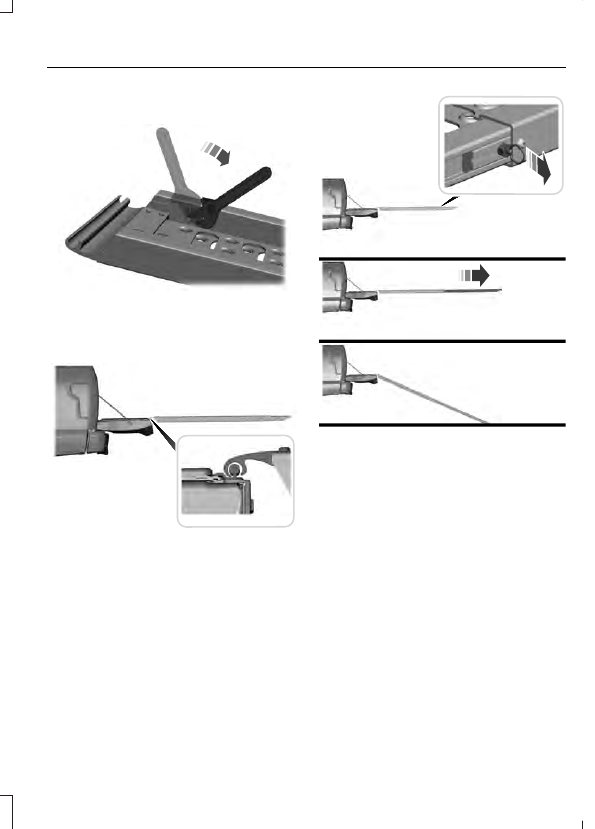
3. Remove the ramp from the ramp

holder.

E211150

4. Rotate the stops at the underside of

the ramp to the open position.

Note:

You can use a smooth surface tool

to rotate the stops.

E194382

5. Slide the ramp claw onto the tailgate

plate.

E194383

6. Pull the location pin outward and

extend the ramp until the pin is seated
in the usage position, then set the ramp
on even ground.

Removing the Ramp

Remove in the reverse order.

STORING THE PICKUP BED
RAMPS

Storing the Bed Ramp

1.

Pick up the ramp. Pull the location pin
outward.

2. Slide the ramp into the storage position

until the location pin locks.

Note:

Make sure the proper pin location has

been applied for your bed size.

321

Pickup Bed

3. Slide the ramp claw off of the tailgate

plate.

4. Rotate the stops at the underside of

the ramp to the closed position.

E194391

5. Place the ramp into the ramp holder.

6. Install the cam bolts and close the cam

lever arms.

7.

Attach the front and rear cables.

Note:

Make sure you properly secure the

locking cable. If the locking cable is
unsecured, you may hear a rattling noise.

322

Pickup Bed

CONNECTING A TRAILER
PRECAUTIONS

WARNING: 

Do not adjust the spring

bars so that your vehicle's rear bumper
is higher than before attaching the trailer.
Doing so will defeat the function of the
weight-distributing hitch, which may
cause unpredictable handling, and could
result in serious personal injury.

Do not tow a trailer until you drive your
vehicle at least 1,000 mi (1,600 km).

Consult your local motor vehicle laws for
towing a trailer.

See the instructions included with towing
accessories for the proper installation and
adjustment specifications.

Service your vehicle more frequently if you
tow a trailer.  See 

Normal Scheduled

Maintenance

 (page 625).

If you use a rental trailer, follow the
instructions the rental agency gives you.

When attaching the trailer wiring connector
to your vehicle, only use a proper fitting
connector that works with the vehicle and
trailer functions.

Account for the trailer coupler weight as
part of your vehicle load when calculating
the total vehicle weight.

Do not exceed the load limits.  See

Calculating the Load Limit

 (page 314).

HITCHES

INSTALLING A HITCH

WARNING: 

You must use the

heavy-duty drawbar pin supplied with
your vehicle when using the heavy-duty
hitch. Failure to follow this instruction
could result in the loss of control of your
vehicle, personal injury or death.

Do not use a hitch that either clamps onto
the bumper or attaches to the axle. You
must distribute the load in your trailer so
that 10-15% for conventional towing or
15-25% for fifth wheel towing of the total
weight of the trailer is on the tongue. Do
not exceed the tongue load rating
indicated on the conventional hitch
receiver.

Note:

On pick-up trucks, the trailer hitch

provided on this vehicle enhances crash
protection for the fuel system. Do not
remove!

Hitch Components

The following components are required.
Some are provided in certain vehicles.

A trailer hitch with a 3 inch receiver and
a 5/8 inch hitch pin. Check the
stamped rating number on the pin to
determine the 21,200 lb (9,616 kg) or
24,200 lb (10,976 kg) hitch pin
capacity.

A hitch pin sleeve stored in the glove
box to use when mounting the 3 inch
drawbar with the 3/4 inch pin hole.

A cotter pin to help keep the hitch pin
in place.

323

Connecting a Trailer

Installing a 3 Inch Drawbar with
3/4 Inch Pin Hole

E247903

The pin sleeve should be inserted in the
3/4 inch pin hole of the 3 inch drawbar.

E247902

Remove reducers before inserting the 3
inch drawbar. Insert the drawbar into hitch
receiver.

E247909

Put the 5/8 inch hitch pin through pin hole.
Place the cotter pin around the neck of
hitch pin.

HOOKING UP A TRAILER USING A
WEIGHT-DISTRIBUTING HITCH

WARNING: 

Do not adjust the spring

bars so that your vehicle's rear bumper
is higher than before attaching the trailer.
Doing so will defeat the function of the
weight-distributing hitch, which may
cause unpredictable handling, and could
result in serious personal injury.

A weight-distributing hitch helps distribute
tongue load to all towing vehicle and trailer
wheels. For more information, visit the links
in the following table.

324

Connecting a Trailer

Website

Market

https://

www.fleet.ford.com/

towing-guides/

United States of

America

https://

www.fleet.ford.ca/

towing-guides/

Canada

FIFTH-WHEEL TRAILER HITCH

Your vehicle has a fifth-wheel prep
package. This package enables your
vehicle to accept certain fifth-wheel trailer
hitches and gooseneck ball hitches. The
fifth-wheel trailer hitch attaches to the four
mounting pads in the pick-up bed. A 7-pin
trailer wiring connector could be in the bed
as well. The gooseneck ball hitch is a
separate mounting pad from the
fifth-wheel hitch in the center of the bed.

Shorter pick-up boxes provide less
clearance between the cab and the
fifth-wheel and gooseneck trailer
compared to longer box pick-ups. When
selecting a trailer and tow vehicle, it is
critical to check that this combination
provides clearance between the front of
the trailer and tow vehicle for turns up to
90°. Failure to follow this recommendation
could result in the trailer contacting the
cab of the tow vehicle during tight turns
that are typical during low-speed parking
and turning maneuvers. This contact could
result in damage to the trailer and tow
vehicle.

Note:

Contact an authorized dealer to

purchase gooseneck and fifth-wheel hitches
that are compatible with your vehicle.

Note:

The mounting pads in the bed are

specifically designed for certain fifth-wheel
trailer hitches and gooseneck ball hitches.
Do not use these mounting pads for other
purposes.

CONNECTING A TRAILER

Recognizing a Trailer

1.

Attach the trailer and wiring connector
to your vehicle.

2. Switch on your vehicle.

3. Set up a profile for the trailer using the

instrument cluster display.

Note:

If your vehicle does not recognize the

trailer, press and hold the brake pedal for a
few seconds.

Note:

Trailer profiles store trailer types,

dimensions, preferences, trailer specific
mileage and fuel economy.

Note:

Disabling the trailer detection

notification makes the default trailer profile
active when a connection is detected.

E163167

When attaching the trailer wiring connector
to your vehicle, only use a proper fitting
connector that works with the vehicle and
trailer functions.

325

Connecting a Trailer

Trailer Light Check

WARNING: 

Never connect any

trailer lamp wiring to the vehicle's tail
lamp wiring; this may damage the
electrical system resulting in fire. Contact
your authorized dealer as soon as
possible for assistance in proper trailer
tow wiring installation. Additional
electrical equipment may be required.

Most towed vehicles require trailer lamps.
Make sure all running lights, brake lights,
turn signals and hazard lights are working.

Safety Chains

Install trailer safety chains to the trailer
hitch as recommended by the
manufacturer. Cross the chains under the
trailer coupler and allow enough slack for
turning tight corners. Do not allow the
chains to drag on the ground.

Note:

Do not attach safety chains to the

bumper. Always connect the safety chains
to the frame or hook retainers of your trailer
hitch.

E265060

If the trailer safety chain hook has a latch,
make sure to fully close the latch.

326

Connecting a Trailer

CONNECTING A TRAILER – TROUBLESHOOTING

CONNECTING A TRAILER – INFORMATION MESSAGES

Description

Message

The system senses a trailer connection

becomes disconnected, either intentionally

or unintentionally, during a given ignition

cycle.

Trailer Disconnected

There are certain faults in your vehicle

wiring and trailer wiring or brake system.

Trailer Wiring Fault

There is a fault with your trailer battery, or

your trailer battery voltage is very low.

Trailer Battery Not Charging See Manual

One or more tires on your trailer is below

the specified tire pressure.

Trailer Tire Low Specified:

Displays when one or more tires on the

trailer is above the recommended temper-

ature.

Trailer Tire Over Temperature

A trailer tire pressure sensor is malfunc-

tioning. If the warning stays on or continues

to come on, have the system checked as

soon as possible.

Trailer Tire Pressure Sensor Fault

The trailer tire pressure monitoring system

is malfunctioning. If the warning stays on

or continues to come on, have the system

checked.

Trailer Tire Pressure Monitor Fault

The system cannot detect the trailer tire

pressure monitoring system.

Trailer Tire Pressure Monitor Capability Not

Detected

The trailer tire pressure monitoring system

is not setup.

Trailer Tire Pressure Indication Not Setup

See Manual

327

Connecting a Trailer

TOWING A TRAILER
PRECAUTIONS

WARNING: 

Do not exceed

the GVWR or the GAWR
specified on the certification
label.

WARNING: 

Towing trailers

beyond the maximum
recommended gross trailer
weight exceeds the limit of your
vehicle and could result in engine
damage, transmission damage,
structural damage, loss of
vehicle control, vehicle rollover
and personal injury.

WARNING: 

Do not exceed

the lowest rating capacity for
your vehicle or trailer hitch.
Overloading your vehicle or
trailer hitch can impair your
vehicle stability and handling.
Failure to follow this instruction
could result in the loss of control
of your vehicle, personal injury or
death.

WARNING: 

Make sure that

the vertical load on the tow ball
is between the minimum and
maximum recommended weight
at all times. Failure to follow this
instruction could result in the
loss of control of your vehicle,
personal injury or death.

WARNING: 

Do not cut,

drill, weld or modify the trailer
hitch. Modifying the trailer hitch
could reduce the hitch rating.

WARNING: 

The anti-lock

brake system does not control
the trailer brakes.

TRAILER BRAKE
PRECAUTIONS

WARNING: 

Do not connect a

trailer's hydraulic brake system directly
to your vehicle's brake system. Your
vehicle may not have enough braking
power and your chances of having a
collision greatly increase.

WARNING: 

Do not tow a trailer

fitted with electric trailer brakes unless
your vehicle is fitted with a compatible
aftermarket electronic trailer brake
controller. Failure to follow this
instruction could result in the loss of
control of your vehicle, personal injury or
death. For additional information and
assistance, we recommend that you
contact an authorized dealer.

Electric brakes and manual, automatic or
surge-type trailer brakes are safe if you
install them properly and adjust them to
the manufacturer's specifications. The
trailer brakes must meet local and federal
regulations.

The rating for the tow vehicle's braking
system operation is at the gross vehicle
weight rating, not the gross combined
weight rating.

328

Towing a Trailer

Certain states require functioning trailer
brakes for trailers over a specified weight.
Be sure to check state regulations for this
specified weight.

Ford Motor Company recommends
separate functioning brake systems for
trailers weighing more than 1,500 lb
(680 kg) when loaded.

TOWING A TRAILER
LIMITATIONS

The vehicle's load capacity
designation is by weight, not by
volume, so you cannot necessarily
use all available space when
loading a vehicle or trailer.

Note:

Your vehicle could have

reduced performance when
operating at high altitudes and
when heavily loaded or towing a
trailer. When driving at elevation,
to match driving performance as
perceived at sea level, reduce gross
vehicle weight and gross
combination weight by 2% per
1,000 ft (300 m) elevation.

LOADING YOUR TRAILER

To help minimize how trailer
movement affects your vehicle
when driving:

Load the heaviest items closest
to the trailer floor.

Load the heaviest items
centered between the
left-hand and right-hand side
trailer tires.

Load the heaviest items above
the trailer axles or just slightly
forward toward the trailer
tongue. Do not allow the final
trailer tongue weight to go
above or below 10-15% of the
loaded trailer weight. The
trailer tongue weight should
never exceed 10% of the
maximum towing capacity
when towing a conventional
trailer, and should never
exceed 15% of the maximum
towing capacity when towing
a fifth-wheel or gooseneck
trailer.

Select a ball mount with the
correct rise or drop. When you
connect both the loaded
vehicle and trailer, the trailer
frame should be level, or

slightly angled down toward
your vehicle, when viewed from
the side.

TRAILER TOWING HINTS

Towing a trailer places an extra load on
your vehicle's engine, transmission, axle,
brakes, tires and suspension. Periodically
inspect these components during and after
any towing operation.

When driving with a trailer or payload, a
slight takeoff vibration or shudder may be
present due to the increased payload
weight.

329

Towing a Trailer

Your vehicle may have a temporary or
conventional spare tire. A temporary spare
tire is different in diameter or width,
tread-type, or is from a different
manufacturer than the road tires on your
vehicle. Consult information on the tire
label or Safety Compliance label for
limitations when using.

When towing a trailer:

Obey country specific regulations for
towing a trailer.

Do not drive faster than 70 mph
(113 km/h) during the first 500 mi
(800 km).

Do not make full-throttle starts.

Check your hitch, electrical connections
and trailer wheel lug nuts thoroughly
after you have traveled 50 mi (80 km).

When stopped in congested or heavy
traffic during hot weather, place the
transmission in park (P) to aid engine
and transmission cooling and to help
A/C performance.

Turn off the speed control with heavy
loads or in hilly terrain. The speed
control may turn off when you are
towing on long, steep slopes.

Shift to a lower gear when driving down
a long or steep hill. Do not continuously
apply the brakes, as they may overheat
and become less effective.

If your transmission has Grade Assist
or Tow/Haul, use this feature when
towing. This provides engine braking
and helps eliminate excessive
transmission shifting for optimum fuel
economy and transmission cooling.

If your vehicle has AdvanceTrac with
roll stability control, this system may
turn on during typical cornering
maneuvers with a heavily loaded trailer.
This is normal. Turning the corner at a
slower speed when towing may reduce
this tendency.

Allow more distance for stopping with
a trailer attached. Anticipate stops and
gradually brake.

Avoid parking on a slope. However, if
you must park on a slope, turn the
steering wheel to point your vehicle
tires away from traffic flow, set the
parking brake, place the transmission
in park (P) and place wheel chocks in
front and back of the trailer wheels.

Note:

Chocks are not included with your

vehicle.

LAUNCHING OR RETRIEVING
A BOAT OR PERSONAL
WATERCRAFT

When backing down a ramp during boat
launching or retrieval:

Do not allow the static water level to
rise above the bottom edge of the rear
bumper.

Do not allow waves to break higher
than 6 in (15 cm) above the bottom
edge of the rear bumper.

Exceeding 6 in (15 cm) could allow water
to enter vehicle components, causing
internal damage to the components and
affecting driveability, emissions and
reliability.

Note:

Replace the rear axle lubricant

anytime the rear axle has been submerged
in water.

Note:

Disconnect the trailer wiring

connector before backing the trailer into the
water.

Note:

Reconnect the trailer wiring

connector after removing the trailer from
the water.

330

Towing a Trailer

TOWING WEIGHTS AND DIMENSIONS

RECOMMENDED TOWING WEIGHTS

Website

Market

https://www.fleet.ford.com/

towing-guides/

United States of America

https://www.fleet.ford.ca/towing-

guides/

Canada

331

Towing a Trailer

WHAT IS THE MAXIMUM LOADED
TRAILER WEIGHT

The maximum loaded trailer
weight is the highest possible
weight of a fully loaded trailer the
vehicle can tow.

CALCULATING THE MAXIMUM
LOADED TRAILER WEIGHT FOR
YOUR VEHICLE

1. Start with the gross combined

weight rating for your vehicle
model and axle ratio.

2. Subtract all of the following

that apply to your vehicle:

Vehicle curb weight.

Hitch hardware weight, for
example a draw bar, ball, locks
or weight distributing hardware.

Driver weight.

Passenger weight.

Payload, cargo and luggage
weight.

Aftermarket equipment weight.

This equals the maximum loaded
trailer weight for this combination.

Note:

The trailer tongue load is

considered part of the payload for
your vehicle. Reduce the total
payload by the final trailer tongue
weight.

Note:

Consult an authorized dealer

to determine the maximum trailer
weight allowed for your vehicle if
you are not sure.

332

Towing a Trailer

TOWING A TRAILER – TROUBLESHOOTING

TOWING A TRAILER – INFORMATION MESSAGES

Details

Message

The left-hand trailer turn lamp requires

service.

Trailer Left Turn Lamps Fault Check Lamps

The right-hand trailer turn lamp requires

service.

Trailer Right Turn Lamps Fault Check

Lamps

The trailer battery voltage is too low to

charge. If there is no trailer attached, the

vehicle battery voltage is low.

Trailer Battery Not Charging See Manual

The system detects a short created by the

trailer lamps. Inspect and repair the trailer

wiring, or have the system checked as soon

as possible.

Trailer Lighting Module Fault See Manual

The trailer stoplamps require service.

Trailer Stop Lamps Fault Check Lamps

The trailer sway control detects trailer

sway. Reduce the vehicle's speed.

Trailer Sway Reduce Speed

Displays when one or more tires on the

trailer is above the recommended temper-

ature.

Trailer Tire Over Temperature

One or more tires on your trailer is below

the specified tire pressure.

Trailer Tire Low Specified:

A trailer tire pressure sensor requires

service. If the warning stays on or continues

to come on, have the system checked as

soon as possible.

Trailer Tire Pressure Sensor Fault

The trailer tire pressure monitoring system

requires service. If the warning stays on or

continues to come on, have the system

checked as soon as possible.

Trailer Tire Pressure Monitor Fault

The system cannot detect the trailer tire

pressure monitoring system.

Trailer Tire Pressure Monitor Capability Not

Detected

The trailer tire pressure monitoring system

is not setup.

Trailer Tire Pressure Indication Not Setup

See Manual

333

Towing a Trailer

WHAT IS THE INTEGRATED
TRAILER BRAKE CONTROLLER

The trailer brake controller assists in
smooth and effective trailer braking based
on the towing vehicle’s brake pressure.

INTEGRATED TRAILER BRAKE
CONTROLLER PRECAUTIONS

WARNING: 

Use the integrated

trailer brake controller to properly adjust
the trailer brakes and check all
connections before towing a trailer.
Failure to follow this instruction could
result in the loss of control of your
vehicle, personal injury or death.

Only use the manual control lever for
proper adjustment of the gain during
trailer setup. Misuse, such as
application during trailer sway, could
cause instability of trailer or tow
vehicle.

Avoid towing in adverse weather
conditions. The trailer brake controller
does not provide anti-lock control of
the trailer wheels. Trailer wheels can
lock up on slippery surfaces, resulting
in reduced stability of trailer and tow
vehicle.

The trailer brake controller is only a
factory-installed or dealer-installed
item. Ford is not responsible for
warranty or performance of the
controller due to misuse or customer
installation.

Note:

Do not attempt removal of the trailer

brake controller without consulting the
Workshop Manual. Damage to the unit may
result.

USING THE INTEGRATED
TRAILER BRAKE CONTROLLER

1.

Make sure the trailer brakes are in good
working condition, functioning normally
and properly adjusted. See your trailer
dealer if necessary.

Note:

An authorized dealer can diagnose

the trailer brake controller to determine
exactly which trailer fault has occurred. Your
vehicle warranty does not cover issues with
your trailer.

2. Hook up the trailer and make the

electrical connections according to the
trailer manufacturer's instructions.

Note:

Select default mode if the trailer has

surge brakes, or no brakes at all. The system
has no effect on the braking performance
of the trailer in either of these cases.

Note:

If a trailer is connected by a four-pin

connector, the trailer braking function will
not be supported.

3. When you plug in a trailer with electric

or electric-over-hydraulic brakes, a
message confirming connection
appears in the information display.

4. Use the gain adjustment to find the

desired starting point. A gain setting of
6.0 is a good starting point for heavier
loads.

Note:

Use the following steps to adjust the

gain setting whenever road, weather and
trailer, or vehicle loading conditions, change
from when you initially set the gain.

5. In a traffic-free environment, tow the

trailer on a dry, level surface and
squeeze the manual control lever
completely.

334

Integrated Trailer Brake Controller

 (If Equipped)

6. If the trailer wheels lock up, indicated

by squealing tires, reduce the gain
setting. If the trailer wheels turn freely,
increase the gain setting. Repeat Steps
5 and 6 until the gain setting is at a
point just below trailer wheel lock-up.
If towing a heavier trailer, trailer wheel
lock-up may not be attainable even
with the maximum gain setting of 10.

Note:

Only perform this procedure at

speeds of approximately 20–25 mph
(30–40 km/h).

Note:

The trailer brake controller reduces

output at vehicle speeds below 11 mph
(18 km/h) so that trailer and vehicle braking
is not jerky or harsh. This feature is only
available when applying the brakes using
your vehicle's brake pedal, not the
controller.

Note:

Your vehicle's brake system and the

trailer brake system work independently of
each other. Changing the gain setting on the
controller does not affect the operation of
your vehicle's brakes whether you attach a
trailer or not.

Note:

With the proper electrical connection,

pressing your vehicle brake pedal or using
the manual control lever illuminates both
trailer and vehicle brake lamps.

Note:

When you switch the engine off, the

controller output is disabled and the display
and module shut down. The controller
module and display turn on when you switch
the ignition on.

Adjusting the Trailer Brake Gain

E333154

Increase or decrease the amount
of gain in set increments.

A

Slide the control to engage the
trailer brakes.

B

Note:

Adjust gain setting before using the

trailer brake controller for the first time.

Note:

The gain should be set to provide the

maximum trailer braking assistance while
making sure the trailer wheels do not lock
when using the brakes. Locked trailer wheels
may lead to trailer instability.

Note:

Setting adjustments are saved when

a trailer profile is selected.

ADJUSTING THE INTEGRATED
TRAILER BRAKE CONTROLLER
MODE

Select the correct integrated trailer brake
controller mode option using the
instrument cluster display.

Note:

Trailer brake gain settings are saved

to the active trailer profile.

335

Integrated Trailer Brake Controller

 (If Equipped)

Selecting the Trailer Brake Type

Use the instrument cluster display controls
on the steering wheel to select the correct
setting for your trailer.

Note:

Select 

Default

Electric/Surge/None

 if the trailer has

electric, surge or no brakes.

Selecting the Trailer Brake Effort

Select the correct setting for your trailer.

Note:

Select a different setting if your

trailer's brakes require more initial voltage,
or you prefer more aggressive trailer braking.

INTEGRATED TRAILER BRAKE CONTROLLER –
TROUBLESHOOTING

INTEGRATED TRAILER BRAKE CONTROLLER – INFORMATION
MESSAGES

Action

Message

The system detects a correct trailer

connection during a given ignition cycle.

Trailer Connected

The system detects the trailer wiring

connection is disconnected, during a given

ignition cycle.

Trailer Disconnected

The system detects an electrical fault in

the trailer brake circuit. If this message

appears without a trailer attached, see your

authorized dealer. If a trailer is attached,

inspect and repair the trailer wiring.

Trailer Wiring Fault

Displays the current gain setting for the

trailer brake.

Trailer Brake Gain: {trailer gain value:#0.0}

Displays the current gain setting for the

trailer brake when you do not have a trailer

connected.

Trailer Brake Gain: {trailer gain value:#0.0}

No Trailer

336

Integrated Trailer Brake Controller

 (If Equipped)


Content      ..     18      19      20      21     ..