Ford Galaxy / Ford S-MAX. Manual - part 865
 

  Index      Ford     Ford Galaxy / Ford S-MAX - service repair manual 2006 year


Search            


Content   ..  863  864  865  866   ..


Ford Galaxy / Ford S-MAX. Manual - part 865


Fuel pump module (FPDM) 

Heated windscreen 

Heated rear window, heated exterior mirrors 

Window washer pump 

Headlamp washer pump 

Electric booster heater 

Instrument cluster 

Remote control receiver module 

Yaw rate sensor 

Parking brake (electriic/mechanical) 

Clutch travel sensor 

Ignition lock 

Stoplamp switch 

Fuel level sensor 

Accelerator pedal position (APP) sensor 

Backup lamp switch 

Multifunction switch 

PATS transceiver 

Speed control switch 

Windscreen heater switch 

Rear window heater switch 

Evaporator temperature sensor 

Hazard flasher switch 

Brake fluid level switch 

Light switch module 

Light/rain sensor 

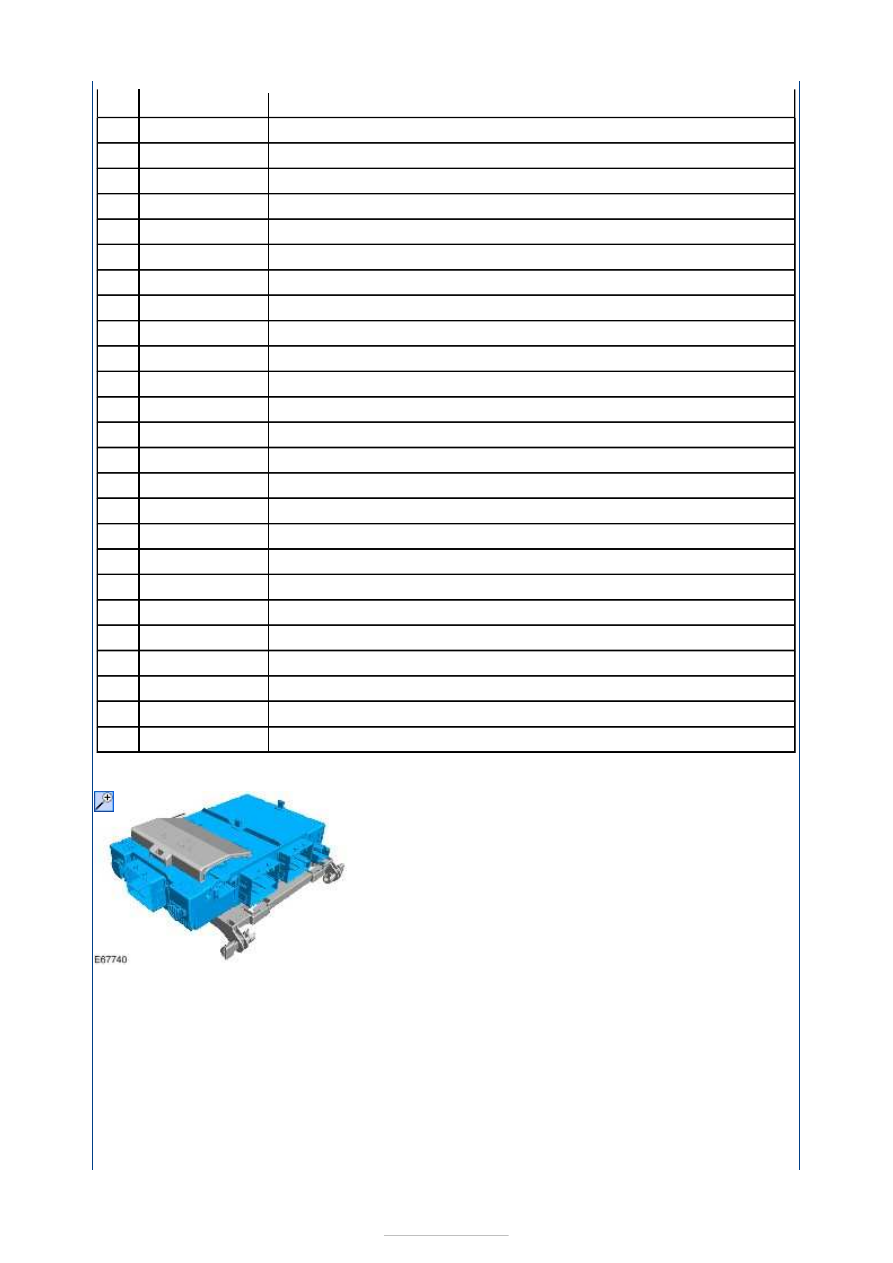
Generic electronics module (GEM) 

The generic electronic module is installed on the passenger's side underneath the dash 
panel. 

It replaces separate components such as the central locking module, the timer relay and the 
fuse box in the passenger compartment. 

It consists of a power distribution section (including fuses and relays) and an electronic 
control module, which controls the operation of most of the electronic convenience systems. 

New vehicles are supplied with different versions of the GEM (depending on the equipment 
specification of the vehicle). Only one version is available for service repair work. When 

7

8

9

10

11

12

13

14

15

16

17

18

19

20

21

22

23

24

25

26

27

28

29

30

31

32

-

-

-

-

-

-

-

-

-

-

-

-

-

-

-

-

-

-

-

-

-

-

-

-

-

-


installing a replacement GEM it needs to be configured for the specific vehicle. 

The following functions are controlled or executed by the GEM if the battery voltage is 
between 9 and 16 V. 

Battery saving function  
Current distribution  
Exterior lighting (except the adaptive front lighting function on vehicles with dynamic 
cornering lights)  
Interior lighting  
Wiper system  
Washer fluid level indicator  
Window heating (heated windshield, heated rear window, heated exterior mirrors)  
Speed control system (reads the speed control switches and transmits signals on the CAN 
bus)  
Locking / Unlocking  
Anti-theft  
Air conditioning controls (partial)  
Handbrake (it monitors the switch and transmits the signal on the CAN bus)  
Monitoring of the brake fluid level.  
Fuel pump (vehicles with 2.0L engine)  
Fuel level indicator  
Battery charging (smart charge, partially)  
Electric booster heater  
Detection of the accelerator pedal position (APP) sensor  
Detection of the clutch pedal switch  
Detection of the clutch pedal position (CPP sensor)  
Brake pedal position (BPP) switch.  
Tire Pressure Monitoring System  
Communications via the mid-speed CAN bus  
Main module in the LIN bus system  
PATS (interface for transceiver)  
Clock control 

The GEM can be diagnosed via the WDS. Furthermore, an integrated service mode enables 
testing of the input and output signals without the need for further tools.  
For additional information, refer to: 

Generic Electronic Module (GEM)

 (419-10 Multifunction 

Electronic Modules, Diagnosis and Testing). 

Emergency function 

The GEM is equipped with restricted emergency running functions on vehicles with medium 
or high levels of equipment. 

A monitoring function within the GEM is sent a control signal at regular intervals by the 
microcontroller. If for example the battery voltage drops below a voltage of approx. 7.5 
Volt then the control signal is not sent and the GEM goes into emergency running mode 
after a specified time. 

In this case the dipped beam headlamps and the side lights are switched on permanently 
depending on the position of the light switch. 

In the event of a communication fault between the wiper switch and the GEM the wiper 
system performs continuous wiping at normal wipe speed regardless of the wiper switch 
position. The emergency running mode is switched off when the ignition switch is turned to 
"0". 

In the event of a communication fault between the GEM and the wiper motors the wiper 
system runs through the following emergency running sequence regardless of the wiper 
switch position: 

Continuous wipe at speed setting 2 for 5 minutes  

Continuous wipe at speed setting 1 for 5 minutes  
Intermittent operation for 5 minutes 

At the end of this 15-minute sequence the emergency running mode automatically switches 
off. It cannot be started up again until the fault has been rectified. Emergency running 
mode cannot be interrupted by switching off the ignition. 

When the control signal is present again the GEM resumes normal functions. 

Light switch 

The light switch has been modified and now includes electronic controls. It is connected to 
the GEM via the control module subnetwork (LIN) bus. 

If the ignition lock is in position "0" for more than 30 minutes then the front fog lamps, rear 
fog lamp and the main beam headlamps are deactivated if they were previously activated. 

Combined rain sensor/light sensor 


Description 

Lens 

Front light sensor 

Ambient light sensor 

The combined rain sensor/light sensor is attached to the windshield, near the interior rear 
view mirror. 

The ambient light sensor determines the general light intensity. 

For this purpose, it detects the light over as wide an angle as possible, without taking the 
direction of incidence into account. 

The front light sensor determines the light intensity directly in front of the vehicle. 

Automatic headlamps 

The low beams, side lamps, license plate lamps as well as the instrument cluster and 
instrument panel illumination are switched on automatically if all the following 
conditions are met: 

Ignition switch in the "II" or "III" position  
Light switch in the "AUTO" position  
Detected ambient light conditions below a stored threshold value 

They are switched on or off by the GEM depending on the input signals of the combined rain 
sensor/light sensor. 

If both the ambient light sensor and the front light sensor simultaneously detect a sudden 
reduction in light intensity then algorithm-based calculations are performed to determine 
that the vehicle has entered a tunnel, multi-storey car park or a long underpass. 

In this type of case a request to switch on the exterior lights and the display lamps in the 

Item

1

2

3


Part Number

-

-

-

instrument cluster is transmitted to the GEM. 

If the vehicle is suddenly thrown into the shade by a large truck, the two sensors will 
register different light intensities. In this case, the algorithm-based calculation will not 
result in the lights being switched on. 

If the vehicle returns to brighter surroundings then the GEM gradually switches off the 
dipped beam headlamps, side lights, license plate lamps and the instrument cluster and 
dashboard lighting. Following a request from the light sensor, the GEM first switches off the 
dipped beam headlamps. After waiting approx. 6 seconds, it then switches off the side 
lights, the license plate lamps and the instrument cluster and dashboard lighting. 

Headlamp switch-off delay 

In vehicles with mid to high-end equipment, the headlamp switch-off delay uses the low 
beams and the peripheral lights (if equipped) for illuminating the vehicle surroundings. The 
function is activated by operating the high beam lever when the ignition switch is in the "0" 
position. 

After the last door has been closed, the function remains active for a further 30 seconds 
and then switches off automatically. 

When a door or the tailgate is open, the switch-off time is extended to 180 seconds. After 
the last door has been closed, the switch-off time is reset to 30 seconds. 

The headlamp switch-off delay can be deactivated prematurely by operating the high beam 
lever again or by switching on the ignition. 

The switch-off time is adjusted to set values at the factory and cannot be re-programmed 
using WDS. 

Interior lighting 

Depending on the vehicle specification, the interior lighting which is controlled by the 
GEM may include: 

Left and right-hand footwell lamps  
Front and rear dome lamps (in "door contact" switch position) 

Depending upon vehicle specification, the interior lamps which can be switched by the 
operator include: 

Front and rear dome lamps (in "On" switch position)  
Map lights  
Mirror lights in sun visors  
Glove compartment lamp  
Luggage compartment lamp 

The GEM-controlled interior lighting is switched on with dimmed brightness if one of 
the following conditions is satisfied: 

One of the vehicle's doors is opened.  
The ignition key is in the "0" or "I" position and the vehicle is unlocked.  
The ignition key is turned from the "II" to the "I" or "0" position. 

The GEM-controlled interior lighting is switched off if all of the doors are closed and 
one of the following conditions is satisfied: 

25 seconds have elapsed since the last door was closed.  
The ignition key is turned from the "0" or "I" to the "II" position.  
The ignition key is in the "0" or "I" position while the vehicle is locked. 

The duration of the dimmer function is 1.7 seconds in both the switch-on and switch-off 


Content   ..  863  864  865  866   ..