Ford Fiesta (2011 year). Manual - part 174
When sanding, produce smooth transitions from
the painted area to the bare metal.
Use an eccentric sander and P80 or P120 abrasive
sheets. Finish off sanding with P150 or P180. The
remaining adhering sanding dust must be
completely removed.
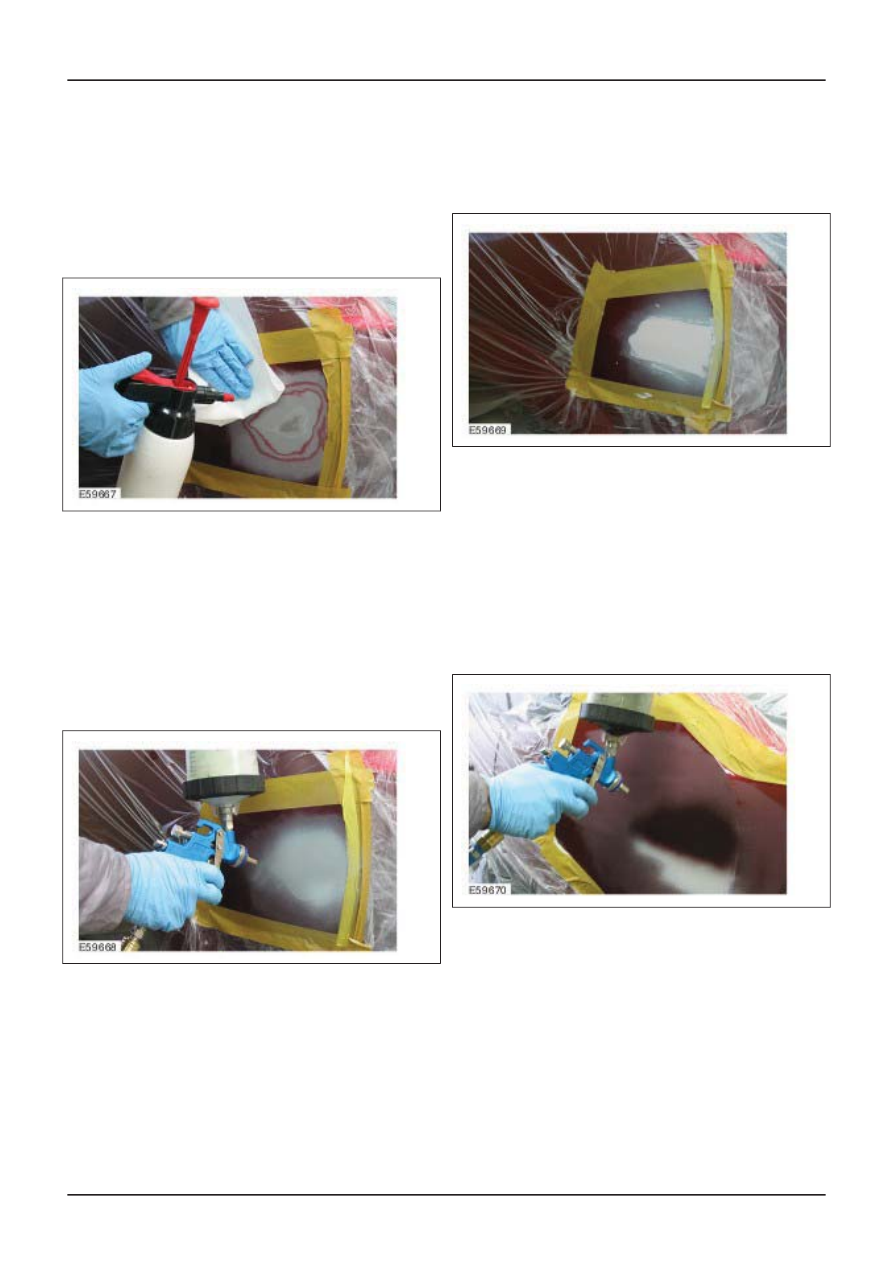
Cleaning, de-greasing
Use silicone remover to thoroughly clean the
surface in order to remove grease residues, sweat
from the hands and other contamination.
NOTE: Use a solvent test to establish whether the
old paint can be etched. Apply 2-component
thinners to the damaged area using a clean cloth
and rub lightly for about 1 minute. If the
subsurfaces can be etched away, special
pre-treatment is necessary.
See "Tips and Tricks"
Apply primer filler
Before applying stopper, apply primer to the
sanded and bare surface.
Allow the primer to dry and then lightly sand by
hand using P220 - P400 dry.
NOTE: Most stopper can be applied directly to bare
metal. But application of a primer filler provides
better corrosion protection.
NOTE: Avoid sanding through to the bare metal.
Points which are sanded through must be retreated
with primer filler.
Stopper application
Pre-sand the hardened stopper using an eccentric
sander and P80 dry, then final-sand using P120 -
P140 dry. Clean the sanded surface using silicone
remover.
Apply 2-component stopper to the filled surface.
The stopper compound must only be applied thinly.
NOTE: Use of a testing powder is recommended
so that the sanding process can be more easily
checked.
Apply filler
Filler can now be applied to the dried repair area.
Choose the correctly toned filler according to the
manufacturer's instructions.
NOTE: Alternatively, filler with the correct tone can
be mixed with the aid of colour matching cards.
G506672en
501-36-
44
Paint - General Information
501-36-
44
DESCRIPTION AND OPERATION
201