Ford Falcon. Manual - part 495
501-25E-6
Body Repairs - Wind Noise
501-25E-6
DESCRIPTION AND OPERATION (Continued)
as when the wind noise was produced
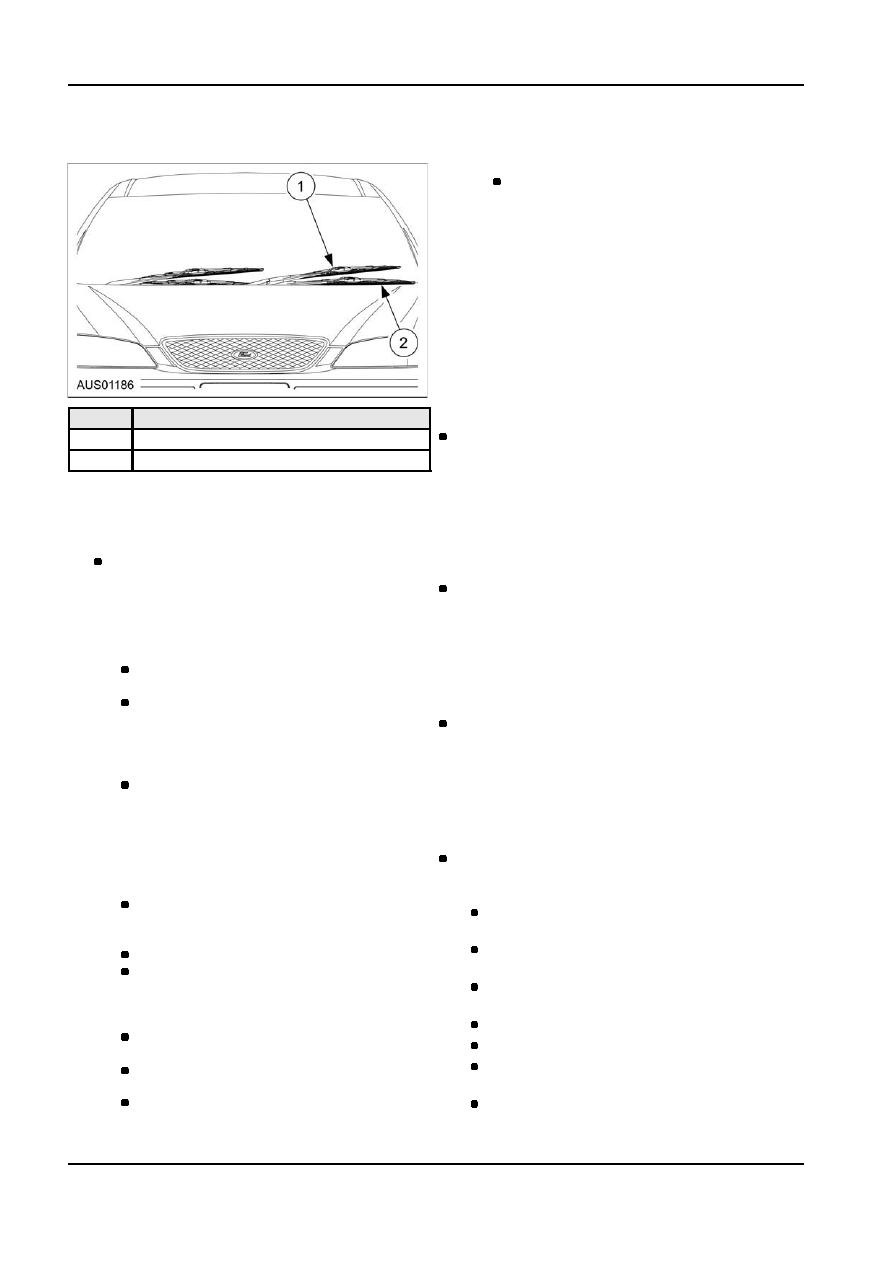
Adjustment of the wiper arm
earlier.
If this road test does not show that the
work has been successful, additional
techniques such as powder testing,
stethoscope testing or ultrasonic detection
must be employed.
Workshop diagnosis
Before repair work is carried out, a visual check of the
vehicle must be performed, paying special attention to
the fit of the doors. When the doors are adjusted to fit
exactly, development of wind noise can often be
eliminated at high speeds (lifting of doors off the
seals).
Stethoscope testing
Item
Description
The stethoscope is a simple and appropriate tool
1
Too high (above black ceramic bend)
for finding bodywork air leaks. If the blower is
2
Correct (within black ceramic bend)
turned on at the highest speed and all the doors,
windows and other openings are closed, the air
Sequence for performing a wind noise
pressure inside the vehicle can be made higher
diagnosis
than that outside. The outside of the vehicle is
then checked for streams of escaping air.
1. Customer
concern
What is the customer concern and what
Powder test
details can they supply about the wind noise?
By coating the contact surface of the door seal
2. Under which conditions does the wind noise
with white powder (eg. chalk), door seals that do
appear?
not make close contact can be found. To do this,
1. Sequence A: A diagnosis is possible based
the door is carefully closed and re-opened. In this
on the details supplied by the customer.
way, the sealing surfaces which do not touch will
Carry out corrective measures to remedy
be visible.
the wind noise.
Ultrasonic detector
Road test the vehicle to check that the
concern is resolved. The vehicle must be
It is also possible to detect leaks using an
driven in the exactly same way as when
ultrasonic detector and a tone generator. To do
the wind noise was produced with the
this, the ultrasonic tone generator is put inside the
customer.
vehicle and the outside of the vehicle is tested
If the corrective measures based on the
using the detector tuned to the generator. The
information supplied by the customer
detector will quite easily show any leaks present.
were not successful, further testing must
Road tests
be carried out in the workshop (see
sequence B).
The causes and origins of wind noises can often
2. Sequence B: A diagnosis based on details
be located by a road test. Attention should be
supplied by the customer is not possible
paid to the following points:
Test for faults in the workshop, referring
Choose a dry, flat and straight road with as
to any TSB (Technical Service Bulletin)
little traffic as possible.
which may be relevant.
Make sure that the tyres are at the correct
Visually check external seals, check gaps.
pressure, to avoid tyre noise.
Visual check: Have any components been
Vehicle speed should be the max legal/safe
fitted to the vehicle after manufacture or
speed (eg. 100km/h)
has the vehicle been repaired after an
accident?
Road surface should be smooth
Perform a diagnosis based on the road
Wind speed should be minimal
test.
Testing should be carried out in N,E,S,W
Carry out corrective measures based on
directions if possible
the diagnosis.
Perform another road test. The vehicle
A separate rear seat auditor is required for
must be driven in the exactly same way
wind noise in the rear of the vehicle
G27425 en