Ford Falcon. Manual - part 494
501-25E-2
Body Repairs - Wind Noise
501-25E-2
DESCRIPTION AND OPERATION
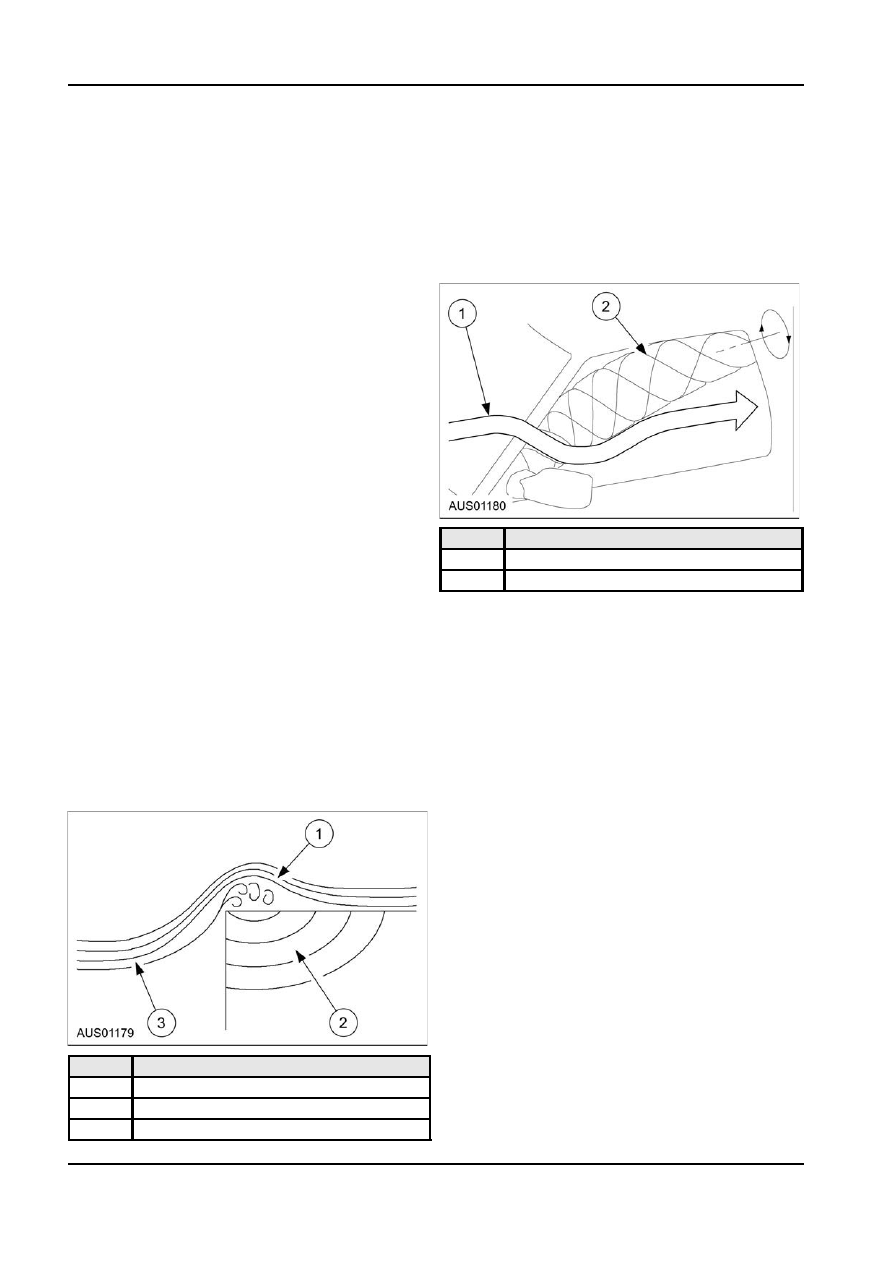
The build-up and decay of turbulence and the
Wind Noise
associated pressure changes lead to creation of
sound waves. A similar effect can be observed at the
General
A-pillar on a vehicle. Here the area where eddies are
Wind noise can not be completely eliminated,
usually formed is directly above the side window. This
however the aim of vehicle development is to
makes it easy for the noise (roaring) to be passed to
significantly reduce wind noise levels and increase
the vehicle interior.
customer comfort is to reduce wind noise. The quieter
Eddy current zone
that noise producing components such as the engine,
drive train, tyres etc. become, the more the wind noise
at high speeds will be heard.
Apart from general wind rush, some noises may arise
which are typically heard as an irritating hissing or
whistling. The causes of these noises may be partly
caused by production or repair factors. They are
mostly caused by incorrectly mounted components,
which must be correctly installed in the correct
position.
Normal air flow noises
At high speed, as air flows past uniform flat surfaces
such as the roof, side windows, etc., turbulent air
layers form, in which air pressure variations occur.
Part of this pressure variation spreads in the form of
Item
Description
sound waves and is transferred to the vehicle interior
1
Air flow
by the side windows and seals. Here the noise is
2
Build up of eddies
particularly loud because of the closeness of the side
window to the driver or passenger. The noise
Eddy currents are also formed underneath the
experienced is mostly a low roaring, which becomes
vehicle, and so associated noise is also produced.
louder as speed increases.
When air flows past smaller components or through
smaller gaps (such as the radiator grill), the roaring
Noises caused partly by changes in the
noise can become a whistling, which may increase in
direction of air flow and by air flow
pitch and becomes louder as speed increases.
around separate components
Noise caused by vibrating seals
If air flows over an edge on a vehicle, the air flow
Seals which are not making firm contact in the window
cannot fully the contour of the surface, and it breaks
and door areas can also lead to vibrations caused by
up at the edge. Eddies are formed, which collapse
pressure variations on the outside of the vehicle which
again after a certain time or distance.
then means transfer of noise into the vehicle interior.
Change in the direction of air flow
The vibrating part of the seal operates here in the
same way as loudspeaker membrane. This type of
noise could be described as a "buzz" and sometimes
can originate around windscreen perimeters.
Item
Description
1
Eddy
2
Sound Wave
3
Flow
G27425 en