Ford Falcon. Manual - part 23
204-00-8
Suspension System — General Information
204-00-8
DIAGNOSIS AND TESTING (Continued)
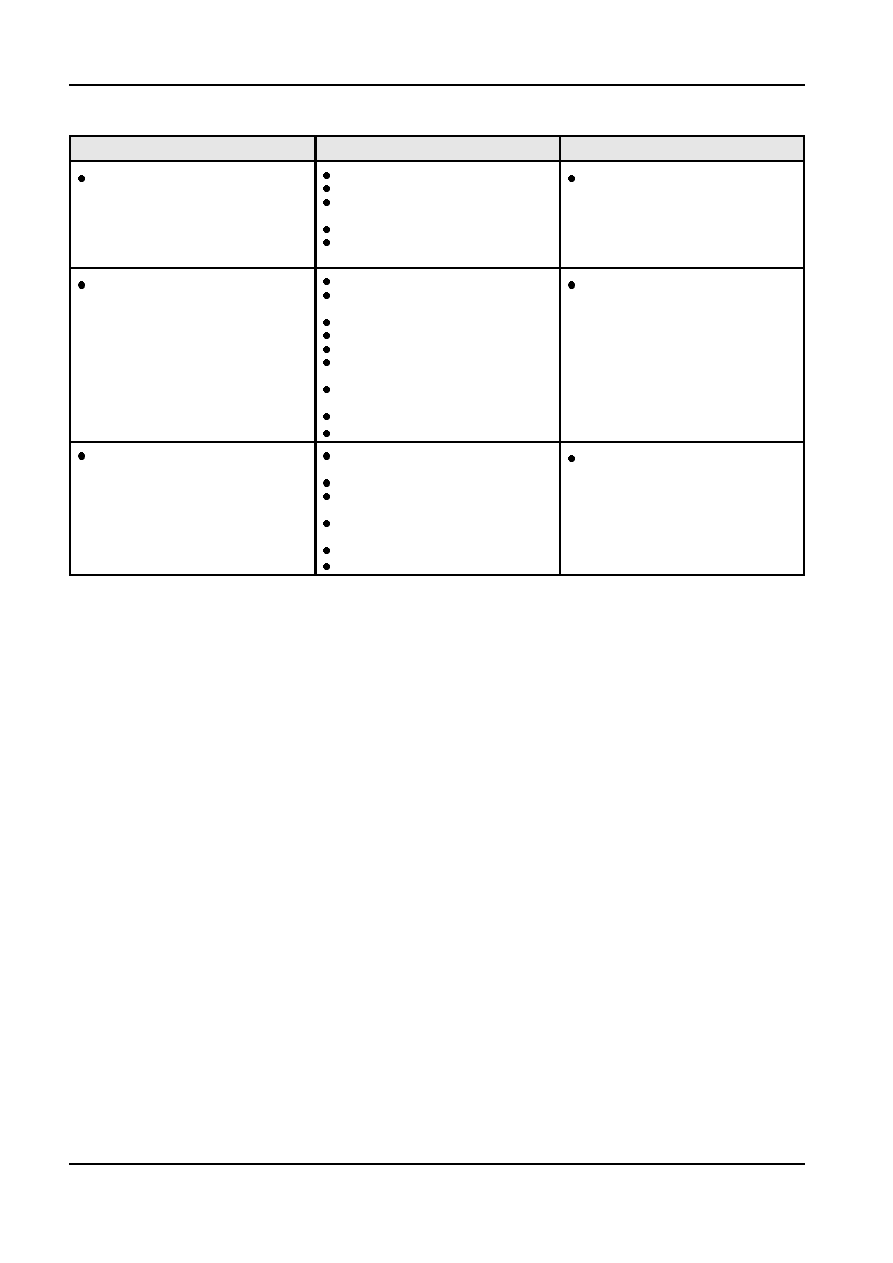
Condition
Source
Action
Incorrect Tyre Pressure
Sag at One Wheel
Remove/Repair as required
Tyre Sizes Not Uniform
Overloaded or Unevenly Loaded
Vehicle
Sagging or Broken Spring
Loose or Worn Suspension Arm
Bushings
Incorrect Tyre Pressure
Hard or Rough Ride
Remove/Repair as required
Overloaded or Unevenly Loaded
Vehicle
Sagging or Broken Spring
Lack of Lubrication
Loose or Weak Shock Absorber
Loose or Worn Suspension Arm
Bushings
Binding Front Suspension Ball Joints
or Steering Linkage
Wheel Out of Balance
Out-of-Round Wheel
Rear Suspension Misalignment (Dog-
Rear Spring Tie Bolt Off Centre
Remove/Repair as required
(Wagon/Ute)
Tracking)
Broken Rear Spring Tie Bolts (Wagon)
Rear Spring Front Hanger Mislocated
(Wagon/Ute)
Loose or Worn Suspension Arm
Bushings
Frame or Underbody Out of Alignment
Bent Rear Axle Housing
Hand Test
Shock Absorbers
1. With the shock absorber removed from the
On Vehicle Tests
vehicle, hold the shock absorber such that it is in
1. Grasp the vehicle bumper bar and bounce the
a vertical position, as it would be installed in the
corner of the vehicle up and down. If the shock
vehicle. Fully compress and extend the shock
absorbers are in serviceable condition the vehicle
absorber unit three times to bleed the shock
will settle to it’s original position within two
absorber. Compress the unit and observe that the
bounces after the bumper is released.
piston rod extends under it’s own internal gas
2. Check the shock absorber to be sure that it is
pressure. There should be a smooth movement of
securely and properly installed on the vehicle.
the shock absorber rod over the complete stroke
Check the shock absorber mounting bushes and
as the shock extends. Any noticeable slowing of
body insulators for damage and / or wear.
the rod, loss of movement or drag, especially as
Replace any defective body insulators and tighten
the piston rod nears the top of its stroke, will
attachments to the specified torque. If wear or
indicate low internal gas pressure, loss of shock
damage is visible on shock absorber mounting
fluid or faulty internal valve operation.
bushes, the entire shock absorber should be
2. Extend and compress the shock as fast as
replaced.
possible, using as much travel of the shock as
3. Check the compression rubbers or bumpers fitted
possible. The action of the shock should become
on the shock rod for signs of damage. Replace if
smooth and uniform throughout each stroke. It is
necessary.
normal for the shock to have higher resistance to
extension than compression. Faint fluid "swishing"
4. Inspect the shock absorber for evidence of fluid
noises are also normal during extension and
leakage. It is important to be sure that any fluid
compression of the shock.
observed is from the shock absorber and not from
any other source.
3. If the action is smooth, but the shock absorbers
are suspected of being weak, repeat Step 2 on a
5. If the leakage is severe, replace the shock
new shock absorber or on the mating shock
absorber if leakage. (Some evidence of fluid
absorber fitted to the opposite side of the vehicle.
weepage on the shock body is not considered
Compare the results of both tests.
harmful to the shock provided that the on-vehicle
and hand tests described below are acceptable).
G22341 en