Ford Falcon. Manual - part 8
100-04-4
Noise, Vibration and Harshness
100-04-4
DESCRIPTION AND OPERATION (Continued)
applied and the transmission engaged. This test is
from side-to-side (wobble). Dynamically unbalanced
used for noise and vibration checks.
wheel and tyre assemblies can cause wheel shimmy.
Driveline Angles
Engine Imbalance
The differences of alignment between the
A condition in which an engine’s center mass is not
transmission output shaft, the driveshaft, and the rear concentric to the rotation center, causing excessive
axle pinion centerline.
motion.
Engine Misfire
When combustion in one or more cylinders does not
occur or occurs at the wrong time.
Engine Shake
An exaggerated engine movement or vibration that
directly increases in frequency as the engine speed
increases. It is caused by non-equal distribution of
mass in the rotating or reciprocating components.
Flexible Coupling
A flexible joint.
Float
A drive mode on the dividing line between cruise and
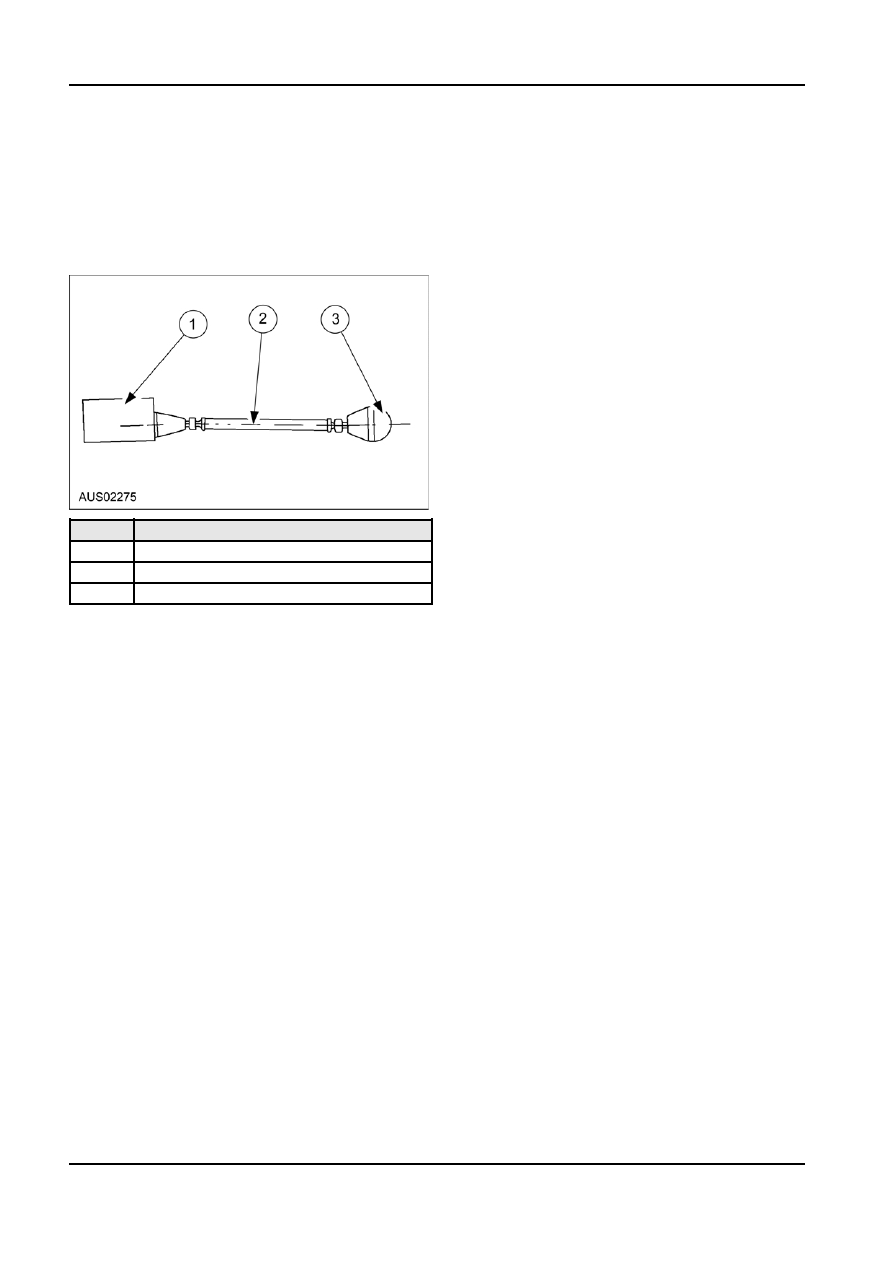
Item
Description
coast where the throttle setting matches the engine
speed with the road speed.
1
Engine
2
Driveshaft
Flutter
3
Differential
Mid to high (100-200 Hz) intermittent sound due to air
flow. Similar to a flag flapping in the wind.
Driveshaft
Frequency
The shaft that transmits power to the rear axle input
The rate at which a cycle occurs within a given time.
shaft (pinion shaft). In a two-piece driveshaft, it is the
rearmost shaft.
Gravelly Feel
Drivetrain
A grinding or growl in a component, similar to the feel
experienced when driving on gravel.
All power transmitting components from the engine to
the wheels; includes the clutch or torque converter,
Grind
the transmission, the transfer case, the driveshaft,
and the front or rear drive axle.
An abrasive sound, similar to using a grinding wheel,
or rubbing sand paper against wood.
Drivetrain Damper
Hiss
A weight attached to the engine, the transmission, the
transfer case, or the axle. It is tuned by weight and
Steady high frequency (200–800 Hz) noise. Vacuum
placement to absorb vibration.
leak sound.
Drone
Hoot
A low frequency (100-200 Hz) steady sound, like a
A steady low frequency tone (50-500 Hz), sounds like
freezer compressor. Also described as a moan.
blowing over a long neck bottle.
Drumming
Howl
A cycling, low-frequency (20–100 Hz), rhythmic noise
A mid-range frequency (200-800 Hz) noise between
often accompanied by a sensation of pressure on the
drumming and whine. Also described as a hum.
ear drums. Also described as a low rumble, boom, or
Hum
rolling thunder.
Mid-frequency (200-800 Hz) steady sound, like a
Dynamic Balance
small fan motor. Also described as a howl.
The equal distribution of weight on each side of the
Hz
centerline, so that when the wheel and tyre assembly
spins, there is no tendency for the assembly to move
Hertz; a frequency measured in cycles per second.
G72678 en