Ford Focus Electric (2018 year). Manual - part 9
 

  Index      Ford     Ford Focus Electric - service manual 2018 year in english


Search            


Content   ..  7  8  9  10   ..


Ford Focus Electric (2018 year). Manual - part 9


After all occupants have adjusted their
seats and put on seatbelts, it is very
important that they continue to sit
properly. A properly seated occupant sits
upright, leaning against the seatback, and
centered on the seat cushion, with their
feet comfortably extended on the floor.
Sitting improperly can increase the chance
of injury in a crash event. For example, if
an occupant slouches, lies down, turns
sideways, sits forward, leans forward or
sideways, or puts one or both feet up, the
chance of injury during a crash is greatly
increased.

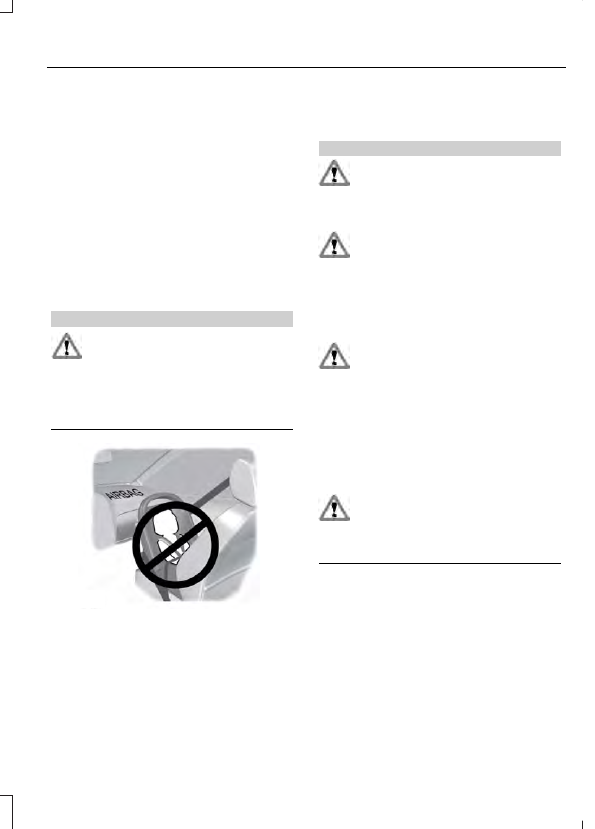
Children and Airbags

WARNING

Airbags can kill or injure a child in a
child restraint. Never place a
rear-facing child restraint in front of

an active airbag. If you must use a
forward-facing child restraint in the front
seat, move the seat upon which the child
restraint is installed all the way back.

E142846

Children must always be properly
restrained. Accident statistics suggest that
children are safer when properly restrained
in the rear seating positions than in the
front seating position. Failure to follow
these instructions may increase the risk of
injury in a crash.

FRONT PASSENGER SENSING
SYSTEM

WARNINGS

Even with advanced restraints
systems, properly restrain children
12 and under in a rear seating

position. Failure to follow this could
seriously increase the risk of injury or death.

Sitting improperly, out of position or
with the seatback reclined too far
can take weight off the seat cushion

and affect the decision of the passenger
sensing system, resulting in serious injury
or death in the event of a crash. Always sit
upright against your seat back, with your
feet on the floor.

Do not stow objects in the seatback
map pocket or hang objects off a
seatback if a child is in the front

passenger seat. Do not place objects under
the front passenger seat or between the
seat and the center console. Check the
passenger airbag indicator lamp for proper
airbag status. Failure to follow these
instructions may interfere with the front
passenger seat sensing system and
increase the risk of serious injury.

Any alteration or modification to the
front passenger seat may affect the
performance of the front passenger

sensing system. This could seriously
increase the risk of injury or death.

This system works with sensors that are
part of the front passenger seat and
seatbelt to detect the presence of a
properly-seated occupant and determine
if the front passenger frontal airbag should
be enabled (may inflate) or not.

E188175

The front passenger sensing system uses
a passenger airbag status indicator that
illuminates indicating that the front
passenger frontal airbag is either ON
(enabled) or OFF (disabled).

The indicator lamp is located in the center
stack of the instrument panel.

Note: The passenger airbag status indicator
OFF and ON indicator lamps illuminate for
a short period of time when the ignition is
first turned on to confirm they are functional.

The front passenger sensing system is
designed to disable (will not inflate) the
front passenger frontal airbag when the
front passenger seat is unoccupied, or a
rear facing infant seat, a forward-facing
child restraint, or a booster seat is
detected. Even with this technology,
parents are strongly encouraged to
always properly restrain children in the rear
seat. The sensor also turns off the
passenger front airbag when the passenger
seat is empty.

When the front passenger sensing
system disables (will not inflate) the
front passenger frontal airbag, the
passenger airbag status indicator
illuminates the OFF lamp and stays lit
to remind you that the front passenger
frontal airbag is disabled.

If the child restraint has been installed
and the passenger airbag status
indicator illuminates the ON lamp, then
turn the vehicle off, remove the child
restraint from the vehicle and reinstall
the restraint following the child
restraint manufacturer's instructions.

The front passenger sensing system is
designed to enable (may inflate) the front
passenger's frontal airbag anytime the
system senses that a person of adult size
is sitting properly in the front passenger
seat.

When the front passenger sensing
system enables the front passenger
frontal airbag (may inflate), the
passenger airbag status indicator
illuminates the ON lamp and remains
illuminated.

If a person of adult size is sitting in the front
passenger seat, but the airbag off indicator
lamp is lit, it is possible that the person is
not sitting properly in the seat. If this
happens:

Turn the vehicle off and ask the person
to place the seatback in the full upright
position.

Have the person sit upright in the seat,
centered on the seat cushion, with the
person’s legs comfortably extended.

Restart the vehicle and have the person
remain in this position for about two
minutes. This allows the system to
detect that person and enable the
passenger’s frontal airbag.

If the indicator OFF lamp remains lit
even after this, the person should be
advised to ride in the rear seat.

Passenger airbag

Passenger airbag status

indicator

Occupant

Disabled

OFF: Lit

Empty

ON: Unlit

Disabled

OFF: Lit

Child

ON: Unlit

Enabled

OFF: Unlit

Adult

ON: Lit

After all occupants have adjusted their
seats and put on seatbelts, it is very
important that they continue to sit
properly. A properly seated occupant sits
upright, leaning against the seatback, and
centered on the seat cushion, with their
feet comfortably extended on the floor.
Sitting improperly can increase the chance
of injury in a crash event. For example, if
an occupant slouches, lies down, turns
sideways, sits forward, leans forward or
sideways, or puts one or both feet up, the
chance of injury during a crash is greatly
increased.

If you think that the status of the passenger
airbag indicator lamp is incorrect, check
for the following:

Objects lodged underneath the seat.

Objects between the seat cushion and
the center console.

Objects hanging off the seatback.

Objects stowed in the seatback map
pocket.

Objects placed on the occupant’s lap.

Cargo interference with the seat.

Other passengers pushing or pulling on
the seat.

Rear passenger feet and knees resting
or pushing on the seat.

The conditions listed above may cause the
weight of a properly seated occupant to
be incorrectly interpreted by the front
passenger sensing system. The person in
the front passenger seat may appear
heavier or lighter due to the conditions
described in the list above.

E67017

Make sure the front passenger
sensing system is operating
properly,  See Crash Sensors

and Airbag Indicator (page 42).

If the airbag readiness lamp is lit, do
the following:

The driver or adult passengers should
check for any objects that may be lodged
underneath the front passenger seat or
cargo interfering with the seat.

If objects are lodged or cargo is interfering
with the seat, please take the following
steps to remove the obstruction:

Pull the vehicle over.

Turn the vehicle off.

Driver or adult passengers should
check for any objects lodged
underneath the front passenger seat
or cargo interfering with the seat.

Remove the obstruction(s) (if found).

Restart the vehicle.

Wait at least two minutes and verify
that the airbag readiness lamp is no
longer illuminated

If the airbag readiness lamp remains
illuminated, this may or may not be a
problem due to the front passenger
sensing system.

Do not attempt to repair or service the
system. Take your vehicle immediately to
an authorized dealer.

If it is necessary to modify an advanced
front airbag system to accommodate a
person with disabilities, contact the Ford
Customer Relationship Center.  See
Getting the Services You Need (page
149).

SIDE AIRBAGS

WARNINGS

Do not place objects or mount
equipment on or near the airbag
cover, on the side of the seatbacks

(of the front seats), or in front seat areas
that may come into contact with a
deploying airbag. Failure to follow these
instructions may increase the risk of
personal injury in the event of a crash.

Do not use accessory seat covers.
The use of accessory seat covers
may prevent the deployment of the

side airbags and increase the risk of injury
in an accident.

Do not lean your head on the door.
The side airbag could injure you as it
deploys from the side of the

seatback.

Do not attempt to service, repair, or
modify the seat airbag supplemental
restraint systems, its fuses or the

seat cover on a vehicle containing seat
airbags as you could be seriously injured
or killed. Contact your authorized dealer
as soon as possible.

WARNINGS

If the side airbag has deployed, the
airbag will not function again. The
side airbag system (including the

seat) must be inspected as soon as
possible. If the airbag is not replaced, the
unrepaired area will increase the risk of
injury in a crash.

The side airbags are on the outboard side
of the seatbacks of the front seats. The
airbag was designed to inflate between
the door panel and occupant to further
enhance the protection provided to
occupants in certain side impact crashes.

E152533

The system consists of the following:

A label or embossed side panel
indicating that side airbags are fitted
to your vehicle.

Side airbags inside the driver and front
passenger seatbacks.

Front passenger sensing system.

E67017

Crash sensors and monitoring
system with readiness indicator.
See Crash Sensors and Airbag

Indicator (page 42).


Content   ..  7  8  9  10   ..