Ford F-150 (2018 year). Manual - part 66
 

  Index      Ford     Ford F-150 - service manual 2018 year in english


Search            


Content   ..  64  65  66  67   ..


Ford F-150 (2018 year). Manual - part 66


LOAD RETAINING FIXTURES

 (If

Equipped)

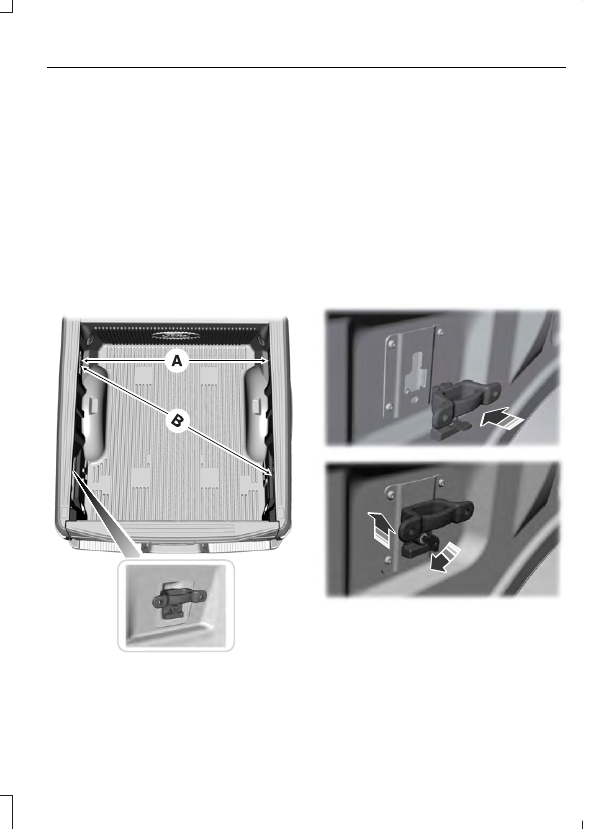
BoxLink™ Cleats

These cleats attach to the inner box walls
to help you to tie down cargo. The cleats
can be locked to prevent removal or
unlocked for removal.

BoxLink Cleats

Note: Leave the key in the lock when
removing or installing the cleats. The key
cannot be removed from the lock unless it
is in the locked position.

E184885

A. 275 lb (1,223 N) maximum force
between directly opposed cleats.

B. 600 lb (2,669 N) maximum force
between diagonally opposed cleats.

Secure cargo with up to 275 lb (1,223 N)
force applied between opposing box link
cleats, or up to 600 lb (2,669 N) force
applied between diagonal box link cleats.

Removing Locking BoxLink Cleats

1.

Insert the key into the lock and turn
clockwise to unlock.

2. Pull bottom of the cleat outward while

pushing top of cleat down.

3. Hold on to the cleat as it clears the

mounting slot.

Installing Locking BoxLink Cleats

E189558

1.

Insert the key into lock and turn
clockwise to unlock.

2. Insert the cleat into the mounting slot

and push upward. Make sure the cleat
is fully engaged.

3. Turn the key counterclockwise to lock.

4. Remove the key.

LOAD LIMIT

Vehicle Loading - with and
without a Trailer

This section guides you in the
proper loading of your vehicle,
trailer, or both. Keep your loaded
vehicle weight within its design
rating capability, with or without
a trailer. Properly loading your
vehicle provides maximum return
of vehicle design performance.
Before you load your vehicle,
become familiar with the
following terms for determining
your vehicle’s weight rating, with
or without a trailer, from the
vehicle’s Tire and Loading
Information label or Safety
Compliance Certification label.

Tire and Loading Label Information
Example:

E198719

Payload

E143816

PAYLOAD

Payload is the combined weight
of cargo and passengers that your
vehicle is carrying. The maximum
payload for your vehicle appears
on the Tire and Loading label. The
label is either on the B-pillar or the
edge of the driver door. Vehicles
exported outside the US and
Canada may not have a tire and
loading label. Look for “The
combined weight of occupants
and cargo should never exceed
XXX kg OR XXX lb” for maximum
payload. The payload listed on the
Tire and Loading Information label
is the maximum payload for your
vehicle as built by the assembly
plant. If you install any additional
equipment on your vehicle, you
must determine the new payload.
Subtract the weight of the
equipment from the payload listed
on the Tire and Loading label.
When towing, trailer tongue
weight or king pin weight is also
part of payload.

WARNING

The appropriate loading
capacity of your vehicle can

be limited either by volume
capacity (how much space is
available) or by payload capacity
(how much weight the vehicle
should carry). Once you have
reached the maximum payload of
your vehicle, do not add more
cargo, even if there is space
available. Overloading or
improperly loading your vehicle
can contribute to loss of vehicle
control and vehicle rollover.

GAWR (Gross Axle Weight
Rating)

GAWR is the maximum allowable
weight that a single axle (front or
rear) can carry. These numbers
are on the Safety Compliance
Certification label. The label is
located on the door hinge pillar,
door-latch post, or the door edge
that meets the door-latch post,
next to the driver seating position.

The total load on each axle must
never exceed its Gross Axle
Weight Rating.

GVWR (Gross Vehicle Weight
Rating)

GVWR is the maximum allowable
weight of the fully loaded vehicle.
This includes all options,
equipment, passengers and cargo.
It appears on the Safety
Compliance Certification label.
The label is located on the door
hinge pillar, door-latch post, or the
door edge that meets the
door-latch post, next to the driver
seating position.

The gross vehicle weight must
never exceed the Gross Vehicle
Weight Rating.

Safety Compliance Certification Label
Example:

E198828

WARNING

Exceeding the Safety
Compliance Certification

label vehicle weight rating limits
could result in substandard
vehicle handling or performance,
engine, transmission and/or
structural damage, serious
damage to the vehicle, loss of
control and personal injury.

Maximum Loaded Trailer
Weight

Maximum loaded trailer weight is
the highest possible weight of a
fully loaded trailer the vehicle can
tow. Consult an authorized dealer
(or the RV and Trailer Towing
Guide available at an authorized
dealer) for more detailed
information.

GCWR (Gross Combined
Weight Rating)

GCWR is the maximum allowable
weight of the vehicle and the
loaded trailer, including all cargo
and passengers, that the vehicle
can handle without risking
damage. (Important: The towing

vehicle’s braking system is rated
for operation at Gross Vehicle
Weight Rating, not at Gross
Combined Weight Rating.)
Separate functional brakes should
be used for safe control of towed
vehicles and for trailers where the
Gross Combined Weight of the
towing vehicle plus the trailer
exceed the Gross Vehicle Weight
Rating of the towing vehicle.

The gross combined weight must
never exceed the Gross Combined
Weight Rating.

Note:  For trailer towing
information refer to the RV and
Trailer Towing Guide available at
an authorized dealer.

WARNINGS

Do not exceed the GVWR or
the GAWR specified on the

Safety Compliance Certification
label.

Do not use replacement tires
with lower load carrying

capacities than the original tires
because they may lower your
vehicle’s GVWR and GAWR
limitations. Replacement tires
with a higher limit than the original
tires do not increase the GVWR
and GAWR limitations.

Exceeding any vehicle weight
rating limitation could result

in serious damage to your vehicle,
personal injury or both.


Content   ..  64  65  66  67   ..