Ford F-150 (2018 year). Manual - part 57
 

  Index      Ford     Ford F-150 - service manual 2018 year in english


Search            


Content   ..  55  56  57  58   ..


Ford F-150 (2018 year). Manual - part 57


E130107

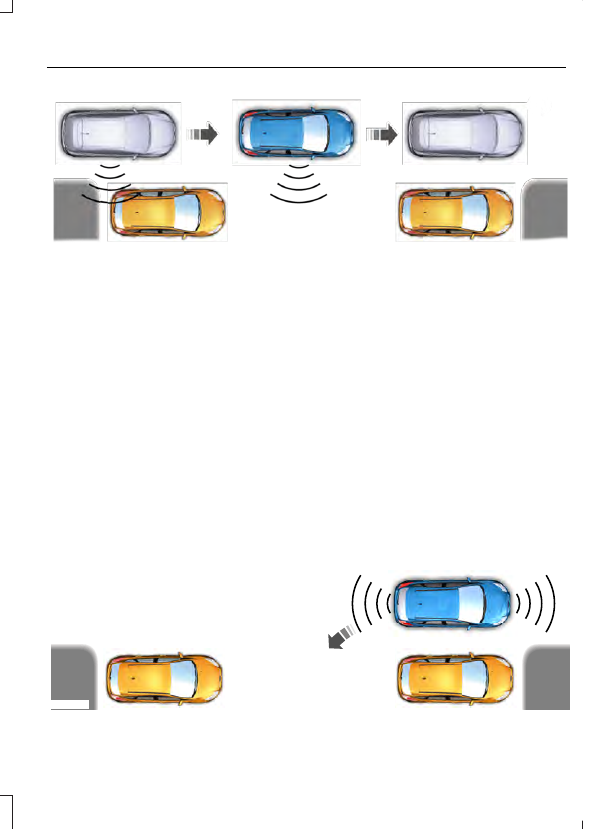
Note: You can also switch the system on
after you have already driven partially or
completely past a parking space. Press the
Active Park Assist button and the system
informs you if you have recently passed a
suitable parking space.

When the system finds a suitable space,
it displays a message and a tone sounds.
Stop your vehicle and follow the
instructions on the screen. If your vehicle
is moving very slowly, you may need to pull
forward a short distance before the system
is ready to park.

Note: You must observe that the space the
system selects remains clear of obstructions
at all times during the maneuver.

Note: Drive your vehicle within 5 ft (1.5 m)
and as parallel as possible to the other
vehicles while passing a parking space.

Note: The system always offers the last
parking space it detects. For example, if your
vehicle detects multiple spaces while you
are driving, it offers the last one.

Note: If driven above approximately 22 mph
(35 km/h), the system shows a message to
alert you to reduce your vehicle speed.

Automatically Steering into a Parking
Space

Note: If your vehicle speed exceeds
approximately 6 mph (9 km/h) or you
interrupt the maneuver, the system switches
off and you need to take full control of your
vehicle.

When you shift the transmission into
reverse (R), with your hands off the
steering wheel and nothing obstructing its
movement, your vehicle steers itself into
the space (hands-free). The system
displays instructions to move your vehicle
backward and forward in the space.

E130108

When you believe your vehicle is properly
parked, or you hear a solid tone
accompanied by a display message, bring
your vehicle to a complete stop.

When the Active Park Assist maneuver is
complete, the system displays a message
and a tone sounds.

Note: You are responsible for checking your
parked vehicle and making any necessary
corrections before leaving your vehicle.

Troubleshooting the System

Possible Cause

Symptom

You may have the traction control system switched off.

The system does not look for a

space.

The transmission is in reverse (R). Your vehicle must
be moving forward to be able to detect a parking space.

The sensors may be covered. For example, snow, ice
or dirt buildup. Covered sensors can affect how the
system functions.

The system does not offer a

parking space.

There is not enough room in the parking space for your
vehicle to safely park.

There is not enough space for the parking maneuver on
the opposite side of the parking space.

The parking space is more than 5 ft (1.5 m) or less than
16 in (0.4 m) away.

Your vehicle speed is greater than 22 mph (35 km/h).

You recently disconnected or replaced the battery. After
a battery disconnect, you must drive your vehicle on a
straight road for a short period of time.

Your vehicle is rolling in the opposite direction of the
current transmission position. For example, rolling
forward when in reverse (R).

The system does not position

the vehicle correctly.

An irregular curb along the parking space prevents the
system from aligning your vehicle properly.

Improperly parked vehicles or objects are boarding the
space.

Your vehicle is too far past the parking space. The
system performs best when you drive the same
distance past the parking space.

Possible Cause

Symptom

You have incorrectly installed or maintained the tires.
For example, not inflated correctly, improper size, or of
different sizes.

A repair or alteration changes the detection capabilities.

A parked vehicle has a high attachment. For example,
a salt sprayer, snowplow or moving truck bed.

The parking space length or position of parked objects
changes after your vehicle passes the space.

The temperature around your vehicle quickly changes.
For example, driving from a heated garage into the cold,
or after leaving a car wash.

REAR VIEW CAMERA

 (If Equipped)

WARNINGS

The rear view camera system is a
reverse aid supplement device that
still requires the driver to use it in

conjunction with the interior and exterior
mirrors for maximum coverage.

Objects that are close to either
corner of the bumper or under the
bumper, might not be seen on the

screen due to the limited coverage of the
camera system.

Reverse your vehicle as slow as
possible, higher speeds may limit
your reaction time to stop your

vehicle.

Use caution when the rear cargo door
is ajar. If the rear cargo door is ajar,
the camera will be out of position

and the video image may be incorrect. All
guidelines disappear when the rear cargo
door is ajar. Some vehicles may not come
equipped with guidelines.

WARNINGS

Use caution when turning camera
features on or off when the
transmission is not in park (P). Make

sure your vehicle is not moving.

The rear view camera system provides a
video image of the area behind your
vehicle.

During operation, lines appear in the
display which represent your vehicle’s path
and proximity to objects behind your
vehicle.

E184050

The rear view camera is located on the
tailgate.

Using the Rear View Camera
System

The rear view camera system displays
what is behind your vehicle when you place
the transmission in reverse (R).

Note: The reverse sensing system is not
effective at speeds above 3 mph (5 km/h)
and may not detect certain angular or
moving objects.

The system uses three types of guides to
help you see what is behind your vehicle:

Active guidelines: Show the intended
path of your vehicle while reversing.

Fixed guidelines: Show the actual path
your vehicle is moving in while reversing
in a straight line. This can be helpful
when backing into a parking space or
aligning your vehicle with another
object behind you.

Centerline: Helps align the center of
your vehicle with an object (for
example, a trailer).

Note: If the image comes on while the
transmission is not in reverse (R), have the
system inspected by your authorized dealer.

Note: When towing, the camera only sees
what you are towing behind your vehicle.
This might not provide adequate coverage
as it usually provides in normal operation
and you might not see some objects. In
some vehicles, the guidelines may disappear
once you engage the trailer tow connector.

Note: If your vehicle is equipped with Pro
Trailer Backup Assist you can set-up the
trailer to work with the Rear View Camera
system.  See Trailer Reversing Aids (page
278).

The camera may not operate correctly
under the following conditions:

Nighttime or dark areas if the reverse
lamps are not operating.

Mud, water or debris obstructs the
camera's view. Clean the lens with a
soft, lint-free cloth and non-abrasive
cleaner.

The rear of your vehicle is hit or
damaged, causing the camera to
become misaligned.

Camera System Settings

You can access the rear view camera
system settings in the display screen.  See
General Information (page 111).

Camera guidelines

Note: Active guidelines and fixed guidelines
are only available when the transmission is
in reverse (R).

Note: The centerline is only available if
active or fixed guidelines are on.


Content   ..  55  56  57  58   ..