Ford F-150 (2018 year). Manual - part 25
 

  Index      Ford     Ford F-150 - service manual 2018 year in english


Search            


Content   ..  23  24  25  26   ..


Ford F-150 (2018 year). Manual - part 25


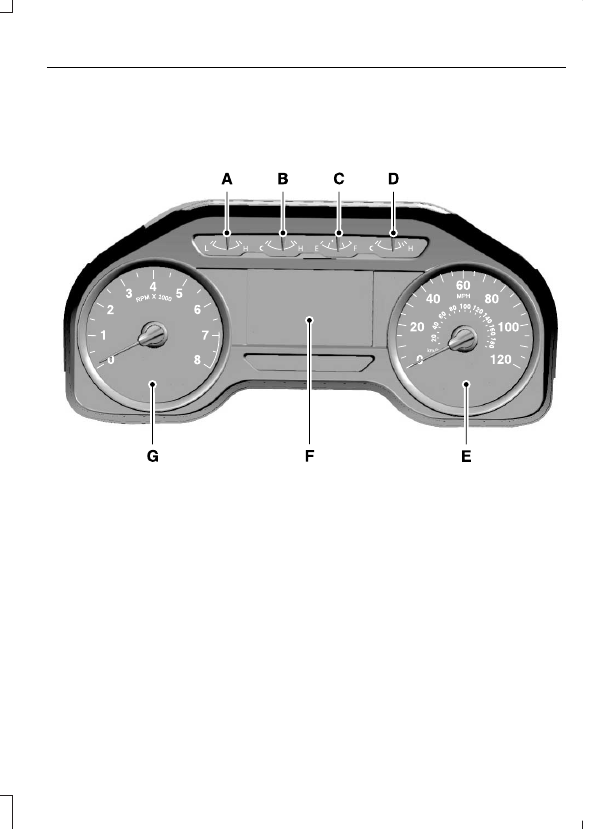
GAUGES

Type 1 and 2

E176090

Engine oil pressure gauge

A

Engine coolant temperature gauge

B

Fuel gauge

C

Transmission fluid temperature gauge

D

Speedometer

E

Information display  See General Information (page 111).

F

Tachometer

G

Type 3

E176091

Engine oil pressure gauge

A

Engine coolant temperature gauge

B

Fuel gauge

C

Transmission fluid temperature or Turbo boost (Ecoboost engine only) gauge

D

Speedometer

E

Information display  See General Information (page 111).

F

Tachometer

G

Engine Oil Pressure Gauge

Indicates engine oil pressure. The needle
should stay in the normal operating range
(between L and H). If the needle falls
below the normal range, stop your vehicle,
turn off the engine and check the engine
oil level. Add oil if needed. If the oil level is
correct, have your vehicle checked by an
authorized dealer.

Engine Coolant Temperature
Gauge

WARNING

Never remove the coolant reservoir
cap when the engine is running or
hot.

Indicates engine coolant temperature. At
normal operating temperature, the level
indicator will be in the normal range. If the
engine coolant temperature exceeds the
normal range, stop your vehicle as soon as
safely possible, switch off the engine and
let the engine cool.

Fuel Gauge

Note: The fuel gauge may vary slightly
when your vehicle is moving or on a gradient.

Switch the ignition on.  The fuel gauge will
indicate approximately how much fuel is
left in the fuel tank.  The arrow adjacent to
the fuel pump symbol indicates on which
side of your vehicle the fuel filler door is
located.

The needle should move toward F when
you refuel your vehicle. If the needle points
to E after adding fuel, this indicates your
vehicle needs service soon.

After refueling some variability in needle
position is normal:

It may take a short time for the needle
to reach F after leaving the gas station.
This is normal and depends upon the
slope of pavement at the gas station.

The fuel amount dispensed into the
tank is a little less or more than the
gauge indicated. This is normal and
depends upon the slope of pavement
at the gas station.

If the gas station nozzle shuts off
before the tank is full, try a different
gas pump nozzle.

Low Fuel Reminder

A low fuel level reminder displays and
sounds when the distance to empty
reaches 75 mi (120 km) to empty for
MyKey, and at 50 mi (80 km), 25 mi
(40 km), 10 mi (20 km) and 0 mi (0 km)
for all vehicle keys.

Transmission Fluid Temperature
Gauge

Indicates transmission fluid temperature.
At normal operating temperature, the level
indicator will be in the normal range. If the
transmission fluid temperature exceeds
the normal range, stop the vehicle as soon
as safely possible and verify the airflow is
not restricted such as snow or debris
blocking airflow through the grill. Also,
higher than normal operating temperature
can be caused by special operation
conditions (i.e. snowplowing, towing or
off-road use). Refer to Special operating
conditions in the scheduled maintenance
information for instructions. Operating the
transmission for extended periods with the
gauge in the higher than normal area may
cause internal transmission damage. You
need to alter the severity of your driving
conditions to lower the transmission
temperature into the normal range. If the
gauge continues to show high
temperatures, see an authorized dealer.

Information Display

Odometer

Located in the bottom of the information
display. Registers the accumulated
distance your vehicle has traveled.

Compass

Displays the vehicle’s heading direction.

Trip Computer

See General Information (page 111).

Vehicle Settings and Personalization

See General Information (page 111).

WARNING LAMPS AND
INDICATORS

The following warning lamps and
indicators alert you to a vehicle condition
that may become serious.  Some lamps
illuminate when you start your vehicle to
make sure they work.  If any lamps remain
on after starting your vehicle, refer to the
respective system warning lamp for further
information.

Note: Some warning indicators appear in
the information display and operate the
same as a warning lamp but do not
illuminate when you start your vehicle.

Adaptive Cruise Control Indicator

(If Equipped)

E144524

It illuminates when you switch
the system on.

It illuminates white when the

system is in standby mode.  It illuminates
green when you set the adaptive cruise
speed.

See Using Adaptive Cruise Control
(page 240).

Anti-Lock Braking System

If it illuminates when you are
driving, this indicates a
malfunction.  Your vehicle

continues to have normal braking without
the anti-lock brake system function.  Have
your vehicle checked as soon as possible.

Automatic Headlamp High Beam
Indicator

 (If Equipped)

It illuminates when the system
automatically turns the
headlamp high beam on.

See Automatic High Beam Control
(page 91).

Automatic Regen Control Off

 (If

Equipped)

E252868

It illuminates if you manually
switch off the automatic regen
control.

See Diesel Particulate Filter (page 195).

Auto-Start-Stop Indicator

 (If Equipped)

It illuminates when the engine
has automatically stopped.  It
flashes to inform you when the

engine needs to restart.  The indicator is
shown with a strikethrough if the system
is not available.

See Auto-Start-Stop (page 175).

Battery

It illuminates when you switch
the ignition on.

If it illuminates when the engine

is running this indicates a malfunction.
Have your vehicle checked as soon as
possible.


Content   ..  23  24  25  26   ..