Ford Explorer (2018 year). Manual - part 41
 

  Index      Ford     Ford Explorer - service manual 2018 year in english


Search            


Content   ..  39  40  41  42   ..


Ford Explorer (2018 year). Manual - part 41


GENERAL INFORMATION

WARNINGS

Extended idling at high engine
speeds can produce very high
temperatures in the engine and

exhaust system, creating the risk of fire or
other damage.

Do not park, idle or drive your vehicle
on dry grass or other dry ground
cover. The emission system heats up

the engine compartment and exhaust
system, creating the risk of fire.

Do not start the engine in a closed
garage or in other enclosed areas.
Exhaust fumes can be toxic. Always

open the garage door before you start the
engine.

Exhaust leaks may result in entry of
harmful and potentially lethal fumes
into the passenger compartment. If

you smell exhaust fumes inside your
vehicle, have your vehicle inspected
immediately. Do not drive if you smell
exhaust fumes.

If you disconnect the battery, your vehicle
may exhibit some unusual driving
characteristics for approximately 5 mi
(8 km) after you reconnect it.  This is
because the engine management system
must realign itself with the engine.  You
can disregard any unusual driving
characteristics during this period.

The powertrain control system meets all
Canadian interference-causing equipment
standard requirements regulating the
impulse electrical field or radio noise.

When you start the engine, avoid pressing
the accelerator pedal before and during
operation. Only use the accelerator pedal
when you have difficulty starting the
engine.

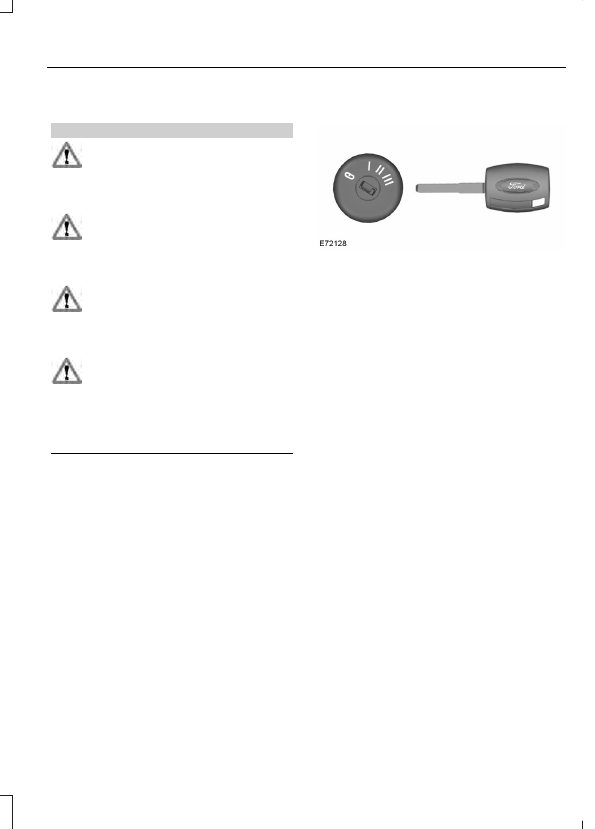
IGNITION SWITCH

 (If Equipped)

0 (off) - The ignition is off.

Note: When you switch the ignition off and
leave your vehicle, do not leave your key in
the ignition. This could cause your vehicle
battery to lose charge.

I (accessory) - Allows the electrical
accessories, such as the radio, to operate
while the engine is not running.

Note: Do not leave the ignition key in this
position for too long. This could cause your
vehicle battery to lose charge.

II (on) - All electrical circuits are
operational and the warning lamps and
indicators illuminate.

III (start) - cranks the engine.

KEYLESS STARTING

 (If Equipped)

Note: The keyless starting system may not
function if the key is close to metal objects
or electronic devices such as cellular
phones.

Note: A valid key must be located inside
your vehicle to switch the ignition on and
start the engine.

Ignition Modes

The keyless starting system has three
modes:

Off: Turns the ignition off.

Without applying the brake pedal,
press and release the button once
when the ignition is in the on mode, or
when the engine is running but the
vehicle is not moving.

On: All electrical circuits are operational
and the warning lamps and indicators
illuminate.

Without applying the brake pedal,
press and release the button once.

Start: Starts the engine.

Press the brake pedal, and then press
the button for any length of time. An
indicator light on the button illuminates
when the ignition is on and when the
engine starts.

STARTING A GASOLINE
ENGINE

When you start the engine, the idle speed
increases. This helps to warm up the
engine. If the engine idle speed does not
slow down automatically, have your
vehicle checked by an authorized dealer.

Note:  You can crank the engine for a total
of 60 seconds without the engine starting
before the starting system temporarily
disables.  The 60 seconds does not have to
be all at once.  For example, if you crank the
engine three times for 20 seconds each
time, without the engine starting, you
reached the 60-second time limit.  A
message appears in the information display
alerting you that you exceeded the cranking
time.  You cannot attempt to start the
engine for at least 15 minutes.  After 15
minutes, you are limited to a 15-second
engine cranking time.  You need to wait 60
minutes before you can crank the engine for
60 seconds again.

Before starting your vehicle, check the
following:

Make sure all occupants have fastened
their safety belts.

Make sure the headlamps and
electrical accessories are off.

Make sure the parking brake is on.

Make sure the transmission is in park
(P).

Switch the ignition on. For vehicles with
a keyless ignition, see the following
instructions.

Vehicles with an Ignition Key

Note: Do not touch the accelerator pedal.

1.

Fully depress the brake pedal.

2. Turn the key to the start position to

start the engine.

Note: The engine may continue cranking
for up to 15 seconds or until it starts.

Note: If you cannot start the engine on the
first try, wait for a short period and try again.

Vehicles with Keyless Start

Note: Do not touch the accelerator pedal.

Note: You must have your intelligent access
key in your vehicle in order to shift the
transmission out of park (P).

1.

Fully depress the brake pedal.

2. Press the push button ignition switch.

The system does not function if:

The passive key frequencies are
jammed.

The key battery has no charge.

If you are unable to start your vehicle, do
the following:

1.

Open the floor console storage
compartment lid.

2. Insert the passive key into the backup

slot.

3. With the key in this position, press the

brake pedal then press the push button
ignition switch to switch the ignition on
and start your vehicle.

Fast Restart

The fast restart feature allows you to
restart your vehicle within 20 seconds of
switching it off, even if it does not detect
a valid passive key.

Within 20 seconds of switching the engine
off, press the brake pedal and press the
push button ignition switch.  After 20
seconds, you can no longer start your
vehicle if it does not detect a valid passive
key.

Once your vehicle starts, it remains running
until you press the push button ignition
switch, even if your vehicle does not detect
a valid passive key.  If you open and close
a door while your vehicle is running, the
system searches for a valid passive key.
You cannot start your vehicle if the system
does not detect a valid passive key within
20 seconds.

Failure to Start

If you cannot start the engine after three
attempts, wait 10 seconds and follow this
procedure:

1.

Fully depress the brake pedal.

2. Shift into park (P).

3. Fully depress the accelerator pedal and

hold it there.

4. Start the engine.

Automatic Engine Shutdown

For vehicles with a keyless ignition, this
feature automatically shuts down the
engine if it has been idling for an extended
period. The ignition also turns off in order
to save battery power. Before your vehicle
shuts down, a message appears in the
information display showing a timer
counting down from 30 seconds. If you do
not intervene within 30 seconds, your
vehicle shuts down. Another message
appears in the information display to
inform you that your vehicle has shut down
to save fuel. Start your vehicle as you
normally do.

Automatic Engine Shutdown Override

Note: You cannot permanently switch off
the automatic shutdown feature. When you
switch it off temporarily, it turns on at the
next ignition cycle.

You can stop the shutdown, or reset the
timer, at any point before the 30-second
countdown has expired by doing any of the
following:

You can reset the timer by interacting
with your vehicle, for example pressing
the brake or accelerator pedal.

You can temporarily switch off the
shutdown feature any time the ignition
is on using the information display.  See
Information Displays (page 104).  T
he
feature only remains off for the current
ignition cycle.

During the 30-second countdown, the
system prompts you to press OK or
RESET to temporarily switch the
feature off for the current ignition cycle
only.

Stopping the Engine When Your

Vehicle is Stationary

Vehicles with an Ignition Key

1.

Shift into park (P).

2. Switch the ignition off.

3. Apply the parking brake.

Vehicles with Keyless Start

1.

Shift into park (P).

2. Press the push button ignition switch.

3. Apply the parking brake.

Note: The ignition, all electrical circuits and
all warning lamps and indicators will be
turned off.

Note: If the engine is idling for 30 minutes,
the ignition and engine automatically shut
down.

Stopping the Engine When Your
Vehicle is Moving

WARNING

Switching off the engine when the
vehicle is still moving will result in a
loss of brake and steering assistance.

The steering will not lock, but higher effort
will be required. When the ignition is
switched off, some electrical circuits,
including air bags, warning lamps and
indicators may also be off. If the ignition
was turned off accidentally, you can shift
into neutral (N) and re-start the engine.

Vehicles with an Ignition Key

1.

Shift into neutral and use the brakes to
bring your vehicle to a safe stop.

2. When your vehicle has stopped, shift

into park (P) and switch the ignition
off.

3. Apply the parking brake.

Vehicles with Keyless Start

1.

Shift into neutral and use the brakes to
bring your vehicle to a safe stop.

2. When your vehicle has stopped, shift

into park (P).


Content   ..  39  40  41  42   ..