Ford Explorer (2018 year). Manual - part 8
 

  Index      Ford     Ford Explorer - service manual 2018 year in english


Search            


Content   ..  6  7  8  9   ..


Ford Explorer (2018 year). Manual - part 8


against the occupant’s body when
activated. This helps increase the
effectiveness of the seatbelts. In frontal
crashes, the seatbelt pretensioners can be
activated alone or, if the crash is of
sufficient severity, together with the front
airbags.

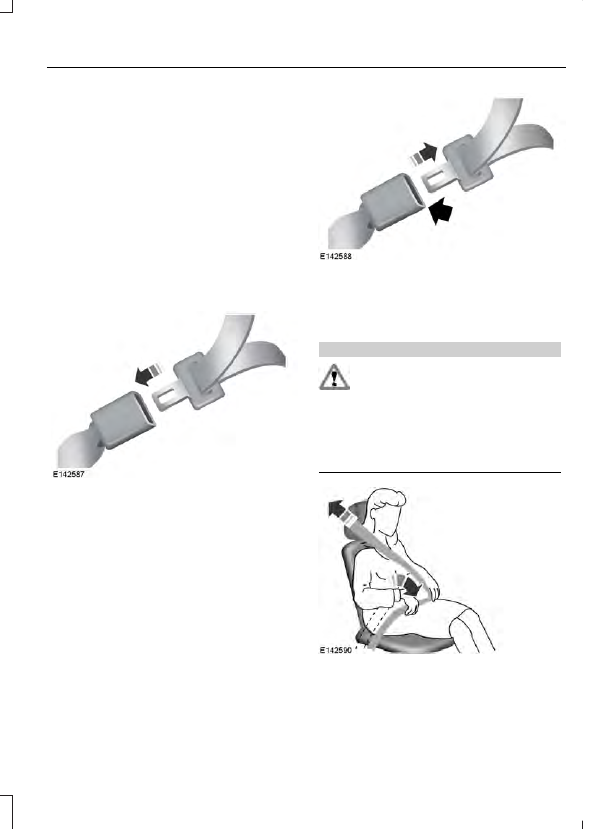
FASTENING THE SEATBELTS

Standard belts shown, inflatable belts
similar

The front outboard and rear safety
restraints in the vehicle are combination
lap and shoulder belts.

1.

Insert the belt tongue into the proper
buckle (the buckle closest to the
direction the tongue is coming from)
until you hear a snap and feel it latch.
Make sure you securely fasten the
tongue in the buckle.

2. To unfasten, press the release button

and remove the tongue from the
buckle.

Using Seatbelts During Pregnancy

WARNING

Always ride and drive with your
seatback upright and properly fasten
your seatbelt. Fit the lap portion of

the seatbelt snugly and low across the
hips. Position the shoulder portion of the
seatbelt across your chest. Pregnant
women must follow this practice. See the
following figure.

Pregnant women should always wear their
seatbelt.  Position the lap belt portion of a
combination lap and shoulder belt low
across the hips below the belly and worn
as tight as comfort allows.  Position the
shoulder belt to cross the middle of the
shoulder and the center of the chest.

Seatbelt Locking Modes

WARNING

If your vehicle is involved in a crash,
have the seatbelts and associated
components inspected as soon as

possible. Failure to follow this instruction
could result in personal injury or death.

All safety restraints in the vehicle are
combination lap and shoulder belts. The
driver seatbelt has the vehicle sensitive
locking mode. The front outboard
passenger and rear seatbelts have both
the vehicle sensitive locking mode and the
automatic locking mode.

Vehicle Sensitive Mode

This is the normal retractor mode, which
allows free shoulder belt length
adjustment to your movements and
locking in response to vehicle movement.
For example, if the driver brakes suddenly
or turns a corner sharply, or the vehicle
receives an impact of about 5 mph
(8 km/h) or more, the combination
seatbelts lock to help reduce forward
movement of the driver and passengers.

In addition, the retractor is designed to lock
if you pull the webbing out too quickly. If
the seatbelt retractor locks, slowly lower
the height adjuster to allow the seatbelt
to retract. If the retractor does not unlock,
pull the seatbelt out slowly then feed a

small length of webbing back toward the
stowed position. For rear seatbelts, recline
the rear seat backrest or push the seat
backrest cushion away from the seatbelt.
Feed a small length of webbing back
toward the stowed position.

Automatic Locking Mode

In this mode, the shoulder belt
automatically pre-locks. The belt still
retracts to remove any slack in the
shoulder belt. The automatic locking mode
is not available on the driver seatbelt.

When to Use the Automatic Locking
Mode

Use this mode when you install a child
safety seat, except a booster, in the
passenger front or rear seating positions.
Properly restrain children 12 years old and
under in a rear seating position whenever
possible.  See Child Safety (page 18).

How to Use the Automatic Locking
Mode

Non-inflatable seatbelts

1.

Buckle the combination lap and
shoulder belt.

2. Grasp the shoulder portion and pull

downward until you pull the entire belt
out. As the belt retracts, you will hear
a clicking sound. This indicates the
seatbelt is now in the automatic
locking mode.

Rear outboard inflatable seatbelts
(second row only–if equipped)

1.

Buckle the combination lap and
shoulder belt.

2. Grasp the lap portion of the belt and

pull upward until you pull the entire
belt out.

3. Allow the belt to retract. As the belt

retracts, you will hear a clicking sound.
This indicates the seatbelt is now in the
automatic locking mode.

How to Disengage the Automatic
Locking Mode

Unbuckle the combination lap and
shoulder belt and allow it to retract
completely to disengage the automatic
locking mode and activate the vehicle
sensitive (emergency) locking mode.

Rear Inflatable Seatbelt

 (If Equipped)

WARNING

Do not attempt to service, repair, or
modify the supplementary restraint
system or associated components.

Failure to follow this instruction could
result in personal injury or death.

The rear inflatable seatbelts are in the
shoulder portion of the seatbelts of the
second-row outboard seating positions.

Note: The rear inflatable seatbelts are
compatible with most infant and child
safety car seats and belt positioning booster
seats when you properly install them. This
is because they are designed to fill with a
cooled gas at a lower pressure and at a
slower rate than traditional airbags. After
inflation, the shoulder portion of the
seatbelt remains cool to the touch.

The rear inflatable seatbelt consists of the
following:

An inflatable bag in the shoulder
seatbelt webbing.

Lap seatbelt webbing with automatic
locking mode.

The same warning light, electronic
control and diagnostic unit as used for
the front seatbelts.

Impact sensors in various parts of the
vehicle.

How does the rear inflatable seatbelt
system work?

WARNING

If a supplementary restraint system
component has deployed, it will not
function again. Have the system and

associated components inspected as soon
as possible. Failure to follow this
instruction could result in personal injury
or death.

The rear inflatable seatbelts function like
standard restraints in everyday usage.

During a crash of sufficient force, the
inflatable belt inflates from inside the
webbing.

The fully inflated seatbelt's increased
diameter more effectively holds the
occupant in the appropriate seating
position, and spreads crash forces over
more area of the body than regular
seatbelts. This helps reduce pressure on
the chest and helps control head and neck
motion for passengers.

The rear inflatable seatbelts are designed
to inflate in frontal or near-frontal crashes,
side impact crashes and rollovers.  The fact
that the rear inflatable seatbelt did not
inflate in a crash does not mean that
something is wrong with the system.
Rather, it means the forces were not of the
type sufficient to cause activation.

SEATBELT HEIGHT
ADJUSTMENT

WARNING

Position the seatbelt height adjuster
so that the belt rests across the
middle of your shoulder. Failure to

adjust the seatbelt properly could reduce
the effectiveness of the seatbelt and
increase the risk of injury in a crash.

To adjust the shoulder belt height, squeeze
the button and slide the height adjuster up
or down. Release the button and pull down
on the height adjuster to make sure it is
locked in place.


Content   ..  6  7  8  9   ..