Ford Explorer (2018 year). Manual - part 6
 

  Index      Ford     Ford Explorer - service manual 2018 year in english


Search            


Content   ..  4  5  6  7   ..


Ford Explorer (2018 year). Manual - part 6


Second row bench seats and third row
passenger side

Perform the following steps to install a
child safety seat with tether anchors:

Note: If you install a child restraint with rigid
LATCH attachments, do not tighten the
tether strap enough to lift the child restraint
off your vehicle seat cushion when the child
is seated in it. Keep the tether strap just snug
without lifting the front of the child restraint.
Keeping the child restraint just touching your
vehicle seat gives the best protection in a
severe crash.

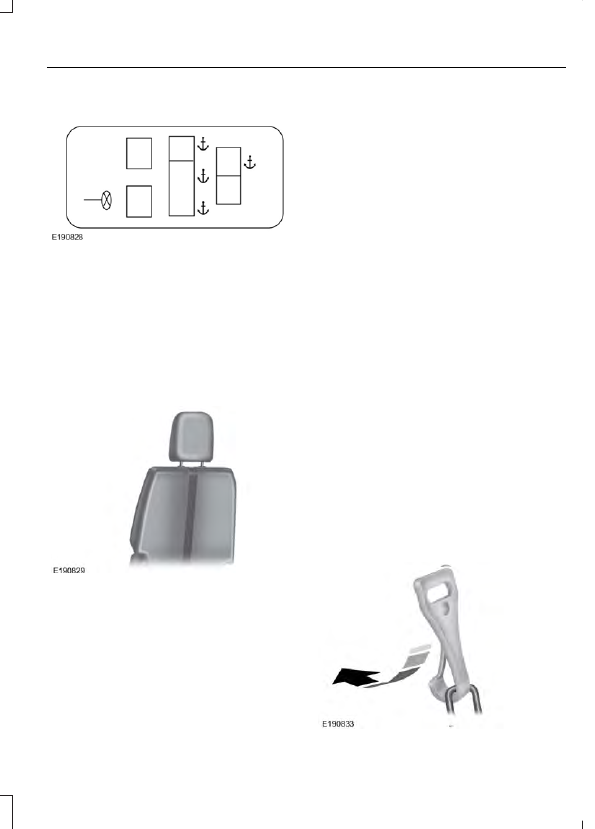
Placement of the tether strap

Second row outboard seat positions:
Route the child safety seat tether strap
over the seatback, under the head
restraint and between the head
restraint posts. If needed, remove the
head restraint to improve the fit of the
child safety seat or tether strap.

Second row center seat positions:
Route the child safety seat tether strap
over the top of the head restraint. If
needed, remove the head restraint to
improve the fit of the child safety seat
or tether strap.  See Head Restraints
(page 143).

Third row seat position: Route the child
safety seat tether strap over the seat
back, under the head restraint and
between the head restraint posts. If
needed, fold the head restraint down
to improve the fit of the child safety
seat or tether strap.  See Head
Restraints (page 143).

1.

Route the tether strap.

2. Locate the correct anchor for the

selected seating position.

3. Clip the tether strap to the anchor as

shown.  The tether hook may be
twisted ½ turn to improve installation.
If the tether strap is clipped incorrectly,
the child safety seat may not be
retained properly in the event of a
crash.

4. Tighten the child safety seat tether

strap according to the manufacturer's
instructions.

If the safety seat is not anchored properly,
the risk of a child being injured in a crash
greatly increases.

If your child restraint system has a tether
strap, and the child restraint manufacturer
recommends its use, we also recommend
its use.

Second row bucket (40/40)

Second row bench (60/40)

Third row seat

Note: The cargo tie downs at the rear edge
of the floor are not tether anchors.

BOOSTER SEATS

WARNING

Never place, or allow a child to place,
the shoulder belt under a child's arm
or behind the back because it

reduces the protection for the upper part
of the body and may increase the risk of
injury or death in a crash.

Note: Some booster seat safety belt guides
may not accommodate the shoulder portion
of the inflatable safety belt.

Use a belt-positioning booster seat for
children who have outgrown or no longer
properly fit in a child safety seat (generally
children who are less than 4 feet 9 inches
(1.45 meters) tall, are greater than age four
(4) and less than age twelve (12), and
between 40 pounds (18 kilograms) and
80 pounds (36 kilograms) and upward to
100 pounds (45 kilograms) if
recommended by your child restraint
manufacturer). Many state and provincial
laws require that children use approved
booster seats until they reach age eight, a
height of 4 feet 9 inches (1.45 meters) tall,
or 80 pounds (36 kilograms).

Booster seats should be used until you can
answer YES to ALL of these questions
when seated without a booster seat:

Can the child sit all the way back
against their vehicle seat back with
knees bent comfortably at the edge of
the seat cushion?

Can the child sit without slouching?

Does the lap belt rest low across the
hips?

Is the shoulder belt centered on the
shoulder and chest?

Can the child stay seated like this for
the whole trip?

Always use booster seats in conjunction
with your vehicle lap and shoulder belt.

Types of Booster Seats

Backless booster seats

If your backless booster seat has a
removable shield, remove the shield. If a
vehicle seating position has a low seat
back or no head restraint, a backless
booster seat may place your child's head
(as measured at the tops of the ears)
above the top of the seat. In this case,
move the backless booster to another
seating position with a higher seat back or
head restraint and lap and shoulder belts,
or consider using a high back booster seat.

High back booster seats

If, with a backless booster seat, you cannot
find a seating position that adequately
supports your child's head, a high back
booster seat would be a better choice.

Children and booster seats vary in size and
shape. Choose a booster that keeps the
lap belt low and snug across the hips,
never up across the stomach, and lets you
adjust the shoulder belt to cross the chest
and rest snugly near the center of the
shoulder. The following drawings compare

the ideal fit (center) to a shoulder belt
uncomfortably close to the neck and a
shoulder belt that could slip off the
shoulder. The drawings also show how the
lap belt should be low and snug across the
child's hips.

If the booster seat slides on the vehicle
seat upon which it is being used, placing a
rubberized mesh sold as shelf or carpet
liner under the booster seat may improve
this condition. Do not introduce any item
thicker than this under the booster seat.
Check with the booster seat
manufacturer's instructions.

CHILD RESTRAINT
POSITIONING

WARNINGS

Airbags can kill or injure a child in a
child seat. Never place a rear-facing
child seat in front of an active airbag.

If you must use a forward-facing child seat
in the front seat, move the vehicle seat
upon which the child seat is installed all


Content   ..  4  5  6  7   ..