Ford Escape Hybrid (2012 year). Manual - part 54
 

  Index      Ford     Ford Escape Hybrid - service manual 2012 year in english


Search            


Content   ..  52  53  54  55   ..


Ford Escape Hybrid (2012 year). Manual - part 54


When the accelerator pedal is released or the brake pedal is applied, the
brake controller automatically detects the amount of deceleration
requested and optimizes how much of the deceleration will be produced
by regenerative braking. The remaining portion is generated by standard
friction braking. When the battery is almost fully charged, the amount of
regenerative braking is limited to avoid overcharging, and the requested
deceleration is produced by standard friction braking alone.

Regenerative braking does not take the place of the standard friction
brakes; it only assists them. Regenerative braking has also been designed
to interact with the anti-lock brake system (ABS). Regenerative braking
is disabled when the ABS is activated or the battery is fully charged.

Parking brake

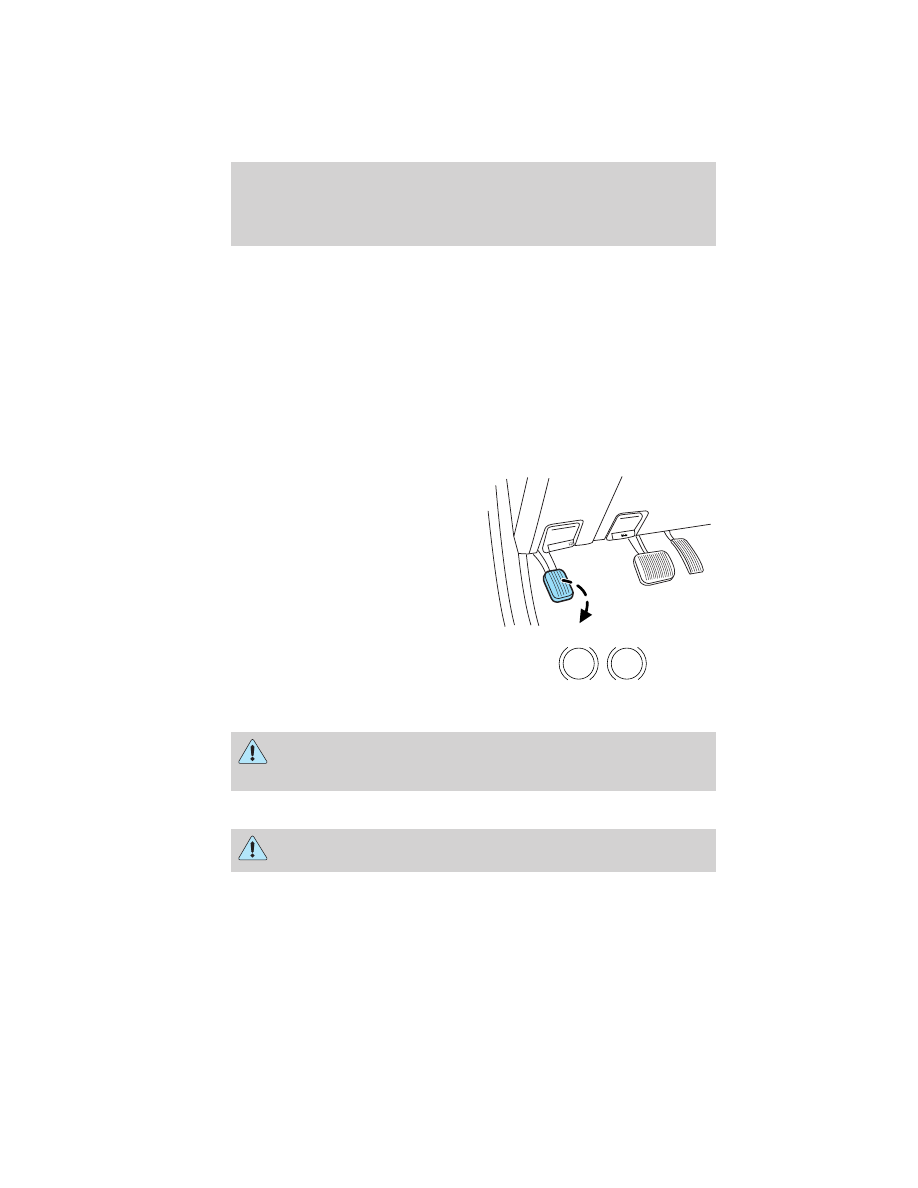
Apply the parking brake whenever
the vehicle is parked. To set the
parking brake, press the parking
brake pedal down until the pedal
stops.

The BRAKE warning lamp in the
instrument cluster illuminates and
remains illuminated (when the
ignition is turned on) until the
parking brake is released.

WARNING: If the parking brake is fully released, but the brake
warning lamp remains illuminated, the brakes may not be

working properly. See your authorized dealer.

WARNING: Always set the parking brake fully and make sure
that the gearshift is securely latched in P (Park).

BRAKE

 RELEA

SE  P


P

!

BRAKE

Driving

218

The parking brake is not recommended to stop a moving vehicle.
However, if the normal brakes fail, the parking brake can be used to stop
your vehicle in an emergency. Since the parking brake applies only the
rear brakes, the vehicle’s stopping distance will increase greatly and the
handling of your vehicle will be adversely affected.

Pull the release lever to release the
brake. Driving with the parking
brake on will cause the brakes to
wear out quickly and reduce fuel
economy.

ADVANCETRAC

姞 WITH ROLL STABILITY CONTROL™ (RSC)

STABILITY ENHANCEMENT SYSTEM

The AdvanceTrac

威 with RSC威 system provides the following stability

enhancement features for certain driving situations:
• Traction control (TCS), which functions to help avoid drive-wheel spin

and loss of traction

• Electronic stability control (ESC), which functions to help avoid skids

or lateral slides

• Roll Stability Control™ (RSC威), which functions to help avoid a

vehicle roll-over

WARNING: Vehicle modifications involving braking system,
aftermarket roof racks, suspension, steering system, tire

construction and/or wheel/tire size may change the handling
characteristics of the vehicle and may adversely affect the performance
of the AdvanceTrac

威 with RSC威 system. In addition, installing any

stereo loudspeakers may interfere with and adversely affect the
AdvanceTrac

威 with RSC威 system. Install any aftermarket stereo

loudspeaker as far as possible from the front center console, the
tunnel, and the front seats in order to minimize the risk of interfering
with the AdvanceTrac

威 with RSC威 sensors. Reducing the effectiveness

of the AdvanceTrac

威 with RSC威 system could lead to an increased risk

of loss of vehicle control, vehicle rollover, personal injury and death.

Driving

219

WARNING: Remember that even advanced technology cannot
defy the laws of physics. It’s always possible to lose control of a

vehicle due to inappropriate driver input for the conditions. Aggressive
driving on any road condition can cause you to lose control of your
vehicle increasing the risk of personal injury or property damage.
Activation of the AdvanceTrac

威 with RSC威 system is an indication that

at least some of the tires have exceeded their ability to grip the road;
this could reduce the operator’s ability to control the vehicle,
potentially resulting in a loss of vehicle control, vehicle rollover,
personal injury and death. If your AdvanceTrac

威 with RSC威 system

activates, SLOW DOWN.

WARNING: If a failure has been detected within the
AdvanceTrac

威 with RSC威 system, the stability control light will

illuminate steadily. Have the system serviced by an authorized dealer
immediately. Operating your vehicle with AdvanceTrac

威 with RSC威

disabled could lead to an increased risk of loss of vehicle control,
vehicle rollover, personal injury and death.

The AdvanceTrac

威 with RSC威 system automatically enables each time

the engine is started. All features of the AdvanceTrac

威 with RSC威 system

(TCS, ESC, and RSC

威) are active and monitor the vehicle from start-up.

However, the system will only intervene if the driving situation requires
it.

The AdvanceTrac

威 with RSC威

system includes a traction control
off button on the instrument panel
below the climate control, a stability
control “OFF” light and a stability control light in the instrument cluster.
The stability control light and stability control “OFF” light in the
instrument cluster will illuminate temporarily during start-up as part of a
normal system self-check, or during driving if a driving situation causes
the AdvanceTrac

威 with RSC威 system to operate. The stability control off

light will illuminate if traction control or trailer sway control are disabled
after pressing the TCS OFF switch. If the stability control light remains
steadily illuminated, have the system serviced by an authorized dealer
immediately.

Note: If the system cannot be turned off, refer to MyKey™ in the Locks
and Security 
chapter for more information.

Driving

220

When AdvanceTrac

威 with RSC威 performs a normal system self-check,

some drivers may notice a slight movement of the brake, and/or a
rumble, grunting, or grinding noise after startup and when driving off.

When an event occurs that activates AdvanceTrac

威 with RSC威, you may

experience the following:
• A slight deceleration of the vehicle
• The stability control light will flash.
• A vibration in the pedal when your foot is on the brake pedal
• If the driving condition is severe and your foot is not on the brake, the

brake pedal may move as the systems applies higher brake forces. You
may also hear a whoosh of air from under the instrument panel during
this severe condition.

• The brake pedal may feel stiffer than usual.
Traction control (TCS)

Traction control is a driver aid feature that helps your vehicle maintain
traction of the wheels, typically when driving on slippery and/or hilly
road surfaces, by detecting and controlling wheel spin.

Excessive wheel spin is controlled in two ways, which may work
separately or in tandem: engine traction control and brake traction
control. Engine traction control works to limit drive-wheel spin by
momentarily reducing engine power. Brake traction control works to limit
wheel spin by momentarily applying the brakes to the wheel that is
slipping. Traction control is most active at low speeds.

During traction control events, the stability control light in the
instrument cluster will flash.

If the traction control system is activated excessively in a short period of
time, the braking portion of the system may become temporarily disabled
to allow the brakes to cool down. In this situation, traction control will
use only engine power reduction or transfer to help control the wheels
from over-spinning. When the brakes have cooled down, the system will
regain all features. Anti-lock braking, RSC

威, and ESC are not affected by

this condition and will continue to function during the cool-down period.

Driving

221


Content   ..  52  53  54  55   ..