Fiat 500 Hybrid (2020 year). Manual in english - page 6
 

  Index      Manuals     Fiat 500 Hybrid (2020 year). Manual in english


Search            copyright infringement  


Content      ..     4      5      6      7     ..


Fiat 500 Hybrid (2020 year). Manual in english - page 6


 SAFETY

88

83

F0S0106

Important notes

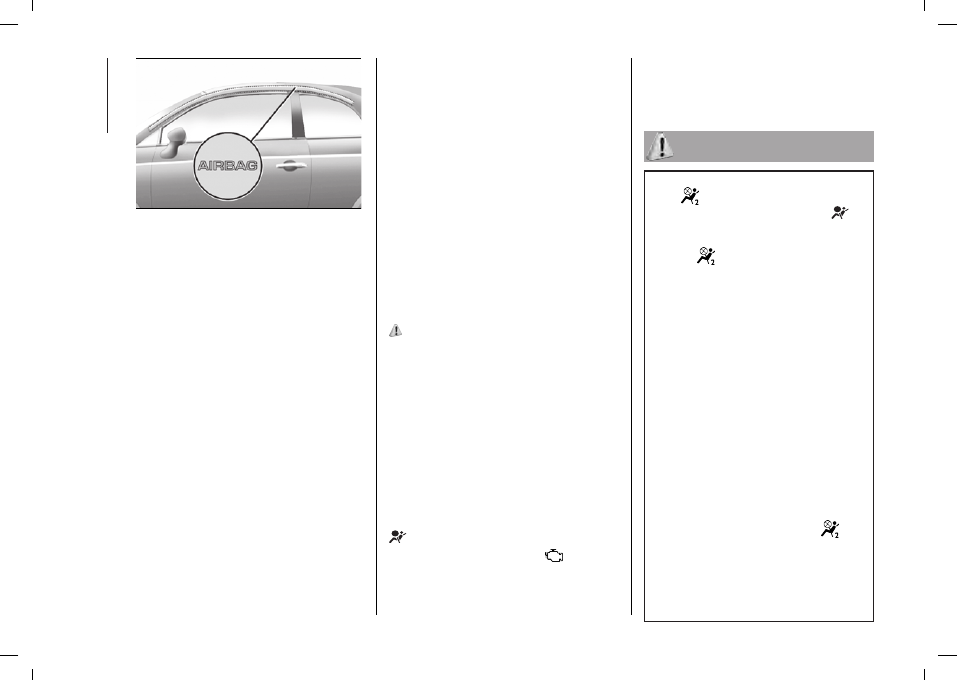
In the event of a side impact, the

system provides best protection if the

passenger sits on the seat in a correct

position, thus allowing correct window

bag deployment.
The front airbags and/or side bags may

be deployed if the car is subject to

heavy knocks or accidents involving

the underbody area, such as for

example violent shocks against steps,

pavements or low obstacles, the car

falling in big holes or dips in the road.
A small amount of dust will be released

when the airbags are deployed.

The dust is not harmful and does

not indicate the beginning of a fire.

Furthermore, the surface of the

deployed bag and the interior of the car

may be covered by a dusty residue:

this may irritate skin and eyes. Wash

with mild soap and water in the event

of exposure. Every control, repair and

replacement operation concerning the

airbags must only be carried out at a

Fiat Dealership. If the car is scrapped,

have the system deactivated at a Fiat

Dealership.
Pretensioners, front airbags and side

bags are deployed according to

different logics on the basis of the type

of crash. Failure to activate one or

more of the devices does not indicate a

system malfunction.
Should an accident occur in which any

of the safety devices are activated, take

the car to a Fiat Dealership to have the

activated devices replaced and to have

the whole system checked.

106) 107) 108) 109) 110) 111) 112) 113) 114) 115) 116)

117)

AUXILIARY BATTERY

DISCONNECTION

WARNING In the event of a collision

that is serious enough to trigger

the airbag, the auxiliary battery is

automatically disconnected from the

electrical system in order to prevent

short circuits and/or fires.

In this case, the airbag warning light

will turn on together with the

engine failure warning light

on the

instrument panel.

Contact a Fiat Dealership as soon as

possible to have the electrical system

checked.

103)

In some versions, in case of LED

failure

(located on the plate of the

instrument panel), the warning light

on

the console turns on and the passenger

side airbags are deactivated.

104)

The

warning light indicates the

passenger airbag protection status. If

the warning light is off, passenger side

protection is active: to deactivate it, use

the Setup Menu (in this case the LED lights

up). When the car is started (ignition key

turned to MAR position), the warning light

turns on for about 8 seconds, provided

that at least 5 seconds have elapsed from

when it was switched off. If not, contact a

Fiat Dealership. If the engine is switched

off/on again in less than 5 seconds the

warning light may remain off. In this case,

to check correct warning light operation,

switch the engine off, wait for at least 5

seconds and switch the engine on again.

The warning light may light up with various

intensity levels depending on the vehicle

conditions. The intensity may also vary

during the same key cycle. When the
ignition key is turned to MAR, the

warning light switches for few seconds,

then if the passenger airbag is active it

should switch off.

105)

If a child must be carried on the front

seat in a rearward facing child restraint

system, it is compulsory to deactivate the

-------------------------------------------------------------------------------------------------------------------------------------------------------------

89

passenger side front airbag, making sure

that it is deactivated by checking the

dedicated warning light on the instrument

panel. Move the passenger's seat as

far back as possible to avoid contact

between the child restraint system and the

dashboard.

106)

Malfunction of the

warning light

is indicated by the activation of an airbag

failure symbol and a dedicated message

on the instrument panel display (or, for

versions where provided, by the activation

of a blinking generic failure warning light).

In this case, the

warning light may not

indicate a possible problem with the airbag

restraint system. Contact a Fiat Dealership

immediately to have the system checked.

107)

Do not use seatcovers on front seats

featuring side airbags.

108)

Do not travel with objects in your lap,

in front of your chest or held in your mouth

(e.g., pipe, pencil etc.). They could cause

severe injury if the airbag is deployed in a

crash.

109)

If the car has been stolen or in the

case of attempt to steal it, if it has been

subjected to vandalism or floods, have

the airbag system checked by a Fiat

Dealership.

110)

The airbags may also be deployed

when the car is not moving if it is hit by

another moving car when the ignition

key is inserted and turned to MAR, even

if the engine is off. Therefore, even if the

vehicle is stationary, when an active front

passenger airbag is fitted, DO NOT install

rearward facing child restraint systems

on the front passenger seat. Deployment

of the airbag following an impact could

cause fatal injuries to the child. Therefore,

always deactivate the passenger side

airbag when a rearward facing child

restraint system is installed on the front

passenger seat. The front passenger seat

must also be positioned back as far as

possible in order to prevent the child

restraint system from coming into contact

with the dashboard. Immediately reactivate

the passenger airbag as soon as the child

restraint system has been removed. Also

remember that, if the key is turned to

STOP, none of the safety devices (airbags

or pretensioners) will be deployed in the

event of collision. Non-deployment in

such cases does not indicate a system

malfunction.

111)

When the ignition key is turned to

MAR, the

warning light switches for

few seconds, then if the passenger airbag

is active it should switch off.

112)

Do not wash the seats with water or

pressurised steam (wash by hand or at

automatic seat washing stations).

113)

The airbag deployment threshold

is higher than that of the pretensioners.

For collisions in the range between the

two thresholds, it is normal for only the

pretensioners to be activated.

114)

Do not affix rigid objects to the coat

hooks or support handles.

115)

The airbag does not replace seat

belts but increases their efficiency.

Furthermore, since front airbags are not

deployed in low-speed frontal impacts,

side impacts, rear shunts or roll-overs, the

passengers are protected only by the seat

belts which must therefore be fastened at

all times.

116)

Do not rest your head, arms or

elbows on the door, on the windows or

in the window bag area to prevent injury

during deployment.

117)

Never lean your head, arms or

elbows out of the window.

-------------------------------------------------------------------------------------------------------------------------------------------------------------

 STARTING AND DRIVING

90

STARTING AND DRIVING

Let’s get to the core of the vehicle:

seeing how you can exploit all of its

potential to the full.
We’ll look at how to drive it safely in any

situation, so that it can be a welcome

companion, with our comfort and our

wallets in mind.

STARTING THE ENGINE ............... 91
PARKING THE VEHICLE ............... 91
MANUAL TRANSMISSION ............ 92
DUALDRIVE ELECTRIC POWER

STEERING .................................. 93
HYBRID SYSTEM......................... 94
START&STOP SYSTEM

(EXTENDED S&S) ......................... 94
SPEED LIMITER........................... 96
ELECTRONIC CRUISE

CONTROL .................................. 97
PARKING SENSORS .................... 98
SUGGESTIONS FOR DRIVING ..... 100
REFUELLING THE CAR .............. 101

-------------------------------------------------------------------------------------------------------------------------------------------------------------

91

STARTING THE

ENGINE

118) 119)

28) 29) 30) 31)

Before starting the engine, adjust the

seat, the interior rear view mirrors, the

door mirrors and fasten the seat belt

correctly. Never press the accelerator

pedal for starting the engine. The

Start&Stop function is activated

whenever the engine is started.

Starting the engine

Proceed as follows:

engage the handbrake and put the

gear lever in neutral;

fully depress the clutch pedal without

touching the accelerator;

turn the ignition key to AVV and

release it as soon as the engine starts.

If the engine does not start at the first

attempt, return the ignition key to

STOP before repeating the starting

procedure.
If, with key at MAR, the

warning

light or symbol on the display stays on
together with the

warning light, it

is advisable to turn the key to STOP

and then back to MAR. If the warning

light remains on, try with the other keys

provided with the car.

Contact a Fiat Dealership if you still

cannot start the engine.

118)

It is dangerous to run the engine in

enclosed areas. The engine consumes

oxygen and engine exhaust contains

carbon dioxide, carbon monoxide and

other toxic gasses.

119)

The brake servo is not active until the

engine is started, so you would need to

apply much more force than usual to the

brake pedal.

28)

It is advisable not to demand

maximum performance from your car (e.g.

excessive acceleration, long distances

at maximum rpm, excessively intense

braking, etc.) when it is first used.

29)

When the engine is off, never leave

the key turned to MAR to prevent useless

current absorption from draining the

conventional battery.

30)

Never, under any circumstances, jump

start the engine by pushing, towing or

coasting downhill. This could cause fuel

to flow into the catalytic converter and

damage it beyond repair.

31)

A quick burst on the accelerator before

stopping the engine serves no practical

purpose; it wastes fuel and is especially

damaging to turbocharged engines.

PARKING THE

VEHICLE

When parking and leaving the car,

proceed as follows:

engage a gear (1st gear if facing

uphill or reverse if facing downhill) and

leave the wheels turned;

stop the engine and engage the

handbrake;

always remove the ignition key.

Block the wheels with a wedge or a

stone if the car is parked on a steep

slope. Do not leave the ignition key at

MAR to avoid draining the conventional

battery. Always remove the key when

you leave the car.

WARNING NEVER leave the vehicle

with the gearbox in neutral.

HANDBRAKE

120) 121) 122)

The handbrake lever fig. 84 is located

between the two front seats.

-------------------------------------------------------------------------------------------------------------------------------------------------------------

 STARTING AND DRIVING

92

84

F0S0048

Handbrake engagement

To use the handbrake pull the lever

upwards until the car cannot be

moved. When the handbrake is on

and the ignition key is at MAR, the

instrument panel warning light

will

come on.

Handbrake disengagement

Proceed as follows to release the

handbrake:

slightly lift the lever and press release

button (A) fig. 84;

keep the button (A) pressed and

lower the lever. The

warning light in

the instrument panel will switch off.

Press the brake pedal when carrying

out this operation to prevent the car

from moving accidentally.

120)

The car should be braked after a few

clicks of the lever, if it is not, contact a Fiat

Dealership to have it adjusted.

121)

Never leave children unattended in

the car. Always remove the key from the

ignition when leaving the car and take it

with you.

122)

In the case of parking manoeuvres

on roads on a gradient, the front wheels

must be steered towards the pavement

(when parking downhill), or in the opposite

direction if the car is parked uphill. Block

the wheels with a wedge or a stone if the

car is parked on a steep slope.

MANUAL

TRANSMISSION

123)

32)

To engage the gears, press the clutch

pedal fully and put the gear lever into

the required position (the diagram for

gear engagement is shown on the grip

fig. 85).

85

F0S0694

To engage 6th gear, operate the lever

by pressing it towards the right in order
to avoid engaging 4th gear by mistake.
The same applies to the shift from 6th
to 5th gear.

To engage reverse R from neutral, lift

the sliding ring (A) fig. 85 under the

knob and at the same time move the

lever to the rightwards and then back.

WARNING Reverse can only be

engaged when the car is completely

stationary. With the engine running,

wait for at least 2 seconds with the

clutch pedal fully depressed before

engaging reverse to prevent damage to

the gears and grating.

WARNING The clutch pedal should

be used only for gear changes. Do

not drive with your foot resting on

the clutch pedal, however lightly. For

-------------------------------------------------------------------------------------------------------------------------------------------------------------

93

versions/markets where provided, the

electronic clutch control could cut in,

interpreting the incorrect driving style

as a fault.

WARNING While driving in 6th

gear, if you decelerate enough to
require shifting down to 5th gear, we

recommend doing so to facilitate

accelerating later.

NOTE 6th gear is for cruising. Use 5th

gear to reach the top speed.

123)

Press the clutch pedal fully to shift

gears correctly. It is therefore essential that

there is nothing under the pedals: make

sure the mats are lying flat and do not get

in the way of the pedals.

32)

Do not drive with your hand resting on

the gear lever as the force exerted, even if

slight, could lead over time to premature

wear of the gearbox internal components.

DUALDRIVE

ELECTRIC POWER

STEERING

(for versions/markets, where provided)

Turning on/off (CITY function)

Press button (A) fig. 86 to turn the

function on/off.

86

F0S0698

When the function is active, the CITY

text on the display turns on.

When the CITY function is on, the

steering wheel effort is lighter, making

parking easier: therefore, this function

is particularly useful for driving in city

centres.

To deactivate the function press the

button again.

124) 125)

124)

It is absolutely forbidden to carry

out any after-market operation involving

steering system or steering column

modifications (e.g.: installation of

anti-theft device) that could badly affect

performance and safety, invalidate

the warranty and also result in non-

compliance of the car with type-approval

requirements.

125)

Before starting any servicing

operation, stop the engine and remove

the key from the ignition switch to operate

the steering lock, particularly when the

wheels do not touch the ground. If this is

not possible (for example if the key needs

to be turned to MAR or the engine must

be running), remove the main fuse that

protects the electric power steering.

-------------------------------------------------------------------------------------------------------------------------------------------------------------

 STARTING AND DRIVING

94

HYBRID SYSTEM

Your car is provided with a hybrid

system, which uses an electric motor

that is mechanically coupled to the

thermal engine (via a dedicated belt)

and powered by an auxiliary lithium

battery (12 V). The electric motor

contributes to driving the car forward

together with the heat engine when

there is a certain acceleration request,

and charges the lithium battery when

the car decelerates.

The hybrid system uses a BSG (Belt

Starter Generator) electric motor

working both as a generator (alternator)

and as a starter motor.

NOTE The system does not operate

continuously, but is activated according

to the car status, driving conditions

(acceleration, braking, deceleration

and starting) and road conditions (e.g.

gradient).

ENERGY RECOVERY

DURING DECELERATION

("e-COASTING"/"e-BRAKING"

functions)

During deceleration with a gear

engaged, the BSG (Belt Starter

Generator) recharges the lithium

auxiliary battery and the traditional lead

battery. When the accelerator pedal

is released with the gear is engaged,

the BSG acts as an engine brake (e-

COASTING function). This contribution

is increased by pressing the brake

pedal at the same time (e-BRAKING

function). The recovered energy is

made available later, helping to save

fuel.
NOTE If the conventional battery is

flat, there is no energy recovery to

the auxiliary battery, and so the Trip

Computer "Energy Flows" screen on

the instrument panel (for versions with

colour display only) does not display

the relative recharging flows.

ACCELERATION ASSIST

FUNCTION ("e-ASSIST"

function)

In general, during pickup from low

engine speeds, the hybrid system

shares the torque between the electric

motor and thermal engine when

necessary, thereby reducing the output

power of the thermal engine in order to

optimise consumption.

HEAT ENGINE RESTART

BY START&STOP

("EXTENDED S&S"

FUNCTION)

The new system automatically switches

the thermal engine on and off using

the Start&Stop ("EXTENDED S&S")

function. In this way, the efficiency

of the car is increased, by reducing

consumption, harmful gas emissions

and noise pollution. Furthermore, the

Start&Stop system restarts the thermal

engine using the electric motor (BSG),

resulting in a quieter restart than that

achieved by starting the thermal engine

using the starter motor.

START&STOP

SYSTEM (EXTENDED

S&S)

126) 127) 128)

33)

The Start&Stop system automatically

turns off the engine whenever:

the car is decelerating and is about

to stop,

or:

the car is stationary.

The system restarts the engine then the

driver intends to continue driving.

In this way, the vehicle efficiency is

increased, by reducing consumption,

dangerous gas emissions and sound

pollution.

OPERATING MODE

Stopping the engine

When the speed drops below 30 km/h

and the conditions permit, the GSI

-------------------------------------------------------------------------------------------------------------------------------------------------------------

95

(Gear Shift Indicator) may advise

shifting to neutral (N) by displaying

the letter "N" on the instrument panel

display. If the conditions permit, the

heat engine turns off after shifting to

neutral in order to reduce consumption.
Stopping of the engine is indicated
by the warning light or the symbol

on the instrument panel switching on

(on some versions, together with a

message on the display).
When the speed varies in the above

condition with the engine off, the

GSI system advises the best gear to

engage if you operate the clutch to

restart the engine.

Restarting the engine

Press the clutch pedal.
For further information about the GSI

display, see the "Display" paragraph

of the "Knowing the instrument panel"

chapter.

MANUAL SYSTEM

ACTIVATION/

DEACTIVATION

The system can be

activated/deactivated by pressing the

button (A) fig. 87 on the dashboard.
With the system off, the warning light
or the symbol

appear on the

instrument panel (with a message for

versions with colour display).
Start&Stop mode will be active

whenever the engine is started.

87

F0S0519

MISSED ENGINE

STOPPING CONDITIONS

When the system is active, for a higher

comfort and safety, and to reduce

emissions, the engine does not stop in

some conditions, such as:

engine still cold

especially cold outside temperature

batteries not sufficiently charged

driver's door not shut

driver's seat belt not fastened

reverse gear engaged (for example,

for parking manoeuvres)

for versions with automatic climate

control, if a suitable thermal comfort

level has not yet been reached or to

enable MAX-DEF function

during the first period of use, to

initialise the system.
In the above cases, a message

appears on the display and (for

versions/markets where provided) the

warning light or the symbol

flash on

the instrument panel.

ENGINE RESTARTING

CONDITIONS

For reasons of comfort, limiting harmful

emissions and safety purposes, the

power unit can restart automatically

without any action by the driver if

certain conditions are met, including:

batteries not sufficiently charged

reduced braking system vacuum

(e.g. if the brake pedal is pressed

repeatedly)

car moving (e.g. when driving on

roads with a gradient)

engine stopping by Start&Stop

system for over 3 minutes

for versions equipped with automatic

climate control, to enable suitable

thermal comfort or with MAX-DEF

activation.
With a gear engaged, the engine can

be automatically restarted only by fully

depressing the clutch pedal.
The operation is indicated to the driver

by a message which appears on the

display and, where provided, by the
warning light or by the symbol

on

the instrument panel.
NOTE If the clutch is not pressed, after

3 minutes from the engine stopping,

the engine can be restarted only using

the ignition key.

-------------------------------------------------------------------------------------------------------------------------------------------------------------

 STARTING AND DRIVING

96

NOTE In cases of undesired engine

stops, due for example to the clutch

pedal being released abruptly with

a gear engaged, if the Start&Stop

system is activated, the engine can be

restarted by fully depressing the clutch

pedal or by placing the gear lever in

neutral.

126)

If the conventional battery needs

to be replaced, always contact a Fiat

Dealership. Replace the battery with a new

one of the same type (EFB - Enhanced

Flooded Battery) and specifications.

127)

Before opening the bonnet, make

sure the engine is off and the ignition key is

in the STOP position. Please follow the

instructions on the decal near the front

crossmember. We recommend that you

remove the key from the ignition if other

people remain in the vehicle. Exit from the

vehicle only after having removed the

ignition key or having rotated it to the

STOP position. During refuelling, make

sure that the engine is off and that the

ignition key is in the STOP position.

128)

We recommend that you remove the

key from the ignition if other people remain

in the vehicle. Exit from the car only after

having removed the ignition key or having

rotated it to the STOP position. During

refuelling, make sure that the engine is off

and that the ignition key is in the STOP

position.

33)

If climate comfort is to be favoured,

the Start&Stop system can be deactivated,

for a continuous operation of the climate

control system.

SPEED LIMITER

(for versions/markets, where provided)

ACTIVATING THE DEVICE

To activate the device, turn ring (C)
fig. 88 to position

.

88

F0S0624

When the device is enabled, it is

indicated by the

symbol being

shown on the display along with the

last speed set.

SPEED LIMIT

PROGRAMMING

The minimum speed that can be set is

30 km/h.
Turn on the speed limiter by turning the
ring (C) to the

position. The speed

limit can be programmed without

necessarily activating the device.

To store a speed value higher than

that displayed

Turn the ring (B) fig. 88 upwards (SET

+ position). On releasing the ring B, the

speed increments by 1 km/h. Holding

it in the SET + position, the speed

continuously increments in steps of

5 km/h.

To store a speed value lower than

that displayed

Turn the ring B downwards (SET-

position). On releasing the ring B, the

speed decrements by 1 km/h. Holding

it in the SET - position, the speed

continuously decrements in steps of 5

km/h.

DEVICE

ACTIVATION/

DEACTIVATION

Activating the device

press and release button (A)

(CANC/RES) fig. 88 or,

if the car speed is in the range 30 to

130 km/h, turn the ring (B) upwards or

downwards.

-------------------------------------------------------------------------------------------------------------------------------------------------------------

97

The function is activated with the

current speed set as the speed limit.

Device activation is indicated by the
symbol

being shown on the display

along with the last speed limit set.

Deactivating the device

Press button (A) (CANC/RES) fig. 88.
Device deactivation is indicated by the

set being replaced by the word CANC.

Reactivating the device

press and release button (A)

(CANC/RES) fig. 88 or,

if the car speed is in the range 30 to

130 km/h, turn the ring (B) upwards or

downwards.

EXCEEDING THE

PROGRAMMED SPEED

By fully depressing the accelerator

pedal, the programmed speed can be

exceeded even with the device active

(e.g. in the event of overtaking).
The device is disabled until the speed

drops below the set limit, after which it

reactivates automatically.
NOTE It is advisable to decelerate

to a speed at least 5 km/h below

that programmed limit. Otherwise,

the acoustic warning may activate to

warn that the speed limit has been

exceeded.

FLASHING OF

PROGRAMMED SPEED

The programmed speed flashes in the

following cases:

when the accelerator pedal has

been fully depressed and the car has

exceeded the programmed speed;

activating the system after setting a

limit below the effective vehicle speed

(with acoustic warning);

when the device cannot reduce the

vehicle speed due to the gradient of the

road (with acoustic warning);

in the event of sharp acceleration.

DEACTIVATING THE

DEVICE

To activate the device, turn ring (C)

fig. 88 to position 0.

Automatic off of the device

The device deactivates automatically in

the event of fault in the system. In this

case, contact a Fiat Dealership.

AUTOMATIC RESET OF

THE PROGRAMMED

SPEED

With the Speed Limiter enabled,

pressing button (A) (CANC/RES) fig. 88

at a higher speed than the set value,

the engine torque will be reduced as

required to reach that value, if it was

not reached within 20 seconds from

pressing the button.

ELECTRONIC

CRUISE CONTROL

(for versions/markets, where provided)

This device can be used at speeds

higher than 30 km/h

ACTIVATING THE DEVICE

129) 130) 131)

To activate the device, turn ring (C)
fig. 89 to position

. Device activation

is indicated by the

symbol lighting

up.

89

F0S0624

The device cannot be engaged in
1st or reverse gear: it is advisable to
engage it in 3rd gear or higher.

WARNING It is dangerous to leave the

device on when it is not used. There

is a risk of inadvertently activating it

and losing control of the car due to

unexpected excessive speed.

-------------------------------------------------------------------------------------------------------------------------------------------------------------

 STARTING AND DRIVING

98

SETTING THE DESIRED

SPEED

Proceed as follows:

activate the device by turning the ring

(C) fig. 89 downwards.

when the vehicle has reached

the desired speed, turn the ring (B)

upwards (or downwards) and release

it to activate the device. When the

accelerator is released, the vehicle will

automatically maintain the selected

speed.
If needed (e.g. when overtaking), you

can increase speed simply by pressing

the accelerator; when you release the

pedal, the car goes back to the speed

stored previously.
When travelling downhill with the device

active, the vehicle speed may slightly

exceed the set one.

WARNING Before turning the ring (B)

upwards or downwards, the vehicle

must travel at a constant speed on

level ground.

INCREASING SPEED

Once the electronic Cruise Control

has been activated, the speed can

be increased by turning the ring (B)

upwards.

DECREASING SPEED

To decrease the speed with the device

activated, turn the ring (B) downwards.

RECALLING THE SPEED

Before returning to the previously set

speed, you need reach a speed close

to it, and then press the button (A)

(CANC/RES) and release it.

DEACTIVATING THE

DEVICE

Lightly pressing the brake pedal or

pressing button (A) (CANC/RES)

deactivates the electronic Cruise

Control without deleting the stored

speed.
Changing gear deactivates the Cruise

Control.

DEACTIVATING THE

DEVICE

The electronic Cruise Control is

disabled by turning the ring (C) fig. 89

to the 0 position or putting the ignition

device at STOP

129)

While driving with the device active,

never move the gear lever to neutral.

130)

In case of a malfunction or failure of

the device, contact a Fiat Dealership.

131)

The electronic Cruise Control can

be dangerous if the system cannot keep

a constant speed. In specific conditions

speed may be excessive, resulting in the

risk of losing control of the vehicle and

causing accidents. Do not use the device

in heavy traffic or on winding, icy, snowy or

slippery roads.

PARKING SENSORS

(for versions/markets, where provided)

132)

34) 35)

SENSORS

Parking sensors are located in the rear

bumper fig. 90 and detect and inform

the driver, through an intermittent

acoustic signal, of the presence of

obstacles at the rear of the car.

90

F0S0578

-------------------------------------------------------------------------------------------------------------------------------------------------------------

99

warning varies as the distance of the

obstacle from the bumper varies. The

frequency of the acoustic warning:

increases as the distance between

car and obstacle decreases

becomes continuous when the

distance between the car and the

obstacle is less than 30 cm and stops

immediately if the distance increases

is constant if the distance between

the vehicle and the obstacle is

unchanged. If this situation concerns

the side sensors, the signal will stop

after approximately 3 seconds to avoid,

for example, indications in the event of

manoeuvres along a wall.
If several obstacles are detected by

the sensors, only the nearest one is

considered.

INDICATIONS ON

DISPLAY

(versions with colour display)
When the sensors are activated, the

screen in fig. 91 appears on the

display.

91

F0S0558

The system indicates a detected

obstacle by displaying an arc according

to the distance of the obstacle and its

position in relation to the car.
When the system detects an obstacle,

an arc appears in one or more

positions according to the distance of

the obstacle from the car. If an object is

detected in the rear left, central or right

zone, the display shows a flashing arc

in the corresponding zone and a sound

is emitted.
As the car approaches the object, the

display shows one or more flashing

arcs that approach the car, and the

sound becomes more frequent until it

becomes continuous.
The colour on the display depends

on the distance from and position

of the obstacle. The car is close to

the obstacle when a blinking red

arc appears on the display (to the

right, in the centre or to the left) and a

continuous sound is emitted. If there

are several obstacles, the closest one

is indicated.

FAULT INDICATIONS

Any parking sensor faults will be

indicated when reverse is engaged
by the

warning light or the

icon (for versions with colour display)

on the instrument panel and by the

relevant message on the display (for

versions/markets, where provided).

132)

Parking and other dangerous

manoeuvres are, however, always the

driver’s responsibility. While carrying out

these manoeuvres, always make sure that

no people (especially children) or animals

are in the area concerned. The parking

sensors are an aid for the driver, but the

driver must never allow their attention

to lapse during potentially dangerous

manoeuvres, even those executed at low

speeds.

34)

For correct operation of the system,

sensors must always be clean from mud,

dirt, snow or ice. Be careful not to scratch

or damage the sensors while cleaning

them. Avoid using dry, rough or hard

cloths. The sensors must be washed using

clean water, with the addition of vehicle

ACOUSTIC WARNING

When reverse gear is engaged and

there is an obstacle behind the car an

acoustic warning is activated and the

-------------------------------------------------------------------------------------------------------------------------------------------------------------

 STARTING AND DRIVING

100

shampoo if necessary. When using special

washing equipment such as high pressure

jets or steam cleaning, clean the sensors

very quickly keeping the jet more than 10

cm away.

35)

Have interventions on the bumper in

the area of the sensors carried out only

by a Fiat Dealership. Interventions on the

bumper that are not carried out properly

may compromise the operation of the

parking sensors.

SUGGESTIONS FOR

DRIVING

SAVING FUEL

Below are some suggestions which

may help you save fuel and thus lower

the amount of harmful emissions

released into the atmosphere.

Vehicle maintenance

Checks and operations should be

carried out in accordance with the

"Scheduled Servicing Plan" (see the

"Maintenance and care" chapter).

Tyres

Check the tyre pressures at least once

every four weeks: if the pressure is too

low, consumption levels increase as

resistance to rolling is higher.

Unnecessary loads

Do not travel with an overloaded

luggage compartment. The weight of

the vehicle and its arrangement greatly

affect fuel consumption and stability.

Roof rack/ski rack

Remove the roof rack or the ski rack

from the roof when they are not used.

These accessories lower aerodynamic

penetration and adversely affect

consumption levels.

Electric devices

Use electrical devices only for the

amount of time needed. The heated

rear window, windscreen wipers and

heater fan require a considerable

amount of energy; increasing

the current uptake increases fuel

consumption (by up to +25% in an

urban cycle).

Climate control system

Using the climate control system will

increase consumption: use standard

ventilation when the temperature

outside permits.

Devices for aerodynamic control

The use of non-certified devices for

aerodynamic control may adversely

affect air drag and consumption levels.

DRIVING STYLE

Start

Do not warm up the engine at low or

high revs when the car is stationary;

this causes the engine to warm up

more slowly, thereby increasing

fuel consumption and emissions. It

is therefore advisable to move off

immediately, slowly, avoiding high

speeds: in this way the engine will

warm up more quickly.

Unnecessary actions

Avoid revving up when starting at traffic

lights or before stopping the engine.

The latter action, as well as double-

declutching, is unnecessary and

causes increased fuel consumption

and pollution.

Gear selection

Use a high gear when traffic and road

conditions allow it. Using a low gear

for faster acceleration will increase

fuel consumption. In the same way,

improper use of a high gear increases

consumption, emissions and engine

wear.

Top speed

Fuel consumption considerably

increases as speed increases.

Maintain a constant speed, avoiding

unnecessary braking and acceleration,

which cost in terms of both fuel

consumption and emissions.

-------------------------------------------------------------------------------------------------------------------------------------------------------------

101

Acceleration

Accelerating violently severely

affects consumption and emissions:

acceleration should be gradual and

should not exceed the maximum

torque.

CONDITIONS OF USE

Cold starting

Short journeys and frequent cold

starts do not allow the engine to reach

optimum operating temperature.

Consequently, both consumption (from

+15 to +30% on the urban cycle) and

emissions will increase.

Traffic and road conditions

High fuel consumption is caused

by heavy traffic, for instance when

travelling in a queue with frequent use

of low gears or in cities with many

traffic lights. Winding mountain roads

and rough road surfaces also adversely

affect consumption.

Stops in traffic

During prolonged hold-ups (e.g. level

crossings) switch off the engine.

REFUELLING THE

CAR

133) 134) 135)

Before refuelling, make sure that the

fuel type is correct. Also stop the

engine before refuelling.

PETROL VERSIONS

Only use unleaded petrol with a

number of octanes (R.O.N.) not lower

than 95 (EN228 specification).

WARNING An inefficient catalytic

converter leads to harmful exhaust

emissions, thus contributing to air

pollution.

WARNING Never introduce leaded

petrol to the tank, even in small

amounts in an emergency, as this

would damage the catalytic converter

beyond repair.

REFUELLING CAPACITY

To ensure that you fill the tank

completely, top up twice after the first

click of the fuel supply gun. Further

top-ups could cause faults in the fuel

feeding system.

FUEL TANK CAP

The cap (B) fig. 92 is fitted with a loss-

prevention device that secures it to the

flap (A) so that it cannot be lost.

92

F0S0678

Refuelling procedure

To unscrew the cap (B) you must first

open the flap (A). The sealing may

cause a slight pressure increase in

the tank. A little breathing off, while

slackening the cap is absolutely

normal.
When refuelling, fasten the cap to the

device inside the flap as in fig. 92.

Fuel - Car compatibility

identification -

Graphic symbol to

inform consumers

in accordance with

EN16942

The symbols shown below facilitated

recognising the correct fuel type to be

used on your car. Before proceeding

with refuelling, check the symbols

inside the fuel filler flap (where provided)

and compare them with the symbols

-------------------------------------------------------------------------------------------------------------------------------------------------------------

 STARTING AND DRIVING

102

shown on the fuel pump (where

provided).

Symbols for petrol powered cars
E5

: Unleaded petrol containing up to

2.7% (m/m) oxygen and with maximum

5.0% (V/V) ethanol compliant with

EN228

.

93

F0S0666

E10

: Unleaded petrol containing up to

3.7% (m/m) oxygen and with maximum

10.0% (V/V) ethanol compliant with

EN228

.

133)

Do not approach naked flames or

lit cigarettes to the fuel tank filler: fire risk.

Keep your face away from the fuel filler to

prevent breathing in harmful vapours.

134)

Do not use a mobile phone near the

refuelling pump: risk of fire.

135)

During normal service the catalyst

reaches high temperatures; therefore do

not park the car over inflammable materials

(grass, dry leaves, pine needles, etc.): fire

hazard.

-------------------------------------------------------------------------------------------------------------------------------------------------------------

103

IN AN EMERGENCY

A punctured tyre or a burnt-out bulb?
At times, a problem may interfere with

our journey.
The pages on emergencies can help

you to deal with critical situations

independently and with calm.
In an emergency we recommend that

you call the freephone number found in

the Warranty Booklet.
It is also possible to call the national

or international universal freephone

number to search for the nearest

Dealership.

HAZARD WARNING LIGHTS ....... 104
REPLACING A BULB .................. 104
REPLACING FUSES ................... 110
CHANGING A WHEEL ................ 116
Fix&Go KIT ................................ 120
JUMP STARTING ....................... 122
FUEL CUT-OFF SYSTEM ............ 124
TOWING THE CAR..................... 124

-------------------------------------------------------------------------------------------------------------------------------------------------------------


Content      ..     4      5      6      7     ..