Dodge 2500-3500 (Diesel) (2006 year). Manual - part 16
 

  Index      Dodge     Dodge 2500-3500 (Diesel) (2006 year) - manual in english


Search            copyright infringement  


Content      ..     14      15      16      17     ..


Dodge 2500-3500 (Diesel) (2006 year). Manual - part 16


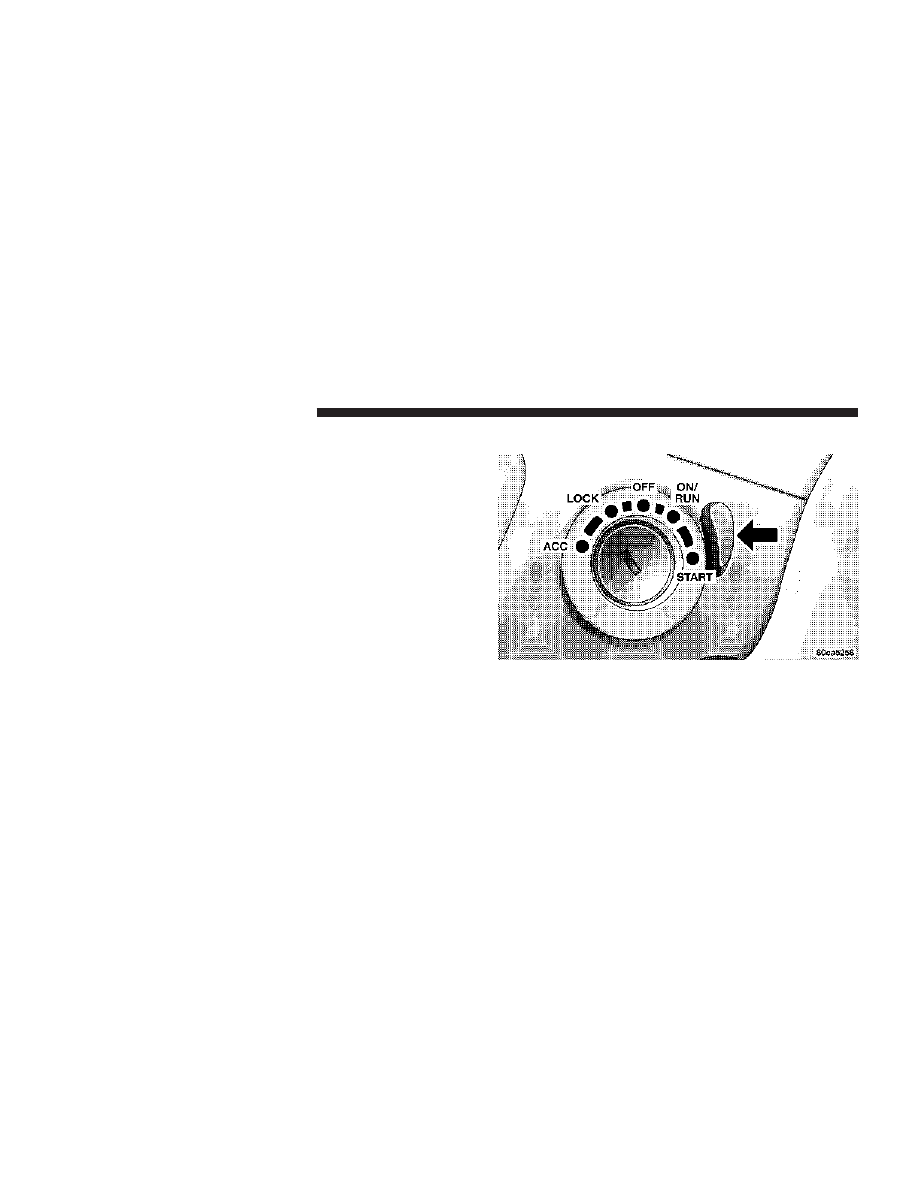
START
Starts the engine. When the engine starts, release the key.
The ignition key will return to the ON position for
normal driving.

ACC
Allows the electrical accessories to be used when the
engine is not running.

Manual Transmission Key Release Button

To remove the key on vehicles equipped with manual
transmissions, turn the key to the Lock position and press
the button to remove the ignition key.

Ignition Key Release Button

252

STARTING AND OPERATING

-------------------------------------------------------------------------------------------------------------------------------------------------------------

Key Reminder
An alarm will sound to remind you if the key is left in the
ignition and the driver’s door is opened.

STARTING PROCEDURES
The Cummins Diesel engine is equipped with several
features designed to assist cold weather starting and
operation:

• The engine block heater is a resistance heater installed

in the water jacket of the engine just above and behind
the oil filter. It requires a 110–115 volt AC electrical
outlet with a grounded, three-wire extension cord.

NOTE:

The engine block heater cord is a factory in-

stalled option. If your vehicle is not equipped, heater
cords are available from your authorized Mopar

威 dealer.

• A 12–volt heater built into the fuel filter housing aids

in preventing fuel gelling. It is controlled by a built-in
thermostat.

• A heated intake air system both improves engine

starting and reduces the amount of white smoke
generated by a warming engine.

Normal Starting Procedure — Engine Manifold
AirTemperature Above 66°F (19°C)
Observe the Instrument Panel Cluster lights when start-
ing the engine.

1. Always apply the parking brake.

2. Shift into PARK for an automatic transmission. Fully
depress and hold the clutch and shift into NEUTRAL for
a manual transmission. Models with manual transmis-
sion are equipped with a clutch interlocking cranking
system. The clutch must be fully depressed to start the
vehicle.

3. Turn the ignition key to the ON position and look at
the instrument panel cluster lamps.

STARTING AND OPERATING

253

5

-------------------------------------------------------------------------------------------------------------------------------------------------------------

The lamps in the instrument panel cluster will illuminate
when the ignition key is first turned to the ON position.
This is a bulb check programmed to last for approxi-
mately 3 seconds. After the bulb check is completed, the
Malfunction Indicator Light and Brake Warning light will
remain on. After the bulb check is complete and the
WAIT TO START indicator goes out proceed to step 4.

CAUTION!

If WATER IN FUEL indicator light remains on DO
NOT START engine before you drain water from the
fuel filter to avoid engine damage. See Section 7 —
Maintaining Your Vehicle, for water drain proce-
dures.

4. Turn the ignition key to START and crank the engine.
Do not press the accelerator during starting.

CAUTION!

Do not crank engine for more than 15 seconds at a
time as starter motor damage may result. Turn key to
OFF and wait at least two minutes before trying
again.

5. When the engine starts, release the key.

6. Check to see that there is oil pressure.

7. Release the parking brake.

Starting Procedure — Engine Manifold Air
Temperature Below 66°F (19°C)

NOTE:

The temperature displayed on the overhead

console (if equipped) does not necessarily reflect the
engine manifold air temperature. The wait-to-start lamp
will illuminate momentarily for a bulb check when the
ignition key is turned to the ON position, however when

254

STARTING AND OPERATING

-------------------------------------------------------------------------------------------------------------------------------------------------------------

certain engine temperatures fall below 66°F (19°C) the
lamp will remain on indicating the intake manifold
heater system is active.

Follow the steps in the Normal Starting Procedure ex-
cept:

CAUTION!

Do not crank engine for more than 15 seconds at a
time or starter motor damage may result. Turn key to
OFF and wait at least 2 minutes for starter to cool
before repeating start procedure.

• The WAIT TO START light will remain on for a period

of time (length of time depends on engine tempera-
ture) after completion of the bulb check.

• After the WAIT TO START light goes off, turn the

ignition key to START. Do not press the accelerator
during starting.

• After engine start-up, check to see that there is oil

pressure.

• Allow the engine to idle about three minutes until

the manifold heaters have completed the post-heat
cycle.

• Release the parking brake and drive.

NOTE:

Engine idle speed will automatically increase to

1000 rpm at low coolant temperatures to improve engine
warm-up.

NOTE:

If the engine stalls or if the ignition switch is left

On for more than 2 minutes after the WAIT TO START
light goes out, reset the grid heaters by turning the

STARTING AND OPERATING

255

5

-------------------------------------------------------------------------------------------------------------------------------------------------------------

ignition switch to Off for at least 5 seconds and then back
On. Repeat steps 3 through 7 of the normal starting
procedure.

For Extremely Cold Weather Starting — Engine
Manifold Air Temperature Below 0°F (- 18°C)
In extremely cold weather below 0°F (- 18°C) it may be
beneficial to cycle the manifold heaters twice before
attempting to start the engine. This can be accomplished
by turning the ignition OFF for at least 5 seconds and
then back ON after the WAIT TO START light has gone
off, but before the engine is started. However, repeated
cycling of the manifold heaters will result in damage to
the heater elements or reduced battery voltage.

NOTE:

If multiple pre-heat cycles are used before

starting, additional engine run time may be required to
maintain battery state of charge at a satisfactory level.

• If the engine stalls after the initial start, the ignition

must be turned to the OFF position for at least 5
seconds and then to the ON position to recycle the
manifold heaters.

NOTE:

Excessive white smoke and poor engine perfor-

mance will result if manifold heaters are not recycled.

• Heat generated by the manifold heaters dissipates

rapidly in a cold engine. If more than two minutes
pass between the time the WAIT TO START light goes
OFF and the engine is started, recycle the manifold
heaters by turning the ignition OFF for at least 5
seconds and then back ON.

• If the vehicle is driven and vehicle speed exceeds 19

mph (31 km) before the manifold heater post-heat
(after start) cycle is complete, the manifold heaters will
shut off.

256

STARTING AND OPERATING

-------------------------------------------------------------------------------------------------------------------------------------------------------------

• If the engine is started before the WAIT TO START

light turns off, the preheat cycle will turn off.

• If the engine is cranked for more than 10 seconds, the

post-heat cycle will turn off.

NOTE:

Engine idle speed will automatically increase to

1000 rpm at low coolant temperatures to improve engine
warm-up.

NOTE:

When a diesel engine is allowed to run out of

fuel or the fuel gels at low temperatures, air is pulled into
the fuel system.

You may try priming as described below.

1. Add a substantial quantity of fuel to the tank (5 to 10
gallons) or eliminate the gelled fuel condition.

2. Crank the engine for 1 to 2 seconds. If the engine does
not start, then release the key or starter button back to the
RUN position (do not turn the key back to the OFF

position). The electric fuel transfer pump will continue to
run and purge air from the system for about 20 seconds.
After 20 seconds, attempt to start the engine again.

3. Start the engine using the Normal Starting Procedure.

4. Repeat the procedure if the engine does not start.

WARNING!

Do not open the high pressure fuel system with the
engine running. Engine operation causes high fuel
pressure. High pressure fuel spray can cause serious
injury or death.

NOTE:

The engine may run rough until the air is forced

from all the fuel lines.

STARTING AND OPERATING

257

5

-------------------------------------------------------------------------------------------------------------------------------------------------------------

Starting Fluids

WARNING!

STARTING FLUIDS or flammable liquids are
NEVER TO BE USED in the Cummins Diesel (see
Warning label). Never pour diesel fuel, flammable
liquid, starting fluids (ether) into the air cleaner
canister, air intake piping, or turbocharger inlet in an
attempt to start the vehicle. This could result in a
flash fire and explosion causing serious personal
injury and engine damage.

The engine is equipped with an automatic electric air
preheating system. If the instructions in this manual are
followed, the engine should start in all conditions.

WARNING!

Do not leave children or animals inside parked
vehicles in hot weather. Interior heat build up may
cause serious injury or death.

NORMAL OPERATION
Observe the following when the engine is operating.

• All message center lights are off.
• Check Engine Lamp is off.
• Engine Oil Pressure is above 10 psi (69 kPa) at idle.
• Low Oil Pressure light is off.

258

STARTING AND OPERATING

-------------------------------------------------------------------------------------------------------------------------------------------------------------

• Voltmeter Operation:

• The voltmeter may show a gauge fluctuation if certain

engine temperatures are below 66°F (19°C). This
cycling operation is caused by the post-heat cycle of
the intake manifold heater system. The number of
cycles and the length of the cycling operation is
controlled by the engine control module, this time
will not exceed 150 seconds. The needle should then
stabilize at the approximate operation point.

• The cycling action will cause temporary dimming of

the headlamps, interior lamps, and also a noticeable
reduction in blower motor speed.

Cold Weather Precautions
Operation in ambient temperature below 32°F (0°C) may
require special considerations. The following charts sug-
gest these options:

Fuel Operating Range

*No. 1 diesel fuel should only be used where extended
arctic conditions (-10°F/-23°C) exist.

NOTE:

• Use of Climatized Diesel Fuel or Number 1 Diesel Fuel

results in a noticeable decrease in fuel economy.

• Climatized Diesel Fuel is a blend of Number 2 and

Number 1 Diesel Fuels which reduces the temperature
at which wax crystals form in fuel.

STARTING AND OPERATING

259

5

-------------------------------------------------------------------------------------------------------------------------------------------------------------

NOTE:

Refer to Fuel Requirements in this section for

further details on fuel recommendations.

Engine Block Heater
The engine block heater warms engine coolant and
permits quicker starts in cold weather. Connect the heater
cord to a ground–fault interrupter protected 110–115 volt
AC electrical outlet with a grounded, three-wire exten-
sion cord.

The engine block heater cord is routed under the hood to
the right side and can be located just behind the grille
near the headlamp.

NOTE:

The engine block heater cord is a factory in-

stalled option. If your vehicle is not equipped, heater
cords are available from your authorized Mopar

威 dealer.

The block heater must be plugged in at least one hour to
have an adequate warming effect on the coolant.

WARNING!

Remember to disconnect the cord before driving.
Damage to the 110–115 volt electrical cord could
cause electrocution.

NOTE:

The block heater will require 110 Volts AC and

6.5 Amps to activate the heater element.

Block Heater Usage

A. Temperatures below 0°F (-18°C)

• Block Heater Required for 15W-40
• Block Heater Recommended for 5W-40

B. Temperatures below - 20°F (-29°C)

• Block Heater Required for 5W-40

260

STARTING AND OPERATING

-------------------------------------------------------------------------------------------------------------------------------------------------------------

Winter Front Usage
If a winter front or cold weather cover is to be used, a
percentage of the total grille opening area must be left
uncovered to provide sufficient air flow to the charge air
cooler and automatic transmission oil cooler. The per-
centage of opening must be increased with the increasing
ambient air temperature and/or engine load. If the
cooling fan can be heard cycling frequently, increase the
size of the opening in the winter front. A suitable cold
weather cover is available from your Mopar

威 dealer.

Battery Blanket Usage
A battery loses 60% of its cranking power as the battery
temperature decreases to 0°F (-18°). For the same de-
crease in temperature, the engine requires twice as much
power to crank at the same RPM. The use of 120 VAC
powered battery blankets will greatly increase starting
capability at low temperatures. Suitable battery blankets
are available from your authorized Mopar

威 dealer.

Arctic Operation
Where there are no provisions to keep the engine warm
when it is operating in ambient temperatures consistently
below (-10°F/-23°C), use 5W-40 synthetic engine oil and
fuel that meets the requirements in Section 7, “Mainte-
nance Procedures,” Engine Oil Selection.

Engine Warm-Up
Avoid full throttle operation when the engine is cold.
When starting a cold engine, bring the engine up to
operating speed slowly to allow the oil pressure to
stabilize as the engine warms up.

NOTE:

High-speed, no-load running of a cold engine

can result in excessive white smoke and poor engine
performance. No-load engine speeds should be kept
under 1,200 rpm during the warm-up period, especially
in cold ambient temperature conditions.

STARTING AND OPERATING

261

5

-------------------------------------------------------------------------------------------------------------------------------------------------------------

If temperatures are below 32°F (0°C), operate the engine
at moderate speeds for 5 minutes before full loads are
applied.

Engine Idling — In Cold Weather
Avoid prolonged idling in ambient temperatures below
0°F. Long periods of idling may be harmful to your
engine because combustion chamber temperatures can
drop so low that the fuel may not burn completely.
Incomplete combustion allows carbon and varnish to
form on piston rings and injector nozzles. Also, the
unburned fuel can enter the crankcase, diluting the oil
and causing rapid wear to the engine.

NOTE:

An optional driver-controlled high idle speed is

available on automatic transmission equipped vehicles
with speed control. This feature allows the driver to
select an elevated idle speed between 1100 and 1500
rpms. Your dealer can enable this feature.

NOTE:

• If ambient temperatures are low and the coolant

temperature is below 200°F (93°C), the engine idle
speed will slowly increase to 1000 RPM after 2 minutes
of idle, if the following conditions are met:

• foot is off brake pedal and throttle pedal
• automatic transmission is in Park (P)
• vehicle speed is zero
• Applying the throttle will cancel fast idle
• If the engine is equipped with an aftermarket exhaust

brake (manual transmissions only), operating the ex-
haust brake at idle will greatly improve warm up rate
and will help keep the engine close to operating
temperature during extended idle.

262

STARTING AND OPERATING

-------------------------------------------------------------------------------------------------------------------------------------------------------------

Stopping The Engine
Idle the engine a few minutes before routine shutdown.
After full load operation, idle the engine 3 to 5 minutes
before shutting it down. This idle period will allow the
lubricating oil and coolant to carry excess heat away from
the combustion chamber, bearings, internal components,
and turbocharger. This is especially important for turbo-
charged, charge air cooled engines, like your Turbo Ram.

Driving

Condition

Load

Turbo-

charger

Temperature

Idle Time

(min.) Be-

fore Engine

Shutdown

Stop and

Go

Empty

Cool

Less than

One

Stop and

Go

Medium

One

Highway

Speeds

Medium

Warm

Two

City Traffic

Maximum

GCWR

Three

Highway

Speeds

Maximum

GCWR

Four

Uphill

Grade

Maximum

GCWR

Hot

Five

Engine Speed Control

CAUTION!

Prevent overspeeding the engine going down hill.
When descending steep grades, use a combination of
gears and service brakes to control vehicle/engine
speed. Overspeed can cause severe engine damage.

STARTING AND OPERATING

263

5

-------------------------------------------------------------------------------------------------------------------------------------------------------------

Operating Precautions

Avoid Overheating The Engine
The temperature of the coolant (a mixture of 50%
ethylene-glycol and 50% water) must not exceed the
normal range of the temperature gauge (240°F/116°C)
with a 16 psi (110 kPa) radiator cap.

Usually the coolant temperature indicated during opera-
tion will be to the left of center in the normal range of the
gauge.

Avoid Low Coolant Temperature Operation
Continual operation at low coolant temperature below
the normal range on the gauge (140°F/60°C) can be
harmful to the engine. Low coolant temperature can
cause incomplete combustion which allows carbon and
varnish to form on piston rings and injector nozzles.
Also, the unburned fuel can enter the crankcase, diluting
the lubricating oil and causing rapid wear to the engine.

Cooling System Tips — Automatic Transmission
To reduce potential for engine and transmission over-
heating in high ambient temperature conditions, take the
following actions:

• City Driving —
when stopped, put transmission in neutral and increase
engine idle speed.

• Highway Driving —
reduce your speed.

• Up Steep Hills —
select a lower transmission gear, but try and keep the
torque converter locked.

• Air Conditioning —
turn it off temporarily.

264

STARTING AND OPERATING

-------------------------------------------------------------------------------------------------------------------------------------------------------------

Do Not Operate The Engine With Low Oil
Pressure
When the engine is at normal operating temperature, the
minimum oil pressures required are:

Idle 700 to 800 RPM . . . . . . . . . . . . . . . 10 psi (69 kPa)
Full speed and load . . . . . . . . . . . . . . 30 psi (207 kPa)

CAUTION!

If oil pressure falls to less than normal readings, shut
the engine off immediately. Failure to do so could
result in immediate and severe engine damage.

Do Not Operate The Engine With Failed Parts
Practically all failures give some warning before the parts
fail. Be on the alert for changes in performance, sounds,
and visual evidence that the engine requires service.
Some important clues are:

• engine misfiring or vibrating severely
• sudden loss of power
• unusual engine noises
• fuel, oil or coolant leaks
• sudden change, outside the normal operating range, in

the engine operating temperature

• excessive smoke
• oil pressure drop

STARTING AND OPERATING

265

5

-------------------------------------------------------------------------------------------------------------------------------------------------------------

TRANSMISSION SHIFTING

Automatic Transmission with Overdrive— If
Equipped
The gear shift selector display, located in the instrument
panel cluster, indicates the transmission gear range (the
selector is illuminated for night driving). The selector
lever is mounted on the right side of the steering column.
You must depress the brake pedal, to pull the selector
lever out of park (P) position (Brake Interlock System). To
drive, move the selector lever from Park or Neutral to the
desired drive position. Pull the selector lever toward you
when shifting into Reverse, Second, First or Park, or
when shifting out of Park.

Gear Ranges
DO NOT race the engine when shifting from Park or
Neutral position into another gear range.

“P” Park
This gear position supplements the parking brake by
locking the transmission. The engine can be started in
this range. Never use Park while the vehicle is in motion.
Apply the parking brake when leaving the vehicle in this
range. Always apply parking brake first, then place the
selector in Park position. On 4-wheel drive vehicles be
sure that the transfer case is in a drive position!

WARNING!

Your vehicle could move and injure you and others if
it is not completely in P (Park). Check by trying to
move the gearshift lever back and forth without first
pulling it toward you after you have set it in P. Make
sure it is in Park before leaving the vehicle.

266

STARTING AND OPERATING

-------------------------------------------------------------------------------------------------------------------------------------------------------------

WARNING!

It is dangerous to shift the selector lever out of “P” or
“N” if the engine speed is higher than idle speed. If
your foot is not firmly on the brake pedal, the
vehicle could accelerate quickly forward or in re-
verse. You could lose control of the vehicle and hit
someone or something. Only shift into gear when
the engine is idling normally and when your right
foot is firmly on the brake pedal.

“R” Reverse
Use this range only after the vehicle has come to a
complete stop.

“N” Neutral
Shift to Neutral when the vehicle is standing for pro-
longed periods with the engine running. The engine may
be started in this range. Set the parking brake if you must
leave the vehicle.

“D” Drive
This position provides all forward gears, including 3rd
gear direct and 4th or 5th (if equipped) gear overdrive
(see Overdrive Operation). Use this range for most city
and highway driving.

“2” Second
Use this position for driving slowly in heavy city traffic
or on mountain roads where more precise speed control
is desirable. Use it also when climbing long grades, and
for engine braking when descending moderately steep
grades. To prevent excessive engine speed do not exceed
45 mph (72 km/h) in this range.

STARTING AND OPERATING

267

5

-------------------------------------------------------------------------------------------------------------------------------------------------------------


Content      ..     14      15      16      17     ..