Dodge Ram Truck 1500-2500-3500. Manual - part 205
INSTALLATION
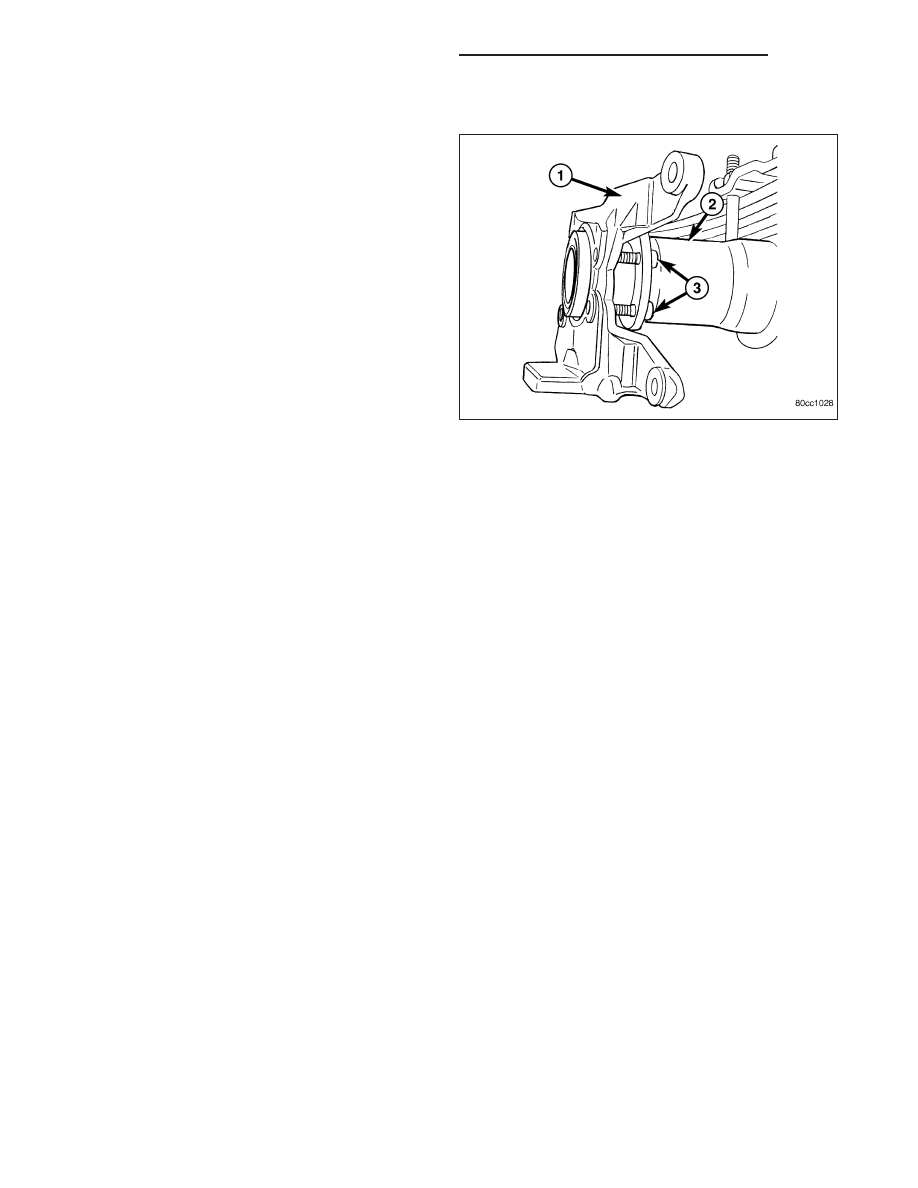
1. Install the caliper adapter mount (1) on the axle
housing (2).
2. Install support plate on axle flange. Tighten attach-
ing bolts (3) to 68 N·m (50 ft. lbs.) LD or tighten to
203 N·m (150 ft.lbs.) HD.
3. Install parking brake cable in the brake lever.
4. Install the park brake shoes (Refer to 5 - BRAKES/PARKING BRAKE/SHOES - INSTALLATION)..
5. Install axle shaft, (Refer to 3 - DIFFERENTIAL & DRIVELINE/REAR AXLE - 9 1/4/AXLE SHAFTS - INSTALLA-
TION).
6. Adjust brake shoes to drum with brake gauge (Refer to 5 - BRAKES/PARKING BRAKE/SHOES - ADJUST-
MENTS).
7. Install the rotor (Refer to 5 - BRAKES/HYDRAULIC/MECHANICAL/ROTORS - INSTALLATION).
8. Install the caliper adapter (Refer to 5 - BRAKES/HYDRAULIC/MECHANICAL/DISC BRAKE CALIPER ADAPTER
- INSTALLATION).
9. Install the caliper (Refer to 5 - BRAKES/HYDRAULIC/MECHANICAL/DISC BRAKE CALIPERS - INSTALLA-
TION).
10. Install wheel and tire assembly.
FLUID
DIAGNOSIS AND TESTING
BRAKE FLUID CONTAMINATION
Indications of fluid contamination are swollen or deteriorated rubber parts.
Swollen rubber parts indicate the presence of petroleum in the brake fluid.
To test for contamination, put a small amount of drained brake fluid in clear glass jar. If fluid separates into layers,
there is mineral oil or other fluid contamination of the brake fluid.
If brake fluid is contaminated, drain and thoroughly flush system. Replace master cylinder, proportioning valve, cal-
iper seals, wheel cylinder seals, Antilock Brakes hydraulic unit and all hydraulic fluid hoses.
5 - 248
BRAKES - BASE - SERVICE INFORMATION
DR/DH