Content .. 1684 1685 1686 1687 ..
Dodge Ram Truck 1500-2500-3500. Manual - part 1686
TURBINE
As the fluid that was put into motion by the impeller blades strikes the blades of the turbine, some of the energy and
rotational force is transferred into the turbine and the input shaft. This causes both of them (turbine and input shaft)
to rotate in a clockwise direction following the impeller. As the fluid is leaving the trailing edges of the turbine’s
blades it continues in a “hindering” direction back toward the impeller. If the fluid is not redirected before it strikes
the impeller, it will strike the impeller in such a direction that it would tend to slow it down.
STATOR
Torque multiplication is achieved by locking the stator’s over-running clutch to its shaft. Under stall conditions (the
turbine is stationary), the oil leaving the turbine blades strikes the face of the stator blades and tries to rotate them
in a counterclockwise direction. When this happens the over-running clutch of the stator locks and holds the stator
from rotating. With the stator locked, the oil strikes the stator blades and is redirected into a “helping” direction
before it enters the impeller. This circulation of oil from impeller to turbine, turbine to stator, and stator to impeller,
can produce a maximum torque multiplication of about 2.4:1. As the turbine begins to match the speed of the impel-
ler, the fluid that was hitting the stator in such as way as to cause it to lock-up is no longer doing so. In this con-
dition of operation, the stator begins to free wheel and the converter acts as a fluid coupling.
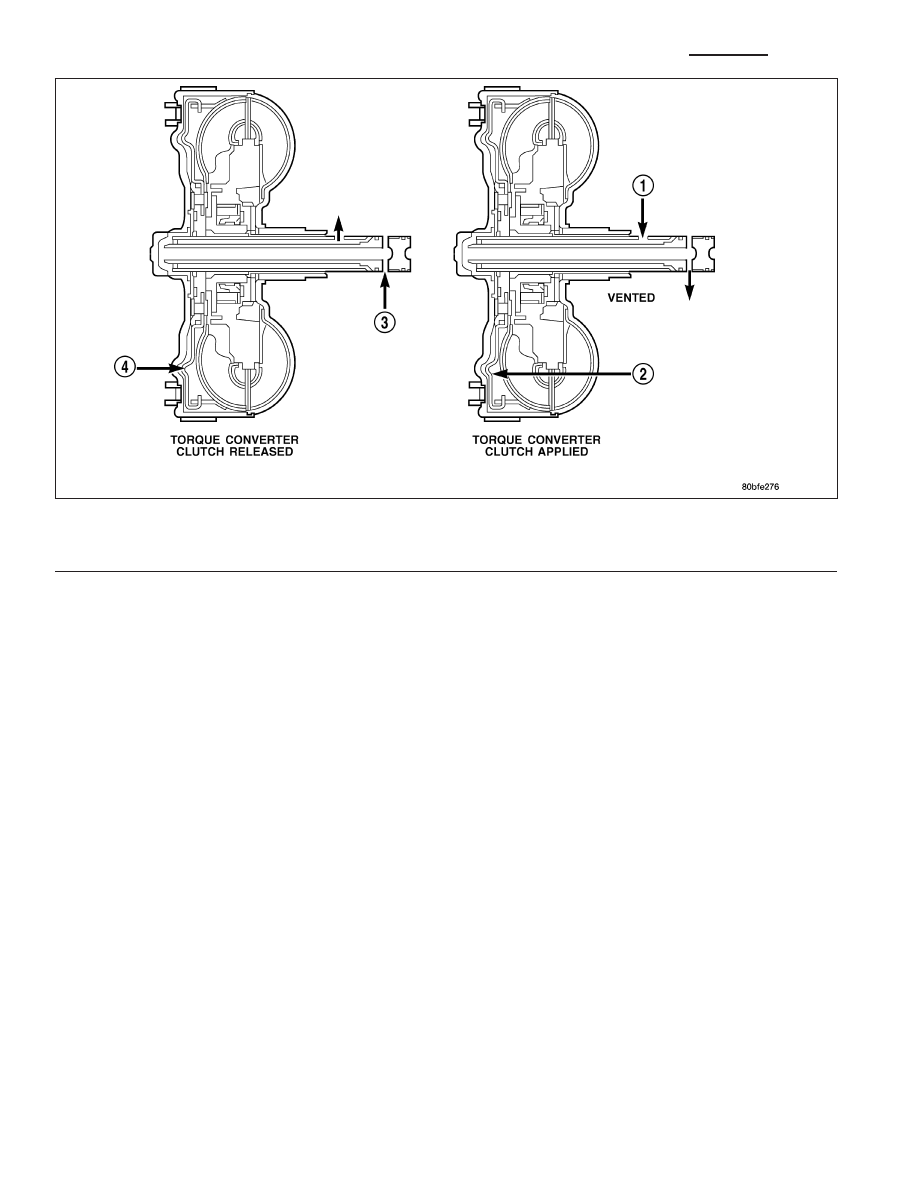
Torque Converter Fluid Operation - Typical
1 - APPLY PRESSURE
3 - RELEASE PRESSURE
2 - THE PISTON MOVES SLIGHTLY FORWARD
4 - THE PISTON MOVES SLIGHTLY REARWARD
21 - 676
AUTOMATIC TRANSMISSION - 45RFE/545RFE - SERVICE INFORMATION
DR/DH