Citroen C4 Cactus (2016 year). Instruction - part 12
 

  Index      Citroen     Citroen C4 Cactus - instruction 2016 year in english


Search            


Content   ..  10  11  12  13   ..


Citroen C4 Cactus (2016 year). Instruction - part 12


175

7

Practical information

Brake wear depends on the style 
of driving, particularly in the case 
of vehicles used in town, over short 
distances. It may be necessary to 

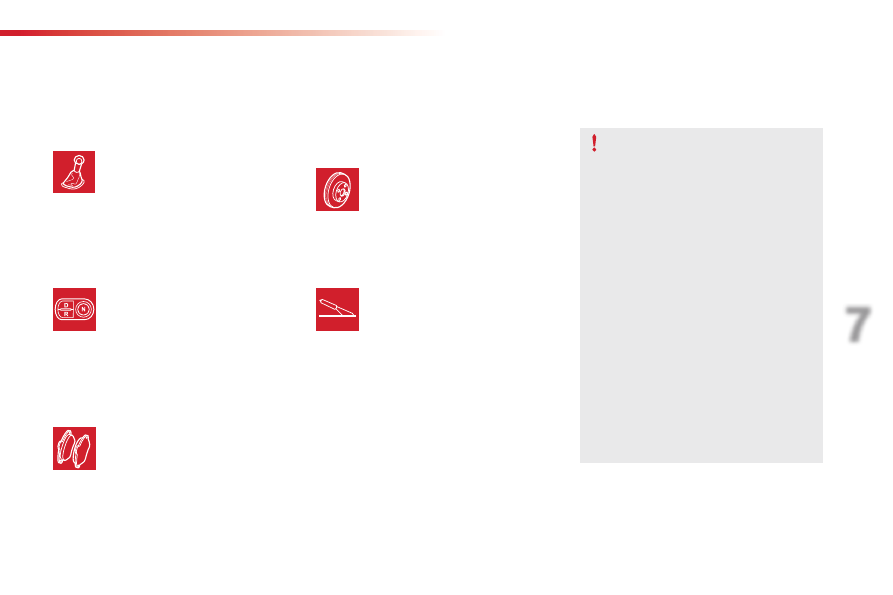
Brake pads

For information on checking brake 
disc wear, contact a CITROËN dealer 
or a qualified workshop.

Brake disc wear

Only use products recommended by 
CITROËN or products of equivalent 
quality and specification.
In order to optimise the operation of 
units as important as those in the 
braking system, CITROËN selects and 
offers very specific products.
After washing the vehicle, dampness, 
or in wintry conditions, ice can form 
on the brake discs and pads: braking 
efficiency may be reduced. Make light 
brake applications to dry and defrost 
the brakes.

Manual gearbox

The gearbox does not require any 
maintenance (no oil change).
Refer to the manufacturer's service 
schedule for the checking interval for 
this component.

Electronic gearbox

The gearbox does not require any 
maintenance (no oil change).
Refer to the manufacturer's service 
schedule for details of the checking 
interval for this component.

Parking brake

If excessive travel or a loss of 
effectiveness of this system is 
noticed, the parking brake must be 
checked, even between two services.

Checking this system must be done by a 
CITROËN dealer or a qualified workshop.

To avoid damaging the electrical units, 
never use

 a high pressure jet wash in 

the engine compartment.

have the condition of the brakes checked, even 
between vehicle services.
Unless there is a leak in the circuit, a drop in 
the brake fluid level indicates that the brake 
pads are worn.

176

Practical information

AdBlue

®

 additive and SCR system

for BlueHDi Diesel engines

To assure respect for the environment and 
conformity with the new Euro 6 emissions 
standard, without adversely affecting the 
performance or fuel consumption of Diesel 
engines, CITROËN has taken the decision to 
equip its vehicles with an effective system that 
associates SCR (Selective Catalytic Reduction) 
with a particle filter (FAP) for the treatment of 
exhaust gases.

Presentation of the SCR system

Using an additive called AdBlue

®

 containing urea, 

a catalytic converter turns up to 85% of nitrous 
oxides (NOx) into nitrogen and water, which are 
harmless to health and the environment.

Once the AdBlue

®

 tank is empty, a 

system required by regulations prevents 
starting of the engine.
If the SCR is faulty, the level of 
emissions from your vehicle will no 
longer meet the Euro 6 standard: your 
vehicle becomes polluting.
In the event of a confirmed fault 
with the SCR system, you must go 
to a CITROËN dealer or a qualified 
workshop as soon as possible: after a 
running distance of 650 miles  
(1 100 km), a system will be triggered 
automatically to prevent engine starting.

The AdBlue

®

 additive is held in a special 

tank located under the boot at the rear of 
the vehicle. It has a capacity of 17 litres: this 
provides a driving range of about 12 500 miles 
(20 000 km), after which an alert is triggered 
warning you when the reserve remaining is 
enough for just 1 500 miles (2 400 km).

During each scheduled service of your vehicle 
by a CITROËN dealer or a qualified workshop, 
the AdBlue

®

 additive tank is refilled in order to 

allow normal operation of the SCR system.

If the estimated mileage between two services 
is greater than 12 500 miles (20 000 km), we 
recommend that you go to a CITROËN dealer 
or a qualified workshop to have the necessary 
top-up carried out.

177

7

Practical information

Range indicators

Once the AdBlue

®

 tank is on reserve or after 

detection of a fault with the SCR emissions 
control system, when the ignition is switched 
on, an indicator displays an estimate of the 
distance that can be covered, the range, before 
engine starting is prevented.
In the event of simultaneous system fault and 
low AdBlue

®

 level, the shortest range figure is 

the one displayed.

Range greater than 1 500 miles (2 400 km)
When the ignition is switched on, no 
information on range is displayed automatically 
in the instrument panel.

The engine start prevention system 
required by regulations is activated 
automatically once the AdBlue

®

 tank is 

empty.

In the event of the risk of non-starting related to a lack of AdBlue

®

Remaining range between 350 and 1500 miles (600 and 2 400 km)

When switching on the ignition, the 
UREA warning lamp comes on, accompanied 
by an audible signal and the display of a 
message (e.g.: "Top up emissions additive: 
Starting prevented in 900 miles") indicating 
the remaining range expressed in miles or 
kilometres.
When driving, the message is displayed every 
200 miles (300 km) until the additive tank has 
been topped-up.
Go to a CITROËN dealer or a qualified 
workshop to have the AdBlue

®

 tank topped-up.

You can also top-up the tank yourself.
For more information on topping-up the 
AdBlue

®

 additive, refer to the corresponding 

section.

178

Practical information

Remaining range between 0 and 350 miles (0 and 600 km)

Breakdown related to a lack of AdBlue

®

 additive

To be able to start the engine, 
we recommend that you call on 
a CITROËN dealer or a qualified 
workshop for the top-up required.
If you carry out the top-up yourself, it 
is essential to add at least 3.8 litres of 
AdBlue

®

 to the tank.

When switching on the ignition, the SERVICE 
warning lamp comes on and the UREA warning 
lamp flashes, accompanied by an audible 
signal and the display of a message (e.g. "Top 
up emissions additive: Starting prevented in 
350 miles") indicating the remaining range 
expressed in miles or kilometres.
When driving, the message is displayed every 
30 seconds until the additive tank has been 
topped-up.
Go to a CITROËN dealer or a qualified 
workshop to have the AdBlue

®

 tank topped-up.

You can also top-up the tank yourself.
Otherwise you will not be able to restart your 
engine.

When switching on the ignition, the SERVICE 
warning lamp comes on and the UREA warning 
lamp flashes, accompanied by an audible 
signal and the display of the message "Top up 
emissions additive: Starting prevented".
The AdBlue

®

 tank is empty: the system required 

by regulations prevents engine starting.

For more information on topping-up the 
AdBlue

®

 additive, refer to the corresponding 

section.

179

7

Practical information

In the event of a fault with the SCR emissions control system

In the event of the detection  
of a fault

During an authorised driving phase (between 
650 miles and 0 miles) (1 100 km and 0 km)

A system that prevents engine starting is activated automatically from 650 miles (1 100 km) after confirmation of a fault with the SCR emissions 
control system. Have the system checked by a CITROËN dealer or a qualified workshop as soon as possible.

If it is a temporary fault, the alert 
disappears during the next journey, 
after self-diagnosis of the SCR system.

The UREA, SERVICE and diagnostic warning 
lamps comes on, accompanied by an audible 
signal and the display of the message 
"Emissions fault".
The alert is triggered when driving when the 
fault is detected for the first time, then when 
switching on the ignition for subsequent 
journeys, while the fault persists.

If a fault with the SCR system is confirmed (after 
30 miles (50 km) covered with the permanent 
display of the message signalling a fault), the 
SERVICE and engine diagnostic warning lamps 
come on and the UREA warning lamp flashes, 
accompanied by an audible signal and the 
display of a message (e.g.: "Emissions fault: 
Starting prevented in 150 miles") indicating the 
remaining range express in miles or kilometres.
While driving, the message is displayed every 
30 seconds while the fault with the SCR system 
persists.
The alert is repeated when switching on the 
ignition.
You should go to a CITROËN dealer or a 
qualified workshop as soon as possible.
Otherwise, you will not be able to restart your 
engine.

Starting prevented

To be able to start the engine, you must call on 
a CITROËN dealer or a qualified workshop.

You have exceeded the authorised 
driving limit: the starting prevention 
system inhibits engine starting.

Every time the ignition is switched on, the SERVICE 
and engine diagnostic warning lamps come on and 
the UREA warning lamp flashes, accompanied by 
an audible signal and the display of the message 
"Emissions fault: Starting prevented".

180

Practical information

Freezing of the AdBlue

®

 additive

The AdBlue

®

 additive freezes at 

temperatures below around -11°C.
The SCR system includes a heater 
for the AdBlue

®

 tank, allowing you to 

continue driving in very cold conditions.

Topping-up the AdBlue

®

 additive

Precautions in use

Filling the AdBlue

®

 tank is an operation 

included in every routine service on your 
vehicle by a CITROËN dealer or a qualified 
workshop.
Nevertheless, given the capacity of the tank, 
it may be necessary to top-up the additive 
between services, more particularly if an alert 
(warning lamps and a message) signals the 
requirement.
You can got to a CITROËN dealer or a qualified 
workshop.
If you envisage topping-up yourself, please 
read the following warnings carefully.

Keep AdBlue

®

 out of the reach of 

children, in its original bottle.
Never transfer AdBlue

®

 to another 

container: it would lose its purity.

Never dilute the additive with water.
Never pour the additive into the Diesel 
fuel tank.

Never top-up from an AdBlue

®


dispenser reserved for heavy goods 
vehicles.

Use only AdBlue

®

 additive that meets the 

ISO 22241 standard.

The supply in a non-drip bottle simplifies 
topping-up. You can obtain 1.89 litre (half a US 
gallon) bottles from a CITROËN dealer or a 
qualified workshop.

The AdBlue

®

 additive is an urea-based 

solution. This liquid is non-flammable, 
colourless and odourless (kept in a cool area).
In the event of contact with the skin, wash 
the affected area with soap and water. In the 
event of contact with the eyes, wash (irrigate) 
the eyes with large amounts of water or with 
an eye wash solution for at least 15 minutes. 
If a burning sensation or irritation persists, get 
medical attention.
If swallowed, immediately wash out the mouth 
with clean water and then drink plenty of water.
In certain conditions (high ambient 
temperature, for example), the risk of release 
of ammonia cannot be excluded: do not inhale 
the product. Ammonia vapour has an irritant 
effect on mucous membranes (eyes, nose and 
throat).

181

7

Practical information

Recommendations on storage

Never store bottles of AdBlue

®

 in your 

vehicle.

Procedure

F

  Switch off the ignition and remove the key.

F

  For access to the AdBlue

®

 tank, raise the 

boot carpet then, depending on equipment, 
lift out the spare wheel and/or the 
storage box.

F

  Without pressing, turn the black cap a 

quarter turn anti-clockwise and lift it off.

AdBlue

®

 freezes at about -11°C and 

deteriorates above 25°C. It is recommended 
that bottles be stored in a cool area and 
protected from direct sunlight.
Under these conditions, the additive can be 
kept for at least a year.
If the additive has frozen, it can be used once it 
has completely thawed out.

Before topping-up, ensure that the vehicle is 
parked on a flat and level surface.
In wintry conditions, ensure that the 
temperature of the vehicle is above -11°C. 
Otherwise the AdBlue

®

 may be frozen and 

so cannot be poured into its tank. Park your 
vehicle in a warmer area for a few hours to 
allow the top-up to be carried out.

F

  Turn the blue cap a 6

th

 of a turn anti-

clockwise.

F

  Lift off the cap.

182

Practical information

F

  Obtain a bottle of AdBlue

®

. After first 

checking the use-by date, read carefully 
the instructions on use on the label before 
pouring the contents of the bottle into your 
vehicle's AdBlue

®

 tank.

Important

: if your vehicle's AdBlue

®


tank is completely empty - which is 
confirmed by the alert messages and 
the impossibility of starting the engine, 
you must add at least 3.8 litres (so 
two 1.89 litre bottles).

If any additive is split or splashed, wash 
immediately with cold water or wipe with 
a damp cloth.
If the additive has crystallised, clean it 
off using a sponge and hot water.

Important: in the event of a top-up 
after a breakdown because of a lack 
of additive

, signalled by the message 

"Top up emissions additive: Starting 
prevented", you must wait around 
5 minutes before switching on the ignition, 
without opening the driver's door, 
locking the vehicle or introducing the 
key into the ignition switch

.

Switch on the ignition, then, after 
10 seconds, start the engine.

Never dispose of AdBlue

®

 additive 

bottles in the household waste. Place 
them in a special container provided 
this purpose or take them to your dealer.

F

  After emptying the bottle, wipe away any 

spillage around the tank filler using a damp 
cloth.

F

  Refit the blue cap to the tank and turn it a 

6

th

 of a turn clockwise, to its stop.

F

  Refit the black cap and turn it a quarter of 

a turn clockwise without pressing. Ensure 
that the indicator on the cap lines up with 
the indicator on the support.

F

  Depending on equipment, return the spare 

wheel and/or the storage box to the bottom 
of the boot.

F

  Refit the boot carpet and close the tailgate.

183

7

Practical information

Made of TPU (Thermo Plastic Urethane) and enclosing bubbles of air on the side protectors only, 
they act as an impact absorber.
Located on the sides, front and rear of your vehicle, they protect the bodywork by reducing the 
effect of minor everyday knocks: parking dings, opening doors, scrapes, ...
These coloured protectors also enhance the appearance of your vehicle.

AIRBUMP

®

 protectors

AIRBUMP

®

 protection areas

A.

  Side.

B.

  Front.

C.

  Rear.

Care of the AIRBUMP

®


protectors

The AIRBUMP

®

 protectors require no 

particular care or maintenance.
They are cleaned simply using water or one of 
the products available from CITROËN dealers.
To avoid problems of premature ageing of 
the AIRBUMP

®

 protectors, do not use polish 

on them.

184

Practical information

Advice on care and maintenance

Recommendations on the care and maintenance your vehicle are given in the maintenance and warranty guide.

The headlamps have polycarbonate 
lenses, finished with a protective 
lacquer.
Do not clean them with a dry or 
abrasive cloth, nor with detergent or 
solvent products.
Use a sponge and soapy water.
The use of a high pressure jet wash 
for cleaning the headlamps, lamps 
and their surrounds may damage the 
lacquer and seals.
Observe the recommendations on 
pressure and distance for jet washing.
First clean persistent stains with a 
sponge and warm soapy water.

For the care of the stickers in the rear 
door glasses, we recommend the 
following:
-  Use a wide jet at a temperature of 

between 25°C and 40°C.

-  Where possible, direct the jet at 

right angles to the stickers.

Leather

Care of the expressive stickers

These styling stickers are treated to give good 
resistance to ageing and tearing.
They have been designed to allow you to 
customise your vehicle's bodywork.
When using a high pressure jet wash, keep the 
end of the lance at least 30 centimetres from 
the stickers

Leather is a natural product. Appropriate 
regular care and cleaning is essential for its 
durability.
Refer to your vehicle's maintenance and 
warranty guide for information on the special 
precautions to observe.

Headlamps and lamps

Care of the AIRBUMP

®

 panels

The AIRBUMP

®

 panels require no particular 

care or maintenance.
They are cleaned simply using water or one of 
the products available from CITROËN dealers.
To avoid problems of premature ageing of the 
AIRBUMP

®

 panels, do not use polish on them.

185

8

In the event of a breakdown

Warning triangle (storage)

Before leaving your vehicle to set up 
and install the triangle, switch on the 
hazard warning lamps and put on your 
high visibility vest.

Refer to the manufacturer's instructions 
on using the triangle.

Placing the triangle in 
the road

F

  Place the triangle behind the vehicle, as 

required by the legislation in force in your 
country.

This safety device is used in addition to the hazard warning lamps.
Its presence in the vehicle is mandatory.
The triangle may be stowed under the boot carpet (in the storage well) or, depending on version, under the front passenger seat.

The triangle is available as an 
accessory; contact a CITROËN dealer 
or a qualified workshop.

186

In the event of a breakdown

The tyre inflation pressures are given on 
this label.

This kit is installed in the storage box, under the 
boot floor.

This kit consists of a compressor and a sealant 
cartridge.
It allows the temporary repair

 of a tyre.

You are then able to go to the nearest garage.
It is designed to repair most punctures which 
could affect the tyre, located on the tyre tread 
or shoulder.
Its compressor can be used to check and 
adjust the pressure of the tyre.

Temporary puncture repair kit

Access to the kit

List of tools

These tools are specific to your vehicle and can 
vary according to equipment. Do not use them 
for other purposes.
1.

  12 V compressor.


Contains a sealant cartridge for the 
temporary repair of a tyre and can also be 
used for adjusting tyre pressures.

2.

  Towing eye.

For more information on towing refer to the 
corresponding section.

187

8

In the event of a breakdown

A.

  "Sealant" or "Air" position selector.

B. On 

"I"

 / off "O" switch.

C.

  Deflation button.

D.

  Pressure gauge (in bars and psi).

E.

  Compartment housing:

-  a cable with adaptor for 12 V socket,
-  various inflation adaptors for 

accessories, such as balls, 
bicycle tyres...

Description of the kit

The speed limit sticker I must be affixed 
to the vehicle's steering wheel to remind 
you that a wheel is in temporary use.
Do not exceed a speed of 50 mph 
(80 km/h) when driving with a tyre 
repaired using this type of kit.

F.

  Sealant cartridge.

G.

  White pipe with cap for repair.

H.

  Black pipe for inflation.

I.

  Speed limit sticker.

188

In the event of a breakdown

1. Sealing

Repair procedure

Avoid removing any foreign bodies 
which have penetrated into the tyre.

F  Uncoil the white pipe G

 fully.

F

  Unscrew the cap from the white pipe.

F  Connect the white pipe to the valve of the 

tyre to be repaired.

F

  Switch off the ignition.

F  Turn the selector A to the 

"Sealant" position.

F

  Check that the switch B is in 

position "O"

.

F

  Connect the compressor's electric plug to 

the vehicle's 12 V socket.

F

  Start the vehicle and leave the engine 

running.

Take care, this product is harmful if 
swallowed and causes irritation to the eyes.
Keep this product out of the reach of 
children.

Do not start the compressor before 
connecting the white pipe to the tyre 
valve: the sealant product would be 
expelled through the pipe.

189

8

In the event of a breakdown

F

  Switch on the compressor by moving 

the switch B to position "I" until the tyre 
pressure reaches 2.0 bars.


The sealant is injected into the tyre under 
pressure; do not disconnect the pipe from 
the valve during this operation (risk of 
splashing).

If after around 5 to 7 minutes the 
pressure is not attained, this indicates 
that the tyre is not repairable; contact 
a CITROËN dealer or a qualified 
workshop for assistance.

F

  Remove the kit and screw the cap back on 

the white pipe.


Take care to avoid staining your vehicle 
with traces of fluid. Keep the kit to hand.

F

  Drive immediately for approximately 

three miles (five kilometres), at reduced 
speed (between 15 and 35 mph (20 and 
60 km/h)), to plug the puncture.

F

  Stop to check the repair and the tyre 

pressure using the kit.

Tyre under-inflation detection

After repair of the tyre, the warning 
lamp will remain on until the system is 
reinitialised.
For more information on under-inflation 
detection, refer to the corresponding 
section.

2. Inflation

F  Turn the selector A to the 

"Air" position.

F

  Uncoil the black pipe H fully.

F

  Connect the black pipe to the 

valve of the wheel.

190

In the event of a breakdown

Removing the cartridge

F

  Stow the black pipe.

Detach the angled base from the white pipe.

F

  Support the compressor vertically.

F

  Unscrew the cartridge from the bottom.

Beware of discharges of fluid.
The expiry date of the fluid is indicated 
on the cartridge.
The sealant cartridge is designed for 
single use; even if only partly used, it 
must be replaced.
After use, do not discard the cartridge 
into the environment, take it to an 
authorised waste disposal site or a 
CITROËN dealer.
Do not forget to obtain a new sealant 
cartridge, available from CITROËN 
dealers or from a qualified workshop.

F

  Connect the compressor's electric plug to 

the vehicle's 12 V socket.

F

  Start the vehicle again and leave the 

engine running.

As soon as possible, go to a CITROËN 
dealer or a qualified workshop.
You must inform the technician that you 
have used this kit. After inspection, the 
technician will advise you on whether 
the tyre can be repaired or if it must be 
replaced.

F

  Adjust the pressure using the compressor 

(to inflate: switch B in position "I"
to deflate: switch B in position "O" and 
press button C

), in accordance with the 

vehicle's tyre pressure label (located on the 
left hand door aperture). 


A loss of pressure indicates that the 
puncture has not been fully plugged; 
contact a CITROËN dealer or qualified 
workshop for assistance.

F

  Remove and stow the kit.

F

  Drive at reduced speed (50 mph [80 km/h] 

max) limiting the distance travelled to 
approximately 120 miles (200 km).


Content   ..  10  11  12  13   ..