Citroen DS4 (2017 year). Instruction - part 12
 

  Index      Citroen     Citroen DS4 - instruction 2017 year in english


Search            


Content   ..  10  11  12  13   ..


Citroen DS4 (2017 year). Instruction - part 12


05

175

Safety

DS4_en_Chap05_securite_ed01-2016

DS4_en_Chap05_securite_ed01-2016

Your vehicle has been approved in accordance 
with the latest

 ISOFIX regulation.

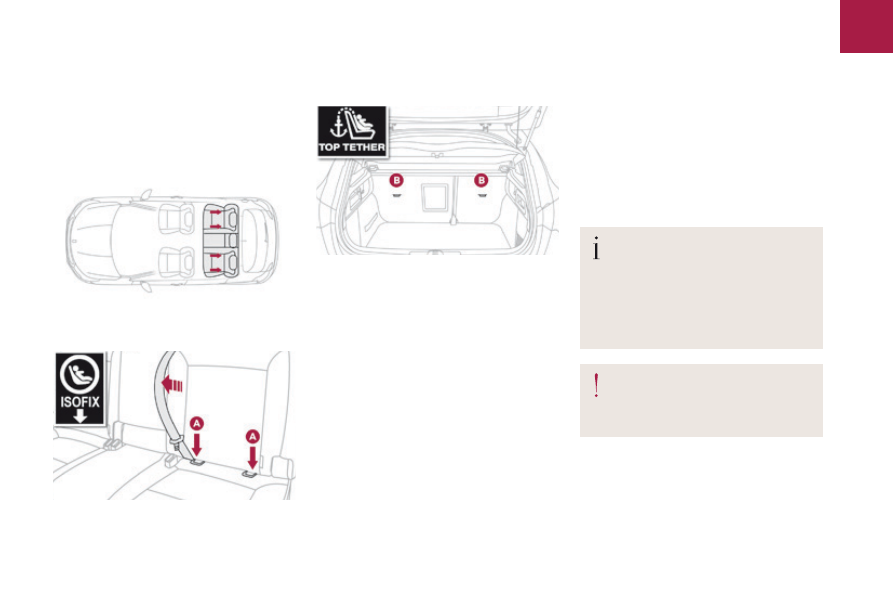
The seats, represented below, are fitted with 
regulation ISOFIX mountings:

"ISOFIX" mountings

There are three rings for each seat:

-  a ring B, located behind the seat and 

identified by a marking, referred to as the 
Top Tether

 for fixing the upper strap.

This ISOFIX mounting system provides fast, 
reliable and safe fitting of the child seat in your 
vehicle.
The ISOFIX child seats are fitted with two 
latches which are secured on the two rings A.
Some seats also have an upper strap, known 
as the Top Tether, which is attached to ring B.

The incorrect installation of a child seat 
in a vehicle compromises the child's 
protection in the event of an accident.

Strictly follow the fitting instructions provided in 
the user guide supplied with the child seat.
For information on the possibilities for installing 
ISOFIX child seats in your vehicle, refer to the 
summary table.

When fitting an ISOFIX child seat to the 
left-hand rear seat of the benchseat, 
before fitting the seat, first move the 
centre rear seat belt towards the middle 
of the vehicle, so as to avoid the seat 
interfering with the operation of the 
seat belt.

-  pass the upper strap of the child seat 

behind the seat backrest, centring it 
between the apertures for the head 
restraint rods,

-  fix the hook of the upper strap to the ring B,
-  tighten the upper strap.

To secure the child seat to the TOP TETHER:
-  remove and stow the head restraint before 

installing the child seat on the seat (refit it 
once the child seat has been removed),

-  two rings A, located between the seat 

backrest and cushion, indicated by a 
marking,

05

176

Safety

ISOFIX child seats recommended by CITROËN

Refer also to the child seat 
manufacturer's fitting instructions for 
information on installing and removing 
the seat.

CITROËN offers a range of ISOFIX child seats listed and type approved for your vehicle.

"RÖMER Baby-Safe Plus" and  

its ISOFIX base 

(size category: E)

Group 0+: from birth to 13 kg

Installed rearward facing using an ISOFIX 
base which is attached to the rings A.
The base has a support leg, adjustable for 
height, which sits on the vehicle's floor.
This child seat can also be secured with a 
seat belt. In this case, only the shell is used 
and attached to the vehicle's seat by the 
three-point seat belt.

Baby P2C Mini and its ISOFIX base

(size categories: C, D, E)

Group 0+: from birth to 13 kg

Installed rearward facing using an ISOFIX 
base which is attached to the rings A.
The base has a support leg, adjustable for 
height, which sits on the vehicle's floor.
This seat can also be secured with a seat 
belt.
In this case only the seat shell is used 
and is attached to the vehicle's seat by the 
three-point seat belt.

05

177

Safety

DS4_en_Chap05_securite_ed01-2016

DS4_en_Chap05_securite_ed01-2016

"RÖMER Duo Plus ISOFIX" 

(size category: B1)

Group 1: from 9 to 18 kg

Is installed only in the forward facing 
position.
Is attached to the rings A and the upper 
ring B, referred to as the TOP TETHER, 
using an upper strap.
Three seat body angles: sitting, reclining, 
lying down.
This child seat can also be used on seats 
not equipped with ISOFIX mountings. In 
this case, it must be secured to the vehicle's 
seat by the three-point seat belt. Adjust the 
position of the vehicle's front seat so that the 
child's feet are not touching the backrest.

"Baby P2C Midi" and its ISOFIX base 

(size categories: D, C, A, B, B1)

Group 1: from 9 to 18 kg

Installed rearward facing using an ISOFIX 
base which is attached to the rings A.
The base has a support leg, adjustable for 
height, which sits on the vehicle's floor.
This child seat can also be used forward 
facing.
This seat can not be secured with a seat 
belt.
We recommend that you use the seat in the 
rearward facing position up to the age of 
3 years.

05

178

Safety

Locations for ISOFIX child seats

In accordance with European Regulations, this table indicates the options for installing ISOFIX child seats on seats in the vehicle fitted with ISOFIX 
mountings.
In the case of universal and semi-universal ISOFIX child seats, the ISOFIX size category, determined by a letter from A to G, is indicated on the child 
seat next to the ISOFIX logo.

IUF: seat suitable for the installation of an I

sofix Universal seat, "Forward facing" secured using the 

upper strap.
IL-SU: seat suitable for the installation of an I

sofix Semi-Universal seat either:

-  rearward facing fitted with an upper strap or a support leg,
-  forward facing fitted with a support leg,
-  an infant car seat fitted with an upper strap or a support leg.
For advice on securing of the upper strap, refer to the "ISOFIX mountings" section.

* Infant car seats and "car cots" cannot be installed on the front passenger seat.
** The ISOFIX infant car seat, secured on the lower rings of a vehicle ISOFIX seat, occupies two rear seats.

Weight of the child

/indicative age

Less than 10 kg

(group 0)

Up to approx. 

6 months

Less than 10 kg

(group 0)

Less than 13 kg

(group 0+)

Up to approx. 1 year

From 9 to 18 kg (group 1)

From approx. 1 to 3 years

Type of ISOFIX child seat

Infant car seat

*

rearward facing

rearward facing

forward facing

ISOFIX size category

F

G

C

D

E

C

D

A

B

B1

ISOFIX child seats universal and semi-
universal which can be installed on the rear 
outer seats

IL-SU

**

IL-SU

IL-SU

IUF

 IL-SU

Remove and stow the head restraint 
before installing a child seat with a 
backrest on a passenger seat. Refit the 
head restraint once the child seat has 
been removed.

05

179

Safety

DS4_en_Chap05_securite_ed01-2016

DS4_en_Chap05_securite_ed01-2016

Advice

The incorrect installation of a child seat in a 
vehicle compromises the child's protection 
in the event of an accident.
Ensure that there is no seat belt or seat belt 
buckle under the child seat, as this could 
destabilise it.
Remember to fasten the seat belts or the 
child seat harnesses keeping the slack 
relative to the child's body to a minimum, 
even for short journeys.
When installing a child seat using the seat 
belt, ensure that the seat belt is tightened 
correctly on the child seat and that it 
secures the child seat firmly on the seat 
of your vehicle. If your passenger seat is 
adjustable, move it forwards if necessary.

For optimum installation of the forward 
facing child seat, ensure that the back of 
the child seat is as close as possible to the 
backrest of the vehicle's seat, in contact if 
possible.
You must remove the head restraint before 
installing a child seat with backrest to a 
passenger seat.
Ensure that the head restraint is stored or 
attached securely to prevent it from being 
thrown around the vehicle in the event of 
sharp braking. Refit the head restraint when 
the child seat is removed.

As a safety precaution, do not leave:
-  a child or children alone and 

unsupervised in a vehicle,

-  a child or an animal in a vehicle which 

is exposed to the sun, with the windows 
closed,

-  the keys within reach of children inside 

the vehicle.

To prevent accidental opening of the doors 
and rear windows, use the child lock.
Take care not to open the rear windows by 
more than one third.
To protect young children from the rays of 
the sun, fit side blinds on the rear windows.

At rear seating positions, always leave 
sufficient space between the front seat and:
-  a rearward facing child seat,
-  the child's feet for a child seat fitted 

forward facing.

To do this, move the front seat forwards 
and, if necessary, move its backrest into the 
upright position.

Children at the front

The legislation on carrying children on the 
front passenger seat is specific to each 
country. Refer to the legislation in force in 
your country.
Deactivate the passenger's front airbag 
when a rearward facing child seat is 
installed on the front passenger seat.
Otherwise, the child risks being seriously 
injured or killed if the airbag is deployed.

Installing a booster seat

The chest part of the seat belt must be 
positioned on the child's shoulder without 
touching the neck.
Ensure that the lap part of the seat belt 
passes correctly over the child's thighs.
CITROËN recommends the use of a 
booster seat which has a back, fitted with a 
seat belt guide at shoulder level.

05

180

Safety

Manual child lock

Mechanical system to prevent opening of the rear door using its interior control.
The control, red in colour, is located on the edge of each rear door. It is identified by a symbol 
marked on the bodywork.

Locking

F

  Using the ignition key or the integral key, 

depending on version, turn the red control 
as far as it will go:
-  to the left on the left-hand rear door,
-  to the right on the right-hand rear door.

Unlocking

F

  Using the ignition key or the integral key, 

depending on version, turn the red control 
as far as it will go:
-  to the right on the left-hand rear door,
-  to the left on the right-hand rear door.

Do not confuse the child lock control, 
which is red, with the back-up locking 
control, which is black.

05

181

Safety

DS4_en_Chap05_securite_ed01-2016

DS4_en_Chap05_securite_ed01-2016

Electric child lock

Remotely operated system to prevent opening of the rear doors using their interior controls and use 
of the rear electric windows.
The control is located on the dashboard, driver's side.

F

  Press this button.

The indicator lamp in the button 
comes on, accompanied by a 
message in the screen.

Any other status of the indicator lamp 
indicates a fault with the electric child 
lock. Have it checked by a CITROËN 
dealer or a qualified workshop.

This system is independent and in no 
circumstances does it take the place of 
the central locking control.
Check the status of the child lock each 
time you switch on the ignition.
Always remove the key from the ignition 
when leaving the vehicle, even for a 
short time.
In the event of a serious impact, the 
electric child lock is switched off 
automatically to permit the exit of the 
rear passengers.

Switching off

Switching on

This indicator lamp remains on until the child 
lock is switched off.

F

  Press this button again.

The indicator lamp on button A goes 
off, accompanied by a message in 
the screen.

This indicator lamp remains on while child lock 
is switched on.

DS4_en_Chap06_conduite_ed01-2016

DRIVING

06

DS4_en_Chap06_conduite_ed01-2016

06

184

Driving

DS4_en_Chap06_conduite_ed01-2016

Driving recommendations

Observe the driving regulations and remain vigilant whatever the traffic conditions.
Pay close attention to the traffic and keep your hands on the wheel so that you are ready to react at 
any time to any eventuality.
As a safety precaution, the driver must only carry out actions requiring sustained attention when 
the vehicle is stationary.
On a long journey, a break every two hours is strongly recommended.
In difficult weather, drive smoothly, anticipate the need to brake and increase the distance from 
other vehicles.

Never drive with the parking brake 
applied - Risk of overheating and 
damage to the braking system!
Risk of fire!
As the exhaust system of your vehicle 
is very hot, even several minutes 
after switching off the engine, do not 
park or leave the engine running over 
areas where inflammable substances 
and materials are present: grass, 
leaves, etc.

Never leave a vehicle unsupervised 
with the engine running. If you have 
to leave your vehicle with the engine 
running, apply the parking brake 
and put the gearbox into neutral or 
position N or P

, depending on the type 

of gearbox.

Driving on flooded roads

We strongly advise against driving on flooded 
roads, as this could cause serious damage 
to the engine or gearbox, as well as to the 
electrical systems of your vehicle.

Important!

-  check that the depth of water does not 

exceed 15 cm, taking account of waves 
that might be generated by other users,

-  deactivate the Stop & Start system,
-  drive as slowly as possible without 

stalling. In all cases, do not exceed 6 mph 
(10 km/h),

-  do not stop and do not switch off the 

engine.

If you are obliged to drive through water:

On leaving the flooded road, as soon as 
circumstances allow, make several light brake 
applications to dry the brake discs and pads.
If in doubt on the state of your vehicle, contact 
a CITROËN dealer or a qualified workshop.

06

185

Driving

DS4_en_Chap06_conduite_ed01-2016

When towing

Distribution of loads

F

  Distribute the load in the trailer so that the 

heaviest items are as close as possible to 
the axle and the nose weight approaches 
the maximum permitted without exceeding 
it.

Air density decreases with altitude, thus 
reducing engine performance. Above 
1 000 metres, the maximum towed load must 
be reduced by 10 % for every 1 000 metres of 
altitude.

Side wind

F

  Take into account the increased sensitivity 

to side wind.

Cooling

Towing a trailer on a slope increases the 
temperature of the coolant.
As the fan is electrically controlled, its cooling 
capacity is not dependent on the engine speed.
F

  To lower the engine speed, reduce your 

speed.

The maximum towed load on a long incline 
depends on the gradient and the exterior 
temperature.
In all cases, keep a check on the coolant 
temperature.

F

  If the warning lamp and the STOP 

warning lamp come on, stop the 
vehicle and switch off the engine 
as soon as possible.

Braking

Towing a trailer increases the braking distance.
To avoid overheating of the brakes, the use of 
engine braking is recommended.

Tyres

F

  Check the tyre pressures of the towing 

vehicle and of the trailer, observing the 
recommended pressures.

Lighting

F

  Check the electrical lighting and signalling 

on the trailer and the headlamp beam 
height of your vehicle.

For more information on Adjusting the 
headlamp beam height
, refer to the 
corresponding section.

For more information on Weights, refer 
to the corresponding section.

The rear parking sensors will be 
deactivated automatically to avoid the 
audible signal if a genuine CITROËN 
towbar is used.

If the exterior temperature is high, it 
is recommended that the engine be 
allowed to idle for 1 to 2 minutes after 
the vehicle comes to a stop, to facilitate 
its cooling.

06

186

Driving

DS4_en_Chap06_conduite_ed01-2016

Avoid attaching heavy objects to the 
key or the remote control, which would 
weigh down on its blade in the ignition 
switch and could cause a malfunction.
It could adversely affect the 
deployment of the front airbag.

Starting / Switching off the engine with the key

It has 3 positions:
- position 

1 (Stop)

: insert and removing the 

key, steering column locked,

- position 

2 (Ignition on)

: steering column 

unlocked, ignition on, Diesel preheating, 
engine running,

- position 

3 (Starting)

.

Ignition switch

Ignition on position

It allows the use of the vehicle's electric 
equipment or portable devices to be charged.
Once the state of charge of the battery drops 
to the reserve level, the system switches to 
energy economy mode: the power supply is 
cut off automatically to preserve the remaining 
battery charge.

Switching off the engine leads to a loss 
of braking assistance.

Anti-theft protection

Electronic engine immobiliser

In the event of a fault, you are 
informed by illumination of this 
warning lamp, an audible signal 
and/or the display of a message, 
depending on version.

Keep safely, away from your vehicle, 
the label attached to the keys given to 
you on acquisition of the vehicle.

In this case, your vehicle will not start; contact 
a CITROËN dealer as soon as possible.

The keys contain an electronic chip which has 
a special code. When the ignition is switched 
on, this code must be recognised for engine 
starting to be authorised.
This electronic engine immobiliser locks the 
engine management system a few minutes 
after the ignition is switched off and prevents 
starting of the engine by anyone who does not 
have the key.

06

187

Driving

DS4_en_Chap06_conduite_ed01-2016

In wintry conditions, the warning lamp 
can stay on for a longer period. When 
the engine is hot, the warning lamp 
does not come on.

In certain cases, you may have to apply 
more force to the steering (wheels on 
full lock, for example).

If the engine does not start straight 
away, switch off the ignition. Wait a 
few moments before operating the 
starter motor again. If the engine does 
not start after several attempts, do not 
keep trying: you risk damaging the 
starter motor or the engine. Contact 
a CITROËN dealer or a qualified 
workshop.

In temperate conditions, do not leave 
the engine at idle to warm up but move 
off straight away and drive at moderate 
speed.

Never leave the engine running in 
an enclosed area without adequate 
ventilation: internal combustion 
engines emit toxic exhaust gases, 
such as carbon monoxide. Danger of 
intoxication and death!
In very severe wintry conditions 
(temperatures below -23°C), to ensure 
the correct operation and durability of 
the mechanical components of your 
vehicle, engine and gearbox, it is 
necessary to leave the engine running 
for 4 minutes before moving off.

Starting the engine

The parking brake must be applied.
F

  With a manual gearbox, place the gear 

lever in neutral and depress the clutch 
pedal fully.

F

  With an automatic gearbox, place the 

selector in position N or P

 and press the 

brake pedal fully.

F

  Insert the key into the ignition switch; the 

system recognises the code.

F

  Unlock the steering column by 

simultaneously turning the steering and the 
key.

F

  With a petrol engine, operate the starter 

motor by turning the key to position 3 
without pressing the accelerator pedal, 
until the engine starts. Once the engine is 
running, release the key.

F

  With a Diesel engine, turn the key to 

position 2

, ignition on, to operate the 

engine pre-heating system.

Wait until this warning lamp goes off in the 
instrument panel then operate the starter 
motor by turning the key to position 3 
without pressing the accelerator pedal, 
until the engine starts. Once the engine is 
running, release the key.

06

188

Driving

DS4_en_Chap06_conduite_ed01-2016

Key left in the "Ignition on" 

position

If the key has been left in the ignition switch 
at position 2 (Ignition on)

, the ignition will 

be switched off automatically after one hour.
To switch the ignition back on, turn the 
key to position 1 (Stop), then back to 
position 2 (Ignition on)

.

F

  Stop the vehicle.

F

  With the engine running at idle, turn the key 

to position 1

.

F

  Remove the key from the ignition switch.

F

  To lock the steering column, turn the 

steering until it locks.

Switching off the engine

To facilitate unlocking of the steering 
column, it is recommended that the 
wheels be returned to the straight ahead 
position before switching off the engine.

When you leave the vehicle, keep the 
key with you and lock the vehicle.

For more information on Energy 
economy mode
, refer to the 
corresponding section.

Never switch off the ignition before the 
vehicle is at a complete stop. With the 
engine off, the braking and steering 
assistance systems are also cut off: 
risk of loss of control of the vehicle.

Energy economy mode

After switching off the engine (position 1-Stop), 
for a maximum of 30 minutes you can still use 
functions such as the audio and telematic 
system, the wipers, dipped beam headlamps, 
courtesy lamps, ...

F

  Check that the parking brake is correctly 

applied, particularly on sloping ground.

06

189

Driving

DS4_en_Chap06_conduite_ed01-2016

Starting / Switching off the engine with Keyless Entry and 

Starting

Starting the engine

F

  With a manual gearbox, place the gear 

lever in neutral and declutch fully.

F

  With an automatic gearbox, place the gear 

selector at P or N

 and press the brake 

pedal.

F

  Briefly press the "START/

STOP

" button while maintaining 

pressure on the pedal until the 
engine starts.

If the electronic key is not detected 
in the zone, a message is displayed. 
Move the electronic key into the zone 
so that the engine can be started.

If one of the starting conditions is not 
met, a reminder message appears in 
the instrument panel screen. In some 
circumstances, it is necessary to 
turn the steering wheel slightly while 
pressing the "START/STOP" button 
to assist unlocking of the steering; 
a message warns you when this is 
needed.
The presence of the "Keyless Entry 
and Starting" electronic key in the 
recognition zone is essential.
As a safety measure, do not leave this 
zone with the vehicle running.

Diesel vehicles

In temperatures below zero 
the engine will not start until 
the preheater warning lamp 
has gone off.

If this warning lamp comes on after 
pressing "START/STOP", you should 
hold the brake or clutch pedal down 
until the warning lamp goes off and do 
not press the "START/STOP" button 
again.

The steering column unlocks and the engine 
starts.
See the advice for Diesel versions.

F

  Place the electronic key inside the vehicle: 

there is no need to place it in the reader.

06

190

Driving

DS4_en_Chap06_conduite_ed01-2016

Switching off the engine

If the vehicle is not immobilised, the 
engine will not stop.

Do not leave your vehicle with the 
electronic key still inside.

Switching off the engine leads to a loss 
of braking assistance.

F

  Immobilise the vehicle.

F

  With a manual gearbox, place the gear 

lever in neutral.

F

  With an automatic gearbox, place the gear 

selector at P or N

.

F

  With the electronic key inside 

the vehicle, press the "START/
STOP

" button.

The engine stops and the steering 
column locks.

Emergency starting

When the electronic key is in the recognition 
zone and, after pressing the "START/STOP
button, the engine does not start:
F

  With a manual gearbox, place the gear 

lever in neutral.

F

  With an automatic gearbox, place the gear 

selector at P or N

.

F

  Open the front armrest

F

  Raise the mat by its tab and remove it.

F

  Place the electronic key in the back-up 

reader.

F

  With an automatic gearbox, press the 

brake pedal.

F

  With a manual gearbox, declutch fully.

F  Press the "START/STOP

button.


The engine starts.


Content   ..  10  11  12  13   ..