Chrysler Stratus Convertible. Manual - part 386
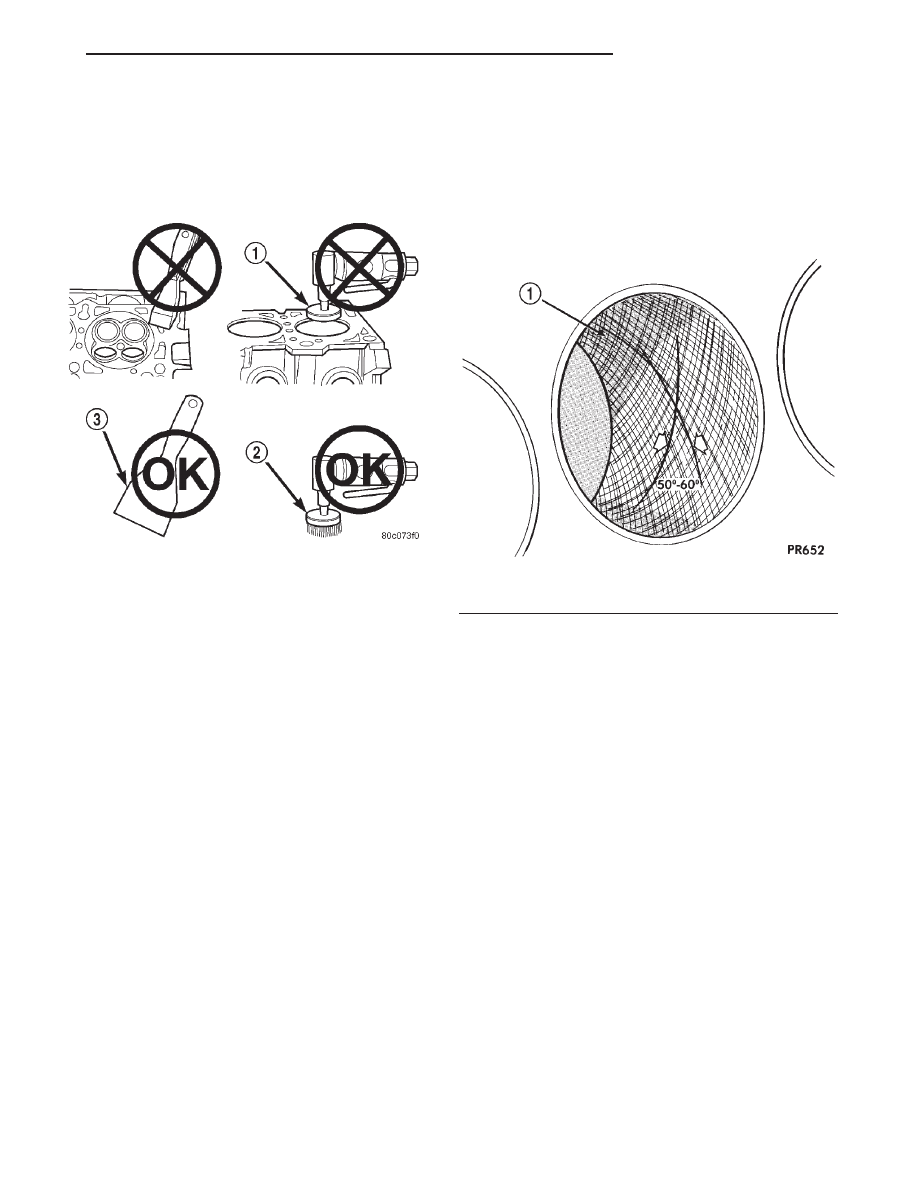
CAUTION: Excessive
pressure
or
high
RPM
(beyond the recommended speed), can damage the
sealing surfaces. The mild (white, 120 grit) bristle
disc is recommended. If necessary, the medium
(yellow, 80 grit) bristle disc may be used on cast
iron surfaces with care.
REPAIR OF DAMAGED OR WORN THREADS
Damaged or worn threads (including aluminum
head spark plug threads) can be repaired. Essen-
tially, this repair consists of drilling out worn or
damaged threads, tapping the hole with a special
Heli-Coil Tap, (or equivalent) and installing an insert
into the tapped hole. This brings the hole back to its
original thread size.
CAUTION: Be sure that the tapped holes maintain
the original centerline.
Heli-Coil tools and inserts are readily available
from automotive parts jobbers.
CYLINDER BORE—HONING
(1) Used carefully, the cylinder bore resizing hone,
recommended tool C-823 or equivalent, equipped
with 220 grit stones, is the best tool for this honing
procedure. In addition to deglazing, it will reduce
taper and out-of-round as well as removing light
scuffing, scoring or scratches. Usually a few strokes
will clean up a bore and maintain the required lim-
its.
(2) Deglazing of the cylinder walls may be done
using a cylinder surfacing hone, recommended tool
C-3501 or equivalent, equipped with 280 grit stones,
if the cylinder bore is straight and round. 20–60
strokes depending on the bore condition, will be suf-
ficient to provide a satisfactory surface. Inspect cyl-
inder walls after each 20 strokes, using a light
honing oil. Do not use engine or transmission oil,
mineral spirits or kerosene.
(3) Honing should be done by moving the hone up
and down fast enough to get a cross-hatch pattern.
When hone marks intersect at 50-60 degrees, the
cross hatch angle is most satisfactory for proper seat-
ing of rings (Fig. 13).
(4) A
controlled
hone
motor
speed
between
200–300 RPM is necessary to obtain the proper cross-
hatch angle. The number of up and down strokes per
minute can be regulated to get the desired 50–60
degree angle. Faster up and down strokes increase
the cross-hatch angle.
(5) After honing, it is necessary that the block be
cleaned again to remove all traces of abrasive.
CAUTION: Ensure all abrasives are removed from
engine parts after honing. It is recommended that a
solution of soap and hot water be used with a
brush and the parts then thoroughly dried. The bore
can be considered clean when it can be wiped
clean with a white cloth and cloth remains clean.
Oil the bores after cleaning to prevent rusting.
CYLINDER BORE AND PISTON—SIZING
The cylinder walls should be checked for out-of-
round and taper with Tool C-119 (Fig. 14). Refer to
Engine Specifications for cylinder bore out-of-round
and cylinder bore taper specifications. If the cylinder
walls are badly scuffed or scored, the cylinder block
should be rebored and honed, and new pistons and
rings fitted. Whatever type of boring equipment is
used, boring and honing operation should be closely
Fig. 12 Proper Tool Usage For Surface Preparation
Fig. 13 Cylinder Bore Cross-Hatch Pattern
1 – CROSS-HATCH PATTERN
JX
2.0L SOHC ENGINE
9 - 17
SERVICE PROCEDURES (Continued)