Acura RLX HYBRID (2020 year). Manual in english - page 28
 

  Index      Manuals     Acura RLX HYBRID (2020 year). Manual in english


Search            copyright infringement  


Content      ..     26      27      28      29     ..


Acura RLX HYBRID (2020 year). Manual in english - page 28


450

Driving

Braking

Brake System

Use the parking brake to keep the vehicle stationary when parked. When the 
parking brake is applied, you can manually or automatically release it.

To apply

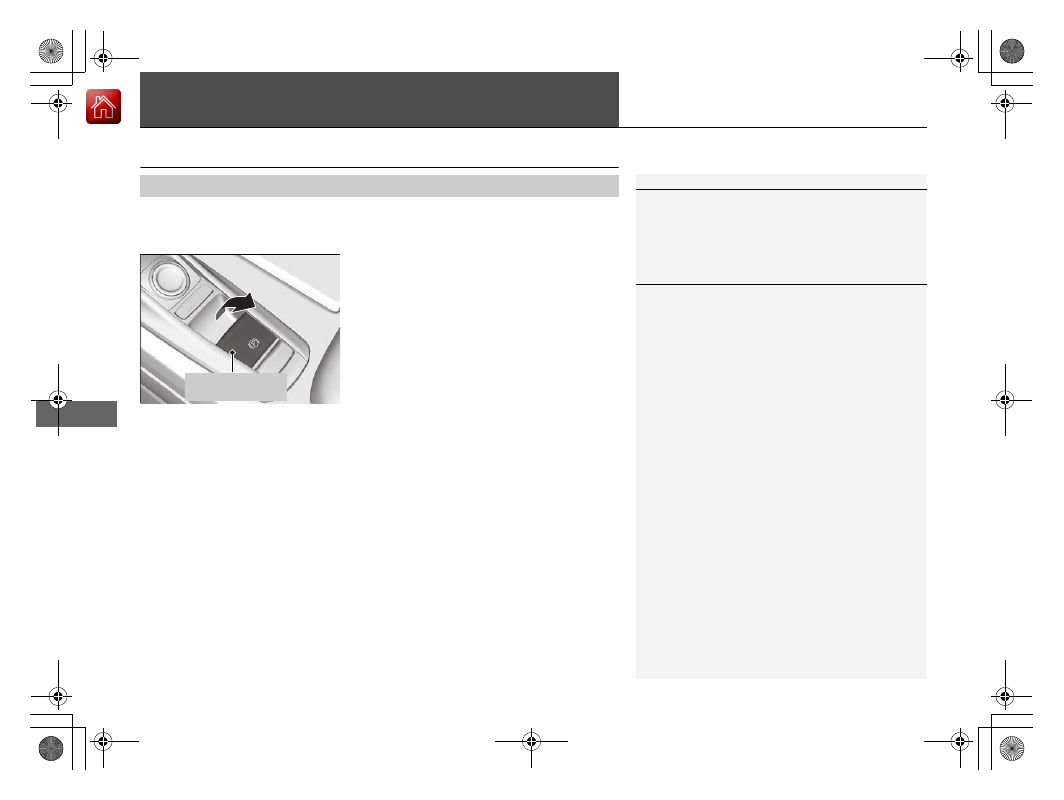
The electric parking brake can be applied any 
time the vehicle has battery, no matter which 
power mode the vehicle is in.

Pull the electric parking brake switch up gently 
and securely.

u

The electric parking brake indicator 
comes on.

Parking Brake

1

Brake System

When you depress the brake pedal, you may hear a 
whirling sound from the engine compartment. This is 
because the brake system is in operation, and it is 
normal.

1

Parking Brake

You may hear the electric parking brake system 
motor operating from the rear wheel area when you 
apply or release the parking brake. This is normal.

The brake pedal may slightly move due to the electric 
parking brake system operation when you apply or 
release the parking brake. This is normal.

You cannot apply or release the parking brake if the 
battery goes dead.

2

Jump Starting

 P. 562

If you pull up and hold the electric parking brake 
switch while driving, the brakes on all four 
wheels are applied by the VSA

®

 system until the 

vehicle come to a stop. The electric parking 
brake then applies, and the switch should be 
released.

Electric Parking 
Brake Switch

-------------------------------------------------------------------------------------------------------------------------------------------------------------

Continued

451

uu

Braking

u

Brake System

Driving

To release

The power mode must be in the ON position 
to release the electric parking brake.

1.

Depress the brake pedal.

2.

Press the electric parking brake switch.

u

The electric parking brake indicator goes 
off.

Manually releasing the parking brake using 
the switch helps your vehicle start slowly and 
smoothly when facing downhill on steep hills.

1

Parking Brake

In the following situations, the parking brake 
automatically operates.

When the vehicle stops more than 10 minutes 
while ACC with Low Speed Follow is activated.

When the driver’s seat belt is unfastened while 
your vehicle is stopped automatically by ACC with 
Low Speed Follow.

When the power system is turned off while ACC 
with Low Speed Follow is activated.

When the vehicle stops with the automatic brake 
hold system activated for more than 10 minutes.

When the driver’s seat belt is unfastened while 
your vehicle is stopped and brake hold is applied.

When the power system is turned off while brake 
hold is applied.

When there is a problem with the Brake Hold 
System.

Electric Parking 
Brake Switch

-------------------------------------------------------------------------------------------------------------------------------------------------------------

uu

Braking

u

Brake System

452

Driving

To release automatically

Depressing the accelerator pedal releases the parking brake.
Use the accelerator pedal to release the brake when you are starting the vehicle 
facing uphill, or in a traffic jam.

Gently depress the accelerator pedal.
When on a hill, it may require more 
accelerator input to release.

u

The electric parking brake indicator goes 
off.

The parking brake automatically releases as you depress the accelerator pedal when:

You are wearing the driver’s seat belt.

The power system is on.

The transmission is not in 

(

P

 or 

(

N

.

1

Parking Brake

If the parking brake cannot be released 
automatically, release it manually.

When the vehicle is traveling uphill, the accelerator 
pedal may need to be pressed farther to 
automatically release the electric parking brake.

The parking brake cannot be released automatically 
while the following indicators are on:

Malfunction indicator lamp

Transmission system indicator

The parking brake may not be released automatically 
while the following indicators are on:

Electric parking brake system indicator

VSA

®

 system indicator

ABS

 indicator

Supplemental restraint system indicator

Accelerator Pedal

-------------------------------------------------------------------------------------------------------------------------------------------------------------

Continued

453

uu

Braking

u

Brake System

Driving

Your vehicle is equipped with disc brakes at all four wheels. The brake assist system 
increases the stopping force when you depress the brake pedal hard in an 
emergency situation. The anti-lock brake system (ABS) helps you retain steering 
control when braking very hard.

2

Brake Assist System

 P. 457

2

Anti-lock Brake System (ABS)

 P. 456

Foot Brake

1

Foot Brake

Check the brakes after driving through deep water, 
or if there is a buildup of road surface water. If 
necessary, dry the brakes by lightly depressing the 
pedal several times.

If you hear a continuous metallic friction sound when 
applying the brakes, this is caused by the brake wear 
indicator rubbing on the brake rotor and indicates 
that the brake pads need to be replaced. Have the 
vehicle checked by a dealer. If you hear only an 
occasional squeak or squeal when you initially apply 
the brake pedal, this may be normal and caused by 
high frequency vibration of the brake pads against 
the rotating brake disc.

Constantly using the brake pedal while going down a 
long hill builds up heat, which reduces the brake 
effectiveness. Apply regenerative braking by taking 
your foot off the accelerator pedal and downshifting 
to a lower gear.

Do not rest your foot on the brake pedal while 
driving, as it will lightly apply the brakes and cause 
them to lose effectiveness over time and reduce pad 
life. It will also confuse drivers behind you.

-------------------------------------------------------------------------------------------------------------------------------------------------------------

uu

Braking

u

Brake System

454

Driving

Keeps the brake applied after releasing the brake pedal until the accelerator pedal is 
pressed. You can use this system only while the vehicle is temporarily stopped, like 
at traffic lights and in heavy traffic.

Automatic Brake Hold

1

Automatic Brake Hold

3

WARNING

Activating the automatic brake hold system 
on steep hills or slippery roads may still 
allow the vehicle to move if you remove 
your foot from the brake pedal.

If a vehicle unexpectedly moves, it may 
cause a crash resulting in serious injury or 
death.

Never activate the automatic brake hold 
system or rely on it to keep a vehicle from 
moving when stopped on a steep hill or 
slippery roads.

3

WARNING

Using the automatic brake hold system to 
park the vehicle may result in the vehicle 
unexpectedly moving.

If a vehicle moves unexpectedly, it may 
cause a crash, resulting in serious injury or 
death.

Never leave the vehicle when braking is 
temporarily kept by automatic brake hold 
and always park the vehicle by putting the 
transmission in 

(

P

 and applying the parking 

brake.

Turning on the system

Fasten your seat belt 
properly, then start the 
power system. Press the 
automatic brake hold 
button.

The automatic brake 
hold system indicator 
comes on. The system 
is turned on.

Activating the system

Depress the brake pedal 
to come to a complete 
stop. The transmission 
must be in 

(

D

 or 

(

N

.

The automatic brake 
hold indicator comes 
on. Braking is kept for 
up to 10 minutes.

Release the brake 
pedal after the 
automatic brake hold 
indicator comes on.

Canceling the system

Depress the accelerator 
pedal while the 
transmission is in 

(

D

The system is canceled 
and the vehicle starts to 
move.

The automatic brake 
hold indicator goes 
off. The system 
continues to be on.

Accelerator Pedal

Brake Pedal

Automatic Brake 
Hold Button

Goes 
Off

U.S.

Canada

On

On

Comes 
On

Comes 
On

Comes 
On

-------------------------------------------------------------------------------------------------------------------------------------------------------------

455

uu

Braking

u

Brake System

Driving

The system automatically cancels when:

You depress the brake pedal and change to 

(

P

 or 

(

R

.

You engage the parking brake.

The system automatically cancels and the parking brake is applied when:

Braking is kept for more than 10 minutes.

The driver’s seat belt is unfastened.

The power system is turned off.

Brake Hold System Problem

 appears on the multi-information display.

Turning off the automatic brake hold system

While the system is on, press the automatic 
brake hold button again.

u

The automatic brake hold system 
indicator goes off.

If you want to turn off automatic brake hold 
while the system is in operation, press the 
automatic brake hold button with the brake 
pedal depressed.

1

Automatic Brake Hold

While the system is activated, you can turn off the 
power system or park the vehicle through the same 
procedure as you normally do.

2

When Stopped

 P. 466

Whether the system is on, or the system is activated, 
the automatic brake hold turns off once the power 
system is off.

1

Turning off the automatic brake hold system

Make sure to turn off the automatic brake hold 
system before using an automated car wash.

You may hear an operating noise if the vehicle moves 
while the automatic brake hold system is in 
operation.

Automatic Brake 
Hold Button

Goes 
Off

-------------------------------------------------------------------------------------------------------------------------------------------------------------

456

uu

Braking

u

Anti-lock Brake System (ABS)

Driving

Anti-lock Brake System (ABS)

Helps prevent the wheels from locking up, and helps you retain steering control by 
pumping the brakes rapidly, much faster than you.

The electronic brake distribution (EBD) system, which is part of the ABS, also 
balances the front-to-rear braking distribution according to vehicle loading.

You should never pump the brake pedal. Let the ABS work for you by always 
keeping firm, steady pressure on the brake pedal. This is sometimes referred to as 
“stomp and steer.”

ABS operation

The brake pedal may pulsate slightly when the ABS is working. Depress the brake 
pedal and keep holding the pedal firmly down. On dry pavement, you will need to 
press on the brake pedal very hard before the ABS activates. However, you may feel 
the ABS activate immediately if you are trying to stop on snow or ice.

ABS may activate when you depress the brake pedal when driving on:

Wet or snow covered roads.

Roads paved with stone.

Roads with uneven surfaces, such as potholes, cracks, manholes, etc.

When the vehicle speed goes under 6 mph (10 km/h), the ABS stops.

ABS

1

Anti-lock Brake System (ABS)

NOTICE

The ABS may not function correctly if you use a tire of 
the wrong size or type.

If the 

ABS

 indicator comes on while driving, there 

may be a problem with the system.
While normal braking will not be affected, there is a 
possibility that the ABS will not operating. Have your 
vehicle checked by a dealer immediately.

The ABS is not designed for the purpose of reducing 
the time or distance it takes for a vehicle to stop: It is 
designed to limit brake lockup which can lead to 
skidding and loss of steering control.

In the following cases, your vehicle may need more 
distance to stop than a vehicle without the ABS:

You are driving on rough or uneven road surfaces, 
such as gravel or snow.

The tires are equipped with snow chains.

The following may be observed with the ABS system:

Motor sounds coming from the engine 
compartment when the brakes are applied, or 
when system checks are being performed after the 
engine has been started and while the vehicle 
accelerates.

Brake pedal and/or the vehicle body vibration when 
ABS activates.

These vibrations and sounds are normal to ABS 
systems and are no cause for concern.

-------------------------------------------------------------------------------------------------------------------------------------------------------------

457

uu

Braking

u

Brake Assist System

Driving

Brake Assist System

Designed to assist the driver by generating greater braking force when you depress 
the brake pedal hard during emergency braking.

Brake assist system operation

Press the brake pedal firmly for more powerful braking.

When brake assist operates, the pedal may wiggle slightly and an operating noise 
may be heard. This is normal. Keep holding the brake pedal firmly down.

-------------------------------------------------------------------------------------------------------------------------------------------------------------

458

uu

Braking

u

Collision Mitigation Braking System

TM

 (CMBS

TM

)

Driving

Collision Mitigation Braking System

TM

 (CMBS

TM

)

Can assist you when there is a possibility of your vehicle colliding with a vehicle or a 
pedestrian detected in front of yours. The CMBS

TM

 is designed to alert you when a 

potential collision is determined, as well as to reduce your vehicle speed to help 
minimize collision severity when a collision is deemed unavoidable.

How the system works

1

Collision Mitigation Braking System

TM

 (CMBS

TM

)

Important Safety Reminder

The CMBS

TM

 is designed to reduce the severity of an 

unavoidable collision. It does not prevent a collision 
nor stop the vehicle automatically. It is still your 
responsibility to operate the brake pedal and steering 
wheel appropriately according to the driving 
conditions.

The CMBS

TM

 may not activate or may not detect a 

vehicle in front of your vehicle under certain 
conditions:

2

CMBS

TM

 Conditions and Limitations

 P. 462

You can read about handling information for the 
camera equipped with this system.

2

Front Sensor Camera

 P. 400

Be careful not to have the radar sensor cover strongly 
impacted.

1

How the system works

Rapid vibrations on the steering wheel alert you 
when your vehicle speed is between 19 and 62 mph 
(30 and 100 km/h) with an oncoming vehicle 
detected in front of you.

When the CMBS

TM

 activates, it may automatically 

apply the brake. It will be canceled when your vehicle 
stops or a potential collision is not determined.

The radar sensor is 
in the front grille.

The camera is 
located behind 
the rearview 
mirror.

The system starts monitoring the roadway ahead when your vehicle speed is about 3 
mph (5 km/h) and there is a vehicle in front of you.

When to use

The CMBS

TM

 activates when:

The speed difference between your vehicle and a vehicle or pedestrian detected 
in front of you becomes about 3 mph (5 km/h) and over with a chance of a 
collision.

Your vehicle speed is about 62 mph (100 km/h) or less and there is a chance of a 
collision with an oncoming detected vehicle or a pedestrian in front of you.

-------------------------------------------------------------------------------------------------------------------------------------------------------------

Continued

459

uu

Braking

u

Collision Mitigation Braking System

TM

 (CMBS

TM

)

Driving

When the system activates

At system’s earliest collision alert stage, you can change the distance (

Long

/

Normal

/

Short

) between vehicles at which alerts will come on through audio/

information screen setting options.

2

Customized Features

 P. 295

Vibration alert on the steering wheel

When a potential collision to an oncoming detected vehicle is determined, the 
system alerts you with rapid vibration on the steering wheel, in addition to visual and 
audible alerts.

u

Take appropriate action to prevent a collision (apply the brakes, operate the 
steering wheel, etc.).

1

When the system activates

The camera in the CMBS

TM

 is also designed to detect 

pedestrians.
However, this pedestrian detection feature may not 
activate or may not detect a pedestrian in front of 
your vehicle under certain conditions.
Refer to the ones indicating the pedestrian detection 
limitations from the list.

2

CMBS

TM

 Conditions and Limitations

 P. 462

The head-up warning uses a lens located at the front 
end of the dashboard.
Do not cover the lens or spill any liquid on it.

Lens

The system provides visual, audible and tactile alerts of a possible collision, and 
stops if the collision is avoided.

u

Take appropriate action to prevent a collision (apply the brakes, change 
lanes, etc.)

Beep

Head-up 
Warning

Visual Alerts

Audible Alert

Tactile Alert

1

Vibration alert on the steering wheel

Vibration alert function is disabled when the electric 
power steering (EPS) system indicator comes on.

2

Electric Power Steering (EPS) System 
Indicator

 P. 84

-------------------------------------------------------------------------------------------------------------------------------------------------------------

460

uu

Braking

u

Collision Mitigation Braking System

TM

 (CMBS

TM

)

Driving

The system has three alert stages for a possible collision. However, depending on circumstances, the CMBS

TM

 may not go through all of 

the stages before initiating the last stage.

Collision Alert Stages

Distance between vehicles

CMBS

TM

The radar sensor 

detects a vehicle

E-pretensioner/

Reactive Force Pedal

Audible & Visual WARNINGS

Steering 

Wheel

Braking

Stage 

one

There is a risk of a 
collision with the 
vehicle ahead of 
you.

Increases the 
accelerator pedal 
resistance force.

When in 

Long

, visual and 

audible alerts come on at a 
longer distance from a vehicle 
ahead than in 

Normal

 setting, 

and in 

Short

, at a shorter 

distance than in 

Normal

.

In case of 
an 
oncoming 
vehicle 
detected, 
rapid 
vibration is 
provided.

Stage 

two

The risk of a 
collision has 
increased, time to 
respond is 
reduced.

Retracts the driver’s 
seat belt gently a few 
times, providing a 
physical warning.

Visual and audible alerts.

Lightly 

applied

Stage 

three 

The CMBS

TM


determines that a 
collision is 
unavoidable.

Forcefully tightens 
driver and front 
passenger seat belts.

Forcefully 

applied

Your Vehicle

Vehicle 
Ahead

Normal

Short

Long

Accelerator Pedal

Your 
Vehicle

Vehicle 
Ahead

Your 
Vehicle

Vehicle 
Ahead

-------------------------------------------------------------------------------------------------------------------------------------------------------------

Continued

461

uu

Braking

u

Collision Mitigation Braking System

TM

 (CMBS

TM

)

Driving

Press and hold the button until the beeper 
sounds to switch the system on or off. 

When the CMBS

TM

 is off:

The CMBS

TM

 indicator in the instrument 

panel comes on.

A message on the multi-information display 
reminds you that the system is off.

The CMBS

TM

 is turned on every time you turn 

the power system on, even if you turned it off 
the last time you drove the vehicle.

CMBS

TM

 On and Off

1

Collision Mitigation Braking System

TM

 (CMBS

TM

)

The CMBS

TM

 may automatically shut off, and the 

CMBS

TM

 indicator will come and stay on under certain 

conditions:

2

CMBS

TM

 Conditions and Limitations

 P. 462

-------------------------------------------------------------------------------------------------------------------------------------------------------------

uu

Braking

u

Collision Mitigation Braking System

TM

 (CMBS

TM

)

462

Driving

The system may automatically shut off and the CMBS

TM

 indicator will come on under 

certain conditions. Some examples of these conditions are listed below. Other 
conditions may reduce some of the CMBS

TM

 functions.

2

Front Sensor Camera

 P. 400

Environmental conditions

Driving in bad weather (rain, fog, snow, etc.).

Sudden changes between light and dark, such as an entrance or exit of a tunnel.

There is little contrast between objects and the background.

Driving into low sunlight (e.g., at dawn or dusk).

Strong light is reflected onto the roadway.

Driving in the shadows of trees, buildings, etc.

Roadway objects or structures are misinterpreted as vehicles and pedestrians.

Reflections on the interior of the windshield.

Driving at night or in a dark condition such as a tunnel.

Roadway conditions

Driving on a snowy or wet roadway (obscured lane marking, vehicle tracks, 
reflected lights, road spray, high contrast).

Driving on curvy, winding, or undulating roads.

The road is hilly or the vehicle is approaching the crest of a hill.

CMBS

TM

 Conditions and Limitations

1

CMBS

TM

 Conditions and Limitations

Do not paint, or apply any coverings or paint to the 
radar sensor area. This can impact CMBS

TM

 operation.

Have your vehicle checked by a dealer if you find any 
unusual behavior of the system (e.g., the warning 
message appears too frequently).

If the front of the vehicle is impacted in any of the 
following situations, the radar sensor may not work 
properly. Have your vehicle checked by a dealer:

The vehicle mounted onto a bump, curb, chock, 
embankment, etc.

You drive the vehicle where the water is deep.

Your vehicle has a frontal collision.

If you need the radar sensor to be repaired, or 
removed, or the radar sensor cover is strongly 
impacted, turn off the system by pressing the 
CMBS

TM


OFF

 button and take your vehicle to a 

dealer.

-------------------------------------------------------------------------------------------------------------------------------------------------------------

463

uu

Braking

u

Collision Mitigation Braking System

TM

 (CMBS

TM

)

Continued

Driving

Vehicle conditions

Headlight lenses are dirty or the headlights are not properly adjusted.

The outside of the windshield is blocked by dirt, mud, leaves, wet snow, etc.

The inside of the windshield is fogged.

An abnormal tire or wheel condition (wrong sized, varied size or construction, 
improperly inflated, compact spare tire

*

, etc.).

When tire chains are installed.

The vehicle is tilted due to a heavy load or suspension modifications.

The camera temperature gets too high.

Driving with the parking brake applied.

When the radar sensor in the front grille gets dirty.

Detection limitations

A vehicle or pedestrian suddenly crosses in front of you.

The distance between your vehicle and the vehicle or pedestrian ahead of you is 
too short.

A vehicle cuts in front of you at a slow speed, and it brakes suddenly.

When you accelerate rapidly and approach the vehicle or pedestrian ahead of you 
at high speed.

The vehicle ahead of you is a motorcycle, bicycle, mobility scooter or other small 
vehicle.

When there are animals in front of your vehicle.

When you drive on a curved, winding or undulating road that makes it difficult for 
the sensor to properly detect a vehicle in front of you.

The speed difference between your vehicle and a vehicle or pedestrian in front of 
you is significantly large.

An oncoming vehicle suddenly comes in front of you.

Another vehicle suddenly comes in front of you at an intersection, etc.

Your vehicle abruptly crosses over in front of an oncoming vehicle.

When driving through a narrow iron bridge.

When the lead vehicle suddenly slows down.

* Not available on all models

-------------------------------------------------------------------------------------------------------------------------------------------------------------

464

uu

Braking

u

Collision Mitigation Braking System

TM

 (CMBS

TM

)

Driving

When there is a group of people in front of your vehicle walking together side by 
side.

Surrounding conditions or belongings of the pedestrian alter the pedestrian’s 
shape, preventing the system from recognizing that the person is a pedestrian.

When the pedestrian is shorter than about 3.3 feet (1 meter) or taller than about 
6.6 feet (2 meters) in height.

When a pedestrian blends in with the background.

When a pedestrian is bent over or squatting, or when their hands are raised or 
they are running.

When several pedestrians are walking ahead in a group.

When the camera cannot correctly identify that a pedestrian is present due to an 
unusual shape (holding luggage, body position, size).

The CMBS

TM

 may automatically shut itself off and the CMBS

TM

 indicator comes and 

stays on when:

The temperature inside the system is high.

You drive off-road or on a mountain road, or curved and winding road for an 
extended period.

An abnormal tire condition is detected (wrong tire size, flat tire, etc.).

The camera behind the rearview mirror, or the area around the camera, including 
the windshield, gets dirty.

Once the conditions that caused the CMBS

TM

 to shut off improve or are addressed 

(e.g., cleaning), the system comes back on.

Automatic shutoff

Limitations applicable to pedestrian detection only

-------------------------------------------------------------------------------------------------------------------------------------------------------------

465

uu

Braking

u

Collision Mitigation Braking System

TM

 (CMBS

TM

)

Driving

The CMBS

TM

 may activate even when you are aware of a vehicle ahead of you, or 

when there is no vehicle ahead. Some examples of this are:

When Passing

Your vehicle approaches another vehicle ahead of you and you change lanes to pass.

At an intersection

Your vehicle approaches or passes another vehicle that is making a left or right turn.

On a curve

When driving through curves, your vehicle comes to a point where an oncoming 
vehicle is right in front of you.

Through a low bridge at high speed

You drive under a low or narrow bridge at high speed.

Speed bumps, road work sites, train tracks, roadside objects, etc.

You drive over speed bumps, steel road plates, etc., or your vehicle approaches train 
tracks or roadside objects [such as a traffic sign and guard rail] on a curve or, when 
parking, stationary vehicles and walls.

With Little Chance of a Collision

1

Collision Mitigation Braking System

TM

 (CMBS

TM

)

For the CMBS

TM

 to work properly:

Always keep the radar sensor cover clean.

Never use chemical solvents or polishing powder for 
cleaning the sensor cover. Clean it with water or a 
mild detergent.

-------------------------------------------------------------------------------------------------------------------------------------------------------------


Content      ..     26      27      28      29     ..