RAM 1500 TRX (2022 year). Manual in english - page 25
 

  Index      Manuals     RAM 1500 TRX (2022 year). Manual in english


Search            copyright infringement  


Content      ..     23      24      25      26     ..


RAM 1500 TRX (2022 year). Manual in english - page 25


IN CASE OF EMERGENCY

397

MANUAL PARK RELEASE

In order to move the vehicle in cases where the 

transmission will not shift out of PARK (P) (such as 

a depleted battery), a Manual Park Release is 

available.
Follow these steps to activate the Manual Park 

Release:
1. Apply firm pressure to the brake pedal while 

seated in the driver’s seat.

2. Apply the parking brake if possible.
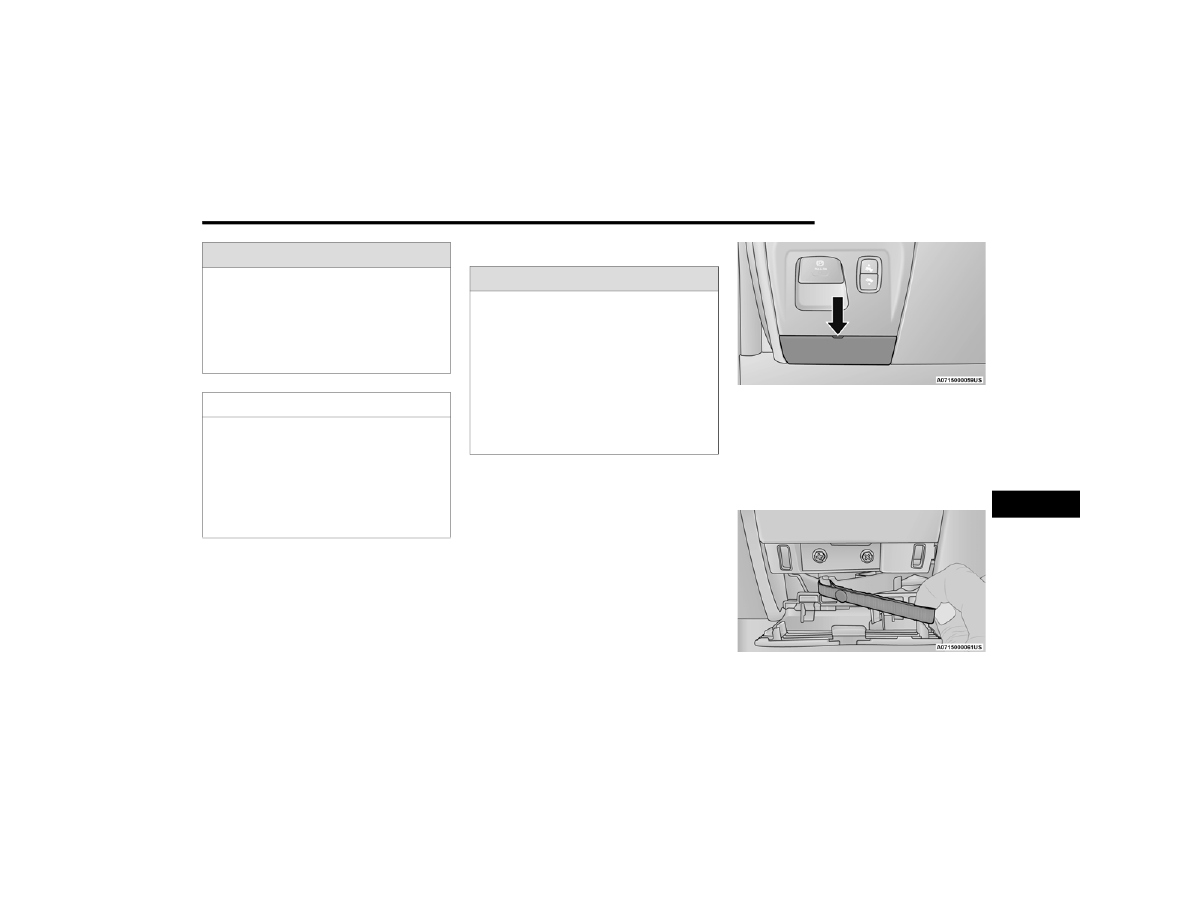
3. Using a small screwdriver or similar tool, open 

the Manual Park Release cover, which is 

located to the lower left of the steering column.

Manual Park Release Access Cover

4. Behind the Manual Park Release access cover 

is the orange tether strap. Pull the tether strap 

out as far as it will go, then release it. The 

tether and lever will remain outside of the trim 

panel and the transmission should now be in 

NEUTRAL, allowing the vehicle to be moved.

Manual Park Release Tether

WARNING!

You or others can be badly burned by hot engine 

coolant (antifreeze) or steam from your radiator. 

If you see or hear steam coming from under the 

hood, do not open the hood until the radiator 

has had time to cool. Never try to open a cooling 

system pressure cap when the radiator or 

coolant bottle is hot.

CAUTION!

Driving with a hot cooling system could damage 

your vehicle. If the temperature gauge reads 

HOT (H), pull over and stop the vehicle. Idle the 

vehicle with the air conditioner turned off until 

the pointer drops back into the normal range. If 

the pointer remains on HOT (H), and you hear 

continuous chimes, turn the engine off 

immediately and call for service.

WARNING!

Always secure your vehicle by fully applying the 

parking brake before activating the Manual Park 

Release. In addition, you should be seated in the 

driver’s seat with your foot firmly on the brake 

pedal when activating the Manual Park Release. 

Activating the Manual Park Release will allow 

your vehicle to roll away if it is not secured by the 

parking brake, or by proper connection to a tow 

vehicle. Activating the Manual Park Release on 

an unsecured vehicle could lead to serious 

injury or death for those in or around the vehicle.

7

-------------------------------------------------------------------------------------------------------------------------------------------------------------

398

IN CASE OF EMERGENCY


(Continued)

To Reset The Manual Park Release:
1. Apply firm pressure to the brake pedal while 

seated in the driver’s seat.

2. Pull the tether strap out again, then release it.
3. Allow the tether to retract with the lever back 

to its original position.

Manual Park Release Tether

4. Verify the transmission is in PARK.
5. Confirm that the tether has retracted fully 

and reinstall the access cover. If the access 

cover cannot be reinstalled, repeat steps 1 

through 4.

NOTE:

When the lever is locked in the released position 

the access cover cannot be reinstalled.

FREEING A STUCK VEHICLE 

If your vehicle becomes stuck in mud, sand, or 

snow, it can often be moved using a rocking 

motion. Turn the steering wheel right and left to 

clear the area around the front wheels. Then shift 

back and forth between DRIVE (D) and REVERSE 

(R), while gently pressing the accelerator. Use the 

least amount of accelerator pedal pressure that 

will maintain the rocking motion, without spinning 

the wheels or racing the engine.

NOTE:

Shifts between DRIVE and REVERSE can only be 

achieved at wheel speeds of 5 mph (8 km/h) or 

less. Whenever the transmission remains in 

NEUTRAL (N) for more than two seconds, you must 

press the brake pedal to engage DRIVE or 

REVERSE.
Push the ESC OFF button to place the Electronic 

Stability Control (ESC) system in “Partial OFF” 

mode, before rocking the vehicle  

Ú

page 321

Once the vehicle has been freed, push the ESC OFF 

button to restore “ESC On” mode.

CAUTION!

Racing the engine or spinning the wheels may 

lead to transmission overheating and failure. 

Allow the engine to idle with the transmission 

in NEUTRAL for at least one minute after every 

five rocking-motion cycles. This will minimize 

overheating and reduce the risk of transmis

-

sion failure during prolonged efforts to free a 

stuck vehicle.

When “rocking” a stuck vehicle by shifting 

between DRIVE and REVERSE, do not spin the 

wheels faster than 15 mph (24 km/h), or 

drivetrain damage may result.

Revving the engine or spinning the wheels too 

fast may lead to transmission overheating and 

failure. It can also damage the tires. Do not 

spin the wheels above 30 mph (48 km/h) 

while in gear (no transmission shifting 

occurring).

CAUTION!

-------------------------------------------------------------------------------------------------------------------------------------------------------------

IN CASE OF EMERGENCY

399

TOWING A DISABLED VEHICLE   

This section describes procedures for towing a 

disabled vehicle using a commercial towing 

service.
If the transmission and drivetrain are operable, 

disabled vehicles may also be towed as described 

on  

Ú

page 231.

NOTE:

Vehicles equipped with the Active-Level Four 

Corner Air Suspension System must be placed in 

Transport mode, before tying them down (from the 

body) on a trailer or flatbed truck  

Ú

page 167. If 

the vehicle cannot be placed in Transport mode 

(for example, engine will not run), tie-downs must 

be fastened to the axles (not to the body). Failure 

to follow these instructions may cause fault codes 

to be set and/or cause loss of proper tie-down 

tension.

WARNING!

Fast spinning tires can be dangerous. Forces 

generated by excessive wheel speeds may 

cause damage, or even failure, of the axle and 

tires. A tire could explode and injure someone. 

Do not spin your vehicle's wheels faster

than 30 mph (48 km/h) or for longer than

30 seconds continuously without stopping when 

you are stuck and do not let anyone near a 

spinning wheel, no matter what the speed.

Towing Condition

Wheels OFF The 

Ground

Two-Wheel Drive 

Models

Four-Wheel Drive Models

Flat Tow

NONE

NOT ALLOWED

See Instructions

Transmission in PARK

Transfer case in N (Neutral)

Tow in forward direction

Dolly Tow

Front

NOT ALLOWED

NOT ALLOWED

Rear

OK

NOT ALLOWED

On Trailer

ALL

OK

OK

7

-------------------------------------------------------------------------------------------------------------------------------------------------------------

400

IN CASE OF EMERGENCY


Proper towing or lifting equipment is required to 

prevent damage to your vehicle. Use only tow bars 

and other equipment designed for this purpose, 

following equipment per FCA US LLC instructions. 

Use of safety chains is mandatory. Attach a tow bar 

or other towing device to main structural members 

of the vehicle, not to fascia/bumpers or associated 

brackets. State and local laws regarding vehicles 

under tow must be observed.
If you must use the accessories (wipers, 

defrosters, etc.) while being towed, the ignition 

must be in the ON/RUN mode, not the ACC mode.
If the key fob is unavailable or the vehicle's battery 

is discharged, find Instructions on shifting the 

transmission out of PARK in order to move the 

vehicle  

Ú

page 397.

T

WO

-W

HEEL

 D

RIVE

 M

ODELS

FCA US LLC recommends towing your vehicle with 

all four wheels OFF the ground using a flatbed.
If flatbed equipment is not available, and the 

transmission is operable, the vehicle may be towed 

(with front wheels on the ground) under the 

following conditions:

The transmission must be in NEUTRAL (N). 

Instructions on shifting the transmission to 

NEUTRAL (N) when the engine is OFF  

Ú

page 397.

The towing speed must not exceed 30 mph 

(48 km/h).

The towing distance must not exceed 30 miles 

(48 km).

If the transmission is not operable, or the vehicle 

must be towed faster than 30 mph (48 km/h) and 

farther than 30 miles (48 km), tow with the rear 

wheels OFF the ground. An acceptable method to 

tow the vehicle on a flatbed are as follows: 

Using a suitable steering wheel stabilizer to hold 

the front wheels in the straight position with the 

rear wheels raised and the front wheels ON the 

ground.

F

OUR

-W

HEEL

 D

RIVE

 M

ODELS

FCA US LLC recommends towing with all wheels 

OFF the ground.

CAUTION!

Do not use sling type equipment when towing. 

Vehicle damage may occur.

When securing the vehicle to a flatbed truck, 

do not attach to front or rear suspension 

components. Damage to your vehicle may 

result from improper towing.

CAUTION!

Towing this vehicle in violation of the above 

requirements can cause severe transmission 

damage. Damage from improper towing is not 

covered under the New Vehicle Limited 

Warranty.

CAUTION!

Front or rear wheel lifts must not be used 

(if the remaining wheels are on the ground). 

Internal damage to the transmission or 

transfer case will occur if a front or rear wheel 

lift is used when towing.

Towing this vehicle in violation of the above 

requirements can cause severe transmission 

and/or transfer case damage. Damage from 

improper towing is not covered under the New 

Vehicle Limited Warranty.

-------------------------------------------------------------------------------------------------------------------------------------------------------------

IN CASE OF EMERGENCY

401

E

MERGENCY

 T

OW

 H

OOKS

 — 

I

F

 E

QUIPPED

Your vehicle may be equipped with emergency tow 

hooks.

Emergency Tow Hooks

NOTE:

For off-road recovery, it is recommended to use 

both of the front tow hooks to minimize the risk of 

damage to the vehicle.

ENHANCED ACCIDENT RESPONSE SYSTEM 

(EARS) 

This vehicle is equipped with an Enhanced 

Accident Response System.
This feature is a communication network that 

takes effect in the event of an impact  

Ú

page 361.

EVENT DATA RECORDER (EDR)

This vehicle is equipped with an event data 

recorder (EDR). The main purpose of an EDR is to 

record data that will assist in understanding how a 

vehicle’s systems performed under certain crash 

or near crash-like situations, such as an air bag 

deployment or hitting a road obstacle  

Ú

page 362.

WARNING!

Do not use a chain for freeing a stuck vehicle. 

Chains may break, causing serious injury or 

death.

Stand clear of vehicles when pulling with tow 

hooks. Tow straps may become disengaged, 

causing serious injury.

CAUTION!

Tow hooks are for emergency use only, to rescue 

a vehicle stranded off road. Do not use tow 

hooks for tow truck hookup or highway towing. 

You could damage your vehicle.

7

-------------------------------------------------------------------------------------------------------------------------------------------------------------

402  

SERVICING AND MAINTENANCE

SCHEDULED SERVICING — GASOLINE 

ENGINE 

Your vehicle is equipped with an automatic oil 

change indicator system. The oil change indicator 

system will remind you that it is time to take your 

vehicle in for scheduled maintenance.
Based on engine operation conditions, the oil 

change indicator message will illuminate. This 

means that service is required for your vehicle. 

Operating conditions such as frequent short-trips, 

trailer tow, and extremely hot or cold ambient 

temperatures will influence when the “Oil Change 

Required” message is displayed. Have your vehicle 

serviced as soon as possible, within the next 

500 miles (805 km).

An authorized dealer will reset the oil change 

indicator message after completing the scheduled 

oil change. If a scheduled oil change is performed 

by someone other than an authorized dealer, the 

message can be reset by referring to the steps 

described under Instrument Cluster Display  

Ú

page 117.

NOTE:

Under no circumstances should oil change 

intervals exceed 10,000 miles (16,000 km), 

12 months or 350 hours of engine run time, 

whichever comes first. The 350 hours of engine 

run or idle time is generally only a concern for fleet 

customers.

Once A Month Or Before A Long Trip:

Check engine oil level.

Check windshield washer fluid level.

Check tire pressure and look for unusual wear 

or damage. Rotate tires at the first sign of irreg

-

ular wear, even if it occurs before the oil

indicator system turns on.

Check the fluid levels of the coolant reservoir, 

brake master cylinder, and fill as needed.

Check function of all interior and exterior lights.

-------------------------------------------------------------------------------------------------------------------------------------------------------------

SERVICING AND MAINTENANCE

403

M

AINTENANCE

 P

LAN

Refer to the Maintenance Plan for required maintenance. More frequent maintenance may be needed in severe conditions, such as dusty areas and very short 

trip driving. In some extreme conditions, additional maintenance not specified in the maintenance schedule may be required.

NOTE:

Using white lithium grease, lubricate the door hinge roller pivot joints twice a year to prevent premature wear.

At Every Oil Change Interval As Indicated By Oil Change Indicator System:

Change the oil and filter.

Rotate the tires at the first sign of irregular wear, even if it occurs before the oil indicator system turns on.

Inspect the battery and clean and tighten terminals as required.

Inspect the CV/Universal joints.

Inspect the brake pads, shoes, rotors, drums, and hoses.

Inspect the engine cooling system protection and hoses.

Inspect the exhaust system.

Inspect the engine air cleaner if using in dusty or off-road conditions, replace the engine air cleaner, as necessary.

Inspect and replace the Evaporative System Fresh Air Filter as necessary; replacement may be more frequent if vehicle is operated in

extreme dusty conditions.

8

-------------------------------------------------------------------------------------------------------------------------------------------------------------

404

SERVICING AND MAINTENANCE


Mileage or time passed (whichever 

comes first)

20,000

30,000

40,000

50,000

60,000

70,000

80,000

90,000

100,000

110,000

120,000

130,000

140,000

150,000

Or Years:

2

3

4

5

6

7

8

9

10

11

12

13

14

15

Or Kilometers:

32,000

48,000

64,000

80,000

96,000

112,000

128,000

144,000

160,000

176,000

192,000

208,000

224,000

240,000

Additional Inspections
Inspect the CV/Universal joints.

X

X

X

X

X

X

X

X

X

X

X

X

X

X

Inspect front suspension, tie rod ends, 

and replace if necessary.

X

X

X

X

X

X

X

Inspect the front and rear axle surfaces. 

If gear oil leakage is suspected, check 

the fluid level. If using your vehicle for 

police, taxi, fleet, off-road or frequent 

trailer towing, change axle fluid.

X

X

X

X

X

Inspect the brake linings, replace as 

necessary.

X

X

X

X

X

X

X

Inspect transfer case fluid.

X

-------------------------------------------------------------------------------------------------------------------------------------------------------------

SERVICING AND MAINTENANCE

405

Additional Maintenance
Replace cabin air filter.

To be replaced every 12,000 miles (19,000 km).

For severe dusty driving conditions, 

inspect and replace the Evaporative 

System Fresh Air Filter as necessary; 

replacement may be more frequent 

depending on conditions.

X

X

X

X

X

X

X

X

X

X

X

X

X

X

Replace engine air cleaner.

X

X

X

X

X

If equipped with Stop/Start, replace 

accessory drive belt with OEM grade 

Mopar® belt.

X

Replace spark plugs. 

1

X

Mileage or time passed (whichever 

comes first)

20,000

30,000

40,000

50,000

60,000

70,000

80,000

90,000

100,000

110,000

120,000

130,000

140,000

150,000

Or Years:

2

3

4

5

6

7

8

9

10

11

12

13

14

15

Or Kilometers:

32,000

48,000

64,000

80,000

96,000

112,000

128,000

144,000

160,000

176,000

192,000

208,000

224,000

240,000

8

-------------------------------------------------------------------------------------------------------------------------------------------------------------

406

SERVICING AND MAINTENANCE


Flush and replace the engine coolant at 

10 years or 150,000 miles (240,000 km) 

whichever comes first.

X

X

Inspect the transfer case fluid, change for 

any of the following: police, taxi, fleet, or 

frequent trailer towing.

X

X

Change the transfer case fluid.

X

Inspect and replace PCV valve if 

necessary.

X

1. The spark plug change interval is mileage-based only; yearly intervals do not apply.

Mileage or time passed (whichever 

comes first)

20,000

30,000

40,000

50,000

60,000

70,000

80,000

90,000

100,000

110,000

120,000

130,000

140,000

150,000

Or Years:

2

3

4

5

6

7

8

9

10

11

12

13

14

15

Or Kilometers:

32,000

48,000

64,000

80,000

96,000

112,000

128,000

144,000

160,000

176,000

192,000

208,000

224,000

240,000

WARNING!

You can be badly injured working on or around a motor vehicle. Do only service work for which you have the knowledge and the right equipment. If you have 

any doubt about your ability to perform a service job, take your vehicle to a competent mechanic.

Failure to properly inspect and maintain your vehicle could result in a component malfunction and effect vehicle handling and performance. This could cause 

an accident.

-------------------------------------------------------------------------------------------------------------------------------------------------------------

SERVICING AND MAINTENANCE

407

SCHEDULED SERVICING — DIESEL ENGINE 

Your vehicle is equipped with an automatic oil 

change indicator system. The oil change indicator 

system will remind you that it is time to take your 

vehicle in for scheduled maintenance.
Based on engine operation conditions, the oil 

change indicator message will illuminate. This 

means that service is required for your vehicle. 

Operating conditions such as frequent short-trips, 

trailer tow, extremely hot or cold ambient 

temperatures will influence when the “Oil Change 

Required” message is displayed. Have your vehicle 

serviced as soon as possible, within the next 

500 miles (805 km).

An authorized dealer will reset the oil change 

indicator message after completing the scheduled 

oil change. If a scheduled oil change is performed 

by someone other than an authorized dealer, the 

message can be reset by referring to the steps 

described under Instrument Cluster Display  

Ú

page 117.

NOTE:

Under no circumstances should oil change 

intervals exceed 10,000 miles (16,000 km) or 

12 months, whichever comes first.

Once A Month Or Before A Long Trip:

Check engine oil level.

Check windshield washer fluid level.

Check the tire inflation pressures and look for 

unusual wear or damage.

Check the fluid levels of the coolant reservoir, 

brake master cylinder, and power steering, and 

fill as needed.

Check function of all interior and exterior lights.

8

-------------------------------------------------------------------------------------------------------------------------------------------------------------

408

SERVICING AND MAINTENANCE


M

AINTENANCE

 P

LAN

 — D

IESEL

 F

UEL

 U

P

 T

O

 B5 B

IODIESEL


Refer to the Maintenance Schedules for required maintenance.

NOTE:

Using white lithium grease, lubricate the door hinge roller pivot joints twice a year to prevent premature wear.

At Every Oil Change Interval As Indicated By Oil Change Indicator System:

Change oil and filter.

Completely fill the Diesel Exhaust Fluid tank.

Drain water from fuel filter assembly.

Rotate the tires at the first sign of irregular wear, even if it occurs before the oil indicator system turns on.

Inspect battery and clean and tighten terminals as required.

Inspect the CV/Universal joints.

Inspect brake pads, shoes, rotors, drums, hoses and parking brake.

Inspect engine cooling system protection and hoses.

Inspect exhaust system.

Inspect engine air cleaner filter if using in dusty or off-road conditions. Replace engine air cleaner, as necessary.

At Every Second Oil Change Interval As Indicated By Oil Change Indicator System:

Change fuel filter.

-------------------------------------------------------------------------------------------------------------------------------------------------------------

SERVICING AND MAINTENANCE

409

Mileage or time passed (whichever comes first)

10,000

20,000

30,000

40,000

50,000

60,000

70,000

80,000

90,000

100,000

110,000

120,000

130,000

140,000

150,000

Or Years:

1

2

3

4

5

6

7

8

9

10

11

12

13

14

15

Or Kilometers:

16,000

32,000

48,000

64,000

80,000

96,000

112,000

128,000

144,000

160,000

176,000

192,000

208,000

224,000

240,000

Additional Inspections
Completely fill the Diesel Exhaust Fluid tank.

X

X

X

X

X

X

X

X

X

X

X

X

X

X

X

Inspect the CV/Universal joints.

X

X

X

X

X

X

X

X

X

X

X

X

X

X

X

Inspect front suspension, tie rod ends, and replace if necessary.

X

X

X

X

X

X

X

Inspect the front and rear axle fluid. If gear oil leakage is 

suspected, check the fluid level. If using your vehicle for police, 

taxi, fleet, off-road or frequent trailer towing change the axle 

fluid.

X

X

X

X

X

Inspect the brake linings, parking brake function.

X

X

X

X

X

X

X

Additional Maintenance
Replace cabin air filter.

To be replaced every 12,000 miles (19,000 km).

Drain water from fuel filter assembly.

X

X

X

X

X

X

X

X

X

X

X

X

X

X

X

8

-------------------------------------------------------------------------------------------------------------------------------------------------------------

410

SERVICING AND MAINTENANCE


Replace fuel filter and drain water from the fuel filter assembly.

1

Fuel filter replacement intervals should be every second oil change and must not exceed 

20,000 miles (32,000 km) if using diesel fuel up to B5.

Replace engine air cleaner.

X

X

X

X

X

Flush and replace the engine coolant at 10 years or 

150,000 miles (240,000 km) whichever comes first.

X

X

Replace accessory drive belt(s).

X

Inspect the transfer case fluid, change for any of the following: 

police, taxi, fleet, or frequent trailer towing.

X

X

Change transfer case fluid.

X

1. Under normal conditions the diesel fuel filter should be replaced every 20,000 miles (32,000 km) (every other oil change). If the vehicle is being used in severe operating conditions, 

or in certain geographical areas of the country (Pennsylvania, New York, Ohio, Maryland, West Virginia, Arkansas, Oklahoma, Kansas, Iowa, Missouri and Nebraska) due to fuel 

cleanliness issues, it’s recommended to replace the fuel filter every 10,000 miles (16,000 km).

Mileage or time passed (whichever comes first)

10,000

20,000

30,000

40,000

50,000

60,000

70,000

80,000

90,000

100,000

110,000

120,000

130,000

140,000

150,000

Or Years:

1

2

3

4

5

6

7

8

9

10

11

12

13

14

15

Or Kilometers:

16,000

32,000

48,000

64,000

80,000

96,000

112,000

128,000

144,000

160,000

176,000

192,000

208,000

224,000

240,000

-------------------------------------------------------------------------------------------------------------------------------------------------------------

SERVICING AND MAINTENANCE

411

A

DDITIONAL

 M

AINTENANCE

 — B6 T

O


B20 B

IODIESEL

NOTE:

Under no circumstances should oil change inter

-

vals exceed 8,000 miles (12,875 km) or six 

months, whichever comes first when using 

biodiesel blends greater than 5% (B5).

The owner is required to monitor mileage for 

B6-B20 biodiesel, the automatic oil change

indicator system does not reflect the use of 

biofuels.

Fuel filter change interval is maintained at every 

second oil change. This is especially important 

with biodiesel usage.

For more information on using biodiesel  

Ú

page 480.

WARNING!

You can be badly injured working on or around 

a motor vehicle. Do only service work for which 

you have the knowledge and the right equip

-

ment. If you have any doubt about your ability 

to perform a service job, take your vehicle to a 

competent mechanic.

Failure to properly inspect and maintain your 

vehicle could result in a component malfunc

-

tion and effect vehicle handling and perfor

-

mance. This could cause an accident.

8

-------------------------------------------------------------------------------------------------------------------------------------------------------------

412

SERVICING AND MAINTENANCE


ENGINE COMPARTMENT  

3.6L E

NGINE

 W

ITH

 S

TOP

/S

TART


1 — Motor Generator Unit Coolant Reservoir Pressure Cap

6 — Battery

2 — Engine Coolant Reservoir Pressure Cap

7 — Engine Air Cleaner Filter

3 — Engine Oil Dipstick

8 — Washer Fluid Reservoir Cap

4 — Engine Oil Fill

9 — Power Distribution Center (Fuses)

5 — Brake Fluid Reservoir

-------------------------------------------------------------------------------------------------------------------------------------------------------------


Content      ..     23      24      25      26     ..