Intel 64 and IA-32 Architectures. Software Developer’s Manual (Collection, 2023) - page 122
SAFER MODE EXTENSIONS REFERENCE
Protected Mode Exceptions
#UD
If CR4.SMXE = 0.
If GETSEC[SENTER] is not reported as supported by GETSEC[CAPABILITIES].
#GP(0)
If CR0.CD = 1 or CR0.NW = 1 or CR0.NE = 0 or CR0.PE = 0 or CPL > 0 or EFLAGS.VM = 1.
If in VMX root operation.
If the initiating processor is not designated as the bootstrap processor via the MSR bit
IA32_APIC_BASE.BSP.
If an Intel® TXT-capable chipset is not present.
If an Intel® TXT-capable chipset interface to TPM is not detected as present.
If a protected partition is already active or the processor is already in authenticated code
mode.
If the processor is in SMM.
If a valid uncorrectable machine check error is logged in IA32_MC[I]_STATUS.
If the authenticated code base is not on a 4096 byte boundary.
If the authenticated code size > processor's authenticated code execution area storage
capacity.
If the authenticated code size is not modulo 64.
Real-Address Mode Exceptions
#UD
If CR4.SMXE = 0.
If GETSEC[SENTER] is not reported as supported by GETSEC[CAPABILITIES].
#GP(0)
GETSEC[SENTER] is not recognized in real-address mode.
Virtual-8086 Mode Exceptions
#UD
If CR4.SMXE = 0.
If GETSEC[SENTER] is not reported as supported by GETSEC[CAPABILITIES].
#GP(0)
GETSEC[SENTER] is not recognized in virtual-8086 mode.
Compatibility Mode Exceptions
All protected mode exceptions apply.
#GP
If AC code module does not reside in physical address below 2^32 -1.
64-Bit Mode Exceptions
All protected mode exceptions apply.
#GP
If AC code module does not reside in physical address below 2^32 -1.
VM-Exit Condition
Reason (GETSEC) If in VMX non-root operation.
GETSEC[SENTER]—Enter a Measured Environment
Vol. 2D
7-29

SAFER MODE EXTENSIONS REFERENCE
GETSEC[SEXIT]—Exit Measured Environment
Opcode
Instruction
Description
NP 0F 37
GETSEC[SEXIT]
Exit measured environment.
(EAX=5)
Description
The GETSEC[SEXIT] instruction initiates an exit of a measured environment established by GETSEC[SENTER]. The
SEXIT leaf of GETSEC is selected with EAX set to 5 at execution. This instruction leaf sends a message to all logical
processors in the platform to signal the measured environment exit.
There are restrictions enforced by the processor for the execution of the GETSEC[SEXIT] instruction:
• Execution is not allowed unless the processor is in protected mode (CR0.PE = 1) with CPL = 0 and EFLAGS.VM
= 0.
• The processor must be in a measured environment as launched by a previous GETSEC[SENTER] instruction,
but not still in authenticated code execution mode.
• To avoid potential interoperability conflicts between modes, the processor is not allowed to execute this
instruction if it currently is in SMM or in VMX operation.
• To ensure consistent handling of SIPI messages, the processor executing the GETSEC[SEXIT] instruction must
also be designated the BSP (bootstrap processor) as defined by the register bit IA32_APIC_BASE.BSP (bit 8).
Failure to abide by the above conditions results in the processor signaling a general protection violation.
This instruction initiates a sequence to rendezvous the RLPs with the ILP. It then clears the internal processor flag
indicating the processor is operating in a measured environment.
In response to a message signaling the completion of rendezvous, all RLPs restart execution with the instruction
that was to be executed at the time GETSEC[SEXIT] was recognized. This applies to all processor conditions, with
the following exceptions:
• If an RLP executed HLT and was in this halt state at the time of the message initiated by GETSEC[SEXIT], then
execution resumes in the halt state.
• If an RLP was executing MWAIT, then a message initiated by GETSEC[SEXIT] causes an exit of the MWAIT state,
falling through to the next instruction.
• If an RLP was executing an intermediate iteration of a string instruction, then the processor resumes execution
of the string instruction at the point which the message initiated by GETSEC[SEXIT] was recognized.
• If an RLP is still in the SENTER sleep state (never awakened with GETSEC[WAKEUP]), it will be sent to the wait-
for-SIPI state after first clearing the bootstrap processor indicator flag (IA32_APIC_BASE.BSP) and any
pending SIPI state. In this case, such RLPs are initialized to an architectural state consistent with having taken
a soft reset using the INIT# pin.
Prior to completion of the GETSEC[SEXIT] operation, both the ILP and any active RLPs unmask the response of the
external event signals INIT#, A20M, NMI#, and SMI#. This unmasking is performed unconditionally to recognize
pin events which are masked after a GETSEC[SENTER]. The state of A20M is unmasked, as the A20M pin is not
recognized while the measured environment is active.
On a successful exit of the measured environment, the ILP re-locks the Intel® TXT-capable chipset private config-
uration space. GETSEC[SEXIT] does not affect the content of any PCR.
At completion of GETSEC[SEXIT] by the ILP, execution proceeds to the next instruction. Since EFLAGS and the
debug register state are not modified by this instruction, a pending trap condition is free to be signaled if previously
enabled.
7-30
Vol. 2D
GETSEC[SEXIT]—Exit Measured Environment
SAFER MODE EXTENSIONS REFERENCE
Operation in a Uni-Processor Platform
(* The state of the internal flag ACMODEFLAG and SENTERFLAG persist across instruction boundary *)
GETSEC[SEXIT] (ILP Only):
IF (CR4.SMXE=0)
THEN #UD;
ELSE IF (in VMX non-root operation)
THEN VM Exit (reason=”GETSEC instruction”);
ELSE IF (GETSEC leaf unsupported)
THEN #UD;
ELSE IF ((in VMX root operation) or
(CR0.PE=0) or (CPL>0) or (EFLAGS.VM=1) or
(IA32_APIC_BASE.BSP=0) or
(TXT chipset not present) or
(SENTERFLAG=0) or (ACMODEFLAG=1) or (IN_SMM=1))
THEN #GP(0);
SignalTXTMsg(SEXIT);
DO
WHILE (no SignalSEXIT message);
TXT_SEXIT_MSG_EVENT (ILP & RLP):
Mask and clear SignalSEXIT event;
Clear MONITOR FSM;
Unmask SignalSENTER event;
IF (in VMX operation)
THEN TXT-SHUTDOWN(#IllegalEvent);
SignalTXTMsg(SEXITAck);
IF (logical processor is not ILP)
THEN GOTO RLP_SEXIT_ROUTINE;
(* ILP waits for all logical processors to ACK *)
DO
DONE := READ(LT.STS);
WHILE (NOT DONE);
SignalTXTMsg(SEXITContinue);
SignalTXTMsg(ClosePrivate);
SENTERFLAG := 0;
Unmask SMI, INIT, A20M, and NMI external pin events;
END;
RLP_SEXIT_ROUTINE (RLPs Only):
Wait for SignalSEXITContinue message;
Unmask SMI, INIT, A20M, and NMI external pin events;
IF (prior execution state = HLT)
THEN reenter HLT state;
IF (prior execution state = SENTER sleep)
THEN
IA32_APIC_BASE.BSP := 0;
Clear pending SIPI state;
Call INIT_PROCESSOR_STATE;
Unmask SIPI event;
GOTO WAIT-FOR-SIPI;
FI;
END;
GETSEC[SEXIT]—Exit Measured Environment
Vol. 2D
7-31
SAFER MODE EXTENSIONS REFERENCE
Flags Affected
ILP: None.
RLPs: All flags are modified for an RLP. returning to wait-for-SIPI state, none otherwise.
Use of Prefixes
LOCK
Causes #UD.
REP*
Cause #UD (includes REPNE/REPNZ and REP/REPE/REPZ).
Operand size
Causes #UD.
NP
66/F2/F3 prefixes are not allowed.
Segment overrides Ignored.
Address size
Ignored.
REX
Ignored.
Protected Mode Exceptions
#UD
If CR4.SMXE = 0.
If GETSEC[SEXIT] is not reported as supported by GETSEC[CAPABILITIES].
#GP(0)
If CR0.PE = 0 or CPL > 0 or EFLAGS.VM = 1.
If in VMX root operation.
If the initiating processor is not designated via the MSR bit IA32_APIC_BASE.BSP.
If an Intel® TXT-capable chipset is not present.
If a protected partition is not already active or the processor is already in authenticated code
mode.
If the processor is in SMM.
Real-Address Mode Exceptions
#UD
If CR4.SMXE = 0.
If GETSEC[SEXIT] is not reported as supported by GETSEC[CAPABILITIES].
#GP(0)
GETSEC[SEXIT] is not recognized in real-address mode.
Virtual-8086 Mode Exceptions
#UD
If CR4.SMXE = 0.
If GETSEC[SEXIT] is not reported as supported by GETSEC[CAPABILITIES].
#GP(0)
GETSEC[SEXIT] is not recognized in virtual-8086 mode.
Compatibility Mode Exceptions
All protected mode exceptions apply.
64-Bit Mode Exceptions
All protected mode exceptions apply.
VM-Exit Condition
Reason (GETSEC) If in VMX non-root operation.
7-32
Vol. 2D
GETSEC[SEXIT]—Exit Measured Environment

SAFER MODE EXTENSIONS REFERENCE
GETSEC[PARAMETERS]—Report the SMX Parameters
Opcode
Instruction
Description
NP 0F 37
GETSEC[PARAMETERS]
Report the SMX parameters.
(EAX=6)
The parameters index is input in EBX with the result returned in EAX, EBX, and ECX.
Description
The GETSEC[PARAMETERS] instruction returns specific parameter information for SMX features supported by the
processor. Parameter information is returned in EAX, EBX, and ECX, with the input parameter selected using EBX.
Software retrieves parameter information by searching with an input index for EBX starting at 0, and then reading
the returned results in EAX, EBX, and ECX. EAX[4:0] is designated to return a parameter type field indicating if a
parameter is available and what type it is. If EAX[4:0] is returned with 0, this designates a null parameter and indi-
cates no more parameters are available.
Table 7-7 defines the parameter types supported in current and future implementations.
Table 7-7. SMX Reporting Parameters Format
Parameter
Type EAX[4:0]
Parameter Description
EAX[31:5]
EBX[31:0]
ECX[31:0]
0
NULL
Reserved (0 returned)
Reserved (unmodified)
Reserved (unmodified)
1
Supported AC module
Reserved (0 returned)
Version comparison mask
Version numbers
versions
supported
2
Max size of authenticated
Multiply by 32 for size in
Reserved (unmodified)
Reserved (unmodified)
code execution area
bytes
3
External memory types
Memory type bit mask
Reserved (unmodified)
Reserved (unmodified)
supported during AC mode
4
Selective SENTER
EAX[14:8] correspond to
Reserved (unmodified)
Reserved (unmodified)
functionality control
available SENTER function
disable controls
5
TXT extensions support
TXT Feature Extensions
Reserved
Reserved
Flags (see Table )
6-31
Undefined
Reserved (unmodified)
Reserved (unmodified)
Reserved (unmodified)
GETSEC[PARAMETERS]—Report the SMX Parameters
Vol. 2D
7-33

SAFER MODE EXTENSIONS REFERENCE
Table 7-8. TXT Feature Extensions Flags
Bit
Definition
Description
5
Processor based S-CRTM
Returns 1 if this processor implements a processor-rooted S-CRTM capability and 0
support
if not (S-CRTM is rooted in BIOS).
This flag cannot be used to infer whether the chipset supports TXT or whether the
processor support SMX.
6
Machine Check Handling
Returns 1 if it machine check status registers can be preserved through ENTERACCS
and SENTER. If this bit is 1, the caller of ENTERACCS and SENTER is not required to
clear machine check error status bits before invoking these GETSEC leaves.
If this bit returns 0, the caller of ENTERACCS and SENTER must clear all machine
check error status bits before invoking these GETSEC leaves.
31:7
Reserved
Reserved for future use. Will return 0.
Supported AC module versions (as defined by the AC module HeaderVersion field) can be determined for a partic-
ular SMX capable processor by the type 1 parameter. Using EBX to index through the available parameters reported
by GETSEC[PARAMETERS] for each unique parameter set returned for type 1, software can determine the complete
list of AC module version(s) supported.
For each parameter set, EBX returns the comparison mask and ECX returns the available HeaderVersion field
values supported, after AND'ing the target HeaderVersion with the comparison mask. Software can then determine
if a particular AC module version is supported by following the pseudo-code search routine given below:
parameter_search_index= 0
do {
EBX= parameter_search_index++
EAX= 6
GETSEC
if (EAX[4:0] = 1) {
if ((version_query & EBX) = ECX) {
version_is_supported= 1
break
}
}
} while (EAX[4:0] ≠ 0)
If only AC modules with a HeaderVersion of 0 are supported by the processor, then only one parameter set of type
1 will be returned, as follows: EAX = 00000001H,
EBX = FFFFFFFFH and ECX = 00000000H.
The maximum capacity for an authenticated code execution area supported by the processor is reported with the
parameter type of 2. The maximum supported size in bytes is determined by multiplying the returned size in
EAX[31:5] by 32. Thus, for a maximum supported authenticated RAM size of 32KBytes, EAX returns with
00008002H.
Supportable memory types for memory mapped outside of the authenticated code execution area are reported
with the parameter type of 3. While is active, as initiated by the GETSEC functions SENTER and ENTERACCS and
terminated by EXITAC, there are restrictions on what memory types are allowed for the rest of system memory. It
is the responsibility of the system software to initialize the memory type range register (MTRR) MSRs and/or the
page attribute table (PAT) to only map memory types consistent with the reporting of this parameter. The reporting
of supportable memory types of external memory is indicated using a bit map returned in EAX[31:8]. These bit
positions correspond to the memory type encodings defined for the MTRR MSR and PAT programming. See
Table 7-9.
7-34
Vol. 2D
GETSEC[PARAMETERS]—Report the SMX Parameters

SAFER MODE EXTENSIONS REFERENCE
The parameter type of 4 is used for enumerating the availability of selective GETSEC[SENTER] function disable
controls. If a 1 is reported in bits 14:8 of the returned parameter EAX, then this indicates a disable control capa-
bility exists with SENTER for a particular function. The enumerated field in bits 14:8 corresponds to use of the EDX
input parameter bits 6:0 for SENTER. If an enumerated field bit is set to 1, then the corresponding EDX input
parameter bit of EDX may be set to 1 to disable that designated function. If the enumerated field bit is 0 or this
parameter is not reported, then no disable capability exists with the corresponding EDX input parameter for
SENTER, and EDX bit(s) must be cleared to 0 to enable execution of SENTER. If no selective disable capability for
SENTER exists as enumerated, then the corresponding bits in the IA32_FEATURE_CONTROL MSR bits 14:8 must
also be programmed to 1 if the SENTER global enable bit 15 of the MSR is set. This is required to enable future
extensibility of SENTER selective disable capability with respect to potentially separate software initialization of the
MSR.
Table 7-9. External Memory Types Using Parameter 3
EAX Bit Position
Parameter Description
8
Uncacheable (UC)
9
Write Combining (WC)
11:10
Reserved
12
Write-through (WT)
13
Write-protected (WP)
14
Write-back (WB)
31:15
Reserved
If the GETSEC[PARAMETERS] leaf or specific parameter is not present for a given SMX capable processor, then
default parameter values should be assumed. These are defined in Table 7-10.
Table 7-10. Default Parameter Values
Parameter Type EAX[4:0]
Default Setting
Parameter Description
1
0.0 only
Supported AC module versions.
2
32 KBytes
Authenticated code execution area size.
3
UC only
External memory types supported during AC execution mode.
4
None
Available SENTER selective disable controls.
Operation
(* example of a processor supporting only a 0.0 HeaderVersion, 32K ACRAM size, memory types UC and WC *)
IF (CR4.SMXE=0)
THEN #UD;
ELSE IF (in VMX non-root operation)
THEN VM Exit (reason=”GETSEC instruction”);
ELSE IF (GETSEC leaf unsupported)
THEN #UD;
(* example of a processor supporting a 0.0 HeaderVersion *)
IF (EBX=0) THEN
EAX := 00000001h;
EBX := FFFFFFFFh;
GETSEC[PARAMETERS]—Report the SMX Parameters
Vol. 2D
7-35
SAFER MODE EXTENSIONS REFERENCE
ECX := 00000000h;
ELSE IF (EBX=1)
(* example of a processor supporting a 32K ACRAM size *)
THEN EAX := 00008002h;
ESE IF (EBX= 2)
(* example of a processor supporting external memory types of UC and WC *)
THEN EAX := 00000303h;
ESE IF (EBX= other value(s) less than unsupported index value)
(* EAX value varies. Consult Table 7-7 and Table *)
ELSE (* unsupported index*)
EAX := 00000000h;
END;
Flags Affected
None.
Use of Prefixes
LOCK
Causes #UD.
REP*
Cause #UD (includes REPNE/REPNZ and REP/REPE/REPZ).
Operand size
Causes #UD.
NP
66/F2/F3 prefixes are not allowed.
Segment overrides Ignored.
Address size
Ignored.
REX
Ignored.
Protected Mode Exceptions
#UD
If CR4.SMXE = 0.
If GETSEC[PARAMETERS] is not reported as supported by GETSEC[CAPABILITIES].
Real-Address Mode Exceptions
#UD
If CR4.SMXE = 0.
If GETSEC[PARAMETERS] is not reported as supported by GETSEC[CAPABILITIES].
Virtual-8086 Mode Exceptions
#UD
If CR4.SMXE = 0.
If GETSEC[PARAMETERS] is not reported as supported by GETSEC[CAPABILITIES].
Compatibility Mode Exceptions
All protected mode exceptions apply.
64-Bit Mode Exceptions
All protected mode exceptions apply.
VM-Exit Condition
Reason (GETSEC) If in VMX non-root operation.
7-36
Vol. 2D
GETSEC[PARAMETERS]—Report the SMX Parameters

SAFER MODE EXTENSIONS REFERENCE
GETSEC[SMCTRL]—SMX Mode Control
Opcode
Instruction
Description
NP 0F 37 (EAX = 7)
GETSEC[SMCTRL]
Perform specified SMX mode control as selected with the input EBX.
Description
The GETSEC[SMCTRL] instruction is available for performing certain SMX specific mode control operations. The
operation to be performed is selected through the input register EBX. Currently only an input value in EBX of 0 is
supported. All other EBX settings will result in the signaling of a general protection violation.
If EBX is set to 0, then the SMCTRL leaf is used to re-enable SMI events. SMI is masked by the ILP executing the
GETSEC[SENTER] instruction (SMI is also masked in the responding logical processors in response to SENTER
rendezvous messages.). The determination of when this instruction is allowed and the events that are unmasked
is dependent on the processor context (See Table 7-11). For brevity, the usage of SMCTRL where EBX=0 will be
referred to as GETSEC[SMCTRL(0)].
As part of support for launching a measured environment, the SMI, NMI, and INIT events are masked after
GETSEC[SENTER], and remain masked after exiting authenticated execution mode. Unmasking these events
should be accompanied by securely enabling these event handlers. These security concerns can be addressed in
VMX operation by a MVMM.
The VM monitor can choose two approaches:
• In a dual monitor approach, the executive software will set up an SMM monitor in parallel to the executive VMM
(i.e., the MVMM), see Chapter 32, “System Management Mode‚” of Intel® 64 and IA-32 Architectures Software
Developer’s Manual, Volume 3C. The SMM monitor is dedicated to handling SMI events without compromising
the security of the MVMM. This usage model of handling SMI while a measured environment is active does not
require the use of GETSEC[SMCTRL(0)] as event re-enabling after the VMX environment launch is handled
implicitly and through separate VMX based controls.
• If a dedicated SMM monitor will not be established and SMIs are to be handled within the measured
environment, then GETSEC[SMCTRL(0)] can be used by the executive software to re-enable SMI that has been
masked as a result of SENTER.
Table 7-11 defines the processor context in which GETSEC[SMCTRL(0)] can be used and which events will be
unmasked. Note that the events that are unmasked are dependent upon the currently operating processor context.
Table 7-11. Supported Actions for GETSEC[SMCTRL(0)]
ILP Mode of Operation
SMCTRL execution action
In VMX non-root operation
VM exit
SENTERFLAG = 0
#GP(0), illegal context
In authenticated code execution mode
#GP(0), illegal context
(ACMODEFLAG = 1)
SENTERFLAG = 1, not in VMX operation, not in
Unmask SMI
SMM
SENTERFLAG = 1, in VMX root operation, not in
Unmask SMI if SMM monitor is not configured, otherwise #GP(0)
SMM
SENTERFLAG = 1, In VMX root operation, in SMM
#GP(0), illegal context
GETSEC[SMCTRL]—SMX Mode Control
Vol. 2D
7-37
SAFER MODE EXTENSIONS REFERENCE
Operation
(* The state of the internal flag ACMODEFLAG and SENTERFLAG persist across instruction boundary *)
IF (CR4.SMXE=0)
THEN #UD;
ELSE IF (in VMX non-root operation)
THEN VM Exit (reason=”GETSEC instruction”);
ELSE IF (GETSEC leaf unsupported)
THEN #UD;
ELSE IF ((CR0.PE=0) or (CPL>0) OR (EFLAGS.VM=1))
THEN #GP(0);
ELSE IF((EBX=0) and (SENTERFLAG=1) and (ACMODEFLAG=0) and (IN_SMM=0) and
(((in VMX root operation) and (SMM monitor not configured)) or (not in VMX operation)) )
THEN unmask SMI;
ELSE
#GP(0);
END
Flags Affected
None.
Use of Prefixes
LOCK
Causes #UD.
REP*
Cause #UD (includes REPNE/REPNZ and REP/REPE/REPZ).
Operand size
Causes #UD.
NP
66/F2/F3 prefixes are not allowed.
Segment overrides Ignored.
Address size
Ignored.
REX
Ignored.
Protected Mode Exceptions
#UD
If CR4.SMXE = 0.
If GETSEC[SMCTRL] is not reported as supported by GETSEC[CAPABILITIES].
#GP(0)
If CR0.PE = 0 or CPL > 0 or EFLAGS.VM = 1.
If in VMX root operation.
If a protected partition is not already active or the processor is currently in authenticated code
mode.
If the processor is in SMM.
If the SMM monitor is not configured.
Real-Address Mode Exceptions
#UD
If CR4.SMXE = 0.
If GETSEC[SMCTRL] is not reported as supported by GETSEC[CAPABILITIES].
#GP(0)
GETSEC[SMCTRL] is not recognized in real-address mode.
Virtual-8086 Mode Exceptions
#UD
If CR4.SMXE = 0.
If GETSEC[SMCTRL] is not reported as supported by GETSEC[CAPABILITIES].
#GP(0)
GETSEC[SMCTRL] is not recognized in virtual-8086 mode.
7-38
Vol. 2D
GETSEC[SMCTRL]—SMX Mode Control
SAFER MODE EXTENSIONS REFERENCE
Compatibility Mode Exceptions
All protected mode exceptions apply.
64-Bit Mode Exceptions
All protected mode exceptions apply.
VM-exit Condition
Reason (GETSEC) If in VMX non-root operation.
GETSEC[SMCTRL]—SMX Mode Control
Vol. 2D
7-39

SAFER MODE EXTENSIONS REFERENCE
GETSEC[WAKEUP]—Wake Up Sleeping Processors in Measured Environment
Opcode
Instruction
Description
NP 0F 37
GETSEC[WAKEUP]
Wake up the responding logical processors from the SENTER sleep state.
(EAX=8)
Description
The GETSEC[WAKEUP] leaf function broadcasts a wake-up message to all logical processors currently in the
SENTER sleep state. This GETSEC leaf must be executed only by the ILP, in order to wake-up the RLPs. Responding
logical processors (RLPs) enter the SENTER sleep state after completion of the SENTER rendezvous sequence.
The GETSEC[WAKEUP] instruction may only be executed:
• In a measured environment as initiated by execution of GETSEC[SENTER].
• Outside of authenticated code execution mode.
• Execution is not allowed unless the processor is in protected mode with CPL = 0 and EFLAGS.VM = 0.
• In addition, the logical processor must be designated as the boot-strap processor as configured by setting
IA32_APIC_BASE.BSP = 1.
If these conditions are not met, attempts to execute GETSEC[WAKEUP] result in a general protection violation.
An RLP exits the SENTER sleep state and start execution in response to a WAKEUP signal initiated by ILP’s execution
of GETSEC[WAKEUP]. The RLP retrieves a pointer to a data structure that contains information to enable execution
from a defined entry point. This data structure is located using a physical address held in the Intel® TXT-capable
chipset configuration register LT.MLE.JOIN. The register is publicly writable in the chipset by all processors and is
not restricted by the Intel® TXT-capable chipset configuration register lock status. The format of this data structure
is defined in Table 7-12.
Table 7-12. RLP MVMM JOIN Data Structure
Offset
Field
0
GDT limit
4
GDT base pointer
8
Segment selector initializer
12
EIP
The MLE JOIN data structure contains the information necessary to initialize RLP processor state and permit the
processor to join the measured environment. The GDTR, LIP, and CS, DS, SS, and ES selector values are initialized
using this data structure. The CS selector index is derived directly from the segment selector initializer field; DS,
SS, and ES selectors are initialized to CS+8. The segment descriptor fields are initialized implicitly with BASE = 0,
LIMIT = FFFFFH, G = 1, D = 1, P = 1, S = 1; read/write/access for DS, SS, and ES; and execute/read/access for
CS. It is the responsibility of external software to establish a GDT pointed to by the MLE JOIN data structure that
contains descriptor entries consistent with the implicit settings initialized by the processor (see Table 7-6). Certain
states from the content of Table 7-12 are checked for consistency by the processor prior to execution. A failure of
any consistency check results in the RLP aborting entry into the protected environment and signaling an Intel® TXT
shutdown condition. The specific checks performed are documented later in this section. After successful comple-
tion of processor consistency checks and subsequent initialization, RLP execution in the measured environment
begins from the entry point at offset 12 (as indicated in Table 7-12).
7-40
Vol. 2D
GETSEC[WAKEUP]—Wake Up Sleeping Processors in Measured Environment
SAFER MODE EXTENSIONS REFERENCE
Operation
(* The state of the internal flag ACMODEFLAG and SENTERFLAG persist across instruction boundary *)
IF (CR4.SMXE=0)
THEN #UD;
ELSE IF (in VMX non-root operation)
THEN VM Exit (reason=”GETSEC instruction”);
ELSE IF (GETSEC leaf unsupported)
THEN #UD;
ELSE IF ((CR0.PE=0) or (CPL>0) or (EFLAGS.VM=1) or (SENTERFLAG=0) or (ACMODEFLAG=1) or (IN_SMM=0) or (in VMX operation) or
(IA32_APIC_BASE.BSP=0) or (TXT chipset not present))
THEN #GP(0);
ELSE
SignalTXTMsg(WAKEUP);
END;
RLP_SIPI_WAKEUP_FROM_SENTER_ROUTINE: (RLP Only)
WHILE (no SignalWAKEUP event);
IF (IA32_SMM_MONITOR_CTL[0] ≠ ILP.IA32_SMM_MONITOR_CTL[0])
THEN TXT-SHUTDOWN(#IllegalEvent)
IF (IA32_SMM_MONITOR_CTL[0] = 0)
THEN Unmask SMI pin event;
ELSE
Mask SMI pin event;
Mask A20M, and NMI external pin events (unmask INIT);
Mask SignalWAKEUP event;
Invalidate processor TLB(s);
Drain outgoing transactions;
TempGDTRLIMIT := LOAD(LT.MLE.JOIN);
TempGDTRBASE := LOAD(LT.MLE.JOIN+4);
TempSegSel := LOAD(LT.MLE.JOIN+8);
TempEIP := LOAD(LT.MLE.JOIN+12);
IF (TempGDTLimit & FFFF0000h)
THEN TXT-SHUTDOWN(#BadJOINFormat);
IF ((TempSegSel > TempGDTRLIMIT-15) or (TempSegSel < 8))
THEN TXT-SHUTDOWN(#BadJOINFormat);
IF ((TempSegSel.TI=1) or (TempSegSel.RPL≠0))
THEN TXT-SHUTDOWN(#BadJOINFormat);
CR0.[PG,CD,NW,AM,WP] := 0;
CR0.[NE,PE] := 1;
CR4 := 00004000h;
EFLAGS := 00000002h;
IA32_EFER := 0;
GDTR.BASE := TempGDTRBASE;
GDTR.LIMIT := TempGDTRLIMIT;
CS.SEL := TempSegSel;
CS.BASE := 0;
CS.LIMIT := FFFFFh;
CS.G := 1;
CS.D := 1;
CS.AR := 9Bh;
DS.SEL := TempSegSel+8;
DS.BASE := 0;
DS.LIMIT := FFFFFh;
DS.G := 1;
GETSEC[WAKEUP]—Wake Up Sleeping Processors in Measured Environment
Vol. 2D
7-41
SAFER MODE EXTENSIONS REFERENCE
DS.D := 1;
DS.AR := 93h;
SS := DS;
ES := DS;
DR7 := 00000400h;
IA32_DEBUGCTL := 0;
EIP := TempEIP;
END;
Flags Affected
None.
Use of Prefixes
LOCK
Causes #UD.
REP*
Cause #UD (includes REPNE/REPNZ and REP/REPE/REPZ).
Operand size
Causes #UD.
NP
66/F2/F3 prefixes are not allowed.
Segment overrides Ignored.
Address size
Ignored.
REX
Ignored.
Protected Mode Exceptions
#UD
If CR4.SMXE = 0.
If GETSEC[WAKEUP] is not reported as supported by GETSEC[CAPABILITIES].
#GP(0)
If CR0.PE = 0 or CPL > 0 or EFLAGS.VM = 1.
If in VMX operation.
If a protected partition is not already active or the processor is currently in authenticated code
mode.
If the processor is in SMM.
#UD
If CR4.SMXE = 0.
If GETSEC[WAKEUP] is not reported as supported by GETSEC[CAPABILITIES].
#GP(0)
GETSEC[WAKEUP] is not recognized in real-address mode.
Virtual-8086 Mode Exceptions
#UD
If CR4.SMXE = 0.
If GETSEC[WAKEUP] is not reported as supported by GETSEC[CAPABILITIES].
#GP(0)
GETSEC[WAKEUP] is not recognized in virtual-8086 mode.
Compatibility Mode Exceptions
All protected mode exceptions apply.
64-Bit Mode Exceptions
All protected mode exceptions apply.
VM-exit Condition
Reason (GETSEC) If in VMX non-root operation.
7-42
Vol. 2D
GETSEC[WAKEUP]—Wake Up Sleeping Processors in Measured Environment

CHAPTER 8
INSTRUCTION SET REFERENCE UNIQUE TO INTEL® XEON PHI™
PROCESSORS
This chapter describes the instruction set that is unique to Intel® Xeon Phi™ Processors based on the Knights
Landing and Knights Mill microarchitectures. The set is not supported in any other Intel processors. Included are
Intel® AVX-512 instructions. For additional instructions supported on these processors, see Chapter 3, “Instruction
Set Reference, A-L”; Chapter 4, “Instruction Set Reference, M-U”; Chapter 5, “Instruction Set Reference, V”; and
Chapter 6, “Instruction Set Reference, W-Z.”
Vol. 2D
8-1

INSTRUCTION SET REFERENCE UNIQUE TO INTEL® XEON PHI™ PROCESSORS
PREFETCHWT1—Prefetch Vector Data Into Caches With Intent to Write and T1 Hint
Opcode/
Op/
64/32 bit
CPUID Feature
Description
Instruction
En
Mode
Flag
Support
0F 0D /2
M
V/V
PREFETCHWT1
Move data from m8 closer to the processor using T1 hint
PREFETCHWT1 m8
with intent to write.
Instruction Operand Encoding
Op/En
Operand 1
Operand 2
Operand 3
Operand 4
M
ModRM:r/m (r)
N/A
N/A
N/A
Description
Fetches the line of data from memory that contains the byte specified with the source operand to a location in the
cache hierarchy specified by an intent to write hint (so that data is brought into ‘Exclusive’ state via a request for
ownership) and a locality hint:
• T1 (temporal data with respect to first level cache)—prefetch data into the second level cache.
The source operand is a byte memory location. (The locality hints are encoded into the machine level instruction
using bits 3 through 5 of the ModR/M byte. Use of any ModR/M value other than the specified ones will lead to
unpredictable behavior.)
If the line selected is already present in the cache hierarchy at a level closer to the processor, no data movement
occurs. Prefetches from uncacheable or WC memory are ignored.
The PREFETCHWT1 instruction is merely a hint and does not affect program behavior. If executed, this instruction
moves data closer to the processor in anticipation of future use.
The implementation of prefetch locality hints is implementation-dependent, and can be overloaded or ignored by a
processor implementation. The amount of data prefetched is also processor implementation-dependent. It will,
however, be a minimum of 32 bytes. Additional details of the implementation-dependent locality hints are
described in Section 9.5, “Memory Optimization Using Prefetch” of the Intel® 64 and IA-32 Architectures Optimi-
zation Reference Manual.
It should be noted that processors are free to speculatively fetch and cache data from system memory regions that
are assigned a memory-type that permits speculative reads (that is, the WB, WC, and WT memory types). A
PREFETCHWT1 instruction is considered a hint to this speculative behavior. Because this speculative fetching can
occur at any time and is not tied to instruction execution, a PREFETCHWT1 instruction is not ordered with respect
to the fence instructions (MFENCE, SFENCE, and LFENCE) or locked memory references. A PREFETCHWT1 instruc-
tion is also unordered with respect to CLFLUSH and CLFLUSHOPT instructions, other PREFETCHWT1 instructions, or
any other general instruction. It is ordered with respect to serializing instructions such as CPUID, WRMSR, OUT, and
MOV CR.
This instruction’s operation is the same in non-64-bit modes and 64-bit mode.
Operation
PREFETCH(mem, Level, State) Prefetches a byte memory location pointed by ‘mem’ into the cache level specified by ‘Level’; a request
for exclusive/ownership is done if ‘State’ is 1. Note that the memory location ignore cache line splits. This operation is considered a
hint for the processor and may be skipped depending on implementation.
Prefetch (m8, Level = 1, EXCLUSIVE=1);
Flags Affected
All flags are affected.
C/C++ Compiler Intrinsic Equivalent
void _mm_prefetch( char const *, int hint= _MM_HINT_ET1);
8-2
Vol. 2D
PREFETCHWT1—Prefetch Vector Data Into Caches With Intent to Write and T1 Hint
INSTRUCTION SET REFERENCE UNIQUE TO INTEL® XEON PHI™ PROCESSORS
Protected Mode Exceptions
#UD
If the LOCK prefix is used.
Real-Address Mode Exceptions
#UD
If the LOCK prefix is used.
Virtual-8086 Mode Exceptions
#UD
If the LOCK prefix is used.
Compatibility Mode Exceptions
#UD
If the LOCK prefix is used.
64-Bit Mode Exceptions
#UD
If the LOCK prefix is used.
PREFETCHWT1—Prefetch Vector Data Into Caches With Intent to Write and T1 Hint
Vol. 2D
8-3

INSTRUCTION SET REFERENCE UNIQUE TO INTEL® XEON PHI™ PROCESSORS
V4FMADDPS/V4FNMADDPS—Packed Single Precision Floating-Point Fused Multiply-Add
(4-Iterations)
Opcode/
Op/
64/32
CPUID Feature
Description
Instruction
En
bit Mode
Flag
Support
EVEX.512.F2.0F38.W0 9A /r
A
V/V
AVX512_4FMAPS
Multiply packed single-precision floating-point
V4FMADDPS zmm1{k1}{z}, zmm2+3,
values from source register block indicated by
m128
zmm2 by values from m128 and accumulate the
result in zmm1.
EVEX.512.F2.0F38.W0 AA /r
A
V/V
AVX512_4FMAPS
Multiply and negate packed single-precision
V4FNMADDPS zmm1{k1}{z},
floating-point values from source register block
zmm2+3, m128
indicated by zmm2 by values from m128 and
accumulate the result in zmm1.
Instruction Operand Encoding
Op/En
Tuple
Operand 1
Operand 2
Operand 3
Operand 4
A
Tuple1_4X
ModRM:reg (r, w)
EVEX.vvvv (r)
ModRM:r/m (r)
N/A
Description
This instruction computes 4 sequential packed fused single-precision floating-point multiply-add instructions with a
sequentially selected memory operand in each of the four steps.
In the above box, the notation of “+3” is used to denote that the instruction accesses 4 source registers based on
that operand; sources are consecutive, start in a multiple of 4 boundary, and contain the encoded register operand.
This instruction supports memory fault suppression. The entire memory operand is loaded if any of the 16 lowest
significant mask bits is set to 1 or if a “no masking” encoding is used.
The tuple type Tuple1_4X implies that four 32-bit elements (16 bytes) are referenced by the memory operation
portion of this instruction.
Rounding is performed at every FMA (fused multiply and add) boundary. Exceptions are also taken sequentially.
Pre- and post-computational exceptions of the first FMA take priority over the pre- and post-computational excep-
tions of the second FMA, etc.
8-4
Vol. 2D
V4FMADDPS/V4FNMADDPS—Packed Single Precision Floating-Point Fused Multiply-Add (4-Iterations)
INSTRUCTION SET REFERENCE UNIQUE TO INTEL® XEON PHI™ PROCESSORS
Operation
src_reg_id is the 5 bit index of the vector register specified in the instruction as the src1 register.
define NFMA_PS(kl, vl, dest, k1, msrc, regs_loaded, src_base, posneg):
tmpdest := dest
// reg[] is an array representing the SIMD register file.
FOR j := 0 to regs_loaded-1:
FOR i := 0 to kl-1:
IF k1[i] or *no writemask*:
IF posneg = 0:
tmpdest.single[i] := RoundFPControl_MXCSR(tmpdest.single[i] - reg[src_base + j ].single[i] * msrc.single[j])
ELSE:
tmpdest.single[i] := RoundFPControl_MXCSR(tmpdest.single[i] + reg[src_base + j ].single[i] * msrc.single[j])
ELSE IF *zeroing*:
tmpdest.single[i] := 0
dest := tmpdst
dest[MAX_VL-1:VL] := 0
V4FMADDPS and V4FNMADDPS dest{k1}, src1, msrc (AVX512)
KL, VL = (16,512)
regs_loaded := 4
src_base := src_reg_id & ~3 // for src1 operand
posneg := 0 if negative form, 1 otherwise
NFMA_PS(kl, vl, dest, k1, msrc, regs_loaded, src_base, posneg)
Intel C/C++ Compiler Intrinsic Equivalent
V4FMADDPS __m512 _mm512_4fmadd_ps( __m512, __m512x4, __m128 *);
V4FMADDPS __m512 _mm512_mask_4fmadd_ps(__m512, __mmask16, __m512x4, __m128 *);
V4FMADDPS __m512 _mm512_maskz_4fmadd_ps(__mmask16, __m512, __m512x4, __m128 *);
V4FNMADDPS __m512 _mm512_4fnmadd_ps(__m512, __m512x4, __m128 *);
V4FNMADDPS __m512 _mm512_mask_4fnmadd_ps(__m512, __mmask16, __m512x4, __m128 *);
V4FNMADDPS __m512 _mm512_maskz_4fnmadd_ps(__mmask16, __m512, __m512x4, __m128 *);
SIMD Floating-Point Exceptions
Overflow, Underflow, Invalid, Precision, Denormal.
Other Exceptions
See Type E2; additionally:
#UD
If the EVEX broadcast bit is set to 1.
#UD
If the MODRM.mod = 0b11.
V4FMADDPS/V4FNMADDPS—Packed Single Precision Floating-Point Fused Multiply-Add (4-Iterations)
Vol. 2D
8-5

INSTRUCTION SET REFERENCE UNIQUE TO INTEL® XEON PHI™ PROCESSORS
V4FMADDSS/V4FNMADDSS—Scalar Single Precision Floating-Point Fused Multiply-Add
(4-Iterations)
Opcode/
Op/
64/32
CPUID Feature
Description
Instruction
En
bit Mode
Flag
Support
EVEX.LLIG.F2.0F38.W0 9B /r
A
V/V
AVX512_4FMAPS
Multiply scalar single-precision floating-point
V4FMADDSS xmm1{k1}{z},
values from source register block indicated by
xmm2+3, m128
xmm2 by values from m128 and accumulate the
result in xmm1.
EVEX.LLIG.F2.0F38.W0 AB /r
A
V/V
AVX512_4FMAPS
Multiply and negate scalar single-precision
V4FNMADDSS xmm1{k1}{z},
floating-point values from source register block
xmm2+3, m128
indicated by xmm2 by values from m128 and
accumulate the result in xmm1.
Instruction Operand Encoding
Op/En
Tuple
Operand 1
Operand 2
Operand 3
Operand 4
A
Tuple1_4X
ModRM:reg (r, w)
EVEX.vvvv (r)
ModRM:r/m (r)
N/A
Description
This instruction computes 4 sequential scalar fused single-precision floating-point multiply-add instructions with a
sequentially selected memory operand in each of the four steps.
In the above box, the notation of “+3” is used to denote that the instruction accesses 4 source registers based that
operand; sources are consecutive, start in a multiple of 4 boundary, and contain the encoded register operand.
This instruction supports memory fault suppression. The entire memory operand is loaded if the least significant
mask bit is set to 1 or if a “no masking” encoding is used.
The tuple type Tuple1_4X implies that four 32-bit elements (16 bytes) are referenced by the memory operation
portion of this instruction.
Rounding is performed at every FMA boundary. Exceptions are also taken sequentially. Pre- and post-computa-
tional exceptions of the first FMA take priority over the pre- and post-computational exceptions of the second FMA,
etc.
Operation
src_reg_id is the 5 bit index of the vector register specified in the instruction as the src1 register.
define NFMA_SS(vl, dest, k1, msrc, regs_loaded, src_base, posneg):
tmpdest := dest
// reg[] is an array representing the SIMD register file.
IF k1[0] or *no writemask*:
FOR j := 0 to regs_loaded - 1:
IF posneg = 0:
tmpdest.single[0] := RoundFPControl_MXCSR(tmpdest.single[0] - reg[src_base + j ].single[0] * msrc.single[j])
ELSE:
tmpdest.single[0] := RoundFPControl_MXCSR(tmpdest.single[0] + reg[src_base + j ].single[0] * msrc.single[j])
ELSE IF *zeroing*:
tmpdest.single[0] := 0
dest := tmpdst
dest[MAX_VL-1:VL] := 0
8-6
Vol. 2D
V4FMADDSS/V4FNMADDSS—Scalar Single Precision Floating-Point Fused Multiply-Add (4-Iterations)
INSTRUCTION SET REFERENCE UNIQUE TO INTEL® XEON PHI™ PROCESSORS
V4FMADDSS and V4FNMADDSS dest{k1}, src1, msrc (AVX512)
VL = 128
regs_loaded := 4
src_base := src_reg_id & ~3 // for src1 operand
posneg := 0 if negative form, 1 otherwise
NFMA_SS(vl, dest, k1, msrc, regs_loaded, src_base, posneg)
Intel C/C++ Compiler Intrinsic Equivalent
V4FMADDSS __m128 _mm_4fmadd_ss(__m128, __m128x4, __m128 *);
V4FMADDSS __m128 _mm_mask_4fmadd_ss(__m128, __mmask8, __m128x4, __m128 *);
V4FMADDSS __m128 _mm_maskz_4fmadd_ss(__mmask8, __m128, __m128x4, __m128 *);
V4FNMADDSS __m128 _mm_4fnmadd_ss(__m128, __m128x4, __m128 *);
V4FNMADDSS __m128 _mm_mask_4fnmadd_ss(__m128, __mmask8, __m128x4, __m128 *);
V4FNMADDSS __m128 _mm_maskz_4fnmadd_ss(__mmask8, __m128, __m128x4, __m128 *);
SIMD Floating-Point Exceptions
Overflow, Underflow, Invalid, Precision, Denormal.
Other Exceptions
See Type E2; additionally:
#UD
If the EVEX broadcast bit is set to 1.
#UD
If the MODRM.mod = 0b11.
V4FMADDSS/V4FNMADDSS—Scalar Single Precision Floating-Point Fused Multiply-Add (4-Iterations)
Vol. 2D
8-7

INSTRUCTION SET REFERENCE UNIQUE TO INTEL® XEON PHI™ PROCESSORS
VEXP2PD—Approximation to the Exponential 2^x of Packed Double Precision Floating-Point
Values With Less Than 2^-23 Relative Error
Opcode/
Op /
64/32
CPUID
Description
Instruction
En
bit Mode
Feature
Support
Flag
EVEX.512.66.0F38.W1 C8 /r
A
V/V
AVX512ER
Computes approximations to the exponential 2^x (with less
VEXP2PD zmm1 {k1}{z},
than 2^-23 of maximum relative error) of the packed double
zmm2/m512/m64bcst {sae}
precision floating-point values from zmm2/m512/m64bcst and
stores the floating-point result in zmm1with writemask k1.
Instruction Operand Encoding
Op/En
Tuple Type
Operand 1
Operand 2
Operand 3
Operand 4
A
Full
ModRM:reg (r, w)
ModRM:r/m (r)
N/A
N/A
Description
Computes the approximate base-2 exponential evaluation of the double precision floating-point values in the
source operand (the second operand) and stores the results to the destination operand (the first operand) using
the writemask k1. The approximate base-2 exponential is evaluated with less than 2^-23 of relative error.
Denormal input values are treated as zeros and do not signal #DE, irrespective of MXCSR.DAZ. Denormal results
are flushed to zeros and do not signal #UE, irrespective of MXCSR.FTZ.
The source operand is a ZMM register, a 512-bit memory location or a 512-bit vector broadcasted from a 64-bit
memory location. The destination operand is a ZMM register, conditionally updated using writemask k1.
EVEX.vvvv is reserved and must be 1111b otherwise instructions will #UD.
A numerically exact implementation of VEXP2xx can be found at https://software.intel.com/en-us/articles/refer-
ence-implementations-for-IA-approximation-instructions-vrcp14-vrsqrt14-vrcp28-vrsqrt28-vexp2.
Operation
VEXP2PD
(KL, VL) = (8, 512)
FOR j := 0 TO KL-1
i := j * 64
IF k1[j] OR *no writemask* THEN
IF (EVEX.b = 1) AND (SRC *is memory*)
THEN DEST[i+63:i] := EXP2_23_DP(SRC[63:0])
ELSE DEST[i+63:i] := EXP2_23_DP(SRC[i+63:i])
FI;
ELSE
IF *merging-masking*
; merging-masking
THEN *DEST[i+63:i] remains unchanged*
ELSE
; zeroing-masking
DEST[i+63:i] := 0
FI;
FI;
ENDFOR;
VEXP2PD—Approximation to the Exponential 2^x of Packed Double Precision Floating-Point Values With Less Than 2^-23 Relative
8-8
Vol. 2D

INSTRUCTION SET REFERENCE UNIQUE TO INTEL® XEON PHI™ PROCESSORS
Table 8-1. Special Values Behavior
Source Input
Result
Comments
NaN
QNaN(src)
If (SRC = SNaN) then #I
+∞
+∞
+/-0
1.0f
Exact result
-∞
+0.0f
Integral value N
2^ (N)
Exact result
Intel C/C++ Compiler Intrinsic Equivalent
VEXP2PD __m512d _mm512_exp2a23_round_pd (__m512d a, int sae);
VEXP2PD __m512d _mm512_mask_exp2a23_round_pd (__m512d a, __mmask8 m, __m512d b, int sae);
VEXP2PD __m512d _mm512_maskz_exp2a23_round_pd ( __mmask8 m, __m512d b, int sae);
SIMD Floating-Point Exceptions
Invalid (if SNaN input), Overflow.
Other Exceptions
See Table 2-46, “Type E2 Class Exception Conditions.”
VEXP2PD—Approximation to the Exponential 2^x of Packed Double Precision Floating-Point Values With Less Than 2^-23 Relative
Vol. 2D
8-9

INSTRUCTION SET REFERENCE UNIQUE TO INTEL® XEON PHI™ PROCESSORS
VEXP2PS—Approximation to the Exponential 2^x of Packed Single Precision Floating-Point
Values With Less Than 2^-23 Relative Error
Opcode/
Op /
64/32
CPUID
Description
Instruction
En
bit Mode
Feature
Support
Flag
EVEX.512.66.0F38.W0 C8 /r
A
V/V
AVX512ER
Computes approximations to the exponential 2^x (with less
VEXP2PS zmm1 {k1}{z},
than 2^-23 of maximum relative error) of the packed single-
zmm2/m512/m32bcst {sae}
precision floating-point values from zmm2/m512/m32bcst and
stores the floating-point result in zmm1with writemask k1.
Instruction Operand Encoding
Op/En
Tuple Type
Operand 1
Operand 2
Operand 3
Operand 4
A
Full
ModRM:reg (r, w)
ModRM:r/m (r)
N/A
N/A
Description
Computes the approximate base-2 exponential evaluation of the single-precision floating-point values in the source
operand (the second operand) and store the results in the destination operand (the first operand) using the write-
mask k1. The approximate base-2 exponential is evaluated with less than 2^-23 of relative error.
Denormal input values are treated as zeros and do not signal #DE, irrespective of MXCSR.DAZ. Denormal results
are flushed to zeros and do not signal #UE, irrespective of MXCSR.FTZ.
The source operand is a ZMM register, a 512-bit memory location, or a 512-bit vector broadcasted from a 32-bit
memory location. The destination operand is a ZMM register, conditionally updated using writemask k1.
EVEX.vvvv is reserved and must be 1111b otherwise instructions will #UD.
A numerically exact implementation of VEXP2xx can be found at https://software.intel.com/en-us/articles/refer-
ence-implementations-for-IA-approximation-instructions-vrcp14-vrsqrt14-vrcp28-vrsqrt28-vexp2.
Operation
VEXP2PS
(KL, VL) = (16, 512)
FOR j := 0 TO KL-1
i := j * 32
IF k1[j] OR *no writemask* THEN
IF (EVEX.b = 1) AND (SRC *is memory*)
THEN DEST[i+31:i] := EXP2_23_SP(SRC[31:0])
ELSE DEST[i+31:i] := EXP2_23_SP(SRC[i+31:i])
FI;
ELSE
IF *merging-masking*
; merging-masking
THEN *DEST[i+31:i] remains unchanged*
ELSE
; zeroing-masking
DEST[i+31:i] := 0
FI;
FI;
ENDFOR;
VEXP2PS—Approximation to the Exponential 2^x of Packed Single Precision Floating-Point Values With Less Than 2^-23 Relative Er-
8-10
Vol. 2D

INSTRUCTION SET REFERENCE UNIQUE TO INTEL® XEON PHI™ PROCESSORS
Table 8-2. Special Values Behavior
Source Input
Result
Comments
NaN
QNaN(src)
If (SRC = SNaN) then #I
+∞
+∞
+/-0
1.0f
Exact result
-∞
+0.0f
Integral value N
2^ (N)
Exact result
Intel C/C++ Compiler Intrinsic Equivalent
VEXP2PS __m512 _mm512_exp2a23_round_ps (__m512 a, int sae);
VEXP2PS __m512 _mm512_mask_exp2a23_round_ps (__m512 a, __mmask16 m, __m512 b, int sae);
VEXP2PS __m512 _mm512_maskz_exp2a23_round_ps (__mmask16 m, __m512 b, int sae);
SIMD Floating-Point Exceptions
Invalid (if SNaN input), Overflow.
Other Exceptions
See Table 2-46, “Type E2 Class Exception Conditions.”
VEXP2PS—Approximation to the Exponential 2^x of Packed Single Precision Floating-Point Values With Less Than 2^-23 Relative Er-
Vol. 2D
8-11

INSTRUCTION SET REFERENCE UNIQUE TO INTEL® XEON PHI™ PROCESSORS
VGATHERPF0DPS/VGATHERPF0QPS/VGATHERPF0DPD/VGATHERPF0QPD—Sparse Prefetch
Packed SP/DP Data Values With Signed Dword, Signed Qword Indices Using T0 Hint
Opcode/
Op/
64/32
CPUID
Description
Instruction
En
bit Mode
Feature
Support
Flag
EVEX.512.66.0F38.W0 C6 /1 /vsib
A
V/V
AVX512PF
Using signed dword indices, prefetch sparse byte
VGATHERPF0DPS vm32z {k1}
memory locations containing single-precision data
using opmask k1 and T0 hint.
EVEX.512.66.0F38.W0 C7 /1 /vsib
A
V/V
AVX512PF
Using signed qword indices, prefetch sparse byte
VGATHERPF0QPS vm64z {k1}
memory locations containing single-precision data
using opmask k1 and T0 hint.
EVEX.512.66.0F38.W1 C6 /1 /vsib
A
V/V
AVX512PF
Using signed dword indices, prefetch sparse byte
VGATHERPF0DPD vm32y {k1}
memory locations containing double precision data
using opmask k1 and T0 hint.
EVEX.512.66.0F38.W1 C7 /1 /vsib
A
V/V
AVX512PF
Using signed qword indices, prefetch sparse byte
VGATHERPF0QPD vm64z {k1}
memory locations containing double precision data
using opmask k1 and T0 hint.
Instruction Operand Encoding
Op/En
Tuple Type
Operand 1
Operand 2
Operand 3
Operand 4
A
Tuple1 Scalar
BaseReg (R): VSIB:base,
N/A
N/A
N/A
VectorReg(R): VSIB:index
Description
The instruction conditionally prefetches up to sixteen 32-bit or eight 64-bit integer byte data elements. The
elements are specified via the VSIB (i.e., the index register is an zmm, holding packed indices). Elements will only
be prefetched if their corresponding mask bit is one.
Lines prefetched are loaded into to a location in the cache hierarchy specified by a locality hint (T0):
• T0 (temporal data)—prefetch data into the first level cache.
[PS data] For dword indices, the instruction will prefetch sixteen memory locations. For qword indices, the instruc-
tion will prefetch eight values.
[PD data] For dword and qword indices, the instruction will prefetch eight memory locations.
Note that:
(1) The prefetches may happen in any order (or not at all). The instruction is a hint.
(2) The mask is left unchanged.
(3) Not valid with 16-bit effective addresses. Will deliver a #UD fault.
(4) No FP nor memory faults may be produced by this instruction.
(5) Prefetches do not handle cache line splits
(6) A #UD is signaled if the memory operand is encoded without the SIB byte.
Operation
BASE_ADDR stands for the memory operand base address (a GPR); may not exist.
VINDEX stands for the memory operand vector of indices (a vector register).
SCALE stands for the memory operand scalar (1, 2, 4 or 8).
DISP is the optional 1, 2 or 4 byte displacement.
PREFETCH(mem, Level, State) Prefetches a byte memory location pointed by ‘mem’ into the cache level specified by ‘Level’; a request
for exclusive/ownership is done if ‘State’ is 1. Note that the memory location ignore cache line splits. This operation is considered a
hint for the processor and may be skipped depending on implementation.
VGATHERPF0DPS/VGATHERPF0QPS/VGATHERPF0DPD/VGATHERPF0QPD—Sparse Prefetch Packed SP/DP Data Values With Signed
8-12
Vol. 2D
INSTRUCTION SET REFERENCE UNIQUE TO INTEL® XEON PHI™ PROCESSORS
VGATHERPF0DPS (EVEX Encoded Version)
(KL, VL) = (16, 512)
FOR j := 0 TO KL-1
i := j * 32
IF k1[j]
Prefetch( [BASE_ADDR + SignExtend(VINDEX[i+31:i]) * SCALE + DISP], Level=0, RFO = 0)
FI;
ENDFOR
VGATHERPF0DPD (EVEX Encoded Version)
(KL, VL) = (8, 512)
FOR j := 0 TO KL-1
i := j * 64
k := j * 32
IF k1[j]
Prefetch( [BASE_ADDR + SignExtend(VINDEX[k+31:k]) * SCALE + DISP], Level=0, RFO = 0)
FI;
ENDFOR
VGATHERPF0QPS (EVEX Encoded Version)
(KL, VL) = (8, 256)
FOR j := 0 TO KL-1
i := j * 64
IF k1[j]
Prefetch( [BASE_ADDR + SignExtend(VINDEX[i+63:i]) * SCALE + DISP], Level=0, RFO = 0)
FI;
ENDFOR
VGATHERPF0QPD (EVEX Encoded Version)
(KL, VL) = (8, 512)
FOR j := 0 TO KL-1
i := j * 64
k := j * 64
IF k1[j]
Prefetch( [BASE_ADDR + SignExtend(VINDEX[k+63:k]) * SCALE + DISP], Level=0, RFO = 0)
FI;
ENDFOR
Intel C/C++ Compiler Intrinsic Equivalent
VGATHERPF0DPD void _mm512_mask_prefetch_i32gather_pd(__m256i vdx, __mmask8 m, void * base, int scale, int hint);
VGATHERPF0DPS void _mm512_mask_prefetch_i32gather_ps(__m512i vdx, __mmask16 m, void * base, int scale, int hint);
VGATHERPF0QPD void _mm512_mask_prefetch_i64gather_pd(__m512i vdx, __mmask8 m, void * base, int scale, int hint);
VGATHERPF0QPS void _mm512_mask_prefetch_i64gather_ps(__m512i vdx, __mmask8 m, void * base, int scale, int hint);
SIMD Floating-Point Exceptions
None.
Other Exceptions
See Table 2-62, “Type E12NP Class Exception Conditions.”
VGATHERPF0DPS/VGATHERPF0QPS/VGATHERPF0DPD/VGATHERPF0QPD—Sparse Prefetch Packed SP/DP Data Values With Signed
Vol. 2D
8-13

INSTRUCTION SET REFERENCE UNIQUE TO INTEL® XEON PHI™ PROCESSORS
VGATHERPF1DPS/VGATHERPF1QPS/VGATHERPF1DPD/VGATHERPF1QPD—Sparse Prefetch
Packed SP/DP Data Values With Signed Dword, Signed Qword Indices Using T1 Hint
Opcode/
Op/
64/32
CPUID
Description
Instruction
En
bit Mode
Feature
Support
Flag
EVEX.512.66.0F38.W0 C6 /2 /vsib
A
V/V
AVX512PF
Using signed dword indices, prefetch sparse byte
VGATHERPF1DPS vm32z {k1}
memory locations containing single-precision data using
opmask k1 and T1 hint.
EVEX.512.66.0F38.W0 C7 /2 /vsib
A
V/V
AVX512PF
Using signed qword indices, prefetch sparse byte
VGATHERPF1QPS vm64z {k1}
memory locations containing single-precision data using
opmask k1 and T1 hint.
EVEX.512.66.0F38.W1 C6 /2 /vsib
A
V/V
AVX512PF
Using signed dword indices, prefetch sparse byte
VGATHERPF1DPD vm32y {k1}
memory locations containing double precision data using
opmask k1 and T1 hint.
EVEX.512.66.0F38.W1 C7 /2 /vsib
A
V/V
AVX512PF
Using signed qword indices, prefetch sparse byte
VGATHERPF1QPD vm64z {k1}
memory locations containing double precision data using
opmask k1 and T1 hint.
Instruction Operand Encoding
Op/En
Tuple Type
Operand 1
Operand 2
Operand 3
Operand 4
A
Tuple1 Scalar
BaseReg (R): VSIB:base,
N/A
N/A
N/A
VectorReg(R): VSIB:index
Description
The instruction conditionally prefetches up to sixteen 32-bit or eight 64-bit integer byte data elements. The
elements are specified via the VSIB (i.e., the index register is an zmm, holding packed indices). Elements will only
be prefetched if their corresponding mask bit is one.
Lines prefetched are loaded into to a location in the cache hierarchy specified by a locality hint (T1):
• T1 (temporal data)—prefetch data into the second level cache.
[PS data] For dword indices, the instruction will prefetch sixteen memory locations. For qword indices, the instruc-
tion will prefetch eight values.
[PD data] For dword and qword indices, the instruction will prefetch eight memory locations.
Note that:
(1) The prefetches may happen in any order (or not at all). The instruction is a hint.
(2) The mask is left unchanged.
(3) Not valid with 16-bit effective addresses. Will deliver a #UD fault.
(4) No FP nor memory faults may be produced by this instruction.
(5) Prefetches do not handle cache line splits
(6) A #UD is signaled if the memory operand is encoded without the SIB byte.
Operation
BASE_ADDR stands for the memory operand base address (a GPR); may not exist.
VINDEX stands for the memory operand vector of indices (a vector register).
SCALE stands for the memory operand scalar (1, 2, 4 or 8).
DISP is the optional 1, 2 or 4 byte displacement.
PREFETCH(mem, Level, State) Prefetches a byte memory location pointed by ‘mem’ into the cache level specified by ‘Level’; a request
for exclusive/ownership is done if ‘State’ is 1. Note that the memory location ignore cache line splits. This operation is considered a
hint for the processor and may be skipped depending on implementation.
VGATHERPF1DPS/VGATHERPF1QPS/VGATHERPF1DPD/VGATHERPF1QPD—Sparse Prefetch Packed SP/DP Data Values With Signed
8-14
Vol. 2D
INSTRUCTION SET REFERENCE UNIQUE TO INTEL® XEON PHI™ PROCESSORS
VGATHERPF1DPS (EVEX Encoded Version)
(KL, VL) = (16, 512)
FOR j := 0 TO KL-1
i := j * 32
IF k1[j]
Prefetch( [BASE_ADDR + SignExtend(VINDEX[i+31:i]) * SCALE + DISP], Level=1, RFO = 0)
FI;
ENDFOR
VGATHERPF1DPD (EVEX Encoded Version)
(KL, VL) = (8, 512)
FOR j := 0 TO KL-1
i := j * 64
k := j * 32
IF k1[j]
Prefetch( [BASE_ADDR + SignExtend(VINDEX[k+31:k]) * SCALE + DISP], Level=1, RFO = 0)
FI;
ENDFOR
VGATHERPF1QPS (EVEX Encoded Version)
(KL, VL) = (8, 256)
FOR j := 0 TO KL-1
i := j * 64
IF k1[j]
Prefetch( [BASE_ADDR + SignExtend(VINDEX[i+63:i]) * SCALE + DISP], Level=1, RFO = 0)
FI;
ENDFOR
VGATHERPF1QPD (EVEX Encoded Version)
(KL, VL) = (8, 512)
FOR j := 0 TO KL-1
i := j * 64
k := j * 64
IF k1[j]
Prefetch( [BASE_ADDR + SignExtend(VINDEX[k+63:k]) * SCALE + DISP], Level=1, RFO = 0)
FI;
ENDFOR
Intel C/C++ Compiler Intrinsic Equivalent
VGATHERPF1DPD void _mm512_mask_prefetch_i32gather_pd(__m256i vdx, __mmask8 m, void * base, int scale, int hint);
VGATHERPF1DPS void _mm512_mask_prefetch_i32gather_ps(__m512i vdx, __mmask16 m, void * base, int scale, int hint);
VGATHERPF1QPD void _mm512_mask_prefetch_i64gather_pd(__m512i vdx, __mmask8 m, void * base, int scale, int hint);
VGATHERPF1QPS void _mm512_mask_prefetch_i64gather_ps(__m512i vdx, __mmask8 m, void * base, int scale, int hint);
SIMD Floating-Point Exceptions
None.
Other Exceptions
See Table 2-62, “Type E12NP Class Exception Conditions.”
VGATHERPF1DPS/VGATHERPF1QPS/VGATHERPF1DPD/VGATHERPF1QPD—Sparse Prefetch Packed SP/DP Data Values With Signed
Vol. 2D
8-15

INSTRUCTION SET REFERENCE UNIQUE TO INTEL® XEON PHI™ PROCESSORS
VP4DPWSSDS—Dot Product of Signed Words With Dword Accumulation and Saturation
(4-Iterations)
Opcode/
Op/
64/32
CPUID Feature
Description
Instruction
En
bit Mode
Flag
Support
EVEX.512.F2.0F38.W0 53 /r
A
V/V
AVX512_4VNNIW
Multiply signed words from source register block
VP4DPWSSDS zmm1{k1}{z},
indicated by zmm2 by signed words from m128
zmm2+3, m128
and accumulate the resulting dword results with
signed saturation in zmm1.
Instruction Operand Encoding
Op/En
Tuple
Operand 1
Operand 2
Operand 3
Operand 4
A
Tuple1_4X
ModRM:reg (r, w)
EVEX.vvvv (r)
ModRM:r/m (r)
N/A
Description
This instruction computes 4 sequential register source-block dot-products of two signed word operands with
doubleword accumulation and signed saturation. The memory operand is sequentially selected in each of the four
steps.
In the above box, the notation of “+3” is used to denote that the instruction accesses 4 source registers based on
that operand; sources are consecutive, start in a multiple of 4 boundary, and contain the encoded register operand.
This instruction supports memory fault suppression. The entire memory operand is loaded if any bit of the lowest
16-bits of the mask is set to 1 or if a “no masking” encoding is used.
The tuple type Tuple1_4X implies that four 32-bit elements (16 bytes) are referenced by the memory operation
portion of this instruction.
Operation
src_reg_id is the 5 bit index of the vector register specified in the instruction as the src1 register.
VP4DPWSSDS dest, src1, src2
(KL,VL) = (16,512)
N := 4
ORIGDEST := DEST
src_base := src_reg_id & ~ (N-1) // for src1 operand
FOR i := 0 to KL-1:
IF k1[i] or *no writemask*:
FOR m := 0 to N-1:
t := SRC2.dword[m]
p1dword := reg[src_base+m].word[2*i] * t.word[0]
p2dword := reg[src_base+m].word[2*i+1] * t.word[1]
DEST.dword[i] := SIGNED_DWORD_SATURATE(DEST.dword[i] + p1dword + p2dword)
ELSE IF *zeroing*:
DEST.dword[i] := 0
ELSE
DEST.dword[i] := ORIGDEST.dword[i]
DEST[MAX_VL-1:VL] := 0
8-16
Vol. 2D
VP4DPWSSDS—Dot Product of Signed Words With Dword Accumulation and Saturation (4-Iterations)
INSTRUCTION SET REFERENCE UNIQUE TO INTEL® XEON PHI™ PROCESSORS
Intel C/C++ Compiler Intrinsic Equivalent
VP4DPWSSDS __m512i _mm512_4dpwssds_epi32(__m512i, __m512ix4, __m128i *);
VP4DPWSSDS __m512i _mm512_mask_4dpwssds_epi32(__m512i, __mmask16, __m512ix4, __m128i *);
VP4DPWSSDS __m512i _mm512_maskz_4dpwssds_epi32(__mmask16, __m512i, __m512ix4, __m128i *);
SIMD Floating-Point Exceptions
None.
Other Exceptions
See Type E4; additionally:
#UD
If the EVEX broadcast bit is set to 1.
#UD
If the MODRM.mod = 0b11.
VP4DPWSSDS—Dot Product of Signed Words With Dword Accumulation and Saturation (4-Iterations)
Vol. 2D
8-17
INSTRUCTION SET REFERENCE UNIQUE TO INTEL® XEON PHI™ PROCESSORS
VP4DPWSSD—Dot Product of Signed Words With Dword Accumulation (4-Iterations)
Opcode/
Op/
64/32
CPUID Feature
Description
Instruction
En
bit Mode
Flag
Support
EVEX.512.F2.0F38.W0 52 /r
A
V/V
AVX512_4VNNIW
Multiply signed words from source register block
VP4DPWSSD zmm1{k1}{z}, zmm2+3,
indicated by zmm2 by signed words from m128
m128
and accumulate resulting signed dwords in zmm1.
Instruction Operand Encoding
Op/En
Tuple
Operand 1
Operand 2
Operand 3
Operand 4
A
Tuple1_4X
ModRM:reg (r, w)
EVEX.vvvv (r)
ModRM:r/m (r)
N/A
Description
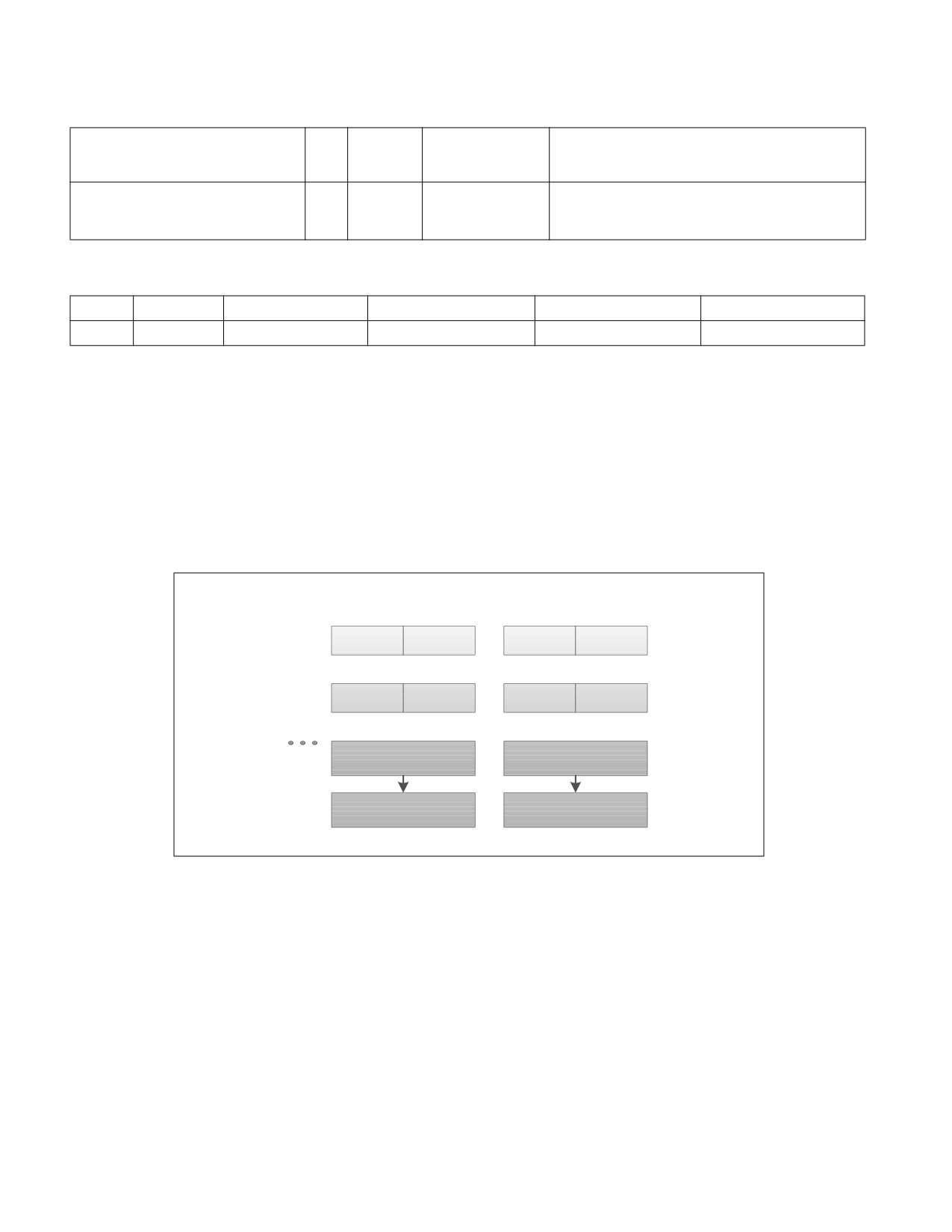
This instruction computes 4 sequential register source-block dot-products of two signed word operands with
doubleword accumulation; see Figure 8-1 below. The memory operand is sequentially selected in each of the four
steps.
In the above box, the notation of “+3”' is used to denote that the instruction accesses 4 source registers based on
that operand; sources are consecutive, start in a multiple of 4 boundary, and contain the encoded register operand.
This instruction supports memory fault suppression. The entire memory operand is loaded if any bit of the lowest
16-bits of the mask is set to 1 or if a “no masking” encoding is used.
The tuple type Tuple1_4X implies that four 32-bit elements (16 bytes) are referenced by the memory operation
portion of this instruction.
16b
16b
16b
16b
a3
a2
a1
a0
b1
b0
b1
b0
32b
32b
c1
c0
c1=c1+a2*b0+a3*b1
c0=c0+a0*b0+a1*b1
32b
32b
Figure 8-1. Register Source-Block Dot Product of Two Signed Word Operands With Doubleword Accumulation1
NOTES:
1. For illustration purposes, one source-block dot product instance is shown out of the four.
8-18
Vol. 2D
VP4DPWSSD—Dot Product of Signed Words With Dword Accumulation (4-Iterations)
INSTRUCTION SET REFERENCE UNIQUE TO INTEL® XEON PHI™ PROCESSORS
Operation
src_reg_id is the 5 bit index of the vector register specified in the instruction as the src1 register.
VP4DPWSSD dest, src1, src2
(KL,VL) = (16,512)
N := 4
ORIGDEST := DEST
src_base := src_reg_id & ~ (N-1) // for src1 operand
FOR i := 0 to KL-1:
IF k1[i] or *no writemask*:
FOR m := 0 to N-1:
t := SRC2.dword[m]
p1dword := reg[src_base+m].word[2*i] * t.word[0]
p2dword := reg[src_base+m].word[2*i+1] * t.word[1]
DEST.dword[i] := DEST.dword[i] + p1dword + p2dword
ELSE IF *zeroing*:
DEST.dword[i] := 0
ELSE
DEST.dword[i] := ORIGDEST.dword[i]
DEST[MAX_VL-1:VL] := 0
Intel C/C++ Compiler Intrinsic Equivalent
VP4DPWSSD __m512i _mm512_4dpwssd_epi32(__m512i, __m512ix4, __m128i *);
VP4DPWSSD __m512i _mm512_mask_4dpwssd_epi32(__m512i, __mmask16, __m512ix4, __m128i *);
VP4DPWSSD __m512i _mm512_maskz_4dpwssd_epi32(__mmask16, __m512i, __m512ix4, __m128i *);
SIMD Floating-Point Exceptions
None.
Other Exceptions
See Type E4; additionally:
#UD
If the EVEX broadcast bit is set to 1.
#UD
If the MODRM.mod = 0b11.
VP4DPWSSD—Dot Product of Signed Words With Dword Accumulation (4-Iterations)
Vol. 2D
8-19

INSTRUCTION SET REFERENCE UNIQUE TO INTEL® XEON PHI™ PROCESSORS
VRCP28PD—Approximation to the Reciprocal of Packed Double Precision Floating-Point Values
With Less Than 2^-28 Relative Error
Opcode/
Op /
64/32
CPUID
Description
Instruction
En
bit Mode
Feature
Support
Flag
EVEX.512.66.0F38.W1 CA /r
A
V/V
AVX512ER
Computes the approximate reciprocals ( < 2^-28 relative error)
VRCP28PD zmm1 {k1}{z},
of the packed double precision floating-point values in
zmm2/m512/m64bcst {sae}
zmm2/m512/m64bcst and stores the results in zmm1. Under
writemask.
Instruction Operand Encoding
Op/En
Tuple Type
Operand 1
Operand 2
Operand 3
Operand 4
A
Full
ModRM:reg (w)
ModRM:r/m (r)
N/A
N/A
Description
Computes the reciprocal approximation of the float64 values in the source operand (the second operand) and store
the results to the destination operand (the first operand). The approximate reciprocal is evaluated with less than
2^-28 of maximum relative error.
Denormal input values are treated as zeros and do not signal #DE, irrespective of MXCSR.DAZ. Denormal results
are flushed to zeros and do not signal #UE, irrespective of MXCSR.FTZ.
If any source element is NaN, the quietized NaN source value is returned for that element. If any source element is
±∞, ±0.0 is returned for that element. Also, if any source element is ±0.0, ±∞ is returned for that element.
The source operand is a ZMM register, a 512-bit memory location or a 512-bit vector broadcasted from a 64-bit
memory location. The destination operand is a ZMM register, conditionally updated using writemask k1.
EVEX.vvvv is reserved and must be 1111b otherwise instructions will #UD.
A numerically exact implementation of VRCP28xx can be found at https://software.intel.com/en-us/articles/refer-
ence-implementations-for-IA-approximation-instructions-vrcp14-vrsqrt14-vrcp28-vrsqrt28-vexp2.
Operation
VRCP28PD (EVEX Encoded Versions)
(KL, VL) = (8, 512)
FOR j := 0 TO KL-1
i := j * 64
IF k1[j] OR *no writemask* THEN
IF (EVEX.b = 1) AND (SRC *is memory*)
THEN DEST[i+63:i] := RCP_28_DP(1.0/SRC[63:0]);
ELSE DEST[i+63:i] := RCP_28_DP(1.0/SRC[i+63:i]);
FI;
ELSE
IF *merging-masking*
; merging-masking
THEN *DEST[i+63:i] remains unchanged*
ELSE
; zeroing-masking
DEST[i+63:i] := 0
FI;
FI;
ENDFOR;
VRCP28PD—Approximation to the Reciprocal of Packed Double Precision Floating-Point Values With Less Than 2^-28 Relative Error
8-20
Vol. 2D

INSTRUCTION SET REFERENCE UNIQUE TO INTEL® XEON PHI™ PROCESSORS
Table 8-3. VRCP28PD Special Cases
Input Value
Result Value
Comments
NAN
QNAN(input)
If (SRC = SNaN) then #I
0 ≤ X < 2-1022
INF
Positive input denormal or zero; #Z
-2-1022 < X ≤ -0
-INF
Negative input denormal or zero; #Z
X > 21022
+0.0f
X < -21022
-0.0f
X = +∞
+0.0f
X = -∞
-0.0f
X = 2-n
2n
Exact result (unless input/output is a denormal)
X = -2-n
-2n
Exact result (unless input/output is a denormal)
Intel C/C++ Compiler Intrinsic Equivalent
VRCP28PD __m512d _mm512_rcp28_round_pd ( __m512d a, int sae);
VRCP28PD __m512d _mm512_mask_rcp28_round_pd(__m512d a, __mmask8 m, __m512d b, int sae);
VRCP28PD __m512d _mm512_maskz_rcp28_round_pd( __mmask8 m, __m512d b, int sae);
SIMD Floating-Point Exceptions
Invalid (if SNaN input), Divide-by-zero.
Other Exceptions
See Table 2-46, “Type E2 Class Exception Conditions.”
VRCP28PD—Approximation to the Reciprocal of Packed Double Precision Floating-Point Values With Less Than 2^-28 Relative Error
Vol. 2D
8-21

INSTRUCTION SET REFERENCE UNIQUE TO INTEL® XEON PHI™ PROCESSORS
VRCP28SD—Approximation to the Reciprocal of Scalar Double Precision Floating-Point Value
With Less Than 2^-28 Relative Error
Opcode/
Op /
64/32
CPUID
Description
Instruction
En
bit Mode
Feature
Support
Flag
EVEX.LLIG.66.0F38.W1 CB /r
A
V/V
AVX512ER
Computes the approximate reciprocal ( < 2^-28 relative
VRCP28SD xmm1 {k1}{z}, xmm2,
error) of the scalar double precision floating-point value in
xmm3/m64 {sae}
xmm3/m64 and stores the results in xmm1. Under
writemask. Also, upper double precision floating-point
value (bits[127:64]) from xmm2 is copied to
xmm1[127:64].
Instruction Operand Encoding
Op/En
Tuple Type
Operand 1
Operand 2
Operand 3
Operand 4
A
Tuple1 Scalar
ModRM:reg (w)
EVEX.vvvv (r)
ModRM:r/m (r)
N/A
Description
Computes the reciprocal approximation of the low float64 value in the second source operand (the third operand)
and store the result to the destination operand (the first operand). The approximate reciprocal is evaluated with
less than 2^-28 of maximum relative error. The result is written into the low float64 element of the destination
operand according to the writemask k1. Bits 127:64 of the destination is copied from the corresponding bits of the
first source operand (the second operand).
A denormal input value is treated as zero and does not signal #DE, irrespective of MXCSR.DAZ. A denormal result
is flushed to zero and does not signal #UE, irrespective of MXCSR.FTZ.
If any source element is NaN, the quietized NaN source value is returned for that element. If any source element is
±∞, ±0.0 is returned for that element. Also, if any source element is ±0.0, ±∞ is returned for that element.
The first source operand is an XMM register. The second source operand is an XMM register or a 64-bit memory
location. The destination operand is a XMM register, conditionally updated using writemask k1.
A numerically exact implementation of VRCP28xx can be found at https://software.intel.com/en-us/articles/refer-
ence-implementations-for-IA-approximation-instructions-vrcp14-vrsqrt14-vrcp28-vrsqrt28-vexp2.
Operation
VRCP28SD ((EVEX Encoded Versions)
IF k1[0] OR *no writemask* THEN
DEST[63: 0] := RCP_28_DP(1.0/SRC2[63: 0]);
ELSE
IF *merging-masking*
; merging-masking
THEN *DEST[63: 0] remains unchanged*
ELSE
; zeroing-masking
DEST[63: 0] := 0
FI;
FI;
ENDFOR;
DEST[127:64] := SRC1[127: 64]
DEST[MAXVL-1:128] := 0
VRCP28SD—Approximation to the Reciprocal of Scalar Double Precision Floating-Point Value With Less Than 2^-28 Relative Error
8-22
Vol. 2D

INSTRUCTION SET REFERENCE UNIQUE TO INTEL® XEON PHI™ PROCESSORS
Table 8-4. VRCP28SD Special Cases
Input Value
Result Value
Comments
NAN
QNAN(input)
If (SRC = SNaN) then #I
0 ≤ X < 2-1022
INF
Positive input denormal or zero; #Z
-2-1022 < X ≤ -0
-INF
Negative input denormal or zero; #Z
X > 21022
+0.0f
X < -21022
-0.0f
X = +∞
+0.0f
X = -∞
-0.0f
X = 2-n
2n
Exact result (unless input/output is a denormal)
X = -2-n
-2n
Exact result (unless input/output is a denormal)
Intel C/C++ Compiler Intrinsic Equivalent
VRCP28SD __m128d _mm_rcp28_round_sd ( __m128d a, __m128d b, int sae);
VRCP28SD __m128d _mm_mask_rcp28_round_sd(__m128d s, __mmask8 m, __m128d a, __m128d b, int sae);
VRCP28SD __m128d _mm_maskz_rcp28_round_sd(__mmask8 m, __m128d a, __m128d b, int sae);
SIMD Floating-Point Exceptions
Invalid (if SNaN input), Divide-by-zero.
Other Exceptions
See Table 2-47, “Type E3 Class Exception Conditions.”
VRCP28SD—Approximation to the Reciprocal of Scalar Double Precision Floating-Point Value With Less Than 2^-28 Relative Error
Vol. 2D
8-23

INSTRUCTION SET REFERENCE UNIQUE TO INTEL® XEON PHI™ PROCESSORS
VRCP28PS—Approximation to the Reciprocal of Packed Single Precision Floating-Point Values
With Less Than 2^-28 Relative Error
Opcode/
Op /
64/32
CPUID
Description
Instruction
En
bit Mode
Feature
Support
Flag
EVEX.512.66.0F38.W0 CA /r
A
V/V
AVX512ER
Computes the approximate reciprocals ( < 2^-28 relative
VRCP28PS zmm1 {k1}{z},
error) of the packed single-precision floating-point values in
zmm2/m512/m32bcst {sae}
zmm2/m512/m32bcst and stores the results in zmm1. Under
writemask.
Instruction Operand Encoding
Op/En
Tuple Type
Operand 1
Operand 2
Operand 3
Operand 4
A
Full
ModRM:reg (w)
ModRM:r/m (r)
N/A
N/A
Description
Computes the reciprocal approximation of the float32 values in the source operand (the second operand) and store
the results to the destination operand (the first operand) using the writemask k1. The approximate reciprocal is
evaluated with less than 2^-28 of maximum relative error prior to final rounding. The final results are rounded to
< 2^-23 relative error before written to the destination.
Denormal input values are treated as zeros and do not signal #DE, irrespective of MXCSR.DAZ. Denormal results
are flushed to zeros and do not signal #UE, irrespective of MXCSR.FTZ.
If any source element is NaN, the quietized NaN source value is returned for that element. If any source element is
±∞, ±0.0 is returned for that element. Also, if any source element is ±0.0, ±∞ is returned for that element.
The source operand is a ZMM register, a 512-bit memory location, or a 512-bit vector broadcasted from a 32-bit
memory location. The destination operand is a ZMM register, conditionally updated using writemask k1.
EVEX.vvvv is reserved and must be 1111b otherwise instructions will #UD.
A numerically exact implementation of VRCP28xx can be found at https://software.intel.com/en-us/articles/refer-
ence-implementations-for-IA-approximation-instructions-vrcp14-vrsqrt14-vrcp28-vrsqrt28-vexp2.
Operation
VRCP28PS (EVEX Encoded Versions)
(KL, VL) = (16, 512)
FOR j := 0 TO KL-1
i := j * 32
IF k1[j] OR *no writemask* THEN
IF (EVEX.b = 1) AND (SRC *is memory*)
THEN DEST[i+31:i] := RCP_28_SP(1.0/SRC[31:0]);
ELSE DEST[i+31:i] := RCP_28_SP(1.0/SRC[i+31:i]);
FI;
ELSE
IF *merging-masking*
; merging-masking
THEN *DEST[i+31:i] remains unchanged*
ELSE
; zeroing-masking
DEST[i+31:i] := 0
FI;
FI;
ENDFOR;
VRCP28PS—Approximation to the Reciprocal of Packed Single Precision Floating-Point Values With Less Than 2^-28 Relative Error
8-24
Vol. 2D

INSTRUCTION SET REFERENCE UNIQUE TO INTEL® XEON PHI™ PROCESSORS
Table 8-5. VRCP28PS Special Cases
Input Value
Result Value
Comments
NAN
QNAN(input)
If (SRC = SNaN) then #I
0 ≤ X < 2-126
INF
Positive input denormal or zero; #Z
-2-126 < X ≤ -0
-INF
Negative input denormal or zero; #Z
X > 2126
+0.0f
X < -2126
-0.0f
X = +∞
+0.0f
X = -∞
-0.0f
X = 2-n
2n
Exact result (unless input/output is a denormal)
X = -2-n
-2n
Exact result (unless input/output is a denormal)
Intel C/C++ Compiler Intrinsic Equivalent
VRCP28PS _mm512_rcp28_round_ps ( __m512 a, int sae);
VRCP28PS __m512 _mm512_mask_rcp28_round_ps(__m512 s, __mmask16 m, __m512 a, int sae);
VRCP28PS __m512 _mm512_maskz_rcp28_round_ps( __mmask16 m, __m512 a, int sae);
SIMD Floating-Point Exceptions
Invalid (if SNaN input), Divide-by-zero.
Other Exceptions
See Table 2-46, “Type E2 Class Exception Conditions.”
VRCP28PS—Approximation to the Reciprocal of Packed Single Precision Floating-Point Values With Less Than 2^-28 Relative Error
Vol. 2D
8-25

INSTRUCTION SET REFERENCE UNIQUE TO INTEL® XEON PHI™ PROCESSORS
VRCP28SS—Approximation to the Reciprocal of Scalar Single Precision Floating-Point Value
With Less Than 2^-28 Relative Error
Opcode/
Op /
64/32
CPUID
Description
Instruction
En
bit Mode
Feature
Support
Flag
EVEX.LLIG.66.0F38.W0 CB /r
A
V/V
AVX512ER
Computes the approximate reciprocal ( < 2^-28 relative
VRCP28SS xmm1 {k1}{z},
error) of the scalar single-precision floating-point value in
xmm2, xmm3/m32 {sae}
xmm3/m32 and stores the results in xmm1. Under
writemask. Also, upper 3 single-precision floating-point
values (bits[127:32]) from xmm2 is copied to
xmm1[127:32].
Instruction Operand Encoding
Op/En
Tuple Type
Operand 1
Operand 2
Operand 3
Operand 4
A
Tuple1 Scalar
ModRM:reg (w)
EVEX.vvvv (r)
ModRM:r/m (r)
N/A
Description
Computes the reciprocal approximation of the low float32 value in the second source operand (the third operand)
and store the result to the destination operand (the first operand). The approximate reciprocal is evaluated with
less than 2^-28 of maximum relative error prior to final rounding. The final result is rounded to < 2^-23 relative
error before written into the low float32 element of the destination according to writemask k1. Bits 127:32 of the
destination is copied from the corresponding bits of the first source operand (the second operand).
A denormal input value is treated as zero and does not signal #DE, irrespective of MXCSR.DAZ. A denormal result
is flushed to zero and does not signal #UE, irrespective of MXCSR.FTZ.
If any source element is NaN, the quietized NaN source value is returned for that element. If any source element is
±∞, ±0.0 is returned for that element. Also, if any source element is ±0.0, ±∞ is returned for that element.
The first source operand is an XMM register. The second source operand is an XMM register or a 32-bit memory
location. The destination operand is a XMM register, conditionally updated using writemask k1.
A numerically exact implementation of VRCP28xx can be found at https://software.intel.com/en-us/articles/refer-
ence-implementations-for-IA-approximation-instructions-vrcp14-vrsqrt14-vrcp28-vrsqrt28-vexp2.
Operation
VRCP28SS ((EVEX Encoded Versions)
IF k1[0] OR *no writemask* THEN
DEST[31: 0] := RCP_28_SP(1.0/SRC2[31: 0]);
ELSE
IF *merging-masking*
; merging-masking
THEN *DEST[31: 0] remains unchanged*
ELSE
; zeroing-masking
DEST[31: 0] := 0
FI;
FI;
ENDFOR;
DEST[127:32] := SRC1[127: 32]
DEST[MAXVL-1:128] := 0
VRCP28SS—Approximation to the Reciprocal of Scalar Single Precision Floating-Point Value With Less Than 2^-28 Relative Error
8-26
Vol. 2D

INSTRUCTION SET REFERENCE UNIQUE TO INTEL® XEON PHI™ PROCESSORS
Table 8-6. VRCP28SS Special Cases
Input Value
Result Value
Comments
NAN
QNAN(input)
If (SRC = SNaN) then #I
0 ≤ X < 2-126
INF
Positive input denormal or zero; #Z
-2-126 < X ≤ -0
-INF
Negative input denormal or zero; #Z
X > 2126
+0.0f
X < -2126
-0.0f
X = +∞
+0.0f
X = -∞
-0.0f
X = 2-n
2n
Exact result (unless input/output is a denormal)
X = -2-n
-2n
Exact result (unless input/output is a denormal)
Intel C/C++ Compiler Intrinsic Equivalent
VRCP28SS __m128 _mm_rcp28_round_ss ( __m128 a, __m128 b, int sae);
VRCP28SS __m128 _mm_mask_rcp28_round_ss(__m128 s, __mmask8 m, __m128 a, __m128 b, int sae);
VRCP28SS __m128 _mm_maskz_rcp28_round_ss(__mmask8 m, __m128 a, __m128 b, int sae);
SIMD Floating-Point Exceptions
Invalid (if SNaN input), Divide-by-zero.
Other Exceptions
See Table 2-47, “Type E3 Class Exception Conditions.”
VRCP28SS—Approximation to the Reciprocal of Scalar Single Precision Floating-Point Value With Less Than 2^-28 Relative Error
Vol. 2D
8-27

INSTRUCTION SET REFERENCE UNIQUE TO INTEL® XEON PHI™ PROCESSORS
VRSQRT28PD—Approximation to the Reciprocal Square Root of Packed Double Precision
Floating-Point Values With Less Than 2^-28 Relative Error
Opcode/
Op /
64/32
CPUID
Description
Instruction
En
bit Mode
Feature
Support
Flag
EVEX.512.66.0F38.W1 CC /r
A
V/V
AVX512ER
Computes approximations to the Reciprocal square root (<2^-
VRSQRT28PD zmm1 {k1}{z},
28 relative error) of the packed double precision floating-point
zmm2/m512/m64bcst {sae}
values from zmm2/m512/m64bcst and stores result in
zmm1with writemask k1.
Instruction Operand Encoding
Op/En
Tuple Type
Operand 1
Operand 2
Operand 3
Operand 4
A
Full
ModRM:reg (w)
ModRM:r/m (r)
N/A
N/A
Description
Computes the reciprocal square root of the float64 values in the source operand (the second operand) and store
the results to the destination operand (the first operand). The approximate reciprocal is evaluated with less than
2^-28 of maximum relative error.
If any source element is NaN, the quietized NaN source value is returned for that element. Negative (non-zero)
source numbers, as well as -∞, return the canonical NaN and set the Invalid Flag (#I).
A value of -0 must return -∞ and set the DivByZero flags (#Z). Negative numbers should return NaN and set the
Invalid flag (#I). Note however that the instruction flush input denormals to zero of the same sign, so negative
denormals return -∞ and set the DivByZero flag.
The source operand is a ZMM register, a 512-bit memory location or a 512-bit vector broadcasted from a 64-bit
memory location. The destination operand is a ZMM register, conditionally updated using writemask k1.
EVEX.vvvv is reserved and must be 1111b otherwise instructions will #UD.
A numerically exact implementation of VRSQRT28xx can be found at https://software.intel.com/en-us/arti-
cles/reference-implementations-for-IA-approximation-instructions-vrcp14-vrsqrt14-vrcp28-vrsqrt28-vexp2.
Operation
VRSQRT28PD (EVEX Encoded Versions)
(KL, VL) = (8, 512)
FOR j := 0 TO KL-1
i := j * 64
IF k1[j] OR *no writemask* THEN
IF (EVEX.b = 1) AND (SRC *is memory*)
THEN DEST[i+63:i] := (1.0/ SQRT(SRC[63:0]));
ELSE DEST[i+63:i] := (1.0/ SQRT(SRC[i+63:i]));
FI;
ELSE
IF *merging-masking*
; merging-masking
THEN *DEST[i+63:i] remains unchanged*
ELSE
; zeroing-masking
DEST[i+63:i] := 0
FI;
FI;
ENDFOR;
VRSQRT28PD—Approximation to the Reciprocal Square Root of Packed Double Precision Floating-Point Values With Less Than 2^-28
8-28
Vol. 2D

INSTRUCTION SET REFERENCE UNIQUE TO INTEL® XEON PHI™ PROCESSORS
Table 8-7. VRSQRT28PD Special Cases
Input Value
Result Value
Comments
NAN
QNAN(input)
If (SRC = SNaN) then #I
X = 2-2n
2n
X < 0
QNaN_Indefinite
Including -INF
X = -0 or negative denormal
-INF
#Z
X = +0 or positive denormal
+INF
#Z
X = +INF
+0
Intel C/C++ Compiler Intrinsic Equivalent
VRSQRT28PD __m512d _mm512_rsqrt28_round_pd(__m512d a, int sae);
VRSQRT28PD __m512d _mm512_mask_rsqrt28_round_pd(__m512d s, __mmask8 m,__m512d a, int sae);
VRSQRT28PD __m512d _mm512_maskz_rsqrt28_round_pd(__mmask8 m,__m512d a, int sae);
SIMD Floating-Point Exceptions
Invalid (if SNaN input), Divide-by-zero.
Other Exceptions
See Table 2-46, “Type E2 Class Exception Conditions.”
VRSQRT28PD—Approximation to the Reciprocal Square Root of Packed Double Precision Floating-Point Values With Less Than 2^-28
Vol. 2D
8-29

INSTRUCTION SET REFERENCE UNIQUE TO INTEL® XEON PHI™ PROCESSORS
VRSQRT28SD—Approximation to the Reciprocal Square Root of Scalar Double Precision
Floating-Point Value With Less Than 2^-28 Relative Error
Opcode/
Op /
64/32
CPUID
Description
Instruction
En
bit Mode
Feature
Support
Flag
EVEX.LLIG.66.0F38.W1 CD /r
A
V/V
AVX512ER
Computes approximate reciprocal square root (<2^-28
VRSQRT28SD xmm1 {k1}{z},
relative error) of the scalar double precision floating-point
xmm2, xmm3/m64 {sae}
value from xmm3/m64 and stores result in xmm1with
writemask k1. Also, upper double precision floating-point
value (bits[127:64]) from xmm2 is copied to
xmm1[127:64].
Instruction Operand Encoding
Op/En
Tuple Type
Operand 1
Operand 2
Operand 3
Operand 4
A
Tuple1 Scalar
ModRM:reg (w)
EVEX.vvvv (r)
ModRM:r/m (r)
N/A
Description
Computes the reciprocal square root of the low float64 value in the second source operand (the third operand) and
store the result to the destination operand (the first operand). The approximate reciprocal square root is evaluated
with less than 2^-28 of maximum relative error. The result is written into the low float64 element of xmm1
according to the writemask k1. Bits 127:64 of the destination is copied from the corresponding bits of the first source operand (the
second operand).
If any source element is NaN, the quietized NaN source value is returned for that element. Negative (non-zero)
source numbers, as well as -∞, return the canonical NaN and set the Invalid Flag (#I).
A value of -0 must return -∞ and set the DivByZero flags (#Z). Negative numbers should return NaN and set the
Invalid flag (#I). Note however that the instruction flush input denormals to zero of the same sign, so negative
denormals return -∞ and set the DivByZero flag.
The first source operand is an XMM register. The second source operand is an XMM register or a 64-bit memory
location. The destination operand is a XMM register.
A numerically exact implementation of VRSQRT28xx can be found at https://software.intel.com/en-us/arti-
cles/reference-implementations-for-IA-approximation-instructions-vrcp14-vrsqrt14-vrcp28-vrsqrt28-vexp2.
Operation
VRSQRT28SD (EVEX Encoded Versions)
IF k1[0] OR *no writemask* THEN
DEST[63: 0] := (1.0/ SQRT(SRC[63: 0]));
ELSE
IF *merging-masking*
; merging-masking
THEN *DEST[63: 0] remains unchanged*
ELSE
; zeroing-masking
DEST[63: 0] := 0
FI;
FI;
ENDFOR;
DEST[127:64] := SRC1[127: 64]
DEST[MAXVL-1:128] := 0
VRSQRT28SD—Approximation to the Reciprocal Square Root of Scalar Double Precision Floating-Point Value With Less Than 2^-28
8-30
Vol. 2D

INSTRUCTION SET REFERENCE UNIQUE TO INTEL® XEON PHI™ PROCESSORS
Table 8-8. VRSQRT28SD Special Cases
Input Value
Result Value
Comments
NAN
QNAN(input)
If (SRC = SNaN) then #I
X = 2-2n
2n
X < 0
QNaN_Indefinite
Including -INF
X = -0 or negative denormal
-INF
#Z
X = +0 or positive denormal
+INF
#Z
X = +INF
+0
Intel C/C++ Compiler Intrinsic Equivalent
VRSQRT28SD __m128d _mm_rsqrt28_round_sd(__m128d a, __m128d b, int rounding);
VRSQRT28SD __m128d _mm_mask_rsqrt28_round_sd(__m128d s, __mmask8 m,__m128d a, __m128d b, int rounding);
VRSQRT28SD __m128d _mm_maskz_rsqrt28_round_sd( __mmask8 m,__m128d a, __m128d b, int rounding);
SIMD Floating-Point Exceptions
Invalid (if SNaN input), Divide-by-zero.
Other Exceptions
See Table 2-47, “Type E3 Class Exception Conditions.”
VRSQRT28SD—Approximation to the Reciprocal Square Root of Scalar Double Precision Floating-Point Value With Less Than 2^-28
Vol. 2D
8-31

INSTRUCTION SET REFERENCE UNIQUE TO INTEL® XEON PHI™ PROCESSORS
VRSQRT28PS—Approximation to the Reciprocal Square Root of Packed Single Precision
Floating-Point Values With Less Than 2^-28 Relative Error
Opcode/
Op /
64/32
CPUID
Description
Instruction
En
bit Mode
Feature
Support
Flag
EVEX.512.66.0F38.W0 CC /r
A
V/V
AVX512ER
Computes approximations to the Reciprocal square root
VRSQRT28PS zmm1 {k1}{z},
(<2^-28 relative error) of the packed single-precision
zmm2/m512/m32bcst {sae}
floating-point values from zmm2/m512/m32bcst and stores
result in zmm1with writemask k1.
Instruction Operand Encoding
Op/En
Tuple Type
Operand 1
Operand 2
Operand 3
Operand 4
A
Full
ModRM:reg (w)
ModRM:r/m (r)
N/A
N/A
Description
Computes the reciprocal square root of the float32 values in the source operand (the second operand) and store
the results to the destination operand (the first operand). The approximate reciprocal is evaluated with less than
2^-28 of maximum relative error prior to final rounding. The final results is rounded to < 2^-23 relative error
before written to the destination.
If any source element is NaN, the quietized NaN source value is returned for that element. Negative (non-zero)
source numbers, as well as -∞, return the canonical NaN and set the Invalid Flag (#I).
A value of -0 must return -∞ and set the DivByZero flags (#Z). Negative numbers should return NaN and set the
Invalid flag (#I). Note however that the instruction flush input denormals to zero of the same sign, so negative
denormals return -∞ and set the DivByZero flag.
The source operand is a ZMM register, a 512-bit memory location, or a 512-bit vector broadcasted from a 32-bit
memory location. The destination operand is a ZMM register, conditionally updated using writemask k1.
EVEX.vvvv is reserved and must be 1111b otherwise instructions will #UD.
A numerically exact implementation of VRSQRT28xx can be found at https://software.intel.com/en-us/arti-
cles/reference-implementations-for-IA-approximation-instructions-vrcp14-vrsqrt14-vrcp28-vrsqrt28-vexp2.
Operation
VRSQRT28PS (EVEX Encoded Versions)
(KL, VL) = (16, 512)
FOR j := 0 TO KL-1
i := j * 32
IF k1[j] OR *no writemask* THEN
IF (EVEX.b = 1) AND (SRC *is memory*)
THEN DEST[i+31:i] := (1.0/ SQRT(SRC[31:0]));
ELSE DEST[i+31:i] := (1.0/ SQRT(SRC[i+31:i]));
FI;
ELSE
IF *merging-masking*
; merging-masking
THEN *DEST[i+31:i] remains unchanged*
ELSE
; zeroing-masking
DEST[i+31:i] := 0
FI;
FI;
ENDFOR;
VRSQRT28PS—Approximation to the Reciprocal Square Root of Packed Single Precision Floating-Point Values With Less Than 2^-28
8-32
Vol. 2D

INSTRUCTION SET REFERENCE UNIQUE TO INTEL® XEON PHI™ PROCESSORS
Table 8-9. VRSQRT28PS Special Cases
Input Value
Result Value
Comments
NAN
QNAN(input)
If (SRC = SNaN) then #I
X = 2-2n
2n
X < 0
QNaN_Indefinite
Including -INF
X = -0 or negative denormal
-INF
#Z
X = +0 or positive denormal
+INF
#Z
X = +INF
+0
Intel C/C++ Compiler Intrinsic Equivalent
VRSQRT28PS __m512 _mm512_rsqrt28_round_ps(__m512 a, int sae);
VRSQRT28PS __m512 _mm512_mask_rsqrt28_round_ps(__m512 s, __mmask16 m,__m512 a, int sae);
VRSQRT28PS __m512 _mm512_maskz_rsqrt28_round_ps(__mmask16 m,__m512 a, int sae);
SIMD Floating-Point Exceptions
Invalid (if SNaN input), Divide-by-zero.
Other Exceptions
See Table 2-46, “Type E2 Class Exception Conditions.”
VRSQRT28PS—Approximation to the Reciprocal Square Root of Packed Single Precision Floating-Point Values With Less Than 2^-28
Vol. 2D
8-33

INSTRUCTION SET REFERENCE UNIQUE TO INTEL® XEON PHI™ PROCESSORS
VRSQRT28SS—Approximation to the Reciprocal Square Root of Scalar Single Precision Floating-
Point Value With Less Than 2^-28 Relative Error
Opcode/
Op /
64/32
CPUID
Description
Instruction
En
bit Mode
Feature
Support
Flag
EVEX.LLIG.66.0F38.W0 CD /r
A
V/V
AVX512ER
Computes approximate reciprocal square root (<2^-28
VRSQRT28SS xmm1 {k1}{z},
relative error) of the scalar single-precision floating-point
xmm2, xmm3/m32 {sae}
value from xmm3/m32 and stores result in xmm1with
writemask k1. Also, upper 3 single-precision floating-point
value (bits[127:32]) from xmm2 is copied to
xmm1[127:32].
Instruction Operand Encoding
Op/En
Tuple Type
Operand 1
Operand 2
Operand 3
Operand 4
A
Tuple1 Scalar
ModRM:reg (w)
EVEX.vvvv (r)
ModRM:r/m (r)
N/A
Description
Computes the reciprocal square root of the low float32 value in the second source operand (the third operand) and
store the result to the destination operand (the first operand). The approximate reciprocal square root is evaluated
with less than 2^-28 of maximum relative error prior to final rounding. The final result is rounded to < 2^-23 rela-
tive error before written to the low float32 element of the destination according to the writemask k1. Bits 127:32 of
the destination is copied from the corresponding bits of the first source operand (the second operand).
If any source element is NaN, the quietized NaN source value is returned for that element. Negative (non-zero)
source numbers, as well as -∞, return the canonical NaN and set the Invalid Flag (#I).
A value of -0 must return -∞ and set the DivByZero flags (#Z). Negative numbers should return NaN and set the
Invalid flag (#I). Note however that the instruction flush input denormals to zero of the same sign, so negative
denormals return -∞ and set the DivByZero flag.
The first source operand is an XMM register. The second source operand is an XMM register or a 32-bit memory
location. The destination operand is a XMM register.
A numerically exact implementation of VRSQRT28xx can be found at https://software.intel.com/en-us/arti-
cles/reference-implementations-for-IA-approximation-instructions-vrcp14-vrsqrt14-vrcp28-vrsqrt28-vexp2.
Operation
VRSQRT28SS (EVEX Encoded Versions)
IF k1[0] OR *no writemask* THEN
DEST[31: 0] := (1.0/ SQRT(SRC[31: 0]));
ELSE
IF *merging-masking*
; merging-masking
THEN *DEST[31: 0] remains unchanged*
ELSE
; zeroing-masking
DEST[31: 0] := 0
FI;
FI;
ENDFOR;
DEST[127:32] := SRC1[127: 32]
DEST[MAXVL-1:128] := 0
VRSQRT28SS—Approximation to the Reciprocal Square Root of Scalar Single Precision Floating-Point Value With Less Than 2^-28 Rel-
8-34
Vol. 2D

INSTRUCTION SET REFERENCE UNIQUE TO INTEL® XEON PHI™ PROCESSORS
Table 8-10. VRSQRT28SS Special Cases
Input Value
Result Value
Comments
NAN
QNAN(input)
If (SRC = SNaN) then #I
X = 2-2n
2n
X < 0
QNaN_Indefinite
Including -INF
X = -0 or negative denormal
-INF
#Z
X = +0 or positive denormal
+INF
#Z
X = +INF
+0
Intel C/C++ Compiler Intrinsic Equivalent
VRSQRT28SS __m128 _mm_rsqrt28_round_ss(__m128 a, __m128 b, int rounding);
VRSQRT28SS __m128 _mm_mask_rsqrt28_round_ss(__m128 s, __mmask8 m,__m128 a,__m128 b, int rounding);
VRSQRT28SS __m128 _mm_maskz_rsqrt28_round_ss(__mmask8 m,__m128 a,__m128 b, int rounding);
SIMD Floating-Point Exceptions
Invalid (if SNaN input), Divide-by-zero.
Other Exceptions
See Table 2-47, “Type E3 Class Exception Conditions.”
VRSQRT28SS—Approximation to the Reciprocal Square Root of Scalar Single Precision Floating-Point Value With Less Than 2^-28 Rel-
Vol. 2D
8-35

INSTRUCTION SET REFERENCE UNIQUE TO INTEL® XEON PHI™ PROCESSORS
VSCATTERPF0DPS/VSCATTERPF0QPS/VSCATTERPF0DPD/VSCATTERPF0QPD—Sparse Prefetch
Packed SP/DP Data Values with Signed Dword, Signed Qword Indices Using T0 Hint With Intent
to Write
Opcode/
Op/
64/32
CPUID
Description
Instruction
En
bit Mode
Feature
Support
Flag
EVEX.512.66.0F38.W0 C6 /5 /vsib
A
V/V
AVX512PF
Using signed dword indices, prefetch sparse byte
VSCATTERPF0DPS vm32z {k1}
memory locations containing single-precision data using
writemask k1 and T0 hint with intent to write.
EVEX.512.66.0F38.W0 C7 /5 /vsib
A
V/V
AVX512PF
Using signed qword indices, prefetch sparse byte
VSCATTERPF0QPS vm64z {k1}
memory locations containing single-precision data using
writemask k1 and T0 hint with intent to write.
EVEX.512.66.0F38.W1 C6 /5 /vsib
A
V/V
AVX512PF
Using signed dword indices, prefetch sparse byte
VSCATTERPF0DPD vm32y {k1}
memory locations containing double precision data
using writemask k1 and T0 hint with intent to write.
EVEX.512.66.0F38.W1 C7 /5 /vsib
A
V/V
AVX512PF
Using signed qword indices, prefetch sparse byte
VSCATTERPF0QPD vm64z {k1}
memory locations containing double precision data
using writemask k1 and T0 hint with intent to write.
Instruction Operand Encoding
Op/En
Tuple Type
Operand 1
Operand 2
Operand 3
Operand 4
A
Tuple1 Scalar
BaseReg (R): VSIB:base,
N/A
N/A
N/A
VectorReg(R): VSIB:index
Description
The instruction conditionally prefetches up to sixteen 32-bit or eight 64-bit integer byte data elements. The
elements are specified via the VSIB (i.e., the index register is an zmm, holding packed indices). Elements will only
be prefetched if their corresponding mask bit is one.
cache lines will be brought into exclusive state (RFO) specified by a locality hint (T0):
• T0 (temporal data)—prefetch data into the first level cache.
[PS data] For dword indices, the instruction will prefetch sixteen memory locations. For qword indices, the instruc-
tion will prefetch eight values.
[PD data] For dword and qword indices, the instruction will prefetch eight memory locations.
Note that:
(1) The prefetches may happen in any order (or not at all). The instruction is a hint.
(2) The mask is left unchanged.
(3) Not valid with 16-bit effective addresses. Will deliver a #UD fault.
(4) No FP nor memory faults may be produced by this instruction.
(5) Prefetches do not handle cache line splits
(6) A #UD is signaled if the memory operand is encoded without the SIB byte.
Operation
BASE_ADDR stands for the memory operand base address (a GPR); may not exist.
VINDEX stands for the memory operand vector of indices (a vector register).
SCALE stands for the memory operand scalar (1, 2, 4 or 8).
DISP is the optional 1, 2 or 4 byte displacement.
PREFETCH(mem, Level, State) Prefetches a byte memory location pointed by ‘mem’ into the cache level specified by ‘Level’; a request
for exclusive/ownership is done if ‘State’ is 1. Note that the memory location ignore cache line splits. This operation is considered a
hint for the processor and may be skipped depending on implementation.
VSCATTERPF0DPS/VSCATTERPF0QPS/VSCATTERPF0DPD/VSCATTERPF0QPD—Sparse Prefetch Packed SP/DP Data Values with
8-36
Vol. 2D