Intel 64 and IA-32 Architectures. Software Developer’s Manual (Collection, 2023) - page 85
INSTRUCTION SET REFERENCE, M-U
Virtual-8086 Mode Exceptions
#UD
If the LOCK prefix is used.
Compatibility Mode Exceptions
#UD
If the LOCK prefix is used.
64-Bit Mode Exceptions
#UD
If the LOCK prefix is used.
PREFETCHW—Prefetch Data Into Caches in Anticipation of a Write
Vol. 2B
4-417

INSTRUCTION SET REFERENCE, M-U
PSADBW—Compute Sum of Absolute Differences
Opcode/
Op/
64/32 bit
CPUID Feature
Description
Instruction
En
Mode
Flag
Support
NP 0F F6 /r1
A
V/V
SSE
Computes the absolute differences of the
packed unsigned byte integers from mm2
PSADBW mm1, mm2/m64
/m64 and mm1; differences are then summed
to produce an unsigned word integer result.
66 0F F6 /r
A
V/V
SSE2
Computes the absolute differences of the
packed unsigned byte integers from xmm2
PSADBW xmm1, xmm2/m128
/m128 and xmm1; the 8 low differences and 8
high differences are then summed separately
to produce two unsigned word integer results.
VEX.128.66.0F.WIG F6 /r
B
V/V
AVX
Computes the absolute differences of the
packed unsigned byte integers from xmm3
VPSADBW xmm1, xmm2, xmm3/m128
/m128 and xmm2; the 8 low differences and 8
high differences are then summed separately
to produce two unsigned word integer results.
VEX.256.66.0F.WIG F6 /r
B
V/V
AVX2
Computes the absolute differences of the
packed unsigned byte integers from ymm3
VPSADBW ymm1, ymm2, ymm3/m256
/m256 and ymm2; then each consecutive 8
differences are summed separately to produce
four unsigned word integer results.
EVEX.128.66.0F.WIG F6 /r
C
V/V
AVX512VL
Computes the absolute differences of the
VPSADBW xmm1, xmm2, xmm3/m128
AVX512BW
packed unsigned byte integers from xmm3
/m128 and xmm2; then each consecutive 8
differences are summed separately to produce
two unsigned word integer results.
EVEX.256.66.0F.WIG F6 /r
C
V/V
AVX512VL
Computes the absolute differences of the
VPSADBW ymm1, ymm2, ymm3/m256
AVX512BW
packed unsigned byte integers from ymm3
/m256 and ymm2; then each consecutive 8
differences are summed separately to produce
four unsigned word integer results.
EVEX.512.66.0F.WIG F6 /r
C
V/V
AVX512BW
Computes the absolute differences of the
VPSADBW zmm1, zmm2, zmm3/m512
packed unsigned byte integers from zmm3
/m512 and zmm2; then each consecutive 8
differences are summed separately to produce
eight unsigned word integer results.
NOTES:
1. See note in Section 2.5, “Intel® AVX and Intel® SSE Instruction Exception Specification” in the Intel® 64 and IA-32 Architectures Soft-
ware Developer’s Manual, Volume 2A and Section 23.25.3, “Exception Conditions of Legacy SIMD Instructions Operating on MMX
Registers” in the Intel® 64 and IA-32 Architectures Software Developer’s Manual, Volume 3A.
Instruction Operand Encoding
Op/En
Tuple Type
Operand 1
Operand 2
Operand 3
Operand 4
A
N/A
ModRM:reg (r, w)
ModRM:r/m (r)
N/A
N/A
B
N/A
ModRM:reg (w)
VEX.vvvv (r)
ModRM:r/m (r)
N/A
C
Full Mem
ModRM:reg (w)
EVEX.vvvv
ModRM:r/m (r)
N/A
4-418
Vol. 2B
PSADBW—Compute Sum of Absolute Differences

INSTRUCTION SET REFERENCE, M-U
Description
Computes the absolute value of the difference of 8 unsigned byte integers from the source operand (second
operand) and from the destination operand (first operand). These 8 differences are then summed to produce an
unsigned word integer result that is stored in the destination operand. Figure 4-14 shows the operation of the
PSADBW instruction when using 64-bit operands.
When operating on 64-bit operands, the word integer result is stored in the low word of the destination operand,
and the remaining bytes in the destination operand are cleared to all 0s.
When operating on 128-bit operands, two packed results are computed. Here, the 8 low-order bytes of the source
and destination operands are operated on to produce a word result that is stored in the low word of the destination
operand, and the 8 high-order bytes are operated on to produce a word result that is stored in bits 64 through 79
of the destination operand. The remaining bytes of the destination operand are cleared.
For 256-bit version, the third group of 8 differences are summed to produce an unsigned word in bits[143:128] of
the destination register and the fourth group of 8 differences are summed to produce an unsigned word in
bits[207:192] of the destination register. The remaining words of the destination are set to 0.
For 512-bit version, the fifth group result is stored in bits [271:256] of the destination. The result from the sixth
group is stored in bits [335:320]. The results for the seventh and eighth group are stored respectively in bits
[399:384] and bits [463:447], respectively. The remaining bits in the destination are set to 0.
In 64-bit mode and not encoded by VEX/EVEX prefix, using a REX prefix in the form of REX.R permits this instruc-
tion to access additional registers (XMM8-XMM15).
Legacy SSE version: The source operand can be an MMX technology register or a 64-bit memory location. The
destination operand is an MMX technology register.
128-bit Legacy SSE version: The first source operand and destination register are XMM registers. The second
source operand is an XMM register or a 128-bit memory location. Bits (MAXVL-1:128) of the corresponding ZMM
destination register remain unchanged.
VEX.128 and EVEX.128 encoded versions: The first source operand and destination register are XMM registers. The
second source operand is an XMM register or a 128-bit memory location. Bits (MAXVL-1:128) of the corresponding
ZMM register are zeroed.
VEX.256 and EVEX.256 encoded versions: The first source operand and destination register are YMM registers. The
second source operand is an YMM register or a 256-bit memory location. Bits (MAXVL-1:256) of the corresponding
ZMM register are zeroed.
EVEX.512 encoded version: The first source operand and destination register are ZMM registers. The second
source operand is a ZMM register or a 512-bit memory location.
SRC
X7
X6
X5
X4
X3
X2
X1
X0
DEST
Y7
Y6
Y5
Y4
Y3
Y2
Y1
Y0
TEMP
ABS(X7:Y7)
ABS(X6:Y6)
ABS(X5:Y5)
ABS(X4:Y4)
ABS(X3:Y3)
ABS(X2:Y2)
ABS(X1:Y1)
ABS(X0:Y0)
DEST
00H
00H
00H
00H
00H
00H
SUM(TEMP7...TEMP0)
Figure 4-14. PSADBW Instruction Operation Using 64-bit Operands
PSADBW—Compute Sum of Absolute Differences
Vol. 2B
4-419
INSTRUCTION SET REFERENCE, M-U
Operation
VPSADBW (EVEX encoded versions)
VL = 128, 256, 512
TEMP0 := ABS(SRC1[7:0] - SRC2[7:0])
(* Repeat operation for bytes 1 through 15 *)
TEMP15 := ABS(SRC1[127:120] - SRC2[127:120])
DEST[15:0] := SUM(TEMP0:TEMP7)
DEST[63:16] := 000000000000H
DEST[79:64] := SUM(TEMP8:TEMP15)
DEST[127:80] := 00000000000H
IF VL >= 256
(* Repeat operation for bytes 16 through 31*)
TEMP31 := ABS(SRC1[255:248] - SRC2[255:248])
DEST[143:128] := SUM(TEMP16:TEMP23)
DEST[191:144] := 000000000000H
DEST[207:192] := SUM(TEMP24:TEMP31)
DEST[223:208] := 00000000000H
FI;
IF VL >= 512
(* Repeat operation for bytes 32 through 63*)
TEMP63 := ABS(SRC1[511:504] - SRC2[511:504])
DEST[271:256] := SUM(TEMP0:TEMP7)
DEST[319:272] := 000000000000H
DEST[335:320] := SUM(TEMP8:TEMP15)
DEST[383:336] := 00000000000H
DEST[399:384] := SUM(TEMP16:TEMP23)
DEST[447:400] := 000000000000H
DEST[463:448] := SUM(TEMP24:TEMP31)
DEST[511:464] := 00000000000H
FI;
DEST[MAXVL-1:VL] := 0
VPSADBW (VEX.256 encoded version)
TEMP0 := ABS(SRC1[7:0] - SRC2[7:0])
(* Repeat operation for bytes 2 through 30*)
TEMP31 := ABS(SRC1[255:248] - SRC2[255:248])
DEST[15:0] := SUM(TEMP0:TEMP7)
DEST[63:16] := 000000000000H
DEST[79:64] := SUM(TEMP8:TEMP15)
DEST[127:80] := 00000000000H
DEST[143:128] := SUM(TEMP16:TEMP23)
DEST[191:144] := 000000000000H
DEST[207:192] := SUM(TEMP24:TEMP31)
DEST[223:208] := 00000000000H
DEST[MAXVL-1:256] := 0
4-420
Vol. 2B
PSADBW—Compute Sum of Absolute Differences
INSTRUCTION SET REFERENCE, M-U
VPSADBW (VEX.128 encoded version)
TEMP0 := ABS(SRC1[7:0] - SRC2[7:0])
(* Repeat operation for bytes 2 through 14 *)
TEMP15 := ABS(SRC1[127:120] - SRC2[127:120])
DEST[15:0] := SUM(TEMP0:TEMP7)
DEST[63:16] := 000000000000H
DEST[79:64] := SUM(TEMP8:TEMP15)
DEST[127:80] := 00000000000H
DEST[MAXVL-1:128] := 0
PSADBW (128-bit Legacy SSE version)
TEMP0 := ABS(DEST[7:0] - SRC[7:0])
(* Repeat operation for bytes 2 through 14 *)
TEMP15 := ABS(DEST[127:120] - SRC[127:120])
DEST[15:0] := SUM(TEMP0:TEMP7)
DEST[63:16] := 000000000000H
DEST[79:64] := SUM(TEMP8:TEMP15)
DEST[127:80] := 00000000000
DEST[MAXVL-1:128] (Unmodified)
PSADBW (64-bit operand)
TEMP0 := ABS(DEST[7:0] - SRC[7:0])
(* Repeat operation for bytes 2 through 6 *)
TEMP7 := ABS(DEST[63:56] - SRC[63:56])
DEST[15:0] := SUM(TEMP0:TEMP7)
DEST[63:16] := 000000000000H
Intel C/C++ Compiler Intrinsic Equivalent
VPSADBW __m512i _mm512_sad_epu8( __m512i a, __m512i b)
PSADBW:__m64 _mm_sad_pu8(__m64 a,__m64 b)
(V)PSADBW:__m128i _mm_sad_epu8(__m128i a, __m128i b)
VPSADBW:__m256i _mm256_sad_epu8( __m256i a, __m256i b)
Flags Affected
None.
SIMD Floating-Point Exceptions
None.
Other Exceptions
Non-EVEX-encoded instruction, see Table 2-21, “Type 4 Class Exception Conditions”.
EVEX-encoded instruction, see Exceptions Type E4NF.nb in Table 2-50, “Type E4NF Class Exception Conditions”.
PSADBW—Compute Sum of Absolute Differences
Vol. 2B
4-421

INSTRUCTION SET REFERENCE, M-U
PSHUFB—Packed Shuffle Bytes
Opcode/
Op/
64/32 bit
CPUID
Description
Instruction
En
Mode
Feature
Support
Flag
NP 0F 38 00 /r1
A
V/V
SSSE3
Shuffle bytes in mm1 according to contents of
mm2/m64.
PSHUFB mm1, mm2/m64
66 0F 38 00 /r
A
V/V
SSSE3
Shuffle bytes in xmm1 according to contents of
xmm2/m128.
PSHUFB xmm1, xmm2/m128
VEX.128.66.0F38.WIG 00 /r
B
V/V
AVX
Shuffle bytes in xmm2 according to contents of
xmm3/m128.
VPSHUFB xmm1, xmm2, xmm3/m128
VEX.256.66.0F38.WIG 00 /r
B
V/V
AVX2
Shuffle bytes in ymm2 according to contents of
ymm3/m256.
VPSHUFB ymm1, ymm2, ymm3/m256
EVEX.128.66.0F38.WIG 00 /r
C
V/V
AVX512VL
Shuffle bytes in xmm2 according to contents of
VPSHUFB xmm1 {k1}{z}, xmm2, xmm3/m128
AVX512BW
xmm3/m128 under write mask k1.
EVEX.256.66.0F38.WIG 00 /r
C
V/V
AVX512VL
Shuffle bytes in ymm2 according to contents of
VPSHUFB ymm1 {k1}{z}, ymm2, ymm3/m256
AVX512BW
ymm3/m256 under write mask k1.
EVEX.512.66.0F38.WIG 00 /r
C
V/V
AVX512BW
Shuffle bytes in zmm2 according to contents of
VPSHUFB zmm1 {k1}{z}, zmm2, zmm3/m512
zmm3/m512 under write mask k1.
NOTES:
1. See note in Section 2.5, “Intel® AVX and Intel® SSE Instruction Exception Specification” in the Intel® 64 and IA-32 Architectures Soft-
ware Developer’s Manual, Volume 2A and Section 23.25.3, “Exception Conditions of Legacy SIMD Instructions Operating on MMX Reg-
isters” in the Intel® 64 and IA-32 Architectures Software Developer’s Manual, Volume 3A.
Instruction Operand Encoding
Op/En
Tuple Type
Operand 1
Operand 2
Operand 3
Operand 4
A
N/A
ModRM:reg (r, w)
ModRM:r/m (r)
N/A
N/A
B
N/A
ModRM:reg (w)
VEX.vvvv (r)
ModRM:r/m (r)
N/A
C
Full Mem
ModRM:reg (w)
EVEX.vvvv (r)
ModRM:r/m (r)
N/A
Description
PSHUFB performs in-place shuffles of bytes in the destination operand (the first operand) according to the shuffle
control mask in the source operand (the second operand). The instruction permutes the data in the destination
operand, leaving the shuffle mask unaffected. If the most significant bit (bit[7]) of each byte of the shuffle control
mask is set, then constant zero is written in the result byte. Each byte in the shuffle control mask forms an index
to permute the corresponding byte in the destination operand. The value of each index is the least significant 4 bits
(128-bit operation) or 3 bits (64-bit operation) of the shuffle control byte. When the source operand is a 128-bit
memory operand, the operand must be aligned on a 16-byte boundary or a general-protection exception (#GP) will
be generated.
In 64-bit mode and not encoded with VEX/EVEX, use the REX prefix to access XMM8-XMM15 registers.
Legacy SSE version 64-bit operand: Both operands can be MMX registers.
128-bit Legacy SSE version: The first source operand and the destination operand are the same. Bits (MAXVL-
1:128) of the corresponding YMM destination register remain unchanged.
VEX.128 encoded version: The destination operand is the first operand, the first source operand is the second
operand, the second source operand is the third operand. Bits (MAXVL-1:128) of the destination YMM register are
zeroed.
VEX.256 encoded version: Bits (255:128) of the destination YMM register stores the 16-byte shuffle result of the
upper 16 bytes of the first source operand, using the upper 16-bytes of the second source operand as control mask.
4-422
Vol. 2B
PSHUFB—Packed Shuffle Bytes
INSTRUCTION SET REFERENCE, M-U
The value of each index is for the high 128-bit lane is the least significant 4 bits of the respective shuffle control
byte. The index value selects a source data element within each 128-bit lane.
EVEX encoded version: The second source operand is an ZMM/YMM/XMM register or an 512/256/128-bit memory
location. The first source operand and destination operands are ZMM/YMM/XMM registers. The destination is condi-
tionally updated with writemask k1.
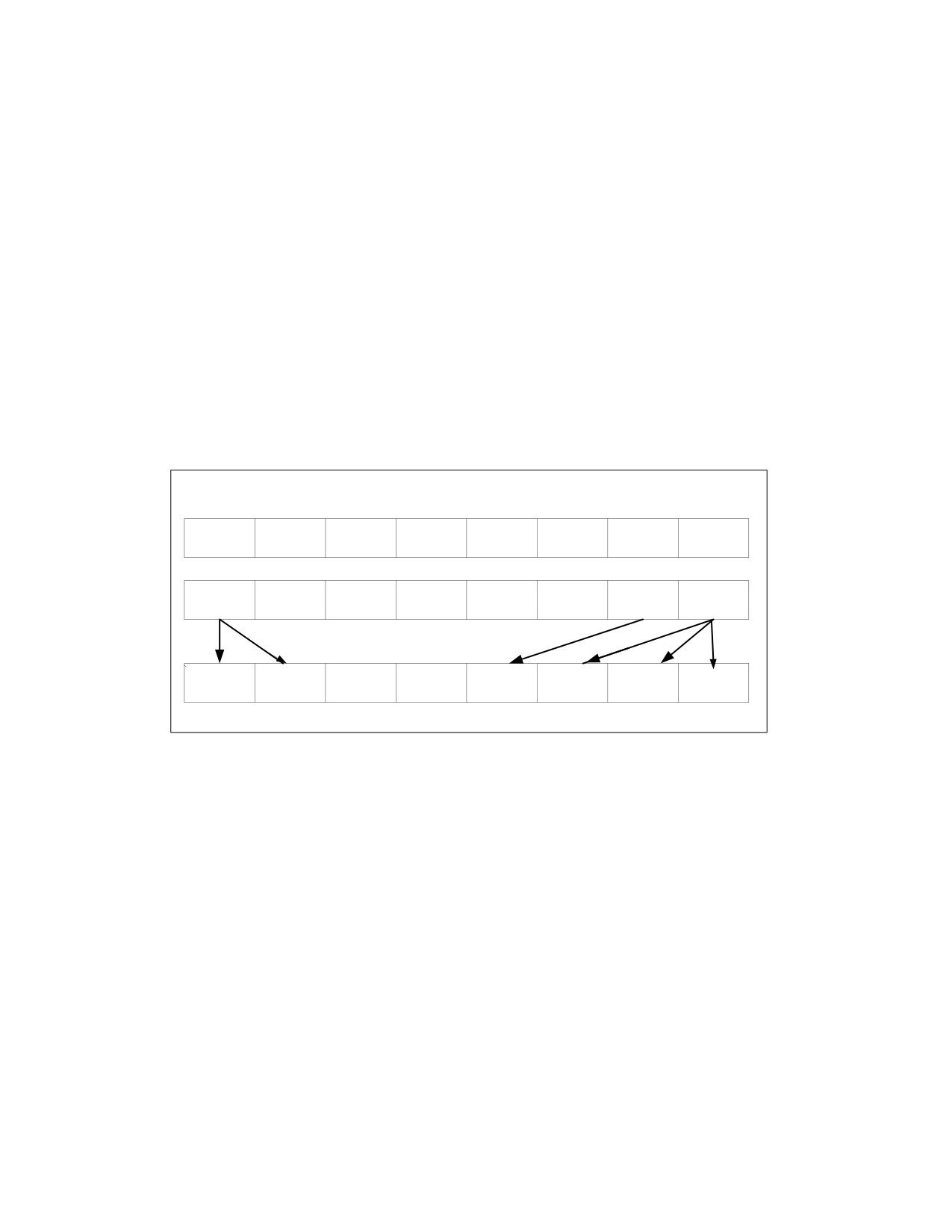
EVEX and VEX encoded version: Four/two in-lane 128-bit shuffles.
Operation
PSHUFB (with 64 bit operands)
TEMP := DEST
for i = 0 to 7 {
if (SRC[(i * 8)+7] = 1 ) then
DEST[(i*8)+7...(i*8)+0] := 0;
else
index[2..0] := SRC[(i*8)+2 .. (i*8)+0];
DEST[(i*8)+7...(i*8)+0] := TEMP[(index*8+7)..(index*8+0)];
endif;
}
PSHUFB (with 128 bit operands)
TEMP := DEST
for i = 0 to 15 {
if (SRC[(i * 8)+7] = 1 ) then
DEST[(i*8)+7..(i*8)+0] := 0;
else
index[3..0] := SRC[(i*8)+3 .. (i*8)+0];
DEST[(i*8)+7..(i*8)+0] := TEMP[(index*8+7)..(index*8+0)];
endif
}
VPSHUFB (VEX.128 encoded version)
for i = 0 to 15 {
if (SRC2[(i * 8)+7] = 1) then
DEST[(i*8)+7..(i*8)+0] := 0;
else
index[3..0] := SRC2[(i*8)+3 .. (i*8)+0];
DEST[(i*8)+7..(i*8)+0] := SRC1[(index*8+7)..(index*8+0)];
endif
}
DEST[MAXVL-1:128] := 0
VPSHUFB (VEX.256 encoded version)
for i = 0 to 15 {
if (SRC2[(i * 8)+7] == 1 ) then
DEST[(i*8)+7..(i*8)+0] := 0;
else
index[3..0] := SRC2[(i*8)+3 .. (i*8)+0];
DEST[(i*8)+7..(i*8)+0] := SRC1[(index*8+7)..(index*8+0)];
endif
if (SRC2[128 + (i * 8)+7] == 1 ) then
DEST[128 + (i*8)+7..(i*8)+0] := 0;
else
index[3..0] := SRC2[128 + (i*8)+3 .. (i*8)+0];
DEST[128 + (i*8)+7..(i*8)+0] := SRC1[128 + (index*8+7)..(index*8+0)];
PSHUFB—Packed Shuffle Bytes
Vol. 2B
4-423
INSTRUCTION SET REFERENCE, M-U
endif
}
VPSHUFB (EVEX encoded versions)
(KL, VL) = (16, 128), (32, 256), (64, 512)
jmask := (KL-1) & ~0xF
// 0x00, 0x10, 0x30 depending on the VL
FOR j = 0 TO KL-1
// dest
IF kl[ i ] or no_masking
index := src.byte[ j ];
IF index & 0x80
Dest.byte[ j ] := 0;
ELSE
index := (index & 0xF) + (j & jmask);
// 16-element in-lane lookup
Dest.byte[ j ] := src.byte[ index ];
ELSE if zeroing
Dest.byte[ j ] := 0;
DEST[MAXVL-1:VL] := 0;
MM2
07H
07H
FFH
80H
01H
00H
00H
00H
MM1
04H
01H
07H
03H
02H
02H
FFH
01H
MM1
04H
04H
00H
00H
FFH
01H
01H
01H
Figure 4-15. PSHUFB with 64-Bit Operands
Intel C/C++ Compiler Intrinsic Equivalent
VPSHUFB __m512i _mm512_shuffle_epi8(__m512i a, __m512i b);
VPSHUFB __m512i _mm512_mask_shuffle_epi8(__m512i s, __mmask64 k, __m512i a, __m512i b);
VPSHUFB __m512i _mm512_maskz_shuffle_epi8( __mmask64 k, __m512i a, __m512i b);
VPSHUFB __m256i _mm256_mask_shuffle_epi8(__m256i s, __mmask32 k, __m256i a, __m256i b);
VPSHUFB __m256i _mm256_maskz_shuffle_epi8( __mmask32 k, __m256i a, __m256i b);
VPSHUFB __m128i _mm_mask_shuffle_epi8(__m128i s, __mmask16 k, __m128i a, __m128i b);
VPSHUFB __m128i _mm_maskz_shuffle_epi8( __mmask16 k, __m128i a, __m128i b);
PSHUFB: __m64 _mm_shuffle_pi8 (__m64 a, __m64 b)
(V)PSHUFB: __m128i _mm_shuffle_epi8 (__m128i a, __m128i b)
VPSHUFB:__m256i _mm256_shuffle_epi8(__m256i a, __m256i b)
SIMD Floating-Point Exceptions
None.
4-424
Vol. 2B
PSHUFB—Packed Shuffle Bytes
INSTRUCTION SET REFERENCE, M-U
Other Exceptions
Non-EVEX-encoded instruction, see Table 2-21, “Type 4 Class Exception Conditions”.
EVEX-encoded instruction, see Exceptions Type E4NF.nb in Table 2-50, “Type E4NF Class Exception Conditions”.
PSHUFB—Packed Shuffle Bytes
Vol. 2B
4-425

INSTRUCTION SET REFERENCE, M-U
PSHUFD—Shuffle Packed Doublewords
Opcode/
Op/
64/32 bit
CPUID
Description
Instruction
En
Mode
Feature
Support
Flag
66 0F 70 /r ib
A
V/V
SSE2
Shuffle the doublewords in xmm2/m128 based on
the encoding in imm8 and store the result in xmm1.
PSHUFD xmm1, xmm2/m128, imm8
VEX.128.66.0F.WIG 70 /r ib
A
V/V
AVX
Shuffle the doublewords in xmm2/m128 based on
the encoding in imm8 and store the result in xmm1.
VPSHUFD xmm1, xmm2/m128, imm8
VEX.256.66.0F.WIG 70 /r ib
A
V/V
AVX2
Shuffle the doublewords in ymm2/m256 based on
the encoding in imm8 and store the result in ymm1.
VPSHUFD ymm1, ymm2/m256, imm8
EVEX.128.66.0F.W0 70 /r ib
B
V/V
AVX512VL
Shuffle the doublewords in xmm2/m128/m32bcst
VPSHUFD xmm1 {k1}{z}, xmm2/m128/m32bcst,
AVX512F
based on the encoding in imm8 and store the result
imm8
in xmm1 using writemask k1.
EVEX.256.66.0F.W0 70 /r ib
B
V/V
AVX512VL
Shuffle the doublewords in ymm2/m256/m32bcst
VPSHUFD ymm1 {k1}{z}, ymm2/m256/m32bcst,
AVX512F
based on the encoding in imm8 and store the result
imm8
in ymm1 using writemask k1.
EVEX.512.66.0F.W0 70 /r ib
B
V/V
AVX512F
Shuffle the doublewords in zmm2/m512/m32bcst
VPSHUFD zmm1 {k1}{z}, zmm2/m512/m32bcst,
based on the encoding in imm8 and store the result
imm8
in zmm1 using writemask k1.
Instruction Operand Encoding
Op/En
Tuple Type
Operand 1
Operand 2
Operand 3
Operand 4
A
N/A
ModRM:reg (w)
ModRM:r/m (r)
imm8
N/A
B
Full
ModRM:reg (w)
ModRM:r/m (r)
imm8
N/A
Description
Copies doublewords from source operand (second operand) and inserts them in the destination operand (first
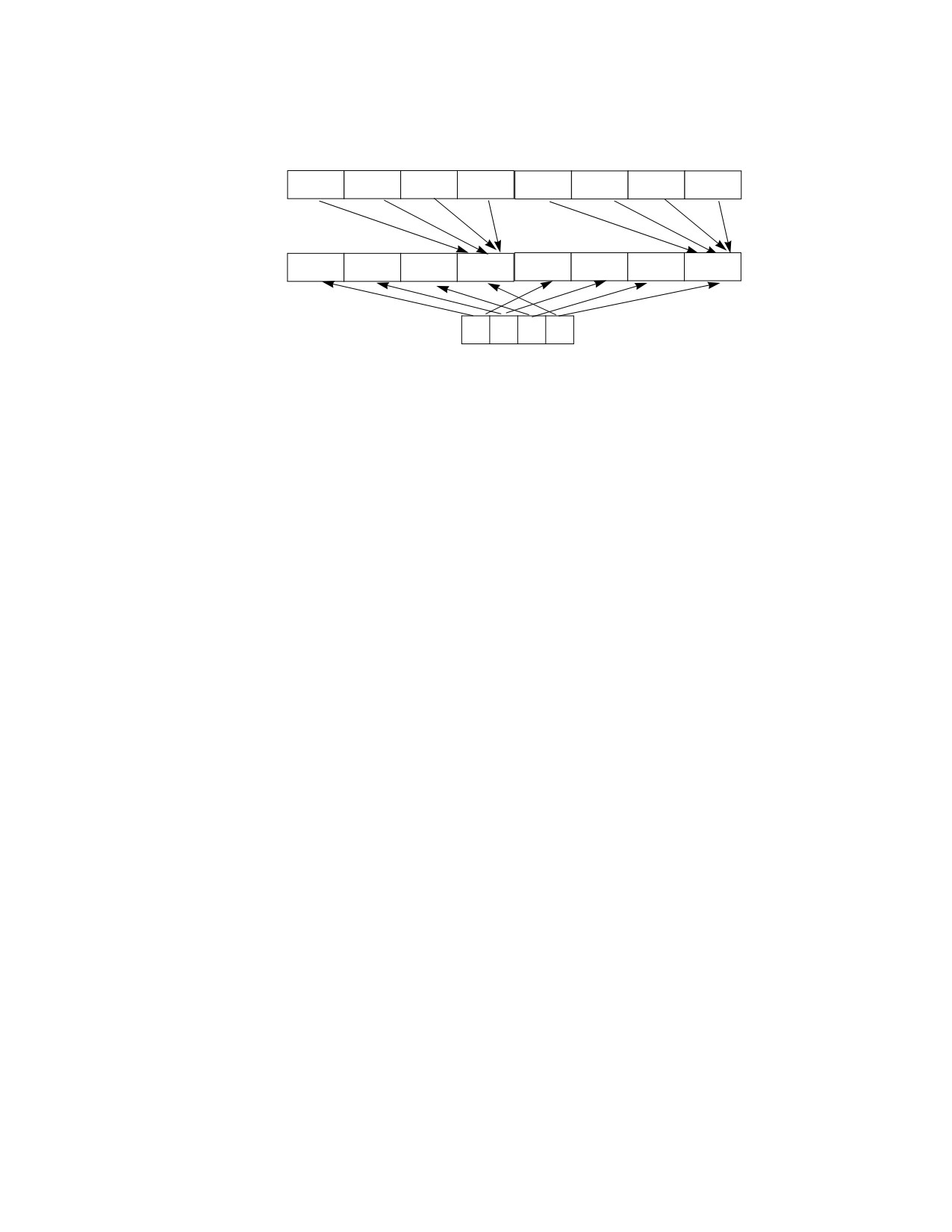
operand) at the locations selected with the order operand (third operand). Figure 4-16 shows the operation of the
256-bit VPSHUFD instruction and the encoding of the order operand. Each 2-bit field in the order operand selects
the contents of one doubleword location within a 128-bit lane and copy to the target element in the destination
operand. For example, bits 0 and 1 of the order operand targets the first doubleword element in the low and high
128-bit lane of the destination operand for 256-bit VPSHUFD. The encoded value of bits 1:0 of the order operand
(see the field encoding in Figure 4-16) determines which doubleword element (from the respective 128-bit lane) of
the source operand will be copied to doubleword 0 of the destination operand.
For 128-bit operation, only the low 128-bit lane are operative. The source operand can be an XMM register or a
128-bit memory location. The destination operand is an XMM register. The order operand is an 8-bit immediate.
Note that this instruction permits a doubleword in the source operand to be copied to more than one doubleword
location in the destination operand.
4-426
Vol. 2B
PSHUFD—Shuffle Packed Doublewords
INSTRUCTION SET REFERENCE, M-U
SRC
X7
X6
X5
X4
X3
X2
X1
X0
DEST
Y7
Y6
Y5
Y4
Y3
Y2
Y1
Y0
Encoding
00B - X4
Encoding
00B - X0
of Fields in
01B - X5
ORDER
of Fields in
01B - X1
ORDER
10B - X6
ORDER
10B - X2
Operand
11B - X7
7
6 5
4 3
2
1
0
Operand
11B - X3
Figure 4-16. 256-bit VPSHUFD Instruction Operation
The source operand can be an XMM register or a 128-bit memory location. The destination operand is an XMM
register. The order operand is an 8-bit immediate. Note that this instruction permits a doubleword in the source
operand to be copied to more than one doubleword location in the destination operand.
In 64-bit mode and not encoded in VEX/EVEX, using REX.R permits this instruction to access XMM8-XMM15.
128-bit Legacy SSE version: Bits (MAXVL-1:128) of the corresponding YMM destination register remain
unchanged.
VEX.128 encoded version: The source operand can be an XMM register or a 128-bit memory location. The destina-
tion operand is an XMM register. Bits (MAXVL-1:128) of the corresponding ZMM register are zeroed.
VEX.256 encoded version: The source operand can be an YMM register or a 256-bit memory location. The destina-
tion operand is an YMM register. Bits (MAXVL-1:256) of the corresponding ZMM register are zeroed. Bits (255-
1:128) of the destination stores the shuffled results of the upper 16 bytes of the source operand using the imme-
diate byte as the order operand.
EVEX encoded version: The source operand can be an ZMM/YMM/XMM register, a 512/256/128-bit memory loca-
tion, or a 512/256/128-bit vector broadcasted from a 32-bit memory location. The destination operand is a
ZMM/YMM/XMM register updated according to the writemask.
Each 128-bit lane of the destination stores the shuffled results of the respective lane of the source operand using
the immediate byte as the order operand.
Note: EVEX.vvvv and VEX.vvvv are reserved and must be 1111b otherwise instructions will #UD.
Operation
PSHUFD (128-bit Legacy SSE version)
DEST[31:0] := (SRC >> (ORDER[1:0] * 32))[31:0];
DEST[63:32] := (SRC >> (ORDER[3:2] * 32))[31:0];
DEST[95:64] := (SRC >> (ORDER[5:4] * 32))[31:0];
DEST[127:96] := (SRC >> (ORDER[7:6] * 32))[31:0];
DEST[MAXVL-1:128] (Unmodified)
VPSHUFD (VEX.128 encoded version)
DEST[31:0] := (SRC >> (ORDER[1:0] * 32))[31:0];
DEST[63:32] := (SRC >> (ORDER[3:2] * 32))[31:0];
DEST[95:64] := (SRC >> (ORDER[5:4] * 32))[31:0];
DEST[127:96] := (SRC >> (ORDER[7:6] * 32))[31:0];
DEST[MAXVL-1:128] := 0
PSHUFD—Shuffle Packed Doublewords
Vol. 2B
4-427
INSTRUCTION SET REFERENCE, M-U
VPSHUFD (VEX.256 encoded version)
DEST[31:0] := (SRC[127:0] >> (ORDER[1:0] * 32))[31:0];
DEST[63:32] := (SRC[127:0] >> (ORDER[3:2] * 32))[31:0];
DEST[95:64] := (SRC[127:0] >> (ORDER[5:4] * 32))[31:0];
DEST[127:96] := (SRC[127:0] >> (ORDER[7:6] * 32))[31:0];
DEST[159:128] := (SRC[255:128] >> (ORDER[1:0] * 32))[31:0];
DEST[191:160] := (SRC[255:128] >> (ORDER[3:2] * 32))[31:0];
DEST[223:192] := (SRC[255:128] >> (ORDER[5:4] * 32))[31:0];
DEST[255:224] := (SRC[255:128] >> (ORDER[7:6] * 32))[31:0];
DEST[MAXVL-1:256] := 0
VPSHUFD (EVEX encoded versions)
(KL, VL) = (4, 128), (8, 256), (16, 512)
FOR j := 0 TO KL-1
i := j * 32
IF (EVEX.b = 1) AND (SRC *is memory*)
THEN TMP_SRC[i+31:i] := SRC[31:0]
ELSE TMP_SRC[i+31:i] := SRC[i+31:i]
FI;
ENDFOR;
IF VL >= 128
TMP_DEST[31:0] := (TMP_SRC[127:0] >> (ORDER[1:0] * 32))[31:0];
TMP_DEST[63:32] := (TMP_SRC[127:0] >> (ORDER[3:2] * 32))[31:0];
TMP_DEST[95:64] := (TMP_SRC[127:0] >> (ORDER[5:4] * 32))[31:0];
TMP_DEST[127:96] := (TMP_SRC[127:0] >> (ORDER[7:6] * 32))[31:0];
FI;
IF VL >= 256
TMP_DEST[159:128] := (TMP_SRC[255:128] >> (ORDER[1:0] * 32))[31:0];
TMP_DEST[191:160] := (TMP_SRC[255:128] >> (ORDER[3:2] * 32))[31:0];
TMP_DEST[223:192] := (TMP_SRC[255:128] >> (ORDER[5:4] * 32))[31:0];
TMP_DEST[255:224] := (TMP_SRC[255:128] >> (ORDER[7:6] * 32))[31:0];
FI;
IF VL >= 512
TMP_DEST[287:256] := (TMP_SRC[383:256] >> (ORDER[1:0] * 32))[31:0];
TMP_DEST[319:288] := (TMP_SRC[383:256] >> (ORDER[3:2] * 32))[31:0];
TMP_DEST[351:320] := (TMP_SRC[383:256] >> (ORDER[5:4] * 32))[31:0];
TMP_DEST[383:352] := (TMP_SRC[383:256] >> (ORDER[7:6] * 32))[31:0];
TMP_DEST[415:384] := (TMP_SRC[511:384] >> (ORDER[1:0] * 32))[31:0];
TMP_DEST[447:416] := (TMP_SRC[511:384] >> (ORDER[3:2] * 32))[31:0];
TMP_DEST[479:448] := (TMP_SRC[511:384] >> (ORDER[5:4] * 32))[31:0];
TMP_DEST[511:480] := (TMP_SRC[511:384] >> (ORDER[7:6] * 32))[31:0];
FI;
FOR j := 0 TO KL-1
i := j * 32
IF k1[j] OR *no writemask*
THEN DEST[i+31:i] := TMP_DEST[i+31:i]
ELSE
IF *merging-masking*
; merging-masking
THEN *DEST[i+31:i] remains unchanged*
ELSE *zeroing-masking*
; zeroing-masking
DEST[i+31:i] := 0
FI
FI;
ENDFOR
4-428
Vol. 2B
PSHUFD—Shuffle Packed Doublewords
INSTRUCTION SET REFERENCE, M-U
DEST[MAXVL-1:VL] := 0
Intel C/C++ Compiler Intrinsic Equivalent
VPSHUFD __m512i _mm512_shuffle_epi32(__m512i a, int n );
VPSHUFD __m512i _mm512_mask_shuffle_epi32(__m512i s, __mmask16 k, __m512i a, int n );
VPSHUFD __m512i _mm512_maskz_shuffle_epi32( __mmask16 k, __m512i a, int n );
VPSHUFD __m256i _mm256_mask_shuffle_epi32(__m256i s, __mmask8 k, __m256i a, int n );
VPSHUFD __m256i _mm256_maskz_shuffle_epi32( __mmask8 k, __m256i a, int n );
VPSHUFD __m128i _mm_mask_shuffle_epi32(__m128i s, __mmask8 k, __m128i a, int n );
VPSHUFD __m128i _mm_maskz_shuffle_epi32( __mmask8 k, __m128i a, int n );
(V)PSHUFD:__m128i _mm_shuffle_epi32(__m128i a, int n)
VPSHUFD:__m256i _mm256_shuffle_epi32(__m256i a, const int n)
Flags Affected
None.
SIMD Floating-Point Exceptions
None.
Other Exceptions
Non-EVEX-encoded instruction, see Table 2-21, “Type 4 Class Exception Conditions”.
EVEX-encoded instruction, see Table 2-50, “Type E4NF Class Exception Conditions”.
Additionally:
#UD
If VEX.vvvv ≠ 1111B or EVEX.vvvv ≠ 1111B.
PSHUFD—Shuffle Packed Doublewords
Vol. 2B
4-429

INSTRUCTION SET REFERENCE, M-U
PSHUFHW—Shuffle Packed High Words
Opcode/
Op/
64/32 bit
CPUID
Description
Instruction
En
Mode
Feature
Support
Flag
F3 0F 70 /r ib
A
V/V
SSE2
Shuffle the high words in xmm2/m128 based
on the encoding in imm8 and store the result in
PSHUFHW xmm1, xmm2/m128, imm8
xmm1.
VEX.128.F3.0F.WIG 70 /r ib
A
V/V
AVX
Shuffle the high words in xmm2/m128 based
on the encoding in imm8 and store the result in
VPSHUFHW xmm1, xmm2/m128, imm8
xmm1.
VEX.256.F3.0F.WIG 70 /r ib
A
V/V
AVX2
Shuffle the high words in ymm2/m256 based
on the encoding in imm8 and store the result in
VPSHUFHW ymm1, ymm2/m256, imm8
ymm1.
EVEX.128.F3.0F.WIG 70 /r ib
B
V/V
AVX512VL
Shuffle the high words in xmm2/m128 based
VPSHUFHW xmm1 {k1}{z}, xmm2/m128, imm8
AVX512BW
on the encoding in imm8 and store the result in
xmm1 under write mask k1.
EVEX.256.F3.0F.WIG 70 /r ib
B
V/V
AVX512VL
Shuffle the high words in ymm2/m256 based
VPSHUFHW ymm1 {k1}{z}, ymm2/m256, imm8
AVX512BW
on the encoding in imm8 and store the result in
ymm1 under write mask k1.
EVEX.512.F3.0F.WIG 70 /r ib
B
V/V
AVX512BW
Shuffle the high words in zmm2/m512 based
VPSHUFHW zmm1 {k1}{z}, zmm2/m512, imm8
on the encoding in imm8 and store the result in
zmm1 under write mask k1.
Instruction Operand Encoding
Op/En
Tuple Type
Operand 1
Operand 2
Operand 3
Operand 4
A
N/A
ModRM:reg (w)
ModRM:r/m (r)
imm8
N/A
B
Full Mem
ModRM:reg (w)
ModRM:r/m (r)
imm8
N/A
Description
Copies words from the high quadword of a 128-bit lane of the source operand and inserts them in the high quad-
word of the destination operand at word locations (of the respective lane) selected with the immediate operand.
This 256-bit operation is similar to the in-lane operation used by the 256-bit VPSHUFD instruction, which is illus-
trated in Figure 4-16. For 128-bit operation, only the low 128-bit lane is operative. Each 2-bit field in the immediate
operand selects the contents of one word location in the high quadword of the destination operand. The binary
encodings of the immediate operand fields select words (0, 1, 2 or 3, 4) from the high quadword of the source
operand to be copied to the destination operand. The low quadword of the source operand is copied to the low
quadword of the destination operand, for each 128-bit lane.
Note that this instruction permits a word in the high quadword of the source operand to be copied to more than one
word location in the high quadword of the destination operand.
In 64-bit mode and not encoded with VEX/EVEX, using a REX prefix in the form of REX.R permits this instruction to
access additional registers (XMM8-XMM15).
128-bit Legacy SSE version: The destination operand is an XMM register. The source operand can be an XMM
register or a 128-bit memory location. Bits (MAXVL-1:128) of the corresponding YMM destination register remain
unchanged.
VEX.128 encoded version: The destination operand is an XMM register. The source operand can be an XMM register
or a 128-bit memory location. Bits (MAXVL-1:128) of the destination YMM register are zeroed. VEX.vvvv is
reserved and must be 1111b, VEX.L must be 0, otherwise the instruction will #UD.
VEX.256 encoded version: The destination operand is an YMM register. The source operand can be an YMM register
or a 256-bit memory location.
4-430
Vol. 2B
PSHUFHW—Shuffle Packed High Words
INSTRUCTION SET REFERENCE, M-U
EVEX encoded version: The destination operand is a ZMM/YMM/XMM registers. The source operand can be a
ZMM/YMM/XMM register, a 512/256/128-bit memory location. The destination is updated according to the
writemask.
Note: In VEX encoded versions, VEX.vvvv is reserved and must be 1111b otherwise instructions will #UD.
Operation
PSHUFHW (128-bit Legacy SSE version)
DEST[63:0] := SRC[63:0]
DEST[79:64] := (SRC >> (imm[1:0] *16))[79:64]
DEST[95:80] := (SRC >> (imm[3:2] * 16))[79:64]
DEST[111:96] := (SRC >> (imm[5:4] * 16))[79:64]
DEST[127:112] := (SRC >> (imm[7:6] * 16))[79:64]
DEST[MAXVL-1:128] (Unmodified)
VPSHUFHW (VEX.128 encoded version)
DEST[63:0] := SRC1[63:0]
DEST[79:64] := (SRC1 >> (imm[1:0] *16))[79:64]
DEST[95:80] := (SRC1 >> (imm[3:2] * 16))[79:64]
DEST[111:96] := (SRC1 >> (imm[5:4] * 16))[79:64]
DEST[127:112] := (SRC1 >> (imm[7:6] * 16))[79:64]
DEST[MAXVL-1:128] := 0
VPSHUFHW (VEX.256 encoded version)
DEST[63:0] := SRC1[63:0]
DEST[79:64] := (SRC1 >> (imm[1:0] *16))[79:64]
DEST[95:80] := (SRC1 >> (imm[3:2] * 16))[79:64]
DEST[111:96] := (SRC1 >> (imm[5:4] * 16))[79:64]
DEST[127:112] := (SRC1 >> (imm[7:6] * 16))[79:64]
DEST[191:128] := SRC1[191:128]
DEST[207192] := (SRC1 >> (imm[1:0] *16))[207:192]
DEST[223:208] := (SRC1 >> (imm[3:2] * 16))[207:192]
DEST[239:224] := (SRC1 >> (imm[5:4] * 16))[207:192]
DEST[255:240] := (SRC1 >> (imm[7:6] * 16))[207:192]
DEST[MAXVL-1:256] := 0
VPSHUFHW (EVEX encoded versions)
(KL, VL) = (8, 128), (16, 256), (32, 512)
IF VL >= 128
TMP_DEST[63:0] := SRC1[63:0]
TMP_DEST[79:64] := (SRC1 >> (imm[1:0] *16))[79:64]
TMP_DEST[95:80] := (SRC1 >> (imm[3:2] * 16))[79:64]
TMP_DEST[111:96] := (SRC1 >> (imm[5:4] * 16))[79:64]
TMP_DEST[127:112] := (SRC1 >> (imm[7:6] * 16))[79:64]
FI;
IF VL >= 256
TMP_DEST[191:128] := SRC1[191:128]
TMP_DEST[207:192] := (SRC1 >> (imm[1:0] *16))[207:192]
TMP_DEST[223:208] := (SRC1 >> (imm[3:2] * 16))[207:192]
TMP_DEST[239:224] := (SRC1 >> (imm[5:4] * 16))[207:192]
TMP_DEST[255:240] := (SRC1 >> (imm[7:6] * 16))[207:192]
FI;
IF VL >= 512
TMP_DEST[319:256] := SRC1[319:256]
TMP_DEST[335:320] := (SRC1 >> (imm[1:0] *16))[335:320]
PSHUFHW—Shuffle Packed High Words
Vol. 2B
4-431
INSTRUCTION SET REFERENCE, M-U
TMP_DEST[351:336] := (SRC1 >> (imm[3:2] * 16))[335:320]
TMP_DEST[367:352] := (SRC1 >> (imm[5:4] * 16))[335:320]
TMP_DEST[383:368] := (SRC1 >> (imm[7:6] * 16))[335:320]
TMP_DEST[447:384] := SRC1[447:384]
TMP_DEST[463:448] := (SRC1 >> (imm[1:0] *16))[463:448]
TMP_DEST[479:464] := (SRC1 >> (imm[3:2] * 16))[463:448]
TMP_DEST[495:480] := (SRC1 >> (imm[5:4] * 16))[463:448]
TMP_DEST[511:496] := (SRC1 >> (imm[7:6] * 16))[463:448]
FI;
FOR j := 0 TO KL-1
i := j * 16
IF k1[j] OR *no writemask*
THEN DEST[i+15:i] := TMP_DEST[i+15:i];
ELSE
IF *merging-masking*
; merging-masking
THEN *DEST[i+15:i] remains unchanged*
ELSE *zeroing-masking*
; zeroing-masking
DEST[i+15:i] := 0
FI
FI;
ENDFOR
DEST[MAXVL-1:VL] := 0
Intel C/C++ Compiler Intrinsic Equivalent
VPSHUFHW __m512i _mm512_shufflehi_epi16(__m512i a, int n);
VPSHUFHW __m512i _mm512_mask_shufflehi_epi16(__m512i s, __mmask16 k, __m512i a, int n );
VPSHUFHW __m512i _mm512_maskz_shufflehi_epi16( __mmask16 k, __m512i a, int n );
VPSHUFHW __m256i _mm256_mask_shufflehi_epi16(__m256i s, __mmask8 k, __m256i a, int n );
VPSHUFHW __m256i _mm256_maskz_shufflehi_epi16( __mmask8 k, __m256i a, int n );
VPSHUFHW __m128i _mm_mask_shufflehi_epi16(__m128i s, __mmask8 k, __m128i a, int n );
VPSHUFHW __m128i _mm_maskz_shufflehi_epi16( __mmask8 k, __m128i a, int n );
(V)PSHUFHW:__m128i _mm_shufflehi_epi16(__m128i a, int n)
VPSHUFHW:__m256i _mm256_shufflehi_epi16(__m256i a, const int n)
Flags Affected
None.
SIMD Floating-Point Exceptions
None.
Other Exceptions
Non-EVEX-encoded instruction, see Table 2-21, “Type 4 Class Exception Conditions”.
EVEX-encoded instruction, see Exceptions Type E4NF.nb in Table 2-50, “Type E4NF Class Exception Conditions”.
Additionally:
#UD
If VEX.vvvv != 1111B, or EVEX.vvvv != 1111B.
4-432
Vol. 2B
PSHUFHW—Shuffle Packed High Words

INSTRUCTION SET REFERENCE, M-U
PSHUFLW—Shuffle Packed Low Words
Opcode/
Op/
64/32 bit
CPUID
Description
Instruction
En
Mode
Feature
Support
Flag
F2 0F 70 /r ib
A
V/V
SSE2
Shuffle the low words in xmm2/m128 based on
the encoding in imm8 and store the result in
PSHUFLW xmm1, xmm2/m128, imm8
xmm1.
VEX.128.F2.0F.WIG 70 /r ib
A
V/V
AVX
Shuffle the low words in xmm2/m128 based on
the encoding in imm8 and store the result in
VPSHUFLW xmm1, xmm2/m128, imm8
xmm1.
VEX.256.F2.0F.WIG 70 /r ib
A
V/V
AVX2
Shuffle the low words in ymm2/m256 based on
the encoding in imm8 and store the result in
VPSHUFLW ymm1, ymm2/m256, imm8
ymm1.
EVEX.128.F2.0F.WIG 70 /r ib
B
V/V
AVX512VL
Shuffle the low words in xmm2/m128 based on
VPSHUFLW xmm1 {k1}{z}, xmm2/m128, imm8
AVX512BW
the encoding in imm8 and store the result in
xmm1 under write mask k1.
EVEX.256.F2.0F.WIG 70 /r ib
B
V/V
AVX512VL
Shuffle the low words in ymm2/m256 based on
VPSHUFLW ymm1 {k1}{z}, ymm2/m256, imm8
AVX512BW
the encoding in imm8 and store the result in
ymm1 under write mask k1.
EVEX.512.F2.0F.WIG 70 /r ib
B
V/V
AVX512BW
Shuffle the low words in zmm2/m512 based on
VPSHUFLW zmm1 {k1}{z}, zmm2/m512, imm8
the encoding in imm8 and store the result in
zmm1 under write mask k1.
Instruction Operand Encoding
Op/En
Tuple Type
Operand 1
Operand 2
Operand 3
Operand 4
A
N/A
ModRM:reg (w)
ModRM:r/m (r)
imm8
N/A
B
Full Mem
ModRM:reg (w)
ModRM:r/m (r)
imm8
N/A
Description
Copies words from the low quadword of a 128-bit lane of the source operand and inserts them in the low quadword
of the destination operand at word locations (of the respective lane) selected with the immediate operand. The
256-bit operation is similar to the in-lane operation used by the 256-bit VPSHUFD instruction, which is illustrated
in Figure 4-16. For 128-bit operation, only the low 128-bit lane is operative. Each 2-bit field in the immediate
operand selects the contents of one word location in the low quadword of the destination operand. The binary
encodings of the immediate operand fields select words (0, 1, 2 or 3) from the low quadword of the source operand
to be copied to the destination operand. The high quadword of the source operand is copied to the high quadword
of the destination operand, for each 128-bit lane.
Note that this instruction permits a word in the low quadword of the source operand to be copied to more than one
word location in the low quadword of the destination operand.
In 64-bit mode and not encoded with VEX/EVEX, using a REX prefix in the form of REX.R permits this instruction to
access additional registers (XMM8-XMM15).
128-bit Legacy SSE version: The destination operand is an XMM register. The source operand can be an XMM
register or a 128-bit memory location. Bits (MAXVL-1:128) of the corresponding YMM destination register remain
unchanged.
VEX.128 encoded version: The destination operand is an XMM register. The source operand can be an XMM register
or a 128-bit memory location. Bits (MAXVL-1:128) of the destination YMM register are zeroed.
VEX.256 encoded version: The destination operand is an YMM register. The source operand can be an YMM register
or a 256-bit memory location.
EVEX encoded version: The destination operand is a ZMM/YMM/XMM registers. The source operand can be a
ZMM/YMM/XMM register, a 512/256/128-bit memory location. The destination is updated according to the
writemask.
PSHUFLW—Shuffle Packed Low Words
Vol. 2B
4-433
INSTRUCTION SET REFERENCE, M-U
Note: In VEX encoded versions, VEX.vvvv is reserved and must be 1111b otherwise instructions will #UD.
Operation
PSHUFLW (128-bit Legacy SSE version)
DEST[15:0] := (SRC >> (imm[1:0] *16))[15:0]
DEST[31:16] := (SRC >> (imm[3:2] * 16))[15:0]
DEST[47:32] := (SRC >> (imm[5:4] * 16))[15:0]
DEST[63:48] := (SRC >> (imm[7:6] * 16))[15:0]
DEST[127:64] := SRC[127:64]
DEST[MAXVL-1:128] (Unmodified)
VPSHUFLW (VEX.128 encoded version)
DEST[15:0] := (SRC1 >> (imm[1:0] *16))[15:0]
DEST[31:16] := (SRC1 >> (imm[3:2] * 16))[15:0]
DEST[47:32] := (SRC1 >> (imm[5:4] * 16))[15:0]
DEST[63:48] := (SRC1 >> (imm[7:6] * 16))[15:0]
DEST[127:64] := SRC[127:64]
DEST[MAXVL-1:128] := 0
VPSHUFLW (VEX.256 encoded version)
DEST[15:0] := (SRC1 >> (imm[1:0] *16))[15:0]
DEST[31:16] := (SRC1 >> (imm[3:2] * 16))[15:0]
DEST[47:32] := (SRC1 >> (imm[5:4] * 16))[15:0]
DEST[63:48] := (SRC1 >> (imm[7:6] * 16))[15:0]
DEST[127:64] := SRC1[127:64]
DEST[143:128] := (SRC1 >> (imm[1:0] *16))[143:128]
DEST[159:144] := (SRC1 >> (imm[3:2] * 16))[143:128]
DEST[175:160] := (SRC1 >> (imm[5:4] * 16))[143:128]
DEST[191:176] := (SRC1 >> (imm[7:6] * 16))[143:128]
DEST[255:192] := SRC1[255:192]
DEST[MAXVL-1:256] := 0
VPSHUFLW (EVEX.U1.512 encoded version)
(KL, VL) = (8, 128), (16, 256), (32, 512)
IF VL >= 128
TMP_DEST[15:0] := (SRC1 >> (imm[1:0] *16))[15:0]
TMP_DEST[31:16] := (SRC1 >> (imm[3:2] * 16))[15:0]
TMP_DEST[47:32] := (SRC1 >> (imm[5:4] * 16))[15:0]
TMP_DEST[63:48] := (SRC1 >> (imm[7:6] * 16))[15:0]
TMP_DEST[127:64] := SRC1[127:64]
FI;
IF VL >= 256
TMP_DEST[143:128] := (SRC1 >> (imm[1:0] *16))[143:128]
TMP_DEST[159:144] := (SRC1 >> (imm[3:2] * 16))[143:128]
TMP_DEST[175:160] := (SRC1 >> (imm[5:4] * 16))[143:128]
TMP_DEST[191:176] := (SRC1 >> (imm[7:6] * 16))[143:128]
TMP_DEST[255:192] := SRC1[255:192]
FI;
IF VL >= 512
TMP_DEST[271:256] := (SRC1 >> (imm[1:0] *16))[271:256]
TMP_DEST[287:272] := (SRC1 >> (imm[3:2] * 16))[271:256]
TMP_DEST[303:288] := (SRC1 >> (imm[5:4] * 16))[271:256]
TMP_DEST[319:304] := (SRC1 >> (imm[7:6] * 16))[271:256]
TMP_DEST[383:320] := SRC1[383:320]
4-434
Vol. 2B
PSHUFLW—Shuffle Packed Low Words
INSTRUCTION SET REFERENCE, M-U
TMP_DEST[399:384] := (SRC1 >> (imm[1:0] *16))[399:384]
TMP_DEST[415:400] := (SRC1 >> (imm[3:2] * 16))[399:384]
TMP_DEST[431:416] := (SRC1 >> (imm[5:4] * 16))[399:384]
TMP_DEST[447:432] := (SRC1 >> (imm[7:6] * 16))[399:384]
TMP_DEST[511:448] := SRC1[511:448]
FI;
FOR j := 0 TO KL-1
i := j * 16
IF k1[j] OR *no writemask*
THEN DEST[i+15:i] := TMP_DEST[i+15:i];
ELSE
IF *merging-masking*
; merging-masking
THEN *DEST[i+15:i] remains unchanged*
ELSE *zeroing-masking*
; zeroing-masking
DEST[i+15:i] := 0
FI
FI;
ENDFOR
DEST[MAXVL-1:VL] := 0
Intel C/C++ Compiler Intrinsic Equivalent
VPSHUFLW __m512i _mm512_shufflelo_epi16(__m512i a, int n);
VPSHUFLW __m512i _mm512_mask_shufflelo_epi16(__m512i s, __mmask16 k, __m512i a, int n );
VPSHUFLW __m512i _mm512_maskz_shufflelo_epi16( __mmask16 k, __m512i a, int n );
VPSHUFLW __m256i _mm256_mask_shufflelo_epi16(__m256i s, __mmask8 k, __m256i a, int n );
VPSHUFLW __m256i _mm256_maskz_shufflelo_epi16( __mmask8 k, __m256i a, int n );
VPSHUFLW __m128i _mm_mask_shufflelo_epi16(__m128i s, __mmask8 k, __m128i a, int n );
VPSHUFLW __m128i _mm_maskz_shufflelo_epi16( __mmask8 k, __m128i a, int n );
(V)PSHUFLW:__m128i _mm_shufflelo_epi16(__m128i a, int n)
VPSHUFLW:__m256i _mm256_shufflelo_epi16(__m256i a, const int n)
Flags Affected
None.
SIMD Floating-Point Exceptions
None.
Other Exceptions
Non-EVEX-encoded instruction, see Table 2-21, “Type 4 Class Exception Conditions”.
EVEX-encoded instruction, see Exceptions Type E4NF.nb in Table 2-50, “Type E4NF Class Exception Conditions”.
Additionally:
#UD
If VEX.vvvv != 1111B, or EVEX.vvvv != 1111B.
PSHUFLW—Shuffle Packed Low Words
Vol. 2B
4-435

INSTRUCTION SET REFERENCE, M-U
PSHUFW—Shuffle Packed Words
Opcode/
Op/
64-Bit
Compat/
Description
Instruction
En
Mode
Leg Mode
NP 0F 70 /r ib
RMI
Valid
Valid
Shuffle the words in mm2/m64 based on the
encoding in imm8 and store the result in mm1.
PSHUFW mm1, mm2/m64, imm8
Instruction Operand Encoding
Op/En
Operand 1
Operand 2
Operand 3
Operand 4
RMI
ModRM:reg (w)
ModRM:r/m (r)
imm8
N/A
Description
Copies words from the source operand (second operand) and inserts them in the destination operand (first
operand) at word locations selected with the order operand (third operand). This operation is similar to the opera-
tion used by the PSHUFD instruction, which is illustrated in Figure 4-16. For the PSHUFW instruction, each 2-bit
field in the order operand selects the contents of one word location in the destination operand. The encodings of the
order operand fields select words from the source operand to be copied to the destination operand.
The source operand can be an MMX technology register or a 64-bit memory location. The destination operand is an
MMX technology register. The order operand is an 8-bit immediate. Note that this instruction permits a word in the
source operand to be copied to more than one word location in the destination operand.
In 64-bit mode, using a REX prefix in the form of REX.R permits this instruction to access additional registers
(XMM8-XMM15).
Operation
DEST[15:0] := (SRC >> (ORDER[1:0] * 16))[15:0];
DEST[31:16] := (SRC >> (ORDER[3:2] * 16))[15:0];
DEST[47:32] := (SRC >> (ORDER[5:4] * 16))[15:0];
DEST[63:48] := (SRC >> (ORDER[7:6] * 16))[15:0];
Intel C/C++ Compiler Intrinsic Equivalent
PSHUFW:
__m64 _mm_shuffle_pi16(__m64 a, int n)
Flags Affected
None.
Numeric Exceptions
None.
Other Exceptions
See Table 23-7, “Exception Conditions for SIMD/MMX Instructions with Memory Reference” in the Intel® 64 and
IA-32 Architectures Software Developer’s Manual, Volume 3A.
4-436
Vol. 2B
PSHUFW—Shuffle Packed Words

INSTRUCTION SET REFERENCE, M-U
PSIGNB/PSIGNW/PSIGND—Packed SIGN
Opcode/
Op/
64/32 bit
CPUID
Description
Instruction
En
Mode
Feature
Support
Flag
NP 0F 38 08 /r1
RM
V/V
SSSE3
Negate/zero/preserve packed byte integers in
PSIGNB mm1, mm2/m64
mm1 depending on the corresponding sign in
mm2/m64.
66 0F 38 08 /r
RM
V/V
SSSE3
Negate/zero/preserve packed byte integers in
xmm1 depending on the corresponding sign in
PSIGNB xmm1, xmm2/m128
xmm2/m128.
NP 0F 38 09 /r1
RM
V/V
SSSE3
Negate/zero/preserve packed word integers
in mm1 depending on the corresponding sign
PSIGNW mm1, mm2/m64
in mm2/m128.
66 0F 38 09 /r
RM
V/V
SSSE3
Negate/zero/preserve packed word integers
in xmm1 depending on the corresponding sign
PSIGNW xmm1, xmm2/m128
in xmm2/m128.
NP 0F 38 0A /r1
RM
V/V
SSSE3
Negate/zero/preserve packed doubleword
integers in mm1 depending on the
PSIGND mm1, mm2/m64
corresponding sign in mm2/m128.
66 0F 38 0A /r
RM
V/V
SSSE3
Negate/zero/preserve packed doubleword
integers in xmm1 depending on the
PSIGND xmm1, xmm2/m128
corresponding sign in xmm2/m128.
VEX.128.66.0F38.WIG 08 /r
RVM
V/V
AVX
Negate/zero/preserve packed byte integers in
xmm2 depending on the corresponding sign in
VPSIGNB xmm1, xmm2, xmm3/m128
xmm3/m128.
VEX.128.66.0F38.WIG 09 /r
RVM
V/V
AVX
Negate/zero/preserve packed word integers
in xmm2 depending on the corresponding sign
VPSIGNW xmm1, xmm2, xmm3/m128
in xmm3/m128.
VEX.128.66.0F38.WIG 0A /r
RVM
V/V
AVX
Negate/zero/preserve packed doubleword
integers in xmm2 depending on the
VPSIGND xmm1, xmm2, xmm3/m128
corresponding sign in xmm3/m128.
VEX.256.66.0F38.WIG 08 /r
RVM
V/V
AVX2
Negate packed byte integers in ymm2 if the
corresponding sign in ymm3/m256 is less
VPSIGNB ymm1, ymm2, ymm3/m256
than zero.
VEX.256.66.0F38.WIG 09 /r
RVM
V/V
AVX2
Negate packed 16-bit integers in ymm2 if the
corresponding sign in ymm3/m256 is less
VPSIGNW ymm1, ymm2, ymm3/m256
than zero.
VEX.256.66.0F38.WIG 0A /r
RVM
V/V
AVX2
Negate packed doubleword integers in ymm2
if the corresponding sign in ymm3/m256 is
VPSIGND ymm1, ymm2, ymm3/m256
less than zero.
NOTES:
1. See note in Section 2.5, “Intel® AVX and Intel® SSE Instruction Exception Specification” in the Intel® 64 and IA-32 Architectures Soft-
ware Developer’s Manual, Volume 2A and Section 23.25.3, “Exception Conditions of Legacy SIMD Instructions Operating on MMX
Registers” in the Intel® 64 and IA-32 Architectures Software Developer’s Manual, Volume 3A.
Instruction Operand Encoding
Op/En
Operand 1
Operand 2
Operand 3
Operand 4
RM
ModRM:reg (r, w)
ModRM:r/m (r)
N/A
N/A
RVM
ModRM:reg (w)
VEX.vvvv (r)
ModRM:r/m (r)
N/A
PSIGNB/PSIGNW/PSIGND—Packed SIGN
Vol. 2B
4-437
INSTRUCTION SET REFERENCE, M-U
Description
(V)PSIGNB/(V)PSIGNW/(V)PSIGND negates each data element of the destination operand (the first operand) if the
signed integer value of the corresponding data element in the source operand (the second operand) is less than
zero. If the signed integer value of a data element in the source operand is positive, the corresponding data
element in the destination operand is unchanged. If a data element in the source operand is zero, the corre-
sponding data element in the destination operand is set to zero.
(V)PSIGNB operates on signed bytes. (V)PSIGNW operates on 16-bit signed words. (V)PSIGND operates on signed
32-bit integers.
Legacy SSE instructions: Both operands can be MMX registers. In 64-bit mode, use the REX prefix to access addi-
tional registers.
128-bit Legacy SSE version: The first source and destination operands are XMM registers. The second source
operand is an XMM register or a 128-bit memory location. Bits (MAXVL-1:128) of the corresponding YMM destina-
tion register remain unchanged.
VEX.128 encoded version: The first source and destination operands are XMM registers. The second source
operand is an XMM register or a 128-bit memory location. Bits (MAXVL-1:128) of the destination YMM register are
zeroed. VEX.L must be 0, otherwise instructions will #UD.
VEX.256 encoded version: The first source and destination operands are YMM registers. The second source
operand is an YMM register or a 256-bit memory location.
Operation
def byte_sign(control, input_val):
if control<0:
return negate(input_val)
elif control==0:
return 0
return input_val
def word_sign(control, input_val):
if control<0:
return negate(input_val)
elif control==0:
return 0
return input_val
def dword_sign(control, input_val):
if control<0:
return negate(input_val)
elif control==0:
return 0
return input_val
PSIGNB srcdest, src
// MMX 64-bit operands
VL=64
KL := VL/8
for i in 0...KL-1:
srcdest.byte[i] := byte_sign(src.byte[i], srcdest.byte[i])
PSIGNW srcdest, src
// MMX 64-bit operands
VL=64
KL := VL/16
FOR i in 0...KL-1:
srcdest.word[i] := word_sign(src.word[i], srcdest.word[i])
4-438
Vol. 2B
PSIGNB/PSIGNW/PSIGND—Packed SIGN
INSTRUCTION SET REFERENCE, M-U
PSIGND srcdest, src
// MMX 64-bit operands
VL=64
KL := VL/32
FOR i in 0...KL-1:
srcdest.dword[i] := dword_sign(src.dword[i], srcdest.dword[i])
PSIGNB srcdest, src
// SSE 128-bit operands
VL=128
KL := VL/8
FOR i in 0...KL-1:
srcdest.byte[i] := byte_sign(src.byte[i], srcdest.byte[i])
PSIGNW srcdest, src
// SSE 128-bit operands
VL=128
KL := VL/16
FOR i in 0...KL-1:
srcdest.word[i] := word_sign(src.word[i], srcdest.word[i])
PSIGND srcdest, src
// SSE 128-bit operands
VL=128
KL := VL/32
FOR i in 0...KL-1:
srcdest.dword[i] := dword_sign(src.dword[i], srcdest.dword[i])
VPSIGNB dest, src1, src2
// AVX 128-bit or 256-bit operands
VL=(128,256)
KL := VL/8
FOR i in 0...KL-1:
dest.byte[i] := byte_sign(src2.byte[i], src1.byte[i])
DEST[MAXVL-1:VL] := 0
VPSIGNW dest, src1, src2
// AVX 128-bit or 256-bit operands
VL=(128,256)
KL := VL/16
FOR i in 0...KL-1:
dest.word[i] := word_sign(src2.word[i], src1.word[i])
DEST[MAXVL-1:VL] := 0
VPSIGND dest, src1, src2
// AVX 128-bit or 256-bit operands
VL=(128,256)
KL := VL/32
FOR i in 0...KL-1:
dest.dword[i] := dword_sign(src2.dword[i], src1.dword[i])
DEST[MAXVL-1:VL] := 0
PSIGNB/PSIGNW/PSIGND—Packed SIGN
Vol. 2B
4-439
INSTRUCTION SET REFERENCE, M-U
Intel C/C++ Compiler Intrinsic Equivalent
PSIGNB:
__m64 _mm_sign_pi8 (__m64 a, __m64 b)
(V)PSIGNB:
__m128i _mm_sign_epi8 (__m128i a, __m128i b)
VPSIGNB:
__m256i _mm256_sign_epi8 (__m256i a, __m256i b)
PSIGNW:
__m64 _mm_sign_pi16 (__m64 a, __m64 b)
(V)PSIGNW:
__m128i _mm_sign_epi16 (__m128i a, __m128i b)
VPSIGNW:
__m256i _mm256_sign_epi16 (__m256i a, __m256i b)
PSIGND:
__m64 _mm_sign_pi32 (__m64 a, __m64 b)
(V)PSIGND:
__m128i _mm_sign_epi32 (__m128i a, __m128i b)
VPSIGND:
__m256i _mm256_sign_epi32 (__m256i a, __m256i b)
SIMD Floating-Point Exceptions
None.
Other Exceptions
See Table 2-21, “Type 4 Class Exception Conditions”; additionally:
#UD
If VEX.L = 1.
4-440
Vol. 2B
PSIGNB/PSIGNW/PSIGND—Packed SIGN

INSTRUCTION SET REFERENCE, M-U
PSLLDQ—Shift Double Quadword Left Logical
Opcode/
Op/
64/32 bit
CPUID
Description
Instruction
En
Mode
Feature
Support
Flag
66 0F 73 /7 ib
A
V/V
SSE2
Shift xmm1 left by imm8 bytes while shifting
in 0s.
PSLLDQ xmm1, imm8
VEX.128.66.0F.WIG 73 /7 ib
B
V/V
AVX
Shift xmm2 left by imm8 bytes while shifting
in 0s and store result in xmm1.
VPSLLDQ xmm1, xmm2, imm8
VEX.256.66.0F.WIG 73 /7 ib
B
V/V
AVX2
Shift ymm2 left by imm8 bytes while shifting
in 0s and store result in ymm1.
VPSLLDQ ymm1, ymm2, imm8
EVEX.128.66.0F.WIG 73 /7 ib
C
V/V
AVX512VL
Shift xmm2/m128 left by imm8 bytes while
VPSLLDQ xmm1,xmm2/ m128, imm8
AVX512BW
shifting in 0s and store result in xmm1.
EVEX.256.66.0F.WIG 73 /7 ib
C
V/V
AVX512VL
Shift ymm2/m256 left by imm8 bytes while
VPSLLDQ ymm1, ymm2/m256, imm8
AVX512BW
shifting in 0s and store result in ymm1.
EVEX.512.66.0F.WIG 73 /7 ib
C
V/V
AVX512BW
Shift zmm2/m512 left by imm8 bytes while
VPSLLDQ zmm1, zmm2/m512, imm8
shifting in 0s and store result in zmm1.
Instruction Operand Encoding
Op/En
Tuple Type
Operand 1
Operand 2
Operand 3
Operand 4
A
N/A
ModRM:r/m (r, w)
imm8
N/A
N/A
B
N/A
VEX.vvvv (w)
ModRM:r/m (r)
imm8
N/A
C
Full Mem
EVEX.vvvv (w)
ModRM:r/m (r)
imm8
N/A
Description
Shifts the destination operand (first operand) to the left by the number of bytes specified in the count operand
(second operand). The empty low-order bytes are cleared (set to all 0s). If the value specified by the count operand
is greater than 15, the destination operand is set to all 0s. The count operand is an 8-bit immediate.
128-bit Legacy SSE version: The source and destination operands are the same. Bits (MAXVL-1:128) of the corre-
sponding YMM destination register remain unchanged.
VEX.128 encoded version: The source and destination operands are XMM registers. Bits (MAXVL-1:128) of the
destination YMM register are zeroed.
VEX.256 encoded version: The source operand is YMM register. The destination operand is an YMM register. Bits
(MAXVL-1:256) of the corresponding ZMM register are zeroed. The count operand applies to both the low and high
128-bit lanes.
EVEX encoded versions: The source operand is a ZMM/YMM/XMM register or a 512/256/128-bit memory location.
The destination operand is a ZMM/YMM/XMM register. The count operand applies to each 128-bit lanes.
Operation
VPSLLDQ (EVEX.U1.512 encoded version)
TEMP := COUNT
IF (TEMP > 15) THEN TEMP := 16; FI
DEST[127:0] := SRC[127:0] << (TEMP * 8)
DEST[255:128] := SRC[255:128] << (TEMP * 8)
DEST[383:256] := SRC[383:256] << (TEMP * 8)
DEST[511:384] := SRC[511:384] << (TEMP * 8)
DEST[MAXVL-1:512] := 0
PSLLDQ—Shift Double Quadword Left Logical
Vol. 2B
4-441
INSTRUCTION SET REFERENCE, M-U
VPSLLDQ (VEX.256 and EVEX.256 encoded version)
TEMP := COUNT
IF (TEMP > 15) THEN TEMP := 16; FI
DEST[127:0] := SRC[127:0] << (TEMP * 8)
DEST[255:128] := SRC[255:128] << (TEMP * 8)
DEST[MAXVL-1:256] := 0
VPSLLDQ (VEX.128 and EVEX.128 encoded version)
TEMP := COUNT
IF (TEMP > 15) THEN TEMP := 16; FI
DEST := SRC << (TEMP * 8)
DEST[MAXVL-1:128] := 0
PSLLDQ(128-bit Legacy SSE version)
TEMP := COUNT
IF (TEMP > 15) THEN TEMP := 16; FI
DEST := DEST << (TEMP * 8)
DEST[MAXVL-1:128] (Unmodified)
Intel C/C++ Compiler Intrinsic Equivalent
(V)PSLLDQ:__m128i _mm_slli_si128 ( __m128i a, int imm)
VPSLLDQ:__m256i _mm256_slli_si256 ( __m256i a, const int imm)
VPSLLDQ __m512i _mm512_bslli_epi128 ( __m512i a, const int imm)
Flags Affected
None.
Numeric Exceptions
None.
Other Exceptions
Non-EVEX-encoded instruction, see Table 2-24, “Type 7 Class Exception Conditions”.
EVEX-encoded instruction, see Exceptions Type E4NF.nb in Table 2-50, “Type E4NF Class Exception Conditions”.
4-442
Vol. 2B
PSLLDQ—Shift Double Quadword Left Logical

INSTRUCTION SET REFERENCE, M-U
PSLLW/PSLLD/PSLLQ—Shift Packed Data Left Logical
Opcode/
Op/
64/32 bit
CPUID
Description
Instruction
En
Mode
Feature
Support
Flag
NP 0F F1 /r1
A
V/V
MMX
Shift words in mm left mm/m64 while shifting in
0s.
PSLLW mm, mm/m64
66 0F F1 /r
A
V/V
SSE2
Shift words in xmm1 left by xmm2/m128 while
shifting in 0s.
PSLLW xmm1, xmm2/m128
NP 0F 71 /6 ib
B
V/V
MMX
Shift words in mm left by imm8 while shifting in
0s.
PSLLW mm1, imm8
66 0F 71 /6 ib
B
V/V
SSE2
Shift words in xmm1 left by imm8 while shifting
in 0s.
PSLLW xmm1, imm8
NP 0F F2 /r1
A
V/V
MMX
Shift doublewords in mm left by mm/m64 while
shifting in 0s.
PSLLD mm, mm/m64
66 0F F2 /r
A
V/V
SSE2
Shift doublewords in xmm1 left by xmm2/m128
while shifting in 0s.
PSLLD xmm1, xmm2/m128
NP 0F 72 /6 ib1
B
V/V
MMX
Shift doublewords in mm left by imm8 while
shifting in 0s.
PSLLD mm, imm8
66 0F 72 /6 ib
B
V/V
SSE2
Shift doublewords in xmm1 left by imm8 while
shifting in 0s.
PSLLD xmm1, imm8
NP 0F F3 /r1
A
V/V
MMX
Shift quadword in mm left by mm/m64 while
shifting in 0s.
PSLLQ mm, mm/m64
66 0F F3 /r
A
V/V
SSE2
Shift quadwords in xmm1 left by xmm2/m128
while shifting in 0s.
PSLLQ xmm1, xmm2/m128
NP 0F 73 /6 ib1
B
V/V
MMX
Shift quadword in mm left by imm8 while
shifting in 0s.
PSLLQ mm, imm8
66 0F 73 /6 ib
B
V/V
SSE2
Shift quadwords in xmm1 left by imm8 while
shifting in 0s.
PSLLQ xmm1, imm8
VEX.128.66.0F.WIG F1 /r
C
V/V
AVX
Shift words in xmm2 left by amount specified in
xmm3/m128 while shifting in 0s.
VPSLLW xmm1, xmm2, xmm3/m128
VEX.128.66.0F.WIG 71 /6 ib
D
V/V
AVX
Shift words in xmm2 left by imm8 while shifting
in 0s.
VPSLLW xmm1, xmm2, imm8
VEX.128.66.0F.WIG F2 /r
C
V/V
AVX
Shift doublewords in xmm2 left by amount
specified in xmm3/m128 while shifting in 0s.
VPSLLD xmm1, xmm2, xmm3/m128
VEX.128.66.0F.WIG 72 /6 ib
D
V/V
AVX
Shift doublewords in xmm2 left by imm8 while
shifting in 0s.
VPSLLD xmm1, xmm2, imm8
VEX.128.66.0F.WIG F3 /r
C
V/V
AVX
Shift quadwords in xmm2 left by amount
specified in xmm3/m128 while shifting in 0s.
VPSLLQ xmm1, xmm2, xmm3/m128
VEX.128.66.0F.WIG 73 /6 ib
D
V/V
AVX
Shift quadwords in xmm2 left by imm8 while
shifting in 0s.
VPSLLQ xmm1, xmm2, imm8
VEX.256.66.0F.WIG F1 /r
C
V/V
AVX2
Shift words in ymm2 left by amount specified in
xmm3/m128 while shifting in 0s.
VPSLLW ymm1, ymm2, xmm3/m128
VEX.256.66.0F.WIG 71 /6 ib
D
V/V
AVX2
Shift words in ymm2 left by imm8 while shifting
in 0s.
VPSLLW ymm1, ymm2, imm8
PSLLW/PSLLD/PSLLQ—Shift Packed Data Left Logical
Vol. 2B
4-443

INSTRUCTION SET REFERENCE, M-U
VEX.256.66.0F.WIG F2 /r
C
V/V
AVX2
Shift doublewords in ymm2 left by amount
VPSLLD ymm1, ymm2, xmm3/m128
specified in xmm3/m128 while shifting in 0s.
VEX.256.66.0F.WIG 72 /6 ib
D
V/V
AVX2
Shift doublewords in ymm2 left by imm8 while
shifting in 0s.
VPSLLD ymm1, ymm2, imm8
VEX.256.66.0F.WIG F3 /r
C
V/V
AVX2
Shift quadwords in ymm2 left by amount
specified in xmm3/m128 while shifting in 0s.
VPSLLQ ymm1, ymm2, xmm3/m128
VEX.256.66.0F.WIG 73 /6 ib
D
V/V
AVX2
Shift quadwords in ymm2 left by imm8 while
shifting in 0s.
VPSLLQ ymm1, ymm2, imm8
EVEX.128.66.0F.WIG F1 /r
G
V/V
AVX512VL
Shift words in xmm2 left by amount specified in
VPSLLW xmm1 {k1}{z}, xmm2, xmm3/m128
AVX512BW
xmm3/m128 while shifting in 0s using
writemask k1.
EVEX.256.66.0F.WIG F1 /r
G
V/V
AVX512VL
Shift words in ymm2 left by amount specified in
VPSLLW ymm1 {k1}{z}, ymm2, xmm3/m128
AVX512BW
xmm3/m128 while shifting in 0s using
writemask k1.
EVEX.512.66.0F.WIG F1 /r
G
V/V
AVX512BW
Shift words in zmm2 left by amount specified in
VPSLLW zmm1 {k1}{z}, zmm2, xmm3/m128
xmm3/m128 while shifting in 0s using
writemask k1.
EVEX.128.66.0F.WIG 71 /6 ib
E
V/V
AVX512VL
Shift words in xmm2/m128 left by imm8 while
VPSLLW xmm1 {k1}{z}, xmm2/m128, imm8
AVX512BW
shifting in 0s using writemask k1.
EVEX.256.66.0F.WIG 71 /6 ib
E
V/V
AVX512VL
Shift words in ymm2/m256 left by imm8 while
VPSLLW ymm1 {k1}{z}, ymm2/m256, imm8
AVX512BW
shifting in 0s using writemask k1.
EVEX.512.66.0F.WIG 71 /6 ib
E
V/V
AVX512BW
Shift words in zmm2/m512 left by imm8 while
VPSLLW zmm1 {k1}{z}, zmm2/m512, imm8
shifting in 0 using writemask k1.
EVEX.128.66.0F.W0 F2 /r
G
V/V
AVX512VL
Shift doublewords in xmm2 left by amount
VPSLLD xmm1 {k1}{z}, xmm2, xmm3/m128
AVX512F
specified in xmm3/m128 while shifting in 0s
under writemask k1.
EVEX.256.66.0F.W0 F2 /r
G
V/V
AVX512VL
Shift doublewords in ymm2 left by amount
VPSLLD ymm1 {k1}{z}, ymm2, xmm3/m128
AVX512F
specified in xmm3/m128 while shifting in 0s
under writemask k1.
EVEX.512.66.0F.W0 F2 /r
G
V/V
AVX512F
Shift doublewords in zmm2 left by amount
VPSLLD zmm1 {k1}{z}, zmm2, xmm3/m128
specified in xmm3/m128 while shifting in 0s
under writemask k1.
EVEX.128.66.0F.W0 72 /6 ib
F
V/V
AVX512VL
Shift doublewords in xmm2/m128/m32bcst left
VPSLLD xmm1 {k1}{z}, xmm2/m128/m32bcst,
AVX512F
by imm8 while shifting in 0s using writemask k1.
imm8
EVEX.256.66.0F.W0 72 /6 ib
F
V/V
AVX512VL
Shift doublewords in ymm2/m256/m32bcst left
VPSLLD ymm1 {k1}{z}, ymm2/m256/m32bcst,
AVX512F
by imm8 while shifting in 0s using writemask k1.
imm8
EVEX.512.66.0F.W0 72 /6 ib
F
V/V
AVX512F
Shift doublewords in zmm2/m512/m32bcst left
VPSLLD zmm1 {k1}{z}, zmm2/m512/m32bcst,
by imm8 while shifting in 0s using writemask k1.
imm8
EVEX.128.66.0F.W1 F3 /r
G
V/V
AVX512VL
Shift quadwords in xmm2 left by amount
VPSLLQ xmm1 {k1}{z}, xmm2, xmm3/m128
AVX512F
specified in xmm3/m128 while shifting in 0s
using writemask k1.
EVEX.256.66.0F.W1 F3 /r
G
V/V
AVX512VL
Shift quadwords in ymm2 left by amount
VPSLLQ ymm1 {k1}{z}, ymm2, xmm3/m128
AVX512F
specified in xmm3/m128 while shifting in 0s
using writemask k1.
EVEX.512.66.0F.W1 F3 /r
G
V/V
AVX512F
Shift quadwords in zmm2 left by amount
VPSLLQ zmm1 {k1}{z}, zmm2, xmm3/m128
specified in xmm3/m128 while shifting in 0s
using writemask k1.
4-444
Vol. 2B
PSLLW/PSLLD/PSLLQ—Shift Packed Data Left Logical
INSTRUCTION SET REFERENCE, M-U
EVEX.128.66.0F.W1 73 /6 ib
F
V/V
AVX512VL
Shift quadwords in xmm2/m128/m64bcst left
VPSLLQ xmm1 {k1}{z}, xmm2/m128/m64bcst,
AVX512F
by imm8 while shifting in 0s using writemask k1.
imm8
EVEX.256.66.0F.W1 73 /6 ib
F
V/V
AVX512VL
Shift quadwords in ymm2/m256/m64bcst left
VPSLLQ ymm1 {k1}{z}, ymm2/m256/m64bcst,
AVX512F
by imm8 while shifting in 0s using writemask k1.
imm8
EVEX.512.66.0F.W1 73 /6 ib
F
V/V
AVX512F
Shift quadwords in zmm2/m512/m64bcst left
VPSLLQ zmm1 {k1}{z}, zmm2/m512/m64bcst,
by imm8 while shifting in 0s using writemask k1.
imm8
NOTES:
1. See note in Section 2.5, “Intel® AVX and Intel® SSE Instruction Exception Specification” in the Intel® 64 and IA-32 Architectures Soft-
ware Developer’s Manual, Volume 2A and Section 23.25.3, “Exception Conditions of Legacy SIMD Instructions Operating on MMX Reg-
isters” in the Intel® 64 and IA-32 Architectures Software Developer’s Manual, Volume 3A.
Instruction Operand Encoding
Op/En
Tuple Type
Operand 1
Operand 2
Operand 3
Operand 4
A
N/A
ModRM:reg (r, w)
ModRM:r/m (r)
N/A
N/A
B
N/A
ModRM:r/m (r, w)
imm8
N/A
N/A
C
N/A
ModRM:reg (w)
VEX.vvvv (r)
ModRM:r/m (r)
N/A
D
N/A
VEX.vvvv (w)
ModRM:r/m (r)
imm8
N/A
E
Full Mem
EVEX.vvvv (w)
ModRM:r/m (r)
imm8
N/A
F
Full
EVEX.vvvv (w)
ModRM:r/m (r)
imm8
N/A
G
Mem128
ModRM:reg (w)
EVEX.vvvv (r)
ModRM:r/m (r)
N/A
Description
Shifts the bits in the individual data elements (words, doublewords, or quadword) in the destination operand (first
operand) to the left by the number of bits specified in the count operand (second operand). As the bits in the data
elements are shifted left, the empty low-order bits are cleared (set to 0). If the value specified by the count
operand is greater than 15 (for words), 31 (for doublewords), or 63 (for a quadword), then the destination operand
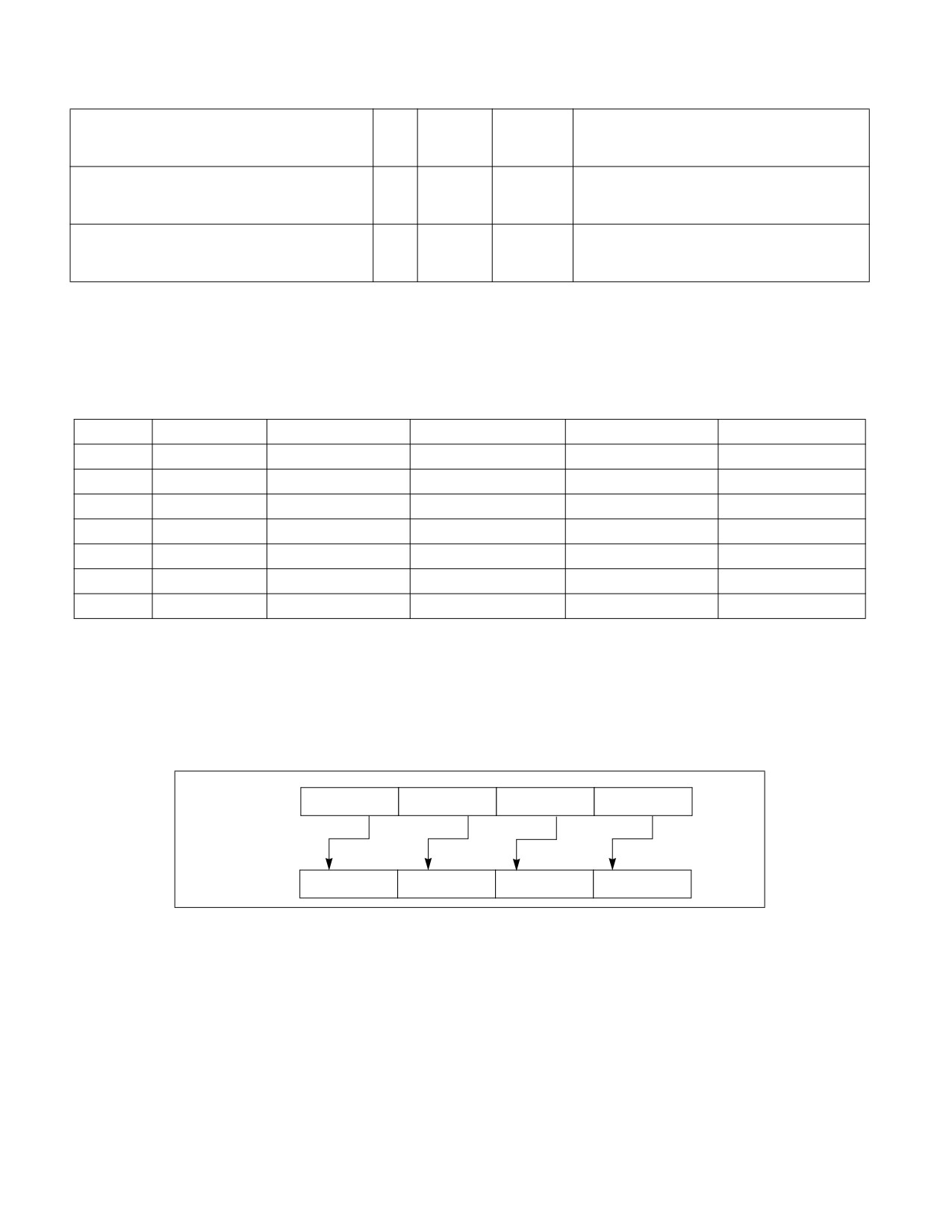
is set to all 0s. Figure 4-17 gives an example of shifting words in a 64-bit operand.
Pre-Shift
X3
X2
X1
X0
DEST
Shift Left
with Zero
Extension
Post-Shift
X3 << COUNT
X2 << COUNT
X1 << COUNT
X0 << COUNT
DEST
Figure 4-17. PSLLW, PSLLD, and PSLLQ Instruction Operation Using 64-bit Operand
The (V)PSLLW instruction shifts each of the words in the destination operand to the left by the number of bits spec-
ified in the count operand; the (V)PSLLD instruction shifts each of the doublewords in the destination operand; and
the (V)PSLLQ instruction shifts the quadword (or quadwords) in the destination operand.
In 64-bit mode and not encoded with VEX/EVEX, using a REX prefix in the form of REX.R permits this instruction to
access additional registers (XMM8-XMM15).
Legacy SSE instructions 64-bit operand: The destination operand is an MMX technology register; the count
operand can be either an MMX technology register or an 64-bit memory location.
PSLLW/PSLLD/PSLLQ—Shift Packed Data Left Logical
Vol. 2B
4-445
INSTRUCTION SET REFERENCE, M-U
128-bit Legacy SSE version: The destination and first source operands are XMM registers. Bits (MAXVL-1:128) of
the corresponding YMM destination register remain unchanged. The count operand can be either an XMM register
or a 128-bit memory location or an 8-bit immediate. If the count operand is a memory address, 128 bits are loaded
but the upper 64 bits are ignored.
VEX.128 encoded version: The destination and first source operands are XMM registers. Bits (MAXVL-1:128) of the
destination YMM register are zeroed. The count operand can be either an XMM register or a 128-bit memory loca-
tion or an 8-bit immediate. If the count operand is a memory address, 128 bits are loaded but the upper 64 bits are
ignored.
VEX.256 encoded version: The destination operand is a YMM register. The source operand is a YMM register or a
memory location. The count operand can come either from an XMM register or a memory location or an 8-bit imme-
diate. Bits (MAXVL-1:256) of the corresponding ZMM register are zeroed.
EVEX encoded versions: The destination operand is a ZMM register updated according to the writemask. The count
operand is either an 8-bit immediate (the immediate count version) or an 8-bit value from an XMM register or a
memory location (the variable count version). For the immediate count version, the source operand (the second
operand) can be a ZMM register, a 512-bit memory location or a 512-bit vector broadcasted from a 32/64-bit
memory location. For the variable count version, the first source operand (the second operand) is a ZMM register,
the second source operand (the third operand, 8-bit variable count) can be an XMM register or a memory location.
Note: In VEX/EVEX encoded versions of shifts with an immediate count, vvvv of VEX/EVEX encode the destination
register, and VEX.B/EVEX.B + ModRM.r/m encodes the source register.
Note: For shifts with an immediate count (VEX.128.66.0F 71-73 /6, or EVEX.128.66.0F 71-73 /6),
VEX.vvvv/EVEX.vvvv encodes the destination register.
Operation
PSLLW (with 64-bit operand)
IF (COUNT > 15)
THEN
DEST[64:0] := 0000000000000000H;
ELSE
DEST[15:0] := ZeroExtend(DEST[15:0] << COUNT);
(* Repeat shift operation for 2nd and 3rd words *)
DEST[63:48] := ZeroExtend(DEST[63:48] << COUNT);
FI;
PSLLD (with 64-bit operand)
IF (COUNT > 31)
THEN
DEST[64:0] := 0000000000000000H;
ELSE
DEST[31:0] := ZeroExtend(DEST[31:0] << COUNT);
DEST[63:32] := ZeroExtend(DEST[63:32] << COUNT);
FI;
PSLLQ (with 64-bit operand)
IF (COUNT > 63)
THEN
DEST[64:0] := 0000000000000000H;
ELSE
DEST := ZeroExtend(DEST << COUNT);
FI;
LOGICAL_LEFT_SHIFT_WORDS(SRC, COUNT_SRC)
COUNT := COUNT_SRC[63:0];
IF (COUNT > 15)
THEN
4-446
Vol. 2B
PSLLW/PSLLD/PSLLQ—Shift Packed Data Left Logical
INSTRUCTION SET REFERENCE, M-U
DEST[127:0] := 00000000000000000000000000000000H
ELSE
DEST[15:0] := ZeroExtend(SRC[15:0] << COUNT);
(* Repeat shift operation for 2nd through 7th words *)
DEST[127:112] := ZeroExtend(SRC[127:112] << COUNT);
FI;
LOGICAL_LEFT_SHIFT_DWORDS1(SRC, COUNT_SRC)
COUNT := COUNT_SRC[63:0];
IF (COUNT > 31)
THEN
DEST[31:0] := 0
ELSE
DEST[31:0] := ZeroExtend(SRC[31:0] << COUNT);
FI;
LOGICAL_LEFT_SHIFT_DWORDS(SRC, COUNT_SRC)
COUNT := COUNT_SRC[63:0];
IF (COUNT > 31)
THEN
DEST[127:0] := 00000000000000000000000000000000H
ELSE
DEST[31:0] := ZeroExtend(SRC[31:0] << COUNT);
(* Repeat shift operation for 2nd through 3rd words *)
DEST[127:96] := ZeroExtend(SRC[127:96] << COUNT);
FI;
LOGICAL_LEFT_SHIFT_QWORDS1(SRC, COUNT_SRC)
COUNT := COUNT_SRC[63:0];
IF (COUNT > 63)
THEN
DEST[63:0] := 0
ELSE
DEST[63:0] := ZeroExtend(SRC[63:0] << COUNT);
FI;
LOGICAL_LEFT_SHIFT_QWORDS(SRC, COUNT_SRC)
COUNT := COUNT_SRC[63:0];
IF (COUNT > 63)
THEN
DEST[127:0] := 00000000000000000000000000000000H
ELSE
DEST[63:0] := ZeroExtend(SRC[63:0] << COUNT);
DEST[127:64] := ZeroExtend(SRC[127:64] << COUNT);
FI;
LOGICAL_LEFT_SHIFT_WORDS_256b(SRC, COUNT_SRC)
COUNT := COUNT_SRC[63:0];
IF (COUNT > 15)
THEN
DEST[127:0] := 00000000000000000000000000000000H
DEST[255:128] := 00000000000000000000000000000000H
ELSE
DEST[15:0] := ZeroExtend(SRC[15:0] << COUNT);
(* Repeat shift operation for 2nd through 15th words *)
PSLLW/PSLLD/PSLLQ—Shift Packed Data Left Logical
Vol. 2B
4-447
INSTRUCTION SET REFERENCE, M-U
DEST[255:240] := ZeroExtend(SRC[255:240] << COUNT);
FI;
LOGICAL_LEFT_SHIFT_DWORDS_256b(SRC, COUNT_SRC)
COUNT := COUNT_SRC[63:0];
IF (COUNT > 31)
THEN
DEST[127:0] := 00000000000000000000000000000000H
DEST[255:128] := 00000000000000000000000000000000H
ELSE
DEST[31:0] := ZeroExtend(SRC[31:0] << COUNT);
(* Repeat shift operation for 2nd through 7th words *)
DEST[255:224] := ZeroExtend(SRC[255:224] << COUNT);
FI;
LOGICAL_LEFT_SHIFT_QWORDS_256b(SRC, COUNT_SRC)
COUNT := COUNT_SRC[63:0];
IF (COUNT > 63)
THEN
DEST[127:0] := 00000000000000000000000000000000H
DEST[255:128] := 00000000000000000000000000000000H
ELSE
DEST[63:0] := ZeroExtend(SRC[63:0] << COUNT);
DEST[127:64] := ZeroExtend(SRC[127:64] << COUNT)
DEST[191:128] := ZeroExtend(SRC[191:128] << COUNT);
DEST[255:192] := ZeroExtend(SRC[255:192] << COUNT);
FI;
VPSLLW (EVEX versions, xmm/m128)
(KL, VL) = (8, 128), (16, 256), (32, 512)
IF VL = 128
TMP_DEST[127:0] := LOGICAL_LEFT_SHIFT_WORDS_128b(SRC1[127:0], SRC2)
FI;
IF VL = 256
TMP_DEST[255:0] := LOGICAL_LEFT_SHIFT_WORDS_256b(SRC1[255:0], SRC2)
FI;
IF VL = 512
TMP_DEST[255:0] := LOGICAL_LEFT_SHIFT_WORDS_256b(SRC1[255:0], SRC2)
TMP_DEST[511:256] := LOGICAL_LEFT_SHIFT_WORDS_256b(SRC1[511:256], SRC2)
FI;
FOR j := 0 TO KL-1
i := j * 16
IF k1[j] OR *no writemask*
THEN DEST[i+15:i] := TMP_DEST[i+15:i]
ELSE
IF *merging-masking*
; merging-masking
THEN *DEST[i+15:i] remains unchanged*
ELSE *zeroing-masking*
; zeroing-masking
DEST[i+15:i] = 0
FI
FI;
ENDFOR
DEST[MAXVL-1:VL] := 0
4-448
Vol. 2B
PSLLW/PSLLD/PSLLQ—Shift Packed Data Left Logical
INSTRUCTION SET REFERENCE, M-U
VPSLLW (EVEX versions, imm8)
(KL, VL) = (8, 128), (16, 256), (32, 512)
IF VL = 128
TMP_DEST[127:0] := LOGICAL_LEFT_SHIFT_WORDS_128b(SRC1[127:0], imm8)
FI;
IF VL = 256
TMP_DEST[255:0] := LOGICAL_RIGHT_SHIFT_WORDS_256b(SRC1[255:0], imm8)
FI;
IF VL = 512
TMP_DEST[255:0] := LOGICAL_LEFT_SHIFT_WORDS_256b(SRC1[255:0], imm8)
TMP_DEST[511:256] := LOGICAL_LEFT_SHIFT_WORDS_256b(SRC1[511:256], imm8)
FI;
FOR j := 0 TO KL-1
i := j * 16
IF k1[j] OR *no writemask*
THEN DEST[i+15:i] := TMP_DEST[i+15:i]
ELSE
IF *merging-masking*
; merging-masking
THEN *DEST[i+15:i] remains unchanged*
ELSE *zeroing-masking*
; zeroing-masking
DEST[i+15:i] = 0
FI
FI;
ENDFOR
DEST[MAXVL-1:VL] := 0
VPSLLW (ymm, ymm, xmm/m128) - VEX.256 encoding
DEST[255:0] := LOGICAL_LEFT_SHIFT_WORDS_256b(SRC1, SRC2)
DEST[MAXVL-1:256] := 0;
VPSLLW (ymm, imm8) - VEX.256 encoding
DEST[255:0] := LOGICAL_LEFT_SHIFT_WORD_256b(SRC1, imm8)
DEST[MAXVL-1:256] := 0;
VPSLLW (xmm, xmm, xmm/m128) - VEX.128 encoding
DEST[127:0] := LOGICAL_LEFT_SHIFT_WORDS(SRC1, SRC2)
DEST[MAXVL-1:128] := 0
VPSLLW (xmm, imm8) - VEX.128 encoding
DEST[127:0] := LOGICAL_LEFT_SHIFT_WORDS(SRC1, imm8)
DEST[MAXVL-1:128] := 0
PSLLW/PSLLD/PSLLQ—Shift Packed Data Left Logical
Vol. 2B
4-449
INSTRUCTION SET REFERENCE, M-U
PSLLW (xmm, xmm, xmm/m128)
DEST[127:0] := LOGICAL_LEFT_SHIFT_WORDS(DEST, SRC)
DEST[MAXVL-1:128] (Unmodified)
PSLLW (xmm, imm8)
DEST[127:0] := LOGICAL_LEFT_SHIFT_WORDS(DEST, imm8)
DEST[MAXVL-1:128] (Unmodified)
VPSLLD (EVEX versions, imm8)
(KL, VL) = (4, 128), (8, 256), (16, 512)
FOR j := 0 TO KL-1
i := j * 32
IF k1[j] OR *no writemask* THEN
IF (EVEX.b = 1) AND (SRC1 *is memory*)
THEN DEST[i+31:i] := LOGICAL_LEFT_SHIFT_DWORDS1(SRC1[31:0], imm8)
ELSE DEST[i+31:i] := LOGICAL_LEFT_SHIFT_DWORDS1(SRC1[i+31:i], imm8)
FI;
ELSE
IF *merging-masking*
; merging-masking
THEN *DEST[i+31:i] remains unchanged*
ELSE *zeroing-masking*
; zeroing-masking
DEST[i+31:i] := 0
FI
FI;
ENDFOR
DEST[MAXVL-1:VL] := 0
VPSLLD (EVEX versions, xmm/m128)
(KL, VL) = (4, 128), (8, 256), (16, 512)
IF VL = 128
TMP_DEST[127:0] := LOGICAL_LEFT_SHIFT_DWORDS_128b(SRC1[127:0], SRC2)
FI;
IF VL = 256
TMP_DEST[255:0] := LOGICAL_LEFT_SHIFT_DWORDS_256b(SRC1[255:0], SRC2)
FI;
IF VL = 512
TMP_DEST[255:0] := LOGICAL_LEFT_SHIFT_DWORDS_256b(SRC1[255:0], SRC2)
TMP_DEST[511:256] := LOGICAL_LEFT_SHIFT_DWORDS_256b(SRC1[511:256], SRC2)
FI;
FOR j := 0 TO KL-1
i := j * 32
IF k1[j] OR *no writemask*
THEN DEST[i+31:i] := TMP_DEST[i+31:i]
ELSE
IF *merging-masking*
; merging-masking
THEN *DEST[i+31:i] remains unchanged*
ELSE *zeroing-masking*
; zeroing-masking
DEST[i+31:i] := 0
FI
FI;
ENDFOR
DEST[MAXVL-1:VL] := 0
4-450
Vol. 2B
PSLLW/PSLLD/PSLLQ—Shift Packed Data Left Logical
INSTRUCTION SET REFERENCE, M-U
VPSLLD (ymm, ymm, xmm/m128) - VEX.256 encoding
DEST[255:0] := LOGICAL_LEFT_SHIFT_DWORDS_256b(SRC1, SRC2)
DEST[MAXVL-1:256] := 0;
VPSLLD (ymm, imm8) - VEX.256 encoding
DEST[255:0] := LOGICAL_LEFT_SHIFT_DWORDS_256b(SRC1, imm8)
DEST[MAXVL-1:256] := 0;
VPSLLD (xmm, xmm, xmm/m128) - VEX.128 encoding
DEST[127:0] := LOGICAL_LEFT_SHIFT_DWORDS(SRC1, SRC2)
DEST[MAXVL-1:128] := 0
VPSLLD (xmm, imm8) - VEX.128 encoding
DEST[127:0] := LOGICAL_LEFT_SHIFT_DWORDS(SRC1, imm8)
DEST[MAXVL-1:128] := 0
PSLLD (xmm, xmm, xmm/m128)
DEST[127:0] := LOGICAL_LEFT_SHIFT_DWORDS(DEST, SRC)
DEST[MAXVL-1:128] (Unmodified)
PSLLD (xmm, imm8)
DEST[127:0] := LOGICAL_LEFT_SHIFT_DWORDS(DEST, imm8)
DEST[MAXVL-1:128] (Unmodified)
VPSLLQ (EVEX versions, imm8)
(KL, VL) = (2, 128), (4, 256), (8, 512)
FOR j := 0 TO KL-1
i := j * 64
IF k1[j] OR *no writemask* THEN
IF (EVEX.b = 1) AND (SRC1 *is memory*)
THEN DEST[i+63:i] := LOGICAL_LEFT_SHIFT_QWORDS1(SRC1[63:0], imm8)
ELSE DEST[i+63:i] := LOGICAL_LEFT_SHIFT_QWORDS1(SRC1[i+63:i], imm8)
FI;
ELSE
IF *merging-masking*
; merging-masking
THEN *DEST[i+63:i] remains unchanged*
ELSE *zeroing-masking*
; zeroing-masking
DEST[i+63:i] := 0
FI
FI;
ENDFOR
VPSLLQ (EVEX versions, xmm/m128)
(KL, VL) = (2, 128), (4, 256), (8, 512)
IF VL = 128
TMP_DEST[127:0] := LOGICAL_LEFT_SHIFT_QWORDS_128b(SRC1[127:0], SRC2)
FI;
IF VL = 256
TMP_DEST[255:0] := LOGICAL_LEFT_SHIFT_QWORDS_256b(SRC1[255:0], SRC2)
FI;
IF VL = 512
TMP_DEST[255:0] := LOGICAL_LEFT_SHIFT_QWORDS_256b(SRC1[255:0], SRC2)
TMP_DEST[511:256] := LOGICAL_LEFT_SHIFT_QWORDS_256b(SRC1[511:256], SRC2)
FI;
PSLLW/PSLLD/PSLLQ—Shift Packed Data Left Logical
Vol. 2B
4-451
INSTRUCTION SET REFERENCE, M-U
FOR j := 0 TO KL-1
i := j * 64
IF k1[j] OR *no writemask*
THEN DEST[i+63:i] := TMP_DEST[i+63:i]
ELSE
IF *merging-masking*
; merging-masking
THEN *DEST[i+63:i] remains unchanged*
ELSE *zeroing-masking*
; zeroing-masking
DEST[i+63:i] := 0
FI
FI;
ENDFOR
DEST[MAXVL-1:VL] := 0
VPSLLQ (ymm, ymm, xmm/m128) - VEX.256 encoding
DEST[255:0] := LOGICAL_LEFT_SHIFT_QWORDS_256b(SRC1, SRC2)
DEST[MAXVL-1:256] := 0;
VPSLLQ (ymm, imm8) - VEX.256 encoding
DEST[255:0] := LOGICAL_LEFT_SHIFT_QWORDS_256b(SRC1, imm8)
DEST[MAXVL-1:256] := 0;
VPSLLQ (xmm, xmm, xmm/m128) - VEX.128 encoding
DEST[127:0] := LOGICAL_LEFT_SHIFT_QWORDS(SRC1, SRC2)
DEST[MAXVL-1:128] := 0
VPSLLQ (xmm, imm8) - VEX.128 encoding
DEST[127:0] := LOGICAL_LEFT_SHIFT_QWORDS(SRC1, imm8)
DEST[MAXVL-1:128] := 0
PSLLQ (xmm, xmm, xmm/m128)
DEST[127:0] := LOGICAL_LEFT_SHIFT_QWORDS(DEST, SRC)
DEST[MAXVL-1:128] (Unmodified)
PSLLQ (xmm, imm8)
DEST[127:0] := LOGICAL_LEFT_SHIFT_QWORDS(DEST, imm8)
DEST[MAXVL-1:128] (Unmodified)
Intel C/C++ Compiler Intrinsic Equivalents
VPSLLD __m512i _mm512_slli_epi32(__m512i a, unsigned int imm);
VPSLLD __m512i _mm512_mask_slli_epi32(__m512i s, __mmask16 k, __m512i a, unsigned int imm);
VPSLLD __m512i _mm512_maskz_slli_epi32( __mmask16 k, __m512i a, unsigned int imm);
VPSLLD __m256i _mm256_mask_slli_epi32(__m256i s, __mmask8 k, __m256i a, unsigned int imm);
VPSLLD __m256i _mm256_maskz_slli_epi32( __mmask8 k, __m256i a, unsigned int imm);
VPSLLD __m128i _mm_mask_slli_epi32(__m128i s, __mmask8 k, __m128i a, unsigned int imm);
VPSLLD __m128i _mm_maskz_slli_epi32( __mmask8 k, __m128i a, unsigned int imm);
VPSLLD __m512i _mm512_sll_epi32(__m512i a, __m128i cnt);
VPSLLD __m512i _mm512_mask_sll_epi32(__m512i s, __mmask16 k, __m512i a, __m128i cnt);
VPSLLD __m512i _mm512_maskz_sll_epi32( __mmask16 k, __m512i a, __m128i cnt);
VPSLLD __m256i _mm256_mask_sll_epi32(__m256i s, __mmask8 k, __m256i a, __m128i cnt);
VPSLLD __m256i _mm256_maskz_sll_epi32( __mmask8 k, __m256i a, __m128i cnt);
VPSLLD __m128i _mm_mask_sll_epi32(__m128i s, __mmask8 k, __m128i a, __m128i cnt);
VPSLLD __m128i _mm_maskz_sll_epi32( __mmask8 k, __m128i a, __m128i cnt);
4-452
Vol. 2B
PSLLW/PSLLD/PSLLQ—Shift Packed Data Left Logical
INSTRUCTION SET REFERENCE, M-U
VPSLLQ __m512i _mm512_mask_slli_epi64(__m512i a, unsigned int imm);
VPSLLQ __m512i _mm512_mask_slli_epi64(__m512i s, __mmask8 k, __m512i a, unsigned int imm);
VPSLLQ __m512i _mm512_maskz_slli_epi64( __mmask8 k, __m512i a, unsigned int imm);
VPSLLQ __m256i _mm256_mask_slli_epi64(__m256i s, __mmask8 k, __m256i a, unsigned int imm);
VPSLLQ __m256i _mm256_maskz_slli_epi64( __mmask8 k, __m256i a, unsigned int imm);
VPSLLQ __m128i _mm_mask_slli_epi64(__m128i s, __mmask8 k, __m128i a, unsigned int imm);
VPSLLQ __m128i _mm_maskz_slli_epi64( __mmask8 k, __m128i a, unsigned int imm);
VPSLLQ __m512i _mm512_mask_sll_epi64(__m512i a, __m128i cnt);
VPSLLQ __m512i _mm512_mask_sll_epi64(__m512i s, __mmask8 k, __m512i a, __m128i cnt);
VPSLLQ __m512i _mm512_maskz_sll_epi64( __mmask8 k, __m512i a, __m128i cnt);
VPSLLQ __m256i _mm256_mask_sll_epi64(__m256i s, __mmask8 k, __m256i a, __m128i cnt);
VPSLLQ __m256i _mm256_maskz_sll_epi64( __mmask8 k, __m256i a, __m128i cnt);
VPSLLQ __m128i _mm_mask_sll_epi64(__m128i s, __mmask8 k, __m128i a, __m128i cnt);
VPSLLQ __m128i _mm_maskz_sll_epi64( __mmask8 k, __m128i a, __m128i cnt);
VPSLLW __m512i _mm512_slli_epi16(__m512i a, unsigned int imm);
VPSLLW __m512i _mm512_mask_slli_epi16(__m512i s, __mmask32 k, __m512i a, unsigned int imm);
VPSLLW __m512i _mm512_maskz_slli_epi16( __mmask32 k, __m512i a, unsigned int imm);
VPSLLW __m256i _mm256_mask_slli_epi16(__m256i s, __mmask16 k, __m256i a, unsigned int imm);
VPSLLW __m256i _mm256_maskz_slli_epi16( __mmask16 k, __m256i a, unsigned int imm);
VPSLLW __m128i _mm_mask_slli_epi16(__m128i s, __mmask8 k, __m128i a, unsigned int imm);
VPSLLW __m128i _mm_maskz_slli_epi16( __mmask8 k, __m128i a, unsigned int imm);
VPSLLW __m512i _mm512_sll_epi16(__m512i a, __m128i cnt);
VPSLLW __m512i _mm512_mask_sll_epi16(__m512i s, __mmask32 k, __m512i a, __m128i cnt);
VPSLLW __m512i _mm512_maskz_sll_epi16( __mmask32 k, __m512i a, __m128i cnt);
VPSLLW __m256i _mm256_mask_sll_epi16(__m256i s, __mmask16 k, __m256i a, __m128i cnt);
VPSLLW __m256i _mm256_maskz_sll_epi16( __mmask16 k, __m256i a, __m128i cnt);
VPSLLW __m128i _mm_mask_sll_epi16(__m128i s, __mmask8 k, __m128i a, __m128i cnt);
VPSLLW __m128i _mm_maskz_sll_epi16( __mmask8 k, __m128i a, __m128i cnt);
PSLLW:__m64 _mm_slli_pi16 (__m64 m, int count)
PSLLW:__m64 _mm_sll_pi16(__m64 m, __m64 count)
(V)PSLLW:__m128i _mm_slli_epi16(__m64 m, int count)
(V)PSLLW:__m128i _mm_sll_epi16(__m128i m, __m128i count)
VPSLLW:__m256i _mm256_slli_epi16 (__m256i m, int count)
VPSLLW:__m256i _mm256_sll_epi16 (__m256i m, __m128i count)
PSLLD:__m64 _mm_slli_pi32(__m64 m, int count)
PSLLD:__m64 _mm_sll_pi32(__m64 m, __m64 count)
(V)PSLLD:__m128i _mm_slli_epi32(__m128i m, int count)
(V)PSLLD:__m128i _mm_sll_epi32(__m128i m, __m128i count)
VPSLLD:__m256i _mm256_slli_epi32 (__m256i m, int count)
VPSLLD:__m256i _mm256_sll_epi32 (__m256i m, __m128i count)
PSLLQ:__m64 _mm_slli_si64(__m64 m, int count)
PSLLQ:__m64 _mm_sll_si64(__m64 m, __m64 count)
(V)PSLLQ:__m128i _mm_slli_epi64(__m128i m, int count)
(V)PSLLQ:__m128i _mm_sll_epi64(__m128i m, __m128i count)
VPSLLQ:__m256i _mm256_slli_epi64 (__m256i m, int count)
VPSLLQ:__m256i _mm256_sll_epi64 (__m256i m, __m128i count)
Flags Affected
None.
Numeric Exceptions
None.
PSLLW/PSLLD/PSLLQ—Shift Packed Data Left Logical
Vol. 2B
4-453
INSTRUCTION SET REFERENCE, M-U
Other Exceptions
VEX-encoded instructions:
Syntax with RM/RVM operand encoding (A/C in the operand encoding table), see Table 2-21, “Type 4 Class
Exception Conditions”.
Syntax with MI/VMI operand encoding (B/D in the operand encoding table), see Table 2-24, “Type 7 Class
Exception Conditions”.
EVEX-encoded VPSLLW (E in the operand encoding table), see Exceptions Type E4NF.nb in Table 2-50, “Type E4NF
Class Exception Conditions”.
EVEX-encoded VPSLLD/Q:
Syntax with Mem128 tuple type (G in the operand encoding table), see Exceptions Type E4NF.nb in
Table 2-50, “Type E4NF Class Exception Conditions”.
Syntax with Full tuple type (F in the operand encoding table), see Table 2-49, “Type E4 Class Exception Condi-
tions”.
4-454
Vol. 2B
PSLLW/PSLLD/PSLLQ—Shift Packed Data Left Logical

INSTRUCTION SET REFERENCE, M-U
PSRAW/PSRAD/PSRAQ—Shift Packed Data Right Arithmetic
Opcode/
Op/
64/32 bit
CPUID
Description
Instruction
En
Mode
Feature
Support
Flag
NP 0F E1 /r1
A
V/V
MMX
Shift words in mm right by mm/m64 while shifting
in sign bits.
PSRAW mm, mm/m64
66 0F E1 /r
A
V/V
SSE2
Shift words in xmm1 right by xmm2/m128 while
shifting in sign bits.
PSRAW xmm1, xmm2/m128
NP 0F 71 /4 ib1
B
V/V
MMX
Shift words in mm right by imm8 while shifting in
sign bits
PSRAW mm, imm8
66 0F 71 /4 ib
B
V/V
SSE2
Shift words in xmm1 right by imm8 while shifting
in sign bits
PSRAW xmm1, imm8
NP 0F E2 /r1
A
V/V
MMX
Shift doublewords in mm right by mm/m64 while
shifting in sign bits.
PSRAD mm, mm/m64
66 0F E2 /r
A
V/V
SSE2
Shift doubleword in xmm1 right by xmm2 /m128
while shifting in sign bits.
PSRAD xmm1, xmm2/m128
NP 0F 72 /4 ib1
B
V/V
MMX
Shift doublewords in mm right by imm8 while
shifting in sign bits.
PSRAD mm, imm8
66 0F 72 /4 ib
B
V/V
SSE2
Shift doublewords in xmm1 right by imm8 while
shifting in sign bits.
PSRAD xmm1, imm8
VEX.128.66.0F.WIG E1 /r
C
V/V
AVX
Shift words in xmm2 right by amount specified in
xmm3/m128 while shifting in sign bits.
VPSRAW xmm1, xmm2, xmm3/m128
VEX.128.66.0F.WIG 71 /4 ib
D
V/V
AVX
Shift words in xmm2 right by imm8 while shifting
in sign bits.
VPSRAW xmm1, xmm2, imm8
VEX.128.66.0F.WIG E2 /r
C
V/V
AVX
Shift doublewords in xmm2 right by amount
specified in xmm3/m128 while shifting in sign
VPSRAD xmm1, xmm2, xmm3/m128
bits.
VEX.128.66.0F.WIG 72 /4 ib
D
V/V
AVX
Shift doublewords in xmm2 right by imm8 while
shifting in sign bits.
VPSRAD xmm1, xmm2, imm8
VEX.256.66.0F.WIG E1 /r
C
V/V
AVX2
Shift words in ymm2 right by amount specified in
xmm3/m128 while shifting in sign bits.
VPSRAW ymm1, ymm2, xmm3/m128
VEX.256.66.0F.WIG 71 /4 ib
D
V/V
AVX2
Shift words in ymm2 right by imm8 while shifting
in sign bits.
VPSRAW ymm1, ymm2, imm8
VEX.256.66.0F.WIG E2 /r
C
V/V
AVX2
Shift doublewords in ymm2 right by amount
specified in xmm3/m128 while shifting in sign
VPSRAD ymm1, ymm2, xmm3/m128
bits.
VEX.256.66.0F.WIG 72 /4 ib
D
V/V
AVX2
Shift doublewords in ymm2 right by imm8 while
shifting in sign bits.
VPSRAD ymm1, ymm2, imm8
EVEX.128.66.0F.WIG E1 /r
G
V/V
AVX512VL
Shift words in xmm2 right by amount specified in
VPSRAW xmm1 {k1}{z}, xmm2, xmm3/m128
AVX512BW
xmm3/m128 while shifting in sign bits using
writemask k1.
EVEX.256.66.0F.WIG E1 /r
G
V/V
AVX512VL
Shift words in ymm2 right by amount specified in
VPSRAW ymm1 {k1}{z}, ymm2, xmm3/m128
AVX512BW
xmm3/m128 while shifting in sign bits using
writemask k1.
EVEX.512.66.0F.WIG E1 /r
G
V/V
AVX512BW
Shift words in zmm2 right by amount specified in
VPSRAW zmm1 {k1}{z}, zmm2, xmm3/m128
xmm3/m128 while shifting in sign bits using
writemask k1.
PSRAW/PSRAD/PSRAQ—Shift Packed Data Right Arithmetic
Vol. 2B
4-455

INSTRUCTION SET REFERENCE, M-U
EVEX.128.66.0F.WIG 71 /4 ib
E
V/V
AVX512VL
Shift words in xmm2/m128 right by imm8 while
VPSRAW xmm1 {k1}{z}, xmm2/m128, imm8
AVX512BW
shifting in sign bits using writemask k1.
EVEX.256.66.0F.WIG 71 /4 ib
E
V/V
AVX512VL
Shift words in ymm2/m256 right by imm8 while
VPSRAW ymm1 {k1}{z}, ymm2/m256, imm8
AVX512BW
shifting in sign bits using writemask k1.
EVEX.512.66.0F.WIG 71 /4 ib
E
V/V
AVX512BW
Shift words in zmm2/m512 right by imm8 while
VPSRAW zmm1 {k1}{z}, zmm2/m512, imm8
shifting in sign bits using writemask k1.
EVEX.128.66.0F.W0 E2 /r
G
V/V
AVX512VL
Shift doublewords in xmm2 right by amount
VPSRAD xmm1 {k1}{z}, xmm2, xmm3/m128
AVX512F
specified in xmm3/m128 while shifting in sign bits
using writemask k1.
EVEX.256.66.0F.W0 E2 /r
G
V/V
AVX512VL
Shift doublewords in ymm2 right by amount
VPSRAD ymm1 {k1}{z}, ymm2, xmm3/m128
AVX512F
specified in xmm3/m128 while shifting in sign bits
using writemask k1.
EVEX.512.66.0F.W0 E2 /r
G
V/V
AVX512F
Shift doublewords in zmm2 right by amount
VPSRAD zmm1 {k1}{z}, zmm2, xmm3/m128
specified in xmm3/m128 while shifting in sign bits
using writemask k1.
EVEX.128.66.0F.W0 72 /4 ib
F
V/V
AVX512VL
Shift doublewords in xmm2/m128/m32bcst right
VPSRAD xmm1 {k1}{z}, xmm2/m128/m32bcst,
AVX512F
by imm8 while shifting in sign bits using
imm8
writemask k1.
EVEX.256.66.0F.W0 72 /4 ib
F
V/V
AVX512VL
Shift doublewords in ymm2/m256/m32bcst right
VPSRAD ymm1 {k1}{z}, ymm2/m256/m32bcst,
AVX512F
by imm8 while shifting in sign bits using
imm8
writemask k1.
EVEX.512.66.0F.W0 72 /4 ib
F
V/V
AVX512F
Shift doublewords in zmm2/m512/m32bcst right
VPSRAD zmm1 {k1}{z}, zmm2/m512/m32bcst,
by imm8 while shifting in sign bits using
imm8
writemask k1.
EVEX.128.66.0F.W1 E2 /r
G
V/V
AVX512VL
Shift quadwords in xmm2 right by amount
VPSRAQ xmm1 {k1}{z}, xmm2, xmm3/m128
AVX512F
specified in xmm3/m128 while shifting in sign bits
using writemask k1.
EVEX.256.66.0F.W1 E2 /r
G
V/V
AVX512VL
Shift quadwords in ymm2 right by amount
VPSRAQ ymm1 {k1}{z}, ymm2, xmm3/m128
AVX512F
specified in xmm3/m128 while shifting in sign bits
using writemask k1.
EVEX.512.66.0F.W1 E2 /r
G
V/V
AVX512F
Shift quadwords in zmm2 right by amount
VPSRAQ zmm1 {k1}{z}, zmm2, xmm3/m128
specified in xmm3/m128 while shifting in sign bits
using writemask k1.
EVEX.128.66.0F.W1 72 /4 ib
F
V/V
AVX512VL
Shift quadwords in xmm2/m128/m64bcst right by
VPSRAQ xmm1 {k1}{z}, xmm2/m128/m64bcst,
AVX512F
imm8 while shifting in sign bits using writemask
imm8
k1.
EVEX.256.66.0F.W1 72 /4 ib
F
V/V
AVX512VL
Shift quadwords in ymm2/m256/m64bcst right by
VPSRAQ ymm1 {k1}{z}, ymm2/m256/m64bcst,
AVX512F
imm8 while shifting in sign bits using writemask
imm8
k1.
EVEX.512.66.0F.W1 72 /4 ib
F
V/V
AVX512F
Shift quadwords in zmm2/m512/m64bcst right by
VPSRAQ zmm1 {k1}{z}, zmm2/m512/m64bcst,
imm8 while shifting in sign bits using writemask
imm8
k1.
NOTES:
1. See note in Section 2.5, “Intel® AVX and Intel® SSE Instruction Exception Specification” in the Intel® 64 and IA-32 Architectures Software
Developer’s Manual, Volume 2A and Section 23.25.3, “Exception Conditions of Legacy SIMD Instructions Operating on MMX Registers”
in the Intel® 64 and IA-32 Architectures Software Developer’s Manual, Volume 3A.
4-456
Vol. 2B
PSRAW/PSRAD/PSRAQ—Shift Packed Data Right Arithmetic

INSTRUCTION SET REFERENCE, M-U
Instruction Operand Encoding
Op/En
Tuple Type
Operand 1
Operand 2
Operand 3
Operand 4
A
N/A
ModRM:reg (r, w)
ModRM:r/m (r)
N/A
N/A
B
N/A
ModRM:r/m (r, w)
imm8
N/A
N/A
C
N/A
ModRM:reg (w)
VEX.vvvv (r)
ModRM:r/m (r)
N/A
D
N/A
VEX.vvvv (w)
ModRM:r/m (r)
imm8
N/A
E
Full Mem
EVEX.vvvv (w)
ModRM:r/m (r)
imm8
N/A
F
Full
EVEX.vvvv (w)
ModRM:r/m (r)
imm8
N/A
G
Mem128
ModRM:reg (w)
EVEX.vvvv (r)
ModRM:r/m (r)
N/A
Description
Shifts the bits in the individual data elements (words, doublewords or quadwords) in the destination operand (first
operand) to the right by the number of bits specified in the count operand (second operand). As the bits in the data
elements are shifted right, the empty high-order bits are filled with the initial value of the sign bit of the data
element. If the value specified by the count operand is greater than 15 (for words), 31 (for doublewords), or 63 (for
quadwords), each destination data element is filled with the initial value of the sign bit of the element. (Figure 4-18
gives an example of shifting words in a 64-bit operand.)
Pre-Shift
X3
X2
X1
X0
DEST
Shift Right
with Sign
Extension
Post-Shift
X3 >> COUNT
X2 >> COUNT
X1 >> COUNT
X0 >> COUNT
DEST
Figure 4-18. PSRAW and PSRAD Instruction Operation Using a 64-bit Operand
Note that only the first 64-bits of a 128-bit count operand are checked to compute the count. If the second source
operand is a memory address, 128 bits are loaded.
The (V)PSRAW instruction shifts each of the words in the destination operand to the right by the number of bits
specified in the count operand, and the (V)PSRAD instruction shifts each of the doublewords in the destination
operand.
In 64-bit mode and not encoded with VEX/EVEX, using a REX prefix in the form of REX.R permits this instruction to
access additional registers (XMM8-XMM15).
Legacy SSE instructions 64-bit operand: The destination operand is an MMX technology register; the count
operand can be either an MMX technology register or an 64-bit memory location.
128-bit Legacy SSE version: The destination and first source operands are XMM registers. Bits (MAXVL-1:128) of
the corresponding YMM destination register remain unchanged. The count operand can be either an XMM register
or a 128-bit memory location or an 8-bit immediate. If the count operand is a memory address, 128 bits are loaded
but the upper 64 bits are ignored.
VEX.128 encoded version: The destination and first source operands are XMM registers. Bits (MAXVL-1:128) of the
destination YMM register are zeroed. The count operand can be either an XMM register or a 128-bit memory loca-
tion or an 8-bit immediate. If the count operand is a memory address, 128 bits are loaded but the upper 64 bits are
ignored.
VEX.256 encoded version: The destination operand is a YMM register. The source operand is a YMM register or a
memory location. The count operand can come either from an XMM register or a memory location or an 8-bit
immediate. Bits (MAXVL-1:256) of the corresponding ZMM register are zeroed.
PSRAW/PSRAD/PSRAQ—Shift Packed Data Right Arithmetic
Vol. 2B
4-457
INSTRUCTION SET REFERENCE, M-U
EVEX encoded versions: The destination operand is a ZMM register updated according to the writemask. The count
operand is either an 8-bit immediate (the immediate count version) or an 8-bit value from an XMM register or a
memory location (the variable count version). For the immediate count version, the source operand (the second
operand) can be a ZMM register, a 512-bit memory location or a 512-bit vector broadcasted from a 32/64-bit
memory location. For the variable count version, the first source operand (the second operand) is a ZMM register,
the second source operand (the third operand, 8-bit variable count) can be an XMM register or a memory location.
Note: In VEX/EVEX encoded versions of shifts with an immediate count, vvvv of VEX/EVEX encode the destination
register, and VEX.B/EVEX.B + ModRM.r/m encodes the source register.
Note: For shifts with an immediate count (VEX.128.66.0F 71-73 /4, EVEX.128.66.0F 71-73 /4),
VEX.vvvv/EVEX.vvvv encodes the destination register.
Operation
PSRAW (with 64-bit operand)
IF (COUNT > 15)
THEN COUNT := 16;
FI;
DEST[15:0] := SignExtend(DEST[15:0] >> COUNT);
(* Repeat shift operation for 2nd and 3rd words *)
DEST[63:48] := SignExtend(DEST[63:48] >> COUNT);
PSRAD (with 64-bit operand)
IF (COUNT > 31)
THEN COUNT := 32;
FI;
DEST[31:0] := SignExtend(DEST[31:0] >> COUNT);
DEST[63:32] := SignExtend(DEST[63:32] >> COUNT);
ARITHMETIC_RIGHT_SHIFT_DWORDS1(SRC, COUNT_SRC)
COUNT := COUNT_SRC[63:0];
IF (COUNT > 31)
THEN
DEST[31:0] := SignBit
ELSE
DEST[31:0] := SignExtend(SRC[31:0] >> COUNT);
FI;
ARITHMETIC_RIGHT_SHIFT_QWORDS1(SRC, COUNT_SRC)
COUNT := COUNT_SRC[63:0];
IF (COUNT > 63)
THEN
DEST[63:0] := SignBit
ELSE
DEST[63:0] := SignExtend(SRC[63:0] >> COUNT);
FI;
ARITHMETIC_RIGHT_SHIFT_WORDS_256b(SRC, COUNT_SRC)
COUNT := COUNT_SRC[63:0];
IF (COUNT > 15)
THEN COUNT := 16;
FI;
DEST[15:0] := SignExtend(SRC[15:0] >> COUNT);
(* Repeat shift operation for 2nd through 15th words *)
DEST[255:240] := SignExtend(SRC[255:240] >> COUNT);
4-458
Vol. 2B
PSRAW/PSRAD/PSRAQ—Shift Packed Data Right Arithmetic
INSTRUCTION SET REFERENCE, M-U
ARITHMETIC_RIGHT_SHIFT_DWORDS_256b(SRC, COUNT_SRC)
COUNT := COUNT_SRC[63:0];
IF (COUNT > 31)
THEN COUNT := 32;
FI;
DEST[31:0] := SignExtend(SRC[31:0] >> COUNT);
(* Repeat shift operation for 2nd through 7th words *)
DEST[255:224] := SignExtend(SRC[255:224] >> COUNT);
ARITHMETIC_RIGHT_SHIFT_QWORDS(SRC, COUNT_SRC, VL)
; VL: 128b, 256b or 512b
COUNT := COUNT_SRC[63:0];
IF (COUNT > 63)
THEN COUNT := 64;
FI;
DEST[63:0] := SignExtend(SRC[63:0] >> COUNT);
(* Repeat shift operation for 2nd through 7th words *)
DEST[VL-1:VL-64] := SignExtend(SRC[VL-1:VL-64] >> COUNT);
ARITHMETIC_RIGHT_SHIFT_WORDS(SRC, COUNT_SRC)
COUNT := COUNT_SRC[63:0];
IF (COUNT > 15)
THEN COUNT := 16;
FI;
DEST[15:0] := SignExtend(SRC[15:0] >> COUNT);
(* Repeat shift operation for 2nd through 7th words *)
DEST[127:112] := SignExtend(SRC[127:112] >> COUNT);
ARITHMETIC_RIGHT_SHIFT_DWORDS(SRC, COUNT_SRC)
COUNT := COUNT_SRC[63:0];
IF (COUNT > 31)
THEN COUNT := 32;
FI;
DEST[31:0] := SignExtend(SRC[31:0] >> COUNT);
(* Repeat shift operation for 2nd through 3rd words *)
DEST[127:96] := SignExtend(SRC[127:96] >> COUNT);
PSRAW/PSRAD/PSRAQ—Shift Packed Data Right Arithmetic
Vol. 2B
4-459
INSTRUCTION SET REFERENCE, M-U
VPSRAW (EVEX versions, xmm/m128)
(KL, VL) = (8, 128), (16, 256), (32, 512)
IF VL = 128
TMP_DEST[127:0] := ARITHMETIC_RIGHT_SHIFT_WORDS_128b(SRC1[127:0], SRC2)
FI;
IF VL = 256
TMP_DEST[255:0] := ARITHMETIC_RIGHT_SHIFT_WORDS_256b(SRC1[255:0], SRC2)
FI;
IF VL = 512
TMP_DEST[255:0] := ARITHMETIC_RIGHT_SHIFT_WORDS_256b(SRC1[255:0], SRC2)
TMP_DEST[511:256] := ARITHMETIC_RIGHT_SHIFT_WORDS_256b(SRC1[511:256], SRC2)
FI;
FOR j := 0 TO KL-1
i := j * 16
IF k1[j] OR *no writemask*
THEN DEST[i+15:i] := TMP_DEST[i+15:i]
ELSE
IF *merging-masking*
; merging-masking
THEN *DEST[i+15:i] remains unchanged*
ELSE *zeroing-masking*
; zeroing-masking
DEST[i+15:i] = 0
FI
FI;
ENDFOR
DEST[MAXVL-1:VL] := 0
VPSRAW (EVEX versions, imm8)
(KL, VL) = (8, 128), (16, 256), (32, 512)
IF VL = 128
TMP_DEST[127:0] := ARITHMETIC_RIGHT_SHIFT_WORDS_128b(SRC1[127:0], imm8)
FI;
IF VL = 256
TMP_DEST[255:0] := ARITHMETIC_RIGHT_SHIFT_WORDS_256b(SRC1[255:0], imm8)
FI;
IF VL = 512
TMP_DEST[255:0] := ARITHMETIC_RIGHT_SHIFT_WORDS_256b(SRC1[255:0], imm8)
TMP_DEST[511:256] := ARITHMETIC_RIGHT_SHIFT_WORDS_256b(SRC1[511:256], imm8)
FI;
FOR j := 0 TO KL-1
i := j * 16
IF k1[j] OR *no writemask*
THEN DEST[i+15:i] := TMP_DEST[i+15:i]
ELSE
IF *merging-masking*
; merging-masking
THEN *DEST[i+15:i] remains unchanged*
ELSE *zeroing-masking*
; zeroing-masking
DEST[i+15:i] = 0
FI
FI;
ENDFOR
DEST[MAXVL-1:VL] := 0
4-460
Vol. 2B
PSRAW/PSRAD/PSRAQ—Shift Packed Data Right Arithmetic
INSTRUCTION SET REFERENCE, M-U
VPSRAW (ymm, ymm, xmm/m128) - VEX
DEST[255:0] := ARITHMETIC_RIGHT_SHIFT_WORDS_256b(SRC1, SRC2)
DEST[MAXVL-1:256] := 0
VPSRAW (ymm, imm8) - VEX
DEST[255:0] := ARITHMETIC_RIGHT_SHIFT_WORDS_256b(SRC1, imm8)
DEST[MAXVL-1:256] := 0
VPSRAW (xmm, xmm, xmm/m128) - VEX
DEST[127:0] := ARITHMETIC_RIGHT_SHIFT_WORDS(SRC1, SRC2)
DEST[MAXVL-1:128] := 0
VPSRAW (xmm, imm8) - VEX
DEST[127:0] := ARITHMETIC_RIGHT_SHIFT_WORDS(SRC1, imm8)
DEST[MAXVL-1:128] := 0
PSRAW (xmm, xmm, xmm/m128)
DEST[127:0] := ARITHMETIC_RIGHT_SHIFT_WORDS(DEST, SRC)
DEST[MAXVL-1:128] (Unmodified)
PSRAW (xmm, imm8)
DEST[127:0] := ARITHMETIC_RIGHT_SHIFT_WORDS(DEST, imm8)
DEST[MAXVL-1:128] (Unmodified)
VPSRAD (EVEX versions, imm8)
(KL, VL) = (4, 128), (8, 256), (16, 512)
FOR j := 0 TO KL-1
i := j * 32
IF k1[j] OR *no writemask* THEN
IF (EVEX.b = 1) AND (SRC1 *is memory*)
THEN DEST[i+31:i] := ARITHMETIC_RIGHT_SHIFT_DWORDS1(SRC1[31:0], imm8)
ELSE DEST[i+31:i] := ARITHMETIC_RIGHT_SHIFT_DWORDS1(SRC1[i+31:i], imm8)
FI;
ELSE
IF *merging-masking*
; merging-masking
THEN *DEST[i+31:i] remains unchanged*
ELSE *zeroing-masking*
; zeroing-masking
DEST[i+31:i] := 0
FI
FI;
ENDFOR
DEST[MAXVL-1:VL] := 0
VPSRAD (EVEX versions, xmm/m128)
(KL, VL) = (4, 128), (8, 256), (16, 512)
IF VL = 128
TMP_DEST[127:0] := ARITHMETIC_RIGHT_SHIFT_DWORDS_128b(SRC1[127:0], SRC2)
FI;
IF VL = 256
TMP_DEST[255:0] := ARITHMETIC_RIGHT_SHIFT_DWORDS_256b(SRC1[255:0], SRC2)
FI;
IF VL = 512
TMP_DEST[255:0] := ARITHMETIC_RIGHT_SHIFT_DWORDS_256b(SRC1[255:0], SRC2)
TMP_DEST[511:256] := ARITHMETIC_RIGHT_SHIFT_DWORDS_256b(SRC1[511:256], SRC2)
PSRAW/PSRAD/PSRAQ—Shift Packed Data Right Arithmetic
Vol. 2B
4-461
INSTRUCTION SET REFERENCE, M-U
FI;
FOR j := 0 TO KL-1
i := j * 32
IF k1[j] OR *no writemask*
THEN DEST[i+31:i] := TMP_DEST[i+31:i]
ELSE
IF *merging-masking*
; merging-masking
THEN *DEST[i+31:i] remains unchanged*
ELSE *zeroing-masking*
; zeroing-masking
DEST[i+31:i] := 0
FI
FI;
ENDFOR
DEST[MAXVL-1:VL] := 0
VPSRAD (ymm, ymm, xmm/m128) - VEX
DEST[255:0] := ARITHMETIC_RIGHT_SHIFT_DWORDS_256b(SRC1, SRC2)
DEST[MAXVL-1:256] := 0
VPSRAD (ymm, imm8) - VEX
DEST[255:0] := ARITHMETIC_RIGHT_SHIFT_DWORDS_256b(SRC1, imm8)
DEST[MAXVL-1:256] := 0
VPSRAD (xmm, xmm, xmm/m128) - VEX
DEST[127:0] := ARITHMETIC_RIGHT_SHIFT_DWORDS(SRC1, SRC2)
DEST[MAXVL-1:128] := 0
VPSRAD (xmm, imm8) - VEX
DEST[127:0] := ARITHMETIC_RIGHT_SHIFT_DWORDS(SRC1, imm8)
DEST[MAXVL-1:128] := 0
PSRAD (xmm, xmm, xmm/m128)
DEST[127:0] := ARITHMETIC_RIGHT_SHIFT_DWORDS(DEST, SRC)
DEST[MAXVL-1:128] (Unmodified)
PSRAD (xmm, imm8)
DEST[127:0] := ARITHMETIC_RIGHT_SHIFT_DWORDS(DEST, imm8)
DEST[MAXVL-1:128] (Unmodified)
VPSRAQ (EVEX versions, imm8)
(KL, VL) = (2, 128), (4, 256), (8, 512)
FOR j := 0 TO KL-1
i := j * 64
IF k1[j] OR *no writemask* THEN
IF (EVEX.b = 1) AND (SRC1 *is memory*)
THEN DEST[i+63:i] := ARITHMETIC_RIGHT_SHIFT_QWORDS1(SRC1[63:0], imm8)
ELSE DEST[i+63:i] := ARITHMETIC_RIGHT_SHIFT_QWORDS1(SRC1[i+63:i], imm8)
FI;
ELSE
IF *merging-masking*
; merging-masking
THEN *DEST[i+63:i] remains unchanged*
ELSE *zeroing-masking*
; zeroing-masking
DEST[i+63:i] := 0
4-462
Vol. 2B
PSRAW/PSRAD/PSRAQ—Shift Packed Data Right Arithmetic
INSTRUCTION SET REFERENCE, M-U
FI
FI;
ENDFOR
DEST[MAXVL-1:VL] := 0
VPSRAQ (EVEX versions, xmm/m128)
(KL, VL) = (2, 128), (4, 256), (8, 512)
TMP_DEST[VL-1:0] := ARITHMETIC_RIGHT_SHIFT_QWORDS(SRC1[VL-1:0], SRC2, VL)
FOR j := 0 TO 7
i := j * 64
IF k1[j] OR *no writemask*
THEN DEST[i+63:i] := TMP_DEST[i+63:i]
ELSE
IF *merging-masking*
; merging-masking
THEN *DEST[i+63:i] remains unchanged*
ELSE *zeroing-masking*
; zeroing-masking
DEST[i+63:i] := 0
FI
FI;
ENDFOR
DEST[MAXVL-1:VL] := 0
Intel C/C++ Compiler Intrinsic Equivalents
VPSRAD __m512i _mm512_srai_epi32(__m512i a, unsigned int imm);
VPSRAD __m512i _mm512_mask_srai_epi32(__m512i s, __mmask16 k, __m512i a, unsigned int imm);
VPSRAD __m512i _mm512_maskz_srai_epi32( __mmask16 k, __m512i a, unsigned int imm);
VPSRAD __m256i _mm256_mask_srai_epi32(__m256i s, __mmask8 k, __m256i a, unsigned int imm);
VPSRAD __m256i _mm256_maskz_srai_epi32( __mmask8 k, __m256i a, unsigned int imm);
VPSRAD __m128i _mm_mask_srai_epi32(__m128i s, __mmask8 k, __m128i a, unsigned int imm);
VPSRAD __m128i _mm_maskz_srai_epi32( __mmask8 k, __m128i a, unsigned int imm);
VPSRAD __m512i _mm512_sra_epi32(__m512i a, __m128i cnt);
VPSRAD __m512i _mm512_mask_sra_epi32(__m512i s, __mmask16 k, __m512i a, __m128i cnt);
VPSRAD __m512i _mm512_maskz_sra_epi32( __mmask16 k, __m512i a, __m128i cnt);
VPSRAD __m256i _mm256_mask_sra_epi32(__m256i s, __mmask8 k, __m256i a, __m128i cnt);
VPSRAD __m256i _mm256_maskz_sra_epi32( __mmask8 k, __m256i a, __m128i cnt);
VPSRAD __m128i _mm_mask_sra_epi32(__m128i s, __mmask8 k, __m128i a, __m128i cnt);
VPSRAD __m128i _mm_maskz_sra_epi32( __mmask8 k, __m128i a, __m128i cnt);
VPSRAQ __m512i _mm512_srai_epi64(__m512i a, unsigned int imm);
VPSRAQ __m512i _mm512_mask_srai_epi64(__m512i s, __mmask8 k, __m512i a, unsigned int imm)
VPSRAQ __m512i _mm512_maskz_srai_epi64( __mmask8 k, __m512i a, unsigned int imm)
VPSRAQ __m256i _mm256_mask_srai_epi64(__m256i s, __mmask8 k, __m256i a, unsigned int imm);
VPSRAQ __m256i _mm256_maskz_srai_epi64( __mmask8 k, __m256i a, unsigned int imm);
VPSRAQ __m128i _mm_mask_srai_epi64(__m128i s, __mmask8 k, __m128i a, unsigned int imm);
VPSRAQ __m128i _mm_maskz_srai_epi64( __mmask8 k, __m128i a, unsigned int imm);
VPSRAQ __m512i _mm512_sra_epi64(__m512i a, __m128i cnt);
VPSRAQ __m512i _mm512_mask_sra_epi64(__m512i s, __mmask8 k, __m512i a, __m128i cnt)
VPSRAQ __m512i _mm512_maskz_sra_epi64( __mmask8 k, __m512i a, __m128i cnt)
VPSRAQ __m256i _mm256_mask_sra_epi64(__m256i s, __mmask8 k, __m256i a, __m128i cnt);
VPSRAQ __m256i _mm256_maskz_sra_epi64( __mmask8 k, __m256i a, __m128i cnt);
VPSRAQ __m128i _mm_mask_sra_epi64(__m128i s, __mmask8 k, __m128i a, __m128i cnt);
VPSRAQ __m128i _mm_maskz_sra_epi64( __mmask8 k, __m128i a, __m128i cnt);
VPSRAW __m512i _mm512_srai_epi16(__m512i a, unsigned int imm);
VPSRAW __m512i _mm512_mask_srai_epi16(__m512i s, __mmask32 k, __m512i a, unsigned int imm);
PSRAW/PSRAD/PSRAQ—Shift Packed Data Right Arithmetic
Vol. 2B
4-463
INSTRUCTION SET REFERENCE, M-U
VPSRAW __m512i _mm512_maskz_srai_epi16( __mmask32 k, __m512i a, unsigned int imm);
VPSRAW __m256i _mm256_mask_srai_epi16(__m256i s, __mmask16 k, __m256i a, unsigned int imm);
VPSRAW __m256i _mm256_maskz_srai_epi16( __mmask16 k, __m256i a, unsigned int imm);
VPSRAW __m128i _mm_mask_srai_epi16(__m128i s, __mmask8 k, __m128i a, unsigned int imm);
VPSRAW __m128i _mm_maskz_srai_epi16( __mmask8 k, __m128i a, unsigned int imm);
VPSRAW __m512i _mm512_sra_epi16(__m512i a, __m128i cnt);
VPSRAW __m512i _mm512_mask_sra_epi16(__m512i s, __mmask16 k, __m512i a, __m128i cnt);
VPSRAW __m512i _mm512_maskz_sra_epi16( __mmask16 k, __m512i a, __m128i cnt);
VPSRAW __m256i _mm256_mask_sra_epi16(__m256i s, __mmask8 k, __m256i a, __m128i cnt);
VPSRAW __m256i _mm256_maskz_sra_epi16( __mmask8 k, __m256i a, __m128i cnt);
VPSRAW __m128i _mm_mask_sra_epi16(__m128i s, __mmask8 k, __m128i a, __m128i cnt);
VPSRAW __m128i _mm_maskz_sra_epi16( __mmask8 k, __m128i a, __m128i cnt);
PSRAW:__m64 _mm_srai_pi16 (__m64 m, int count)
PSRAW:__m64 _mm_sra_pi16 (__m64 m, __m64 count)
(V)PSRAW:__m128i _mm_srai_epi16(__m128i m, int count)
(V)PSRAW:__m128i _mm_sra_epi16(__m128i m, __m128i count)
VPSRAW:__m256i _mm256_srai_epi16 (__m256i m, int count)
VPSRAW:__m256i _mm256_sra_epi16 (__m256i m, __m128i count)
PSRAD:__m64 _mm_srai_pi32 (__m64 m, int count)
PSRAD:__m64 _mm_sra_pi32 (__m64 m, __m64 count)
(V)PSRAD:__m128i _mm_srai_epi32 (__m128i m, int count)
(V)PSRAD:__m128i _mm_sra_epi32 (__m128i m, __m128i count)
VPSRAD:__m256i _mm256_srai_epi32 (__m256i m, int count)
VPSRAD:__m256i _mm256_sra_epi32 (__m256i m, __m128i count)
Flags Affected
None.
Numeric Exceptions
None.
Other Exceptions
VEX-encoded instructions:
Syntax with RM/RVM operand encoding (A/C in the operand encoding table), see Table
2-21, “Type 4 Class
Exception Conditions”.
Syntax with MI/VMI operand encoding (B/D in the operand encoding table), see Table
2-24, “Type 7 Class
Exception Conditions”.
EVEX-encoded VPSRAW (E in the operand encoding table), see Exceptions Type E4NF.nb in Table 2-50, “Type E4NF
Class Exception Conditions”.
EVEX-encoded VPSRAD/Q:
Syntax with Mem128 tuple type (G in the operand encoding table), see Exceptions Type E4NF.nb in
Table 2-50, “Type E4NF Class Exception Conditions”.
Syntax with Full tuple type (F in the operand encoding table), see Table 2-49, “Type E4 Class Exception Condi-
tions”.
4-464
Vol. 2B
PSRAW/PSRAD/PSRAQ—Shift Packed Data Right Arithmetic

INSTRUCTION SET REFERENCE, M-U
PSRLDQ—Shift Double Quadword Right Logical
Opcode/
Op/
64/32 bit
CPUID
Description
Instruction
En
Mode
Feature
Support
Flag
66 0F 73 /3 ib
A
V/V
SSE2
Shift xmm1 right by imm8 while shifting in 0s.
PSRLDQ xmm1, imm8
VEX.128.66.0F.WIG 73 /3 ib
B
V/V
AVX
Shift xmm2 right by imm8 bytes while shifting in
0s.
VPSRLDQ xmm1, xmm2, imm8
VEX.256.66.0F.WIG 73 /3 ib
B
V/V
AVX2
Shift ymm1 right by imm8 bytes while shifting in
0s.
VPSRLDQ ymm1, ymm2, imm8
EVEX.128.66.0F.WIG 73 /3 ib
C
V/V
AVX512VL
Shift xmm2/m128 right by imm8 bytes while
VPSRLDQ xmm1, xmm2/m128, imm8
AVX512BW
shifting in 0s and store result in xmm1.
EVEX.256.66.0F.WIG 73 /3 ib
C
V/V
AVX512VL
Shift ymm2/m256 right by imm8 bytes while
VPSRLDQ ymm1, ymm2/m256, imm8
AVX512BW
shifting in 0s and store result in ymm1.
EVEX.512.66.0F.WIG 73 /3 ib
C
V/V
AVX512BW
Shift zmm2/m512 right by imm8 bytes while
VPSRLDQ zmm1, zmm2/m512, imm8
shifting in 0s and store result in zmm1.
Instruction Operand Encoding
Op/En
Tuple Type
Operand 1
Operand 2
Operand 3
Operand 4
A
N/A
ModRM:r/m (r, w)
imm8
N/A
N/A
B
N/A
VEX.vvvv (w)
ModRM:r/m (r)
imm8
N/A
C
Full Mem
EVEX.vvvv (w)
ModRM:r/m (r)
imm8
N/A
Description
Shifts the destination operand (first operand) to the right by the number of bytes specified in the count operand
(second operand). The empty high-order bytes are cleared (set to all 0s). If the value specified by the count
operand is greater than 15, the destination operand is set to all 0s. The count operand is an 8-bit immediate.
In 64-bit mode and not encoded with VEX/EVEX, using a REX prefix in the form of REX.R permits this instruction to
access additional registers (XMM8-XMM15).
128-bit Legacy SSE version: The source and destination operands are the same. Bits (MAXVL-1:128) of the corre-
sponding YMM destination register remain unchanged.
VEX.128 encoded version: The source and destination operands are XMM registers. Bits (MAXVL-1:128) of the
destination YMM register are zeroed.
VEX.256 encoded version: The source operand is a YMM register. The destination operand is a YMM register. The
count operand applies to both the low and high 128-bit lanes.
VEX.256 encoded version: The source operand is YMM register. The destination operand is an YMM register. Bits
(MAXVL-1:256) of the corresponding ZMM register are zeroed. The count operand applies to both the low and high
128-bit lanes.
EVEX encoded versions: The source operand is a ZMM/YMM/XMM register or a 512/256/128-bit memory location.
The destination operand is a ZMM/YMM/XMM register. The count operand applies to each 128-bit lanes.
Note: VEX.vvvv/EVEX.vvvv encodes the destination register.
PSRLDQ—Shift Double Quadword Right Logical
Vol. 2B
4-465
INSTRUCTION SET REFERENCE, M-U
Operation
VPSRLDQ (EVEX.512 encoded version)
TEMP := COUNT
IF (TEMP > 15) THEN TEMP := 16; FI
DEST[127:0] := SRC[127:0] >> (TEMP * 8)
DEST[255:128] := SRC[255:128] >> (TEMP * 8)
DEST[383:256] := SRC[383:256] >> (TEMP * 8)
DEST[511:384] := SRC[511:384] >> (TEMP * 8)
DEST[MAXVL-1:512] := 0;
VPSRLDQ (VEX.256 and EVEX.256 encoded version)
TEMP := COUNT
IF (TEMP > 15) THEN TEMP := 16; FI
DEST[127:0] := SRC[127:0] >> (TEMP * 8)
DEST[255:128] := SRC[255:128] >> (TEMP * 8)
DEST[MAXVL-1:256] := 0;
VPSRLDQ (VEX.128 and EVEX.128 encoded version)
TEMP := COUNT
IF (TEMP > 15) THEN TEMP := 16; FI
DEST := SRC >> (TEMP * 8)
DEST[MAXVL-1:128] := 0;
PSRLDQ(128-bit Legacy SSE version)
TEMP := COUNT
IF (TEMP > 15) THEN TEMP := 16; FI
DEST := DEST >> (TEMP * 8)
DEST[MAXVL-1:128] (Unmodified)
Intel C/C++ Compiler Intrinsic Equivalents
(V)PSRLDQ __m128i _mm_srli_si128 ( __m128i a, int imm)
VPSRLDQ __m256i _mm256_bsrli_epi128 ( __m256i, const int)
VPSRLDQ __m512i _mm512_bsrli_epi128 ( __m512i, int)
Flags Affected
None.
Numeric Exceptions
None.
Other Exceptions
Non-EVEX-encoded instruction, see Table 2-24, “Type 7 Class Exception Conditions”.
EVEX-encoded instruction, see Exceptions Type E4NF.nb in Table 2-50, “Type E4NF Class Exception Conditions”.
4-466
Vol. 2B
PSRLDQ—Shift Double Quadword Right Logical