Intel 64 and IA-32 Architectures. Software Developer’s Manual (Collection, 2023) - page 70

INSTRUCTION SET REFERENCE, A-L
CVTSD2SS—Convert Scalar Double Precision Floating-Point Value to Scalar Single Precision
Floating-Point Value
Opcode/
Op /
64/32
CPUID
Description
Instruction
En
bit Mode
Feature
Support
Flag
F2 0F 5A /r
A
V/V
SSE2
Convert one double precision floating-point value in
CVTSD2SS xmm1, xmm2/m64
xmm2/m64 to one single precision floating-point value
in xmm1.
VEX.LIG.F2.0F.WIG 5A /r
B
V/V
AVX
Convert one double precision floating-point value in
VCVTSD2SS xmm1,xmm2,
xmm3/m64 to one single precision floating-point value
xmm3/m64
and merge with high bits in xmm2.
EVEX.LLIG.F2.0F.W1 5A /r
C
V/V
AVX512F
Convert one double precision floating-point value in
VCVTSD2SS xmm1 {k1}{z}, xmm2,
xmm3/m64 to one single precision floating-point value
xmm3/m64{er}
and merge with high bits in xmm2 under writemask k1.
Instruction Operand Encoding
Op/En
Tuple Type
Operand 1
Operand 2
Operand 3
Operand 4
A
N/A
ModRM:reg (r, w)
ModRM:r/m (r)
N/A
N/A
B
N/A
ModRM:reg (w)
VEX.vvvv (r)
ModRM:r/m (r)
N/A
C
Tuple1 Scalar
ModRM:reg (w)
EVEX.vvvv (r)
ModRM:r/m (r)
N/A
Description
Converts a double precision floating-point value in the “convert-from” source operand (the second operand in SSE2
version, otherwise the third operand) to a single precision floating-point value in the destination operand.
When the “convert-from” operand is an XMM register, the double precision floating-point value is contained in the
low quadword of the register. The result is stored in the low doubleword of the destination operand. When the
conversion is inexact, the value returned is rounded according to the rounding control bits in the MXCSR register.
128-bit Legacy SSE version: The “convert-from” source operand (the second operand) is an XMM register or
memory location. Bits (MAXVL-1:32) of the corresponding destination register remain unchanged. The destination
operand is an XMM register.
VEX.128 and EVEX encoded versions: The “convert-from” source operand (the third operand) can be an XMM
register or a 64-bit memory location. The first source and destination operands are XMM registers. Bits (127:32) of
the XMM register destination are copied from the corresponding bits in the first source operand. Bits (MAXVL-
1:128) of the destination register are zeroed.
EVEX encoded version: the converted result in written to the low doubleword element of the destination under the
writemask.
Software should ensure VCVTSD2SS is encoded with VEX.L=0. Encoding VCVTSD2SS with VEX.L=1 may encounter
unpredictable behavior across different processor generations.
CVTSD2SS—Convert Scalar Double Precision Floating-Point Value to Scalar Single Precision Floating-Point Value
Vol. 2A
3-291
INSTRUCTION SET REFERENCE, A-L
Operation
VCVTSD2SS (EVEX encoded version)
IF (SRC2 *is register*) AND (EVEX.b = 1)
THEN
SET_ROUNDING_MODE_FOR_THIS_INSTRUCTION(EVEX.RC);
ELSE
SET_ROUNDING_MODE_FOR_THIS_INSTRUCTION(MXCSR.RC);
FI;
IF k1[0] or *no writemask*
THEN DEST[31:0] := Convert_Double_Precision_To_Single_Precision_Floating_Point(SRC2[63:0]);
ELSE
IF *merging-masking*
; merging-masking
THEN *DEST[31:0] remains unchanged*
ELSE
; zeroing-masking
THEN DEST[31:0] := 0
FI;
FI;
DEST[127:32] := SRC1[127:32]
DEST[MAXVL-1:128] := 0
VCVTSD2SS (VEX.128 encoded version)
DEST[31:0] := Convert_Double_Precision_To_Single_Precision_Floating_Point(SRC2[63:0]);
DEST[127:32] := SRC1[127:32]
DEST[MAXVL-1:128] := 0
CVTSD2SS (128-bit Legacy SSE version)
DEST[31:0] := Convert_Double_Precision_To_Single_Precision_Floating_Point(SRC[63:0]);
(* DEST[MAXVL-1:32] Unmodified *)
Intel C/C++ Compiler Intrinsic Equivalent
VCVTSD2SS __m128 _mm_mask_cvtsd_ss(__m128 s, __mmask8 k, __m128 a, __m128d b);
VCVTSD2SS __m128 _mm_maskz_cvtsd_ss( __mmask8 k, __m128 a,__m128d b);
VCVTSD2SS __m128 _mm_cvt_roundsd_ss(__m128 a, __m128d b, int r);
VCVTSD2SS __m128 _mm_mask_cvt_roundsd_ss(__m128 s, __mmask8 k, __m128 a, __m128d b, int r);
VCVTSD2SS __m128 _mm_maskz_cvt_roundsd_ss( __mmask8 k, __m128 a,__m128d b, int r);
CVTSD2SS __m128_mm_cvtsd_ss(__m128 a, __m128d b)
SIMD Floating-Point Exceptions
Overflow, Underflow, Invalid, Precision, Denormal
Other Exceptions
VEX-encoded instructions, see Table 2-20, “Type 3 Class Exception Conditions”.
EVEX-encoded instructions, see Table 2-47, “Type E3 Class Exception Conditions”.
3-292
Vol. 2A
CVTSD2SS—Convert Scalar Double Precision Floating-Point Value to Scalar Single Precision Floating-Point Value

INSTRUCTION SET REFERENCE, A-L
CVTSI2SD—Convert Doubleword Integer to Scalar Double Precision Floating-Point Value
Opcode/
Op /
64/32
CPUID
Description
Instruction
En
bit Mode
Feature
Support
Flag
F2 0F 2A /r
A
V/V
SSE2
Convert one signed doubleword integer from
CVTSI2SD xmm1, r32/m32
r32/m32 to one double precision floating-point
value in xmm1.
F2 REX.W 0F 2A /r
A
V/N.E.
SSE2
Convert one signed quadword integer from r/m64
CVTSI2SD xmm1, r/m64
to one double precision floating-point value in
xmm1.
VEX.LIG.F2.0F.W0 2A /r
B
V/V
AVX
Convert one signed doubleword integer from
VCVTSI2SD xmm1, xmm2, r/m32
r/m32 to one double precision floating-point
value in xmm1.
VEX.LIG.F2.0F.W1 2A /r
B
V/N.E.1
AVX
Convert one signed quadword integer from r/m64
VCVTSI2SD xmm1, xmm2, r/m64
to one double precision floating-point value in
xmm1.
EVEX.LLIG.F2.0F.W0 2A /r
C
V/V
AVX512F
Convert one signed doubleword integer from
VCVTSI2SD xmm1, xmm2, r/m32
r/m32 to one double precision floating-point
value in xmm1.
EVEX.LLIG.F2.0F.W1 2A /r
C
V/N.E.1
AVX512F
Convert one signed quadword integer from r/m64
VCVTSI2SD xmm1, xmm2, r/m64{er}
to one double precision floating-point value in
xmm1.
NOTES:
1. VEX.W1/EVEX.W1 in non-64 bit is ignored; the instructions behaves as if the W0 version is used.
Instruction Operand Encoding
Op/En
Tuple Type
Operand 1
Operand 2
Operand 3
Operand 4
A
N/A
ModRM:reg (w)
ModRM:r/m (r)
N/A
N/A
B
N/A
ModRM:reg (w)
VEX.vvvv (r)
ModRM:r/m (r)
N/A
C
Tuple1 Scalar
ModRM:reg (w)
EVEX.vvvv (r)
ModRM:r/m (r)
N/A
Description
Converts a signed doubleword integer (or signed quadword integer if operand size is 64 bits) in the “convert-from”
source operand to a double precision floating-point value in the destination operand. The result is stored in the low
quadword of the destination operand, and the high quadword left unchanged. When conversion is inexact, the
value returned is rounded according to the rounding control bits in the MXCSR register.
The second source operand can be a general-purpose register or a 32/64-bit memory location. The first source and
destination operands are XMM registers.
128-bit Legacy SSE version: Use of the REX.W prefix promotes the instruction to 64-bit operands. The “convert-
from” source operand (the second operand) is a general-purpose register or memory location. The destination is
an XMM register Bits (MAXVL-1:64) of the corresponding destination register remain unchanged.
VEX.128 and EVEX encoded versions: The “convert-from” source operand (the third operand) can be a general-
purpose register or a memory location. The first source and destination operands are XMM registers. Bits (127:64)
of the XMM register destination are copied from the corresponding bits in the first source operand. Bits (MAXVL-
1:128) of the destination register are zeroed.
EVEX.W0 version: attempt to encode this instruction with EVEX embedded rounding is ignored.
VEX.W1 and EVEX.W1 versions: promotes the instruction to use 64-bit input value in 64-bit mode.
Software should ensure VCVTSI2SD is encoded with VEX.L=0. Encoding VCVTSI2SD with VEX.L=1 may encounter
unpredictable behavior across different processor generations.
CVTSI2SD—Convert Doubleword Integer to Scalar Double Precision Floating-Point Value
Vol. 2A
3-293
INSTRUCTION SET REFERENCE, A-L
Operation
VCVTSI2SD (EVEX encoded version)
IF (SRC2 *is register*) AND (EVEX.b = 1)
THEN
SET_ROUNDING_MODE_FOR_THIS_INSTRUCTION(EVEX.RC);
ELSE
SET_ROUNDING_MODE_FOR_THIS_INSTRUCTION(MXCSR.RC);
FI;
IF 64-Bit Mode And OperandSize = 64
THEN
DEST[63:0] := Convert_Integer_To_Double_Precision_Floating_Point(SRC2[63:0]);
ELSE
DEST[63:0] := Convert_Integer_To_Double_Precision_Floating_Point(SRC2[31:0]);
FI;
DEST[127:64] := SRC1[127:64]
DEST[MAXVL-1:128] := 0
VCVTSI2SD (VEX.128 encoded version)
IF 64-Bit Mode And OperandSize = 64
THEN
DEST[63:0] := Convert_Integer_To_Double_Precision_Floating_Point(SRC2[63:0]);
ELSE
DEST[63:0] := Convert_Integer_To_Double_Precision_Floating_Point(SRC2[31:0]);
FI;
DEST[127:64] := SRC1[127:64]
DEST[MAXVL-1:128] := 0
CVTSI2SD
IF 64-Bit Mode And OperandSize = 64
THEN
DEST[63:0] := Convert_Integer_To_Double_Precision_Floating_Point(SRC[63:0]);
ELSE
DEST[63:0] := Convert_Integer_To_Double_Precision_Floating_Point(SRC[31:0]);
FI;
DEST[MAXVL-1:64] (Unmodified)
Intel C/C++ Compiler Intrinsic Equivalent
VCVTSI2SD __m128d _mm_cvti32_sd(__m128d s, int a);
VCVTSI2SD __m128d _mm_cvti64_sd(__m128d s, __int64 a);
VCVTSI2SD __m128d _mm_cvt_roundi64_sd(__m128d s, __int64 a, int r);
CVTSI2SD __m128d _mm_cvtsi64_sd(__m128d s, __int64 a);
CVTSI2SD __m128d_mm_cvtsi32_sd(__m128d a, int b)
SIMD Floating-Point Exceptions
Precision
Other Exceptions
VEX-encoded instructions, see Table 2-20, “Type 3 Class Exception Conditions” if W1; else see Table
2-22, “Type 5
Class Exception Conditions”.
EVEX-encoded instructions, see Table 2-48, “Type E3NF Class Exception Conditions” if W1; else see Table 2-59,
“Type E10NF Class Exception Conditions”.
3-294
Vol. 2A
CVTSI2SD—Convert Doubleword Integer to Scalar Double Precision Floating-Point Value

INSTRUCTION SET REFERENCE, A-L
CVTSI2SS—Convert Doubleword Integer to Scalar Single Precision Floating-Point Value
Opcode/
Op /
64/32
CPUID
Description
Instruction
En
bit Mode
Feature
Support
Flag
F3 0F 2A /r
A
V/V
SSE
Convert one signed doubleword integer from r/m32
CVTSI2SS xmm1, r/m32
to one single precision floating-point value in xmm1.
F3 REX.W 0F 2A /r
A
V/N.E.
SSE
Convert one signed quadword integer from r/m64
CVTSI2SS xmm1, r/m64
to one single precision floating-point value in xmm1.
VEX.LIG.F3.0F.W0 2A /r
B
V/V
AVX
Convert one signed doubleword integer from r/m32
VCVTSI2SS xmm1, xmm2, r/m32
to one single precision floating-point value in xmm1.
VEX.LIG.F3.0F.W1 2A /r
B
V/N.E.1
AVX
Convert one signed quadword integer from r/m64
VCVTSI2SS xmm1, xmm2, r/m64
to one single precision floating-point value in xmm1.
EVEX.LLIG.F3.0F.W0 2A /r
C
V/V
AVX512F
Convert one signed doubleword integer from r/m32
VCVTSI2SS xmm1, xmm2, r/m32{er}
to one single precision floating-point value in xmm1.
EVEX.LLIG.F3.0F.W1 2A /r
C
V/N.E.1
AVX512F
Convert one signed quadword integer from r/m64
VCVTSI2SS xmm1, xmm2, r/m64{er}
to one single precision floating-point value in xmm1.
NOTES:
1. VEX.W1/EVEX.W1 in non-64 bit is ignored; the instructions behaves as if the W0 version is used.
Instruction Operand Encoding
Op/En
Tuple Type
Operand 1
Operand 2
Operand 3
Operand 4
A
N/A
ModRM:reg (w)
ModRM:r/m (r)
N/A
N/A
B
N/A
ModRM:reg (w)
VEX.vvvv (r)
ModRM:r/m (r)
N/A
C
Tuple1 Scalar
ModRM:reg (w)
EVEX.vvvv (r)
ModRM:r/m (r)
N/A
Description
Converts a signed doubleword integer (or signed quadword integer if operand size is 64 bits) in the “convert-from”
source operand to a single precision floating-point value in the destination operand (first operand). The “convert-
from” source operand can be a general-purpose register or a memory location. The destination operand is an XMM
register. The result is stored in the low doubleword of the destination operand, and the upper three doublewords
are left unchanged. When a conversion is inexact, the value returned is rounded according to the rounding control
bits in the MXCSR register or the embedded rounding control bits.
128-bit Legacy SSE version: In 64-bit mode, Use of the REX.W prefix promotes the instruction to use 64-bit input
value. The “convert-from” source operand (the second operand) is a general-purpose register or memory location.
Bits (MAXVL-1:32) of the corresponding destination register remain unchanged.
VEX.128 and EVEX encoded versions: The “convert-from” source operand (the third operand) can be a general-
purpose register or a memory location. The first source and destination operands are XMM registers. Bits (127:32)
of the XMM register destination are copied from corresponding bits in the first source operand. Bits (MAXVL-1:128)
of the destination register are zeroed.
EVEX encoded version: the converted result in written to the low doubleword element of the destination under the
writemask.
Software should ensure VCVTSI2SS is encoded with VEX.L=0. Encoding VCVTSI2SS with VEX.L=1 may encounter
unpredictable behavior across different processor generations.
CVTSI2SS—Convert Doubleword Integer to Scalar Single Precision Floating-Point Value
Vol. 2A
3-295
INSTRUCTION SET REFERENCE, A-L
Operation
VCVTSI2SS (EVEX encoded version)
IF (SRC2 *is register*) AND (EVEX.b = 1)
THEN
SET_ROUNDING_MODE_FOR_THIS_INSTRUCTION(EVEX.RC);
ELSE
SET_ROUNDING_MODE_FOR_THIS_INSTRUCTION(MXCSR.RC);
FI;
IF 64-Bit Mode And OperandSize = 64
THEN
DEST[31:0] := Convert_Integer_To_Single_Precision_Floating_Point(SRC[63:0]);
ELSE
DEST[31:0] := Convert_Integer_To_Single_Precision_Floating_Point(SRC[31:0]);
FI;
DEST[127:32] := SRC1[127:32]
DEST[MAXVL-1:128] := 0
VCVTSI2SS (VEX.128 encoded version)
IF 64-Bit Mode And OperandSize = 64
THEN
DEST[31:0] := Convert_Integer_To_Single_Precision_Floating_Point(SRC[63:0]);
ELSE
DEST[31:0] := Convert_Integer_To_Single_Precision_Floating_Point(SRC[31:0]);
FI;
DEST[127:32] := SRC1[127:32]
DEST[MAXVL-1:128] := 0
CVTSI2SS (128-bit Legacy SSE version)
IF 64-Bit Mode And OperandSize = 64
THEN
DEST[31:0] := Convert_Integer_To_Single_Precision_Floating_Point(SRC[63:0]);
ELSE
DEST[31:0] :=Convert_Integer_To_Single_Precision_Floating_Point(SRC[31:0]);
FI;
DEST[MAXVL-1:32] (Unmodified)
Intel C/C++ Compiler Intrinsic Equivalent
VCVTSI2SS __m128 _mm_cvti32_ss(__m128 s, int a);
VCVTSI2SS __m128 _mm_cvt_roundi32_ss(__m128 s, int a, int r);
VCVTSI2SS __m128 _mm_cvti64_ss(__m128 s, __int64 a);
VCVTSI2SS __m128 _mm_cvt_roundi64_ss(__m128 s, __int64 a, int r);
CVTSI2SS __m128 _mm_cvtsi64_ss(__m128 s, __int64 a);
CVTSI2SS __m128 _mm_cvtsi32_ss(__m128 a, int b);
SIMD Floating-Point Exceptions
Precision
Other Exceptions
VEX-encoded instructions, see Table 2-20, “Type 3 Class Exception Conditions”.
EVEX-encoded instructions, see Table 2-48, “Type E3NF Class Exception Conditions”.
3-296
Vol. 2A
CVTSI2SS—Convert Doubleword Integer to Scalar Single Precision Floating-Point Value

INSTRUCTION SET REFERENCE, A-L
CVTSS2SD—Convert Scalar Single Precision Floating-Point Value to Scalar Double Precision
Floating-Point Value
Opcode/
Op /
64/32
CPUID
Description
Instruction
En
bit Mode
Feature
Support
Flag
F3 0F 5A /r
A
V/V
SSE2
Convert one single precision floating-point value in
CVTSS2SD xmm1, xmm2/m32
xmm2/m32 to one double precision floating-point value
in xmm1.
VEX.LIG.F3.0F.WIG 5A /r
B
V/V
AVX
Convert one single precision floating-point value in
VCVTSS2SD xmm1, xmm2,
xmm3/m32 to one double precision floating-point value
xmm3/m32
and merge with high bits of xmm2.
EVEX.LLIG.F3.0F.W0 5A /r
C
V/V
AVX512F
Convert one single precision floating-point value in
VCVTSS2SD xmm1 {k1}{z}, xmm2,
xmm3/m32 to one double precision floating-point value
xmm3/m32{sae}
and merge with high bits of xmm2 under writemask k1.
Instruction Operand Encoding
Op/En
Tuple Type
Operand 1
Operand 2
Operand 3
Operand 4
A
N/A
ModRM:reg (r, w)
ModRM:r/m (r)
N/A
N/A
B
N/A
ModRM:reg (w)
VEX.vvvv (r)
ModRM:r/m (r)
N/A
C
Tuple1 Scalar
ModRM:reg (w)
EVEX.vvvv (r)
ModRM:r/m (r)
N/A
Description
Converts a single precision floating-point value in the “convert-from” source operand to a double precision floating-
point value in the destination operand. When the “convert-from” source operand is an XMM register, the single
precision floating-point value is contained in the low doubleword of the register. The result is stored in the low
quadword of the destination operand.
128-bit Legacy SSE version: The “convert-from” source operand (the second operand) is an XMM register or
memory location. Bits (MAXVL-1:64) of the corresponding destination register remain unchanged. The destination
operand is an XMM register.
VEX.128 and EVEX encoded versions: The “convert-from” source operand (the third operand) can be an XMM
register or a 32-bit memory location. The first source and destination operands are XMM registers. Bits (127:64) of
the XMM register destination are copied from the corresponding bits in the first source operand. Bits (MAXVL-
1:128) of the destination register are zeroed.
Software should ensure VCVTSS2SD is encoded with VEX.L=0. Encoding VCVTSS2SD with VEX.L=1 may encounter
unpredictable behavior across different processor generations.
Operation
VCVTSS2SD (EVEX encoded version)
IF k1[0] or *no writemask*
THEN DEST[63:0] := Convert_Single_Precision_To_Double_Precision_Floating_Point(SRC2[31:0]);
ELSE
IF *merging-masking*
; merging-masking
THEN *DEST[63:0] remains unchanged*
ELSE
; zeroing-masking
THEN DEST[63:0] = 0
FI;
FI;
DEST[127:64] := SRC1[127:64]
DEST[MAXVL-1:128] := 0
CVTSS2SD—Convert Scalar Single Precision Floating-Point Value to Scalar Double Precision Floating-Point Value
Vol. 2A
3-297
INSTRUCTION SET REFERENCE, A-L
VCVTSS2SD (VEX.128 encoded version)
DEST[63:0] := Convert_Single_Precision_To_Double_Precision_Floating_Point(SRC2[31:0])
DEST[127:64] := SRC1[127:64]
DEST[MAXVL-1:128] := 0
CVTSS2SD (128-bit Legacy SSE version)
DEST[63:0] := Convert_Single_Precision_To_Double_Precision_Floating_Point(SRC[31:0]);
DEST[MAXVL-1:64] (Unmodified)
Intel C/C++ Compiler Intrinsic Equivalent
VCVTSS2SD __m128d _mm_cvt_roundss_sd(__m128d a, __m128 b, int r);
VCVTSS2SD __m128d _mm_mask_cvt_roundss_sd(__m128d s, __mmask8 m, __m128d a,__m128 b, int r);
VCVTSS2SD __m128d _mm_maskz_cvt_roundss_sd(__mmask8 k, __m128d a, __m128 a, int r);
VCVTSS2SD __m128d _mm_mask_cvtss_sd(__m128d s, __mmask8 m, __m128d a,__m128 b);
VCVTSS2SD __m128d _mm_maskz_cvtss_sd(__mmask8 m, __m128d a,__m128 b);
CVTSS2SD __m128d_mm_cvtss_sd(__m128d a, __m128 a);
SIMD Floating-Point Exceptions
Invalid, Denormal
Other Exceptions
VEX-encoded instructions, see Table 2-20, “Type 3 Class Exception Conditions”.
EVEX-encoded instructions, see Table 2-47, “Type E3 Class Exception Conditions”.
3-298
Vol. 2A
CVTSS2SD—Convert Scalar Single Precision Floating-Point Value to Scalar Double Precision Floating-Point Value

INSTRUCTION SET REFERENCE, A-L
CVTSS2SI—Convert Scalar Single Precision Floating-Point Value to Doubleword Integer
Opcode/
Op /
64/32
CPUID
Description
Instruction
En
bit Mode
Feature
Support
Flag
F3 0F 2D /r
A
V/V
SSE
Convert one single precision floating-point value from
CVTSS2SI r32, xmm1/m32
xmm1/m32 to one signed doubleword integer in r32.
F3 REX.W 0F 2D /r
A
V/N.E.
SSE
Convert one single precision floating-point value from
CVTSS2SI r64, xmm1/m32
xmm1/m32 to one signed quadword integer in r64.
VEX.LIG.F3.0F.W0 2D /r 1
A
V/V
AVX
Convert one single precision floating-point value from
VCVTSS2SI r32, xmm1/m32
xmm1/m32 to one signed doubleword integer in r32.
VEX.LIG.F3.0F.W1 2D /r 1
A
V/N.E.2
AVX
Convert one single precision floating-point value from
VCVTSS2SI r64, xmm1/m32
xmm1/m32 to one signed quadword integer in r64.
EVEX.LLIG.F3.0F.W0 2D /r
B
V/V
AVX512F
Convert one single precision floating-point value from
VCVTSS2SI r32, xmm1/m32{er}
xmm1/m32 to one signed doubleword integer in r32.
EVEX.LLIG.F3.0F.W1 2D /r
B
V/N.E.2
AVX512F
Convert one single precision floating-point value from
VCVTSS2SI r64, xmm1/m32{er}
xmm1/m32 to one signed quadword integer in r64.
NOTES:
1. Software should ensure VCVTSS2SI is encoded with VEX.L=0. Encoding VCVTSS2SI with VEX.L=1 may
encounter unpredictable behavior across different processor generations.
2. VEX.W1/EVEX.W1 in non-64 bit is ignored; the instructions behaves as if the W0 version is used.
Instruction Operand Encoding
Op/En
Tuple Type
Operand 1
Operand 2
Operand 3
Operand 4
A
N/A
ModRM:reg (w)
ModRM:r/m (r)
N/A
N/A
B
Tuple1 Fixed
ModRM:reg (w)
ModRM:r/m (r)
N/A
N/A
Description
Converts a single precision floating-point value in the source operand (the second operand) to a signed doubleword
integer (or signed quadword integer if operand size is 64 bits) in the destination operand (the first operand). The
source operand can be an XMM register or a memory location. The destination operand is a general-purpose
register. When the source operand is an XMM register, the single precision floating-point value is contained in the
low doubleword of the register.
When a conversion is inexact, the value returned is rounded according to the rounding control bits in the MXCSR
register or the embedded rounding control bits. If a converted result cannot be represented in the destination
format, the floating-point invalid exception is raised, and if this exception is masked, the indefinite integer value
(2w-1, where w represents the number of bits in the destination format) is returned.
Legacy SSE instructions: In 64-bit mode, Use of the REX.W prefix promotes the instruction to produce 64-bit data.
See the summary chart at the beginning of this section for encoding data and limits.
VEX.W1 and EVEX.W1 versions: promotes the instruction to produce 64-bit data in 64-bit mode.
Note: VEX.vvvv and EVEX.vvvv are reserved and must be 1111b, otherwise instructions will #UD.
Software should ensure VCVTSS2SI is encoded with VEX.L=0. Encoding VCVTSS2SI with VEX.L=1 may encounter
unpredictable behavior across different processor generations.
CVTSS2SI—Convert Scalar Single Precision Floating-Point Value to Doubleword Integer
Vol. 2A
3-299
INSTRUCTION SET REFERENCE, A-L
Operation
VCVTSS2SI (EVEX encoded version)
IF (SRC *is register*) AND (EVEX.b = 1)
THEN
SET_ROUNDING_MODE_FOR_THIS_INSTRUCTION(EVEX.RC);
ELSE
SET_ROUNDING_MODE_FOR_THIS_INSTRUCTION(MXCSR.RC);
FI;
IF 64-bit Mode and OperandSize = 64
THEN
DEST[63:0] := Convert_Single_Precision_Floating_Point_To_Integer(SRC[31:0]);
ELSE
DEST[31:0] := Convert_Single_Precision_Floating_Point_To_Integer(SRC[31:0]);
FI;
(V)CVTSS2SI (Legacy and VEX.128 encoded version)
IF 64-bit Mode and OperandSize = 64
THEN
DEST[63:0] := Convert_Single_Precision_Floating_Point_To_Integer(SRC[31:0]);
ELSE
DEST[31:0] := Convert_Single_Precision_Floating_Point_To_Integer(SRC[31:0]);
FI;
Intel C/C++ Compiler Intrinsic Equivalent
VCVTSS2SI int _mm_cvtss_i32( __m128 a);
VCVTSS2SI int _mm_cvt_roundss_i32( __m128 a, int r);
VCVTSS2SI __int64 _mm_cvtss_i64( __m128 a);
VCVTSS2SI __int64 _mm_cvt_roundss_i64( __m128 a, int r);
SIMD Floating-Point Exceptions
Invalid, Precision
Other Exceptions
VEX-encoded instructions, see Table 2-20, “Type 3 Class Exception Conditions”; additionally:
#UD
If VEX.vvvv != 1111B.
EVEX-encoded instructions, see Table 2-48, “Type E3NF Class Exception Conditions”.
3-300
Vol. 2A
CVTSS2SI—Convert Scalar Single Precision Floating-Point Value to Doubleword Integer

INSTRUCTION SET REFERENCE, A-L
CVTTPD2DQ—Convert with Truncation Packed Double Precision Floating-Point Values to
Packed Doubleword Integers
Opcode/
Op /
64/32
CPUID
Description
Instruction
En
bit Mode
Feature
Support
Flag
66 0F E6 /r
A
V/V
SSE2
Convert two packed double precision floating-point
CVTTPD2DQ xmm1, xmm2/m128
values in xmm2/mem to two signed doubleword
integers in xmm1 using truncation.
VEX.128.66.0F.WIG E6 /r
A
V/V
AVX
Convert two packed double precision floating-point
VCVTTPD2DQ xmm1, xmm2/m128
values in xmm2/mem to two signed doubleword
integers in xmm1 using truncation.
VEX.256.66.0F.WIG E6 /r
A
V/V
AVX
Convert four packed double precision floating-point
VCVTTPD2DQ xmm1, ymm2/m256
values in ymm2/mem to four signed doubleword
integers in xmm1 using truncation.
EVEX.128.66.0F.W1 E6 /r
B
V/V
AVX512VL
Convert two packed double precision floating-point
VCVTTPD2DQ xmm1 {k1}{z},
AVX512F
values in xmm2/m128/m64bcst to two signed
xmm2/m128/m64bcst
doubleword integers in xmm1 using truncation subject
to writemask k1.
EVEX.256.66.0F.W1 E6 /r
B
V/V
AVX512VL
Convert four packed double precision floating-point
VCVTTPD2DQ xmm1 {k1}{z},
AVX512F
values in ymm2/m256/m64bcst to four signed
ymm2/m256/m64bcst
doubleword integers in xmm1 using truncation subject
to writemask k1.
EVEX.512.66.0F.W1 E6 /r
B
V/V
AVX512F
Convert eight packed double precision floating-point
VCVTTPD2DQ ymm1 {k1}{z},
values in zmm2/m512/m64bcst to eight signed
zmm2/m512/m64bcst{sae}
doubleword integers in ymm1 using truncation subject
to writemask k1.
Instruction Operand Encoding
Op/En
Tuple Type
Operand 1
Operand 2
Operand 3
Operand 4
A
N/A
ModRM:reg (w)
ModRM:r/m (r)
N/A
N/A
B
Full
ModRM:reg (w)
ModRM:r/m (r)
N/A
N/A
Description
Converts two, four or eight packed double precision floating-point values in the source operand (second operand)
to two, four or eight packed signed doubleword integers in the destination operand (first operand).
When a conversion is inexact, a truncated (round toward zero) value is returned. If a converted result is larger than
the maximum signed doubleword integer, the floating-point invalid exception is raised, and if this exception is
masked, the indefinite integer value (80000000H) is returned.
EVEX encoded versions: The source operand is a ZMM/YMM/XMM register, a 512/256/128-bit memory location, or
a 512/256/128-bit vector broadcasted from a 64-bit memory location. The destination operand is a
YMM/XMM/XMM (low 64 bits) register conditionally updated with writemask k1. The upper bits (MAXVL-1:256) of
the corresponding destination are zeroed.
VEX.256 encoded version: The source operand is a YMM register or 256- bit memory location. The destination
operand is an XMM register. The upper bits (MAXVL-1:128) of the corresponding ZMM register destination are
zeroed.
VEX.128 encoded version: The source operand is an XMM register or 128- bit memory location. The destination
operand is a XMM register. The upper bits (MAXVL-1:64) of the corresponding ZMM register destination are zeroed.
128-bit Legacy SSE version: The source operand is an XMM register or 128- bit memory location. The destination
operand is an XMM register. The upper bits (MAXVL-1:128) of the corresponding ZMM register destination are
unmodified.
Note: VEX.vvvv and EVEX.vvvv are reserved and must be 1111b, otherwise instructions will #UD.
CVTTPD2DQ—Convert with Truncation Packed Double Precision Floating-Point Values to Packed Doubleword Integers
Vol. 2A
3-301
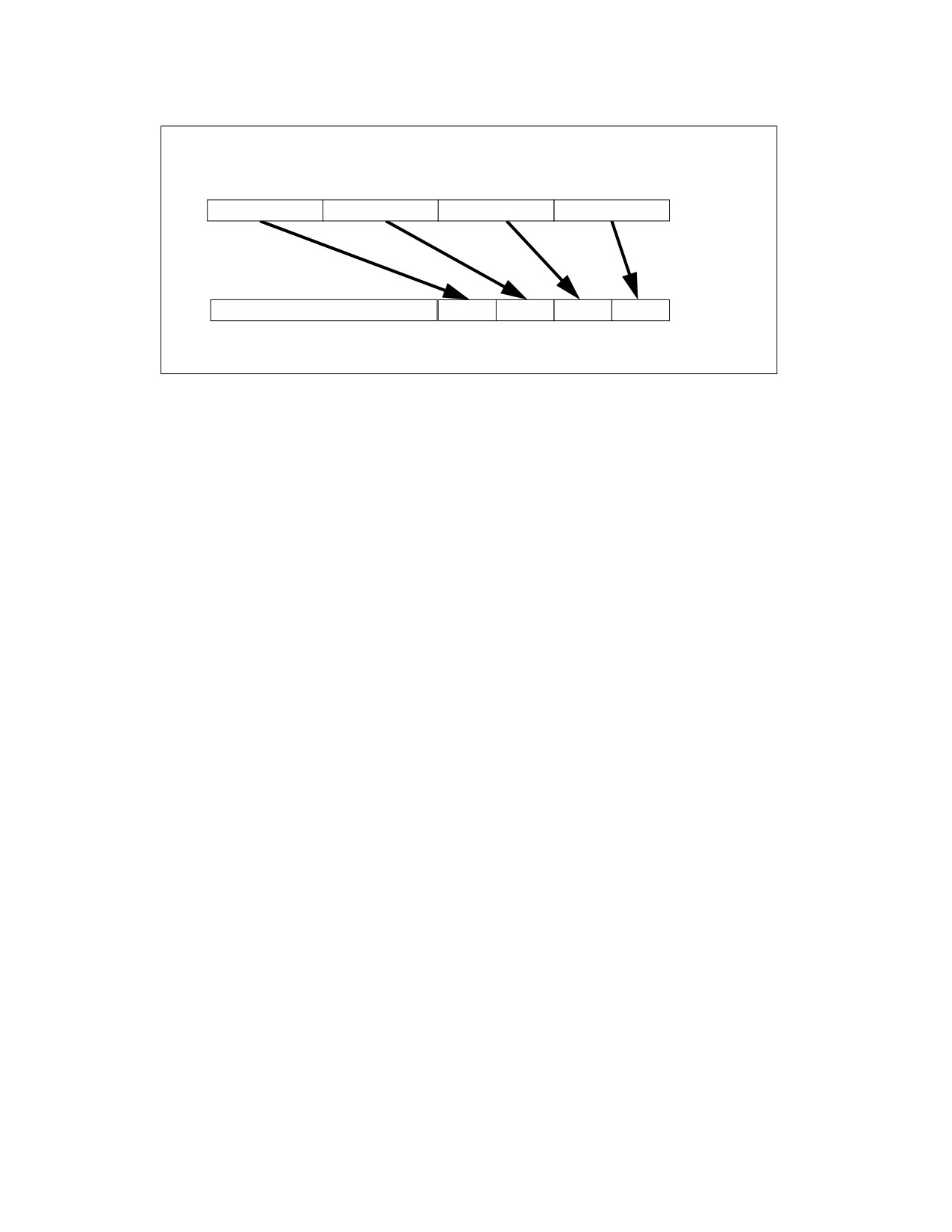
INSTRUCTION SET REFERENCE, A-L
SRC
X3
X2
X1
X0
DEST
0
X3
X2
X1
X0
Figure 3-15. VCVTTPD2DQ (VEX.256 encoded version)
Operation
VCVTTPD2DQ (EVEX encoded versions) when src operand is a register
(KL, VL) = (2, 128), (4, 256), (8, 512)
FOR j := 0 TO KL-1
i := j * 32
k := j * 64
IF k1[j] OR *no writemask*
THEN DEST[i+31:i] :=
Convert_Double_Precision_Floating_Point_To_Integer_Truncate(SRC[k+63:k])
ELSE
IF *merging-masking*
; merging-masking
THEN *DEST[i+31:i] remains unchanged*
ELSE
; zeroing-masking
DEST[i+31:i] := 0
FI
FI;
ENDFOR
DEST[MAXVL-1:VL/2] := 0
3-302
Vol. 2A
CVTTPD2DQ—Convert with Truncation Packed Double Precision Floating-Point Values to Packed Doubleword Integers
INSTRUCTION SET REFERENCE, A-L
VCVTTPD2DQ (EVEX encoded versions) when src operand is a memory source
(KL, VL) = (2, 128), (4, 256), (8, 512)
FOR j := 0 TO KL-1
i := j * 32
k := j * 64
IF k1[j] OR *no writemask*
THEN
IF (EVEX.b = 1)
THEN
DEST[i+31:i] :=
Convert_Double_Precision_Floating_Point_To_Integer_Truncate(SRC[63:0])
ELSE
DEST[i+31:i] :=
Convert_Double_Precision_Floating_Point_To_Integer_Truncate(SRC[k+63:k])
FI;
ELSE
IF *merging-masking*
; merging-masking
THEN *DEST[i+31:i] remains unchanged*
ELSE
; zeroing-masking
DEST[i+31:i] := 0
FI
FI;
ENDFOR
DEST[MAXVL-1:VL/2] := 0
VCVTTPD2DQ (VEX.256 encoded version)
DEST[31:0] := Convert_Double_Precision_Floating_Point_To_Integer_Truncate(SRC[63:0])
DEST[63:32] := Convert_Double_Precision_Floating_Point_To_Integer_Truncate(SRC[127:64])
DEST[95:64] := Convert_Double_Precision_Floating_Point_To_Integer_Truncate(SRC[191:128])
DEST[127:96] := Convert_Double_Precision_Floating_Point_To_Integer_Truncate(SRC[255:192)
DEST[MAXVL-1:128] := 0
VCVTTPD2DQ (VEX.128 encoded version)
DEST[31:0] := Convert_Double_Precision_Floating_Point_To_Integer_Truncate(SRC[63:0])
DEST[63:32] := Convert_Double_Precision_Floating_Point_To_Integer_Truncate(SRC[127:64])
DEST[MAXVL-1:64] := 0
CVTTPD2DQ (128-bit Legacy SSE version)
DEST[31:0] := Convert_Double_Precision_Floating_Point_To_Integer_Truncate(SRC[63:0])
DEST[63:32] := Convert_Double_Precision_Floating_Point_To_Integer_Truncate(SRC[127:64])
DEST[127:64] := 0
DEST[MAXVL-1:128] (unmodified)
CVTTPD2DQ—Convert with Truncation Packed Double Precision Floating-Point Values to Packed Doubleword Integers
Vol. 2A
3-303
INSTRUCTION SET REFERENCE, A-L
Intel C/C++ Compiler Intrinsic Equivalent
VCVTTPD2DQ __m256i _mm512_cvttpd_epi32( __m512d a);
VCVTTPD2DQ __m256i _mm512_mask_cvttpd_epi32( __m256i s, __mmask8 k, __m512d a);
VCVTTPD2DQ __m256i _mm512_maskz_cvttpd_epi32( __mmask8 k, __m512d a);
VCVTTPD2DQ __m256i _mm512_cvtt_roundpd_epi32( __m512d a, int sae);
VCVTTPD2DQ __m256i _mm512_mask_cvtt_roundpd_epi32( __m256i s, __mmask8 k, __m512d a, int sae);
VCVTTPD2DQ __m256i _mm512_maskz_cvtt_roundpd_epi32( __mmask8 k, __m512d a, int sae);
VCVTTPD2DQ __m128i _mm256_mask_cvttpd_epi32( __m128i s, __mmask8 k, __m256d a);
VCVTTPD2DQ __m128i _mm256_maskz_cvttpd_epi32( __mmask8 k, __m256d a);
VCVTTPD2DQ __m128i _mm_mask_cvttpd_epi32( __m128i s, __mmask8 k, __m128d a);
VCVTTPD2DQ __m128i _mm_maskz_cvttpd_epi32( __mmask8 k, __m128d a);
VCVTTPD2DQ __m128i _mm256_cvttpd_epi32 (__m256d src);
CVTTPD2DQ __m128i _mm_cvttpd_epi32 (__m128d src);
SIMD Floating-Point Exceptions
Invalid, Precision
Other Exceptions
VEX-encoded instructions, see Table 2-19, “Type 2 Class Exception Conditions”.
EVEX-encoded instructions, see Table 2-46, “Type E2 Class Exception Conditions”.
Additionally:
#UD
If VEX.vvvv != 1111B or EVEX.vvvv != 1111B.
3-304
Vol. 2A
CVTTPD2DQ—Convert with Truncation Packed Double Precision Floating-Point Values to Packed Doubleword Integers

INSTRUCTION SET REFERENCE, A-L
CVTTPD2PI—Convert With Truncation Packed Double Precision Floating-Point Values to Packed
Dword Integers
Opcode/
Op/
64-Bit
Compat/
Description
Instruction
En
Mode
Leg Mode
66 0F 2C /r
RM
Valid
Valid
Convert two packer double precision floating-
CVTTPD2PI mm, xmm/m128
point values from xmm/m128 to two packed
signed doubleword integers in mm using
truncation.
Instruction Operand Encoding
Op/En
Operand 1
Operand 2
Operand 3
Operand 4
RM
ModRM:reg (w)
ModRM:r/m (r)
N/A
N/A
Description
Converts two packed double precision floating-point values in the source operand (second operand) to two packed
signed doubleword integers in the destination operand (first operand). The source operand can be an XMM register
or a 128-bit memory location. The destination operand is an MMX technology register.
When a conversion is inexact, a truncated (round toward zero) result is returned. If a converted result is larger
than the maximum signed doubleword integer, the floating-point invalid exception is raised, and if this exception is
masked, the indefinite integer value (80000000H) is returned.
This instruction causes a transition from x87 FPU to MMX technology operation (that is, the x87 FPU top-of-stack
pointer is set to 0 and the x87 FPU tag word is set to all 0s [valid]). If this instruction is executed while an x87 FPU
floating-point exception is pending, the exception is handled before the CVTTPD2PI instruction is executed.
In 64-bit mode, use of the REX.R prefix permits this instruction to access additional registers (XMM8-XMM15).
Operation
DEST[31:0] := Convert_Double_Precision_Floating_Point_To_Integer32_Truncate(SRC[63:0]);
DEST[63:32] := Convert_Double_Precision_Floating_Point_To_Integer32_
Truncate(SRC[127:64]);
Intel C/C++ Compiler Intrinsic Equivalent
CVTTPD1PI:
__m64 _mm_cvttpd_pi32(__m128d a)
SIMD Floating-Point Exceptions
Invalid, Precision
Other Mode Exceptions
See Table 23-4, “Exception Conditions for Legacy SIMD/MMX Instructions with FP Exception and 16-Byte Align-
ment” in the Intel® 64 and IA-32 Architectures Software Developer’s Manual, Volume 3B.
CVTTPD2PI—Convert With Truncation Packed Double Precision Floating-Point Values to Packed Dword Integers
Vol. 2A
3-305

INSTRUCTION SET REFERENCE, A-L
CVTTPS2DQ—Convert With Truncation Packed Single Precision Floating-Point Values to Packed
Signed Doubleword Integer Values
Opcode/
Op /
64/32
CPUID
Description
Instruction
En
bit Mode
Feature
Support
Flag
F3 0F 5B /r
A
V/V
SSE2
Convert four packed single precision floating-point
CVTTPS2DQ xmm1, xmm2/m128
values from xmm2/mem to four packed signed
doubleword values in xmm1 using truncation.
VEX.128.F3.0F.WIG 5B /r
A
V/V
AVX
Convert four packed single precision floating-point
VCVTTPS2DQ xmm1, xmm2/m128
values from xmm2/mem to four packed signed
doubleword values in xmm1 using truncation.
VEX.256.F3.0F.WIG 5B /r
A
V/V
AVX
Convert eight packed single precision floating-point
VCVTTPS2DQ ymm1, ymm2/m256
values from ymm2/mem to eight packed signed
doubleword values in ymm1 using truncation.
EVEX.128.F3.0F.W0 5B /r
B
V/V
AVX512VL
Convert four packed single precision floating-point
VCVTTPS2DQ xmm1 {k1}{z},
AVX512F
values from xmm2/m128/m32bcst to four packed
xmm2/m128/m32bcst
signed doubleword values in xmm1 using truncation
subject to writemask k1.
EVEX.256.F3.0F.W0 5B /r
B
V/V
AVX512VL
Convert eight packed single precision floating-point
VCVTTPS2DQ ymm1 {k1}{z},
AVX512F
values from ymm2/m256/m32bcst to eight packed
ymm2/m256/m32bcst
signed doubleword values in ymm1 using truncation
subject to writemask k1.
EVEX.512.F3.0F.W0 5B /r
B
V/V
AVX512F
Convert sixteen packed single precision floating-point
VCVTTPS2DQ zmm1 {k1}{z},
values from zmm2/m512/m32bcst to sixteen packed
zmm2/m512/m32bcst {sae}
signed doubleword values in zmm1 using truncation
subject to writemask k1.
Instruction Operand Encoding
Op/En
Tuple Type
Operand 1
Operand 2
Operand 3
Operand 4
A
N/A
ModRM:reg (w)
ModRM:r/m (r)
N/A
N/A
B
Full
ModRM:reg (w)
ModRM:r/m (r)
N/A
N/A
Description
Converts four, eight or sixteen packed single precision floating-point values in the source operand to four, eight or
sixteen signed doubleword integers in the destination operand.
When a conversion is inexact, a truncated (round toward zero) value is returned. If a converted result is larger than
the maximum signed doubleword integer, the floating-point invalid exception is raised, and if this exception is
masked, the indefinite integer value (80000000H) is returned.
EVEX encoded versions: The source operand is a ZMM/YMM/XMM register, a 512/256/128-bit memory location or
a 512/256/128-bit vector broadcasted from a 32-bit memory location. The destination operand is a
ZMM/YMM/XMM register conditionally updated with writemask k1.
VEX.256 encoded version: The source operand is a YMM register or 256- bit memory location. The destination
operand is a YMM register. The upper bits (MAXVL-1:256) of the corresponding ZMM register destination are
zeroed.
VEX.128 encoded version: The source operand is an XMM register or 128- bit memory location. The destination
operand is a XMM register. The upper bits (MAXVL-1:128) of the corresponding ZMM register destination are
zeroed.
128-bit Legacy SSE version: The source operand is an XMM register or 128- bit memory location. The destination
operand is an XMM register. The upper bits (MAXVL-1:128) of the corresponding ZMM register destination are
unmodified.
Note: VEX.vvvv and EVEX.vvvv are reserved and must be 1111b otherwise instructions will #UD.
CVTTPS2DQ—Convert With Truncation Packed Single Precision Floating-Point Values to Packed Signed Doubleword Integer Values
3-306
Vol. 2A
INSTRUCTION SET REFERENCE, A-L
Operation
VCVTTPS2DQ (EVEX encoded versions) when src operand is a register
(KL, VL) = (4, 128), (8, 256), (16, 512)
FOR j := 0 TO KL-1
i := j * 32
IF k1[j] OR *no writemask*
THEN DEST[i+31:i] :=
Convert_Single_Precision_Floating_Point_To_Integer_Truncate(SRC[i+31:i])
ELSE
IF *merging-masking*
; merging-masking
THEN *DEST[i+31:i] remains unchanged*
ELSE
; zeroing-masking
DEST[i+31:i] := 0
FI
FI;
ENDFOR
DEST[MAXVL-1:VL] := 0
VCVTTPS2DQ (EVEX encoded versions) when src operand is a memory source
(KL, VL) = (4, 128), (8, 256), (16, 512)
FOR j := 0 TO 15
i := j * 32
IF k1[j] OR *no writemask*
THEN
IF (EVEX.b = 1)
THEN
DEST[i+31:i] :=
Convert_Single_Precision_Floating_Point_To_Integer_Truncate(SRC[31:0])
ELSE
DEST[i+31:i] :=
Convert_Single_Precision_Floating_Point_To_Integer_Truncate(SRC[i+31:i])
FI;
ELSE
IF *merging-masking*
; merging-masking
THEN *DEST[i+31:i] remains unchanged*
ELSE
; zeroing-masking
DEST[i+31:i] := 0
FI
FI;
ENDFOR
DEST[MAXVL-1:VL] := 0
VCVTTPS2DQ (VEX.256 encoded version)
DEST[31:0] := Convert_Single_Precision_Floating_Point_To_Integer_Truncate(SRC[31:0])
DEST[63:32] := Convert_Single_Precision_Floating_Point_To_Integer_Truncate(SRC[63:32])
DEST[95:64] := Convert_Single_Precision_Floating_Point_To_Integer_Truncate(SRC[95:64])
DEST[127:96] := Convert_Single_Precision_Floating_Point_To_Integer_Truncate(SRC[127:96)
DEST[159:128] := Convert_Single_Precision_Floating_Point_To_Integer_Truncate(SRC[159:128])
DEST[191:160] := Convert_Single_Precision_Floating_Point_To_Integer_Truncate(SRC[191:160])
DEST[223:192] := Convert_Single_Precision_Floating_Point_To_Integer_Truncate(SRC[223:192])
DEST[255:224] := Convert_Single_Precision_Floating_Point_To_Integer_Truncate(SRC[255:224])
CVTTPS2DQ—Convert With Truncation Packed Single Precision Floating-Point Values to Packed Signed Doubleword Integer Values
Vol. 2A
3-307
INSTRUCTION SET REFERENCE, A-L
VCVTTPS2DQ (VEX.128 encoded version)
DEST[31:0] := Convert_Single_Precision_Floating_Point_To_Integer_Truncate(SRC[31:0])
DEST[63:32] := Convert_Single_Precision_Floating_Point_To_Integer_Truncate(SRC[63:32])
DEST[95:64] := Convert_Single_Precision_Floating_Point_To_Integer_Truncate(SRC[95:64])
DEST[127:96] := Convert_Single_Precision_Floating_Point_To_Integer_Truncate(SRC[127:96])
DEST[MAXVL-1:128] := 0
CVTTPS2DQ (128-bit Legacy SSE version)
DEST[31:0] := Convert_Single_Precision_Floating_Point_To_Integer_Truncate(SRC[31:0])
DEST[63:32] := Convert_Single_Precision_Floating_Point_To_Integer_Truncate(SRC[63:32])
DEST[95:64] := Convert_Single_Precision_Floating_Point_To_Integer_Truncate(SRC[95:64])
DEST[127:96] := Convert_Single_Precision_Floating_Point_To_Integer_Truncate(SRC[127:96])
DEST[MAXVL-1:128] (unmodified)
Intel C/C++ Compiler Intrinsic Equivalent
VCVTTPS2DQ __m512i _mm512_cvttps_epi32( __m512 a);
VCVTTPS2DQ __m512i _mm512_mask_cvttps_epi32( __m512i s, __mmask16 k, __m512 a);
VCVTTPS2DQ __m512i _mm512_maskz_cvttps_epi32( __mmask16 k, __m512 a);
VCVTTPS2DQ __m512i _mm512_cvtt_roundps_epi32( __m512 a, int sae);
VCVTTPS2DQ __m512i _mm512_mask_cvtt_roundps_epi32( __m512i s, __mmask16 k, __m512 a, int sae);
VCVTTPS2DQ __m512i _mm512_maskz_cvtt_roundps_epi32( __mmask16 k, __m512 a, int sae);
VCVTTPS2DQ __m256i _mm256_mask_cvttps_epi32( __m256i s, __mmask8 k, __m256 a);
VCVTTPS2DQ __m256i _mm256_maskz_cvttps_epi32( __mmask8 k, __m256 a);
VCVTTPS2DQ __m128i _mm_mask_cvttps_epi32( __m128i s, __mmask8 k, __m128 a);
VCVTTPS2DQ __m128i _mm_maskz_cvttps_epi32( __mmask8 k, __m128 a);
VCVTTPS2DQ __m256i _mm256_cvttps_epi32 (__m256 a)
CVTTPS2DQ __m128i _mm_cvttps_epi32 (__m128 a)
SIMD Floating-Point Exceptions
Invalid, Precision
Other Exceptions
VEX-encoded instructions, see Table 2-19, “Type 2 Class Exception Conditions”.
EVEX-encoded instructions, see Table 2-46, “Type E2 Class Exception Conditions”.
Additionally:
#UD
If VEX.vvvv != 1111B or EVEX.vvvv != 1111B.
CVTTPS2DQ—Convert With Truncation Packed Single Precision Floating-Point Values to Packed Signed Doubleword Integer Values
3-308
Vol. 2A

INSTRUCTION SET REFERENCE, A-L
CVTTPS2PI—Convert With Truncation Packed Single Precision Floating-Point Values to Packed
Dword Integers
Opcode/
Op/
64-Bit
Compat/
Description
Instruction
En
Mode
Leg Mode
NP 0F 2C /r
RM
Valid
Valid
Convert two single precision floating-point
values from xmm/m64 to two signed
CVTTPS2PI mm, xmm/m64
doubleword signed integers in mm using
truncation.
Instruction Operand Encoding
Op/En
Operand 1
Operand 2
Operand 3
Operand 4
RM
ModRM:reg (w)
ModRM:r/m (r)
N/A
N/A
Description
Converts two packed single precision floating-point values in the source operand (second operand) to two packed
signed doubleword integers in the destination operand (first operand). The source operand can be an XMM register
or a 64-bit memory location. The destination operand is an MMX technology register. When the source operand is
an XMM register, the two single precision floating-point values are contained in the low quadword of the register.
When a conversion is inexact, a truncated (round toward zero) result is returned. If a converted result is larger
than the maximum signed doubleword integer, the floating-point invalid exception is raised, and if this exception is
masked, the indefinite integer value (80000000H) is returned.
This instruction causes a transition from x87 FPU to MMX technology operation (that is, the x87 FPU top-of-stack
pointer is set to 0 and the x87 FPU tag word is set to all 0s [valid]). If this instruction is executed while an x87 FPU
floating-point exception is pending, the exception is handled before the CVTTPS2PI instruction is executed.
In 64-bit mode, use of the REX.R prefix permits this instruction to access additional registers (XMM8-XMM15).
Operation
DEST[31:0] := Convert_Single_Precision_Floating_Point_To_Integer_Truncate(SRC[31:0]);
DEST[63:32] := Convert_Single_Precision_Floating_Point_To_Integer_Truncate(SRC[63:32]);
Intel C/C++ Compiler Intrinsic Equivalent
CVTTPS2PI:
__m64 _mm_cvttps_pi32(__m128 a)
SIMD Floating-Point Exceptions
Invalid, Precision
Other Exceptions
See Table 23-5, “Exception Conditions for Legacy SIMD/MMX Instructions with XMM and FP Exception” in the
Intel® 64 and IA-32 Architectures Software Developer’s Manual, Volume 3B.
CVTTPS2PI—Convert With Truncation Packed Single Precision Floating-Point Values to Packed Dword Integers
Vol. 2A
3-309

INSTRUCTION SET REFERENCE, A-L
CVTTSD2SI—Convert With Truncation Scalar Double Precision Floating-Point Value to Signed
Integer
Opcode/
Op /
64/32
CPUID
Description
Instruction
En
bit Mode
Feature
Support
Flag
F2 0F 2C /r
A
V/V
SSE2
Convert one double precision floating-point value from
CVTTSD2SI r32, xmm1/m64
xmm1/m64 to one signed doubleword integer in r32
using truncation.
F2 REX.W 0F 2C /r
A
V/N.E.
SSE2
Convert one double precision floating-point value from
CVTTSD2SI r64, xmm1/m64
xmm1/m64 to one signed quadword integer in r64
using truncation.
VEX.LIG.F2.0F.W0 2C /r 1
A
V/V
AVX
Convert one double precision floating-point value from
VCVTTSD2SI r32, xmm1/m64
xmm1/m64 to one signed doubleword integer in r32
using truncation.
VEX.LIG.F2.0F.W1 2C /r 1
B
V/N.E.2
AVX
Convert one double precision floating-point value from
VCVTTSD2SI r64, xmm1/m64
xmm1/m64 to one signed quadword integer in r64
using truncation.
EVEX.LLIG.F2.0F.W0 2C /r
B
V/V
AVX512F
Convert one double precision floating-point value from
VCVTTSD2SI r32, xmm1/m64{sae}
xmm1/m64 to one signed doubleword integer in r32
using truncation.
EVEX.LLIG.F2.0F.W1 2C /r
B
V/N.E.2
AVX512F
Convert one double precision floating-point value from
VCVTTSD2SI r64, xmm1/m64{sae}
xmm1/m64 to one signed quadword integer in r64
using truncation.
NOTES:
1. Software should ensure VCVTTSD2SI is encoded with VEX.L=0. Encoding VCVTTSD2SI with VEX.L=1 may encounter unpredictable
behavior across different processor generations.
2. For this specific instruction, VEX.W/EVEX.W in non-64 bit is ignored; the instructions behaves as if the W0 version is used.
Instruction Operand Encoding
Op/En
Tuple Type
Operand 1
Operand 2
Operand 3
Operand 4
A
N/A
ModRM:reg (w)
ModRM:r/m (r)
N/A
N/A
B
Tuple1 Fixed
ModRM:reg (w)
ModRM:r/m (r)
N/A
N/A
Description
Converts a double precision floating-point value in the source operand (the second operand) to a signed double-
word integer (or signed quadword integer if operand size is 64 bits) in the destination operand (the first operand).
The source operand can be an XMM register or a 64-bit memory location. The destination operand is a general
purpose register. When the source operand is an XMM register, the double precision floating-point value is
contained in the low quadword of the register.
When a conversion is inexact, the value returned is rounded according to the rounding control bits in the MXCSR
register.
If a converted result exceeds the range limits of signed doubleword integer (in non-64-bit modes or 64-bit mode
with REX.W/VEX.W/EVEX.W=0), the floating-point invalid exception is raised, and if this exception is masked, the
indefinite integer value (80000000H) is returned.
If a converted result exceeds the range limits of signed quadword integer (in 64-bit mode and
REX.W/VEX.W/EVEX.W = 1), the floating-point invalid exception is raised, and if this exception is masked, the
indefinite integer value (80000000_00000000H) is returned.
Legacy SSE instructions: In 64-bit mode, Use of the REX.W prefix promotes the instruction to 64-bit operation. See
the summary chart at the beginning of this section for encoding data and limits.
VEX.W1 and EVEX.W1 versions: promotes the instruction to produce 64-bit data in 64-bit mode.
3-310
Vol. 2A
CVTTSD2SI—Convert With Truncation Scalar Double Precision Floating-Point Value to Signed Integer
INSTRUCTION SET REFERENCE, A-L
Note: VEX.vvvv and EVEX.vvvv are reserved and must be 1111b, otherwise instructions will #UD.
Software should ensure VCVTTSD2SI is encoded with VEX.L=0. Encoding VCVTTSD2SI with VEX.L=1 may
encounter unpredictable behavior across different processor generations.
Operation
(V)CVTTSD2SI (All versions)
IF 64-Bit Mode and OperandSize = 64
THEN
DEST[63:0] := Convert_Double_Precision_Floating_Point_To_Integer_Truncate(SRC[63:0]);
ELSE
DEST[31:0] := Convert_Double_Precision_Floating_Point_To_Integer_Truncate(SRC[63:0]);
FI;
Intel C/C++ Compiler Intrinsic Equivalent
VCVTTSD2SI int _mm_cvttsd_i32( __m128d a);
VCVTTSD2SI int _mm_cvtt_roundsd_i32( __m128d a, int sae);
VCVTTSD2SI __int64 _mm_cvttsd_i64( __m128d a);
VCVTTSD2SI __int64 _mm_cvtt_roundsd_i64( __m128d a, int sae);
CVTTSD2SI int _mm_cvttsd_si32( __m128d a);
CVTTSD2SI __int64 _mm_cvttsd_si64( __m128d a);
SIMD Floating-Point Exceptions
Invalid, Precision
Other Exceptions
VEX-encoded instructions, see Table 2-20, “Type 3 Class Exception Conditions”; additionally:
#UD
If VEX.vvvv != 1111B.
EVEX-encoded instructions, see Table 2-48, “Type E3NF Class Exception Conditions”.
CVTTSD2SI—Convert With Truncation Scalar Double Precision Floating-Point Value to Signed Integer
Vol. 2A
3-311

INSTRUCTION SET REFERENCE, A-L
CVTTSS2SI—Convert With Truncation Scalar Single Precision Floating-Point Value to Integer
Opcode/
Op /
64/32
CPUID
Description
Instruction
En
bit Mode
Feature
Support
Flag
F3 0F 2C /r
A
V/V
SSE
Convert one single precision floating-point value from
CVTTSS2SI r32, xmm1/m32
xmm1/m32 to one signed doubleword integer in r32
using truncation.
F3 REX.W 0F 2C /r
A
V/N.E.
SSE
Convert one single precision floating-point value from
CVTTSS2SI r64, xmm1/m32
xmm1/m32 to one signed quadword integer in r64
using truncation.
VEX.LIG.F3.0F.W0 2C /r 1
A
V/V
AVX
Convert one single precision floating-point value from
VCVTTSS2SI r32, xmm1/m32
xmm1/m32 to one signed doubleword integer in r32
using truncation.
VEX.LIG.F3.0F.W1 2C /r 1
A
V/N.E.2
AVX
Convert one single precision floating-point value from
VCVTTSS2SI r64, xmm1/m32
xmm1/m32 to one signed quadword integer in r64
using truncation.
EVEX.LLIG.F3.0F.W0 2C /r
B
V/V
AVX512F
Convert one single precision floating-point value from
VCVTTSS2SI r32, xmm1/m32{sae}
xmm1/m32 to one signed doubleword integer in r32
using truncation.
EVEX.LLIG.F3.0F.W1 2C /r
B
V/N.E.2
AVX512F
Convert one single precision floating-point value from
VCVTTSS2SI r64, xmm1/m32{sae}
xmm1/m32 to one signed quadword integer in r64
using truncation.
NOTES:
1. Software should ensure VCVTTSS2SI is encoded with VEX.L=0. Encoding VCVTTSS2SI with VEX.L=1 may encounter unpredictable
behavior across different processor generations.
2. For this specific instruction, VEX.W/EVEX.W in non-64 bit is ignored; the instructions behaves as if the W0 version is used.
Instruction Operand Encoding
Op/En
Tuple Type
Operand 1
Operand 2
Operand 3
Operand 4
A
N/A
ModRM:reg (w)
ModRM:r/m (r)
N/A
N/A
B
Tuple1 Fixed
ModRM:reg (w)
ModRM:r/m (r)
N/A
N/A
Description
Converts a single precision floating-point value in the source operand (the second operand) to a signed doubleword
integer (or signed quadword integer if operand size is 64 bits) in the destination operand (the first operand). The
source operand can be an XMM register or a 32-bit memory location. The destination operand is a general purpose
register. When the source operand is an XMM register, the single precision floating-point value is contained in the
low doubleword of the register.
When a conversion is inexact, a truncated (round toward zero) result is returned. If a converted result is larger than
the maximum signed doubleword integer, the floating-point invalid exception is raised. If this exception is masked,
the indefinite integer value (80000000H or 80000000_00000000H if operand size is 64 bits) is returned.
Legacy SSE instructions: In 64-bit mode, Use of the REX.W prefix promotes the instruction to 64-bit operation. See
the summary chart at the beginning of this section for encoding data and limits.
VEX.W1 and EVEX.W1 versions: promotes the instruction to produce 64-bit data in 64-bit mode.
Note: VEX.vvvv and EVEX.vvvv are reserved and must be 1111b, otherwise instructions will #UD.
Software should ensure VCVTTSS2SI is encoded with VEX.L=0. Encoding VCVTTSS2SI with VEX.L=1 may
encounter unpredictable behavior across different processor generations.
3-312
Vol. 2A
CVTTSS2SI—Convert With Truncation Scalar Single Precision Floating-Point Value to Integer
INSTRUCTION SET REFERENCE, A-L
Operation
(V)CVTTSS2SI (All versions)
IF 64-Bit Mode and OperandSize = 64
THEN
DEST[63:0] := Convert_Single_Precision_Floating_Point_To_Integer_Truncate(SRC[31:0]);
ELSE
DEST[31:0] := Convert_Single_Precision_Floating_Point_To_Integer_Truncate(SRC[31:0]);
FI;
Intel C/C++ Compiler Intrinsic Equivalent
VCVTTSS2SI int _mm_cvttss_i32( __m128 a);
VCVTTSS2SI int _mm_cvtt_roundss_i32( __m128 a, int sae);
VCVTTSS2SI __int64 _mm_cvttss_i64( __m128 a);
VCVTTSS2SI __int64 _mm_cvtt_roundss_i64( __m128 a, int sae);
CVTTSS2SI int _mm_cvttss_si32( __m128 a);
CVTTSS2SI __int64 _mm_cvttss_si64( __m128 a);
SIMD Floating-Point Exceptions
Invalid, Precision
Other Exceptions
See Table 2-20, “Type 3 Class Exception Conditions”; additionally:
#UD
If VEX.vvvv != 1111B.
EVEX-encoded instructions, see Table 2-48, “Type E3NF Class Exception Conditions”.
CVTTSS2SI—Convert With Truncation Scalar Single Precision Floating-Point Value to Integer
Vol. 2A
3-313

INSTRUCTION SET REFERENCE, A-L
CWD/CDQ/CQO—Convert Word to Doubleword/Convert Doubleword to Quadword
Opcode
Instruction
Op/
64-Bit
Compat/
Description
En
Mode
Leg Mode
99
CWD
ZO
Valid
Valid
DX:AX := sign-extend of AX.
99
CDQ
ZO
Valid
Valid
EDX:EAX := sign-extend of EAX.
REX.W + 99
CQO
ZO
Valid
N.E.
RDX:RAX:= sign-extend of RAX.
Instruction Operand Encoding
Op/En
Operand 1
Operand 2
Operand 3
Operand 4
ZO
N/A
N/A
N/A
N/A
Description
Doubles the size of the operand in register AX, EAX, or RAX (depending on the operand size) by means of sign
extension and stores the result in registers DX:AX, EDX:EAX, or RDX:RAX, respectively. The CWD instruction
copies the sign (bit 15) of the value in the AX register into every bit position in the DX register. The CDQ instruction
copies the sign (bit 31) of the value in the EAX register into every bit position in the EDX register. The CQO instruc-
tion (available in 64-bit mode only) copies the sign (bit 63) of the value in the RAX register into every bit position
in the RDX register.
The CWD instruction can be used to produce a doubleword dividend from a word before word division. The CDQ
instruction can be used to produce a quadword dividend from a doubleword before doubleword division. The CQO
instruction can be used to produce a double quadword dividend from a quadword before a quadword division.
The CWD and CDQ mnemonics reference the same opcode. The CWD instruction is intended for use when the
operand-size attribute is 16 and the CDQ instruction for when the operand-size attribute is 32. Some assemblers
may force the operand size to 16 when CWD is used and to 32 when CDQ is used. Others may treat these
mnemonics as synonyms (CWD/CDQ) and use the current setting of the operand-size attribute to determine the
size of values to be converted, regardless of the mnemonic used.
In 64-bit mode, use of the REX.W prefix promotes operation to 64 bits. The CQO mnemonics reference the same
opcode as CWD/CDQ. See the summary chart at the beginning of this section for encoding data and limits.
Operation
IF OperandSize = 16 (* CWD instruction *)
THEN
DX := SignExtend(AX);
ELSE IF OperandSize = 32 (* CDQ instruction *)
EDX := SignExtend(EAX); FI;
ELSE IF 64-Bit Mode and OperandSize = 64 (* CQO instruction*)
RDX := SignExtend(RAX); FI;
FI;
Flags Affected
None
Exceptions (All Operating Modes)
#UD
If the LOCK prefix is used.
3-314
Vol. 2A
CWD/CDQ/CQO—Convert Word to Doubleword/Convert Doubleword to Quadword

INSTRUCTION SET REFERENCE, A-L
DAA—Decimal Adjust AL After Addition
Opcode
Instruction
Op/
64-Bit
Compat/
Description
En
Mode
Leg Mode
27
DAA
ZO
Invalid
Valid
Decimal adjust AL after addition.
Instruction Operand Encoding
Op/En
Operand 1
Operand 2
Operand 3
Operand 4
ZO
N/A
N/A
N/A
N/A
Description
Adjusts the sum of two packed BCD values to create a packed BCD result. The AL register is the implied source and
destination operand. The DAA instruction is only useful when it follows an ADD instruction that adds (binary addi-
tion) two 2-digit, packed BCD values and stores a byte result in the AL register. The DAA instruction then adjusts
the contents of the AL register to contain the correct 2-digit, packed BCD result. If a decimal carry is detected, the
CF and AF flags are set accordingly.
This instruction executes as described above in compatibility mode and legacy mode. It is not valid in 64-bit mode.
Operation
IF 64-Bit Mode
THEN
#UD;
ELSE
old_AL := AL;
old_CF := CF;
CF := 0;
IF (((AL AND 0FH) > 9) or AF = 1)
THEN
AL := AL + 6;
CF := old_CF or (Carry from AL := AL + 6);
AF := 1;
ELSE
AF := 0;
FI;
IF ((old_AL > 99H) or (old_CF = 1))
THEN
AL := AL + 60H;
CF := 1;
ELSE
CF := 0;
FI;
FI;
Example
ADD AL, BL Before: AL=79H BL=35H EFLAGS(OSZAPC)=XXXXXX
After: AL=AEH BL=35H EFLAGS(0SZAPC)=110000
DAA
Before: AL=AEH BL=35H EFLAGS(OSZAPC)=110000
After: AL=14H BL=35H EFLAGS(0SZAPC)=X00111
DAA
Before: AL=2EH BL=35H EFLAGS(OSZAPC)=110000
After: AL=34H BL=35H EFLAGS(0SZAPC)=X00101
DAA—Decimal Adjust AL After Addition
Vol. 2A
3-315
INSTRUCTION SET REFERENCE, A-L
Flags Affected
The CF and AF flags are set if the adjustment of the value results in a decimal carry in either digit of the result (see
the “Operation” section above). The SF, ZF, and PF flags are set according to the result. The OF flag is undefined.
Protected Mode Exceptions
#UD
If the LOCK prefix is used.
Real-Address Mode Exceptions
#UD
If the LOCK prefix is used.
Virtual-8086 Mode Exceptions
#UD
If the LOCK prefix is used.
Compatibility Mode Exceptions
#UD
If the LOCK prefix is used.
64-Bit Mode Exceptions
#UD
If in 64-bit mode.
3-316
Vol. 2A
DAA—Decimal Adjust AL After Addition

INSTRUCTION SET REFERENCE, A-L
DAS—Decimal Adjust AL After Subtraction
Opcode
Instruction
Op/
64-Bit
Compat/
Description
En
Mode
Leg Mode
2F
DAS
ZO
Invalid
Valid
Decimal adjust AL after subtraction.
Instruction Operand Encoding
Op/En
Operand 1
Operand 2
Operand 3
Operand 4
ZO
N/A
N/A
N/A
N/A
Description
Adjusts the result of the subtraction of two packed BCD values to create a packed BCD result. The AL register is the
implied source and destination operand. The DAS instruction is only useful when it follows a SUB instruction that
subtracts (binary subtraction) one 2-digit, packed BCD value from another and stores a byte result in the AL
register. The DAS instruction then adjusts the contents of the AL register to contain the correct 2-digit, packed BCD
result. If a decimal borrow is detected, the CF and AF flags are set accordingly.
This instruction executes as described above in compatibility mode and legacy mode. It is not valid in 64-bit mode.
Operation
IF 64-Bit Mode
THEN
#UD;
ELSE
old_AL := AL;
old_CF := CF;
CF := 0;
IF (((AL AND 0FH) > 9) or AF = 1)
THEN
AL := AL - 6;
CF := old_CF or (Borrow from AL := AL − 6);
AF := 1;
ELSE
AF := 0;
FI;
IF ((old_AL > 99H) or (old_CF = 1))
THEN
AL := AL − 60H;
CF := 1;
FI;
FI;
Example
SUB AL, BL Before: AL = 35H, BL = 47H, EFLAGS(OSZAPC) = XXXXXX
After: AL = EEH, BL = 47H, EFLAGS(0SZAPC) = 010111
DAA
Before: AL = EEH, BL = 47H, EFLAGS(OSZAPC) = 010111
After: AL = 88H, BL = 47H, EFLAGS(0SZAPC) = X10111
Flags Affected
The CF and AF flags are set if the adjustment of the value results in a decimal borrow in either digit of the result
(see the “Operation” section above). The SF, ZF, and PF flags are set according to the result. The OF flag is unde-
fined.
DAS—Decimal Adjust AL After Subtraction
Vol. 2A
3-317
INSTRUCTION SET REFERENCE, A-L
Protected Mode Exceptions
#UD
If the LOCK prefix is used.
Real-Address Mode Exceptions
#UD
If the LOCK prefix is used.
Virtual-8086 Mode Exceptions
#UD
If the LOCK prefix is used.
Compatibility Mode Exceptions
#UD
If the LOCK prefix is used.
64-Bit Mode Exceptions
#UD
If in 64-bit mode.
3-318
Vol. 2A
DAS—Decimal Adjust AL After Subtraction

INSTRUCTION SET REFERENCE, A-L
DEC—Decrement by 1
Opcode
Instruction
Op/
64-Bit
Compat/
Description
En
Mode
Leg Mode
FE /1
DEC r/m8
M
Valid
Valid
Decrement r/m8 by 1.
REX + FE /1
DEC r/m8*
M
Valid
N.E.
Decrement r/m8 by 1.
FF /1
DEC r/m16
M
Valid
Valid
Decrement r/m16 by 1.
FF /1
DEC r/m32
M
Valid
Valid
Decrement r/m32 by 1.
REX.W + FF /1
DEC r/m64
M
Valid
N.E.
Decrement r/m64 by 1.
48+rw
DEC r16
O
N.E.
Valid
Decrement r16 by 1.
48+rd
DEC r32
O
N.E.
Valid
Decrement r32 by 1.
NOTES:
* In 64-bit mode, r/m8 can not be encoded to access the following byte registers if a REX prefix is used: AH, BH, CH, DH.
Instruction Operand Encoding
Op/En
Operand 1
Operand 2
Operand 3
Operand 4
M
ModRM:r/m (r, w)
N/A
N/A
N/A
O
opcode + rd (r, w)
N/A
N/A
N/A
Description
Subtracts 1 from the destination operand, while preserving the state of the CF flag. The destination operand can be
a register or a memory location. This instruction allows a loop counter to be updated without disturbing the CF flag.
(To perform a decrement operation that updates the CF flag, use a SUB instruction with an immediate operand of
1.)
This instruction can be used with a LOCK prefix to allow the instruction to be executed atomically.
In 64-bit mode, DEC r16 and DEC r32 are not encodable (because opcodes 48H through 4FH are REX prefixes).
Otherwise, the instruction’s 64-bit mode default operation size is 32 bits. Use of the REX.R prefix permits access to
additional registers (R8-R15). Use of the REX.W prefix promotes operation to 64 bits.
See the summary chart at the beginning of this section for encoding data and limits.
Operation
DEST := DEST - 1;
Flags Affected
The CF flag is not affected. The OF, SF, ZF, AF, and PF flags are set according to the result.
Protected Mode Exceptions
#GP(0)
If the destination operand is located in a non-writable segment.
If a memory operand effective address is outside the CS, DS, ES, FS, or GS segment limit.
If the DS, ES, FS, or GS register contains a NULL segment selector.
#SS(0)
If a memory operand effective address is outside the SS segment limit.
#PF(fault-code)
If a page fault occurs.
#AC(0)
If alignment checking is enabled and an unaligned memory reference is made while the
current privilege level is 3.
#UD
If the LOCK prefix is used but the destination is not a memory operand.
DEC—Decrement by 1
Vol. 2A
3-319
INSTRUCTION SET REFERENCE, A-L
Real-Address Mode Exceptions
#GP
If a memory operand effective address is outside the CS, DS, ES, FS, or GS segment limit.
#SS
If a memory operand effective address is outside the SS segment limit.
#UD
If the LOCK prefix is used but the destination is not a memory operand.
Virtual-8086 Mode Exceptions
#GP(0)
If a memory operand effective address is outside the CS, DS, ES, FS, or GS segment limit.
#SS(0)
If a memory operand effective address is outside the SS segment limit.
#PF(fault-code)
If a page fault occurs.
#AC(0)
If alignment checking is enabled and an unaligned memory reference is made.
#UD
If the LOCK prefix is used but the destination is not a memory operand.
Compatibility Mode Exceptions
Same exceptions as in protected mode.
64-Bit Mode Exceptions
#SS(0)
If a memory address referencing the SS segment is in a non-canonical form.
#GP(0)
If the memory address is in a non-canonical form.
#PF(fault-code)
If a page fault occurs.
#AC(0)
If alignment checking is enabled and an unaligned memory reference is made while the
current privilege level is 3.
#UD
If the LOCK prefix is used but the destination is not a memory operand.
3-320
Vol. 2A
DEC—Decrement by 1

INSTRUCTION SET REFERENCE, A-L
DIV—Unsigned Divide
Opcode
Instruction
Op/
64-Bit
Compat/
Description
En
Mode
Leg Mode
F6 /6
DIV r/m8
M
Valid
Valid
Unsigned divide AX by r/m8, with result
stored in AL := Quotient, AH := Remainder.
REX + F6 /6
DIV r/m81
M
Valid
N.E.
Unsigned divide AX by r/m8, with result
stored in AL := Quotient, AH := Remainder.
F7 /6
DIV r/m16
M
Valid
Valid
Unsigned divide DX:AX by r/m16, with result
stored in AX := Quotient, DX := Remainder.
F7 /6
DIV r/m32
M
Valid
Valid
Unsigned divide EDX:EAX by r/m32, with
result stored in EAX := Quotient, EDX :=
Remainder.
REX.W + F7 /6
DIV r/m64
M
Valid
N.E.
Unsigned divide RDX:RAX by r/m64, with
result stored in RAX := Quotient, RDX :=
Remainder.
NOTES:
1. In 64-bit mode, r/m8 can not be encoded to access the following byte registers if a REX prefix is used: AH, BH, CH, DH.
Instruction Operand Encoding
Op/En
Operand 1
Operand 2
Operand 3
Operand 4
M
ModRM:r/m (w)
N/A
N/A
N/A
Description
Divides unsigned the value in the AX, DX:AX, EDX:EAX, or RDX:RAX registers (dividend) by the source operand
(divisor) and stores the result in the AX (AH:AL), DX:AX, EDX:EAX, or RDX:RAX registers. The source operand can
be a general-purpose register or a memory location. The action of this instruction depends on the operand size
(dividend/divisor). Division using 64-bit operand is available only in 64-bit mode.
Non-integral results are truncated (chopped) towards 0. The remainder is always less than the divisor in magni-
tude. Overflow is indicated with the #DE (divide error) exception rather than with the CF flag.
In 64-bit mode, the instruction’s default operation size is 32 bits. Use of the REX.R prefix permits access to addi-
tional registers (R8-R15). Use of the REX.W prefix promotes operation to 64 bits. In 64-bit mode when REX.W is
applied, the instruction divides the unsigned value in RDX:RAX by the source operand and stores the quotient in
RAX, the remainder in RDX.
See the summary chart at the beginning of this section for encoding data and limits. See Table 3-15.
Table 3-15. DIV Action
Maximum
Operand Size
Dividend
Divisor
Quotient
Remainder
Quotient
Word/byte
AX
r/m8
AL
AH
255
Doubleword/word
DX:AX
r/m16
AX
DX
65,535
Quadword/doubleword
EDX:EAX
r/m32
EAX
EDX
232 − 1
Doublequadword/
RDX:RAX
r/m64
RAX
RDX
264 − 1
quadword
DIV—Unsigned Divide
Vol. 2A
3-321
INSTRUCTION SET REFERENCE, A-L
Operation
IF SRC = 0
THEN #DE; FI; (* Divide Error *)
IF OperandSize = 8 (* Word/Byte Operation *)
THEN
temp := AX / SRC;
IF temp > FFH
THEN #DE; (* Divide error *)
ELSE
AL := temp;
AH := AX MOD SRC;
FI;
ELSE IF OperandSize = 16 (* Doubleword/word operation *)
THEN
temp := DX:AX / SRC;
IF temp > FFFFH
THEN #DE; (* Divide error *)
ELSE
AX := temp;
DX := DX:AX MOD SRC;
FI;
FI;
ELSE IF Operandsize = 32 (* Quadword/doubleword operation *)
THEN
temp := EDX:EAX / SRC;
IF temp > FFFFFFFFH
THEN #DE; (* Divide error *)
ELSE
EAX := temp;
EDX := EDX:EAX MOD SRC;
FI;
FI;
ELSE IF 64-Bit Mode and Operandsize = 64 (* Doublequadword/quadword operation *)
THEN
temp := RDX:RAX / SRC;
IF temp > FFFFFFFFFFFFFFFFH
THEN #DE; (* Divide error *)
ELSE
RAX := temp;
RDX := RDX:RAX MOD SRC;
FI;
FI;
FI;
Flags Affected
The CF, OF, SF, ZF, AF, and PF flags are undefined.
3-322
Vol. 2A
DIV—Unsigned Divide
INSTRUCTION SET REFERENCE, A-L
Protected Mode Exceptions
#DE
If the source operand (divisor) is 0
If the quotient is too large for the designated register.
#GP(0)
If a memory operand effective address is outside the CS, DS, ES, FS, or GS segment limit.
If the DS, ES, FS, or GS register contains a NULL segment selector.
#SS(0)
If a memory operand effective address is outside the SS segment limit.
#PF(fault-code)
If a page fault occurs.
#AC(0)
If alignment checking is enabled and an unaligned memory reference is made while the
current privilege level is 3.
#UD
If the LOCK prefix is used.
Real-Address Mode Exceptions
#DE
If the source operand (divisor) is 0.
If the quotient is too large for the designated register.
#GP
If a memory operand effective address is outside the CS, DS, ES, FS, or GS segment limit.
If the DS, ES, FS, or GS register contains a NULL segment selector.
#SS(0)
If a memory operand effective address is outside the SS segment limit.
#UD
If the LOCK prefix is used.
Virtual-8086 Mode Exceptions
#DE
If the source operand (divisor) is 0.
If the quotient is too large for the designated register.
#GP(0)
If a memory operand effective address is outside the CS, DS, ES, FS, or GS segment limit.
#SS
If a memory operand effective address is outside the SS segment limit.
#PF(fault-code)
If a page fault occurs.
#AC(0)
If alignment checking is enabled and an unaligned memory reference is made.
#UD
If the LOCK prefix is used.
Compatibility Mode Exceptions
Same exceptions as in protected mode.
64-Bit Mode Exceptions
#SS(0)
If a memory address referencing the SS segment is in a non-canonical form.
#GP(0)
If the memory address is in a non-canonical form.
#DE
If the source operand (divisor) is 0
If the quotient is too large for the designated register.
#PF(fault-code)
If a page fault occurs.
#AC(0)
If alignment checking is enabled and an unaligned memory reference is made while the
current privilege level is 3.
#UD
If the LOCK prefix is used.
DIV—Unsigned Divide
Vol. 2A
3-323

INSTRUCTION SET REFERENCE, A-L
DIVPD—Divide Packed Double Precision Floating-Point Values
Opcode/
Op /
64/32
CPUID
Description
Instruction
En
bit Mode
Feature
Support
Flag
66 0F 5E /r
A
V/V
SSE2
Divide packed double precision floating-point values
DIVPD xmm1, xmm2/m128
in xmm1 by packed double precision floating-point
values in xmm2/mem.
VEX.128.66.0F.WIG 5E /r
B
V/V
AVX
Divide packed double precision floating-point values
VDIVPD xmm1, xmm2, xmm3/m128
in xmm2 by packed double precision floating-point
values in xmm3/mem.
VEX.256.66.0F.WIG 5E /r
B
V/V
AVX
Divide packed double precision floating-point values
VDIVPD ymm1, ymm2, ymm3/m256
in ymm2 by packed double precision floating-point
values in ymm3/mem.
EVEX.128.66.0F.W1 5E /r
C
V/V
AVX512VL
Divide packed double precision floating-point values
VDIVPD xmm1 {k1}{z}, xmm2,
AVX512F
in xmm2 by packed double precision floating-point
xmm3/m128/m64bcst
values in xmm3/m128/m64bcst and write results to
xmm1 subject to writemask k1.
EVEX.256.66.0F.W1 5E /r
C
V/V
AVX512VL
Divide packed double precision floating-point values
VDIVPD ymm1 {k1}{z}, ymm2,
AVX512F
in ymm2 by packed double precision floating-point
ymm3/m256/m64bcst
values in ymm3/m256/m64bcst and write results to
ymm1 subject to writemask k1.
EVEX.512.66.0F.W1 5E /r
C
V/V
AVX512F
Divide packed double precision floating-point values
VDIVPD zmm1 {k1}{z}, zmm2,
in zmm2 by packed double precision floating-point
zmm3/m512/m64bcst{er}
values in zmm3/m512/m64bcst and write results to
zmm1 subject to writemask k1.
Instruction Operand Encoding
Op/En
Tuple Type
Operand 1
Operand 2
Operand 3
Operand 4
A
N/A
ModRM:reg (r, w)
ModRM:r/m (r)
N/A
N/A
B
N/A
ModRM:reg (w)
VEX.vvvv (r)
ModRM:r/m (r)
N/A
C
Full
ModRM:reg (w)
EVEX.vvvv (r)
ModRM:r/m (r)
N/A
Description
Performs a SIMD divide of the double precision floating-point values in the first source operand by the floating-
point values in the second source operand (the third operand). Results are written to the destination operand (the
first operand).
EVEX encoded versions: The first source operand (the second operand) is a ZMM/YMM/XMM register. The second
source operand can be a ZMM/YMM/XMM register, a 512/256/128-bit memory location or a 512/256/128-bit vector
broadcasted from a 64-bit memory location. The destination operand is a ZMM/YMM/XMM register conditionally
updated with writemask k1.
VEX.256 encoded version: The first source operand (the second operand) is a YMM register. The second source
operand can be a YMM register or a 256-bit memory location. The destination operand is a YMM register. The upper
bits (MAXVL-1:256) of the corresponding destination are zeroed.
VEX.128 encoded version: The first source operand (the second operand) is a XMM register. The second source
operand can be a XMM register or a 128-bit memory location. The destination operand is a XMM register. The upper
bits (MAXVL-1:128) of the corresponding destination are zeroed.
128-bit Legacy SSE version: The second source operand (the second operand) can be an XMM register or an 128-
bit memory location. The destination is the same as the first source operand. The upper bits (MAXVL-1:128) of the
corresponding destination are unmodified.
3-324
Vol. 2A
DIVPD—Divide Packed Double Precision Floating-Point Values
INSTRUCTION SET REFERENCE, A-L
Operation
VDIVPD (EVEX encoded versions)
(KL, VL) = (2, 128), (4, 256), (8, 512)
IF (VL = 512) AND (EVEX.b = 1) AND SRC2 *is a register*
THEN
SET_ROUNDING_MODE_FOR_THIS_INSTRUCTION(EVEX.RC); ; refer to Table 15-4 in the Intel® 64 and IA-32 Architectures
Software Developer’s Manual, Volume 1
ELSE
SET_ROUNDING_MODE_FOR_THIS_INSTRUCTION(MXCSR.RC);
FI;
FOR j := 0 TO KL-1
i := j * 64
IF k1[j] OR *no writemask*
THEN
IF (EVEX.b = 1) AND (SRC2 *is memory*)
THEN
DEST[i+63:i] := SRC1[i+63:i] / SRC2[63:0]
ELSE
DEST[i+63:i] := SRC1[i+63:i] / SRC2[i+63:i]
FI;
ELSE
IF *merging-masking*
; merging-masking
THEN *DEST[i+63:i] remains unchanged*
ELSE
; zeroing-masking
DEST[i+63:i] := 0
FI
FI;
ENDFOR
DEST[MAXVL-1:VL] := 0
VDIVPD (VEX.256 encoded version)
DEST[63:0] := SRC1[63:0] / SRC2[63:0]
DEST[127:64] := SRC1[127:64] / SRC2[127:64]
DEST[191:128] := SRC1[191:128] / SRC2[191:128]
DEST[255:192] := SRC1[255:192] / SRC2[255:192]
DEST[MAXVL-1:256] := 0;
VDIVPD (VEX.128 encoded version)
DEST[63:0] := SRC1[63:0] / SRC2[63:0]
DEST[127:64] := SRC1[127:64] / SRC2[127:64]
DEST[MAXVL-1:128] := 0;
DIVPD (128-bit Legacy SSE version)
DEST[63:0] := SRC1[63:0] / SRC2[63:0]
DEST[127:64] := SRC1[127:64] / SRC2[127:64]
DEST[MAXVL-1:128] (Unmodified)
DIVPD—Divide Packed Double Precision Floating-Point Values
Vol. 2A
3-325
INSTRUCTION SET REFERENCE, A-L
Intel C/C++ Compiler Intrinsic Equivalent
VDIVPD __m512d _mm512_div_pd( __m512d a, __m512d b);
VDIVPD __m512d _mm512_mask_div_pd(__m512d s, __mmask8 k, __m512d a, __m512d b);
VDIVPD __m512d _mm512_maskz_div_pd( __mmask8 k, __m512d a, __m512d b);
VDIVPD __m256d _mm256_mask_div_pd(__m256d s, __mmask8 k, __m256d a, __m256d b);
VDIVPD __m256d _mm256_maskz_div_pd( __mmask8 k, __m256d a, __m256d b);
VDIVPD __m128d _mm_mask_div_pd(__m128d s, __mmask8 k, __m128d a, __m128d b);
VDIVPD __m128d _mm_maskz_div_pd( __mmask8 k, __m128d a, __m128d b);
VDIVPD __m512d _mm512_div_round_pd( __m512d a, __m512d b, int);
VDIVPD __m512d _mm512_mask_div_round_pd(__m512d s, __mmask8 k, __m512d a, __m512d b, int);
VDIVPD __m512d _mm512_maskz_div_round_pd( __mmask8 k, __m512d a, __m512d b, int);
VDIVPD __m256d _mm256_div_pd (__m256d a, __m256d b);
DIVPD __m128d _mm_div_pd (__m128d a, __m128d b);
SIMD Floating-Point Exceptions
Overflow, Underflow, Invalid, Divide-by-Zero, Precision, Denormal
Other Exceptions
VEX-encoded instructions, see Table 2-19, “Type 2 Class Exception Conditions”.
EVEX-encoded instructions, see Table 2-46, “Type E2 Class Exception Conditions”.
3-326
Vol. 2A
DIVPD—Divide Packed Double Precision Floating-Point Values

INSTRUCTION SET REFERENCE, A-L
DIVPS—Divide Packed Single Precision Floating-Point Values
Opcode/
Op /
64/32
CPUID
Description
Instruction
En
bit Mode
Feature
Support
Flag
NP 0F 5E /r
A
V/V
SSE
Divide packed single precision floating-point values
DIVPS xmm1, xmm2/m128
in xmm1 by packed single precision floating-point
values in xmm2/mem.
VEX.128.0F.WIG 5E /r
B
V/V
AVX
Divide packed single precision floating-point values
VDIVPS xmm1, xmm2, xmm3/m128
in xmm2 by packed single precision floating-point
values in xmm3/mem.
VEX.256.0F.WIG 5E /r
B
V/V
AVX
Divide packed single precision floating-point values
VDIVPS ymm1, ymm2, ymm3/m256
in ymm2 by packed single precision floating-point
values in ymm3/mem.
EVEX.128.0F.W0 5E /r
C
V/V
AVX512VL
Divide packed single precision floating-point values
VDIVPS xmm1 {k1}{z}, xmm2,
AVX512F
in xmm2 by packed single precision floating-point
xmm3/m128/m32bcst
values in xmm3/m128/m32bcst and write results to
xmm1 subject to writemask k1.
EVEX.256.0F.W0 5E /r
C
V/V
AVX512VL
Divide packed single precision floating-point values
VDIVPS ymm1 {k1}{z}, ymm2,
AVX512F
in ymm2 by packed single precision floating-point
ymm3/m256/m32bcst
values in ymm3/m256/m32bcst and write results to
ymm1 subject to writemask k1.
EVEX.512.0F.W0 5E /r
C
V/V
AVX512F
Divide packed single precision floating-point values
VDIVPS zmm1 {k1}{z}, zmm2,
in zmm2 by packed single precision floating-point
zmm3/m512/m32bcst{er}
values in zmm3/m512/m32bcst and write results to
zmm1 subject to writemask k1.
Instruction Operand Encoding
Op/En
Tuple Type
Operand 1
Operand 2
Operand 3
Operand 4
A
N/A
ModRM:reg (r, w)
ModRM:r/m (r)
N/A
N/A
B
N/A
ModRM:reg (w)
VEX.vvvv (r)
ModRM:r/m (r)
N/A
C
Full
ModRM:reg (w)
EVEX.vvvv (r)
ModRM:r/m (r)
N/A
Description
Performs a SIMD divide of the four, eight or sixteen packed single precision floating-point values in the first source
operand (the second operand) by the four, eight or sixteen packed single precision floating-point values in the
second source operand (the third operand). Results are written to the destination operand (the first operand).
EVEX encoded versions: The first source operand (the second operand) is a ZMM/YMM/XMM register. The second
source operand can be a ZMM/YMM/XMM register, a 512/256/128-bit memory location or a 512/256/128-bit vector
broadcasted from a 32-bit memory location. The destination operand is a ZMM/YMM/XMM register conditionally
updated with writemask k1.
VEX.256 encoded version: The first source operand is a YMM register. The second source operand can be a YMM
register or a 256-bit memory location. The destination operand is a YMM register.
VEX.128 encoded version: The first source operand is a XMM register. The second source operand can be a XMM
register or a 128-bit memory location. The destination operand is a XMM register. The upper bits (MAXVL-1:128) of
the corresponding ZMM register destination are zeroed.
128-bit Legacy SSE version: The second source can be an XMM register or an 128-bit memory location. The desti-
nation is not distinct from the first source XMM register and the upper bits (MAXVL-1:128) of the corresponding
ZMM register destination are unmodified.
DIVPS—Divide Packed Single Precision Floating-Point Values
Vol. 2A
3-327
INSTRUCTION SET REFERENCE, A-L
Operation
VDIVPS (EVEX encoded versions)
(KL, VL) = (4, 128), (8, 256), (16, 512)
IF (VL = 512) AND (EVEX.b = 1) AND SRC2 *is a register*
THEN
SET_ROUNDING_MODE_FOR_THIS_INSTRUCTION(EVEX.RC);
ELSE
SET_ROUNDING_MODE_FOR_THIS_INSTRUCTION(MXCSR.RC);
FI;
FOR j := 0 TO KL-1
i := j * 32
IF k1[j] OR *no writemask*
THEN
IF (EVEX.b = 1) AND (SRC2 *is memory*)
THEN
DEST[i+31:i] := SRC1[i+31:i] / SRC2[31:0]
ELSE
DEST[i+31:i] := SRC1[i+31:i] / SRC2[i+31:i]
FI;
ELSE
IF *merging-masking*
; merging-masking
THEN *DEST[i+31:i] remains unchanged*
ELSE
; zeroing-masking
DEST[i+31:i] := 0
FI
FI;
ENDFOR
DEST[MAXVL-1:VL] := 0
VDIVPS (VEX.256 encoded version)
DEST[31:0] := SRC1[31:0] / SRC2[31:0]
DEST[63:32] := SRC1[63:32] / SRC2[63:32]
DEST[95:64] := SRC1[95:64] / SRC2[95:64]
DEST[127:96] := SRC1[127:96] / SRC2[127:96]
DEST[159:128] := SRC1[159:128] / SRC2[159:128]
DEST[191:160] := SRC1[191:160] / SRC2[191:160]
DEST[223:192] := SRC1[223:192] / SRC2[223:192]
DEST[255:224] := SRC1[255:224] / SRC2[255:224].
DEST[MAXVL-1:256] := 0;
VDIVPS (VEX.128 encoded version)
DEST[31:0] := SRC1[31:0] / SRC2[31:0]
DEST[63:32] := SRC1[63:32] / SRC2[63:32]
DEST[95:64] := SRC1[95:64] / SRC2[95:64]
DEST[127:96] := SRC1[127:96] / SRC2[127:96]
DEST[MAXVL-1:128] := 0
3-328
Vol. 2A
DIVPS—Divide Packed Single Precision Floating-Point Values
INSTRUCTION SET REFERENCE, A-L
DIVPS (128-bit Legacy SSE version)
DEST[31:0] := SRC1[31:0] / SRC2[31:0]
DEST[63:32] := SRC1[63:32] / SRC2[63:32]
DEST[95:64] := SRC1[95:64] / SRC2[95:64]
DEST[127:96] := SRC1[127:96] / SRC2[127:96]
DEST[MAXVL-1:128] (Unmodified)
Intel C/C++ Compiler Intrinsic Equivalent
VDIVPS __m512 _mm512_div_ps( __m512 a, __m512 b);
VDIVPS __m512 _mm512_mask_div_ps(__m512 s, __mmask16 k, __m512 a, __m512 b);
VDIVPS __m512 _mm512_maskz_div_ps(__mmask16 k, __m512 a, __m512 b);
VDIVPD __m256d _mm256_mask_div_pd(__m256d s, __mmask8 k, __m256d a, __m256d b);
VDIVPD __m256d _mm256_maskz_div_pd( __mmask8 k, __m256d a, __m256d b);
VDIVPD __m128d _mm_mask_div_pd(__m128d s, __mmask8 k, __m128d a, __m128d b);
VDIVPD __m128d _mm_maskz_div_pd( __mmask8 k, __m128d a, __m128d b);
VDIVPS __m512 _mm512_div_round_ps( __m512 a, __m512 b, int);
VDIVPS __m512 _mm512_mask_div_round_ps(__m512 s, __mmask16 k, __m512 a, __m512 b, int);
VDIVPS __m512 _mm512_maskz_div_round_ps(__mmask16 k, __m512 a, __m512 b, int);
VDIVPS __m256 _mm256_div_ps (__m256 a, __m256 b);
DIVPS __m128 _mm_div_ps (__m128 a, __m128 b);
SIMD Floating-Point Exceptions
Overflow, Underflow, Invalid, Divide-by-Zero, Precision, Denormal
Other Exceptions
VEX-encoded instructions, see Table 2-19, “Type 2 Class Exception Conditions”.
EVEX-encoded instructions, see Table 2-46, “Type E2 Class Exception Conditions”.
DIVPS—Divide Packed Single Precision Floating-Point Values
Vol. 2A
3-329

INSTRUCTION SET REFERENCE, A-L
DIVSD—Divide Scalar Double Precision Floating-Point Value
Opcode/
Op /
64/32
CPUID
Description
Instruction
En
bit Mode
Feature
Support
Flag
F2 0F 5E /r
A
V/V
SSE2
Divide low double precision floating-point value in
DIVSD xmm1, xmm2/m64
xmm1 by low double precision floating-point value in
xmm2/m64.
VEX.LIG.F2.0F.WIG 5E /r
B
V/V
AVX
Divide low double precision floating-point value in
VDIVSD xmm1, xmm2, xmm3/m64
xmm2 by low double precision floating-point value in
xmm3/m64.
EVEX.LLIG.F2.0F.W1 5E /r
C
V/V
AVX512F
Divide low double precision floating-point value in
VDIVSD xmm1 {k1}{z}, xmm2,
xmm2 by low double precision floating-point value in
xmm3/m64{er}
xmm3/m64.
Instruction Operand Encoding
Op/En
Tuple Type
Operand 1
Operand 2
Operand 3
Operand 4
A
N/A
ModRM:reg (r, w)
ModRM:r/m (r)
N/A
N/A
B
N/A
ModRM:reg (w)
VEX.vvvv (r)
ModRM:r/m (r)
N/A
C
Tuple1 Scalar
ModRM:reg (w)
EVEX.vvvv (r)
ModRM:r/m (r)
N/A
Description
Divides the low double precision floating-point value in the first source operand by the low double precision
floating-point value in the second source operand, and stores the double precision floating-point result in the desti-
nation operand. The second source operand can be an XMM register or a 64-bit memory location. The first source
and destination are XMM registers.
128-bit Legacy SSE version: The first source operand and the destination operand are the same. Bits (MAXVL-
1:64) of the corresponding ZMM destination register remain unchanged.
VEX.128 encoded version: The first source operand is an xmm register encoded by VEX.vvvv. The quadword at bits
127:64 of the destination operand is copied from the corresponding quadword of the first source operand. Bits
(MAXVL-1:128) of the destination register are zeroed.
EVEX.128 encoded version: The first source operand is an xmm register encoded by EVEX.vvvv. The quadword
element of the destination operand at bits 127:64 are copied from the first source operand. Bits (MAXVL-1:128) of
the destination register are zeroed.
EVEX version: The low quadword element of the destination is updated according to the writemask.
Software should ensure VDIVSD is encoded with VEX.L=0. Encoding VDIVSD with VEX.L=1 may encounter unpre-
dictable behavior across different processor generations.
3-330
Vol. 2A
DIVSD—Divide Scalar Double Precision Floating-Point Value
INSTRUCTION SET REFERENCE, A-L
Operation
VDIVSD (EVEX encoded version)
IF (EVEX.b = 1) AND SRC2 *is a register*
THEN
SET_ROUNDING_MODE_FOR_THIS_INSTRUCTION(EVEX.RC);
ELSE
SET_ROUNDING_MODE_FOR_THIS_INSTRUCTION(MXCSR.RC);
FI;
IF k1[0] or *no writemask*
THEN DEST[63:0] := SRC1[63:0] / SRC2[63:0]
ELSE
IF *merging-masking*
; merging-masking
THEN *DEST[63:0] remains unchanged*
ELSE
; zeroing-masking
THEN DEST[63:0] := 0
FI;
FI;
DEST[127:64] := SRC1[127:64]
DEST[MAXVL-1:128] := 0
VDIVSD (VEX.128 encoded version)
DEST[63:0] := SRC1[63:0] / SRC2[63:0]
DEST[127:64] := SRC1[127:64]
DEST[MAXVL-1:128] := 0
DIVSD (128-bit Legacy SSE version)
DEST[63:0] := DEST[63:0] / SRC[63:0]
DEST[MAXVL-1:64] (Unmodified)
Intel C/C++ Compiler Intrinsic Equivalent
VDIVSD __m128d _mm_mask_div_sd(__m128d s, __mmask8 k, __m128d a, __m128d b);
VDIVSD __m128d _mm_maskz_div_sd( __mmask8 k, __m128d a, __m128d b);
VDIVSD __m128d _mm_div_round_sd( __m128d a, __m128d b, int);
VDIVSD __m128d _mm_mask_div_round_sd(__m128d s, __mmask8 k, __m128d a, __m128d b, int);
VDIVSD __m128d _mm_maskz_div_round_sd( __mmask8 k, __m128d a, __m128d b, int);
DIVSD __m128d _mm_div_sd (__m128d a, __m128d b);
SIMD Floating-Point Exceptions
Overflow, Underflow, Invalid, Divide-by-Zero, Precision, Denormal
Other Exceptions
VEX-encoded instructions, see Table 2-20, “Type 3 Class Exception Conditions”.
EVEX-encoded instructions, see Table 2-47, “Type E3 Class Exception Conditions”.
DIVSD—Divide Scalar Double Precision Floating-Point Value
Vol. 2A
3-331

INSTRUCTION SET REFERENCE, A-L
DIVSS—Divide Scalar Single Precision Floating-Point Values
Opcode/
Op /
64/32
CPUID
Description
Instruction
En
bit Mode
Feature
Support
Flag
F3 0F 5E /r
A
V/V
SSE
Divide low single precision floating-point value in
DIVSS xmm1, xmm2/m32
xmm1 by low single precision floating-point value in
xmm2/m32.
VEX.LIG.F3.0F.WIG 5E /r
B
V/V
AVX
Divide low single precision floating-point value in
VDIVSS xmm1, xmm2, xmm3/m32
xmm2 by low single precision floating-point value in
xmm3/m32.
EVEX.LLIG.F3.0F.W0 5E /r
C
V/V
AVX512F
Divide low single precision floating-point value in
VDIVSS xmm1 {k1}{z}, xmm2,
xmm2 by low single precision floating-point value in
xmm3/m32{er}
xmm3/m32.
Instruction Operand Encoding
Op/En
Tuple Type
Operand 1
Operand 2
Operand 3
Operand 4
A
N/A
ModRM:reg (r, w)
ModRM:r/m (r)
N/A
N/A
B
N/A
ModRM:reg (w)
VEX.vvvv (r)
ModRM:r/m (r)
N/A
C
Tuple1 Scalar
ModRM:reg (w)
EVEX.vvvv (r)
ModRM:r/m (r)
N/A
Description
Divides the low single precision floating-point value in the first source operand by the low single precision floating-
point value in the second source operand, and stores the single precision floating-point result in the destination
operand. The second source operand can be an XMM register or a 32-bit memory location.
128-bit Legacy SSE version: The first source operand and the destination operand are the same. Bits (MAXVL-
1:32) of the corresponding YMM destination register remain unchanged.
VEX.128 encoded version: The first source operand is an xmm register encoded by VEX.vvvv. The three high-order
doublewords of the destination operand are copied from the first source operand. Bits (MAXVL-1:128) of the desti-
nation register are zeroed.
EVEX.128 encoded version: The first source operand is an xmm register encoded by EVEX.vvvv. The doubleword
elements of the destination operand at bits 127:32 are copied from the first source operand. Bits (MAXVL-1:128)
of the destination register are zeroed.
EVEX version: The low doubleword element of the destination is updated according to the writemask.
Software should ensure VDIVSS is encoded with VEX.L=0. Encoding VDIVSS with VEX.L=1 may encounter unpre-
dictable behavior across different processor generations.
3-332
Vol. 2A
DIVSS—Divide Scalar Single Precision Floating-Point Values
INSTRUCTION SET REFERENCE, A-L
Operation
VDIVSS (EVEX encoded version)
IF (EVEX.b = 1) AND SRC2 *is a register*
THEN
SET_ROUNDING_MODE_FOR_THIS_INSTRUCTION(EVEX.RC);
ELSE
SET_ROUNDING_MODE_FOR_THIS_INSTRUCTION(MXCSR.RC);
FI;
IF k1[0] or *no writemask*
THEN DEST[31:0] := SRC1[31:0] / SRC2[31:0]
ELSE
IF *merging-masking*
; merging-masking
THEN *DEST[31:0] remains unchanged*
ELSE
; zeroing-masking
THEN DEST[31:0] := 0
FI;
FI;
DEST[127:32] := SRC1[127:32]
DEST[MAXVL-1:128] := 0
VDIVSS (VEX.128 encoded version)
DEST[31:0] := SRC1[31:0] / SRC2[31:0]
DEST[127:32] := SRC1[127:32]
DEST[MAXVL-1:128] := 0
DIVSS (128-bit Legacy SSE version)
DEST[31:0] := DEST[31:0] / SRC[31:0]
DEST[MAXVL-1:32] (Unmodified)
Intel C/C++ Compiler Intrinsic Equivalent
VDIVSS __m128 _mm_mask_div_ss(__m128 s, __mmask8 k, __m128 a, __m128 b);
VDIVSS __m128 _mm_maskz_div_ss( __mmask8 k, __m128 a, __m128 b);
VDIVSS __m128 _mm_div_round_ss( __m128 a, __m128 b, int);
VDIVSS __m128 _mm_mask_div_round_ss(__m128 s, __mmask8 k, __m128 a, __m128 b, int);
VDIVSS __m128 _mm_maskz_div_round_ss( __mmask8 k, __m128 a, __m128 b, int);
DIVSS __m128 _mm_div_ss(__m128 a, __m128 b);
SIMD Floating-Point Exceptions
Overflow, Underflow, Invalid, Divide-by-Zero, Precision, Denormal
Other Exceptions
VEX-encoded instructions, see Table 2-20, “Type 3 Class Exception Conditions”.
EVEX-encoded instructions, see Table 2-47, “Type E3 Class Exception Conditions”.
DIVSS—Divide Scalar Single Precision Floating-Point Values
Vol. 2A
3-333

INSTRUCTION SET REFERENCE, A-L
DPPD—Dot Product of Packed Double Precision Floating-Point Values
Opcode/
Op/
64/32-bit
CPUID
Description
Instruction
En
Mode
Feature
Flag
66 0F 3A 41 /r ib
RMI
V/V
SSE4_1
Selectively multiply packed double precision
floating-point values from xmm1 with packed
DPPD xmm1, xmm2/m128, imm8
double precision floating-point values from
xmm2, add and selectively store the packed
double precision floating-point values to
xmm1.
VEX.128.66.0F3A.WIG 41 /r ib
RVMI
V/V
AVX
Selectively multiply packed double precision
floating-point values from xmm2 with packed
VDPPD xmm1,xmm2, xmm3/m128, imm8
double precision floating-point values from
xmm3, add and selectively store the packed
double precision floating-point values to
xmm1.
Instruction Operand Encoding
Op/En
Operand 1
Operand 2
Operand 3
Operand 4
RMI
ModRM:reg (r, w)
ModRM:r/m (r)
imm8
N/A
RVMI
ModRM:reg (w)
VEX.vvvv (r)
ModRM:r/m (r)
imm8
Description
Conditionally multiplies the packed double precision floating-point values in the destination operand (first operand)
with the packed double precision floating-point values in the source (second operand) depending on a mask
extracted from bits [5:4] of the immediate operand (third operand). If a condition mask bit is zero, the corre-
sponding multiplication is replaced by a value of 0.0 in the manner described by Section 12.8.4 of Intel® 64 and
IA-32 Architectures Software Developer’s Manual, Volume 1.
The two resulting double precision values are summed into an intermediate result. The intermediate result is condi-
tionally broadcasted to the destination using a broadcast mask specified by bits [1:0] of the immediate byte.
If a broadcast mask bit is “1”, the intermediate result is copied to the corresponding qword element in the destina-
tion operand. If a broadcast mask bit is zero, the corresponding element in the destination is set to zero.
DPPD follows the NaN forwarding rules stated in the Software Developer’s Manual, vol. 1, table 4.7. These rules do
not cover horizontal prioritization of NaNs. Horizontal propagation of NaNs to the destination and the positioning of
those NaNs in the destination is implementation dependent. NaNs on the input sources or computationally gener-
ated NaNs will have at least one NaN propagated to the destination.
128-bit Legacy SSE version: The second source can be an XMM register or an 128-bit memory location. The desti-
nation is not distinct from the first source XMM register and the upper bits (MAXVL-1:128) of the corresponding
YMM register destination are unmodified.
VEX.128 encoded version: the first source operand is an XMM register or 128-bit memory location. The destination
operand is an XMM register. The upper bits (MAXVL-1:128) of the corresponding YMM register destination are
zeroed.
If VDPPD is encoded with VEX.L= 1, an attempt to execute the instruction encoded with VEX.L= 1 will cause an
#UD exception.
3-334
Vol. 2A
DPPD—Dot Product of Packed Double Precision Floating-Point Values
INSTRUCTION SET REFERENCE, A-L
Operation
DP_primitive (SRC1, SRC2)
IF (imm8[4] = 1)
THEN Temp1[63:0] := DEST[63:0] * SRC[63:0]; // update SIMD exception flags
ELSE Temp1[63:0] := +0.0; FI;
IF (imm8[5] = 1)
THEN Temp1[127:64] := DEST[127:64] * SRC[127:64]; // update SIMD exception flags
ELSE Temp1[127:64] := +0.0; FI;
/* if unmasked exception reported, execute exception handler*/
Temp2[63:0] := Temp1[63:0] + Temp1[127:64]; // update SIMD exception flags
/* if unmasked exception reported, execute exception handler*/
IF (imm8[0] = 1)
THEN DEST[63:0] := Temp2[63:0];
ELSE DEST[63:0] := +0.0; FI;
IF (imm8[1] = 1)
THEN DEST[127:64] := Temp2[63:0];
ELSE DEST[127:64] := +0.0; FI;
DPPD (128-bit Legacy SSE version)
DEST[127:0] := DP_Primitive(SRC1[127:0], SRC2[127:0]);
DEST[MAXVL-1:128] (Unmodified)
VDPPD (VEX.128 encoded version)
DEST[127:0] := DP_Primitive(SRC1[127:0], SRC2[127:0]);
DEST[MAXVL-1:128] := 0
Flags Affected
None
Intel C/C++ Compiler Intrinsic Equivalent
DPPD:
__m128d _mm_dp_pd ( __m128d a, __m128d b, const int mask);
SIMD Floating-Point Exceptions
Overflow, Underflow, Invalid, Precision, Denormal
Exceptions are determined separately for each add and multiply operation. Unmasked exceptions will leave the
destination untouched.
Other Exceptions
See Table 2-19, “Type 2 Class Exception Conditions”; additionally:
#UD
If VEX.L= 1.
DPPD—Dot Product of Packed Double Precision Floating-Point Values
Vol. 2A
3-335

INSTRUCTION SET REFERENCE, A-L
DPPS—Dot Product of Packed Single Precision Floating-Point Values
Opcode/
Op/
64/32-bit
CPUID
Description
Instruction
En
Mode
Feature
Flag
66 0F 3A 40 /r ib
RMI
V/V
SSE4_1
Selectively multiply packed single precision
floating-point values from xmm1 with packed
DPPS xmm1, xmm2/m128, imm8
single precision floating-point values from
xmm2, add and selectively store the packed
single precision floating-point values or zero
values to xmm1.
VEX.128.66.0F3A.WIG 40 /r ib
RVMI
V/V
AVX
Multiply packed single precision floating-point
values from xmm1 with packed single
VDPPS xmm1,xmm2, xmm3/m128, imm8
precision floating-point values from
xmm2/mem selectively add and store to
xmm1.
VEX.256.66.0F3A.WIG 40 /r ib
RVMI
V/V
AVX
Multiply packed single precision floating-point
values from ymm2 with packed single
VDPPS ymm1, ymm2, ymm3/m256, imm8
precision floating-point values from
ymm3/mem, selectively add pairs of elements
and store to ymm1.
Instruction Operand Encoding
Op/En
Operand 1
Operand 2
Operand 3
Operand 4
RMI
ModRM:reg (r, w)
ModRM:r/m (r)
imm8
N/A
RVMI
ModRM:reg (w)
VEX.vvvv (r)
ModRM:r/m (r)
imm8
Description
Conditionally multiplies the packed single precision floating-point values in the destination operand (first operand)
with the packed single precision floats in the source (second operand) depending on a mask extracted from the
high 4 bits of the immediate byte (third operand). If a condition mask bit in imm8[7:4] is zero, the corresponding
multiplication is replaced by a value of 0.0 in the manner described by Section 12.8.4 of Intel® 64 and IA-32 Archi-
tectures Software Developer’s Manual, Volume 1.
The four resulting single precision values are summed into an intermediate result. The intermediate result is condi-
tionally broadcasted to the destination using a broadcast mask specified by bits [3:0] of the immediate byte.
If a broadcast mask bit is “1”, the intermediate result is copied to the corresponding dword element in the destina-
tion operand. If a broadcast mask bit is zero, the corresponding element in the destination is set to zero.
DPPS follows the NaN forwarding rules stated in the Software Developer’s Manual, vol. 1, table 4.7. These rules do
not cover horizontal prioritization of NaNs. Horizontal propagation of NaNs to the destination and the positioning of
those NaNs in the destination is implementation dependent. NaNs on the input sources or computationally gener-
ated NaNs will have at least one NaN propagated to the destination.
128-bit Legacy SSE version: The second source can be an XMM register or an 128-bit memory location. The desti-
nation is not distinct from the first source XMM register and the upper bits (MAXVL-1:128) of the corresponding
YMM register destination are unmodified.
VEX.128 encoded version: the first source operand is an XMM register or 128-bit memory location. The destination
operand is an XMM register. The upper bits (MAXVL-1:128) of the corresponding YMM register destination are
zeroed.
VEX.256 encoded version: The first source operand is a YMM register. The second source operand can be a YMM
register or a 256-bit memory location. The destination operand is a YMM register.
3-336
Vol. 2A
DPPS—Dot Product of Packed Single Precision Floating-Point Values
INSTRUCTION SET REFERENCE, A-L
Operation
DP_primitive (SRC1, SRC2)
IF (imm8[4] = 1)
THEN Temp1[31:0] := DEST[31:0] * SRC[31:0]; // update SIMD exception flags
ELSE Temp1[31:0] := +0.0; FI;
IF (imm8[5] = 1)
THEN Temp1[63:32] := DEST[63:32] * SRC[63:32]; // update SIMD exception flags
ELSE Temp1[63:32] := +0.0; FI;
IF (imm8[6] = 1)
THEN Temp1[95:64] := DEST[95:64] * SRC[95:64]; // update SIMD exception flags
ELSE Temp1[95:64] := +0.0; FI;
IF (imm8[7] = 1)
THEN Temp1[127:96] := DEST[127:96] * SRC[127:96]; // update SIMD exception flags
ELSE Temp1[127:96] := +0.0; FI;
Temp2[31:0] := Temp1[31:0] + Temp1[63:32]; // update SIMD exception flags
/* if unmasked exception reported, execute exception handler*/
Temp3[31:0] := Temp1[95:64] + Temp1[127:96]; // update SIMD exception flags
/* if unmasked exception reported, execute exception handler*/
Temp4[31:0] := Temp2[31:0] + Temp3[31:0]; // update SIMD exception flags
/* if unmasked exception reported, execute exception handler*/
IF (imm8[0] = 1)
THEN DEST[31:0] := Temp4[31:0];
ELSE DEST[31:0] := +0.0; FI;
IF (imm8[1] = 1)
THEN DEST[63:32] := Temp4[31:0];
ELSE DEST[63:32] := +0.0; FI;
IF (imm8[2] = 1)
THEN DEST[95:64] := Temp4[31:0];
ELSE DEST[95:64] := +0.0; FI;
IF (imm8[3] = 1)
THEN DEST[127:96] := Temp4[31:0];
ELSE DEST[127:96] := +0.0; FI;
DPPS (128-bit Legacy SSE version)
DEST[127:0] := DP_Primitive(SRC1[127:0], SRC2[127:0]);
DEST[MAXVL-1:128] (Unmodified)
VDPPS (VEX.128 encoded version)
DEST[127:0] := DP_Primitive(SRC1[127:0], SRC2[127:0]);
DEST[MAXVL-1:128] := 0
VDPPS (VEX.256 encoded version)
DEST[127:0] := DP_Primitive(SRC1[127:0], SRC2[127:0]);
DEST[255:128] := DP_Primitive(SRC1[255:128], SRC2[255:128]);
Flags Affected
None
DPPS—Dot Product of Packed Single Precision Floating-Point Values
Vol. 2A
3-337
INSTRUCTION SET REFERENCE, A-L
Intel C/C++ Compiler Intrinsic Equivalent
(V)DPPS:
__m128 _mm_dp_ps ( __m128 a, __m128 b, const int mask);
VDPPS:
__m256 _mm256_dp_ps ( __m256 a, __m256 b, const int mask);
SIMD Floating-Point Exceptions
Overflow, Underflow, Invalid, Precision, Denormal
Exceptions are determined separately for each add and multiply operation, in the order of their execution.
Unmasked exceptions will leave the destination operands unchanged.
Other Exceptions
See Table 2-19, “Type 2 Class Exception Conditions”.
3-338
Vol. 2A
DPPS—Dot Product of Packed Single Precision Floating-Point Values

INSTRUCTION SET REFERENCE, A-L
EMMS—Empty MMX Technology State
Opcode
Instruction
Op/
64-Bit
Compat/
Description
En
Mode
Leg Mode
NP 0F 77
EMMS
ZO
Valid
Valid
Set the x87 FPU tag word to empty.
Instruction Operand Encoding
Op/En
Operand 1
Operand 2
Operand 3
Operand 4
ZO
N/A
N/A
N/A
N/A
Description
Sets the values of all the tags in the x87 FPU tag word to empty (all 1s). This operation marks the x87 FPU data
registers (which are aliased to the MMX technology registers) as available for use by x87 FPU floating-point instruc-
tions. (See Figure 8-7 in the Intel® 64 and IA-32 Architectures Software Developer’s Manual, Volume 1, for the
format of the x87 FPU tag word.) All other MMX instructions (other than the EMMS instruction) set all the tags in
x87 FPU tag word to valid (all 0s).
The EMMS instruction must be used to clear the MMX technology state at the end of all MMX technology procedures
or subroutines and before calling other procedures or subroutines that may execute x87 floating-point instructions.
If a floating-point instruction loads one of the registers in the x87 FPU data register stack before the x87 FPU tag
word has been reset by the EMMS instruction, an x87 floating-point register stack overflow can occur that will
result in an x87 floating-point exception or incorrect result.
EMMS operation is the same in non-64-bit modes and 64-bit mode.
Operation
x87FPUTagWord := FFFFH;
Intel C/C++ Compiler Intrinsic Equivalent
void _mm_empty()
Flags Affected
None
Protected Mode Exceptions
#UD
If CR0.EM[bit 2] = 1.
#NM
If CR0.TS[bit 3] = 1.
#MF
If there is a pending FPU exception.
#UD
If the LOCK prefix is used.
Real-Address Mode Exceptions
Same exceptions as in protected mode.
Virtual-8086 Mode Exceptions
Same exceptions as in protected mode.
Compatibility Mode Exceptions
Same exceptions as in protected mode.
64-Bit Mode Exceptions
Same exceptions as in protected mode.
EMMS—Empty MMX Technology State
Vol. 2A
3-339

INSTRUCTION SET REFERENCE, A-L
ENCODEKEY128—Encode 128-Bit Key With Key Locker
Opcode/
Op/
64/32-bit
CPUID
Description
Instruction
En
Mode
Feature
Flag
F3 0F 38 FA 11:rrr:bbb
A
V/V
AESKLE
Wrap a 128-bit AES key from XMM0 into a key handle
ENCODEKEY128 r32, r32, <XMM0-2>,
and output handle in XMM0—2.
<XMM4-6>
Instruction Operand Encoding
Op/En
Tuple
Operand 1
Operand 2
Operand 3
Operands 4—5
Operands 6—7
A
N/A
ModRM:reg (w)
ModRM:r/m (r)
Implicit XMM0 (r, w)
Implicit XMM1—2 (w)
Implicit XMM4—6 (w)
Description
The ENCODEKEY1281 instruction wraps a 128-bit AES key from the implicit operand XMM0 into a key handle that
is then stored in the implicit destination operands XMM0-2.
The explicit source operand specifies handle restrictions, if any.
The explicit destination operand is populated with information on the source of the key and its attributes. XMM4
through XMM6 are reserved for future usages and software should not rely upon them being zeroed.
Operation
ENCODEKEY128
#GP (0) if a reserved bit2 in SRC[31:0] is set
InputKey[127:0] := XMM0;
KeyMetadata[2:0] = SRC[2:0];
KeyMetadata[23:3] = 0;
// Reserved for future usage
KeyMetadata[27:24] = 0;
// KeyType is AES-128 (value of 0)
KeyMetadata[127:28] = 0;
// Reserved for future usage
// KeyMetadata is the AAD input and InputKey is the Plaintext input for WrapKey128
Handle[383:0] := WrapKey128(InputKey[127:0], KeyMetadata[127:0], IWKey.Integrity Key[127:0], IWKey.Encryption Key[255:0]);
DEST[0] := IWKey.NoBackup;
DEST[4:1] := IWKey.KeySource[3:0];
DEST[31:5] = 0;
XMM0 := Handle[127:0];
// AAD
XMM1 := Handle[255:128]; // Integrity Tag
XMM2 := Handle[383:256]; // CipherText
XMM4 := 0;
// Reserved for future usage
XMM5 := 0;
// Reserved for future usage
XMM6 := 0;
// Reserved for future usage
RFLAGS.OF, SF, ZF, AF, PF, CF := 0;
Flags Affected
All arithmetic flags (OF, SF, ZF, AF, PF, CF) are cleared to 0. Although they are cleared for the currently defined oper-
ations, future extensions may report information in the flags.
1. Further details on Key Locker and usage of this instruction can be found here:
https://software.intel.com/content/www/us/en/develop/download/intel-key-locker-specification.html.
2. SRC[31:3] are currently reserved for future usages. SRC[2], which indicates a no-decrypt restriction, is reserved if CPUID.19H:EAX[2]
is 0. SRC[1], which indicates a no-encrypt restriction, is reserved if CPUID.19H:EAX[1] is 0. SRC[0], which indicates a CPL0-only
restriction, is reserved if CPUID.19H:EAX[0] is 0.
3-340
Vol. 2A
ENCODEKEY128—Encode 128-Bit Key With Key Locker