Kia Soul (2024 year). Manual in english - page 11
 

  Index      Kia     Kia Soul (2024 year). Manual in english


Search            copyright infringement  


Content      ..     9      10      11      12     ..


Kia Soul (2024 year). Manual in english - page 11


Driver assistance system

78

6

Smart Cruise Control (SCC)

• Always set the vehicle speed under 

the speed limit in your country.

NOTICE

• Smart Cruise Control may not operate 

for a few seconds after the vehicle is 
restarted or the front view camera or 
front radar is initialized.

• You may hear a sound when the 

brake is controlled by Smart Cruise 
Control.

Smart Cruise Control malfunc

-

tion and limitations

Smart Cruise Control malfunction

A: Watch for surrounding vehicles
When Smart Cruise Control is not work

-

ing properly, the warning message will 
appear, and the (

) warning light will 

appear on the cluster. Have Smart 
Cruise Control inspected by an autho

-

rized Kia dealer.

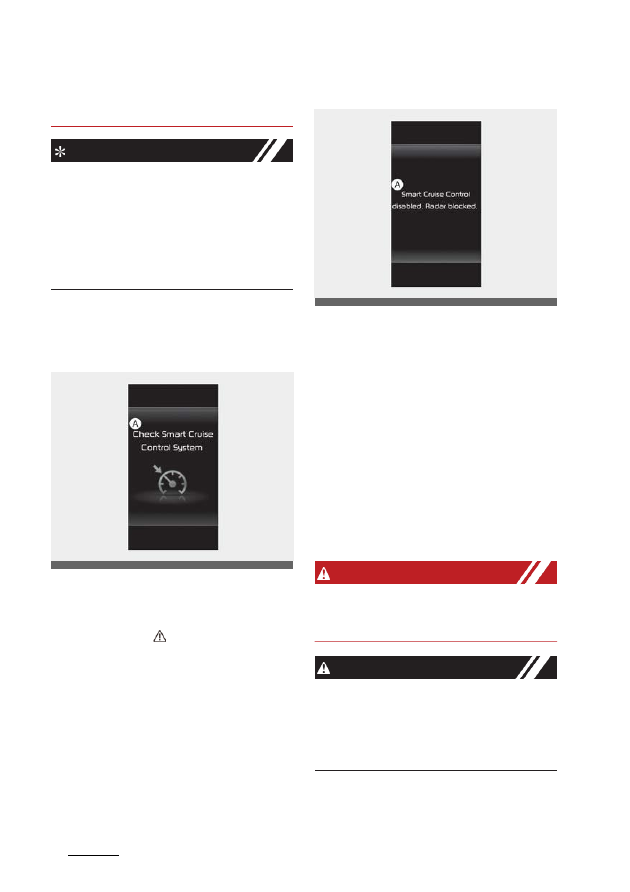
Smart Cruise Control disabled

A: SCC (Smart Cruise Control) dis

-

abled. Radar blocked

When the front radar cover or sensor is 
covered with snow, rain, or foreign 
material, it can reduce the detecting per

-

formance and temporarily limit or dis

-

able

Smart Cruise Control.

If this occurs the warning message will 
appear for a certain period of time on 
the cluster.

Smart Cruise Control will operate prop

-

erly when snow, rain or foreign material
is removed.

Always keep it clean.

W ARNING

Even though the warning message does 
not appear on the cluster, Smart Cruise
Control may not properly operate.

CAUTION

Smart Cruise Control may not properly 
operate in an area (e.g. open terrain), 
where there is nothing to detect, or 
detecting sensor is covered in foreign 
material after turning ON the vehicle.

OSK3052335N

OSK3052336N

79

6

6

Driver assistance system

Smart Cruise Control (SCC)

Limitations of Smart Cruise Con

-

trol

Smart Cruise Control may not operate 
properly, or it may operate unexpectedly 
under the following circumstances:
• The detecting sensor or the surround

-

ings are contaminated or damaged

• Washer fluid is continuously sprayed, 

or the wiper is on

• The camera lens is contaminated due 

to tinted, filmed or coated windshield, 
damaged glass, or sticky foreign 
material (sticker, bug, etc.) on the 
glass

• Moisture is not removed or frozen on 

the windshield

• The field of view of the front view 

camera is obstructed by sun glare

• Street light or light from an oncoming 

vehicle is reflected on the wet road 
surface, such as a puddle on the road

• The temperature around the front 

view camera is high or low

• An object is placed on the dashboard

The surrounding is very bright

• The surrounding is very dark, such as 

in a tunnel, etc.

• The brightness changes suddenly, for 

example when entering or exiting a
tunnel

• The brightness outside is low, and the 

headlamps are not on or are not bright

• Driving in heavy rain or snow, or thick 

fog

• Driving through steam, smoke or 

shadow

• Only part of the vehicle is detected
• The vehicle in front has no tail lights, 

tail lights are located unusually, etc.

• The brightness outside is low, and the 

tail lamps are not on or are not bright

• The rear of the front vehicle is small or 

does not look normal (for example, 
tilted, overturned, etc.)

• The front vehicle's ground clearance 

is low or high

• A vehicle suddenly cuts in front

Your vehicle is being towed

• An object reflecting off the front radar 

such as a guardrail, nearby vehicle, 
etc.

• The bumper around the front radar is

impacted, damaged or the front radar
is out of position

• The temperature around the front

radar is high or low

• The vehicle in front is made of mate

-

rial that does not reflect on the front
radar

• Driving near a highway (or motorway)

interchange or tollgate

• Driving on a slippery surface due to 

snow, water puddle, ice, etc.

• Driving on a curved road
• The vehicle in front is detected late

The vehicle in front is suddenly
blocked by an obstacle

• The vehicle in front suddenly changes 

lane or suddenly reduces speed

• The vehicle in front is bent out of 

shape

• The front vehicle's speed is fast or 

slow

• With a vehicle in front, your vehicle 

changes lane suddenly at low speed

• The vehicle in front is covered with 

snow

• Unstable driving
• You are on a roundabout and the 

vehicle in front is not detected

Driver assistance system

80

6

Smart Cruise Control (SCC)

• You are continuously driving in a cir

-

cle

• The adverse road conditions cause 

excessive vehicle vibrations while 
driving

• Your vehicle height is low or high due 

to heavy loads, abnormal tire pres

-

sure, etc.

• Driving in following places

- Driving in a parking lot
- Driving through a construction 

area, unpaved road, partial paved 
road, uneven road, speed bumps, 
etc.

- Driving on an incline road, curved 

road, etc.

- Driving through a roadside with 

trees or streetlights

- Driving through a narrow road where

trees or grass are overgrown

- There is interference by electro

-

magnetic waves, such as driving in 
an area with strong radio waves or 
electrical noise

- Driving on a curved road

• Driving through a tunnel or iron 

bridge

• Driving near areas containing metal 

substances, such as a construction 
zone, railroad, etc.

• Driving in vast areas where there are

few vehicles or structures (for exam

-

ple, desert, meadow, suburb, etc.)

- Driving through steam, smoke or

shadow

- Driving near a highway (or motor

-

way) interchange or tollgate

- Driving near areas containing metal

substances, such as a construction
zone, railroad, etc.

On curves, Smart Cruise Control may 
not detect a vehicle in the same lane, 
and may accelerate to the set speed. 
Also, vehicle speed may rapidly 
decrease when the vehicle ahead is 
detected suddenly.

Select the appropriate set speed on 
curves and apply the brake pedal or 
accelerator pedal according to the 
road and driving conditions ahead.

Your vehicle speed can be reduced 
due to a vehicle in the adjacent lane.

Check to be sure that the road condi

-

tions permit safe operation of Smart 
Cruise Control and if necessary, 
depress the brake pedal to reduce 
your driving speed in order to main

-

tain a safe distance

OSK3052170L

OSK3052169L

81

6

6

Driver assistance system

Smart Cruise Control (SCC)

• Driving on an inclined road

During uphill or downhill driving, the 
Smart Cruise Control may not detect a
moving vehicle in your lane, and
cause your vehicle to accelerate to the 
set speed. Also, vehicle speed will rap

-

idly decrease when the vehicle ahead 
is detected suddenly.

Select the appropriate set speed on 
inclines and apply the brake pedal or 
accelerator pedal according to the 
road and driving conditions ahead.

• Changing lanes

A. : Your vehicle,

B. : Lane changing vehicle
When a vehicle (B) moves into your 
lane from an adjacent lane, it cannot 
be detected by the sensor until it is in 
the sensor's detection range. Smart 
Cruise Control may not immediately 
detect the vehicle when the vehicle 
changes lanes abruptly. In this case, 
you must maintain a safe braking dis

-

tance, and if necessary, depress the 
brake pedal to reduce your driving 
speed in order to maintain a safe dis

-

tance.

OSK3052168L

OSK3052392L

Driver assistance system

82

6

Smart Cruise Control (SCC)

• Situations when detecting are limited

In the following cases, some vehicles 
in your lane cannot be detected by 
the sensor:

- Vehicles offset to one side
- Slow-moving vehicles or sudden-

decelerating vehicles

- Vehicles with higher ground clear

-

ance or vehicles carrying loads that 
stick out of the back of the vehicle

- Vehicles that has the front lifted 

dueto heavy loads

- Vehicles within approximately 2 m

(6 ft.) from your vehicle

- Oncoming vehicles

- Stopped vehicles
- Vehicles with small rear profile, 

such as trailers

- Narrow vehicles, such as bicycles

- Special vehicles

- Animals and pedestrians

In the following cases, the vehicle in 
front cannot be detected by the sen

-

sor. Always pay attention to the road 
and driving conditions and drive 
safely. If necessary, adjust your vehi

-

cle speed.

- You are steering your vehicle
- Driving on narrow or sharply 

curved roads

• When a vehicle ahead disappears at 

an intersection, your vehicle may 
accelerate.

Always pay attention to road and driv

-

ing conditions while driving.

OSK3052049L

OSK3052402L

OSK3052393L

83

6

6

Driver assistance system

Navigation-based Smart Cruise Control (NSCC)

• When a vehicle in front of you merges 

out of the lane, Smart Cruise Control 
may not immediately detect the new 
vehicle that is now in front of you.

Always pay attention to road and driv

-

ing conditions while driving.

• Always look out for pedestrians when

your vehicle is maintaining a distance
with the vehicle ahead.

Navigation-based

Smart

Cruise Control (NSCC) (if
equipped)

Navigation-based Smart Cruise Control 
can help drive at a certain speed accord

-

ing to the road conditions when driving on
highways (or motorways) by using road
information from the navigation system
while Smart Cruise Control is operating.

NOTICE

• Navigation-based Smart Cruise Con

-

trol is available only on controlled 
access road of certain highways.

*Controlled access road indicates 

roads with limited entrances and 
exits that allow uninterrupted high 
speed traffic flow. Only passenger 
cars are allowed on controlled 
access roads.

• Additional highways may be 

expanded by future navigation 
updates.

NOTICE

Navigation-based Smart Cruise Control 
operates on main roads of highways (or 
motorways), and does not operate on 
interchanges or junctions.

NOTICE

Recommend adding Warning:

“Naviga

-

tion-based Smart Cruise Control (NSCC) 
is a supplemental function and is not a
substitute for safe driving. It is the

OSK3052394L

OSK3052047L

Available highway (Controlled access road)

USA

Select Interstate Highway and

U.S.(Fed

-

eral) and State

Highways

Canada

Select Provincial and Territorial High

-

ways

Driver assistance system

84

6

Navigation-based Smart Cruise Control (NSCC)

responsibility of the driver to always 
check the speed and distance to the 
vehicle ahead. Always drive safely and 
use

caution.”

Highway Curve Zone Auto Slow

-

down

If vehicle speed is high, Highway Curve 
Zone Auto Slowdown function will tem

-

porarily decelerate your vehicle or limit 
acceleration to help you drive safely on a
curve based on the curve information 
from the navigation.

Navigation-based Smart Cruise 
Control settings

Highway Auto Speed Change

A: Driver Assistance

1 Driving Convenience
2 Highway Auto Speed Change With
the vehicle on, select Settings

Vehicle

→ Driver Assistance → High

-

way Auto Speed Change on the info

-

tainment system.

CAUTION

When the trailer is connected, Lane 
Keeping Assist automatically turns off (if 
equipped). In this case, you cannot get 
help from Forward Collision-Avoidance 
Assist. Always drive with care.

NOTICE

When there is a problem with Naviga

-

tion-based Smart Cruise Control, the 
function cannot be set from the Settings 
menu.

Navigation-based Smart Cruise 
Control operation

Operating conditions

Navigation-based Smart Cruise Control
is ready to operate if all of the following
conditions are satisfied:
• Smart Cruise Control is operating
• Driving on main roads of highways (or

motorways)

NOTICE

For more details on how to operate 
Smart Cruise Control, refer to "Smart 
Cruise Control (SCC) (if equipped)" on 
page 6-69.

Navigation-based Smart Cruise 
Control display and control

When Navigation-based Smart Cruise 
Control operates, it will be displayed on 
the cluster as follows:

OSK3052493N

85

6

6

Driver assistance system

Navigation-based Smart Cruise Control (NSCC)

Navigation-based Smart Cruise 
Control standby

If the operating conditions are satisfied, 
the white (

) symbol will appear.

Navigation-based Smart Cruise 
Control operating

If temporary deceleration is required in 
the standby state and Navigation-based 
Smart Cruise Control is operating, the 
green (

) symbol will appear on the 

cluster.

W ARNING

A: Drive carefully
The warning message will appear in the 
following circumstances:
• Navigation-based Smart Cruise Con

-

trol is not able to slow down your 
vehicle to a safe speed

NOTICE

The images and colors in the instrument 
cluster may differ depending on the 
cluster type or theme selected from the 
settings menu.

Highway Curve Zone Auto Slow

-

down

• Depending on the curve ahead on the 

highway (or motorway), the vehicle will
decelerate, and after passing the 
curve, the vehicle will accelerate to 
Smart Cruise Control set speed.

• Vehicle deceleration time may differ 

depending on the vehicle speed and 
the degree of the curve on the road. 
The higher the driving speed, deceler

-

ation will start faster.

OSK3052354N

OSK3052342N

OSK3052319L

Driver assistance system

86

6

Navigation-based Smart Cruise Control (NSCC)

Limitations

of

Navigation-based

Smart Cruise Control

Navigation-based Smart Cruise Control
may not operate properly under the fol

-

lowing circumstances:
• The navigation is not working prop

-

erly

• Speed limit and road information in 

the navigation is not updated

• Map information is not transmitted 

due to infotainment system's abnor

-

mal operation

• Speed limit and road information in 

the navigation is not updated

• The map information and the actual 

road is different because of real-time 
GPS data or map information error

• The navigation searches for a route 

while driving

• GPS signals are blocked in areas 

such as a tunnel

• A road that divides into two or more 

roads and joins again

• The driver goes off course the route 

set in the navigation

• The route to the destination is 

changed or canceled by resetting the 
navigation

• The vehicle enters a service station or 

rest area

• Android Auto or Car Play is operating

The navigation cannot detect the cur

-

rent vehicle position (for example, ele

-

vated roads including overpass
adjacent to general roads or nearby 
roads exist in a parallel way)

• The navigation is being updated while 

driving

• The navigation is being restarted 

while driving

• The speed limit of some sections 

changes according to the road situa

-

tions

• Driving on a road under construction

Driving on a road that is controlled

• There is bad weather, such as heavy 

rain, heavy snow, etc.

• Driving on a road that is sharply 

curved

1

: Set route, [2]: Branch line, [3]: Driving 

route, [4]: Main road, [5]: Curved road 
section
• When there is a difference between 

the navigation set route (branch line) 
and the driving route (main road), 
Highway Curve Zone Auto Slowdown 
function may not operate until the 
driving route is recognized as the 
main road.

• When the vehicle's driving route is 

recognized as the main road by main

-

taining the main road instead of the 
navigation set route, Highway Curve 
Zone Auto Slowdown function will 
operate. Depending on the distance to 
the curve and the current vehicle 
speed, vehicle deceleration may not be
sufficient or may decelerate rap

-

idly.

ODL3A050307

87

6

6

Driver assistance system

Navigation-based Smart Cruise Control (NSCC)

1

: Main road, [2]: Branch line, [3]: Driv

-

ing route, [4]: Set route, [5]: Curved road
section
• When there is a difference between 

the navigation route (main road) and 
the driving route (branch line), High

-

way Curve Zone Auto Slowdown func

-

tion will operate based on the curve 
information on the main road.

• When it is judged that you are driving 

out of the route by entering the high

-

way interchange or junction, Highway 
Curve Zone Auto Slowdown function 
will not operate.

1

: Driving route, [2]: Branch line, [3]: 

Curved road section, [4]: Main road
• If there is no destination set on the 

navigation, Highway Curve Zone Auto 
Slowdown function will operate based

on the curve information on the main 
road.

• Even if you depart from the main

road, Highway Curve Zone Auto Slow

-

down function may temporarily oper

-

ate due to navigation information of the
highway curve section.

W ARNING

• Navigation-based Smart Cruise Con

-

trol is not a substitute for safe driving 
practices, but a convenience function. 
Always have your eyes on the road, 
and it is the responsibility of the driver 
to avoid violating traffic laws.

• The navigation's speed limit informa

-

tion may differ from the actual speed 
limit information on the road. It is the 
driver's responsibility to check the 
speed limit on the actual driving road 
or lane.

• Navigation-based Smart Cruise Con

-

trol will automatically be canceled 
when you leave the highway (or 
motorway) main road. Always pay 
attention to road and driving condi

-

tions while driving.

• Navigation-based Smart Cruise Con

-

trol may not operate due to the exis

-

tence of leading vehicles and the 
driving conditions of the vehicle. 
Always pay attention to road and driv

-

ing conditions while driving.

• When you are towing a trailer or 

another vehicle, turn off Navigation-
based Smart Cruise Control for safety 
reasons. If you tow a European spec 
trailer, the function may be limited.

• After you pass through a tollgate on a

highway (or motorway), Navigation-
based Smart Cruise Control will oper

-

ate based on the first lane. If you enter 
one of the other lanes, Navigation-

ODL3A050305

ODL3A050306

Driver assistance system

88

6

Navigation-based Smart Cruise Control (NSCC)

based Smart Cruise Control might not 
operate properly.

• The vehicle will accelerate if the driver 

depresses the accelerator pedal while 
Navigation-based Smart Cruise Con

-

trol is operating, and the function will 
not decelerate the vehicle. However, if 
the accelerator pedal is depressed 
insufficiently, the vehicle may deceler

-

ate.

• If the driver accelerates and releases 

the accelerator pedal while Naviga

-

tion-based Smart Cruise Control is 
operating, the vehicle may not decel

-

erate sufficiently or may rapidly 
decelerate to a safe speed.

• If the curve is too large or too small, 

Navigation-based Smart Cruise Con

-

trol may not operate.

NOTICE

• A time gap could occur between the 

navigation's guidance and when Navi

-

gation-based Smart Cruise Control 
operation starts and ends.

• The speed information on the cluster 

and navigation may differ.

• Even if you are driving at a speed 

lower than Smart Cruise Control set 
speed, acceleration may be limited by 
the curve sections ahead.

• If Navigation-based Smart Cruise 

Control is operating while leaving the 
main road to enter an interchange, 
junction, rest area, etc., the function 
may operate for a certain period of 
time.

• Deceleration by Navigation-based 

Smart Cruise Control may feel it is not 
sufficient due to road conditions such 
as uneven road surfaces, narrow 
lanes, etc.

This device complies with Part 15
of the FCC rules

Operation is subject to the following
three conditions:

1. This device may not cause harmful

interference, and

2. This device must accept any interfer

-

ence received, including interference
that may cause undesired operation.

3. Changes or modifications not 

expressly approved by the party 
responsible for compliance could void 
the user's authority to operate the 
device.

Radio frequency radiation expo

-

sure information:

This equipment complies with FCC radi

-

ation exposure limits set forth for an 
uncontrolled environment. This equip

-

ment should be installed and operated 
with minimum distance of 8 inches (20 
cm) between the radiator (antenna) and 
your body. This transmitter must not be 
colocated or operating in conjunction 
with any other antenna or transmitter.

89

6

6

Driver assistance system

Lane Following Assist (LFA)

Lane Following Assist (LFA) (if
equipped)

Lane Following Assist is designed to help
detect lane markings and/or vehicles on
the road, and assists the driver's steering
to help center the vehicle in the lane.

Detecting sensor

Front view camera

The front view camera is used as a
detecting sensor to detect lane markings 
and front vehicles.

Refer to the picture above for the detailed 
location of the detecting sensor.

CAUTION

For more details on the precautions of 
the front view camera, refer to "Forward 
Collision-Avoidance Assist (FCA) (Front 
Camera Only) (if equipped)" on page 6-
4.

Lane Following Assist settings

Warning methods

A: Driver Assistance

1 Warning Volume

2 Driving Safety Priority

3 High

4 Medium

5 Low
With the vehicle on, select Settings

Driver Assistance

→ Warning Volume

on the instrument cluster or Settings

Vehicle

→ Driver Assistance → Warn

-

ing Methods on the infotainment sys

-

tem to change the Warning Sound.
• Warning Volume: You can adjust the 

Warning Volume.

OSK3052374L

OSK3052320L

OMQ4A052388

Driver assistance system

90

6

Lane Following Assist (LFA)

• Driving Safety Priority: For safe driv

-

ing, the audio volume will temporarily 
decrease to warn the driver with the 
audible warning.

CAUTION

• Ensure that Warning Methods you 

have set may apply to the Warning 
Methods of other Driver Assistance 
systems.

• Warning Methods will maintain its last 

setting even if the vehicle is restarted.

• The setting menu may not be avail

-

able for your vehicle depending on 
the vehicle features and specifica

-

tions.

Lane Following Assist operation

Turning Lane Following Assist 
On/Off

With the vehicle on, shortly press the 
Lane Driving Assist button located on 
the steering wheel to turn on Lane Fol

-

lowing Assist. The grey or green (

)

indicator light will appear on the cluster.

Press the button again to turn off the 
function.

Lane Following Assist

If the vehicle ahead and/or both lane 
markings are detected and The vehicle 
speed is below 100 mph (160 km/h), the 
green (

) indicator light appears on the 

cluster, and Lane Following Assist helps 
center the vehicle in the lane by assist

-

ing the steering wheel.

CAUTION

When the steering wheel is not assisted, 
the white (

) indicator light blinks and 

change to grey.

Hands-off warning

A: Keep hands on steering wheel
If the driver takes their hands off the 
steering wheel for several seconds, the

OSK3052283L

OSK3052345N

OSK3052304N

91

6

6

Driver assistance system

Lane Following Assist (LFA)

warning message will appear and an 
audible warning will sound in stages.
• First stage: Warning message
• Second stage: Warning message

(red steering wheel) and audible
warning

A: LFA (Lane Following Assist) can

-

celled

If the driver still does not have their hands
on the steering wheel after the hands-off
warning the warning message will appear
and Lane Following Assist will be
automatically canceled.

W ARNING

• The steering wheel may not be 

assisted if the steering wheel is held 
very tight or the steering wheel is 
steered over a certain degree.

• Lane Following Assist does not oper

-

ate at all times. It is the responsibility of
the driver to safely steer the vehicle 
and to maintain the vehicle in its lane.

• The hands–off warning message may 

appear late depending on road condi

-

tions. Always have your hands on the 
steering wheel while driving.

• If the steering wheel is held very 

lightly the hands

–off warning mes

-

sage may appear because Lane Fol

-

lowing Assist may not recognize that

the driver has their hands on the 
steering wheel.

• If you attach objects to the steering 

wheel, the hands-off warning may not 
work properly.

NOTICE

• When both lane markings are 

detected, the lane lines on the cluster 
will change from grey to white.

Lane undetected

Lane detected

• The images and colors in the instru

-

ment cluster may differ depending on 
the cluster type or theme selected 
from the settings menu.

• If lane markings are not detected, 

steering wheel control by Lane Fol

-

OSK3052344N

OSK3052345L

OSK3052345N

Driver assistance system

92

6

Highway Driving Assist (HDA)

lowing Assist can be limited depend

-

ing on whether a vehicle is in front or
the driving conditions of the vehicle.

• Even though the steering is assisted 

by Lane Following Assist, the driver 
may control the steering wheel.

• The steering wheel may feel heavier 

or lighter when the steering wheel is 
assisted by Lane Following Assist than 
when it is not.

Lane Following Assist malfunc

-

tion and limitations

Lane Following Assist malfunc

-

tion

A: Check LFA (Lane Following Assist)
system

When Lane Following Assist is not work

-

ing properly, the warning message will 
appear and the master warning light (

)

will appear on the cluster.

If this occurs, have Lane Following Assist 
inspected by an authorized Kia dealer.

Limitations of Lane Following 
Assist

For more details on Lane Following
Assist limitations, refer to "Lane Keeping 
Assist (LKA) (if equipped)" on page 6-30.

Highway Driving Assist (HDA) 
(if equipped)

Highway Driving Assist is designed to 
help detect vehicles and lanes ahead, 
and help maintain distance from the 
vehicle ahead, maintain the set speed, 
help center the vehicle in the lane while 
driving on the highway (or motorway).

NOTICE

• Highway Driving Assist is available 

only on controlled access road of cer

-

tain highways.

*Controlled access road indicates 

roads with limited entrances and 
exits that allow uninterrupted high 
speed traffic flow. Only passenger 
cars are allowed on controlled 
access roads.

• Additional highways may be 

expanded by future navigation 
updates.

• Highway Driving Assist operates on 

main roads of highways (or motor

-

OSK3052346N

Available highway (Controlled access road)

USA

Select Interstate Highway and

U.S.(Fed

-

eral) and State

Highways

Canada

Select Provincial and Territorial High

-

ways

OSK3052496N

93

6

6

Driver assistance system

Highway Driving Assist (HDA)

ways), and does not operate on inter

-

changes or junctions.

Detecting sensor

Front view camera

Front radar

Refer to the picture above for the 
detailed location of the detecting sen

-

sors.

CAUTION

For more details on the precautions of 
the detecting sensors, refer to "Forward 
Collision-Avoidance Assist (FCA) (Sen

-

sor Fusion) (if equipped)" on page 6-16.

Highway Driving Assist settings

Highway Driving Assist

A: Driver Assistance

1 Driving Convenience

2 Highway Driving Assist
With the vehicle on, select Settings

Driver Assistance

→ Driving Conve

-

nience

→ Highway Driving Assist on 

the instrument cluster or Settings

Vehicle

→ Driver Assistance → Driving

Convenience

→ Highway Driving

Assist on the infotainment system.

If Highway Driving Assist is selected, it 
helps maintain distance from the vehicle 
ahead, maintain the set speed, and
helps center the vehicle in the lane.

W ARNING

For your safety, change the Settings 
after parking the vehicle at a safe loca

-

tion.

NOTICE

• If there is a problem with the func

-

tions, the settings cannot be changed. 
Have the function be inspected by an 
authorized Kia dealer.

OSK3052374L

OSK3052014L

OSK3052494N

Driver assistance system

94

6

Highway Driving Assist (HDA)

• If the vehicle is restarted, the func

-

tions will maintain the last setting.

Warning methods

A: Driver Assistance

1 Warning Volume

2 Driving Safety Priority

3 High

4 Medium

5 Low
With the vehicle on, select Settings

Driver Assistance

→ Warning Volume

on the instrument cluster or Settings

Vehicle

→ Driver Assistance → Warn

-

ing Methods on the infotainment sys

-

tem to change the Warning Sound.

• Warning Volume: You can adjust the 

Warning Volume.

• Driving Safety Priority: For safe driv

-

ing, the audio volume will temporarily 
decrease to warn the driver with the 
audible warning.

CAUTION

• Ensure that Warning Methods you 

have set may apply to the Warning 
Methods of other Driver Assistance 
systems.

• Warning Methods will maintain its last 

setting even if the vehicle is restarted.

• The setting menu may not be avail

-

able for your vehicle depending on 
the vehicle features and specifica

-

tions.

Highway Driving Assist operation 

Displaying operating status

You can see the status of the Highway 
Driving Assist operation in the Driving 
Assist view on the cluster. Refer to "LCD 
Display Modes" on page 4-46.

Operating State

OSK3052320L

OMQ4A052388

OSK3052497N

95

6

6

Driver assistance system

Highway Driving Assist (HDA)

Standby State

Highway Driving Assist will be displayed
as below depending on the status of the
function.

1 Highway Driving Assist indicator, 

whether there is a vehicle ahead and 
the selected distance level are dis

-

played.
• Highway Driving Assist indicator

- Green : Operating state

- Grey : Standby state
- White blink: Accelerator 

depressed state

2 Set speed
3 Whether there is a vehicle ahead and 

the selected headway

4 Whether the lane is detected or not

NOTICE

• For more details on the display refer 

to "Smart Cruise Control (SCC) (if 
equipped)" on page 6-69.

• For more details on the display, refer 

to "Lane Following Assist (LFA) (if 
equipped)" on page 6-89.

• The images and colors in the instru

-

ment cluster may differ depending on 
the cluster type or theme selected 
from the settings menu.

Highway Driving Assist operating 

Highway Driving Assist operates when:

When driving on available road, press
Drive Assist button to turn on High

-

way Driving Assist.

• When entering the main roads of 

highways (or motorways) while Smart 
Cruise Control is operating, Driving 
Assist will not turn on if Lane Follow

-

ing Assist is turned off.

Restarting after stopping

A: Use switch or pedal to accelerate
When Highway Driving Assist is operat

-

ing, your vehicle will stop if the vehicle 
ahead of you stops. Also, if the vehicle 
ahead of you starts moving within 30 
seconds after the stop, your vehicle will 
start as well. In addition, after the vehicle 
has stopped and 30 seconds have 
passed, the message will appear on the 
cluster. Depress the accelerator pedal or 
operate the + switch, - switch or
switch to start driving.

OSK3052499N

OSK3052339L

Driver assistance system

96

6

Highway Driving Assist (HDA)

Hands-off warning

A: Keep hands on steering wheel
If the driver takes their hands off the 
steering wheel for several seconds, the 
'Keep hands on the steering wheel' 
warning message will appear and an 
audible warning will sound in stages.
• First stage: Warning message
• Second stage: Warning message

(red steering wheel) and audible
warning

A: Highway Driving Assist (HDA) sys

-

tem cancelled

If the driver still does not have their 
hands on the steering wheel after the 
hands-off warning, warning message 
will appear and Highway Driving Assist 
will be automatically canceled.

Driving speed limit

A: Driver's grasp not detected. Driving
speed will be limited

When Highway Driving Assist is can

-

celed by the hands-off warning, The
driving speed will be limited.

While Driving Speed Limit function is 
operating, the warning message will 
appear on the cluster, and an audible 
warning will sound continuously.

Highway Driving Assist standby

When the Smart Cruise Control is tem

-

porarily canceled while Highway Driving 
Assist is operating, Highway Driving 
Assist will be in the standby state. At this 
time, Lane Following Assist will operate 
properly.

NOTICE

• Driving Speed Limit helps you drive 

below 40 mph (60 km/h). At this time, 
the vehicle decelerates due to the 
vehicle ahead. After the vehicle has 
decelerated, it cannot automatically 
accelerate.

• Driving Speed Limit will cancel in the 

following circumstances:

- When the driver grabs the steering 

wheel again

OSK3052304N

OSK3052347N

OSK3052501N

97

6

6

Driver assistance system

Highway Driving Assist (HDA)

- When the driver turns on Lane Fol

-

lowing Assist by pressing the Lane
Driving Assist button

- When (+), (-), (

) switch or (

) but

-

ton is operated, or the accelerator 
pedal or the brake pedal is 
depressed

Highway Driving Assist malfunc

-

tion and limitations

Highway Driving Assist malfunc

-

tion

A: Check HDA (Motorway Driving
Assist) system

When Highway Driving Assist is not 
working properly, the warning message 
will appear, and the (

) warning light

will appear on the cluster. Have Highway 
Driving Assist be inspected by an autho

-

rized Kia dealer.

W ARNING

• The driver is responsible for con

-

trolling the vehicle for safe driving.

• Always have your hands on the steer

-

ing wheel while driving.

• Highway Driving Assist is a supple

-

mental function that assists the driver 
in driving the vehicle and is not a
complete autonomous driving system.

Always check road conditions, and if 
necessary, take appropriate actions to 
drive safely.

• Always have your eyes on the road, 

and it is the responsibility of the driver 
to avoid violating traffic laws. The 
vehicle manufacturer is not responsi

-

ble for any traffic violation or acci

-

dents caused by the driver.

• Highway Driving Assist may not be 

able to recognize all traffic situations. 
Highway Driving Assist may not 
detect possible collisions due to lim

-

itations of the function. Always be 
aware of the limitations of the func

-

tion. Obstacles such as vehicles, bicy

-

cles, pedestrians, or unspecified 
objects or structures such as guard

-

rails, tollgate, etc., that may collide 
with the vehicle may not be detected.

• Highway Driving Assist will turn off 

automatically under the following sit

-

uations:

- Driving on roads that Highway 

Driving Assist does not operate, 
such as a rest area, intersection, 
junction, etc.

- The navigation does not operate 

properly such as when the naviga

-

tion is being updated or restarted

• Highway Driving Assist may inadver

-

tently operate or turn off depending
on road conditions (navigation infor

-

mation) and surroundings.

• Lane Following Assist function may be 

temporarily disabled when the front 
view camera cannot detect lanes 
properly or the hands-off warning is 
on.

• You may not hear the warning sound 

of Highway Driving Assist if the sur

-

rounding is noisy.

OSK3052348N

Driver assistance system

98

6

Highway Driving Assist (HDA)

• If the vehicle is driven at high speed 

above a certain speed at a curve, your 
vehicle may drive to one side or may 
depart from the driving lane.

• When you are towing a trailer or 

another vehicle, turn off Highway 
Driving Assist for safety reasons.

• The hands–off warning message may 

appear early or late depending on how
the steering wheel is held or road 
conditions. Always have your hands 
on the steering wheel while driving.

• For your safety, please read the 

owner's manual before using the 
Highway Driving Assist.

• Highway Driving Assist will not oper

-

ate when the vehicle is started, or 
when the detecting sensors or naviga

-

tion is being initialized.

Limitations of Highway Driving 
Assist

Highway Driving Assist may not operate
properly, or it may not operate under the
following circumstances:
• The map information and the actual 

road is different because the naviga

-

tion is not updated

• The map information and the actual 

road is different because of real-time 
GPS data or map information error

• The infotainment system is over

-

loaded by simultaneously performing 
functions such as route search, video 
playback, voice recognition, etc.

• GPS signals are blocked in areas 

such as a tunnel

• The driver goes off course, or reset

-

ting the navigation route by changing 
the destination (including route 
change according to real-time road

traffic information), or canceling the 
route to the destination

• The vehicle enters a service station or 

rest area

• Android Auto or Car Play is operating

The navigation cannot detect the cur

-

rent vehicle position (for example, ele

-

vated roads including overpass 
adjacent to general roads or nearby 
roads exist in a parallel way)

NOTICE

For more details on the limitations of the 
front view camera and front radar, refer 
to "Forward Collision-Avoidance Assist 
(FCA) (Sensor Fusion) (if equipped)" on 
page 6-16.

This device complies with Part 15
of the FCC rules.

Operation is subject to the following
three conditions:

1. This device may not cause harmful

interference, and

2. This device must accept any interfer

-

ence received, including interference
that may cause undesired operation.

3. Changes or modifications not 

expressly approved by the party 
responsible for compliance could void 
the user's authority to operate the 
device.

99

6

6

Driver assistance system

Rear View Monitor (RVM)

Radio frequency radiation expo

-

sure information:

This equipment complies with FCC radi

-

ation exposure limits set forth for an 
uncontrolled environment. This equip

-

ment should be installed and operated 
with minimum distance of 8 inches (20 
cm) between the radiator (antenna) and 
your body. This transmitter must not be 
colocated or operating in conjunction 
with any other antenna or transmitter.

Rear View Monitor (RVM)

Rear View Monitor shows the area 
behind the vehicle to assist you when 
parking or backing up.

Detecting sensor

Rear view camera

Refer to the picture above for the detailed
location of the detecting sensor.

Rear View Monitor settings

Warning methods

A: Driver Assistance

1 Warning Methods

2 Parking Safety Priority

OSK3042455N

OMQ4A052388

Driver assistance system

100

6

Rear View Monitor (RVM)

With the vehicle on, select Settings

Vehicle

→ Driver Assistance → Warn

-

ing Methods on the infotainment sys

-

tem to change the Warning Sound.
• Parking Safety Priority: For safe 

parking, the audio volume will tempo

-

rarily decrease while Rear View Moni

-

tor is operating.

CAUTION

• The setting menu may not be avail

-

able for your vehicle depending on 
the vehicle features and specifica

-

tions.

Camera settings

A: Camera Settings

1 Display Contents

2 Display Settings (if equipped)
You can change Rear View Monitor 'Dis

-

play Contents' by touching the setup 
icon ( ) on the screen while Rear View 
Monitor is operating, or selecting Driver
assistance

→ Parking safety → Cam

-

era settings from the Settings menu 
while the vehicle is on.
• Display Contents: To change the set

-

tings of Extended Rear View Monitor 
and Rear View Parking Guide Lines.

• Display Settings: To change the 

screen's brightness and contrast.

NOTICE

The settings menu may not be depend

-

ing on the specifications of the vehicle 
specifications.

Extended Rear View Monitor

If Extended Rear View Monitor is 
selected, the Rear View keeps displaying 
when shifting from R to N/D.

Rear View Parking Guide

Rear View Parking Guide Lines

If Rear View Parking Guide Lines is 
selected, the rear view parking guide 
lines will be displayed at the left side of 
the infotainment system screen.

NOTICE

The horizontal guideline shows the dis

-

tance of 0.5 m (1.6 ft.), 1 m (3.3 ft.) and
2.3 m (7.6 ft.) from the vehicle.

OSK3052360L

OSK3052368L

101

6

6

Driver assistance system

Rear View Monitor (RVM)

Top View Parking Guide Lines

If Rear View Parking Guide Lines is 
selected, the top view parking guide 
lines will be displayed at the left side of 
the infotainment system screen.

NOTICE

The horizontal scale of rear top view 
paring guide indicates the liftgate open

-

ing distance, 1.5 m from the vehicle.

Extended Rear View Monitor

If Extended Rear View Monitor is 
selected, the Rear View keeps displaying 
when shifting from R to N/D.

Rear View Monitor operation

Parking/View button (if
equipped)

Press the Parking/View button (1) to turn 
on Rear View Monitor.

Press the button again to turn off the 
function.

Rear view function

Operating conditions

Rear View Monitor will turn on when the 
following conditions are satisfied:
• Shifting the gear to R (Reverse).
• Pressing the Parking/View button (1) 

while P (Park) gear position is selected

• Pressing the View icon with the Rear 

top view on the screen

Off conditions

Rear View Monitor will turn off when the 
following conditions are satisfied:
• Pressing the Parking/View button (1) 

again while P (Park) gear position is 
selected. with the rear view on the 
screen.

• Changing the gear from R (Reverse) 

to P (Park).

NOTICE

Rear View Monitor will not turn off when 
the vehicle is in R (Reverse).

OSK3052364L

OSK3052418N

OSK3052368L

Driver assistance system

102

6

Rear View Monitor (RVM)

Rear View Monitor operation

Parking/View button (if
equipped)

Press the Parking/View button (1) to turn 
on Rear View Monitor.

Press the button again to turn off the 
function.

Rear view function

Operating conditions

Rear View Monitor will turn on when the 
following conditions are satisfied:
• Shifting the gear to R (Reverse).
• Pressing the Parking/View button (1) 

while P (Park) gear position is selected

• Pressing the View icon with the Rear 

top view on the screen

Off conditions

Rear View Monitor will turn off when the 
following conditions are satisfied:
• Pressing the Parking/View button (1) 

again while P (Park) gear position is 
selected. with the rear view on the 
screen.

• Changing the gear from R (Reverse) 

to P (Park).

NOTICE

Rear View Monitor will not turn off when 
the vehicle is in R (Reverse).

Extended Rear View Monitor

Extended Rear View Monitor function 
maintains the rear view of the vehicle 
when shifting the gear from R (Reverse) 
to N (Neutral) or D (Drive) to help you 
park safely.

Operating conditions

Rear View Monitor will maintain when 
the following conditions are satisfied:
• Shifting the gear from R (Reverse) to 

N (Neutral) or D (Drive).

• The vehicle speed is below approxi

-

mately 6 mph (10 km/h).

Off conditions

Extended Rear View Monitor function will
turn off when one the following con

-

ditions are satisfied:
• The vehicle speed is above approxi

-

mately 6 mph (10 km/h).

• Pressing the Parking/View button (1).

Shifting the gear to P (Park).

OSK3052418N

OSK3052368L

103

6

6

Driver assistance system

Rear View Monitor (RVM)

Rear Top View

Rear Top View shows the rear top view 
of your vehicle when parking for you to 
check the distance between an object 
and behind the vehicle.

Rear Top View will turn on under the fol

-

lowing conditions:
• The gear is shifted to R (Reverse)

and the icon is selected among the
view buttons.

• The Parking/View button is pressed, 

while the gear is in P (Park), N (Neu

-

tral) or D (Drive), and vehicle speed is 
6 mph (10 km/h) or less.

Rear Top View

Rear Top View shows the rear top view 
of your vehicle when parking for you to

check the distance between an object 
and behind the vehicle.

Rear Top View will turn on under the fol

-

lowing conditions:
• The gear is shifted to R (Reverse)

and the icon is selected among the
view buttons.

• The Parking/View button is pressed, 

while the gear is in P (Park), N (Neu

-

tral) or D (Drive), and vehicle speed is 
6 mph (10 km/h) or less.

Rear View Monitor malfunction 
and limitations

Rear View Monitor malfunction

When Rear View Monitor is not working 
properly, or the screen flickers, or the 
camera image does not display properly, 
Visit an authorized Kia dealer.

Limitations of Rear View Monitor

When the vehicle is stopped for a long 
time in winter or when the vehicle is 
parked in an indoor parking lot, the 
exhaust fumes may temporarily blur the 
image.

W ARNING

• The rear view camera does not cover 

the complete area behind the vehicle. 
The driver should always check the 
rear area directly through the inside 
and outside rearview mirror before 
parking or backing up.

• The image shown on the screen may 

differ from the actual distance of the 
object. Make sure to directly check the 
vehicle's surroundings for safety.

• If the camera lens is covered with for

-

eign material, the Rear View Monitor 
may not operate normally. Always 
keep the camera lens clean. However, 
do not use chemical solvents such as 
strong detergents containing high

OSK3052364L

OSK3052364L

Driver assistance system

104

6

Rear Cross-Traffic Collision-Avoidance Assist (RCCA)

alkaline or volatile organic solvents 
(gasoline, acetone etc.). This may 
damage the camera lens.

Rear Cross-Traffic Collision-
Avoidance Assist (RCCA) (if
equipped)

Rear Cross-Traffic Collision-Avoidance 
Assist is designed to help detect vehicles 
approaching from the left and right side 
while your vehicle is reversing, and warn 
the driver that a collision is imminent with 
a warning message and an audible 
warning. Also, braking is assisted to help 
prevent collision.

A.

: Rear Cross-Traffic Collision Warning 

operating range

B.

: Rear Cross-Traffic Collision-Avoid

-

ance Assist operating range

CAUTION

Warning timing may vary depending on 
vehicle speed of the approaching vehi

-

cle.

OSK3052395L

105

6

6

Driver assistance system

Rear Cross-Traffic Collision-Avoidance Assist (RCCA)

Detecting sensor

Rear corner radar

Refer to the picture above for the 
detailed location of the detecting sen

-

sors.

NOTICE

For more details on the precautions of 
the rear corner radar, refer to "Blind- Spot
Collision-Avoidance Assist (BCA) (if 
equipped)" on page 6-36.

Rear Cross-Traffic Collision-
Avoidance Assist settings

Rear Cross-Traffic Safety

A: Driver Assistance

1 Parking Safety

2 Rear Cross-Traffic Safety
With the vehicle on, select Settings

→ 

Driver Assistance

→ Parking Safety →

Rear Cross-Traffic Safety on the instru

-

ment cluster or Settings

→ Vehicle →

Driver Assistance

→ Parking Safety →

Rear Cross-Traffic Safety on the info

-

tainment system screen to turn on Rear 
Cross-Traffic Collision-Avoidance Assist.

W ARNING

When the vehicle is restarted, Rear 
Cross-Traffic Collision-Avoidance Assist 
will always turn on. However, if Rear
Cross-Traffic Safety is deselected after 
the vehicle is restarted, the driver should 
always be aware of the surroundings 
and drive safely.

NOTICE

Rear Cross Safety settings include
'Rear Cross-Traffic Collision-Warning'
and 'Rear Cross-Traffic Collision-
Avoidance Assist'.

OSK3052028L

OSK3052349N

OSK3052350N

Driver assistance system

106

6

Rear Cross-Traffic Collision-Avoidance Assist (RCCA)

NOTICE

If the vehicle is restarted, Warning Vol

-

ume will maintain the last setting.

Warning methods

A: Driver Assistance

1 Warning Methods

2 Parking Safety Priority
With the vehicle on, select Settings

Vehicle

→ Driver Assistance → Warn

-

ing Methods on the infotainment sys

-

tem to change the Warning Sound.
• Parking Safety Priority: For safe 

parking, the audio volume will tempo

-

rarily decrease while Rear View Moni

-

tor is operating.

CAUTION

• Ensure that Warning Methods you 

have set may apply to the Warning 
Methods of other Driver Assistance 
systems.

• Warning Methods will maintain its last 

setting even if the vehicle is restarted.

• The setting menu may not be avail

-

able for your vehicle depending on 
the vehicle features and specifica

-

tions.

Rear Cross-Traffic Collision-
Avoidance Assist operation

Rear Cross-Traffic Collision-Avoidance
Assist will warn and control the vehicle
depending on collision risk level:

'Collision warning', 'Emergency braking'
and 'Stopping vehicle and ending brake
control'.

Collision warning

OMQ4A052388

OSK3052366L

OSK3052351L

107

6

6

Driver assistance system

Rear Cross-Traffic Collision-Avoidance Assist (RCCA)

A: Collision warning
• To warn the driver of an approaching

vehicle from the rear left/right side of
your vehicle, the warning light on the
outside rearview mirror will blink and a
warning will appear on the cluster.

At the same time, an audible warning
will sound. If the Rear View Monitor is
operating, a warning will also appear
on the infotainment system screen.

• Rear Cross-Traffic Collision-Avoid

-

ance Assist will operate when all the 
following conditions are satisfied:

- The gear is shifted to R (Reverse)
- Vehicle speed is below 5 mph (8 

km/h)

- The approaching vehicle is within 

approximately 82 ft. (25 m) from 
the left and right side of your vehi

-

cle

- The speed of the vehicle approach

-

ing from the left and right is above 3
mph (5 km/h)

NOTICE

• If the operating conditions are satis

-

fied, there will be a warning whenever 
the vehicle approaches from the left or
right side even though your vehicle 
speed is 0 mph (0 km/h).

• The images and colors in the cluster 

may differ depending on the cluster 
type or theme selected from the clus

-

ter.

Emergency braking

A: Emergency Braking

OSK3052370L

OSK3052366L

OSK3052306N

OSK3052370L

Driver assistance system

108

6

Rear Cross-Traffic Collision-Avoidance Assist (RCCA)

• To warn the driver of an approaching 

vehicle from the rear left/right side of 
your vehicle, the warning light on the 
outside rearview mirror will blink and a
warning message will appear on the 
cluster. At the same time, an audible 
warning will sound. A warning will also 
appear on the infotainment system 
screen.

• Emergency braking will be assisted to

help prevent collision with approach

-

ing vehicles from the left and right.

• Rear Cross-Traffic Collision-Avoid

-

ance Assist will operate when all the 
following conditions are satisfied:

- The gear is shifted to R (Reverse)
- Vehicle speed is below 5 mph (8 

km/h)

- The approaching vehicle is within 

approximately 5 ft. (1.5 m) from the 
left and right side of your vehicle

- The speed of the vehicle approach

-

ing from the left and right is above 3
mph (5 km/h)

W ARNING

Brake control ends when the conditions
of the approaching vehicle from the rear
left or right side are as below:
• The approaching vehicle is out of the 

detecting range

• The approaching vehicle passes 

behind your vehicle

• The approaching vehicle does not 

drive toward your vehicle

• The approaching vehicle speed slows 

down

• The driver depresses the brake pedal 

with sufficient power

Stopping vehicle and ending 
brake control

A: Drive carefully
• When the vehicle is stopped due to 

emergency braking, the warning mes

-

sage will appear on the cluster.

• Brake control will end after the vehicle 

is stopped by emergency braking for 
approximately 2 seconds.

• During emergency braking, braking 

control by Rear Cross-Traffic Colli

-

sion-Avoidance Assist will automati

-

cally cancel when the driver 
excessively depresses the brake 
pedal.

W ARNING

• For your safety, change the Settings 

after parking the vehicle at a safe 
location.

• If any other function's warning mes

-

sage is displayed or audible warning 
is generated, Rear Cross-Traffic Colli

-

sion-Avoidance Assist's warning mes

-

sage may not be displayed and 
audible warning may not be gener

-

ated.

• You may not hear the warning sound

of Rear Cross-Traffic Collision-Avoid

-

ance Assist if the surrounding is noisy.

OSK3052319L

109

6

6

Driver assistance system

Rear Cross-Traffic Collision-Avoidance Assist (RCCA)

• Rear Cross-Traffic Collision-Avoid

-

ance Assist may not operate if the 
driver applies the brake pedal to avoid 
collision.

• During Rear Cross-Traffic Collision-

Avoidance Assist operation, the vehi

-

cle may stop suddenly injuring pas

-

sengers and shifting loose objects. 
Always have the seat belt on and keep 
loose objects secured.

• Even if there is a problem with Rear 

Cross-Traffic Collision-Avoidance 
Assist, the vehicle's basic braking per

-

formance will operate properly.

W ARNING

• When Rear Cross-Traffic Collision-

Avoidance Assist is operating, braking 
control by function will automatically 
cancel when the driver excessively 
depresses the accelerator pedal.

• Rear Cross-Traffic Collision-Avoid

-

ance Assist does not operate in all sit

-

uations or cannot avoid all collisions.

• Rear Cross-Traffic Collision-Avoid

-

ance Assist may warn the driver late or
may not warn the driver depending on
the road and driving conditions.

• The driver should hold the responsi

-

bility to control the vehicle. Do not 
solely depend on Rear Cross-Traffic 
Collision-Avoidance Assist. Rather, 
maintain a safe braking distance, and 
if necessary, depress the brake pedal 
to reduce driving speed or to stop the 
vehicle.

• Never deliberately operate Rear 

Cross-Traffic Collision-Avoidance 
Assist on people, animal, objects, etc. 
It may cause serious injury or death.

W ARNING

The brake control may not operate 
properly depending on the status of ESC 
(Electronic Stability Control).

There will only be a warning when:
• The ESC (Electronic Stability

Control) warning light is on

• ESC (Electronic Stability Control)

is engaged in a different function

NOTICE

• If braking is assisted by Rear Cross-

Traffic Collision-Avoidance Assist, the 
driver must immediately depress the 
brake pedal and check vehicle sur

-

roundings.

• After shifting the gear to R (Reverse), 

braking control will operate once for 
left and right vehicle approach.

Rear Cross-Traffic Collision-
Avoidance Assist malfunction 
and limitations

Rear Cross-Traffic Collision-
Avoidance Assist malfunction

A: Check blind-spot safety systems
When Rear Cross-Traffic Collision-
Avoidance Assist is not working prop

-

OSK3052307N


Content      ..     9      10      11      12     ..