Scion tC. Service Manual - part 7
 

  Index      Manuals     Scion tC. Service Manual


Search            copyright infringement  


Content      ..     5      6      7      8     ..


Scion tC. Service Manual - part 7


97

1

Be
fo

re driving

tC_OM_OM21056U_(U)

1-5. Refueling

Opening the fuel tank cap

Perform the following steps to open the fuel tank cap:

Before refueling the vehicle
● Vehicles without a smart key system

Turn the engine switch to the “LOCK” position and ensure that
all the doors and windows are closed.

● Vehicles with a smart key system

Turn the “ENGINE START STOP” switch off and ensure that
all the doors and windows are closed.

● Confirm the type of fuel. (P. 441)

Opening the fuel tank cap

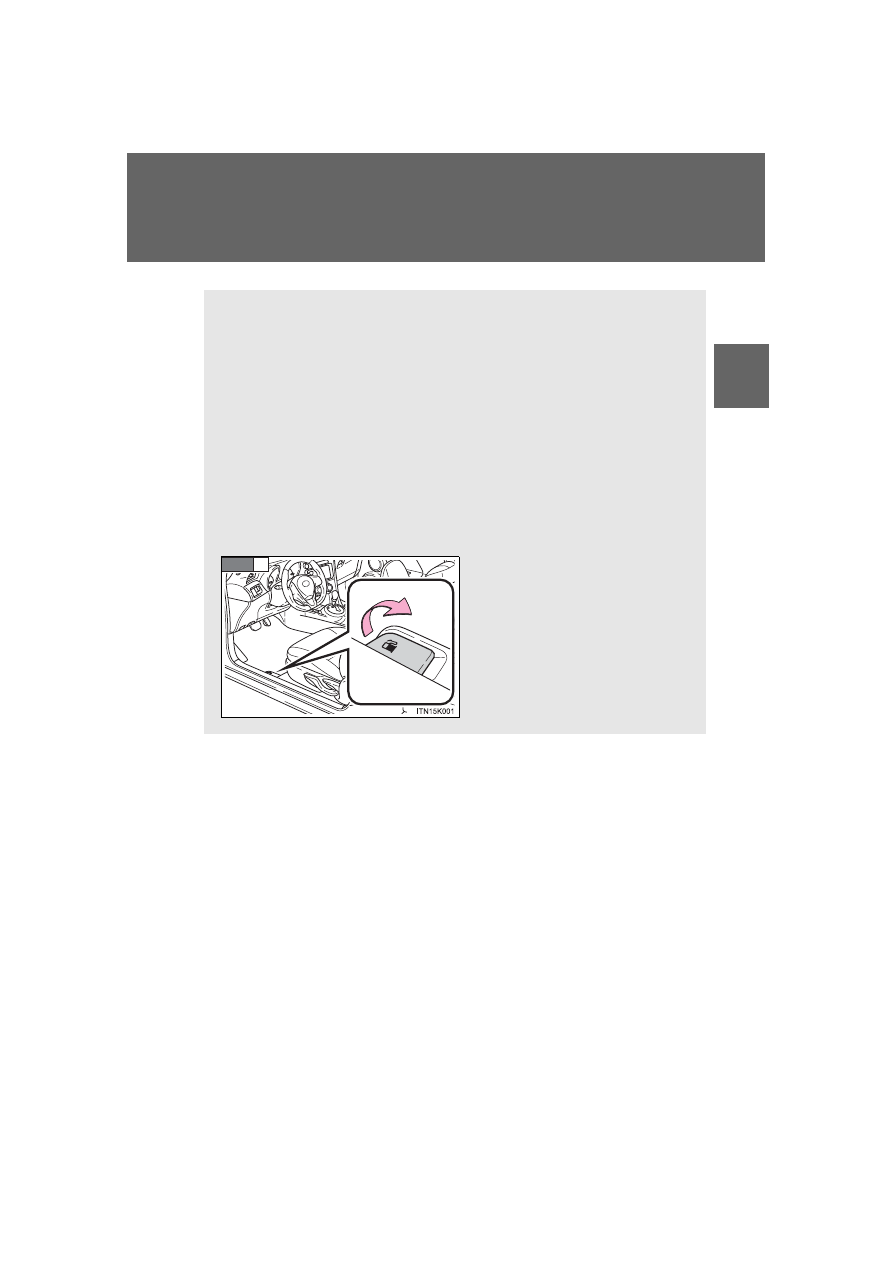
Pull up the opener to open the
fuel filler door.

STEP 

-------------------------------------------------------------------------------------------------------------------------------------------------------------

98

1-5. Refueling

tC_OM_OM21056U_(U)

Turn the fuel tank cap slowly
to open.

Hang the fuel tank cap on the
back of the fuel filler door.

STEP 

STEP 

-------------------------------------------------------------------------------------------------------------------------------------------------------------

99

1-5. Refueling

1

Be
fo

re driving

tC_OM_OM21056U_(U)

Closing the fuel tank cap

After refueling, turn the fuel tank
cap until you hear a click. Once
the cap is released, it will turn
slightly in the opposite direction.

Fuel types

P. 441

Fuel tank opening for unleaded gasoline

To help prevent incorrect fueling, your vehicle has a fuel tank opening that
only accommodates the special nozzle on unleaded fuel pumps.

-------------------------------------------------------------------------------------------------------------------------------------------------------------

100

1-5. Refueling

tC_OM_OM21056U_(U)

CAUTION

When refueling the vehicle

Observe the following precautions while refueling the vehicle. 
Failure to do so may result in death or serious injury.

After exiting the vehicle and before opening the fuel door, touch an
unpainted metal surface to discharge any static electricity. It is important to
discharge static electricity before refueling because sparks resulting from
static electricity can cause fuel vapors to ignite while refueling.

Always hold the grips on the fuel tank cap and turn it slowly to remove it. 
A whooshing sound may be heard when the fuel tank cap is loosened.
Wait until the sound cannot be heard before fully removing the cap.
In hot weather, pressurized fuel may spray out the filler neck and cause
injury.

Do not allow anyone that has not discharged static electricity from their
body to come close to an open fuel tank.

Do not inhale vaporized fuel.
Fuel contains substances that are harmful if inhaled.

Do not smoke while refueling the vehicle.
Doing so may cause the fuel to ignite and cause a fire.

Do not return to the vehicle or touch any person or object that is statically
charged.
This may cause static electricity to build up, resulting in a possible ignition
hazard.

-------------------------------------------------------------------------------------------------------------------------------------------------------------

101

1-5. Refueling

1

Be
fo

re driving

tC_OM_OM21056U_(U)

CAUTION

When refueling

Observe the following precautions to prevent fuel overflowing from the fuel
tank:

Securely insert the fuel nozzle into the fuel filler neck

Stop filling the tank after the fuel nozzle automatically clicks off

Do not top off the fuel tank.

When replacing the fuel tank cap

Do not use anything but a genuine Scion fuel tank cap designed for your
vehicle. Doing so may cause a fire or other incident which may result in
death or serious injury.

NOTICE

Refueling

Do not spill fuel during refueling.
Doing so may damage the vehicle, such as causing the emission control
system to operate abnormally or damaging fuel system components or the
vehicle’s painted surface.

-------------------------------------------------------------------------------------------------------------------------------------------------------------

102

tC_OM_OM21056U_(U)

1-6. Theft deterrent system

Engine immobilizer system

The vehicle’s keys have built-in transponder chips that prevent the

engine from starting if a key has not been previously registered in

the vehicle’s on-board computer.

Never leave the keys inside the vehicle when you leave the vehicle.

This system is designed to help prevent vehicle theft but does not
guarantee absolute security against all vehicle thefts.

Vehicles without a smart
key system

The indicator light flashes after
the key has been removed
from the engine switch to indi-
cate that the system is operat-
ing.
The indicator light stops flash-
ing after the registered key
has been inserted into the
engine switch to indicate that
the system has been can-
celed.

-------------------------------------------------------------------------------------------------------------------------------------------------------------

103

1-6. Theft deterrent system

1

Be
fo

re driving

tC_OM_OM21056U_(U)

System maintenance

The vehicle has a maintenance-free type engine immobilizer system.

Conditions that may cause the system to malfunction

If the grip portion of the key is in contact with a metallic object

If the key is in close proximity to or touching a key to the security system
(key with a built-in transponder chip) of another vehicle

Vehicles with a smart key
system

The indicator light flashes after
the “ENGINE START STOP”
switch has been turned off to
indicate that the system is
operating.
The indicator light stops flash-
ing after the “ENGINE START
STOP” switch has been turned
to ACCESSORY or IGNITION
ON mode to indicate that the
system has been canceled.

-------------------------------------------------------------------------------------------------------------------------------------------------------------

104

1-6. Theft deterrent system

tC_OM_OM21056U_(U)

Certifications for the engine immobilizer system

For vehicles sold in the U.S.A.
Vehicles without a smart key system

Vehicles with a smart key system

For vehicles sold in Canada

NOTICE

To ensure the system operates correctly

Do not modify or remove the system. If modified or removed, the proper
operation of the system cannot be guaranteed.

-------------------------------------------------------------------------------------------------------------------------------------------------------------

105

1

1-6. Theft deterrent system

Be
fo

re driving

tC_OM_OM21056U_(U)

Theft prevention labels (for U.S.A.)

These labels are attached to
the vehicle to reduce vehicle
theft by facilitating the tracing
and recovery of parts from sto-
len vehicles. Do not remove
under penalty of law.

-------------------------------------------------------------------------------------------------------------------------------------------------------------

106

tC_OM_OM21056U_(U)

1-7. Safety information

Correct driving posture

Drive with a good posture as follows:

Sit upright and well back in
the seat. (

P. 67)

Adjust the position of the
seat forward or backward to
ensure the pedals can be
reached and easily
depressed to the extent
required. (

P. 67)

Adjust the seatback so that
the controls are easily oper-
able. (

P. 67)

Adjust the tilt and telescopic
positions of the steering
wheel downward so the air-
bag is facing your chest. 
(

P. 84)

Lock the head restraint in
place with the center of the
head restraint closest to the
top of your ears. (

P. 75)

Wear the seat belt correctly.
(

P. 77)

-------------------------------------------------------------------------------------------------------------------------------------------------------------

107

1-7. Safety information

1

Be
fo

re driving

tC_OM_OM21056U_(U)

CAUTION

While driving

Do not adjust the position of the driver’s seat.
Doing so could cause the driver to lose control of the vehicle.

Do not place a cushion between the driver or passenger and the seatback.
A cushion may prevent correct posture from being achieved, and reduce
the effectiveness of the seat belt and head restraint, increasing the risk of
death or serious injury to the driver or passenger.

Do not place anything under the front seats.
Objects placed under the front seats may become jammed in the seat
tracks and stop the seat from locking in place. This may lead to an acci-
dent, resulting in death or serious injury. The adjustment mechanism may
also be damaged.

Adjusting the seat position

Take care when adjusting the seat position to ensure that other passen-
gers are not injured by the moving seat.

Do not put your hands under the seat or near the moving parts to avoid
injury.
Fingers or hands may become jammed in the seat mechanism.

-------------------------------------------------------------------------------------------------------------------------------------------------------------

108

1-7. Safety information

tC_OM_OM21056U_(U)

SRS airbags

The SRS airbags inflate when the vehicle is subjected to certain

types of severe impacts that may cause significant injury to the

occupants. They work together with the seat belts to help reduce the

risk of death or serious injury.

SRS front airbags

SRS driver airbag/front passenger airbag
Can help protect the head and chest of the driver and front pas-
senger from impact with interior components

SRS knee airbags
Can help provide driver and front passenger protection

-------------------------------------------------------------------------------------------------------------------------------------------------------------

109

1-7. Safety information

1

Be
fo

re driving

tC_OM_OM21056U_(U)

SRS side and curtain shield airbags

SRS side airbags
Can help protect the torso of the front seat occupants

SRS curtain shield airbags
Can help protect primarily the heads of occupants in the outer
seats

-------------------------------------------------------------------------------------------------------------------------------------------------------------

110

1-7. Safety information

tC_OM_OM21056U_(U)

SRS airbag system components

Front impact sensors

Front passenger occupant
classification system (ECU
and sensors)

Knee airbags

Side impact sensors (front
door)

Front passenger airbag

Curtain shield airbags

“AIR BAG ON” and “AIR
BAG OFF” indicator lights

Side impact sensors (front)

Seat belt pretensioners and
force limiters

Side airbags

SRS warning light

Side impact sensors (rear)

Driver airbag

Front passenger’s seat belt
buckle switch

Driver’s seat position sen-
sor

Driver’s seat belt buckle
switch

Airbag sensor assembly

-------------------------------------------------------------------------------------------------------------------------------------------------------------

111

1-7. Safety information

1

Be
fo

re driving

tC_OM_OM21056U_(U)

Your vehicle is equipped with ADVANCED AIRBAGS designed based
on the US motor vehicle safety standards (FMVSS208). The airbag
sensor assembly (ECU) controls airbag deployment based on infor-
mation obtained from the sensors etc. shown in the system compo-
nents diagram above. This information includes crash severity and
occupant information. As the airbags deploy, a chemical reaction in
the inflators quickly fills the airbags with non-toxic gas to help restrain
the motion of the occupants.

If the SRS airbags deploy (inflate)

Slight abrasions, burns, bruising etc., may be sustained from SRS air-
bags, due to the extremely high speed deployment (inflation) by hot
gases. 

Bruising and slight abrasions may result from contact with a deploying
(inflating) SRS airbag.

A loud noise and white powder will be emitted.

Parts of the airbag module (steering wheel hub, airbag cover and inflator)
as well as the front seats, parts of the front and rear pillars, and roof side
rails may be hot for several minutes. The airbag itself may also be hot.

The windshield may crack.

-------------------------------------------------------------------------------------------------------------------------------------------------------------

112

1-7. Safety information

tC_OM_OM21056U_(U)

SRS airbag deployment conditions (SRS front airbags)

The SRS front airbags will deploy in the event of an impact that exceeds
the set threshold level (the level of force corresponding to an approxi-
mately 12 - 18 mph [20 - 30 km/h] frontal collision with a fixed wall that
does not move or deform).

However, this threshold velocity will be considerably higher in the following
situations:

• If the vehicle strikes an object, such as a parked vehicle or sign pole,

which can move or deform on impact

• If the vehicle is involved in an underride collision, such as a collision in

which the front of the vehicle “underrides”, or goes under, the bed of a
truck

Depending on the type of collision, it is possible that only the seat belt
pretensioners will activate.

The SRS front airbags for the front passenger will not activate if there is
no passenger sitting in the front passenger seat. However, the SRS front
airbags for the front passenger may deploy if luggage is put in the seat,
even if the seat is unoccupied. (

P. 123)

SRS airbag deployment conditions (SRS side and curtain shield air-
bags)

The SRS side and curtain shield airbags will deploy in the event of an
impact that exceeds the set threshold level (the level of force corre-
sponding to the impact force produced by an approximately 3300 lb.
[1500 kg] vehicle colliding with the vehicle cabin from a direction perpen-
dicular to the vehicle orientation at an approximate speed of 12 - 18 mph
[20 - 30 km/h]).

The SRS curtain shield airbags may also deploy in the event of a severe
frontal collision.

-------------------------------------------------------------------------------------------------------------------------------------------------------------


Content      ..     5      6      7      8     ..