Scion Q EV. Service Manual - part 5
 

  Index      Manuals     Scion Q EV. Service Manual


Search            copyright infringement  


Content      ..     3      4      5      6     ..


Scion Q EV. Service Manual - part 5


77

2-1. Electric vehicle

2

EV system

Driving Range

Sound and vibrations specific to an electric vehicle

Because an electric vehicle does not have the engine sound or vibrations that
a conventional vehicle has, the driver may not notice that the “READY” indi-
cator is illuminated and the vehicle can be driven. For safety reasons, always
shift the shift lever to P and apply the parking brake when the vehicle is
parked.
Before and after the EV system is started, the following sounds and vibrations
may occur.
However, these sounds and/or vibrations are not signs of malfunctions:

The brake system operation sound heard from the front of the vehicle when
the driver’s door is opened.

Motor sounds coming from the motor compartment.

Electrical relay sounds may be heard from the motor compartment when the
EV system starts or stops.

Relay operating sounds such as a snap or soft clank will be emitted from the
traction battery in the following situations:

• When the EV system is started or stopped
• When charging starts or finishes
• When the vehicle is driven the first time after the traction battery has been

charged using quick charge

Operating sounds or motor sounds that occur when the brake pedal is oper-
ated.

Cooling fan operating sounds from the radiator and/or traction battery.

The operation sound of the air conditioning system (air conditioning com-
pressor, blower motor).

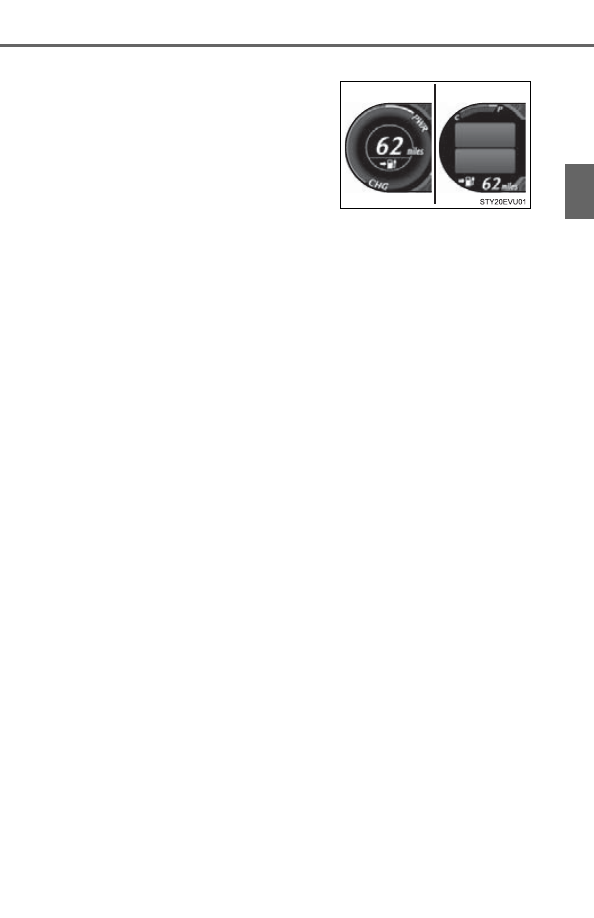
An estimated possible driving range,
which is calculated from traction battery’s
remaining charge, the air conditioning
operating mode and so forth, is shown on
the multi-information display.
However, the actual possible driving
range significantly varies depending on
the driving manner, weather and usage of
electrical components. 
Use the estimated possible driving range
as a reference only, and try to keep the
battery as charged as possible.

-------------------------------------------------------------------------------------------------------------------------------------------------------------

78

2-1. Electric vehicle

Vehicle Proximity Notification System

In the following cases, the vehicle proximity notification system sound may be
difficult for pedestrians, people riding bicycles or other people, and vehicles in
the surrounding area to hear:

When there is a lot of noise in the vicinity

When it is raining or during strong winds

For your information, since this system is located in the front of the vehicle,
people who are in the area surrounding the rear of the vehicle are less easy
to hear the sound sometime than those who are in the front of the vehicle.

Maintenance, repair, recycling, and disposal

Contact your Scion dealer regarding maintenance, repair, recycling and dis-
posal. When disposing of your vehicle, traction batteries are recovered
through Scion dealers, and as such we appreciate your cooperation.

-------------------------------------------------------------------------------------------------------------------------------------------------------------

79

2-1. Electric vehicle

2

EV system

EV (Electric Vehicle) system precautions

The illustration is an example for explanation purposes only and may
vary from the actual vehicle.

Be careful of the high voltage components (about 300 V at maxi-
mum), such as the traction battery, power control unit, orange
colored high voltage cables, and electric motor, as well as high
temperature components such as the cooling radiator, which are
provided on the electric vehicle. For the high voltage compo-
nents, caution labels are provided on them. Read them when
they need to be handled.

Caution label

High voltage cables (orange)

Power control unit and DC/DC
converter

Service plug

Traction battery

Air conditioning compressor

Electric motor (traction motor)

Quick charging inlet (if
equipped)

Normal charging inlet

Battery charger for normal
charging

1
2
3

4
5

6
7
8

9

10

-------------------------------------------------------------------------------------------------------------------------------------------------------------

80

2-1. Electric vehicle

When a certain level of impact is detected by the impact sensor, the
emergency shut off system turns off the EV system and blocks off the
high voltage current. If the emergency shut off system activates, your
vehicle will not restart. To restart the EV system, contact your Scion
dealer.

A message is automatically displayed when a malfunction occurs in
the EV system or an improper operation is attempted.

If a warning message is shown on
the multi-information display, read
the message and follow the
instructions. (

P. 344)

If a warning light comes on, a warning message is displayed, or the
12-volt battery is disconnected

The EV system may not start. In that case, try to start the system again. If the
“READY” indicator does not come on, contact your Scion dealer.

Electromagnetic waves

High voltage parts and cables on the electric vehicles incorporate electro-
magnetic shielding, and therefore emit approximately the same amount of
electromagnetic waves as conventional gasoline powered vehicles or home
electronic appliances.

Your vehicle may cause sound interference in some third party-produced
radio parts.

Emergency shut off system

Warning message

-------------------------------------------------------------------------------------------------------------------------------------------------------------

81

2-1. Electric vehicle

2

EV system

Traction battery (Lithium-ion battery)

The traction battery has a limited service life.
The traction battery capacity (the ability to store energy) reduces with time
and use in the same way as other rechargeable batteries. The extent at which
capacity reduces changes drastically depending on the environment (outside
temperature, etc.) and usage conditions, such as how the vehicle is driven
and how the traction battery is charged.
This is a natural characteristic of lithium-ion batteries, and is not a malfunc-
tion. Also, even though the EV driving range decreases when the traction bat-
tery capacity reduces, vehicle performance does not significantly become
worse.
In order to reduce the possibility of the capacity reducing, follow the directions
listed on P. 190, “Capacity reduction of the traction battery”.

CAUTION

High voltage precautions

The vehicle has high voltage DC and AC systems as well as a 12-volt sys-
tem.

DC and AC high voltage systems are very dangerous and can cause severe
burns and electric shock that may result in death or serious injury.

Never touch, disassemble, remove, or replace the high voltage parts,
cables (orange) or their connectors.

The EV system will become hot after starting as the system uses high volt-
age. Be careful of both the high voltage and the high temperature, and
always obey the caution labels attached to the vehicle.

Never try to open the service plug
access hole located under the driver
seat. The service plug is used only
when the vehicle is serviced and is sub-
ject to high voltage.

-------------------------------------------------------------------------------------------------------------------------------------------------------------

82

2-1. Electric vehicle

CAUTION

Road accident cautions

Follow the instructions described below to reduce the risk of death or seri-
ous injury, and immediately contact your Scion dealer:

Stop the vehicle in a safe place, apply the parking brake while depressing
the brake pedal, shift the shift lever to P and turn the EV system off.
Then, slowly release the brake pedal.

Do not touch the high voltage parts, cables (orange) and connectors.

If electric wires are exposed inside or outside your vehicle, an electric
shock may occur. Never touch exposed electric wires.

Do not touch the traction battery if liquid is leaking from or adhered to it.
If electrolyte (Organic Carbonate-based electrolyte) from the traction bat-
tery comes into contact with the eyes or skin, it could cause blindness or
skin wounds. In the unlikely event that it comes into contact with the eyes
or skin, wash it off immediately with a large amount of water, and seek
immediate medical attention.

If electrolyte is leaking from the traction battery, do not approach the vehi-
cle.
Even in the unlikely event that the traction battery has been damaged, the
internal construction of the battery will prevent a large amount of electro-
lyte from leaking out. However, if electrolyte leaks, vapors will be emitted.
These vapors are an irritant to skin and eyes and could cause acute poi-
soning if inhaled.

Do not bring burning or high-temperature items close to the electrolyte.
The electrolyte may ignite and cause a fire.

If a fire occurs in the electric vehicle, leave the vehicle as soon as possi-
ble. Never use a fire extinguisher that is not meant for electrical fires.
Using even a small amount of water may be dangerous.

If your vehicle needs to be towed, do so with the front wheels raised. If the
wheels connected to the electric motor (traction motor) are on the ground
when towing, the motor may continue to generate electricity. This may
cause an electricity leakage leading to a fire. (

P. 330)

-------------------------------------------------------------------------------------------------------------------------------------------------------------

83

2-1. Electric vehicle

2

EV system

CAUTION

Carefully inspect the ground under the vehicle. If leaked liquid (other than
water from the air conditioning) is found on the ground, the traction battery
may have been damaged. Leave the vehicle as soon as possible.
In addition, inform your Scion dealer about the leakage found on the
ground when contacting them.

Traction battery (lithium-ion battery) replacement and disposal

Do not replace, dispose of, modify, or reuse the traction battery and do not
use it for anything other than its intended use. Contact your Scion dealer
for replacement or disposal.

If the traction battery is replaced, disposed of, modify or reused in an
improper way, or if the traction battery is used in a way it is not intended
for, there is a risk of severe burns and electrical shock that may result in
death or serious injury.

Also, improper handling of the traction battery can lead to environmental
hazards.

If your vehicle is disposed of without the traction battery having been
removed, there is a danger of serious electric shock if high voltage parts,
cables and their connectors are touched. In the event that your vehicle
must be disposed of, the traction battery must be disposed of by your
Scion dealer or a qualified service shop. If the traction battery is not dis-
posed of properly, it may cause electric shock that can result in death or
serious injury.

Caution while driving

An electric vehicle does not have the engine sounds like a conventional
vehicle has. Therefore, people in the surrounding area may not notice the
vehicle start or approach. Since people may not notice the vehicle
approaching when the surrounding area noises and so forth are loud, even
with the vehicle proximity notification system operating, take extra care
when operating.

-------------------------------------------------------------------------------------------------------------------------------------------------------------

84

2-2. Charging

Charging equipment

Charging equipment and names

This vehicle is charged by connecting to an external power
source.

Charging indicator

Charging inlet light

Normal charging inlet 

Charging inlet cap

Quick charging inlet (if
equipped)

Normal charging cable

Recharge inlet door (charging
port lid)

1
2
3
4

5

6
7

-------------------------------------------------------------------------------------------------------------------------------------------------------------

85

2-2. Charging

2

EV system

The names of each part of the charging cable

*

: The shape of the plug differs in accordance with the voltage and the target

region.

Charging connector

Latch release button

Power indicator

Error warning indicator

Test button

Reset button

CCID (Charging Circuit Inter-
rupting Device)

Plug

*

1
2
3
4
5

6
7

8

-------------------------------------------------------------------------------------------------------------------------------------------------------------

86

2-2. Charging

The CCID (Charging Circuit Interrupting Device) has the following
safety features.

Electrical leakage detection function

If an electrical leakage is detected during charging, the power
source will be automatically interrupted, thus preventing fires or
electrical shocks caused by electrical leakage. 

If the power source is interrupted, the error warning indicator will illumi-
nate. If the power source is interrupted: 

P. 382

Electrical leakage test function

The electrical leakage detection function can be tested prior to
charging to confirm that it is operating correctly.

When the test button is pressed while the plug is connected to an exter-
nal power source, the error warning indicator should illuminate. 
(

P. 262)

Conditions for supplying current to the vehicle

The CCID (Charging Circuit Interrupting Device) is designed to pre-
vent electrical current from being supplied to the charging connec-
tor when it is not connected to the vehicle, even if the plug is
inserted in the outlet.

Safety functions

-------------------------------------------------------------------------------------------------------------------------------------------------------------

87

2-2. Charging

2

EV system

CAUTION

When using the charging cable and CCID (Charging Circuit Interrupt-
ing Device)

Observe the following precautions.
If you do not follow them, fire, electrical shock and/or damage may occur,
possibly resulting in death or serious injury.

Do not attempt to disassemble and/or repair the charging cable, charging
connector, plug or CCID (Charging Circuit Interrupting Device). If a prob-
lem arises with the charging cable and/or the CCID (Charging Circuit Inter-
rupting Device), stop charging immediately and contact your Scion dealer.

Do not subject the charging cable, charging connector, plug or CCID
(Charging Circuit Interrupting Device) to any strong force or impact.

Do not forcefully fold the charging cable and/or damage the charging cable
with sharp objects.

Do not fold the charging connector and/or plug and do not insert foreign
objects into them.

Do hold the body of the charging connector or plug when removing or
inserting.

Remove the charging connector from the vehicle’s charging inlet FIRST,
before removing the plug from the outlet.

Do not touch the terminals of the charging connector or inlet, or allow a
short circuit to occur with foreign objects.

Do not get in the charging connector or inlet wet. 
Do not wash the vehicle while the charging cable is connected to the vehi-
cle. (

P. 249)

Do not touch the terminals of the charging connector or inlet with metallic
sharp tips (wires and needles).

Avoid exposure of plug to water or moisture.

-------------------------------------------------------------------------------------------------------------------------------------------------------------

88

2-2. Charging

Power sources that can be used

Power sources
● Connect to an AC 120 V outlet (NEMA 5-15R) with a Ground-

Fault Circuit-Interrupter (GFCI) and a circuit breaker. Use of a
15 A individual circuit is strongly recommended to ensure charg-
ing cable will operate properly.

● When charging outdoors, make sure to connect to a weather-

proof outlet that is certified for outdoor use.
Checking Ground-Fault Circuit-Interrupter (GFCI) operation
before its use is recommended.

Outlets that can be connected

NEMA 5-15R outlet

The illustration is an example
shown for demonstration pur-
poses, and may differ from the
actual configuration.

An external power source that fulfills the following criteria is
necessary for charging this vehicle. Confirm this before charg-
ing.

-------------------------------------------------------------------------------------------------------------------------------------------------------------

89

2-2. Charging

2

EV system

The charging environment

For safer charging, the following charging equipment and settings are recom-
mended.

Weatherproof outlet

When charging outdoors, connect the plug to a weatherproof outlet, and
maintain the waterproof property if you connect the plug.

Dedicated circuit

• To reduce the risk of fire, connect only to a circuit provided with 15 A

maximum branch circuit over-current protection in accordance with the
National Electric Code, ANSI/NFPA 70.

• To reduce the risk of electric shock when working with the plug, connect

to a outlet with a Ground-Fault Circuit-Interrupter (GFCI) or that has an
Earth Leakage Circuit Breaker installed.

-------------------------------------------------------------------------------------------------------------------------------------------------------------

90

2-2. Charging

CAUTION

Warnings for electrical faults

Make sure to observe the following precautions when charging the vehicle.
Failure to use a power source that does not fulfill the requirements, or fail-
ure to observe regulations while charging could lead to an accident, possi-
bly resulting in death or serious injury.

Power sources precautions

Observe the following precautions.
If you do not follow them, fire, electrical shock or damage may occur, possi-
bly resulting in death or serious injury.

Connect to an AC 120 V outlet (NEMA 5-15R) with a Ground-Fault Circuit-
Interrupter (GFCI) and supplied by a circuit breaker per your local code.
Use of a 15 A individual circuit is strongly recommended.

Use of a block heater for charging is prohibited.

Do not connect the charging cable to a
multi-outlet adapter, multi-plugs, or con-
version plug.

Connecting the charging cable to an
extension cord is strictly prohibited.
The extension cord may overheat and
does not contain a Ground-Fault Cir-
cuit-Interrupter (GFCI).

Do not connect to a power strip.

-------------------------------------------------------------------------------------------------------------------------------------------------------------

91

2-2. Charging

2

EV system

Charge methods

The vehicle differs greatly from standard household electrical goods in
the following ways, and incorrect usage could cause fire and/or elec-
tric shock, possibly leading to death or serious injury.
● Large current flows for a long period of time.
● Charging can be conducted outdoors.
To charge properly, follow the procedure after reading the explanation
below. Charging is intended to be carried out by licensed drivers only
who properly understand the charging procedure. Charging should
not be carried out by children.

Normal charging (

P. 181)

The traction battery can be charged from an AC outlet using the
vehicle’s charging cable or from charging equipment that is
installed at public charging stations or home.

Quick charging (if equipped) (

P. 195)

The traction battery is charged in a short time with quick chargers
that are compliant with the CHAdeMO (CHAdeMO is a trade name
of quick charging method) specifications.

The charging time varies depending on the battery temperature and the
type of a quick charger. However, the battery can only be charged from
when the SOC (State of Charge) warning light has come on up to 80%
in approximately 15 minutes.

In order to minimize decrease in the traction battery’s capacity, avoid
consecutive use of quick charging. Minimal use of quick charging is rec-
ommended.

The traction battery can be charged in the two ways: normal or
quick charging.

Charging methods

-------------------------------------------------------------------------------------------------------------------------------------------------------------

92

2-2. Charging

Charging methods

*

: Time to fully charge the battery will vary depending on the conditions such

as the remaining battery level and outside temperature.

Normal charging

(

P. 181)

Quick charging

(

P. 195)

Charging inlet

Charging
connector

Charging
cable/battery
charger

Outlet shape

Estimated
time charge

*

Approximately 7 hours

Approxi-
mately 3 

hours

Approximately 15 

minutes

CAUTION

Warning for the normal charge
P. 192

Warning for the quick charge
P. 200

-------------------------------------------------------------------------------------------------------------------------------------------------------------


Content      ..     3      4      5      6     ..