Scion Q EV. Service Manual - part 4
 

  Index      Manuals     Scion Q EV. Service Manual


Search            copyright infringement  


Content      ..     2      3      4      5     ..


Scion Q EV. Service Manual - part 4


61

1-1. For safe use

1

For safet

y and s

e

curity

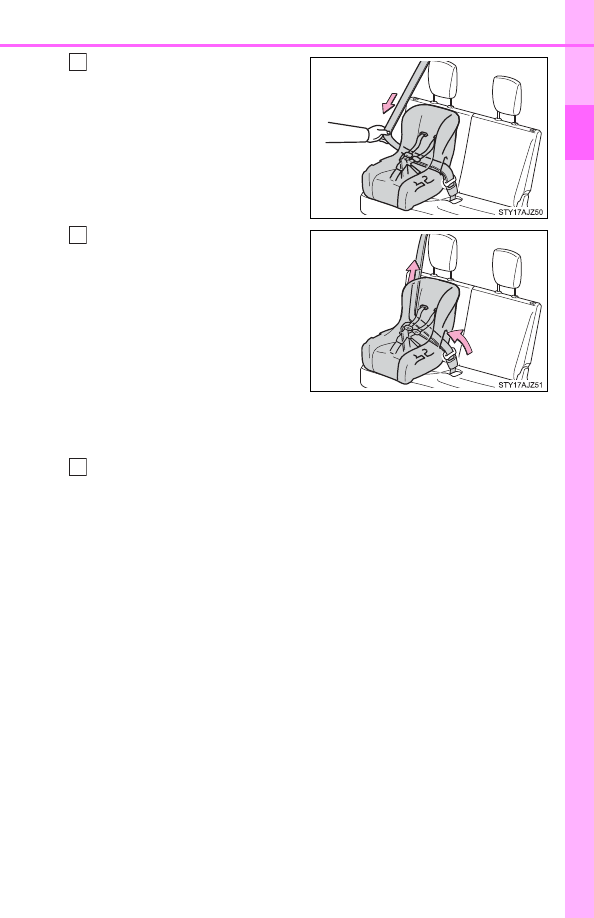
Fully extend the shoulder belt
and allow it to retract to put it
in lock mode. In lock mode,
the belt cannot be extended.

While pushing the child
restraint system into the rear
seat, allow the shoulder belt
to retract until the child
restraint system is securely
in place.

After the shoulder belt has
retracted to a point where there
is no slack in the belt, pull the
belt to check that it cannot be
extended.

If the child restraint has a top tether strap, the top tether strap
should be latched onto the top tether strap anchor. (

P. 63)

3

4

5

-------------------------------------------------------------------------------------------------------------------------------------------------------------

62

1-1. For safe use

Booster seat

Place the child restraint sys-
tem on the seat facing the
front of the vehicle.

Sit the child in the child
restraint system. Fit the seat
belt to the child restraint sys-
tem according to the manu-
facturer’s instructions and
insert the plate into the
buckle. Make sure that the
belt is not twisted.

Check that the shoulder belt is
correctly positioned over the
child’s shoulder and that the lap
belt is as low as possible. 
(

P. 26)

Push the buckle release button
and fully retract the seat belt. 

1

2

Removing a child restraint installed with a seat belt

-------------------------------------------------------------------------------------------------------------------------------------------------------------

63

1-1. For safe use

1

For safet

y and s

e

curity

Secure the child restraint system using the seat belt or LATCH
anchors.

Remove the anchor bracket
cover.

Store the removed cover in a safe
place.

Latch the hook onto the anchor bracket and tighten the top tether
strap.

Make sure the top tether strap is securely latched.

Laws and regulations pertaining to anchorages

The LATCH system conforms to FMVSS225. 
Child restraint systems conforming to FMVSS213 specifications can be used.
This vehicle is designed to conform to the SAE J1819.

Child restraint systems with a top tether strap

1

2

3

Type A

Type B

-------------------------------------------------------------------------------------------------------------------------------------------------------------

64

1-1. For safe use

CAUTION

When installing a booster seat 

To prevent the belt from going into ALR lock mode, do not fully extend the
shoulder belt. ALR mode causes the belt to tighten only. This could cause
injury or discomfort to the child. (

P. 28)

When installing a child restraint system

Follow the directions given in the child restraint system installation manual
and fix the child restraint system securely in place.
If the child restraint system is not correctly fixed in place, the child or other
passengers may be seriously injured or even killed in the event of sudden
braking, sudden swerving or an accident.

If the driver’s seat interferes with the
child restraint system and prevents it
from being attached correctly, attach the
child restraint system to the right-hand
rear seat.

Adjust the front passenger seat so that
it does not interfere with the child
restraint system.

Only put a forward-facing child restraint
system on the front seat when unavoid-
able. When installing a forward-facing
child restraint system on the front pas-
senger seat, move the seat as far back
as possible even if the “AIR BAG OFF”
indicator light is illuminated. Failure to
do so may result in death or serious
injury if the airbags deploy (inflate).

-------------------------------------------------------------------------------------------------------------------------------------------------------------

65

1-1. For safe use

1

For safet

y and s

e

curity

CAUTION

When installing a child restraint system

When a booster seat is installed, always ensure that the shoulder belt is
positioned across the center of the child’s shoulder. The belt should be
kept away from the child’s neck, but not so that it could fall off the child’s
shoulder. Failure to do so may result in death or serious injury in the event
of sudden braking, sudden swerving or an accident.

Ensure that the belt and plate are securely locked and the seat belt is not
twisted.

Shake the child restraint system left and right, and forward and backward
to ensure that it has been securely installed.

After securing a child restraint system, never adjust the seat.

Follow all installation instructions provided by the child restraint system
manufacturer.

Do not use a seat belt extender

If a seat belt extender is used when installing a child restraint system, the
seat belt will not securely hold the child restraint system, which could cause
death or serious injury to the child or other passengers in the event of sud-
den braking, sudden swerving or an accident.

To correctly attach a child restraint system to the anchors

When using the LATCH anchors, be sure that there are no foreign objects
around the anchors and that the seat belt is not caught behind the child
restraint system. Make sure the child restraint system is securely attached,
or it may cause death or serious injury to the child or other passengers in
the event of sudden stop, sudden swerve or an accident.

-------------------------------------------------------------------------------------------------------------------------------------------------------------

66

1-2. Theft deterrent system

Immobilizer system

The indicator flashes after the
power switch has been turned off
to indicate that the system is oper-
ating.

The indicator stops flashing after
the power switch has been turned
to ACCESSORY or ON mode to
indicate that the system has been
canceled.

System maintenance

The vehicle has a maintenance-free type immobilizer system.

Conditions that may cause the system to malfunction

Depending on the surrounding environment and conditions, the immobilizer
system may not operate properly. This may prevent the EV system from start-
ing. (

P. 125)

Certifications for the immobilizer system 

FCC ID: NI4TMIMB-2
NOTE:
This device complies with part 15 of the FCC Rules. Operation is subject to
the following two conditions: (1) This device may not cause harmful interfer-
ence, and (2) this device must accept any interference received, including
interference that may cause undesired operation. 

FCC WARNING:
Changes or modifications not expressly approved by the party responsible for
compliance could void the user’s authority to operate the equipment.

The vehicle’s keys have built-in transponder chips that prevent
the EV system from starting if a key has not been previously reg-
istered in the vehicle’s on-board computer. 

Never leave the keys inside the vehicle when you leave the vehi-
cle.

-------------------------------------------------------------------------------------------------------------------------------------------------------------

67

1-2. Theft deterrent system

1

For safet

y and s

e

curity

CAUTION

Certifications for the immobilizer system

Changes or modifications not expressly approved by the party responsible
for compliance could void the user’s authority to operate the equipment.

NOTICE

To ensure the system operates correctly

Do not modify or remove the system. If modified or removed, the proper
operation of the system cannot be guaranteed.

-------------------------------------------------------------------------------------------------------------------------------------------------------------

68

1-2. Theft deterrent system

Theft prevention labels

These labels are attached to the
vehicle to reduce vehicle theft by
facilitating the tracing and recov-
ery of parts from stolen vehicles.
Do not remove under penalty of
law.

-------------------------------------------------------------------------------------------------------------------------------------------------------------

69

EV system

2

2-1. Electric vehicle

Electric vehicle’s day........... 70

Characteristics of the 

EV (Electric Vehicle) 
system .............................. 72

EV (Electric Vehicle) 

system precautions ........... 79

2-2. Charging

Charging equipment............ 84

Power sources that can 

be used ............................. 88

Charge methods ................. 91

2-3. Driving the EV 

(Electric Vehicle)

EV (Electric Vehicle) 

driving tips........................... 94

-------------------------------------------------------------------------------------------------------------------------------------------------------------

70

2-1. Electric vehicle

Before driving

Comfortable interior temperature 
by Remote Climate Control

Going to the 
destination

Estimated driving range 
checked on screen

P. 74

P. 228

-------------------------------------------------------------------------------------------------------------------------------------------------------------

71

2-1. Electric vehicle

After coming home

Timer charging for tomorrow

Away from home

• Charging the traction battery
• Comfortable interior temperature 

by Remote Climate Control

If charging cannot be 
done...

P. 202

P. 91, 228

P. 377

While driving

• Safe driving
• Economical driving
• Remaining battery

charge notice

P. 75, 94

-------------------------------------------------------------------------------------------------------------------------------------------------------------

72

2-1. Electric vehicle

Characteristics of the EV (Electric Vehicle) 

system

The illustration is an example for explanation purposes only and may
vary from the actual vehicle.

Electric motor (traction motor)

Traction battery

Provides electricity to the electric motor.

12-volt battery

Provides electricity to various vehicle systems such as the SRS air-
bags, headlights, wipers, etc.

Electric vehicles are considerably different from conventional
vehicle.

They use electricity charged in a traction battery, instead of fos-
sil fuels, to drive the electric motor. Since electric vehicles drive
using electricity, they do not emit any emissions such as CO2
(Carbon Dioxide) and NOx (Nitrogen Oxides). Electric vehicles
are environmentally friendly vehicles.

1
2

3

-------------------------------------------------------------------------------------------------------------------------------------------------------------

73

2-1. Electric vehicle

2

EV system

When braking (regenerative braking)

The electric motor (traction motor) charges the traction battery.
The driving range can be extended by actively using this regenera-
tive braking to store electricity in the traction battery.

Charging

The electric vehicle is driven using electricity, received from an
external power source, that is stored in the traction battery. Not only
public charging stations, but also household electrical outlets can
be used for charging. Procedures are different from refueling a con-
ventional vehicle. Therefore, make sure to read the following thor-
oughly.
● Charging equipment (P. 84)
● Power sources that can be used (P. 88)
● How to charge your vehicle (P. 181, 195)
● If charging cannot be done (P. 377)
● Inspecting the charging cable (P. 262)

-------------------------------------------------------------------------------------------------------------------------------------------------------------

74

2-1. Electric vehicle

Electric vehicles do not emit engine sounds. To warn pedestrians,
people riding bicycles or other people, and vehicles in the surrounding
area that the vehicle is approaching, a sound is intentionally produced
while driving. The pitch of the sound adjusts according to vehicle
speed. When vehicle speed is approximately 16 mph (25 km/h) or
more, the warning system turns off.

The estimated driving range
based on the amount of remaining
battery charge can be displayed.

For details, refer to the “Navigation
System Owner’s Manual”.

Power consumption information
can be displayed on the screen.

For details, refer to the “Navigation
System Owner’s Manual”.

Vehicle Proximity Notification System

Range map screen

Power consumption screen

-------------------------------------------------------------------------------------------------------------------------------------------------------------

75

2-1. Electric vehicle

2

EV system

Regenerative braking

In the following situations, kinetic energy is converted to electric energy and
deceleration force can be obtained in conjunction with the recharging of the
traction battery.

The accelerator pedal is released while driving with the shift lever in D, S or
B.

The brake pedal is depressed while driving with the shift lever in D, S or B.

If “REGENERATIVE BRAKING LIMITED” appears on the multi-information
display, refer to P. 347.

12-volt battery recharging

The 12-volt battery is charged from the traction battery when the EV system
is operated or while the traction battery is being charged. 
If the vehicle has not been used for a long time, the 12-volt battery may
become low due to self-discharge. If this occurs, follow the correct proce-
dures. (

P. 386)

When not using the vehicle for an extended period of time
P. 191

Charging the traction battery

Be sure to maintain the traction battery charge level suitable for your driving
needs.
If the traction battery fully discharges, the vehicle cannot be driven at all.
When the battery becomes low, charge it as soon as possible.

If the traction battery becomes low

If the SOC (State of Charge) warning light flashes, the power used by the air
conditioning system will automatically be restricted and the traction battery’s
remaining charge will be distributed for driving the vehicle. If the traction bat-
tery fully discharges, driving will not be possible. When the battery becomes
low, charge it as soon as possible.

-------------------------------------------------------------------------------------------------------------------------------------------------------------

76

2-1. Electric vehicle

When the traction battery becomes low, the SOC (State of Charge) warning
light comes on or flashes and a following message will appear on the multi-
information display.

SOC

 gauge

Warning light

Warning message

Vehicle’s state

No effect on driving. 
(However, 
the vehicle cannot 
drive long distances, 
therefore charge the 
battery as soon as 
possible.)

• The remaining bat-

tery charge is very
low, and continuous
driving will be diffi-
cult.

• To drive the vehicle

as long as possible,
the motor output is
restricted.

The battery power has 
discharged while driv-
ing (the vehicle is 
moving while the EV 
system is down).

The vehicle cannot 
start because the bat-
tery is completely dis-
charged.

(Comes on)

(Comes on)

(Comes on)

(Flashes)

(Flashes)

(Flashes)

(Flashes)

(A buzzer also 
sounds once)

(A buzzer also 
sounds 3 times)

(A buzzer also 
sounds intermittently)

-------------------------------------------------------------------------------------------------------------------------------------------------------------


Content      ..     2      3      4      5     ..