Maserati Grandturismo Sport. Service Manual - part 2
 

  Index      Manuals     Maserati Grandturismo Sport. Service Manual


Search            copyright infringement  


Content      ..      1      2      3      ..


Maserati Grandturismo Sport. Service Manual - part 2


A

B

1

21

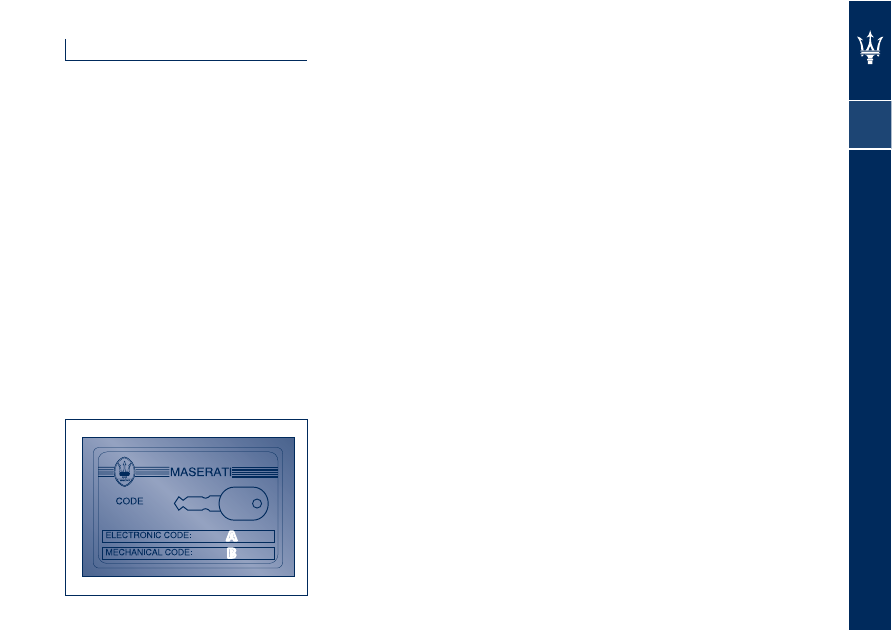
Key codes

A CODE CARD is supplied with the 
keys. This card indicates the following:
-  the electronic code to be used for 

“emergency ignition”

-  the mechanical key code to 

be provided to your Authorized 
Maserati Dealer
 in case you may 
need duplicate keys.

WARNING: The code numbers shown 
on the CODE CARD should be kept in 
a safe place.

WARNING: You are advised to always 
keep the CODE CARD number with 
you, as this is absolutely necessary in 
the event of an “emergency starting”.

WARNING: In the event of a vehicle 
ownership transfer, it is essential that 
the new owner is provided with all 
the keys and with the CODE CARD.

WARNING: You are advised to record 
and keep the codes listed on the 
tags delivered with the keys and the 
remote control in a safe place (not 
in the vehicle) in order to request 
duplicates if needed.

-------------------------------------------------------------------------------------------------------------------------------------------------------------

2

23

Seat belts  

24

Proper transport of children 

29

ESC system 

43

ASR system 

44

ABS, EBD, HBA and BOS systems 

45

TPMS – Tire Pressure Monitoring System  

47

Parking sensors  

52

Fuel cut-off inertia switch 

57

Active and passive safety

-------------------------------------------------------------------------------------------------------------------------------------------------------------

A

C

B

2

24

Seat belts 

The vehicle is equipped with seat belts 
with automatic retractor designed for 
maximum freedom of movement. 
The seat belts are equipped with 
electronically-controlled load limiting 
devices and pretensioners. In addition, 
the attachment points of all the 
seat belts are directly attached to 
the seat, in order to help ensure 
optimal protection, whatever the seat 
position.

Maserati urges you to use 
the seat belts correctly 
fastened and adjusted at all 

times!

Correct use of the seat belts 
can help reduce the risk of 
serious injury in the event of 

an accident.

The passenger and rear side seats are 
equipped with KISI System, which 
is designed to help improve safety 
when children are traveling in special 
child seats. The system is activated 
by pulling out the belt to its full 
length: once the child seat is securely 
fastened, the belt can no longer be 
pulled out and hence the belt/child 
seat system is more secure.

When the belt is released and fully 
retracted, the system deactivates and 
resumes its normal operation.

 
Do not pass seat belts over 
sharp edges. They could tear.

Do not pin anything to the 
seat belts. This could reduce 
their initial strength and 

cause them to tear in the event of a 
crash.

Always deactivate this 
feature prior to using the 
seat belt for normal use. 

Having the retractor locked can be 
dangerous when the seat belt is used 
for directly restraining a passenger. 

Fastening the seat belts

Extract the lower section of the seat 
belt from the outer side of the seat 
and secure it by holding the fastening 
tang A, and pulling out the belt until 
the tang inserts into the buckle lock B.
The belt is correctly engaged when 
the lock clicks into position. To release 
the belts, press button C.
If the driver’s seat belt is not fastened 
or improperly fastened, the warning 
light 

 on the instrument panel 

illuminates.

If the passenger’s seat belt is not 
fastened or improperly fastened, 
on the display appear the message 
“Fasten passenger seat belt”.
A buzzer is also actived when 
the warning light or message are 
activated.
The retractor locking device is 
designed to activate whenever the 
belt is pulled out too rapidly or in case 
of sudden braking or collision.
If the belt locks due to too rapid 
extraction, allow it to retract a short 
distance to disengage the locking 
device. The retractor is designed to 
allow the belt to automatically fit 
to the passenger’s body, allowing 
free movement. When the vehicle is 
parked on a steep slope, the retractor 
may lock: this is normal.

WARNING: Feed the belt back into the 
retractor by hand to avoid twisting 
and snagging.

-------------------------------------------------------------------------------------------------------------------------------------------------------------

D

2

25

Adjusting the front seat belts 
height (front seats only) 

The seat belts height must 
be adjusted only with the 
vehicle stationary. 

Always adjust the height of the 
front seat belts so that they suit the 
driver’s and passenger’s height. This 
precaution can help to substantially 
reduce the risk of injury in a collision.
The correct adjustment is achieved 
when the belt passes about mid-way 
between the end of the shoulder and 
the neck.
The upper attachment point of 
the seat belts is equipped with an 
oscillating ring capable of moving 
into 4 different positions, allowing 
the belts position to be adjusted.

Do not bring sharp edges 
in contact with a seat belt. 
This could reduce their initial 

strength and cause them to tear in 
the event of a crash. 
If a seat belt has been brought in 
contact with a sharp edge, or has 
been used to pin something to it, 
have it immediately replaced by our 
Authorized Maserati Dealer.

To move the attachment fitting, press 
control D.

After the adjustment, always 
check that the slider to 
which the oscillating ring 

is fixed, is locked into one of the 
positions provided. With the handgrip 
released, push again downward to 
allow the anchoring device to click 
into place, in the event that it has not 
been released in one of the positions 
provided. 

Using the rear seat belts

The belts for the rear seats must be 
worn as shown in the figure.

Remember that, in the event 
of a violent impact, the 
passengers on the rear seats 

that are not wearing the seat belts 
are not only subject to personal injury 
but they also represent a danger for 
passengers sitting in the front seats. 

The seat belts must be worn keeping 
your chest in the upright position and 
lying against the backrest.

-------------------------------------------------------------------------------------------------------------------------------------------------------------

2

26

Load limiting devices 

To help increase passive safety levels, 
the seat belt retractors are equipped 
with a load limiting device designed 
to control the belt reeling out, so that 
the force exerted on the shoulders 
while the seat belt is in restraining 
mode can be suitably adjusted.

Pretensioners

To further enhance the seat belt 
efficiency, the vehicle seat belts are 
equipped with ETD (Emergency 
Tensioning Device) pretensioners.
These devices are designed to 
“detect”, by means of a sensor, that a 
violent crash is occurring and retract 
the belts by a few centimeters. This 
helps ensure that the belt continues 
to adhere to the occupants’ bodies 
before the restraining action takes 
place.
The smoke is not toxic and does not 
indicate the presence of a fire.
The pretensioners are activated in 
the event of an impact of a certain 
severity.
The pretensioner only activates when 
the seat belt is fastened.
After the pretensioner activation, the 
seat belt can be unfastened as usual, 
by pressing the button on the buckle.

The pretensioner does not require any 
maintenance or lubrication.

WARNING: Tampering with the 
device will compromise its efficient 
operation. If, as a result of exceptional 
natural circumstances (e.g., floods, 
heavy seas, etc.), the device has been 
in contact with water and sludge, it 
is mandatory to replace it. To help 
ensure the best protection from the 
pretensioners, wear the belt in such 
a way that it fits snugly against your 
chest and pelvis.

The pretensioners can be 
deployed only once and 
activate only when the seat 

belts are fastened. After activation, 
contact an Authorized Maserati 
Dealer to have the pretensioners 
replaced and for properly discarding 
the old components. 

WARNING: Work on the vehicle which 
involves blows, vibrations or localized 
heating (welding) in the area of the 
pretensioners may damage or activate 
them: vibrations due to uneven road 
surfaces or unintentional underbody 
collisions, for instance, should not 
affect the units. Contact your local 
Authorized Maserati Dealer for any 
inspection that may be required.

It is strictly forbidden to 
remove or tamper with the 
pretensioner components. 

Any intervention must be carried 
out only by qualified and authorized 
personnel. Always contact your local 
Authorized Maserati Dealer.

-------------------------------------------------------------------------------------------------------------------------------------------------------------

2

27

General warnings for using the 
seat belts

The driver and any 
passengers are obliged by 
law to respect and obey 

the provisions of local legislation 
regarding the compulsory use of seat 
belts.

To help provide maximum 
protection, you are advised 
to keep the seatback in the 

most upright position possible and 
the seat belt close to your chest and 
pelvis. If the seat belt is loose, in the 
event of an accident you could move 
too far forward and could be injured. 
Travelling with the seatback too far 
reclined could also be dangerous: 
even if the seat belts are fastened, 
they may not work correctly. In 
fact, the belt itself may not be 

close enough to your body and, if 
it is in front of you, it could cause 
neck wounds or other injuries in an 
accident. Additionally, in an accident, 
the lower section of the belt could 
press against the upper part of your 
stomach rather than the pelvic area, 
causing serious internal injuries.

Do not use child seats or child 
booster cushions/backrests 
in the front passenger seat. 

Occupants in the front passenger seat 
must never sit on the edge of the seat, 
leaning toward the instrument panel 
or otherwise sit out of position. 
The occupants’ back must be as 
upright as comfort allows, and must 
rest against the seatback with the seat 
belt properly fastened. Feet must be 
on the floor (i.e. not on the dashboard, 
seat or out of the window).

Always fasten the seat belts. 
Travelling without the seat 
belts fastened significantly 

increases the risk of serious injury in 
the event of a collision, even with the 
airbags. In the event of a collision, 
the seat belts help reduce the 
possibility of the vehicle’s occupants 
being thrown against the structures 
of the passenger compartment or 
out of the vehicle. The airbags are 
designed to work together with the 
seat belts, not to substitute them. 
The front airbags only deploy in the 
event of certain head-on collisions of 
sufficient intensity. They will not be 
activated if the vehicle rolls over, or 
in the event of rear bumps or minor 
frontal collisions, or non-frontal 
collisions.

-------------------------------------------------------------------------------------------------------------------------------------------------------------

2

28

Do not fasten your seat belt 
using the buckle lock for the 
other seat: in the event of an 

accident, the lower section of the belt 
could press against the upper part of 
your stomach rather than the pelvic 
area, causing serious internal injuries.

It is extremely dangerous 
to travel with the belt 
positioned underneath your 

arm. In the event of an accident, you 
would be thrown forward and would 
likely suffer head and neck injuries. 
Additionally, if the belt presses 
against your ribs, it could cause 
serious internal injuries.

The belt must not be 
twisted; make sure that it is 
snugly fitted to the driver’s 

and passenger’s bodies. In fact, in an 
accident, the restraining force would 
not be distributed evenly along the 
belt and would consequently cause 
injuries. The upper part of the belt 
must pass over the shoulder and 
diagonally across the chest. The 
lower section must adhere to your 
pelvis, not the stomach, to avoid 
that you slide forward in the event 
of a collision. Do not use devices 
(clips, fastners etc.) that prevent the 
seat belts from laying close to the 

passenger bodies.

Do not carry children on a 
passenger’s lap using only 
one seat belt for protecting 

both of them.

If the seat belt has suffered a 
heavy mechanical stress, for 
example during a collision, it 

must be completely replaced together 
with its anchorages, the screws 
fastening these anchorages and the 
pretensioner. In fact, even if there 
are no visible defects, the resistance 
level offered by the seat belt could be 
reduced.

Pregnant women must 
observe local legislation 
regarding the use of seat 

belts. Make sure, in any case, that the 
lower section of the belt is positioned 
well down on the hips, below the 
abdominal region of the body.

Maintaining the seat belts

1) Always use the seat belts keeping 
the belt flat, not twisted; make sure 
the belt can slide freely, without 
jamming.
2) The seat belts must be replaced 
following every pretensioner 
activation and whenever the belt 
itself shows visible damages or 
abrasions.
3) Wash the seat belts by hand using 
water and neutral soap, rinse them 
and let them dry in the shade. Do 
not use strong detergents, bleaches 
or colorants and any other chemical 
substance that could weaken the belt 
fibers.
4) Make sure the retractors do not get 
wet: as they will not operate properly.

-------------------------------------------------------------------------------------------------------------------------------------------------------------

2

29

Proper transport of 
children

For optimal protection in the 
event of a collision, all the vehicle’s 
occupants must travel seated 
and protected by all the suitable 
restraining systems. The seat belts 
are designed to be used by persons 
whose physical characteristics (age, 
height, weight) are provided for 
by established legislation in each 
country. Anyone who does not comply 
with these provisions may not travel 
in the front passenger seat. This also 
applies to children. Their heads are 
proportionally heavier and larger 
than those of adults, while their 
bones and muscles are relatively 
undeveloped. To help protect them 
in case of a collision, they must use 
special restraint or safety systems, 
even in the rear seat.

Incorrect fastening of a child 
restraint system increases 
the risk of injury to the child 

in the event of a collision.

The seat belts on the vehicle have 
been designed and tested to protect 
people weighing at least 79 lbs 
(36 kg) and taller than 59 in (1.50 m).
To help properly protect a child 

outside these limits, specific restraint 
systems with dedicated belts or 
accessories capable of adapting the 
child’s position to the vehicle’s seat 
belts must be fitted.

If a child seat is installed 
on the front passenger’s 
seat, the restraint must be 

positioned completely backwards and 
upwards.

We recommend that child 
seats be installed in the rear 
seating positions ONLY. 

Even with advanced airbags, 
children should always be 
seated in the rear seats. The 

rear seat is the optimal location for 
children.

The use of specific restraint systems 
for newborns and children is 
mandatory, as provided by the law 
in all the 50 States of the United 
States, the District of Columbia, the 
U.S. territories and the Canadian 
provinces.
Newborns and children must travel 
seated in suitable restraint systems, 
using adequate safety abdominal or 
diagonal belts or, if present, an upper 
anchoring point and a system with 2 
lower anchoring points, in order to be 

compliant with the U.S. Federal Motor 
Vehicle Safety Standards 213 and 225 
and with the Canadian Motor Vehicle 
Safety Standards 213 and 210.2.

No child under 12 should 
travel in the front passenger 
seat. 

Children must never travel 
seated on a passenger’s lap. 
In a collision, a child becomes 

so heavy that it is impossible to hold 
onto him or her. For example, in the 
event of a collision at only 25 mph 
(40 km/h), a child weighing 12 lbs (5.5 
kg) exerts a force equal to 240 lbs 
(110 kg) on the arms of the person 
carrying him/her. Children must 
always be protected by a suitable 
restraining system when travelling.

WARNING: The vehicle is equipped 
with airbag technology that no longer 
uses a Passenger Airbag Off function 
to indicate that the front passenger 
seat is occupied. 
Children should be properly 
restrained in suitable child seats, 
which must be properly installed in 
the vehicle (following the child seat 
manufacturer’s instructions), and be 
placed in the rear passenger seating 
area.

-------------------------------------------------------------------------------------------------------------------------------------------------------------

2

30

Children (or adults) who 
are resting on the airbag or 
are too close to it when it is 

activated, may be seriously injured. 
The airbags and pretensioners are 
designed to offer suitable protection 
for adults and teenagers, but not for 
children and babies. Neither the seat 
belts or the airbags are designed for 
them. Children and babies must travel 
in suitable restraining systems.

Babies must be supported 
completely, including 
their head and neck. 

This is necessary since the baby’s 
neck is weak while their head is 
proportionally bigger and heavier in 
relation to their body. In a collision, 
if a baby is travelling in a rearward-
facing seat, the forces of an impact 
are distributed throughout the 
strongest parts of the body, i.e., the 
back and shoulders. Babies must 
always be protected by a suitable 
restraining system when travelling.

Babies travelling in a 
rearward-facing seat may 
be seriously injured in the 

event of airbag activation. This could 
happen because the seatback of 
the child’s seat may be positioned 
extremely close to the airbag at the 

moment it is inflated. Do not place 
an infant or a child in the front 
passenger seat at any time.

The structure of a child’s 
body is completely different 
from that of an adult or 

a teenager (whom the seat belts 
are designed for). Children’s hips 
are so small that the seat belt will 
not stay in the correct position on 
them. The belt may rise up on the 
child’s stomach and, in the event of 
a collision, can cause serious internal 
injuries. Children must always be 
protected by suitable restraining 
systems.

We recommend that child 
seats be installed in the rear 
seating positions ONLY. 

All minors whose physical 
characteristics (age, height, weight) 
fall within the value ranges/limits 
provided by established legislation in 
each country must also be protected 
by special restraint or safety systems 
(e.g., certified child seats, booster 
seats).
Make sure to always use approved 
universal child restraining systems.
Follow the instructions that the 
manufacturer of the device is required 

to supply together with the child 
restraint systems.
To help ensure the best restraining 
action of the child seats, we 
recommend that you choose the 
model that best suits the shape of 
your seats. If possible, try to install the 
seat on the vehicle before purchasing 
it. 
Do not install child seats that, when 
placed on the seat, have an unstable 
or unnatural position due to the 
shape of your vehicle seat.

In an emergency situation, if you 
have to carry a baby in a specific child 
seat facing rearward on the front 
passenger seat:
-  adjust the front pasenger seat to 

the most rearward position;

-  install the child seat following the 

instructions provided by the child 
seat’s Manufacturer;

-  position all the movable parts 

of the child seats (e.g., handle, 
reclining seatback, sunshade etc.) 
carefully following the instructions 
provided by the Manufacturer and 
found on the instructions manual 
of the same child seat.

-------------------------------------------------------------------------------------------------------------------------------------------------------------

2

31

The seat belts on the front passenger 
seat and on the rear side seats are 
fitted with the KISI system, which 
improves safety when children are 
travelling in special child seats. 
The system is activated by pulling out 
the belt to its full length: once the 
child seat is securely fastened, the 
belt can no longer be pulled out and 
hence the belt/child seat system is 
more secure.
When the belt is released and fully 
retracted, the system deactivates and 
resumes its normal operation.

To help ensure the best 
restraining action of the child 
seat, we recommend that 

you choose the seat that best suits 
the shape of your vehicle’s seat and 
that you try to install the child seat 
before purchasing it.

In the event of an accident, 
an improperly fastened 
child restraining system can 

increase the risk of injury. 

Rearward-mounting child 
seats must not be used 
on front passenger seats 

equipped with airbags, as these could 
cause serious injuries during inflation, 
even in minor collisions.  

We recommend that you always 
carry children seated in their specific 
child seats, which must be fitted on 
the rear seat, as this is generally the 
safest place in the event of a collision.

No modifications can be 
made to the seat belts 
and the child restraining 

systems. Established legislation in 
some countries already provides that 
children under 12 years of age may 
not travel in the front passenger seat.

Check on the label found on 
the child restraint system 
and on the manual provided 

by the child seat manufacturer that 
the system complies with the above 
mentioned standards, as certified by 
the manufacturer declaration.

Whenever using a restraint 
system for infants or 
children, we recommend 

that you carefully read and follow 
the instructions provided by the child 
seat manufacturer on installation and 
use.

Please read and observe the 
instructions on the warning 
labels found inside the 

vehicle and on the restraint devices 
for infants and children.

To fasten the child seat to 
the vehicle seat, follow 
the assembly instructions 

provided with the restraint system 
itself. Then fully pull out the seat 
belt to then let it rewind. During 
rewinding, you will hear a click 
sound: this means that the special 
retractor has activated. The seat belt 
is now locked. Then push the child 
seat against the seat to rewind any 
excess length of the seat belt. To 
deactivate the retractor, unbuckle the 
seat belt and let it rewind completely. 
The seat belt can now be used 
normally.

Never unbuckle the seat belt 
that retains the child seat 
when the vehicle is moving.

-------------------------------------------------------------------------------------------------------------------------------------------------------------

2

32

When the child seat is not 
used, remove it from the 
vehicle or fasten it using 

the seat belt, in order to prevent it 
from being ejected out of the vehicle 
in the event of an accident. Never 
leave children unattended in the 
vehicle, even if they are secured and 
seated in their child seat. Unattended 
children in a child seat may use some 
of the vehicle equipment and cause 
accidents and/or serious personal 
injuries.

Children whose weight/height are 
below the minimum limits established 
by the manufacturer of the child 
restraint systems must use the 
standard seat belts. Adjust the seat 
belt in a diagonal position, across 
your chest and on your shoulder, and 
not on your neck or face. Starting 
from a weight of approximately 41 
lbs (18.6 kg), it may be necessary to 
add a booster seat to obtain a correct 
position for fitting the seat belt, until 
the children reach a sufficient height 
to have an abdominal/diagonal seat 
belt suitably fitted without needing 
a rise.

Below is a summary of the safety 
regulations applying to the transport 
of children:
We recommend that you always carry 
children in the specific restraining 
systems installed in the rear outer 
seats, as this is usually the best place 
in the event of a collision. 
Always follow strictly the instructions 
that the manufacturer provides with 
the seat. 
Keep the instructions in the vehicle 
together with the documents and this 
manual. Do not use a seat which does 
not have any instructions for use.

WARNING: We recommend that you 
choose the seat that best suits the 
shape of your vehicle’s seat and that 
you try to install the seat before 
purchasing it. 

Always pull on the seat belt to check 
that it is locked in place.
All restraint system must be used by a 
single passenger only: never carry two 
children in the same seat. 
Always check that the seat belts are 
not resting against the child’s neck.

Always drive slowly and 
carefully when carrying 
a child. Hard acceleration 

due to sport-style driving can be 
dangerous for children, even if no 
crash occurs.

Even with advanced airbags, 
the rear seat is generally the 
safest location for children. 

Whenever possible, always place 
children in the rear seats.

-------------------------------------------------------------------------------------------------------------------------------------------------------------

B

A

B

A

C

2

33

Do not allow the child to assume 
incorrect positions or undo the seat 
belt /child seat safety harness during 
travel.
Do not carry children in your arms, 
even newborns. Nobody, however 
strong, can hold on to a child in the 
event of a collision.
After an accident, always replace the 
child seat with a new one.
The vehicle is designed for mounting 
child seats with top anchoring.

To fit the child seat, pass the strap A 
underneath the rear headrest and 
anchor it on one side to the backrest 
of the child seat and on the other side 
to the bracket B on the car body. 
This anchoring point can be easily 
identified thanks to the logo found 
on the Isofix bracket covering cap 
shown below: 

Then anchor the base of the child seat 
to the brackets C.

Latch system 

The rear side seats of the vehicle are 
equipped with anchoring points for 
Latch system child seats. This is a new 
system complying with applicable 
standards for carrying children. 
This system offers a special anchoring 

system for child seats, which uses two 
metal brackets C positioned between 
the seat cushion and backrest. 
These metal brackets are easily 
identifiable through the label bearing 
the logo shown below. 

The seats designed for Latch system 
child seats installation can however 
be fitted with standard child seats; 
you can install a standard and a Latch 
system child seat at the same time 
(one in each outer rear seat). 
No more than two standard child 
seats or two Latch system type child 
seats can be installed on the rear 
seats. 
Only standard type child seats can be 
mounted on the front passenger seat. 

Fit the child seat only when 
the vehicle is stationary. 
The child seat is correctly 

anchored to the provided brackets 
when a click indicates it is locked in 
place. Follow the mounting, removal 
and positioning instructions provided 
by the child seat manufacturer.

-------------------------------------------------------------------------------------------------------------------------------------------------------------

D

E

F

G

F

D

F

E

H

2

34

Fitting the child seat in forward-
facing position

For installation, proceed as follows: 
-  make sure that the release lever E is 

in the standby position (retracted);

-  align the anchoring points F with 

the brackets D, then push the seat 
until you hear it click into place, 
which indicates it is secured; 

-  check for correct locking by 

trying to move the child seat; the 
safety mechanisms in fact, help 
prevent the child seat from being 
improperly fitted if only one of the 
attachment fittings is locked; 

-  pass the strap H underneath the 

rear headrest and anchor it onto 
the child seat backrest and onto the 
bracket on the car body.

This way, the child seat is retained 
not only by the brackets D but also by 
the vehicle seat belt and by the upper 
strap H.
In any case, see the instruction 
booklet provided with the child seat 
for fitting the vehicle belts into the 
seat correctly. 

Fitting the Latch system child 
seat in rearward-facing position 

To fit the Latch system child seat 
in a rearward-facing position, be 
particularly careful that the brackets 
D are properly inserted in their 
seatings F
The baby is then secured by the child 
seat’s harness G.

-------------------------------------------------------------------------------------------------------------------------------------------------------------

2

35

Remember, the best child safety 
seat is the one that fits your child 
properly, is easy to use, and fits in 
your vehicle correctly. The best way to 
ensure a proper fit in your vehicle is 
to try installing the child seat before 
purchasing.
You can be certain you’ve installed 
your child safety or booster seat 
correctly by having it checked at a 
child safety seat inspection station or 
by a certified child passenger safety 
technician. To find one near you, 
visit http://www.nhtsa.dot.gov/CPS/ 
CPSFitting or www.seatcheck.org. You 
can also call 1-888-DASH-2-DOT or 1-
866-SEATCHECK.

Transport of persons with 
disability

If it is necessary to modify the 
advanced airbag system of your 
vehicle to accommodate a person with 
disabilities, contact an Authorized 
Maserati Dealer
.

The advanced airbag 
system of your vehicle is 
not designed to protect 

adults with disabilities that require 
deactivation of the passenger or 
driver airbag. 

If you or or another occupant 
is an adult with a medical 
condition that requires 

airbag deactivation, please contact an 
Authorized Maserati Dealer.

As long as the airbag is 
activated, persons with 
disabilities are advised not 

to travel in the front seat in order to 
avoid the risk of serious injuries or 
death, even in minor crashes.

-------------------------------------------------------------------------------------------------------------------------------------------------------------

9

2

5

13

8

1

15

16

12

11

10

7

6

3

4

14

2

36

Front and side airbags 

-------------------------------------------------------------------------------------------------------------------------------------------------------------

2

37

The vehicle is equipped with 6 
airbags (2 front and 4 lateral ones) 
and with electronically- controlled 
pretentioners for all of the seats belts.
The system components are the 
following: 
1)  Electronic control unit
2)  Passenger’s front airbag
3)  Passenger’s front seat belt 

pretensioner

4)  Passenger’s side bag (for head 

and chest protection).

5)  Passenger’s satellite crash sensor
6)  Driver’s side bag (for head and 

chest protection).

7)  Driver’s satellite crash sensor
8)  Driver’s front seat belt 

pretensioner

9)  Airbag system failure warning 

light

10)  Driver’s front airbag
11) Clock Spring
12) Diagnostics socket
13)  Rear left-hand pretensioner
14)  Rear right-hand pretensioner
15)  Front left-hand Crash Zone Sensor 
16)  Front right-hand Crash Zone 

Sensor. 

Front airbags

The airbag is not a substitute 
for the seat belts. Correct 
use of the seat belts, in 

combination with the airbag, will 
offer protection for the driver and 
passenger in the front seat in the 
event of a head-on collision. 

Airbag system components

The airbag system is composed of two 
cushions that are designed to inflate 
almost instantaneously. One (12) is 
on the driver’s side, in the center of 
the steering wheel, and the other (2) 
is on the passenger side, inside the 
dashboard.

Deployment

The front airbags of your vehicle 
have been designed to inflate in 2 
stages. This allows the airbag to have 
different rates of inflation based on 
the crash severity, as assessed by the 
airbag control unit.
The driver’s airbag is designed to be 
deployed in certain head-on collisions 
according to the following strategy.
-  For low severity crashes, the airbag 

control unit will not deploy the 
airbag.

-  For crashes of higher severity, the 

control unit will deploy the driver 
airbag in low energy mode.

-  For crashes of even higher severity, 

the control unit will deploy the 
driver airbag in high energy mode.

The front passenger’s airbag is 
designed to be deployed in certain 
head-on collisions according to the 
following strategy.
-  For low severity crashes, the airbag 

control unit will not deploy the 
airbags.

-  For crashes of higher severity, the 

control unit will deploy the airbag 
in low energy mode.

-  For crashes of even higher severity, 

the control unit will deploy the 
airbag in high energy mode.

Never place an object over 
or near the driver and 
passenger airbags. In the 

event that the passenger airbag is 
deployed, it will project any object 
over it, or near it, in the passenger 
compartment at very high speed. 
The object will be transformed into a 
projectile propelled in the passenger 
compartment. This could cause 
serious injuries. 

-------------------------------------------------------------------------------------------------------------------------------------------------------------


Content      ..      1      2      3      ..