Pontiac GTO (2006 year). Manual - part 4
 

  Index      Pontiac     Pontiac GTO (2006 year) - manual in english


Search            copyright infringement  


Content      ..     2      3      4      5     ..


Pontiac GTO (2006 year). Manual - part 4


Your vehicle has a right front passenger’s airbag.

Never

put a rear-facing child restraint in this seat. Here is why:

{

CAUTION:

A child in a rear-facing child restraint can be
seriously injured or killed if the right front
passenger’s airbag inflates. This is because
the back of the rear-facing child restraint
would be very close to the inflating airbag.
Always secure a rear-facing child restraint in a
rear seat.

A rear seat is a safer place to secure a forward-facing
child restraint. If you need to secure a forward-facing
child restraint in the right front seat, you will be using the
lap-shoulder belt to secure the child restraint in this
position. Be sure to follow the instructions that came with
the child restraint. Secure the child in the child restraint
when and as the instructions say.

1. Because your vehicle has a right front passenger’s

airbag, always move the seat as far back as it will
go before securing a forward-facing child restraint.
See

Power Seats on page 1-2.

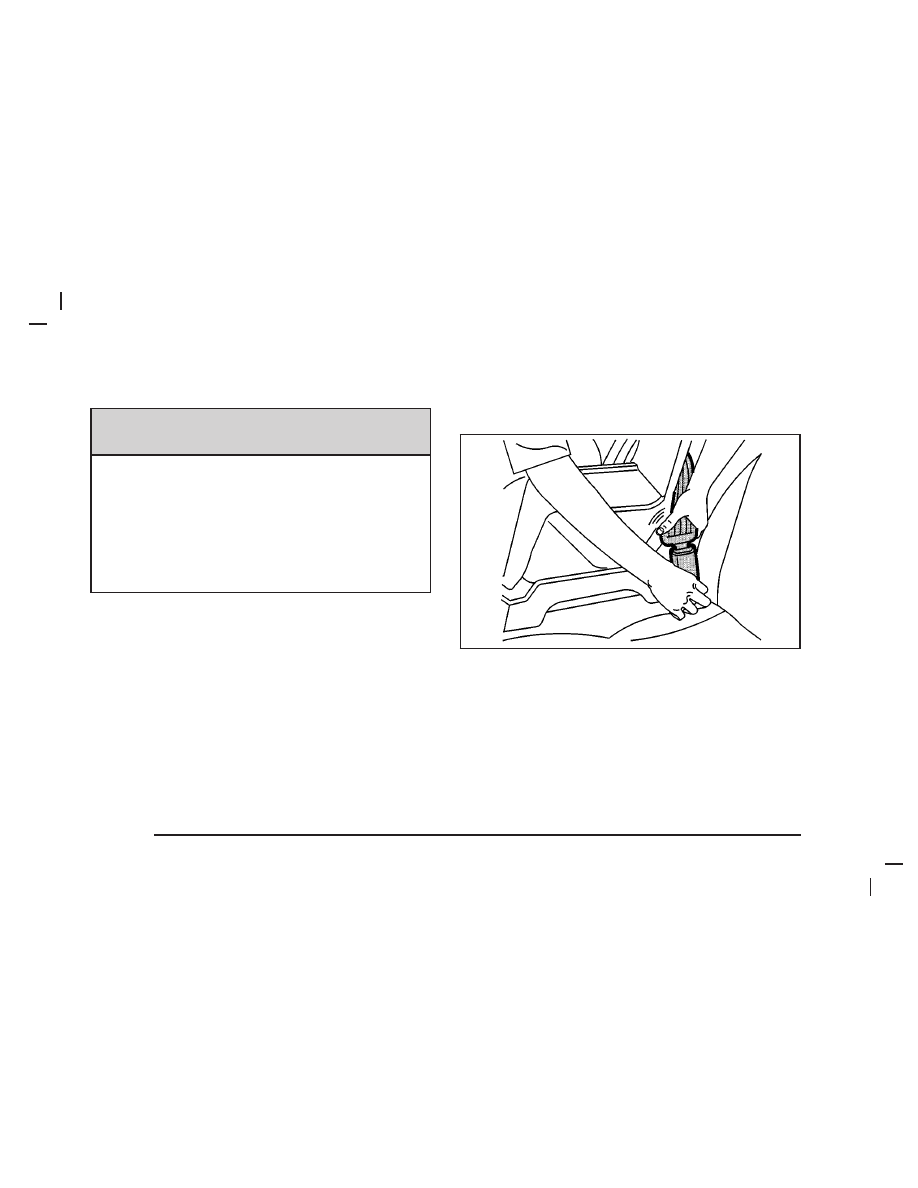
2. Put the child restraint on the seat.

3. Pick up the latch plate, and run the lap and shoulder

portions of the vehicle’s safety belt through or
around the restraint. The child restraint instructions
will show you how.

4. Buckle the belt. Make sure the release button is

positioned so you would be able to unbuckle the
safety belt quickly if you ever had to.

1-44

2006 - Pontiac GTO Owner Manual

-------------------------------------------------------------------------------------------------------------------------------------------------------------

5. Pull the rest of the shoulder belt all the way out of

the retractor to set the lock.

6. To tighten the belt, push down on the child restraint,

pull the shoulder portion of the belt to tighten the
lap portion of the belt and feed the shoulder
belt back into the retractor. You may find it helpful
to use your knee to push down on the child
restraint as you tighten the belt.

7. Push and pull the child restraint in different

directions to be sure it is secure.

To remove the child restraint, just unbuckle the vehicle’s
safety belt and let it go back all the way. The safety
belt will move freely again and be ready to work for an
adult or larger child passenger.

1-45

2006 - Pontiac GTO Owner Manual

-------------------------------------------------------------------------------------------------------------------------------------------------------------

Airbag System

Your vehicle has an airbag for the driver and an airbag
for the right front passenger.

Frontal airbags are designed to help reduce the risk of
injury from the force of an inflating frontal airbag.
But these airbags must inflate very quickly to do their
job and comply with federal regulations.

Here are the most important things to know about the
airbag system:

{

CAUTION:

You can be severely injured or killed in a crash
if you are not wearing your safety belt — even if
you have airbags. Wearing your safety belt
during a crash helps reduce your chance of
hitting things inside the vehicle or being ejected
from it. Airbags are “supplemental restraints” to
the safety belts. Airbags are designed to work
with safety belts, but do not replace them.

CAUTION:

(Continued)

CAUTION:

(Continued)

Airbags are designed to deploy in moderate to
severe frontal and near frontal crashes. They
are not designed to inflate in rollover, rear
crashes, or in many side crashes. And, for
some unrestrained occupants, airbags may
provide less protection in frontal crashes than
more forceful airbags have provided in the
past. Everyone in your vehicle should wear a
safety belt properly — whether or not there is
an airbag for that person.

1-46

2006 - Pontiac GTO Owner Manual

-------------------------------------------------------------------------------------------------------------------------------------------------------------

{

CAUTION:

Airbags inflate with great force, faster than the
blink of an eye. If you are too close to an
inflating airbag, as you would be if you were
leaning forward, it could seriously injure you.
Safety belts help keep you in position before
and during a crash. Always wear your safety
belt, even with airbags. The driver should sit
as far back as possible while still maintaining
control of the vehicle.

{

CAUTION:

Anyone who is up against, or very close to,
any airbag when it inflates can be seriously
injured or killed. Airbags plus lap-shoulder
belts offer the best protection for adults, but
not for young children and infants. Neither the

CAUTION:

(Continued)

CAUTION:

(Continued)

vehicle’s safety belt system nor its airbag
system is designed for them. Young children
and infants need the protection that a child
restraint system can provide. Always secure
children properly in your vehicle. To read how,
see

Older Children on page 1-25 and Infants

and Young Children on page 1-28.

There is an airbag
readiness light on the
instrument panel cluster,
which shows the airbag
symbol.

The system checks the airbag electrical system for
malfunctions. The light tells you if there is an electrical
problem. See

Airbag Readiness Light on page 3-25

for more information.

1-47

2006 - Pontiac GTO Owner Manual

-------------------------------------------------------------------------------------------------------------------------------------------------------------

Where Are the Airbags?

The driver’s airbag is in the middle of the steering
wheel.

The right front passenger’s airbag is in the instrument
panel on the passenger’s side.

1-48

2006 - Pontiac GTO Owner Manual

-------------------------------------------------------------------------------------------------------------------------------------------------------------

{

CAUTION:

If something is between an occupant and an
airbag, the bag might not inflate properly or it
might force the object into that person causing
severe injury or even death. The path of an
inflating airbag must be kept clear. Do not put
anything between an occupant and an airbag,
and do not attach or put anything on the
steering wheel hub or on or near any other
airbag covering.

When Should an Airbag Inflate?

The driver’s and right front passenger’s frontal airbags
are designed to inflate in moderate to severe frontal
or near-frontal crashes. But they are designed to inflate
only if the impact exceeds a predetermined deployment
threshold. Deployment thresholds take into account
a variety of desired deployment and non-deployment
events and are used to predict how severe a crash
is likely to be in time for the airbags to inflate and help
restrain the occupants. Whether your frontal airbags
will or should deploy is not based on how fast your

vehicle is traveling. It depends largely on what you hit,
the direction of the impact and how quickly your
vehicle slows down.

If your vehicle goes straight into a wall that does not
move or deform, the threshold level is about 11 to
17 mph (18 to 28 km/h). (The threshold level can vary,
however, with specific vehicle design, so that it can
be somewhat above or below this range.)

Frontal airbags may inflate at different crash speeds.
For example:

If the vehicle hits a stationary object, the airbags
could inflate at a different crash speed than if the
vehicle hits a moving object.

If the vehicle hits an object that deforms, the
airbags could inflate at a different crash speed than
if the vehicle hits an object that does not deform.

If the vehicle hits a narrow object (like a pole) the
airbags could inflate at a different crash speed
than if the vehicle hits a wide object (like a wall).

If the vehicle goes into an object at an angle the
airbags could inflate at a different crash speed
than if the vehicle goes straight into the object.

The frontal airbags (driver and right front passenger) are
not intended to inflate during vehicle rollovers, rear
impacts, or in many side impacts.

1-49

2006 - Pontiac GTO Owner Manual

-------------------------------------------------------------------------------------------------------------------------------------------------------------

In any particular crash, no one can say whether an
airbag should have inflated simply because of the
damage to a vehicle or because of what the repair costs
were. Inflation is determined by what the vehicle hits,
the angle of the impact, and how quickly the vehicle
slows down in frontal and near-frontal impacts.

What Makes an Airbag Inflate?

In an impact of sufficient severity, the airbag sensing
system detects that the vehicle is in a crash. The
sensing system triggers a release of gas from the
inflator, which inflates the airbag. The inflator, airbag,
and related hardware are all part of the airbag modules
inside the steering wheel and in the instrument panel
in front of the right front passenger.

How Does an Airbag Restrain?

In moderate to severe frontal or near-frontal collisions,
even belted occupants can contact the steering wheel or
the instrument panel. Airbags supplement the protection
provided by safety belts. Airbags distribute the force
of the impact more evenly over the occupant’s upper
body, stopping the occupant more gradually.

But airbags would not help you in many types of
collisions, including rollovers, rear impacts and many
side impacts, primarily because an occupant’s motion is
not toward those airbags. Airbags should never be
regarded as anything more than a supplement to safety
belts, and then only in moderate to severe frontal or
near-frontal collisions.

What Will You See After an Airbag
Inflates?

After the airbag inflates, it quickly deflates, so quickly
that some people may not even realize the airbag
inflated. Some components of the airbag module will be
hot for a short time. These components include the
steering wheel hub for the driver’s frontal airbag and the
instrument panel for the right front passenger’s frontal
airbag. The parts of the bag that come into contact with
you may be warm, but not too hot to touch. There will
be some smoke and dust coming from the vents in
the deflated airbags. Airbag inflation does not prevent
the driver from seeing or being able to steer the vehicle,
nor does it stop people from leaving the vehicle.

1-50

2006 - Pontiac GTO Owner Manual

-------------------------------------------------------------------------------------------------------------------------------------------------------------

{

CAUTION:

When an airbag inflates, there is dust in the
air. This dust could cause breathing problems
for people with a history of asthma or other
breathing trouble. To avoid this, everyone in
the vehicle should get out as soon as it is safe
to do so. If you have breathing problems but
cannot get out of the vehicle after an airbag
inflates, then get fresh air by opening a
window or a door. If you experience breathing
problems following an airbag deployment, you
should seek medical attention.

Your vehicle has a feature that may automatically
unlock the doors, turn off the engine, turn off the fuel
pump, and turn the interior lamps on when the airbags
inflate (if battery power is available). You can operate
these features by switching the ignition off and then on.

In many crashes severe enough to inflate an airbag,
windshields are broken by vehicle deformation.
Additional windshield breakage may also occur from the
right front passenger airbag.

Airbags are designed to inflate only once. After an
airbag inflates, you will need some new parts for
your airbag system. If you do not get them,
the airbag system will not be there to help protect
you in another crash. A new system will include
airbag modules and possibly other parts. The
service manual for your vehicle covers the need to
replace other parts.

Your vehicle is equipped with a crash sensing and
diagnostic module, which records information after
a crash. See

Vehicle Data Collection and Event

Data Recorders on page 7-9.

Let only qualified technicians work on your airbag
system. Improper service can mean that an
airbag system will not work properly. See your
dealer for service.

1-51

2006 - Pontiac GTO Owner Manual

-------------------------------------------------------------------------------------------------------------------------------------------------------------

Servicing Your Airbag-Equipped
Vehicle

Airbags affect how your vehicle should be serviced.
There are parts of the airbag system in several places
around your vehicle. You do not want the system to
inflate while someone is working on your vehicle. Your
dealer and the service manual have information
about servicing your vehicle and the airbag system. To
purchase a service manual, see

Service Publications

Ordering Information on page 7-14.

{

CAUTION:

For up to 10 seconds after the ignition key is
turned off and the battery is disconnected, an
airbag can still inflate during improper service.
You can be injured if you are close to an
airbag when it inflates. Avoid yellow wires,
wires wrapped with yellow tape or yellow
connectors. They are probably part of the
airbag system. Be sure to follow proper
service procedures, and make sure the person
performing work for you is qualified to do so.

The airbag system does not need regular maintenance.

Adding Equipment to Your
Airbag-Equipped Vehicle

Q:

Is there anything I might add to the front of the
vehicle that could keep the airbags from
working properly?

A:

Yes. If you add things that change your vehicle’s
frame, bumper system, front end sheet metal or
height, they may keep the airbag system from
working properly. Also, the airbag system may not
work properly if you relocate any of the airbag
sensors. If you have any questions about this, you
should contact Customer Assistance before you
modify your vehicle. The phone numbers and
addresses for Customer Assistance are in Step Two
of the

Customer Satisfaction Procedure on

page 7-2.

1-52

2006 - Pontiac GTO Owner Manual

-------------------------------------------------------------------------------------------------------------------------------------------------------------

Restraint System Check

Checking the Restraint Systems

Now and then, make sure the safety belt reminder light
and all your belts, buckles, latch plates, retractors
and anchorages are working properly. Look for any other
loose or damaged safety belt system parts. If you see
anything that might keep a safety belt system from doing
its job, have it repaired.

Torn or frayed safety belts may not protect you in a
crash. They can rip apart under impact forces. If a belt
is torn or frayed, get a new one right away.

Also look for any opened or broken airbag covers, and
have them repaired or replaced. (The airbag system
does not need regular maintenance.)

Notice: If you damage the covering for the driver’s
or the right front passenger’s airbag, the airbag
may not work properly. You may have to replace the
airbag module in the steering wheel or both the
airbag module and the instrument panel for the right
front passenger’s airbag. Do not open or break
the airbag coverings.

Replacing Restraint System Parts
After a Crash

{

CAUTION:

A crash can damage the restraint systems in
your vehicle. A damaged restraint system may
not properly protect the person using it,
resulting in serious injury or even death in a
crash. To help make sure your restraint
systems are working properly after a crash,
have them inspected and any necessary
replacements made as soon as possible.

If you have had a crash, do you need new belts or
LATCH system parts?

After a very minor collision, nothing may be necessary.
But if the belts were stretched, as they would be if worn
during a more severe crash, then you need new parts.

1-53

2006 - Pontiac GTO Owner Manual

-------------------------------------------------------------------------------------------------------------------------------------------------------------

If the LATCH system was being used during a more
severe crash, you may need new LATCH system parts.

If belts are cut or damaged, replace them. Collision
damage also may mean you will need to have LATCH
system, safety belt or seat parts repaired or replaced.
New parts and repairs may be necessary even if the belt
or LATCH system was not being used at the time of
the collision.

If an airbag inflates, you will need to replace airbag
system parts. See the part on the airbag system earlier
in this section.

If the frontal airbags inflate, you will also need to
replace the driver’s and right front passenger’s safety
belt buckle assembly. Be sure to do so. Then the
new buckle assembly will be there to help protect you in
a collision.

After a crash you may need to replace the driver and
front passenger’s safety belt buckle assemblies, even if
the frontal airbags have not deployed. The driver
and front passenger’s safety belt buckle assemblies
contain the safety belt pretensioners. Have your safety
belt pretensioners checked if your vehicle has been
in a collision, or if your airbag readiness light stays on
after you start your vehicle or while you are driving. See
Airbag Readiness Light on page 3-25.

1-54

2006 - Pontiac GTO Owner Manual

-------------------------------------------------------------------------------------------------------------------------------------------------------------

Keys ...............................................................2-2

Remote Keyless Entry System .........................2-4
Remote Keyless Entry System Operation ...........2-5

Doors and Locks .............................................2-7

Door Locks ....................................................2-7
Power Door Locks ..........................................2-8
Programmable Automatic Door Locks ................2-9
Trunk ............................................................2-9

Windows ........................................................2-12

Power Windows ............................................2-13
Sun Visors ...................................................2-13

Theft-Deterrent Systems ..................................2-14

Immobilizer ..................................................2-14
Immobilizer Operation ....................................2-14
Content Theft-Deterrent .................................2-15

Starting and Operating Your Vehicle ................2-16

New Vehicle Break-In ....................................2-16
Ignition Positions ..........................................2-16
Retained Accessory Power (RAP) ...................2-17
Starting the Engine .......................................2-18

Automatic Transmission Operation ...................2-19
Manual Transmission Operation ......................2-21
Parking Brake ..............................................2-24
Shifting Into Park (P)

(Automatic Transmission) ............................2-24

Shifting Out of Park (P)

(Automatic Transmission) ............................2-26

Parking Over Things That Burn .......................2-27
Engine Exhaust ............................................2-27
Running the Engine While Parked ...................2-28

Mirrors ...........................................................2-29

Manual Rearview Mirror .................................2-29
Outside Power Mirrors ...................................2-29
Outside Convex Mirror ...................................2-29

Storage Areas ................................................2-30

Glove Box ...................................................2-30
Cupholder(s) ................................................2-30
Front Storage Area .......................................2-30
Center Console Storage Area .........................2-30

Vehicle Personalization ...................................2-31

Section 2

Features and Controls

2-1

2006 - Pontiac GTO Owner Manual

-------------------------------------------------------------------------------------------------------------------------------------------------------------

Keys

{

CAUTION:

Leaving children in a vehicle with the ignition
key is dangerous for many reasons. They
could operate the power windows or other
controls or even make the vehicle move. The
children or others could be badly injured or
even killed. Do not leave the keys in a vehicle
with children.

2-2

2006 - Pontiac GTO Owner Manual

-------------------------------------------------------------------------------------------------------------------------------------------------------------

The main key can be used
for the ignition and the
driver’s door lock.

There is another key that
locks and unlocks the
glove box.

This key can usually be kept in the unlocked glove box.
Then, when leaving your vehicle and main key with a
parking attendant, you can lock valuables in the
glove box and take the glove box key with you.

The vehicle comes with a security card that lists various
security numbers for your vehicle, including key
numbers, and the radio PIN. Please keep the card in a
safe place, away from your vehicle.

If a replacement key is needed, you will have to go to
the dealership to purchase one.

In an emergency, contact Pontiac Roadside Assistance.
See

Roadside Assistance Program on page 7-6 for

more information.

Notice: If you ever lock your keys in your vehicle,
you may have to damage the vehicle to get in.
Be sure you have spare keys.

2-3

2006 - Pontiac GTO Owner Manual

-------------------------------------------------------------------------------------------------------------------------------------------------------------

Remote Keyless Entry System

Your keyless entry system operates on a radio
frequency subject to Federal Communications
Commission (FCC) Rules.

This device complies with Part 15 of the FCC Rules.
Operation is subject to the following two conditions:

1. This device may not cause interference.

2. This device must accept any interference received,

including interference that may cause undesired
operation of the device.

Changes or modifications to this system by other than
an authorized service facility could void authorization to
use this equipment.

At times you may notice a decrease in range. This is
normal for any remote keyless entry system. If the
transmitter does not work or if you have to stand closer
to your vehicle for the transmitter to work, try this:

Check the distance. You may be too far from your
vehicle. You may need to stand closer during
rainy or snowy weather.

Check the location. Other vehicles or objects may
be blocking the signal. Take a few steps to the
left or right, hold the transmitter higher, and
try again.

If you have to get close to your vehicle before the
key works, the battery may be weak or discharged.
The battery in the remote key should last about
five years. When the battery is weak or discharged,
the remote key will need to be replaced. There is
no battery replacement for the remote key
transmitter. See

Remote Keyless Entry System

Operation on page 2-5.

If you are still having trouble, see your dealer or a
qualified technician for service.

2-4

2006 - Pontiac GTO Owner Manual

-------------------------------------------------------------------------------------------------------------------------------------------------------------

Remote Keyless Entry System
Operation

The buttons on your key
allow you to lock and
unlock your doors
or unlock your trunk.

When pressing the key buttons, ensure that other keys
on the key ring are not between the main key and
the vehicle. Other keys can obscure the signal being
transmitted to the vehicle.

When a button on the key is pressed, it sends a signal
to the vehicle. The receiver of the signal is a small
rectangle centered on top of the dashboard. The
receiver is also used to measure sunlight. It is important
that the receiver is clean, not covered, and that there
are no metal objects close by, as this may block
the signals.

LOCK: Press this button on the key to lock all the
doors, disable the engine, and set the alarm. The
vehicle’s turn signals will briefly flash.

If you prefer to have the turn signals flash accompanied
by the horn sounding, the LOCK feature can be
changed. See

Vehicle Personalization on page 2-31.

The LOCK button on the key will not work if the ignition
is turned on, or if the driver’s and/or passenger’s
door is open.

Prior to locking your vehicle, make sure all the doors are
closed completely. If the LOCK button is pressed when a
door is open, the horn will sound three times to indicate
that a door has not locked. Close the open door and reset
the remote system by first pressing the UNLOCK button
and then the LOCK button on the key.

2-5

2006 - Pontiac GTO Owner Manual

-------------------------------------------------------------------------------------------------------------------------------------------------------------


Content      ..     2      3      4      5     ..