Oldsmobile Bravada (2004 year). Manual - part 4


  Index      Oldsmobile     Oldsmobile Bravada (2004 year) - manual in english


Search            copyright infringement  


Content      ..     2      3      4      5     ..


Oldsmobile Bravada (2004 year). Manual - part 4


-------------------------------------------------------------------------------------------------------------------------------------------------------------
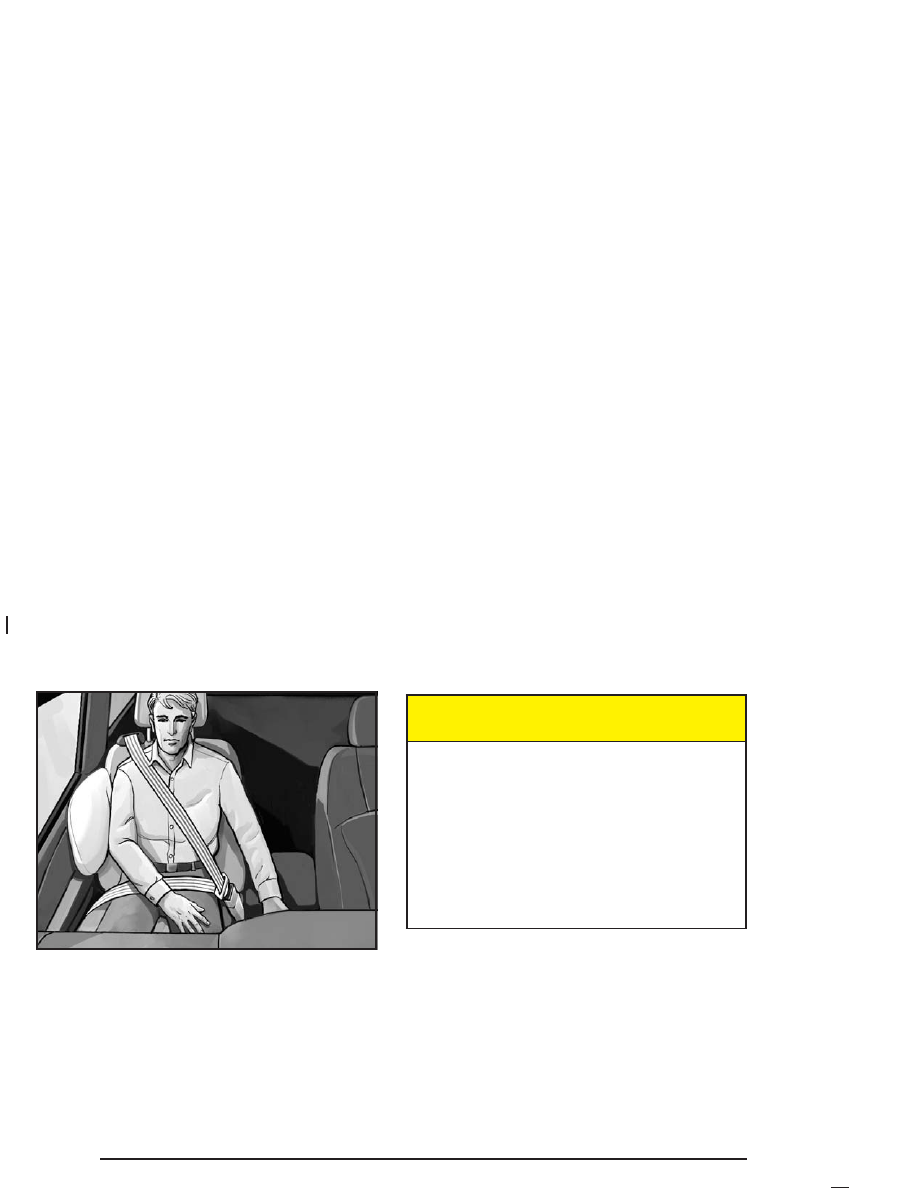
If your vehicle has a right front passenger’s side impact
air bag it is located in the side of the passenger’s
seatback closest to the door.

{

CAUTION:

If something is between an occupant and an
air bag, the bag might not inflate properly or it
might force the object into that person causing
severe injury or even death. The path of an
inflating air bag must be kept clear. Don’t put
anything between an occupant and an air bag,
and don’t attach or put anything on the
steering wheel hub or on or near any other air
bag covering. Don’t let seat covers block the
inflation path of a side impact air bag.

1-50

-------------------------------------------------------------------------------------------------------------------------------------------------------------

-------------------------------------------------------------------------------------------------------------------------------------------------------------

When Should an Air Bag Inflate?

The driver’s and right front passenger’s frontal air bags
are designed to inflate in moderate to severe frontal
or near-frontal crashes. But they are designed to inflate
only if the impact speed is above the system’s
designed “threshold level.”

In addition, your vehicle has “dual stage” frontal air bags,
which adjust the amount of restraint according to crash
severity. For moderate frontal impacts, these air bags
inflate at a level less than full deployment. For more
severe frontal impacts, full deployment occurs. If the front
of your vehicle goes straight into a wall that doesn’t move
or deform, the threshold level for the reduced deployment
is about 12 to 16 mph (19 to 26 km/h), and the threshold
level for a full deployment is about 16 to 25 mph (26 to
40 km/h). The threshold level can vary, however, with
specific vehicle design, so that it can be somewhat above
or below this range.

If your vehicle strikes something that will move or
deform, such as a parked car, the threshold level will be
higher. The driver’s and right front passenger’s frontal
air bags are not designed to inflate in rollovers, rear
impacts, or in many side impacts because inflation
would not help the occupant.

Your vehicle may or may not have a side impact air
bag. See Air Bag Systems in the Index. Side impact air
bags are designed to inflate in moderate to severe
side crashes. A side impact air bag will inflate if
the crash severity is above the system’s designed
“threshold level.” The threshold level can vary with
specific vehicle design. Side impact air bags are
not designed to inflate in frontal or near-frontal impacts,
rollovers or rear impacts, because inflation would not
help the occupant. A side impact air bag will only deploy
on the side of the vehicle that is struck.

In any particular crash, no one can say whether an air
bag should have inflated simply because of the damage
to a vehicle or because of what the repair costs were.
For frontal air bags, inflation is determined by the angle
of the impact and how quickly the vehicle slows down
in frontal and near-frontal impacts. For side impact
air bags, inflation is determined by the location
and severity of the impact.

The air bag system is designed to work properly under
a wide range of conditions, including off-road usage.
Observe safe driving speeds, especially on rough
terrain. As always, wear your safety belt. See Operating
Your All-Wheel-Drive Vehicle Off Paved Roads 
on
page 4-16 
for tips on off-road driving.

1-51

-------------------------------------------------------------------------------------------------------------------------------------------------------------

-------------------------------------------------------------------------------------------------------------------------------------------------------------

What Makes an Air Bag Inflate?

In an impact of sufficient severity, the air bag sensing
system detects that the vehicle is in a crash. For
both frontal and side impact air bags, the sensing
system triggers a release of gas from the inflator, which
inflates the air bag. The inflator, the air bag and
related hardware are all part of the air bag modules.
Frontal air bag modules are located inside the steering
wheel and instrument panel. For vehicles with side
impact air bags, the air bag modules are located in the
seatback closest to the driver’s and/or right front
passenger’s door.

How Does an Air Bag Restrain?

In moderate to severe frontal or near frontal collisions,
even belted occupants can contact the steering wheel or
the instrument panel. In moderate to severe side
collisions, even belted occupants can contact the inside
of the vehicle. The air bag supplements the protection
provided by safety belts. Air bags distribute the force of
the impact more evenly over the occupant’s upper
body, stopping the occupant more gradually. But the

frontal air bags would not help you in many types of
collisions, including rollovers, rear impacts, and
many side impacts, primarily because an occupant’s
motion is not toward the air bag. Side impact air bags
would not help you in many types of collisions,
including frontal or near frontal collisions, rollovers, and
rear impacts, primarily because an occupant’s motion
is not toward those air bags. Air bags should never
be regarded as anything more than a supplement to
safety belts, and then only in moderate to severe frontal
or near-frontal collisions for the driver’s and right front
passenger’s frontal air bags, and only in moderate
to severe side collisions for vehicles with a driver’s and
right front passenger’s side impact air bag.

1-52

-------------------------------------------------------------------------------------------------------------------------------------------------------------

-------------------------------------------------------------------------------------------------------------------------------------------------------------

What Will You See After an Air Bag
Inflates?

After the air bag inflates, it quickly deflates, so quickly
that some people may not even realize the air bag
inflated. Some components of the air bag module will be
hot for a short time. These components include the
steering wheel hub for the driver’s frontal air bag and the
instrument panel for the right front passenger’s frontal
air bag. For vehicles with side impact air bags, the side
of the seatback closest to the driver’s and/or right
front passenger’s door will be hot. The parts of the bag
that come into contact with you may be warm, but
not too hot to touch. There will be some smoke and dust
coming from the vents in the deflated air bags. Air
bag inflation doesn’t prevent the driver from seeing or
being able to steer the vehicle, nor does it stop
people from leaving the vehicle.

{

CAUTION:

When an air bag inflates, there is dust in the
air. This dust could cause breathing problems
for people with a history of asthma or other
breathing trouble. To avoid this, everyone in
the vehicle should get out as soon as it is safe
to do so. If you have breathing problems but
can’t get out of the vehicle after an air bag
inflates, then get fresh air by opening a
window or a door. If you experience breathing
problems following an air bag deployment, you
should seek medical attention.

Your vehicle has a feature that will automatically unlock
the doors and turn the interior lamps on when the air
bags inflate (if battery power is available). You can lock
the doors again and turn the interior lamps off by
using the door lock and interior lamp controls.

In many crashes severe enough to inflate an air bag,
windshields are broken by vehicle deformation.
Additional windshield breakage may also occur from the
right front passenger air bag.

1-53

-------------------------------------------------------------------------------------------------------------------------------------------------------------

-------------------------------------------------------------------------------------------------------------------------------------------------------------

Air bags are designed to inflate only once. After an
air bag inflates, you’ll need some new parts for
your air bag system. If you don’t get them, the air
bag system won’t be there to help protect you
in another crash. A new system will include air bag
modules and possibly other parts. The service
manual for your vehicle covers the need to replace
other parts.

Your vehicle is equipped with electronic frontal
sensors, which help the sensing system distinguish
between a moderate frontal impact and a more
severe frontal impact. Your vehicle is also equipped
with a crash sensing and diagnostic module,
which records information about the frontal air bag
system. The module records information about
the readiness of the system, when the system
commands air bag inflation and driver’s safety belt
usage at deployment. The module also records
speed, engine rpm, brake and throttle data.

Let only qualified technicians work on your air bag
systems. Improper service can mean that an air bag
system won’t work properly. See your dealer for
service.

Notice: If you damage the covering for the driver’s
or the right front passenger’s air bag, or the air bag
covering on the driver’s and right front passenger’s
seatback, the bag may not work properly. You may
have to replace the air bag module in the steering
wheel, both the air bag module and the instrument
panel for the right front passenger’s air bag, or both
the air bag module and seatback for the driver’s and
right front passenger’s side impact air bag. Do not
open or break the air bag coverings.

1-54

-------------------------------------------------------------------------------------------------------------------------------------------------------------

-------------------------------------------------------------------------------------------------------------------------------------------------------------

Servicing Your Air Bag-Equipped
Vehicle

Air bags affect how your vehicle should be serviced.
There are parts of the air bag systems in several places
around your vehicle. Your dealer and the service
manual have information about servicing your vehicle
and the air bag systems. To purchase a service manual,
see Service Publications Ordering Information on
page 7-12
.

{

CAUTION:

For up to 10 minutes after the ignition key is
turned of and the battery is disconnected, an
air bag can still inflate during improper
service. You can be injured if you are close to
an air bag when it inflates. Avoid yellow
connectors. They are probably part of the air
bag system. Be sure to follow proper service
procedures, and make sure the person
performing work for you is qualified to do so.

The air bag systems do not need regular maintenance.

Restraint System Check

Checking Your Restraint Systems

Now and then, make sure the safety belt reminder light
and all your belts, buckles, latch plates, retractors
and anchorages are working properly. Look for any other
loose or damaged safety belt system parts. If you see
anything that might keep a safety belt system from doing
its job, have it repaired.

Torn or frayed safety belts may not protect you in a
crash. They can rip apart under impact forces. If a belt
is torn or frayed, get a new one right away.

Also look for any opened or broken air bag covers, and
have them repaired or replaced. (The air bag system
does not need regular maintenance.)

1-55

-------------------------------------------------------------------------------------------------------------------------------------------------------------

-------------------------------------------------------------------------------------------------------------------------------------------------------------

Replacing Restraint System Parts
After a Crash

{

CAUTION:

A crash can damage the restraint systems in
your vehicle. A damaged restraint system may
not properly protect the person using it,
resulting in serious injury or even death in a
crash. To help make sure your restraint
systems are working properly after a crash,
have them inspected and any necessary
replacements made as soon as possible.

If you’ve had a crash, do you need new belts or LATCH
system parts?

After a very minor collision, nothing may be necessary.
But if the belts were stretched, as they would be if worn
during a more severe crash, then you need new parts.

If the LATCH system was being used during a more
severe crash, you may need new LATCH system parts.

If belts are cut or damaged, replace them. Collision
damage also may mean you will need to have LATCH
system, safety belt or seat parts repaired or replaced.
New parts and repairs may be necessary even if the belt
or LATCH system wasn’t being used at the time of
the collision.

If an air bag inflates, you’ll need to replace air bag
system parts. See the part on the air bag system earlier
in this section.

1-56

-------------------------------------------------------------------------------------------------------------------------------------------------------------

-------------------------------------------------------------------------------------------------------------------------------------------------------------

Keys ...............................................................2-3

Remote Keyless Entry System .........................2-4
Remote Keyless Entry System Operation ...........2-5

Doors and Locks .............................................2-7

Door Locks ....................................................2-7
Power Door Locks ..........................................2-8
Delayed Locking .............................................2-9
Programmable Automatic Door Locks ................2-9
Rear Door Security Locks ..............................2-12
Lockout Protection ........................................2-12
Leaving Your Vehicle ....................................2-12
Liftgate/Liftglass ............................................2-13

Windows ........................................................2-14

Power Windows ............................................2-15
Sun Visors ...................................................2-15

Theft-Deterrent Systems ..................................2-16

Content Theft-Deterrent .................................2-16
Passlock

®

....................................................2-18

Starting and Operating Your Vehicle ................2-18

New Vehicle Break-In ....................................2-18

Ignition Positions ..........................................2-19
Starting Your Engine .....................................2-20
Engine Coolant Heater ..................................2-21
Automatic Transmission Operation ...................2-22
All-Wheel Drive ............................................2-24
Parking Brake ..............................................2-24
Shifting Into Park (P) .....................................2-25
Shifting Out of Park (P) .................................2-26
Parking Over Things That Burn .......................2-27
Engine Exhaust ............................................2-27
Running Your Engine While You Are Parked ....2-28

Mirrors ...........................................................2-29

Automatic Dimming Rearview Mirror with

OnStar

®

and Compass ...............................2-29

Outside Manual Mirrors ..................................2-31
Outside Power Mirror ....................................2-31
Outside Convex Mirror ...................................2-31
Outside Heated Mirrors ..................................2-32
Outside Automatic Dimming Mirror with Curb

View Assist ..............................................2-32

Section 2

Features and Controls

2-1

-------------------------------------------------------------------------------------------------------------------------------------------------------------

-------------------------------------------------------------------------------------------------------------------------------------------------------------

-------------------------------------------------------------------------------------------------------------------------------------------------------------

-------------------------------------------------------------------------------------------------------------------------------------------------------------

Keys

{

CAUTION:

Leaving children in a vehicle with the ignition
key is dangerous for many reasons. They
could operate the power windows or other
controls or even make the vehicle move. The
children or others could be badly injured or
even killed. Do not leave the keys in a vehicle
with children.

2-3

-------------------------------------------------------------------------------------------------------------------------------------------------------------

-------------------------------------------------------------------------------------------------------------------------------------------------------------

This vehicle has one
double-sided key for the
ignition and door lock.
It will fit with either side up.

When a new vehicle is delivered, the dealer provides
the owner with a pair of identical keys and a key
code number.

The key code number tells your dealer or a qualified
locksmith how to make extra keys. Keep this number in
a safe place. If you lose your keys, you’ll be able to
have new ones made easily using this number.
Your selling dealer should also have this number.

Notice: If you ever lock your keys in your vehicle,
you may have to damage the vehicle to get in.
Be sure you have spare keys.

If you ever do get locked out of your vehicle, call the
GM Roadside Assistance Center. See Roadside
Assistance Program 
on page 7-6.

If your vehicle is equipped with the OnStar

®

system with

an active subscription and you lock your keys inside
the vehicle, OnStar

®

may be able to send a command to

unlock your vehicle. See OnStar

®

System on page 2-32

for more information.

Remote Keyless Entry System

Your keyless entry system operates on a radio
frequency subject to Federal Communications
Commission (FCC) Rules and with Industry Canada.

This device complies with Part 15 of the FCC Rules.
Operation is subject to the following two conditions:

1. This device may not cause interference, and

2. This device must accept any interference received,

including interference that may cause undesired
operation of the device.

This device complies with RSS-210 of Industry Canada.
Operation is subject to the following two conditions:

1. This device may not cause interference, and

2. This device must accept any interference received,

including interference that may cause undesired
operation of the device.

2-4

-------------------------------------------------------------------------------------------------------------------------------------------------------------

-------------------------------------------------------------------------------------------------------------------------------------------------------------

Changes or modifications to this system by other than
an authorized service facility could void authorization to
use this equipment.

At times you may notice a decrease in range. This is
normal for any remote keyless entry system. If the
transmitter does not work or if you have to stand closer
to your vehicle for the transmitter to work, try this:

Check the distance. You may be too far from your
vehicle. You may need to stand closer during
rainy or snowy weather.

Check the location. Other vehicles or objects may
be blocking the signal. Take a few steps to the
left or right, hold the transmitter higher, and
try again.

Check to determine if battery replacement is
necessary. See “Battery Replacement” under
Remote Keyless Entry System Operation on
page 2-5
.

If you are still having trouble, see your dealer or a
qualified technician for service.

Remote Keyless Entry System
Operation

With this system you can lock and unlock your doors
from about 3 feet (1 m) up to 30 feet (9 m) away
using the remote keyless entry transmitter supplied with
your vehicle.

K

(Unlock): When you

press unlock, the driver’s
door will unlock
automatically, the parking
lamps may flash and the
interior lights will go on.

You can program different feedback settings through the
Driver Information Center (DIC). For more information
see Driver Information Center (DIC) on page 3-45.

2-5

-------------------------------------------------------------------------------------------------------------------------------------------------------------

-------------------------------------------------------------------------------------------------------------------------------------------------------------

Q

(Lock): Press lock to lock all the doors. Press lock

again within three seconds and the horn may chirp.

L

(Panic): Press the horn symbol to make the horn

sound. The headlamps and taillamps will also flash
for up to 30 seconds. This can be turned off by pressing
the horn button again, or by waiting for 30 seconds,
or by starting the vehicle.

Matching Transmitter(s) to Your
Vehicle

Each remote keyless entry transmitter is coded to
prevent another transmitter from unlocking your vehicle.
If a transmitter is lost or stolen, a replacement can
be purchased through your dealer. Remember to bring
any remaining transmitters with you when you go to
your dealer. When the dealer matches the replacement
transmitter to your vehicle, any remaining transmitters
must also be matched. Once your dealer has coded the
new transmitter, the lost transmitter will not unlock
your vehicle. Each vehicle can have a maximum of four
transmitters matched to it.

Battery Replacement

Under normal use, the battery in your remote keyless
entry transmitter should last about two years.

You can tell the battery is weak if the transmitter won’t
work at the normal range in any location. If you have
to get close to your vehicle before the transmitter works,
it’s probably time to change the battery.

The Driver Information Center (DIC) will display a RFA
# BATTERY LOW message when the transmitter
battery is low.

Notice: When replacing the battery, use care not to
touch any of the circuitry. Static from your body
transferred to these surfaces may damage the
transmitter.

2-6

-------------------------------------------------------------------------------------------------------------------------------------------------------------

-------------------------------------------------------------------------------------------------------------------------------------------------------------

To replace the battery in the remote keyless entry
transmitter do the following:

1. Insert a thin coin in the slot between the covers of

the transmitter housing. Gently pry the transmitter
apart.

2. Remove and replace the battery with a three-volt

CR2032 or equivalent battery, positive (+) side down.

3. Align the covers and snap them together.

4. Check the operation of the transmitter.

Doors and Locks

Door Locks

{

CAUTION:

Unlocked doors can be dangerous.

Passengers — especially children — can
easily open the doors and fall out of a
moving vehicle. When a door is locked, the
handle will not open it. You increase the
chance of being thrown out of the vehicle
in a crash if the doors are not locked. So,
wear safety belts properly and lock the
doors whenever you drive.

Young children who get into unlocked
vehicles may be unable to get out. A child
can be overcome by extreme heat and can
suffer permanent injuries or even death
from heat stroke. Always lock your vehicle
whenever you leave it.

Outsiders can easily enter through an
unlocked door when you slow down or
stop your vehicle. Locking your doors can
help prevent this from happening.

2-7

-------------------------------------------------------------------------------------------------------------------------------------------------------------

-------------------------------------------------------------------------------------------------------------------------------------------------------------

There are several ways to lock and unlock your vehicle.
You can use the remote keyless entry transmitter.

You can use your key to unlock your door from the
outside.

You can lock or unlock the door from the inside by
sliding the manual lever forward or rearward.
When the door is unlocked, you can see a red area on
the lever.

The manual lever on each door works only
that door’s lock.

Power Door Locks

The power door lock
switches are located on
the driver’s and front
passenger’s armrests.

Remove the ignition key and press the lock symbol to
lock all of the doors at once. To unlock the doors, press
the other side of the switch.

2-8

-------------------------------------------------------------------------------------------------------------------------------------------------------------

-------------------------------------------------------------------------------------------------------------------------------------------------------------

Delayed Locking

This feature delays the locking of the doors and the
liftgate when using the power lock or the remote keyless
entry system.

The first time you attempt to lock the doors with the
driver’s door open, three chimes will signal that delayed
locking is being used. This can be performed by
using the power lock switch or the remote keyless entry
transmitter. All doors and the liftgate can be reopened
for up to five seconds from the time the last door is
closed.

Five seconds after the last door is closed, all the doors
will lock. You can lock the doors immediately by
using the power door lock switch or by pressing the lock
button on the optional remote keyless entry transmitter
a second time.

If the key is inserted in the ignition, this feature will not
lock the doors. The lockout prevention feature will
operate instead.

You can enable or disable the delayed locking feature.
If the feature is disabled, the doors will lock immediately
when a power door lock switch or remote keyless
entry transmitter lock button is pressed.

Programming Delayed Locking

When your vehicle was shipped from the factory, the
delayed locking feature was programmed on, or
enabled. The mode may have been changed since it
left the factory. To turn the delayed locking feature on or
off, do the following:

1. Press and hold the power door lock switch on the

driver’s door in the lock position.

2. Press the remote keyless entry transmitter unlock

button twice.

If the delayed locking feature was on, it will now be off.
If the feature was off, it will now be on.

Programmable Automatic Door
Locks

Your vehicle is equipped with an automatic lock/unlock
feature which enables you to program your vehicle’s
power door locks. You can program this feature through
the Driver Information Center (DIC), or by the following
method.

2-9

-------------------------------------------------------------------------------------------------------------------------------------------------------------


Content      ..     2      3      4      5     ..