Genesis G90 (2017 year). Manual - part 25
 

  Index      Genesis     Genesis G90 (2017 year) - manual in english


Search            copyright infringement  


Content      ..     23      24      25      26     ..


Genesis G90 (2017 year). Manual - part 25


7-13

07

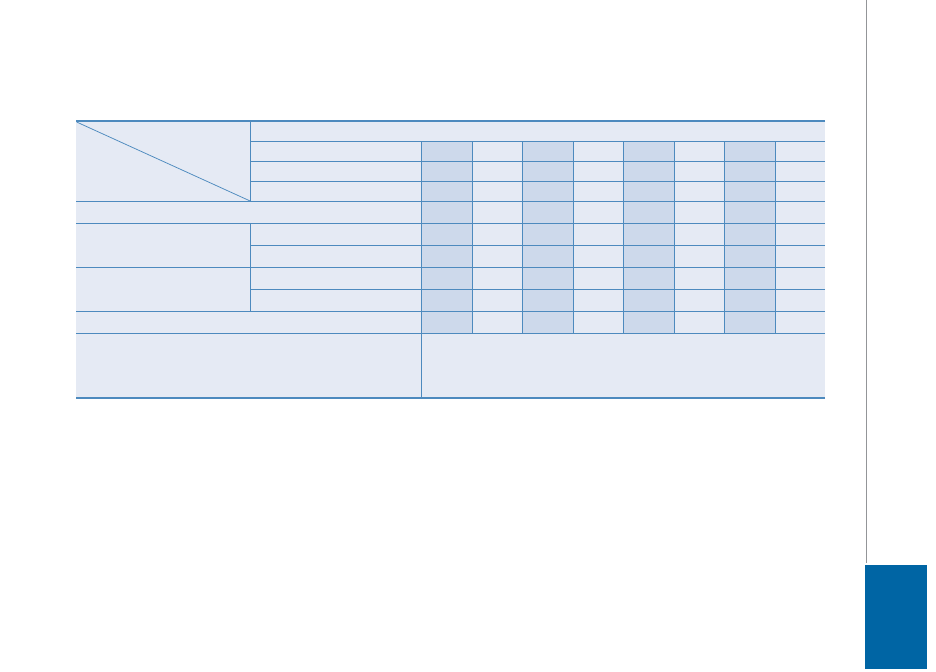
NORMAL MAINTENANCE SCHEDULE

I : Inspect and if necessary, adjust, correct, clean or replace.

R : Replace or change.

*

6

: The fuel filter is considered to be maintenance free but periodic inspection is recommended for this maintenance schedule

depends on fuel quality. If there are some important matters like fuel flow restriction, surging, loss of power, hard starting
problem etc, replace the fuel filter immediately regardless of maintenance schedule. We recommend that you consult an
authorized retailer of Genesis Branded products for details.

Number of months or driving distance, whichever comes first

96

80

120

I

R

I

R

I

I

Inspect “Coolant level adjustment and leak” every day.

At first, inspect 60,000 km (40,000 miles) or 

48 months after that, inspect every 30,000 km (20,000 miles) or 24

months

84

70

105

I

72

60

90

I

I

I

60

50

75

I

48

40

60

I

R

I

R

I

I

36

30

45

I

24

20

30

I

I

I

12

10

15

I

Months

Miles×1,000

Km×1,000

Vacuum hose and crankcase ventilation hoses

Except Europe, For Russia

For Europe, Except Russia

Except Europe, For Russia

For Europe, Except Russia

Fuel lines, hoses and connections

Cooling system

Fuel tank air filter

Fuel filter *

6

MAINTENANCE

INTERVALS

MAINTENANCE
ITEM

-------------------------------------------------------------------------------------------------------------------------------------------------------------

7-14

Maintenance

NORMAL MAINTENANCE SCHEDULE

I : Inspect and if necessary, adjust, correct, clean or replace.

R : Replace or change.

*

7

: When adding coolant, use only deionized water or soft water for your vehicle and never mix hard water in the coolant filled

at the factory. An improper coolant mixture can result in serious malfunction or engine damage. For your convenience, it
can be replaced prior to it's interval when you do maintenance of other items.

Number of months or driving distance, whichever comes first

96

80

120

At first, replace at 200,000 km (120,000 miles) or 120 months :

after that, replace every 40,000 km (25,000 miles) or 24 months

At first, replace at 210,000 km (120,000 miles) or 120 months :

after that, replace every 30,000 km (20,000 miles) or 24 months

I

I

I

I

I

I

R

84

70

105

I

I

I

I

72

60

90

I

I

I

I

I

I

R

60

50

75

I

I

I

I

48

40

60

I

I

I

I

I

I

R

36

30

45

I

I

I

I

24

20

30

I

I

I

I

I

I

R

12

10

15

I

I

I

I

Months

Miles×1,000

Km×1,000

Except Europe, 

For Russia

For Europe, 

Except Russia

Battery condition

All electrical systems

Brake lines, hoses and connections

Brake pedal

Parking brake

Except Europe, 
For Russia

For Europe, 
Except Russia

Engine coolant *

7

Brake fluid

MAINTENANCE

INTERVALS

MAINTENANCE
ITEM

-------------------------------------------------------------------------------------------------------------------------------------------------------------

7-15

07

I : Inspect and if necessary, adjust, correct, clean or replace.

R : Replace or change.

*

8

: Front/Rear differential oil should be changed anytime they have been submerged in water.

NORMAL MAINTENANCE SCHEDULE

Number of months or driving distance, whichever comes first

96

80

120

I

I

I

I

I

I

I

I

I

R

R

No check, No service required

I

I

84

70

105

I

I

I

I

I

I

I

R

I

72

60

90

I

I

I

I

I

I

I

I

I

R

R

I

60

50

75

I

I

I

I

I

I

I

R

I

48

40

60

I

I

I

I

I

I

I

I

I

R

R

I

I

36

30

45

I

I

I

I

I

I

I

R

I

24

20

30

I

I

I

I

I

I

I

I

I

R

R

I

12

10

15

I

I

I

I

I

I

I

R

I

Months

Miles×1,000

Km×1,000

Disc brakes and pads

Steering gear rack, linkage and boots

Driveshaft and boots

Tire (pressure & tread wear)

Front suspension ball joints

Bolt and nuts on chassis and body

Exhaust system

Air conditioner refrigerant

Air conditioner compressor

Except Europe, For Russia

For Europe, Except Russia

Automatic transmission fluid

Front(AWD)/Rear differential oil *

8

Propeller shaft

Climate control air filter

MAINTENANCE

INTERVALS

MAINTENANCE
ITEM

-------------------------------------------------------------------------------------------------------------------------------------------------------------

7-16

Maintenance

MAINTENANCE UNDER SEVERE USAGE CONDITIONS

The following items must be serviced more frequently on cars mainly used under severe driving conditions.
Refer to the chart below for the appropriate maintenance intervals.
R : Replace     I : Inspect and if necessary, adjust, correct, clean or replace

Driving 

condition

A, B, C, D, E,

F, G, H, I, J,

K

C, E

A, B, H, I

C, D, E, F, G

C, E

C, D, E, F, G

C, D, E, G, H

Maintenance intervals

5,000 km (3,000 miles) or 

6 months

7,500 km (4,500 miles) or 

6 months

5,000 km (3,000 miles) or 

6 months

7,500 km (4,500 miles) or 

6 months

5,000 km (3,000 miles) or 

6 months

Replace more frequently depending on the condition

Replace more frequently depending on the condition

Inspect more frequently depending on the condition

Every 15,000 km (10,000 miles) or 12 months

Inspect more frequently depending on the condition

Inspect more frequently depending on the condition

3.3 T-GDI

Except Middle East,

Central & South America

For Middle East, Central

& South America

Except Middle East

For Middle East

3.8

GDI

5.0

GDI

Maintenance

operation

R

R

R

I

I

I

I

Maintenance item

Engine oil and 
engine oil filter

Air cleaner filter

Spark plugs 

Steering gear rack, linkage
and boots

Propeller shaft 

Front suspension ball joints

Disc brakes and pads,
calipers and rotors

-------------------------------------------------------------------------------------------------------------------------------------------------------------

7-17

07

Severe driving conditions

A : Repeatedly driving short distance of less than 8 km (5

miles) in normal temperature or less than 16 km (10
miles) in freezing temperature

B : Extensive engine idling or low speed driving for long dis-

tances

C : Driving on rough, dusty, muddy, unpaved, graveled or salt-

spread roads

D : Driving in areas using salt or other corrosive materials or

in very cold weather

E : Driving in the condition of inflowing sand or dust into

engine

F : Driving in heavy traffic area
G : Driving on uphill, downhill, or mountain roads
H : Towing a trailer (if equipped)
I : Driving for patrol car, taxi, commercial car or vehicle tow-

ing

J : Driving over 170 km/h (106 mile/h)
K : Frequently driving in stop-and-go conditions

Driving 

condition

C, D, G, H

C, D, E, F, H

C, E

A, C, D, E, F, G,

H, I, K

C, G, H, I, J

Maintenance intervals

Inspect more frequently depending on 

the condition

Inspect more frequently depending on 

the condition

Replace more frequently depending 

on the condition

Every 100,000 km (62,000 miles)

Every 90,000 km (60,000 miles)

Every 120,000 km (80,000 miles)

Except for

Europe

For Europe

Maintenance

operation

I

I

R

R

R

Maintenance item

Parking brake

Driveshaft and boots

Climate control air filter 
(if equipped)

Automatic transmission fluid

Front(AWD)/Rear differential oil

-------------------------------------------------------------------------------------------------------------------------------------------------------------

7-18

Maintenance

Engine oil and filter

The engine oil and filter should be
changed at the intervals specified in
the maintenance schedule. If the car
is being driven in severe conditions,
more frequent oil and filter changes
are required.

Drive belts

Inspect all drive belts for evidence of
cuts, cracks, excessive wear or oil
saturation and replace if necessary.
Drive belts should be checked peri-
odically for proper tension and
adjusted as necessary.

When you are inspecting the belt,
place the Engine Start/Stop button
in the OFF or ACC position.

Fuel filter (cartridge)

A clogged filter can limit the speed at
which the vehicle may be driven,
damage the emission system and
cause multiple issues such as hard
starting. If an excessive amount of
foreign matter accumulates in the
fuel tank, the filter may require
replacement more frequently.
After installing a new filter, run the
engine for several minutes, and
check for leaks at the connections.
We recommend that the fuel filter be
replaced by an authorized retailer of
Genesis Branded products.

Fuel lines, fuel hoses and con-
nections

Check the fuel lines, fuel hoses and
connections for leakage and dam-
age. We recommend that the fuel
lines, fuel hoses and connections be
replaced by an authorized retailer of
Genesis Branded products.

Vapor hose and fuel filler cap

The vapor hose and fuel filler cap
should be inspected at those inter-
vals specified in the maintenance
schedule. Make sure that a new
vapor hose or fuel filler cap is cor-
rectly replaced.

Vacuum crankcase ventilation
hoses (if equipped)

Inspect the surface of hoses for evi-
dence of heat and/or mechanical
damage. Hard and brittle rubber,
cracking, tears, cuts, abrasions, and
excessive swelling indicate deterio-
ration. Particular attention should be
paid to examine those hose surfaces
nearest to high heat sources, such
as the exhaust manifold.
Inspect the hose routing to assure
that the hoses do not come in con-
tact with any heat source, sharp
edges or moving component which
might cause heat damage or
mechanical wear. Inspect all hose
connections, such as clamps and
couplings, to make sure they are
secure, and that no leaks are pres-
ent. Hoses should be replaced
immediately if there is any evidence
of deterioration or damage.

NOTICE

E

EX

XP

PL

LA

AN

NA

AT

TIIO

ON

N  O

OF

F  S

SC

CH

HE

ED

DU

UL

LE

ED

D  M

MA

AIIN

NT

TE

EN

NA

AN

NC

CE

E  IIT

TE

EM

MS

S

-------------------------------------------------------------------------------------------------------------------------------------------------------------

7-19

07

Air cleaner filter

We recommend that the air cleaner
filter be replaced by an authorized
retailer of Genesis Branded products.

Spark plugs

Make sure to install new spark plugs
of the correct heat range.

Valve clearance 
(3.3 T-GDI / 3.8 GDI Engine)

Inspect excessive valve noise and/or
engine vibration and adjust if neces-
sary. We recommend that the system
be serviced by an authorized retailer
of Genesis Branded products.

Cooling system

Check the cooling system parts,
such as radiator, coolant reservoir,
hoses and connections for leakage
and damage. Replace any damaged
parts.

Coolant

The coolant  should  be  changed at
the intervals specified in the mainte-
nance schedule.

Automatic transmission fluid 

Automatic transmission fluid should
not be checked under normal usage
conditions.
We recommend that the automatic
transmission fluid changed by an
authorized retailer of Genesis Branded
products according to the mainte-
nance schedule.

Information 

Automatic transmission fluid color is
basically red. 
As the vehicle is driven, the automatic
transmission fluid will begin to look
darker. 
It is normal condition and you should
not judge the need to replace the fluid
based upon the changed color.

The use of a non-specified fluid
could result in transmission mal-
function and failure.
Use only specified automatic
transmission fluid.

(Refer to

“Recommended lubricants and
capacities” in section 8.)

Brake hoses and lines

Visually check for proper installation,
chafing, cracks, deterioration and
any leakage. Replace any deteriorat-
ed or damaged parts immediately.

NOTICE

i

Do not disconnect and inspect
spark plugs when the engine is
hot. You may burn yourself.

WARNING

-------------------------------------------------------------------------------------------------------------------------------------------------------------

7-20

Maintenance

Brake fluid

Check brake fluid level in the brake
fluid reservoir. The level should be
between “MIN” and “MAX” marks on
the side of the reservoir. Use only
hydraulic brake fluid conforming to
DOT 3 or DOT 4 specification.

Brake pads, calipers and
rotors

Check the pads for excessive wear,
discs for run out and wear, and
calipers for fluid leakage.
For more information on checking
the pads or lining wear limit, refer to
the Genesis Branded Vehicle web
site.
(http://service.hyundai-motor.com)

Suspension mounting bolts

Check the suspension connections
for looseness or damage. Retighten
to the specified torque.

Steering gear box, linkage &
boots/lower arm ball joint

With the vehicle stopped and engine
off, check for excessive free-play in
the steering wheel.
Check the linkage for bends or dam-
age. Check the dust boots and ball
joints for deterioration, cracks, or dam-
age. Replace any damaged parts.

Drive shafts and boots

Check the drive shafts, boots and
clamps for cracks, deterioration, or
damage. Replace any damaged
parts and, if necessary, repack the
grease.

Air conditioning refrigerant/
compressor

Check the air conditioning lines and
connections for leakage and damage.

-------------------------------------------------------------------------------------------------------------------------------------------------------------

7-21

07

Checking the engine oil level  

1. Be sure the vehicle is on level

ground.

2. Start the engine and allow it to

reach normal operating tempera-
ture.

3. Turn the engine off and wait for a

few minutes (about 5 minutes) for
the oil to return to the oil pan.

4. Pull the dipstick out, wipe it clean,

and re-insert it fully.

5. Pull the dipstick out again and

check the level. The level should
be between F and L.

• Do not overfill the engine oil. It

may damage the engine.

• Do not spill engine oil, when

adding or changing engine oil. If
you drop the engine oil on the
engine room, wipe it off immedi-
ately.

• When you wipe the oil level

gauge, you should wipe it with a
clean cloth. When mixed with
debris, it can cause engine dam-
age.

NOTICE

E

EN

NG

GIIN

NE

E  O

OIIL

L

OHI076004

Lambda 3.3 T-GDI

OHI076005

■ 

Lambda 3.8 GDI

OHI076006

■ 

Tau 5.0 GDI

Radiator hose

Be very careful not to touch the
radiator hose when checking or
adding the engine oil as it may
be hot enough to burn you.

WARNING

-------------------------------------------------------------------------------------------------------------------------------------------------------------

7-22

Maintenance

If it is near or at L, add enough oil to
bring the level to F. Do not overfill.
Use a funnel to help prevent oil
from being spilled on engine com-
ponents.
Use only the specified engine oil.
(Refer to “Recommended lubricants
and capacities” in section 8.)

Changing the engine oil and
filter

We recommend that the engine oil
and filter be replaced by an author-
ized retailer of Genesis Branded
products.

OHI076007

Lambda 3.3 T-GDI

OHI076008

■ 

Lambda 3.8 GDI

OHI076009

■ 

Tau 5.0 GDI

Used engine oil may cause irri-
tation or cancer of the skin if
left in contact with the skin for
prolonged periods of time. Used
engine oil contains chemicals
that have caused cancer in lab-
oratory animals. Always protect
your skin by washing your
hands thoroughly with soap
and warm water as soon as pos-
sible after handling used oil.

WARNING

-------------------------------------------------------------------------------------------------------------------------------------------------------------

7-23

07

The high-pressure cooling system
has a reservoir filled with year-round
antifreeze coolant. The reservoir is
filled at the factory.
Check the antifreeze protection and
coolant concentration level at least
once a year, at the beginning of the
winter season, and before traveling
to a colder climate.

• When the engine overheats from

low engine coolant, suddenly
adding engine coolant may
cause cracks in the engine. To
prevent damage, add engine
coolant slowly in small quanti-
ties.

• Do not drive with no engine

coolant. It may cause  water
pump failure and engine seizure,
etc.

Checking the coolant level     

NOTICE

E

EN

NG

GIIN

NE

E  C

CO

OO

OL

LA

AN

NT

T

Removing radiator

cap

• Never attempt to remove the

radiator cap while the engine
is operating or hot. Doing so
might lead to cooling system
and engine damage and could
result in serious personal
injury from escaping hot
coolant or steam.

• Turn the engine off and wait

until it cools down. Use
extreme care when removing
the radiator cap. Wrap a thick
towel around it, and turn it
counterclockwise slowly to
the first stop. Step back while
the pressure is released from
the cooling system.
When you are sure all the
pressure has been released,
press down on the cap, using
a thick towel, and continue
turning counterclockwise to
remove it.

• Even if the engine is not oper-

ating, do not remove the radi-
ator cap or the drain plug
while the engine and radiator
are hot. Hot coolant and
steam may still blow out
under pressure, causing seri-
ous injury.

WARNING

-------------------------------------------------------------------------------------------------------------------------------------------------------------

7-24

Maintenance

Check the condition and connections
of all cooling system hoses and
heater hoses. Replace any swollen
or deteriorated hoses.
The coolant level should be filled
between F (MAX) and L (MIN) marks
on the side of the coolant reservoir
when the engine is cool.
If the coolant level is low, add enough
distilled (deionized) or soft water.
Bring the level to F (MAX), but do not
overfill.
If frequent additions are required, we
recommend that the system be
inspected by an authorized retailer of
Genesis Branded products.

The electric motor
(cooling fan) is con-
trolled by engine
coolant temperature,
refrigerant pressure
and vehicle speed. It
may sometimes oper-

ate even when the engine is not
running. Use extreme caution
when working near the blades
of the cooling fan so that you
are not injured by a rotating fan
blades. As the engine coolant
temperature decreases,

the

electric motor will automatically
shut off. This is a normal condi-
tion.
The electric motor (cooling fan)
may operate until you discon-
nect the negative battery cable.

WARNING

OHI076010

■ 

Lambda 3.3 T-GDI / 3.8 GDI 

OHI076012

■ 

Tau 5.0 GDI

-------------------------------------------------------------------------------------------------------------------------------------------------------------

7-25

07

Recommended engine coolant

• When adding coolant, use only

deionized water or soft water for
your vehicle and never mix hard
water in the coolant filled at the fac-
tory. An improper coolant mixture
can result in serious malfunction or
engine damage.

• The engine in your vehicle has alu-

minum engine parts and must be
protected by an phosphate-based
ethylene glycol coolant to prevent
corrosion and freezing.

• DO NOT USE alcohol or methanol

coolant or mix them with the spec-
ified coolant.

• Do not use a solution that contains

more than 60% antifreeze or less
than 35% antifreeze, which would
reduce the effectiveness of the
solution.

For mixture percentage, refer to the
following table.

Ambient

Temperature

Mixture Percentage 

(volume)

Antifreeze

Water

-15°C (5°F)

35

65

-25°C (-13°F)

40

60

-35°C (-31°F)

50

50

-45°C (-49°F)

60

40

OHI076013

■ 

Lambda 3.3 T-GDI / 3.8 GDI 

OHI076015

■ 

Tau 5.0 GDI

Radiator cap
Do not remove the
radiator cap when the
engine and radiator
are hot. Scalding hot
coolant and steam
may blow out under
pressure causing seri-
ous injury.

WARNING

-------------------------------------------------------------------------------------------------------------------------------------------------------------

7-26

Maintenance

Changing the coolant

We recommend that the coolant be
replaced by an authorized retailer of
Genesis Branded products.

Put a thick cloth or fabric around
the radiator cap before refilling
the coolant in order to prevent the
coolant from overflowing into
engine parts such as generator.

NOTICE

Coolant

• Do not use radiator coolant or

antifreeze in the washer fluid
reservoir.

• Radiator coolant can severely

obscure visibility when
sprayed on the windshield
and may cause loss of vehicle
control or damage to paint
and body trim.

WARNING

-------------------------------------------------------------------------------------------------------------------------------------------------------------

7-27

07

Checking the brake fluid level  

Check the fluid level in the reservoir
periodically. The fluid level should be
between MAX and MIN marks on the
side of the reservoir.
Before removing the reservoir cap
and adding brake fluid, clean the
area around the reservoir cap thor-
oughly to prevent brake fluid contam-
ination.
If the level is low, add fluid to the
MAX level. The level will fall with
accumulated mileage. This is a nor-
mal condition associated with the
wear of the brake linings.
If the fluid level is excessively low, we
recommend that the system be
checked by an authorized retailer of
Genesis Branded products.

Use only the specified brake fluid.
(Refer to “Recommended lubricants
and capacities” in section 8.)

Never mix different types of fluid.

Information 

Before removing the brake filler cap,
read the warning on the cap.

i

B

BR

RA

AK

KE

E  F

FL

LU

UIID

D

OHI076016

Loss of brake fluid
In the event the brake system
requires frequent additions of
fluid, we recommend that the
system be inspected by an
authorized retailer of Genesis
Branded products.

WARNING

Clean filler cap before remov-
ing. Use only DOT3 or DOT4
brake fluid from a sealed con-
tainer.

WARNING

Brake fluid

When changing and adding
brake fluid, handle it carefully.
Do not let it come in contact
with your eyes. If brake fluid
should come in contact with
your eyes, immediately flush
them with a large quantity of
fresh tap water. Have your eyes
examined by a doctor as soon
as possible.

WARNING

-------------------------------------------------------------------------------------------------------------------------------------------------------------

7-28

Maintenance

Do not allow brake fluid to contact
the vehicle's body paint, as paint
damage will result. Brake fluid,
which has been exposed to open
air for an extended time should
never be used as its quality can-
not be guaranteed. It should be
disposed of properly. Don't put in
the wrong kind of fluid.
A few drops of mineral-based oil,
such as engine oil, in your brake
system can damage brake system
parts.

NOTICE

-------------------------------------------------------------------------------------------------------------------------------------------------------------


Content      ..     23      24      25      26     ..