НАК „НАФТОГАЗ УКРАЇНИ“. Річний звіт англійською (2018 рік) - 6


  Главная      Учебники - Разные     НАК „НАФТОГАЗ УКРАЇНИ“. Річний звіт англійською (2018 рік)


поиск по сайту            правообладателям  


содержание      ..     4      5      6      7     ..


НАК „НАФТОГАЗ УКРАЇНИ“. Річний звіт англійською (2018 рік) - 6


87

86

OPERATIONS

ANNUAL REPORT 2018

2018

UKRNAFTA PJSC

1

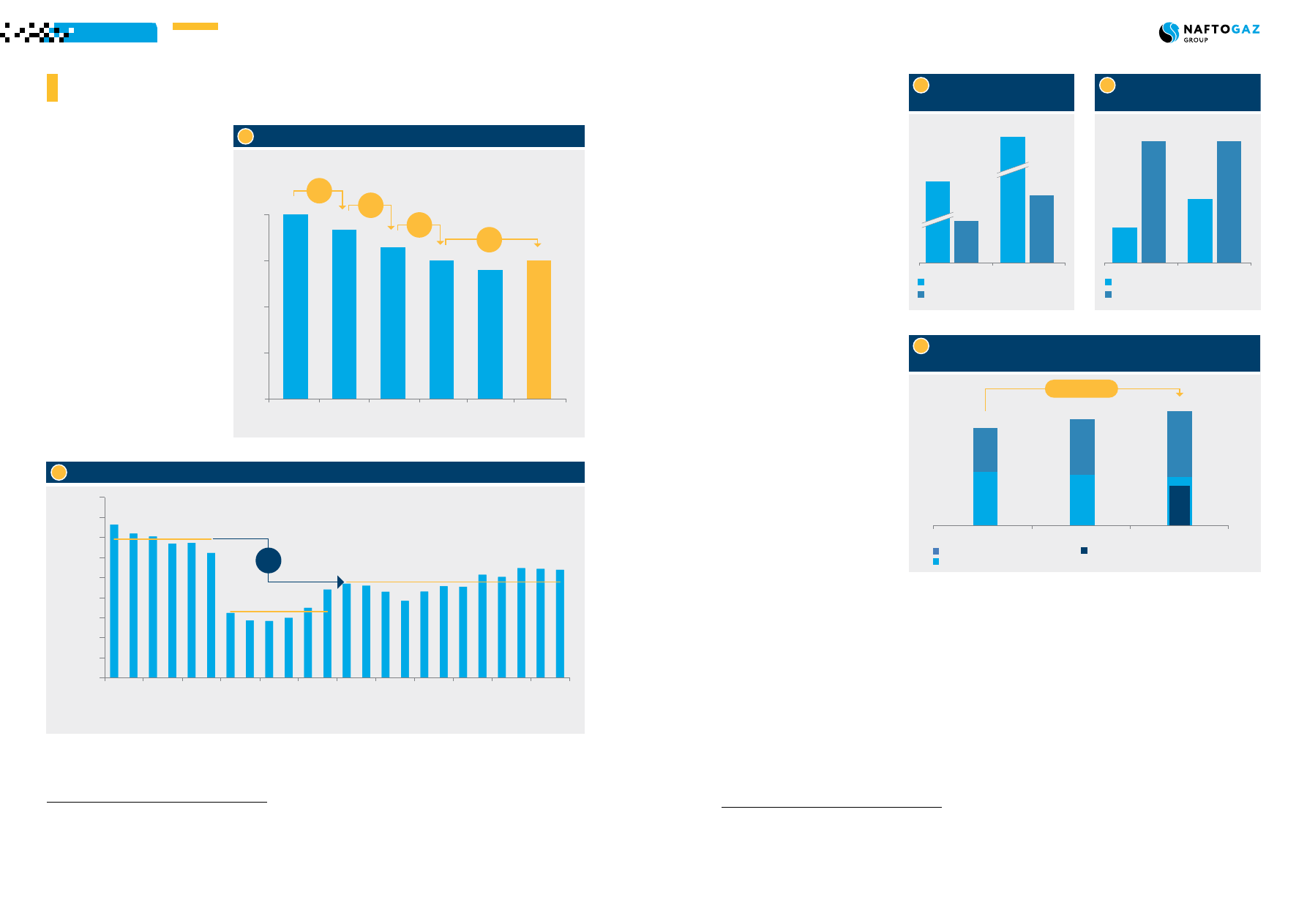
  In 2017, the validity period of 9 permits issued to Ukrnafta expired. Attempts by the company to continue the validity of the special permits were blocked by State Geological Survey of Ukraine, and from April to June 2017 

Ukrnafta had to stop oil and gas production at 6 oilfields. The company won a number of lawsuits, challenging the inaction of the regulator in prolongation of special permits. In late October and November, after the special 
permits were prolongated, Ukrnafta was able to resume oil and gas production. By the end of 2017, Ukrnafta filed an application to State Geological Survey of Ukraine for the prolongation of 27 special permits, which expire in 
2018 and which accounts for 24% of the company’s annual oil production and 18% of annual gas production.

2

  NOPLAT – adjusted operating profit / (loss) for one-time and / or non-typical transactions, as well as income tax calculated at nominal rates, according to the consolidated financial statements of Naftogaz for 2018.

3

  ROIC is calculated as NOPLAT divided by invested capital, which is determined as the sum of capital invested in fixed assets and net working capital. The capital invested in fixed assets is calculated based on the company’s 

proprietary estimate of opportunity cost of hydrocarbon resources and the value of petroleum fuel stations' network.

4

 https://www.ukrnafta.com/u-2018-ukrnafta-splatila-15,3-mlrd-grn-podatkiv

5

  As a result of an audit of hydrocarbon reserves carried out by DeGolyer & MacNaughton, the proved and probable reserves of liquid hydrocarbons за PJSC Ukrnafta amounted to 24.14 million tonnes, of which 9.66 million 

tonnes are undeveloped thus could be a prime target for short- and medium-term increase of oil output.

According to the results of 2018, Ukrnafta 

recorded an annual growth of oil and 

condensate production. At the same time, 

2017 is not a particularly relevant base 

for comparison, since in 2017 the process 

of prolongation of the company’s special 

permits was blocked by Derzhgeonadra

1

which became a temporary one-off factor 

impacting the decline in production. 

At the beginning of 2018, Ukrnafta 

identified 100 most promising production 

targets within 33 fields for further 

extensive campaign aimed to run 

stimulation operations, re-perforations, 

recovery of idle wells, updating subsurface 

equipment and other works to increase 

output. Due to these operations, Ukrnafta 

managed to achieve an observable 

increase in average daily natural gas 

production from the second half of 

2018. At the same time, the company's 

declared growth was made compared to 

2017, when Ukrnafta reduced its natural 

gas production by 14.8% to 1.1 bcm 

(compared to 2016).

In 2018, the Ukrnafta return on 

investment capital (ROIC)

3

 improved 

from 5.0% to 10.8%, but still remains 

twice lower than the cost of capital rate 

estimated at 21.8%. This means that 

Ukrnafta’s businesses of hydrocarbons 

extraction and production as well as 

petroleum products sales still do not 

generate the value to the company in a 

financially sustainable way.

In 2018, Ukrnafta paid UAH 15.3 billion 

of taxes to the state budgets of all levels, 

including UAH 1.2 billion as repayment of 

an overdue tax debt. The amount of tax 

payments for the past year exceeded the 

corresponding figure in 2017 by 45.7% 

(UAH 10.5 billion), and in 2016 by 88.9% 

(UAH 8.1 billion). In 2018, the company 

fully paid its current tax liabilities, while 

repaying its past due tax on a regular 

basis. 

Over 2017-2018, Ukrnafta reduced its 

tax liability to UAH 11.9 billion (of which 

89% was overdue

4

), however, due to the 

accrued fines and penalties for past due 

of taxes and duties, the total debt grew 

by UAH 4.5 billion to UAH 29 billion as of 

the end of 2018. The average effective 

rate of fines and penalties accrued on the 

principal amount of tax debt is 23.4% per 

annum, which exceeds the Ukrnafta's cost 

of capital, which is 21.8%. This indicates 

that ignoring the issue of repayment of 

Ukrnafta’s tax debt leads to the destruction 

of the company's value. 

In addition to improving operational 

performance compared to 2017, 

Ukrnafta also increased revenue by 1.3 

to UAH 36.1 billion and its net operating 

profit after tax (NOPLAT

2

) by 2.3 times to  

UAH 9.3 billion in 2018. This improvement 

was mostly caused by an increase in the 

market price of oil and condensation is  

almost 40%.

The issue of tax debt is probably the 

main risk for the further effective 

operations of the company. In view 

of the fact that Ukrnafta is one of the 

leading taxpayers to the state budget 

and the available confirmed potential 

to increase hydrocarbons production by 

the company

5

, the financial recovery of 

Ukrnafta is a matter of public interest.

In order to bring Ukrnafta out of crisis 

and to achieve the financial stabilization 

of one of the largest enterprises in the 

oil and gas industry in Ukraine without 

applying bankruptcy and sanction proce-

dures, including to reduce social tension 

and retain its personnel capacity, the 

company's management has repeatedly 

appealed to the executive authorities 

requesting to restructure its tax debt. To 

support the implementation of the com-

pany’s financial recovery plan, in March 

2019, an extraordinary general meeting 

of shareholders of Ukrnafta discussed a 

number of issues related to the compa-

ny management and operations. In par-

ticular, the decisions of the shareholders 

included the approval of changes that 

brought the company's corporate gov-

ernance system into line with the best 

international standards and OECD rec-

ommendations, and also agreed to enter 

into the contracts between Ukrnafta 

PJSC and NJSC Naftogaz of Ukraine on 

the sale and purchase of natural gas for 

a total of 4.062 bcm. 

The contracts stipulate that Naftogaz will 

acquire 2.062 bcm of Ukrnafta gas from 

underground gas storage, as well as 2 bcm 

of gas that will be extracted in the future. 

Payments are to be made by the funds 

received by Naftogaz from the CMU as 

compensation for the fulfillment of special 

gas supply obligations for the needs of 

households and district heating companies. 

In turn, Ukrnafta will use the money 

received solely to repay its tax debt,  

as well as other tax liabilities that will  

arise during the fulfillment of the  

contracts.

m

ill

io

n t

on

s

2013

2014

2015

2016

2017

2018

0

2,0

1,0

0,5

1,5

2.0

1.9

1.7

1.5

1.4

1.5

-7.0%

-11.5%

-9.2%

-4.6%

Ukrnafta’s production of oil and condensate in 2013-2018

January 2017

Mar

ch 2017

Mar

ch 2018

Ma

y 2017

Ma

y 2018

July 2017

July 2018

Sep

tember 2017

Sep

tember 2018

No

vember 

2018

No

vember 2017

January 2018

3 800

3 600

3 400

3 200

3 000

2 800

2 600

2 400

2 200

2 000

tcm

-13%

Ukrnafta's average daily gas production, 2017-2018

2017

2018

2017

2018

26.9

5.0%

10.8%

21.8%

21.8%

36.1

9.3

4.1

Sales revenue, UAH billion
NOPLAT, UAH billion

ROIC
Cost of capital

Ukrnafta financial results

in 2017-2018

UAH denominated 

ROIC vs cost of capital, %

31.12.2016

31.12.2017

31.12.2018

24.5

26.9

10.6

11.9

29.0

17.1

14.1

11.2

13.3

12.8

Provision for fines and penalties, UAH billions
Ukrnafta's tax liabilities, UAH billions

-4,6%

+4.5 UAH billion

Change in Ukrnafta’s tax liabilities and provision for fines and

penalties in 2017-2018, UAH billion

Including overdue as of 31 December 2018

Source: Ukrnafta

Source: Ukrtransgaz’ operational data

Source: Consolidated financial statements 

of “Naftogaz of Ukraine” for 2018

Source: Consolidated financial statements of Naftogaz of Ukraine for 2018-2017, Ukrnafta

Source: Naftogaz calculations

-------------------------------------------------------------------------------------------------------------------------------------------------------------

89

88

OPERATIONS

ANNUAL REPORT 2018

2018

NEW BUSINESSES. ENERGY SERVICE

Modernization of individual and district heating systems

Increasing energy efficiency is the most 

important way to increase the energy 

security of Ukraine. Given the significant 

share of total energy expenditure on 

heating where gas is the predominant 

fuel, reducing gas use by installing 

efficient heating systems would bring 

the country closer to this goal. Given 

the global volatility of energy prices, this 

would increase consumer protection 

from energy poverty, and offer particular 

protection to socially vulnerable 

consumers.

Naftogaz group is implementing 

several energy efficiency programs for 

households. For example, the Chernihiv 

region implements "Affordable Heat 

for employees". The project aims 

to enhance the efficiency of gas 

consumption to heat the homes of 

Naftogaz group employees and in the 

cities and villages where the group is 

present.

In recent decades, small settlements 

have accumulated serious problems 

related to the district heating system 

caused by unsystematic disconnection 

of individual apartments from district 

heating systems. Since 2018, in the 

village of Mryn, Chernihiv region, 

apartments in two- to three-storied 

multi-apartment buildings began to shift 

to individual heating. This would enable 

the shutting down of the boiler plant in 

2019, which brought losses to Naftogaz 

group of at least UAH 500 000 per year. 

Following the modernization 

of their heating equipment, 

consumers have been saving 

80% on heating.

The residents of the village of Mryn 

enjoyed a corporate discount of 40% 

for new heating equipment provided 

by producers under cooperation 

agreements with Naftogaz. Moreover, 

some consumers, supported by 

SE Naftogaz-Energoservis, received 

additional compensation of 35% for 

expenses incurred during the installation 

of energy-efficient equipment under the 

EBRD IQ Energy program.

In 2018, the Affordable Heat program 

was implemented by Naftogaz Group 

in two areas: energy services for the 

residents of the city of Kropyvnytskyi 

and Kirovohrad region, and installation 

of individual heating equipment for the 

residents of Kropyvnytskyi jointly with the 

municipality. For the convenience of the 

residents of the region, an energy service 

center was set up in Kropyvnytskyi. This 

center provides professional advice, 

accepts requests for "turnkey" projects 

to upgrade the heating system of houses, 

and provides support obtaining the 

required permits. In addition, Naftogaz 

group companies together with the local 

authorities of Kropyvnytskyi are engaged 

in the transformation to individual 

heating in 95 residential houses in the 

city. Low-income citizens have already 

benefited from this program and received 

guaranteed compensation from local 

authorities at a rate of 50%, or from the 

EBRD IQ Energy program, and received 

an additional 35% compensation for 

purchased services, components and 

equipment.

In 2018, under the "Affordable Heat" 

program, heating systems in 704 houses 

underwent upgrades. Customers who 

have switched to individual heating have 

cut their heating costs by half or more. 

Customers who have upgraded obsolete 

individual heating systems reduced their 

costs by 10% to 60%. 

The implementation of the 

"Affordable Heat" program 

made it possible to reduce  

gas consumption by more 

than 200 tcm for the period 

from November 2018  

to March 2019.

Naftogaz considers opportunities to 

extend the energy service and energy 

efficiency program for the household 

segment. The company also seeks to 

increase renewable generation. 

Estimated budget for the energy modernization of housing in Ukraine, USD bn

10.3

14.0

3.7

15.9

18,3

3.7

2.0

1.7

2.4

15.9

Insulation of 
private houses

Upgrading of heating systems
for heat producers

Upgrading networks
of heat producers

Metering and thermoregulation
in apartment buildings

Insulation of apartment 
buildings

DHCs

Private

houses

Upgrading of heating systems
for private houses

36

USD bn

Apart-

ment

houses

51%

10%

39%

Ukrainian households
are 

6


times behind Polish

households in terms 
of energy efficiency

Ukraine has spent
USD 

54

 billion on direct

and cross subsidies
for households
over the last 10 years

Naftogaz paid
USD 

60

 billion

to Russian gas suppliers
in 2006-2015

-------------------------------------------------------------------------------------------------------------------------------------------------------------

91

90

2018

OPERATIONS

ANNUAL REPORT 2018

ARBITRATION PROCEEDINGS:  

GAZPROM, CRIMEA, UKRNAFTA

The Gas Sales Arbitration was initiated 

by both Naftogaz and Gazprom on 

16 June 2014 under the auspices 

of the Arbitration Institute of the 

Stockholm Chamber of Commerce (

“SCC 

Arbitration Institute”). In its Request 

for Arbitration, Gazprom claimed 

payment of unpaid invoices for gas 

delivered under the Gas Sales Contract 

from November 2013 to May 2014, 

while Naftogaz claimed a retroactive 

revision of the price under the Gas 

Sales Contract, and compensation for 

previous overpayments under the prices 

applied before the revision. Gazprom 

has later added a claim for payment of 

gas which Gazprom did not deliver, but 

which Naftogaz allegedly nevertheless 

was obliged to pay for under the 

Contract (the so-called 

“take or pay” 

claim). On 13 October 2014, Naftogaz 

initiated another arbitration under the 

Gas Transit Contract claiming a revision  

of the transit tariff with retroactive 

effect, compensation for underpayments 

as a result of tariff revision, 

compensation of under delivery of 

volumes for transit and revision of 

certain provisions of the Gas Transit 

Contract.

2014 Gas Sales and Gas Transit Arbitrations

On 31 May 2017, the arbitral tribunal 

decided on the case of Naftogaz against 

Gazprom relating to 

the Gas Sales 

Contract by rendering the separate 

arbitral award. The tribunal decided that:

On 22 December 2017, the arbitral 

tribunal issued the final award on the 

case of Naftogaz against Gazprom 

relating to 

the Gas Sales Contract. The 

tribunal:

revised the price formula of the Gas Sales Contract and fully linked the price for gas to 

European (German) hub prices, starting from 27 April 2014;

reduced the annual contract volume obligations of Naftogaz from 52 billion cubic 

metres to 5 billion cubic metres in 2018 and 2019;

fully rejected Gazprom’s take-or-pay claims to Naftogaz (amounting to USD56 billion 

for 2009-2017);

found that Naftogaz is not responsible for gas supplies by Gazprom to any third parties 

in the uncontrolled territories in Donetsk and Luhansk regions; and

obliged Naftogaz to pay USD2 billion in favour of Gazprom for the volume of gas 

received but not paid for by Naftogaz in certain months of 2013 and 2014.

I

the clauses of the Gas Sales Contract concerning the minimum contract amounts 

and “take-or-pay” provision are invalid starting from 19 January 2009 and until the 

date of the final award and must be amended starting from the date of the final 

award taking into account the real import demand from Naftogaz;

the price formula provided in the Gas Sales Contract shall be revised starting from 

27 April 2014 so as to bring the price to the market level;

Naftogaz is entitled to repayment of amounts paid in cases of a factual payments 

price excess over the price as provided by the revised formula of the Gas Sales 

Contract; and

the clause of the Gas Sales Contract on the prohibition to Naftogaz to sell gas 

purchased under the Gas Sales Contract outside Ukraine is invalid starting from 19 

January 2009.

The tribunal has obliged the parties to 

determine the elements of gas price 

formula to be used for gas supplies 

starting from 27 April 2014 through 

negotiations. Such negotiations took 

place during June-August 2017, but the 

parties failed to reach agreement on 

remaining issues and thus the Tribunal 

had to decide on these issues.

31 May 2017

22 December 2017

4.63

USD billion

On 28 February 2018, the arbitral 

tribunal issued the final award on the 

case of Naftogaz against Gazprom 

relating to 

the Gas Transit Contract. The 

tribunal:

found that Gazprom had defaulted on its obligations regarding volumes to be transit-

ed and awarded damages in the amount of USD 4.63 billion in favour of Naftogaz;

confirmed obligations of Gazprom in respect of supplies of minimum transit 

amounts of 110 bcm of gas under the Gas Transit Contract, which is effective until 

the end of 2019;

rejected Naftogaz’s claim for tariff revision due to procedural reasons, as Naftogaz 

in its request for transit tariff revision in 2009 did not follow the procedural re-

quirements established by the Gas Transit Contract;

rejected Naftogaz’s claim in respect of the prospective assignment of its rights and 

obligations under the Contract to Ukrtransgaz or any other entity designated as 

transmission system operator;

rejected Naftogaz’s claim in respect of adjustments of the Gas Transit Contract 

according to the EU and Ukrainian competition and energy law, stating that the 

EU law does not apply to the dispute and that it is not the role of the Tribunal to 

implement reforms in Ukraine, which should be decided by the Ukrainian govern-

ment; and

made the set-off of amounts owing between Naftogaz and Gazprom  

pursuant to the Gas Sales Arbitration and the Gas Transit Arbitration  

with the effect of net amount of USD 2.56 billion to be paid by Gazprom  

to Naftogaz.

28 February 2018

The compansation to be paid by 

Gazprom to Naftogaz for breaching 

contractual conditions.

Gazprom’s challenges to the awards

After both arbitration awards were 

rendered, Gazprom launched the 

challenge proceedings against the awards 

in the Swedish courts, though challenging 

the final award does not suspend its 

enforcement by default.

Gazprom filed the challenges with the 

Svea Court of Appeals (Sweden) against 

the separate and final awards in the  

Gas Sales Arbitration on 8 November 

2017 and 21 March 2018 respectively.  

On 29 March 2018 Gazprom filed a 

challenge (as supplemented on 28 May 

2018) with the Svea Court of Appeal 

against the final award in the dispute 

with Naftogaz over the Gas Transit  

Contract, alleging inter alia that the 

administrative Secretary of the tribunal 

wrote a large part of the reasons of the 

award.

In March 2018, Gazprom officially 

declared its refusal to resume deliveries 

of natural gas to Ukraine. Additionally, 

Gazprom refused to settle outstanding 

amount as decided by the tribunal in the 

Transit Arbitration.

Naftogaz’s efforts  

to enforce the Transit Award

Based on the final awards and in view of 

the Gazprom’s failure to comply with the 

awards Naftogaz has moved to pursue 

enforcement and attach Gazprom’s assets 

in several jurisdictions, including the 

Netherlands, Switzerland and England.

In late May 2018, Naftogaz received 

permission from a Dutch judge to 

attach Gazprom’s shares in its seven 

Dutch subsidiaries and the debts those 

subsidiaries owe to Gazprom. Six of them 

refused to cooperate with enforcement 

authorities.

In June 2018, the Commercial Court in 

London issued an order to enforce the 

Transit Award. In addition to freezing 

assets, it requires Gazprom to provide 

Naftogaz with a list of all assets with a 

value greater than USD 50.000 located in 

England or Wales.

According to the ruling of the London 

Commercial Court of 15 March 2019, 

the enforcement of the award should be 

adjourned until the decision of the Svea 

Court of Appeal if Gazprom undertakes 

certain obligations, in particular, 

withholding from hiding or reducing its 

assets in England and the Netherlands. 

Besides that, Gazprom deposited cash 

security for fulfilling the court’s order.

In July 2018, the Zug Superior Court, 

Switzerland re-instated attachment of 

Gazprom's shares in Nord Stream AG and 

Nord Stream 2 AG. These attachments 

will stay in place until the Zug Superior 

Court decides on Naftogaz’ appeal 

against the local debt enforcement 

office's earlier decision to lift the share 

attachments.

2018 Gazprom-Naftogaz Arbitrations

In furtherance of the refusal both to 

settle the debt under the final award 

in the Gas Transit Arbitration and to 

resume gas supplies to Ukraine in 

compliance with the final award in the 

Gas Sales Arbitration, Gazprom initiated 

a new SCC arbitration on 20 April 2018 

(the “Reversal Claim”) essentially 

attempting to reverse the outcome of 

the awards of 2014 Arbitrations. The 

preliminary relief sought by Gazprom in 

In 2017, Naftogaz 

won the case 

against Gazprom. 

For more details 

watch #Stockholm 

documentary.

-------------------------------------------------------------------------------------------------------------------------------------------------------------

93

92

2018

OPERATIONS

ANNUAL REPORT 2018

I I I

I I

CRIMEA

On 15 September 2017, Naftogaz and 

six subsidiaries — Chornomornaftogaz, 

Ukrtransgaz, Ukrgasvydobuvann-

ya, Ukrtransnafta, Likvo, and Gas of 

Ukraine – submitted a statement of claim 

to the tribunal claiming compensation for 

damages caused by the Russian Federa-

tion's illegal expropriation of the Group’s 

assets in Crimea.

On 26 April 2018, the London Court of 

International Arbitration rendered an 

award in the case initiated by Ukrnafta 

minority shareholders against Naftogaz. 

The Tribunal concluded that the key clauses 

of the shareholders agreement between 

Naftogaz and the companies controlled by 

Ihor Kolomoyskyi on corporate governance 

at Ukrnafta are unenforceable, being 

in contradiction with the mandatory 

provisions of Ukrainian corporate law.

Parts of article 9 of the shareholders 

agreement — stipulating that six 

members of the Ukrnafta supervisory 

board are elected from among 

candidates suggested by Naftogaz while 

the other five members and CEO from 

among those suggested by Ukrnafta 

minority shareholders, i.e. the companies 

controlled by Ihor Kolomoyskyi — are 

unenforceable. Article 9 also provides that 

members of the Ukrnafta executive board 

are approved by the Ukrnafta supervisory 

board upon submission by the CEO.

The Tribunal, however, declared that 

the shareholders agreement was valid 

in whole, though its key clauses on 

corporate governance at Ukrnafta were 

unenforceable.

the Request for Arbitration was stated 

in the general terms and concerns 

adjustment of the specific provisions 

of both the Gas Sales Contract and 

the Gas Transit Contract based on the 

Article 36 of the Swedish Contracts 

Act or, alternatively, setting aside both 

contracts in their entirety as well as 

ordering Naftogaz to pay Gazprom all 

amounts due from Naftogaz arising out 

of the adjustment sought or setting 

aside both contracts. In turn, Naftogaz 

filed a number of counterclaims in view 

of Gazprom’s breaches of the Gas Sales 

and Gas Transit Contracts, the amount 

of which is to be quantified at a later 

stage of the proceedings.

Apart from the above, on 6 July 2018 

Naftogaz filed to the SCC a Request for 

Arbitration seeking transit tariff revision 

under the Gas Transit Contract based 

on the regular application of the transit 

tariff revision clause of the contract, 

with effect from 13 March 2018 (the 

“Tariff Revision Claim”). The Gas Transit 

Contract allows the parties to request a 

revision of the tariff in case of significant 

changes in the European gas market 

and if the tariff does not correspond 

to the level of tariffs in Europe. In the 

final award in the Transit Arbitration, 

Naftogaz’s claim for tariff revision was 

rejected for procedural reasons, and 

Naftogaz’s substantive right to a revision 

of the tariff was therefore not decided in 

that award. Naftogaz submitted a request 

for revision of the tariff to Gazprom in 

March 2018, triggering negotiations 

pursuant to the Gas Transit Contract. The 

reasons for the request are significant 

changes in the European gas market, 

in particular the rules for setting transit 

tariffs, after the Gas Transit Contract was 

concluded in January 2009, and the fact 

that the tariff level does not correspond 

to the European level. Gazprom has not 

been constructive in the negotiations, 

compelling Naftogaz to refer the matter 

to arbitration as provided for in the 

contract. The preliminary estimate of 

the value of the claim, assuming the 

application of the revised tariffs sought 

by Naftogaz, is USD 11.58 billion.

Upon request from Gazprom, on 06 

September 2018 the SCC Board made a 

decision to consolidate both the Reversal 

Claim and the Tariff Revision Claim into 

the one joint proceeding.

15 September 2017

26 April 2018

14 - 17 May 2018

From 14 to 17 May 2018, oral hearings 

were held at the Peace Palace in The 

Hague.

Quantum was bifurcated and will 

be heard and considered during the 

second phase of the proceedings, after 

the first arbitral award (on jurisdiction 

and the merits) is rendered. On 

22 February 2019 the tribunal rendered 

its first award and found that the 

Russian Federation violated the Russia-

Ukraine bilateral investment treaty 

by seizing assets owned by Naftogaz 

and its subsidiaries in Crimea. The 

tribunal has launched a second phase 

of the proceedings to determine the 

amount of compensation Russia owes 

to Naftogaz. Naftogaz experts have 

estimated the value of Naftogaz’s over 

5 billion pecuniary claims.

-------------------------------------------------------------------------------------------------------------------------------------------------------------

Chair of the          

supervisory board 

Spottiswoode Clare 

Mary Joan

Deputy chair of the 

supervisory board 

Demchyshyn      

Volodymyr        

Vasylyovych

Independent 

director

Lescoeur Bruno, 

Jean, Gaston

Independent 

director 

Hochstein          

Amos

Board member 

Popyk Sergii         

Dmytrovych

Board member 

Kudrytskyi          

Volodymyr            

Dmytrovych

Structure of the board and its committees

Appointments within the supervisory board

Proceedings of the board and its committees

The new composition of the supervisory 

board had been formed by Ordinance of 

the Cabinet of Ministers of Ukraine dated 

13 December 2017 # 892-p “On certain 

matters of the Supervisory board of Public 

Joint Stock Company ’National Joint-Stock 

Company ’Naftogaz of Ukraine’” which 

came into force on 15 December 2017. 

Spottiswoode Clare Mary Joan, Lescoeur 

Bruno, Jean, Gaston, Hochstein Amos 

and Haysom Steven John were elected as 

independent directors. They were joined 

by Popyk Sergii Dmytrovych, Kudrytskyi 

Volodymyr Dmytrovych and Demchyshyn 

Volodymyr Vasylyovych as government 

appointees. 

During 2018, Haysom Steven John did 

not discharge his duties as supervisory 

board member and, in particular, did not 

participate in meetings of the Supervisory 

board and its committees. He did not 

enter into a service agreement with ’Na-

tional Joint-Stock Company ’Naftogaz of 

Ukraine’. He was not remunerated and did 

not make statement of his independence 

in line with the Rules of Procedure of the 

supervisory board. The decision on early 

termination of his authorities was adopted 

by Ordinance of the Cabinet of Ministers 

of Ukraine dated 20 March 2019 # 160-р. 

During 2018, all of the supervisory board 

members who concluded the agreements 

with the company were compliant with 

the necessary criteria including regarding 

competences and dedication of time to 

the work of the board. 

During January and February 2018, the 

company concluded service agreements 

with the all board members, except 

for Haysom Steven John, pursuant to 

Ordinance of the Cabinet of Ministers of 

Ukraine dated 17 January 2018 # 21-p 

“Certain matters pertaining to conclusion 

of service agreements with members of 

the Supervisory board of Public Joint Stock 

Company ’National Joint-Stock Company 

’Naftogaz of Ukraine’”. 

According to the provisions of the 

concluded service agreements with 

members of the supervisory board, re-

muneration for the performance of board 

duties is established at the level of gross 

UAH 6 328 000 annually for independent 

directors and 75% of that amount for 

government appointees. Supervisory 

board members are also entitled to ad-

ditional remuneration amounting to 20% 

of total remuneration for performance of 

the function of the chair of the supervi-

sory board and 10% of the remuneration 

for participation as the member of a 

committee of the supervisory board, as 

well as to compensation of their expens-

es incurred during performance of board 

member functions. 

In total, during 2018 the company in-

curred approx. UAH 53 million in expenses 

for the operations of the supervisory 

board. This amount includes UAH 46 mil-

lion in service fees accrued and UAH 7 mil-

lion in compensation of expenses incurred 

by board members during performance 

of their duties, as well as D&O insurance 

which covers liability of these officers after 

their appointment.

Following the formation of the new 

supervisory board, at the first meeting 

which was held on 22 December 2017, 

Spottiswoode Clare Mary Joan was 

elected as the chair of the supervisory 

board. All members of the supervisory 

board supported the motion that 

Demchyshyn Volodymyr Vasylyovych 

should continue to hold the position 

of the deputy chair of the supervisory 

board. 

The new composition of the supervisory 

board’s committees was elected at the 

meeting held in January 2018, and in July 

2018, Lescoeur Bruno, Jean, Gaston was 

elected as the chair of the committee 

on health, safety, environment and 

reserves. The current composition of the 

committees is as follows: 

•  

audit and risks committee: Lescoeur 

Bruno, Jean, Gaston – chair of the 

committee, Spottiswoode Clare 

Mary Joan and Kudrytskyi Volodymyr 

Dmytrovych – members of the 

committee;

•  

ethics and unbundling committee: 

Spottiswoode Clare Mary Joan – chair 

of the committee, Hochstein Amos, 

Kudrytskyi Volodymyr Dmytrovych and 

Demchyshyn Volodymyr Vasylyovych – 

members of the committee;

•  

nomination and remuneration 

committee: Hochstein Amos – chair of 

the committee, Lescoeur Bruno, Jean, 

Gaston and Popyk Sergii Dmytrovych – 

members of the committee;

•  

committee on health, safety, 

environment and reserves: Lescoeur 

Bruno, Jean, Gaston – chair of 

the committee, Hochstein Amos, 

Demchyshyn Volodymyr Vasylyovych 

and Popyk Sergii Dmytrovych – 

members of the committee.

The majority of the supervisory board 

members devoted twice as much time to 

the discharge of their duties compared to 

time commitment required by the  

Rules of Procedure of the supervisory 

board.

In 2018, the company’s supervisory board 

held 17 meetings during which it passed 

resolutions on more than 130 items 

of agenda and considered numerous 

matters submitted for discussion. The 

most frequent matters submitted by 

the executive board for consideration at 

meetings of the supervisory board and 

its committees were those pertaining to 

endorsement of financial plans of the 

company and key business companies 

of Naftogaz group, increase in natural 

gas production, personnel-related 

matters, internal transformation of 

Naftogaz group, approval of entering into 

transactions exceeding the thresholds 

set out in clause 27 of the company’s 

Charter, the matters of unbundling of the 

natural gas transmission business and 

liquidity of the company and Naftogaz 

group as a whole. The supervisory board 

focused substantially on ensuring the 

proper operation of the internal audit 

department and risk management office, 

and in 2018, approved a series of key 

documents, policies and procedures 

in the areas of internal audit and risk 

management in Naftogaz group. In 

preparation for the annual general 

shareholder’s meeting for 2017, 

the supervisory board endorsed for 

approval by the shareholder the restated 

version of the company’s Charter that 

was proposed for aligning provisions 

of the company’s Charter with the 

effective laws and the requirements 

for implementation of the system of 

internal control of the company and 

Naftogaz group. The supervisory board 

also proposed for approval at the annual 

general shareholder’s meeting the Key 

directions of Public Joint Stock Company 

“National Joint-Stock Company “Naftogaz 

of Ukraine” for 2018. Charters of key 

business companies of Naftogaz groups 

incorporated as joint stock companies 

were restated so that they comply with 

the laws and approved by the supervisory 

board and the executive board of the 

company at the beginning of Q2 2018. 

Furthermore, during the reporting year, 

members of the supervisory board 

participated in a number of events 

related to the preparation of Naftogaz 

group for unbundling of the natural 

gas transmission business, including 

meetings with the shareholder, external 

stakeholders, EU representatives and 

other stakeholders.

Also, as part of the competencies 

development program members of 

the supervisory board undertook the 

training on best corporate governance 

practices in operation of two-tier boards, 

which was delivered in April 2018 by the 

professionals from Deloitte Corporate 

Governance Academy.

Attendance of the supervisory 

board meetings in 2018 (regular, 

extraordinary and by absentee 

voting)

Supervisory board

Audit and risks 

committee

Ethics and unbundling 

committee

Nomination 

and 

remuneration 

committee

Committee on health, 

safety, environment 

and reserves

1

Spottiswoode Clare Mary Joan 

17/17

13/13

6/6

11/11

1/3

Demchyshyn Volodymyr Vasylyovych

17/17

13/13

6/6

10/11

3/3

Lescoeur Bruno, Jean, Gaston 

17/17

13/13

6/6

11/11

3/3

Hochstein Amos

13/17

4/13

2/6

8/11

1/3

Haysom Steven John

2


0/17

0/13

0/6

0/11

0/3

Popyk Sergii Dmytrovych 

15/17 

(with partial presence during 

meetings on 16-18 April 2018 and 

21-22 May 2018)

9/13

3/6

10/11

1/3

Kudrytskyi Volodymyr Dmytrovych

16/17

13/13

6/6

11/11

2/3

Officially remained a supervisory board member In 2018. His powers were terminated only in March 2019

Total number of meetings includes one meeting of the Committee on Health, Safety, Environment and Reserves as of 20 December 2018 which was not valid due to absence of quorum

97

96

2018

CORPORATE GOVERNANCE AND CSR

ANNUAL REPORT 2018

REPORT OF NAFTOGAZ 

SUPERVISORY BOARD

-------------------------------------------------------------------------------------------------------------------------------------------------------------

Conflict of interest 

During a number of supervisory board 

meetings, Kudrytskyi Volodymyr 

Dmytrovych notified of a potential 

conflict of interest in relation to agenda 

items on the performance assessment 

and resolving other matters reserved 

to the supervisory board as regards 

Havrylenko Mykola Mykolayovych, 

members of the executive board of 

the company and director general of 

JSC Ukrtransnafta, because he had been 

direct subordinate of Havrylenko Mykola 

Mykolayovych in one of his previous 

positions.

Board priorities

The priorities of the supervisory board 

in 2018 were to continue working on 

the implementation of the system of 

internal control of the company and to 

collaborate with the executive board 

and key subsidiaries of the group in 

ensuring the increase in natural gas 

production and preparation of Naftogaz 

group for unbundling of the natural gas 

transmission business by 1 January 2020. 

Other issues intensively reviewed by the 

Supervisory board included liquidity of 

the companies across Naftogaz Group, 

as well as approval and monitoring of 

implementation of the internal audit plan 

for 2018.

Shareholder and external communication 

Audit and risks committee 

In 2018, the supervisory board 

maintained regular liaison with the 

government by holding joint meetings 

with the Prime Minister of Ukraine and 

other representatives of the  

shareholder. 

Additionally, the board regularly 

met   and held public events engaging 

international consortium partners and 

and other key stakeholders who engaged 

in unbundling matters. Members of the 

Supervisory board also took part in the 

round table discussion “Cooperation in 

the Parliament-Government_Naftogaz 

Triangle” which was held at the Verkhovna 

Rada Committees in February 2018 

engaging dialogue of the members of the 

parliament, government and the company 

on important topics of unbundling and 

role of the supervisory boards in SOEs.

Key functions of the committee 

The new version of the Regulations 

on the Audit and Risks Committee of 

the supervisory board was approved 

by resolution of the supervisory board 

in February 2018. In particular, these 

Regulations define the following key tasks 

and functions of the committee:

1.  Assisting the supervisory board 

in protection of the company’s 

interests by preparing drafts and 

providing recommendations and 

proposals regarding:

1)  the completeness, accuracy and 

timeliness of the preparation of the 

company’s financial statements;

2)  the effectiveness of the internal 

accounting and financial controls of 

the company;

3)  the effectiveness of the company’s 

risk management activities;

4)  the selection, appointment, 

performance and ongoing work of 

the external (independent) auditor;

5)  the selection, appointment, 

reappointment and dismissal of the 

chief audit executive, performance 

and ongoing work of the internal 

audit;

6)  the treasury arrangements in place 

for the company.

2.  In accordance with the above tasks, 

the committee shall perform the 

following functions:

2.1.  To organize and perform preliminary 

review of the matters included into 

the agendas of the committee and 

the supervisory board meetings, and 

related to finance, audit and risk 

management.

2.2.  To organize and elaborate 

drafting of conclusions, proposals, 

recommendations, other 

documents, draft policies, strategies, 

rules of procedure, procedures, 

decisions related to finance, audit 

and risk management, and submit 

them for supervisory board’s review.

2.3.  To organize and perform the 

following functions related to 

financial statements:

1)  to monitor and review the 

integrity, completeness, accuracy 

and timeliness of the preparation 

of financial information of the 

company;

2)   to review with the management 

of the company and the external 

auditor the summary financial 

statements, as well as justification 

and acceptability of applied 

principles of financial statements, 

and any material correction of the 

statements;

3)  to review the compliance and 

consistency of and any changes 

to accounting methods and the 

accounting policy along with how 

these changes affect the content 

of the statements, across the 

company and its subsidiaries;

4)  to consider any significant 

differences between the external 

auditor and management 

regarding the company’s financial 

statements.

2.4.  To organize and perform the 

following functions related 

to internal controls and risk 

management:

1)  to review at least annually the 

overall state and efficiency of the 

company’s internal control and risk 

management systems, including 

review of reports of the external and 

internal auditors;

2)  to review the effectiveness of 

corrective actions taken by the 

management with respect to 

improvement of the system 

of internal control and risk 

management;

3)  to meet regularly with the 

executive board of the company to 

review significant risks and issues 

of control and planning.

2.5.  To organize and perform the 

following functions related to 

external audit of the company:

1)  to make recommendations 

to the supervisory board and 

where appropriate to the general 

shareholders’ meeting on the 

appointment, reappointment or 

removal of the external auditor, 

the audit fee and the terms of 

engagement of the external 

auditor, to study issues that may 

COMPETENCE AND PROCEEDINGS OF SUPERVISORY BOARD COMMITTEES

be deemed as the reason for 

dismissal of the external auditor 

and to answer any questions of 

resignation or dismissal relating to 

the external auditor;

2)  to control compliance with 

the Law of Ukraine "On Public 

Procurement" as of 25 December 

2015 #922-VIII and other 

applicable legislation in the 

selection of the external auditor;

3)  to control independence and 

objectivity of the external auditor 

in line with the Handbook of 

International Quality Control, 

Auditing, Review, Other Assurance, 

and Related Services;

4)  to establish and apply an official 

definition of a policy, types of ser-

vices that are not subject to audit, 

and which are excluded or permit-

ted after the committee’s review or 

permissible without the recommen-

dation of the committee;

5)  to develop and implement 

policy on the engagement of 

the external auditor to supply 

non-audit services, taking 

into account relevant ethical 

guidance regarding the provision 

of non-audit services by the 

external audit firm;

6)  to review efficiency of processes 

of the external audit, the nature 

and scope of the audit, to monitor 

the audit and review any problems 

or reservations arising from 

the audit, the responsiveness 

of the management to written 

recommendations and to review 

the findings of the audit with the 

external auditor, including but not 

limited to the discussion of any 

major issues which arose during 

the audit, including:

-  any accounting and audit 

judgments;

-  levels of errors identified during 

the audit.

2.6.  To organize and perform the 

following functions related to 

internal audit of the company:

1)  to submit for approval by the 

supervisory board the regulations 

on the internal audit;

2)  to make recommendations to 

the supervisory board on the 

appointment, reappointment 

or removal of the chief audit 

executive;

3)  to make recommendations to the 

supervisory board on the terms of 

labor agreements which are being 

concluded with the internal audit 

staff (including with the chief audit 

executive);

4)  to prepare the draft budget of 

the supervisory board, including 

the budget of the internal audit, 

and submit it for approval by the 

supervisory board;

5)  to submit the annual plan of 

risk-oriented internal audits for 

approval by the supervisory board;

6)  to review reports on the activities 

of the internal audit;

7)  to review at least annually the 

performance and effectiveness of 

the internal audit;

8)  to consider issues that prevent 

the internal audit from effective 

performance of set tasks, and help 

eliminate such restrictions;

9)  to ensure sufficient and adequate 

resources for the effective 

performance of the internal audit.

2.7.  To organize and perform the 

following functions related to 

treasury arrangements of the 

company to review and report to 

the supervisory board on the overall 

management of treasury activities in 

the company, including:

-  banking arrangements and 

relationships;

-  liquidity management and 

forecasting;

-  debt management;

-  interest rate risk management;

-  treasury internal control.

2.8.  To organize and perform other 

responsibilities in the company, 

including:

1)  to initiate and conduct special 

investigations as needed, including 

involving independent consultants 

(experts);

2)  to consider cases of fraud and 

assess the adequacy of measures 

taken by the management to 

prevent fraud;

3)  to consider the need for 

amendments to these Regulations;

4)  providing recommendations 

on the selection, appointment, 

reappointment and dismissal of 

the head of the budgeting unit;

5)  to provide the supervisory board 

with the report on the committee’s 

activity at least once every six 

months, as also, upon supervisory 

board’s demand, regular reports or 

information on certain matters of 

the committee’s activity;

6)  to submit for review by the 

supervisory board of draft new 

versions of these Regulations 

or necessary amendments 

and additions hereto with the 

respective substantiation;

7)  to perform other duties related 

to the committee’s competence 

when requested by the 

supervisory board.

The Regulations governing the 

committee’s activity provide for reporting 

to the supervisory board not less than 

once per six months.

Key results in 2018 

In 2018, the audit and risks committee 

held 13 meetings during which it passed 

more than 45 resolutions. In January 

2018, the supervisory board resolved 

on renaming this committee to audit 

and risks committee by extending the 

competence of this committee to risk 

management matters, as reflected in the 

restated version of the Regulations on the 

Audit and Risks Committee which came 

into force in February 2018. In 2018, this 

committee focused on consideration 

and endorsement of financial and 

investment plans of the company and key 

business companies of Naftogaz group, 

review of the results of internal audits 

and revisions of operations conducted 

in the company and across Naftogaz 

group, matters of forensic audits and 

ensuring appropriate action based on 

recommendations of the internal and 

external audit of the company and 

Naftogaz group companies. During 2018, 

the committee worked closely with 

the external auditor of the company 

on the results of audit of consolidated 

financial statements of the company for 

2017 and planning of external audit for 

2018, including meetings without the 

company’s management.

PrJSC “Deloitte and TOUCHE USC” was 

elected as the external auditor of the 

company for the reporting period. The 

external auditor of the company was 

elected through an open bidding for the 

procurement of services on financial 

audit and revision of financial and 

business operations of National Joint 

Stock Company “Naftogaz of Ukraine” 

conducted in line with the Law of Ukraine 

“On Public Procurement”. In addition, 

the company verified independence of 

the auditor, namely its compliance with 

the specific requirements of the Law 

of Ukraine “On Audit Activity” effective 

as of the date of such verification, 

and performed internal compliance 

procedures. In its letter dated 12 April 

2019 PrJSC “Deloitte and TOUCHE USC” 

informed the company and the audit 

and risks committee that the key audit 

partner and auditors engaged in  

auditing were independent from the 

company.

99

98

2018

CORPORATE GOVERNANCE AND CSR

ANNUAL REPORT 2018

-------------------------------------------------------------------------------------------------------------------------------------------------------------

Key functions of the committee 

The restated version of the Regulations 

on the Nomination and Remuneration 

Committee of the supervisory board was 

approved by resolution of the superviso-

ry board in February 2018. In particular, 

these Regulations define the following 

key tasks and functions of the committee:

1.  Assist the supervisory board in 

preparing draft:

1)  succession strategy of the company’s 

supervisory board, executive board 

and other officials (if applicable) 

that includes in particular search of 

potential nominees for the position 

of the chief executive officer in case 

of termination of authorities of the 

current chief executive officer, in order 

to ensure continuous work of the 

executive board;

2)  policies and standards of the company 

on selection of nominees for the 

positions of the chief executive 

officer and members of the executive 

board, other officers of the company 

nominated and dismissed by 

Key functions of the committee 

The restated version of the Regulations 

on the Ethics and Unbundling Committee 

of the supervisory board was approved 

by resolution of the supervisory board in 

February 2018. In particular, in line with 

these Regulations, the key task of the 

committee is to assist the supervisory 

board in protection of the company’s 

interests by evaluating and providing 

recommendations and proposals 

regarding:

1)  application of the Code of corporate 

ethics;

2)  conflict of interest at the level of 

the officers and employees of the 

company;

3)  amendments to the Code of corporate 

ethics as mandated by the company’s 

mission and strategy in the changing 

operative environment;

4)  effective implementation of the Code 

of corporate ethics in the company, 

monitoring and elimination of one-off 

and recurring violations of the Code 

of corporate ethics by the company’s 

officers and employees;

5)  specific rules and procedures for 

handling of third-party complaints 

related to ethics breaches committed 

by the company’s officers and 

employees;

6)  appropriate means to mitigate 

negative consequences caused by 

ethics breaches committed by the 

company’s officers and employees;

7)  processes pertaining to or associated 

with unbundling of the gas transmission 

system operator, which are taking place 

both inside and outside of Naftogaz 

group as to ensure their compliance 

with the Law of Ukraine "On Natural 

Gas Market", the Third Energy Package, 

and taking into account legitimate 

interests of Naftogaz group.

The ethics and unbundling committee 

shall organize and perform the functions 

related to:

1)  review of the matters included into 

the agendas of the committee and 

the supervisory board meeting, and 

related to corporate ethics, including 

conflict of interest and unbundling;

2)  review of allegations of ethics-related 

breaches by officers and employees 

of the company, and submission of 

relevant recommendations to the 

supervisory board;

3)  permanent review and monitoring 

of the conflict of interest between 

officers, executives and employees of 

the company;

4)  upon requests of officers, executives 

and employees of the company 

conducting, on a confidentiality 

basis, of preliminary evaluation of 

compliance of particular instances 

of conduct with ethics rules of the 

company;

5)  analysis and review of the company’s 

rules, procedures and practice on 

ethics-related issues with a view 

to identify possible breaches and 

assess their effectiveness to meet the 

company’s interests and needs;

6)  monitoring of the operating 

environment and best international 

practices (general and sector-specific) 

in terms of corporate ethics and 

unbundling, engagement with various 

stakeholders to assess the adequacy 

of current company’s policies in these 

areas;

7)  ensuring the appropriate level of 

accountability and transparency of 

the company where this can eliminate 

or mitigate ethical risks for the 

company with due account of the data 

protection requirements;

8)  ensuring awareness of ethics-related 

issues with the company’s officers 

and employees, and the efficiency of 

available means to raise and handle 

their complaints;

9)  promotion of effective communication 

between the company’s management 

and its staff with a view to reinforce 

understanding of the company’s 

ethical values and encourage their 

implementation, as well as to deter 

unacceptable practices;

10)  advice to the executive board on 

corporate ethics issues upon request 

of the latter;

11)  reporting to the supervisory board 

on the tasks and functions of the 

committee performed within the 

framework of preparing the annual 

report;

12)  issuing recommendations to the 

supervisory board regarding the 

matters of the gas transmission 

system operator unbundling.

The Regulations governing the 

committee’s activity provide for reporting 

to the supervisory board not less than 

once a year.

Key results in 2018

In 2018, the ethics and unbundling 

committee held six meetings during 

which it passed two resolutions and 

discussed more than 15 matters 

submitted for consideration of 

this committee. In January 2018, 

the supervisory board resolved on 

renaming this committee to ethics and 

unbundling committee by extending 

the competence of this committee to 

unbundling matters, as reflected in the 

restated version of the Regulations on 

the ethics and unbundling committee 

which came into force in February 

2018. In 2018, this committee focused 

on the matters of unbundling and 

cooperation with key external and 

internal stakeholders, and members 

of the committee gave prominent 

attention to holding regular meetings 

with representatives of key stakeholders 

in order to raise awareness of processes 

and work undertaken in Naftogaz group 

with the aim to prepare for completion 

of the unbundling by 1 January 2020.

The committee reviewed, among other 

things, conflicts of interests and leakage 

of information.

Ethics and unbundling committee 

Nomination and remuneration committee

the supervisory board, aimed at 

engagement of qualified specialists for 

the management of the company;

3)  principles for defining of 

remuneration for the chief executive 

officer and members of the executive 

board in order to create necessary 

incentives for the efficient work in 

implementation of the company’s 

development strategy;

4)  terms of employment agreements 

(contracts) to be concluded with the 

chief executive officer and members 

of the executive board, other 

officers of the company nominated 

and dismissed by the supervisory 

board.

2.  Submission to the general meeting or 

the supervisory board (as established 

by the Charter) of recommendations 

and proposals on:

1)  candidates for the positions of the 

chief executive officer and members 

of the executive board, other 

officers of the company nominated 

and dismissed by the supervisory 

board;

2)  termination of authorities of the 

chief executive officer and members 

of the executive board;

3)  engagement of independent 

external adviser for assessment of 

the supervisory board members’ 

work;

4)  candidates for the positions of the 

supervisory board members.

3.  In accordance with the tasks, the 

committee shall perform the following 

functions:

1)  development and periodic review 

of the company’s policy (internal 

regulation) on nomination and 

remuneration;

2)  preliminary review of the matters 

related to the nomination and 

remuneration of the chief executive 

officer and members of the executive 

board, as well as other officials (if 

applicable);

3)  organization of drafting and 

processing of draft policies, strategies, 

rules of procedure, resolutions and 

other documents that regulate the 

activity in the sphere of nominations 

and remunerations of the chief 

executive officer and members 

of the executive board, preparing 

conclusions, recommendations, 

proposals for the supervisory board;

4)  analysis of current and expected 

needs of the company in 

professional qualification of the 

chief executive officer and members 

of the executive board, other 

officers of the company nominated 

and dismissed by the supervisory 

board, based on the company’s 

interests and development strategy, 

defining the eligibility criteria for 

nomination of candidates;

5)  determination and ensuring selection 

procedures, nomination of candidates 

and recommendation for approval 

by the general meeting or the 

supervisory board (as defined by the 

Charter) of candidates for vacancies in 

the Supervisory board, the executive 

board or other officers of the 

company nominated and dismissed by 

the supervisory board;

6)  preparation and submission for 

review by the general meeting 

or the supervisory board (as 

established by the Charter) of 

proposals regarding election or 

termination of authorities of the 

chief executive officer and members 

of the executive board, other 

officers of the company nominated 

and dismissed by the supervisory 

board;

7)  making comparative analysis and 

informing the supervisory board on 

the policies, programs, international 

practice, situation at the employment 

market regarding levels and systems 

of remuneration for members of 

executive bodies of business entities, 

proposals of remuneration to the chief 

executive officer and members of the 

executive board;

8)   submitting proposals to the 

supervisory board concerning 

individual remuneration for 

members of the executive board, 

ensuring their compatibility with 

the remuneration policy adopted 

by the company and compliance 

with the assessment of the 

performance of the member of the 

executive board who is individually 

remunerated;

9)   organization of development, 

processing, making 

recommendations regarding 

forms and essential terms of labor 

agreements (contracts) to be 

concluded with the chief executive 

officer and members of the executive 

board;

10)  forming proposals regarding key 

performance indicators criteria and 

organization of procedures of their 

periodical assessment for the chief 

executive officer and members of 

the executive board, the corporate 

secretary, the risk management 

officer, the chief audit executive, 

the chief compliance officer, the 

anticorruption officer;

11)  periodic assessment of the structure, 

size, composition and performance 

of the executive board and provision 

of recommendations for any 

changes;

12)  periodic assessment of the chief 

executive officer and members of 

the executive board for conformity 

with qualification requirements and 

relevant reporting to the supervisory 

board;

13)  development of the succession plans 

for the chair and members of the 

supervisory board;

14)  development of the succession plans 

for the executive board, ensuring 

that the executive board has an 

appropriate succession plan for the 

company’s executives;

15)  advising the supervisory board on 

the composition of its committees 

and periodic rotation of committees’ 

members;

16)  ensuring training programs for 

members of the supervisory board 

and the executive board required 

for their efficient performance 

in the corporate governance 

framework implemented by the 

company;

17)  preliminary analysis of performance 

results of the chief executive officer 

and members of the executive 

board, including in view of possible 

remuneration increase, application 

of other incentives;

18)  monitoring of the supervisory board 

decisions’ fulfillment within the 

committee’s authority;

19)  approving nomination of the 

company’s executives at their 

appointment;

20)  controlling the level and 

structure of remuneration of the 

company’s executives, provision of 

recommendations to the executive 

board on these issues;

21)  making an annual report to the 

supervisory board on the activity 

of the committee including 

information on the composition, 

number of meetings and main 

activities of the committee, and 

also, upon supervisory board’s 

demand, regular reports or 

information on certain matters of 

the committee’s activity.

The Regulations governing the 

committee’s activity provide for reporting 

to the supervisory board not less than 

once a year.

Key results in 2018

In 2018, the nomination and 

101

100

2018

CORPORATE GOVERNANCE AND CSR

ANNUAL REPORT 2018

-------------------------------------------------------------------------------------------------------------------------------------------------------------

To drive internal transformation, insulate the 

company from political meddling, and ensure 

effective management of the company, 

Naftogaz has been pursuing corporate gover-

nance reform in accordance with the OECD 

Guidelines on Corporate Governance for State-

Owned Enterprises. In 2015, the plan of actions 

for corporate governance reform implemen-

tation at Naftogaz (the Corporate Governance 

Action Plan or CGAP) was adopted by the 

Cabinet of Ministers of Ukraine (the CMU) and 

the first-ever independent supervisory board 

was appointed and became operational in May 

2016. Corporate governance reform of Naf-

togaz is a part of Ukraine's undertakings under 

the Loan Agreement with the European Bank 

of Reconstruction and Development (Project 

“Reconstruction, capital repairs and technical 

re-equipping of the main gas pipeline Urengoy 

– Pomary – Uzhgorod”). 

The achievement of the company's objectives 

and implementation of the corporate strategy 

depend on the successful implementation of 

corporate governance reform of Naftogaz. The 

government should delegate the necessary lev-

el of authority and control over the company to 

the supervisory board by allowing to substitute 

statutory controls with a system of internal 

controls that has been developed within the 

company. This should insulate Naftogaz from 

political meddling and become a condition 

precedent for the large-scale transformation 

envisaged by the corporate strategy. 

CGAP is a comprehensive roadmap for corpo-

rate governance reform that includes proposed 

amendments to laws and regulations with 

regard to governance of the company and its 

subsidiaries.   

The main prerequisites for achieving the goal 

of the corporate governance reform of the 

company are:

-  elimination of political interference in the 

governance of the company; 

-  supervisory board with majority of indepen-

dent directors; 

-  duly empowered supervisory board, including 

the authority to elect and terminate the 

authorities of CEO and members of executive 

body, approve strategy, financial and invest-

ment plans, etc.; 

-  efficient system of internal control that should 

replace the existing inefficient state controls; 

-  clear status of the company's assets, including 

shares of the companies where the company 

is a shareholder.

Regardless of the huge scope of work aimed 

at compliance of the company's corporate 

governance with the best practices and stan-

dards that has already been done, it is worth 

mentioning that the reform of the company as 

at the end of 2018 has not been completed. 

Neither has the Corporate Governance Action 

Plan been fulfilled. Furthermore, amendments 

to legal acts regulating governance of the 

company, approved by the government in late 

2018 – early 2019 demonstrate not only a lack 

of progress, but actual rolling back of corporate 

governance reform. The following important 

issues crucial for the implementation of effi-

cient corporate governance at Naftogaz group 

remain unresolved:

-  provision of supervisory board with the re-

quired scope of authority, including approval 

of strategy, financial and investment plan of 

the company, election and termination of 

authorities of the CEO and executive board 

members;

-  establishment of understandable and clear 

procedure for payment of dividends based on 

the performance results of the company and 

its subsidiaries;

-  approval of the company's strategy

1

-  approval of the new edition of the company's 

Charter

2

 in order to make it compliant with 

the current legislation and the CGAP.

It is expected that some of these issues that 

require amendments to legislation of Ukraine 

will be resolved after approval of the Draft 

Law "On amendments to certain legal acts of 

Ukraine with regard to improvement of cor-

porate governance of the legal entities whose 

shareholder (founder, participant) is the State". 

Other actions aimed at further implementation 

of corporate governance reform of the com-

pany and Naftogaz group companies should 

be undertaken by the Cabinet of Ministers of 

Ukraine that manages the corporate rights of 

the state in the share capital of the company. 

In addition, certain actions of the government 

have exacerbated the slow pace of corporate 

governance reform of the company, resulting 

in the return of political meddling into the 

governance of the company. This is evident in 

the following:

-  restoration of limitations for expenditures in 

the absence of the duly approved financial 

plan (cancellation of this limitations, set by 

the CMU Resolution as of 3 October 2012 

#899 "On rules for making expenditures by 

the state-owned enterprises in the absence 

of the duly approved annual financial plan" is 

envisaged by the CGAP);

-  amendments to the Charter of the company 

that substantially limit the authority of the 

supervisory board and executive board (CMU 

Resolution as of 6 March 2019 #226 "Certain 

matters of the JOINT STOCK COMPANY 

"NATIONAL JOINT STOCK COMPANY "NAF-

TOGAZ OF UKRAINE") and cancel the positive 

achievements in the course of CGAP fulfill-

ment, inter alia exclusion of the consulting 

role of the supervisory board in the election 

of the CEO and executive board members, 

definition of the status of immovable assets 

contributed to the share capital

3

 and  the 

status of the company as a full-fledged share-

holder of its subsidiaries

4

;

-  CMU Ordinance as of 27 March 2019 #176-p 

"Some matters concerning implementation 

by the Cabinet of Ministers of Ukraine of the 

authorities of the general meeting of the 

JOINT STOCK COMPANY "NATIONAL JOINT 

STOCK COMPANY "NAFTOGAZ OF UKRAINE" 

that additionally limits the powers of the 

supervisory board and the executive board by 

obliging them to pre-approve with a general 

meeting (CMU) its resolutions concerning 

transactions that require prior approval of the 

supervisory board under the Charter of the 

company. 

Corporate governance reform of the company 

is in the spotlight of international organizations, 

including reputable experts on SOE activities 

as a whole and their corporate governance in 

particular.   

In 2018, experts from OECD, with active 

engagement of the company and other stake-

holders, implemented two important projects 

on the issues of anticorruption reform and SOE 

corporate governance reform, the results of 

which has been incorporated in the following 

reports:

-  Anti-Corruption Reforms in Ukraine: Preven-

tion and Prosecution of Corruption in State-

Owned Enterprises

5

.

-  State-Owned Enterprise Reform in the Hydro-

carbons Sector in Ukraine

6

.    

These reports include important conclusions 

and recommendations addressed to the 

government and the company with regard 

to corporate governance, reform and further 

development of Naftogaz group. Cooperation 

with international organizations is key to 

Ukraine's energy security and the company 

carries out the actions required for implemen-

tation of the respective recommendations, 

both within the company and in Naftogaz 

group.

1

  Corporate strategy of Naftogaz group has been developed by the executive board, endorsed by the supervi-

sory board, and submitted for approval to the shareholder in July 2017.

2

  A new edition of the company's Charter was developed by the executive board, endorsed by  

the supervisory board, and submitted for approval to the shareholder in April 2018. In March 2019,  
the CMU has changed the type of the company from public to private joint stock company  
and introduced the respective amendments to the Charter. Additional amendments have  
also been introduced into the Charter, which contradict the goal of the corporate governance  
reform and requirements of legislation. 

3

  The previous editions of the Charter included provision that all immovable property transferred to the share 

capital of the company or legally acquired by it, constitutes the company’s ownership. The new Charter 
reverted to uncertain status of the company's immovable property and specifically excluded the clause 
mentioned above. 

4

  The company is now defined as an economic entity that manages 'state owned assets, including shares 

in subsidiaries that were contributed to its share capital'. This provision contradicts CGAP. It questions the 
status of the company as a fully-fledged owner and shareholder of its subsidiaries (settled as part of CGAP 
implementation).

5

 https://www.oecd.org/corruption/acn/OECD-ACN-Ukraine-4th-Round-Bis-Report-SOE-Sector-2018-ENG.pdf

6

 http://www.oecd.org/daf/ca/SOE-Reform-in-the-Hydrocarbons-Sector-in-Ukraine-ENG.pdf

Key functions of the committee 

The restated version of the Regulations 

on the Committee on Health, Safety, 

Environment and Reserves of the 

supervisory board was approved by 

resolution of the supervisory board of 

21-22 February 2018. In particular, these 

Regulations define the following key tasks 

and functions of the committee:

1.  Examine and prepare for 

consideration by the supervisory 

board of the items with regard to 

exercise of the control over:

1)  HSE and evaluation and 

management of hydrocarbon 

resources and reserves (Reserves) 

strategy, plans and related risk 

assessment in the context of the 

overall business strategy of the 

company;

2)  scope and focus of policies and 

action plans prepared to support 

delivery of the HSE and Reserves 

strategy including mitigation of 

related risks;

3)  implementations of plans, internal 

performance and controls in 

relation to HSE and Reserves 

strategy, implementation of plans 

and measures including emergency 

and accident (accident situation) 

response plan;

4)  scope and outcomes of social 

investment programs and social 

development partnerships;

5)  evaluation of major and recurring 

failures within the company in terms 

of HSE and Reserves governance 

and performance and its influence 

on general economic activities, 

including those that lead to 

significant legal consequences;

6)  integrations of HSE and Reserves 

into a major business process 

including major capital programs, 

exploration programs, mergers and 

acquisitions, and exposition into 

new markets;

7)  external disclosures of information 

relating to HSE and Reserves;

8)  the quality of HSE and Reserves 

management, and appropriateness 

of methods and measures that 

achieve the main goal and make the 

appropriate management decisions;

9)  creating favorable conditions for 

attracting investments to increase 

the production of hydrocarbons.

2.  Review the rating and position 

of the company with respect to 

international best practice for HSE 

and Reserves, and legal requirements 

on these issues including relevant 

corporate governance developments.

The Regulations governing the 

committee’s activity provide for reporting 

to the supervisory board not less than 

once a year.

Key results in 2018

In 2018, the committee on health, safety, 

environment and reserves held three 

meetings during which it passed one res-

olution and discussed five matters submit-

ted for consideration of this committee. 

The total number of meetings includes 

the meeting of 20 December 2018 which 

was not valid due to the absence of 

quorum, however, during that meeting, 

the present members of the committee 

held discussions on the items of agenda. 

In January 2018, the supervisory board 

resolved on renaming this committee to 

committee on health, safety, environ-

ment and reserves by extending the com-

petence of this committee to reserves 

matters, as reflected in the restated ver-

sion of the Regulations on the committee 

on health, safety, environment and re-

serves which came into force in February 

2018. In 2018, this committee focused 

on the matters pertaining to mitigation of 

risks of occupational injuries, accidents, 

emergencies and other incidents across 

Naftogaz group, as well as on expanding 

the resource base and increase in natural 

gas production. Furthermore, in October  

2018, the committee members visited 

one of JSC Ukrtransgaz’s production 

facilities to show supervisory board’s 

commitment to addressing the matters of 

occupational health and safety, environ-

mental protection, industrial safety and 

prevention of man-made emergencies.

Committee on health, safety, environment and reserves

remuneration committee held 11 

meetings during which it passed more 

than 40 resolutions. In February 2018, 

the restated version of the nomination 

and remuneration committee of the 

supervisory board came into force. In 

2018, this committee focused on the 

matters pertaining to reform of the 

remuneration system in the company and 

Naftogaz group as a whole, introduction 

of the system of staff performance 

evaluation and ensuring establishment 

of key performance indicators for 

members of the executive body, as well 

as on approval of standard terms and 

conditions of employment contracts for 

key executives of Naftogaz group, bonus 

payments and succession planning for 

the executive board. In particular, the 

committee reviewed and recommended 

for approval by the supervisory board 

the remuneration policy for the executive 

board members of National Joint-Stock 

Company “Naftogaz of Ukraine” and 

chief executives of business companies 

in which National Joint-Stock Company 

“Naftogaz of Ukraine” is the sole 

shareholder (founder, participant). 

The committee also placed a strong 

emphasis on the matters of the graded 

pay structure implementation both 

in the company and across Naftogaz 

group, as well as on the introduction 

of a comprehensive performance 

management system in all companies of 

Naftogaz group.

103

102

2018

CORPORATE GOVERNANCE AND CSR

ANNUAL REPORT 2018

CORPORATE GOVERNANCE

-------------------------------------------------------------------------------------------------------------------------------------------------------------


содержание      ..     4      5      6      7     ..