HUAWEI OptiX OSN 8800 T64/T32 Intelligent Optical Transport Platform. Product Description - part 28

Table 7-5 Service level (WDM Service)
Service
Protection
Implement
Switchi
Rerouting
Bandwidth
and
ation
ng Time
Time
Utilization
Restoratio
Means
n Scheme
Diamond
Protection
intra-board 1
Less than
The rerouting
33% (1+1
service
and
+1
50 ms
time varies with
protection. One
restoration
protection,
the network
restoration trail
ODUk
size, capacity
is reserved.)
SNCP and
and service
rerouting
types.
Silver
Restoration
Rerouting
-
75% (Dynamic
service
rerouting and
shared mesh
protection,
resulting in high
utilization of
resources.
Consider a four-
dimensional
node as an
example. The
resource
utilization is
75% in the case
of a single fiber
break.)
Copper
No
-
-
-
100% (No
service
protection
protection.
Theoretically,
No
the resources
restoration
can be fully
occupied.)
Table 7-6 lists details of the TE links used by ASON services.
Table 7-6 TE links used by WDM ASON trails (WDM Service)
Service Level
Working Resource
Protection
Non-Protection
of TE Link
Resource of TE
Resource of TE Link
Link
Diamond
Not used
Not used
Used
service
Silver service
Not used
Not used
Used
Copper service
Not used
Not used
Used
290
7.5.4 Diamond WDM ASON Trail
Diamond WDM ASON trails have the best protection ability. When there are enough resources
on the network, diamond WDM ASON trails provide a permanent 1+1 protection for the WDM
ASON diamond ODUk trail. Diamond services are applicable to voice and data services, VIP
private line, such as banking, security and aviation.
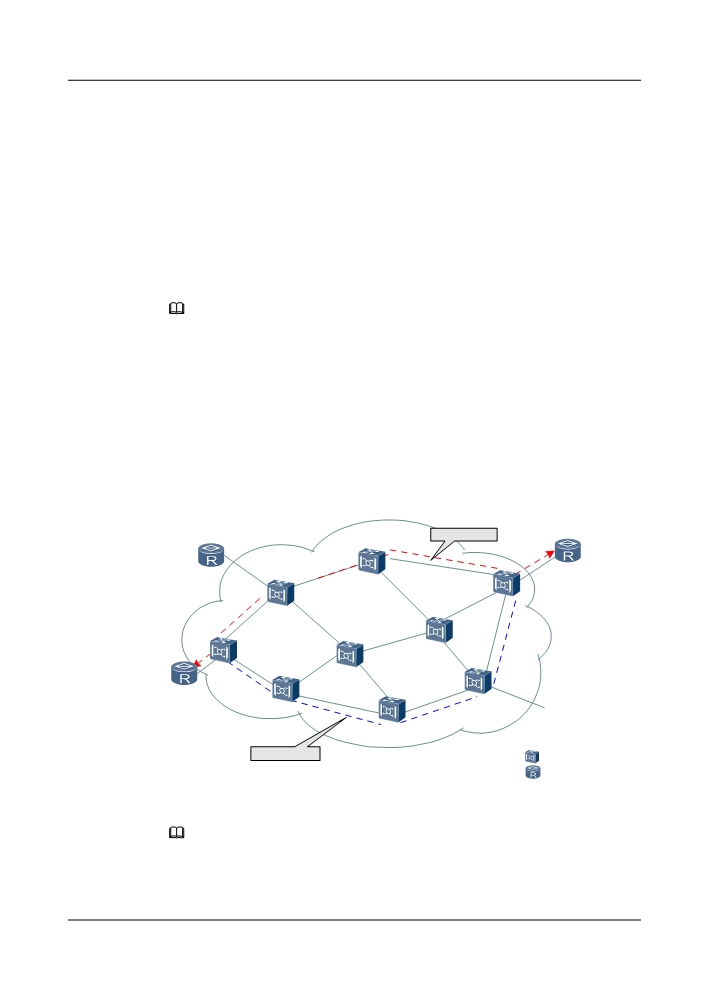
A diamond service is a service with 1+1 protection from the source node to the sink node. It is
also called a 1+1 service. For a diamond service, there are two different LSPs available between
the source node and the sink node. The two LSPs should be as separate as possible. One is the
working LSP and the other is the protection LSP. The same service is transmitted to the working
LSP and the protection LSP at the same time. If the working LSP is proper, the sink node receives
the service from the working LSP; otherwise, from the protection LSP.
NOTE
The optical-layer diamond service specification is removed because of the following factors: (the optical-
layer diamond service solution will be replaced by the associated silver ASON service solution)
l When two LSPs share the same OTU, they use the same wavelength. Therefore, rerouting of the two
LSPs also must use the same wavelength, which makes finding a route very difficult.
l Service switching within 50 ms cannot be guaranteed when 40G OTUs are used because the TDC
adjustment requires more than 50 ms.
l When the service runs on the working LSP, the service performance monitoring is not available for
the backup LSP. This cannot ensure that the backup LSP is in normal state or available, which will
impair the service SLA.
Figure 7-29 shows a diamond service.
Figure 7-29 Diamond Services
Working LSP
R1
R4
E
I
D
F
C
A
B
H
G
R2
R3
Protection LSP
: ASON NE
: User equipment
NOTE
In the creation of diamond services, two LSPs are generated, which have the feature of 1+1 protection for
traditional WDM services. The working trail corresponds to the working LSP, and the protection trail
corresponds to the protection LSP. When the working trail fails, the protection switching is performed
through the traditional WDM 1+1 protection and then a new LSP is created through rerouting.
291

There are three types of diamond services.
l Permanent 1+1 diamond service: rerouting is triggered once an LSP fails.
l Rerouting 1+1 diamond service: rerouting is triggered only when both LSPs fail.
l Non-rerouting diamond service: rerouting is never triggered.
Table 7-7 lists the attributes of the permanent 1+1 diamond service.
Table 7-8 lists the attributes of the rerouting 1+1 diamond service.
Table 7-9 lists the attributes of the non-rerouting 1+1 diamond service.
Table 7-7 Attributes of the permanent 1+1 diamond services
Attribute
Permanent 1+1 Diamond Service
Requirements for
Sufficient non-protection resources are available between the
creation
source node and the sink node.
Protection type
During creation, diamond services generate the services that have
the traditional WDM 1+1 protection attribute at the same time.
Different ASON trails support different protection schemes.
For WDM ASON ODUk trail: supports ODUk SNCP
Protection and
l If the resources are sufficient, two LSPs are always available
restoration
for a permanent 1+1 diamond service. One is the active LSP
and the other is the standby LSP.
l If the resources are not sufficient, one valid LSP can still be
reserved for a permanent 1+1 diamond service to ensure the
service survivability. The other LSP is also available but may
be invalid.
Rerouting
l Supports rerouting lockout.
l Supports rerouting priority.
l Supports several rerouting policies:
- Use existing trails whenever possible
- Do not use existing trails whenever possible
- Best route
- Simulated span restoration policy
Revertive
Supports reverting to the previous route.
Preset restoring trail
Supports setting the preset restoring trail.
Service conversion
l Supports conversion between diamond services and traditional
1+1 services.
l Supports conversion between diamond WDM ASON trails
and silver WDM ASON trails.
l Supports conversion between diamond WDM ASON trails
and copper WDM ASON trails.
Service switching
Supports manual switching.
292

Attribute
Permanent 1+1 Diamond Service
Service optimization
Supports manual service optimization.
Table 7-8 Attributes of the rerouting 1+1 diamond service
Attribute
Rerouting 1+1 Diamond Service
Requirements for
Sufficient non-protection resources are available between the source node
creation
and the sink node.
Protection type
During creation, diamond services generate the services that have the
traditional WDM 1+1 protection attribute at the same time. Different
ASON trails support different protection schemes.
For WDM ASON ODUk trail: supports ODUk SNCP
Protection and
l When the standby LSP fails, services are not switched. Rerouting is
restoration
not triggered.
l When the active LSP fails, services are switched to the standby LSP
for transmission. Rerouting is not triggered.
l When both the active and the standby LSPs fail, rerouting is triggered
to create a new LSP to restore services.
Rerouting
l Supports rerouting lockout.
l Supports rerouting priority.
l Supports several rerouting policies:
- Use existing trails whenever possible
- Do not use existing trails whenever possible
- Best route
- Simulated span restoration policy
Revertive
Supports reverting to the previous route.
Preset restoring
Supports setting the preset restoring trail.
trail
Service
l Supports conversion between diamond services and traditional 1+1
conversion
services.
l Supports conversion between diamond WDM ASON trails and silver
WDM ASON trails.
l Supports conversion between diamond WDM ASON trails and copper
WDM ASON trails.
Service
Supports manual switching.
switching
Service
Supports manual service optimization.
optimization
293

Table 7-9 Attributes of the non-rerouting 1+1 diamond service
Attribute
Non-rerouting 1+1 diamond service
Requirements
Sufficient non-protection resources are available between the source node
for creation
and the sink node.
Protection type
During creation, diamond services generate the services that have the
traditional WDM 1+1 protection attribute at the same time. Different
ASON trails support different protection schemes.
For WDM ASON ODUk trail: supports ODUk SNCP
Protection and
l When the active LSP fails, services are switched to the standby LSP
restoration
for transmission. Rerouting is not triggered.
l When the standby LSP fails, services are not switched. Rerouting is
not triggered.
l When both the active and the standby LSPs fail, rerouting is not
triggered.
Preset restoring
Supports setting the preset restoring trail.
trail
Service
l Supports conversion between diamond services and traditional 1+1
conversion
services.
l Supports conversion between diamond WDM ASON trails and silver
WDM ASON trails.
l Supports conversion between diamond WDM ASON trails and copper
WDM ASON trails.
Service
Supports manual switching.
switching
Service
Supports manual service optimization.
optimization
NOTE
When diamond ODUk ASON WDM trails are created, setting the SNC/N(PM) and SNC/S(TCM) modes
is supported.
When k is 0, only the non-intrusive monitoring (SNC/N(PM)) is supported. When k is 1, 2 or 3, the sub-
layer monitoring (SNC/S(TCM)) and non-intrusive monitoring (SNC/N(PM)) are supported.
When the SNCP type is set as sub-layer monitoring, the U2000 supports setting TCM layers (TCM=1-5).
Traditional services in SNC/I, SNC/N, and SNC/S protection modes can be upgraded into diamond ASON
services with the protection modes unchanged. After rerouting, SNC protection for services in the SNC/I
and SNC/N(TCM) protection modes changes into SNC/N(PM).
7.5.5 Silver WDM ASON Trail
Silver WDM ASON services, including WDM ASON OCh trails, ODUk trails, the revertive
time is several seconds. The silver level service is suitable for those data or internet services that
have low real-time requirement.
Silver services refer to the service connections from the source node to the destination node with
the rerouting protection attribute. They are also called rerouting services. If the LSP of the silver
294
services fails, rerouting is repeatedly initiated to restore the services until the rerouting is
successful. The silver services compute the restoration tail in real time, and thus no resource
needs to be reserved in advance. Hence, the bandwidth utilization is high. If there are not enough
resources, the services may be interrupted.
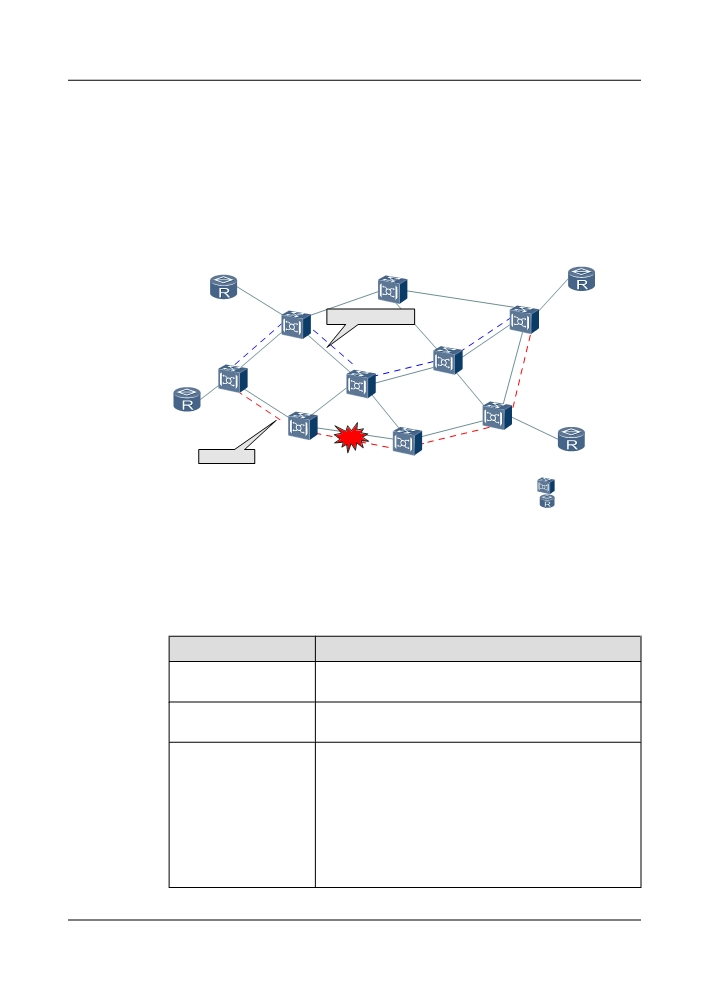
As shown in Figure 7-30, A-B-G-H-I is a silver service trail. If the fiber between B and G is
cut, the ASON triggers rerouting from A to create a new LSP that does not pass the cut fiber.
Hence, services are protected.
Figure 7-30 A silver service
R1
R4
LSP after rerouting
I
D
F
C
A
B
H
G
R2
Original LSP
R3
: ASON NE
: User equipment
Table 7-10 lists the attributes of silver services.
Table 7-10 Attributes of silver services
Attribute
Silver Services
Requirements for creation
Sufficient non-protection resources are available between the
source node and the sink node.
Service restoration
When the original LSP fails, rerouting is triggered to create a
new LSP to restore services.
Rerouting
l Supports rerouting lockout.
l Supports rerouting priority.
l Supports several rerouting policies:
- Use existing trails whenever possible
- Do not use existing trails whenever possible
- Best route
- Simulated span restoration policy
295

Attribute
Silver Services
Revertive
Services in the WDM ASON ODUk, OCh trail support reverting
to the previous route manually or automatically.
Preset restoring trail
Supports setting the preset restoring trail.
Service migration
l Supports migration between silver services and traditional
unprotected services without affecting them.
l Supports migration between silver services and diamond
services.
l Supports migration between silver services and copper
services.
NOTE
In the case of the WDM ASON OCh trails, the conversion between the
silver and diamond or copper is not supported.
Service optimization
Supports manual service optimization.
Service association
Supports service association.
7.5.6 Copper WDM ASON Trail
The copper services are seldom used. Generally, temporary services, such as the abrupt services
in holidays, are configured as copper services. The copper WDM ASON trails are classified into
OCh trail, ODUk trail.
Copper services are also called non-protection services. If an LSP fails, services do not reroute
and are interrupted. Table 7-11 lists the attributes of copper services.
Table 7-11 Attributes of copper services
Attribute
Silver Service
Requirements for
Sufficient non-protection resources are available between the source
creation
node and the sink node.
Service restoration
Does not support rerouting.
Service migration
l Supports migration between copper services and traditional
services.
l Supports migration between copper services and diamond services.
l Supports migration between copper services and silver services.
NOTE
In the case of the WDM ASON OCh trails, the conversion between the copper
and diamond or silver levels is not supported.
Service
Supports manual service optimization.
optimization
Service association
Supports service association.
296
7.5.7 OVPN
In the case of an optical virtual private network (OVPN), multiple operators share one ASON.
When multiple operators share one ASON, different TE link resources are allocated to each
operator. In this case, an operator can use and manage its own TE link resources and ASON
services only. The operators are called OVPN customers.
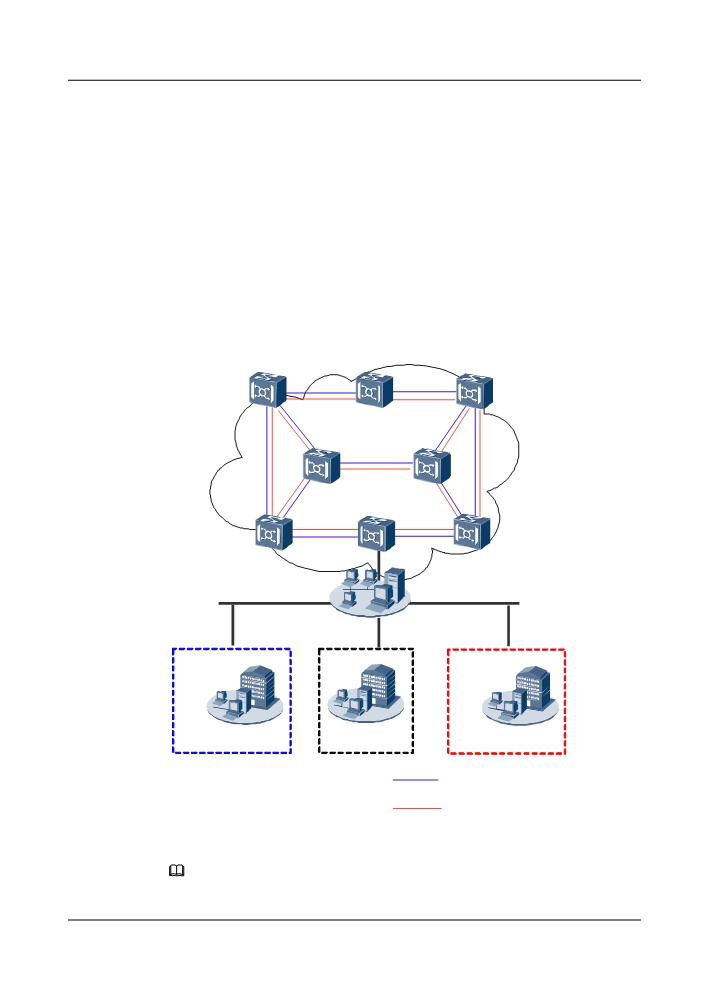
As shown in Figure 7-31, certain resources are separately allocated to OVPN customers 1 and
2. The network management (NM) users of OVPN customers 1 and 2 are separately created on
the U2000. Then, OVPN customers 1 and 2 can log in to the U2000 through their respective
clients and NM users. OVPN customers 1 and 2 can separately manage and maintain their
resources and ASON services.
Multiple NM users can be created for one OVPN customer. One NM user can manage multiple
OVPN customers.
Figure 7-31 Networking diagram of an OVPN
U2000 Server
U2000 Client
U2000 Client
U2000 Client
OVPN
OVPN
NM User Admin
Customer1
Customer2
: Resource of OVPN customer 1
: Resource of OVPN customer 2
NOTE
The OVPN function is available only to the optical-layer ASON services.
297

Enabling the OVPN Function
To perform the OVPN function, you must ensure that all the ASON NEs in the ASON domain
enable the OVPN function. In addition, the OVPN License can be started on the NMS side.
Partitioning the TE Link Resources
The TE link resources are divided into three types: shared resources, unshared resources, and
OVPN customer resources, as shown in Figure 7-32.
Figure 7-32 Partitioning the TE link resources
VC-4
timeslot
Shared
resources
Unshared
TE links
resources
Resources of OVPN
customers
VC-4
timeslot
Table 7-12 shows the principle for the NM user to use the resources. The NM users are classified
into the following three types:
l NM user (admin): By default, admin is the superuser. The NM user uniquely has the right
to manage the OVPN customers, to partition the OVPN resources, and to use all the TE
link resources.
l OVPN NM user: The OVPN NM user can use the OVPN customer resources (colored) and
shared resources that are partitioned by the NM user admin.
l NM user without the authorities of OVPN customers: This NM user can use the shared
resources only.
Table 7-12 Principle for an NM user to use resources
User Level
Shared Resource
OVPN User
Unshared
Resource
Resource
admin
Available
Available
Available
OVPN NM user
Available
Available
Unavailable
NM user without the
Available
Unavailable
Unavailable
authorities of OVPN
customers
298

NOTE
To allocate the TE links on the MSP ring for OVPN customers, ensure that the timeslots are consistent
with each other in each segment.
OVPN Services
Table 7-13 lists the OVPN service attributes.
Table 7-13 OVPN service attributes
Attribute
OVPN Service
Creating a service
l When creating a service, the NM user admin can use the shared
resources and OVPN customer resources. Each OVPN service can
use only the timeslot resources of the same color.
l An OVPN customer can create a service on the resources only
allocated to the OVPN customer.
Rerouting
When the OVPN service is rerouted, it can use the resources allocated to
the OVPN customer first. If the OVPN customer resources are not
available, the OVPN service can use the shared resources.
Presetting the
A restoration trail can be preset. An OVPN customer can use the allocated
restoration trail
resources only.
Shared Mesh
A shared Mesh restoration trail can be preset. An OVPN customer can
restoration trail
use the allocated resources only.
Service switching
OVPN services and traditional services can be mutually switched from
each other.
l To switch an SDH service to an ASON service, you need to switch
the static SDH resources to the ASON resources.
l After an ASON service is degraded to an SDH service, the original
ASON service switch to the static SDH resources.
Service
An ASON service of an OVPN customer can be optimized on the
optimization
resources only allocated to the OVPN customer.
7.5.8 Crankback Mechanism
The Crankback mechanism during rerouting, optimization, and creation of the wavelength/sub-
wavelength LSP is supported.
It takes a certain time to spread network routing information. When rerouting is performed, the
source node may use the outdated network status information to calculate the trail. Therefore,
the selected route may be unavailable, resulting in a rerouting failure.
The ASON software supports the Crankback rerouting mechanism. When setting up connections
according to the calculated trail, the ASON software informs the source node of the information
related to the faulty network nodes or links if the connection setup process is baffled due to
insufficient network resources or network faults. In this case, the source node recalculates a trail
that meets the constraint conditions but does not traverse the obstacle node and then establishes
the connections for the calculated trail. This effectively restores a service by means of rerouting.
299
7.5.9 Network Traffic Engineering
An ASON network has one network traffic engineering policies, that is, network traffic
equilibrium, so as to make network resources distributed in the best state. In addition, various
restraint conditions for route selection are developed. In this manner, network resources are
properly used.
Network Traffic Equilibrium
Due to manual planning of services on a traditional network, it is difficult for the traditional
network to achieve traffic equilibrium on the entire network. The introduction of ASON features
makes the network resources automatically adjusted. With the traffic engineering algorithm, the
resources of the entire network can be automatically and evenly allocated, which avoids
congestion and improves network security and operability.
On an ASON network, the traffic of each trail is equalized, and thus the situation where the
traffic of certain trails is large but certain trails are idle can be avoided.
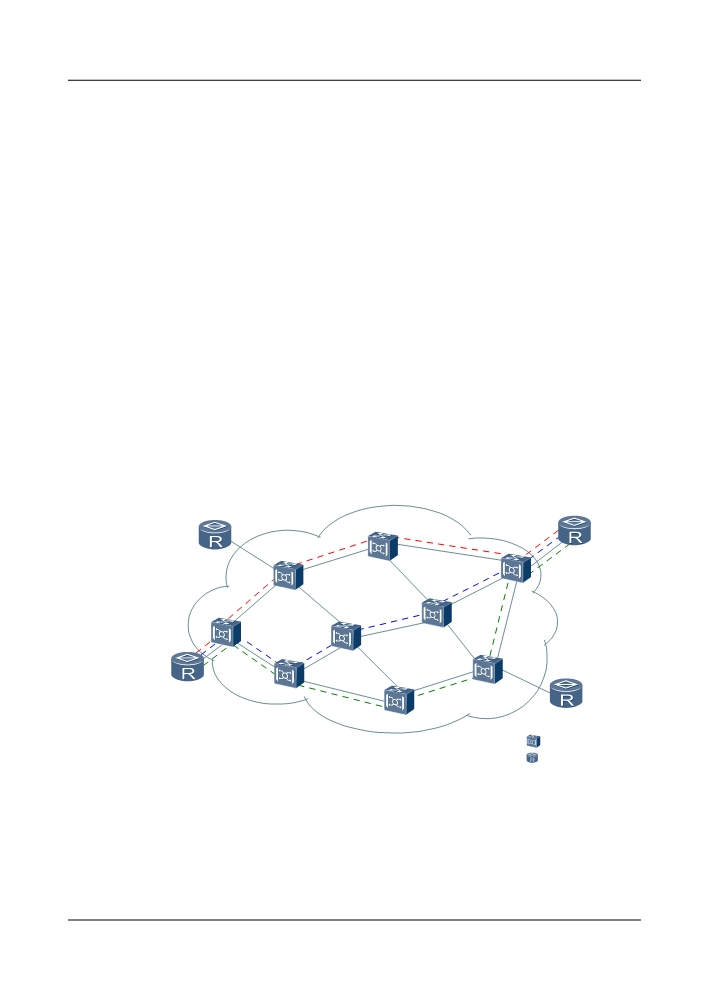
The ASON computes a best route according to the CSPF algorithm. If there are many services
between two nodes, there may be several services sharing a same route. The traffic equilibrium
function is used to avoid this situation. As shown in Figure 7-33, there are many silver services
between R2 and R4. To make the network more safe and reliable, the ASON allocates them to
different routes such as A-D-E-I, A-B-C-F-I and A-B-G-H-I as evenly as possible. In this
manner, network security and stability are enhanced.
Figure 7-33 Traffic equilibrium
R4
R1
E
I
D
F
C
A
B
H
G
R2
R3
: ASON NE
: User equipment
Route Selection Policy
With traffic engineering, Huawei ASON equipment develops various constraint conditions on
the control plane for route selection based on the WDM/OTN ASON network. The constraint
conditions for route selection are as follows:
300