Sany SRT55D Off-Highway Truck. Safety, Operation and Maintenance Manual (2014) - page 2
Safety
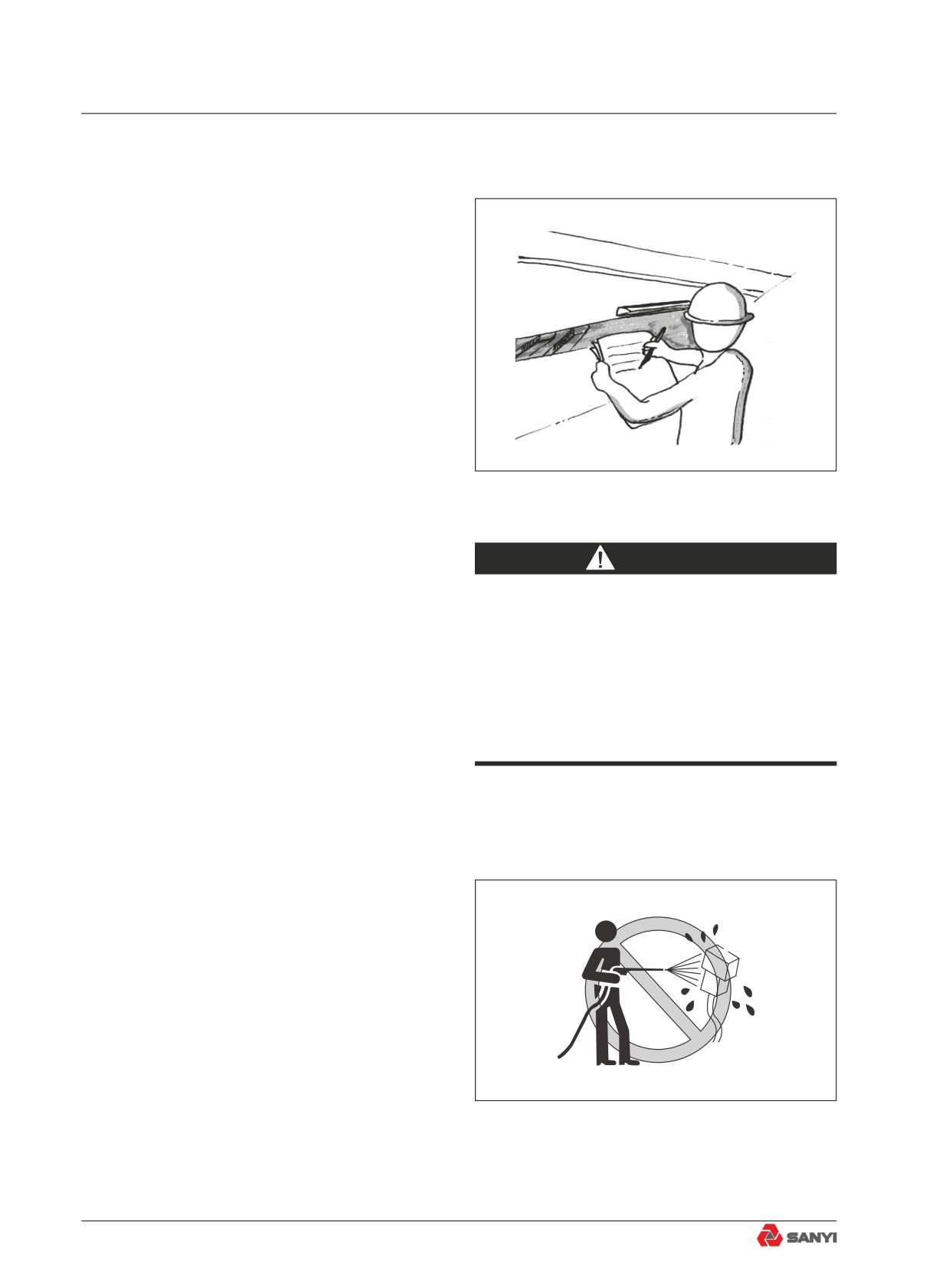
2.2.5 Safety equipment
To protect you and others around you, your
machine may be equipped with the following
safety equipment. Make sure that they are
secured in place and in good condition.
● Falling Object Protection (Body pivot pin)
● Rollover Protection
● Sealt belt
● Lamps
● Horn
● Guards
● Backup alarm
Fig. 2.2-4
● Mirrors
● Fire extinguisher
NOTICE
● Make sure all covers and caps are in
proper place. Repair or replace any of them
immediately once found damaged.
● Know how to use these facilities and use
them correctly.
● Never remove the guard rail of the operator
cab (unless necessary) .
2.2.6 Cleaning your machine
● Clean the windshields, mirrors and lights.
Make sure that the operating area, steps
and handholds are free from oil, grass,
snow, ice or mud, which can cause you
to slip and fall. Remove the mud on your
soles before getting on the machine.
● If water has penetrated into the electrical
system, never rush to power on your
machine and start the engine, which
can cause machine failure or PC board
damage. Never flush the electrical system
Fig. 2.2-5
(including sensors, connectors, etc.) with
water or steam.
2-10
Safety
2.2.7 Keeping the cab clean
● Clean the mud and oil on your soles when
getting into the cab. Mud or oil under
your shoes can cause your foot to slip on
the pedal during operation, and serious
accident could result.
● Remove all loose personal items or other
objects from the operator's area. Secure
these items in the tool box or remove
them from the machine.
● Never use cellular phone when operating
or driving the machine.
● Never bring Hazardous articles, such as
flammable or explosive products, into the
cab.
2.2.8 Precautions when leaving the
machine
● If the correct procedures are not followed
when stopping the machine, the machine
may suddenly move off with no operator
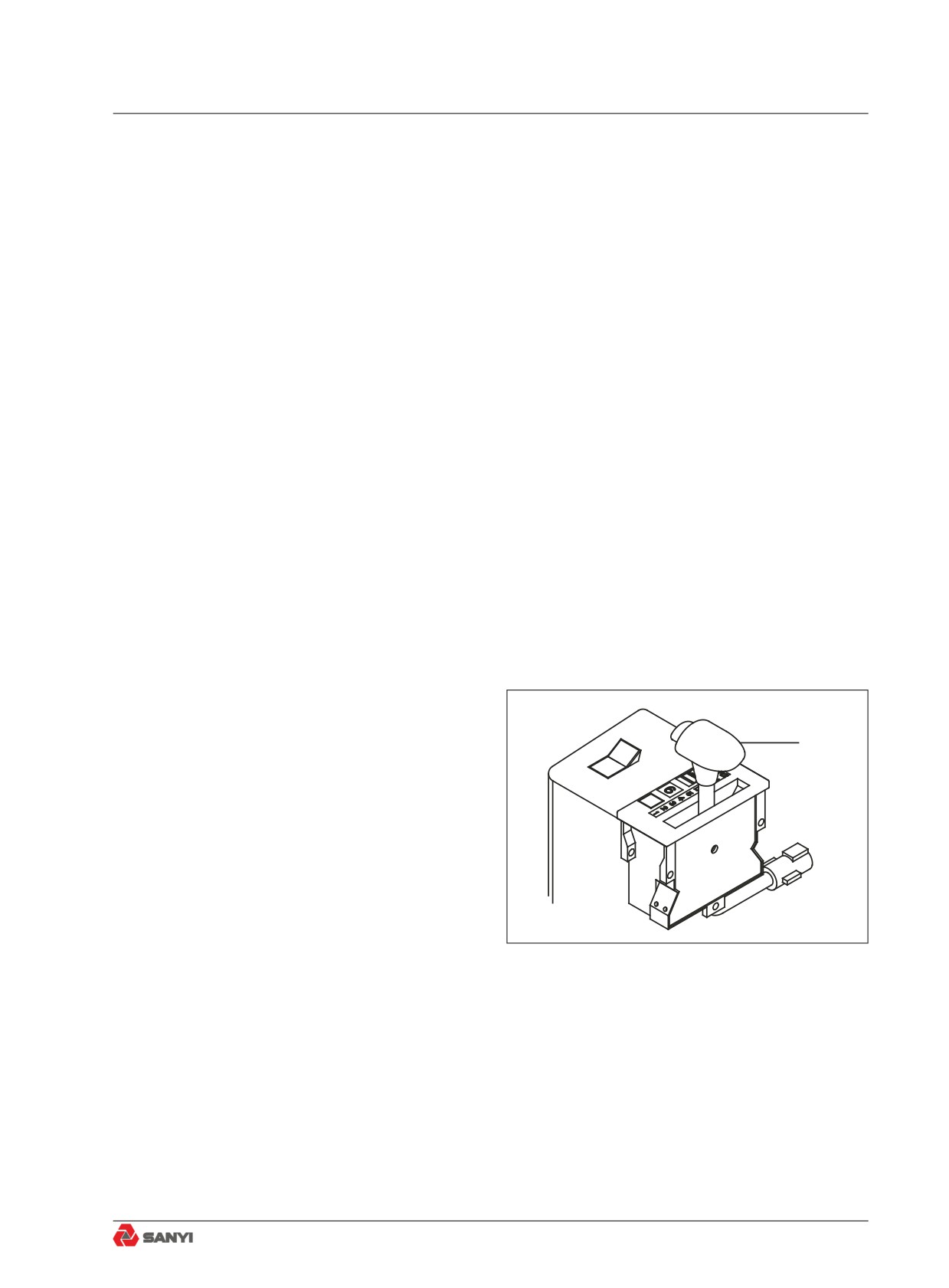
1
on it. This may lead to serious personal
injury. Always observe the following
precautions strictly.
● When leaving the operator’s cab, place
gear shift lever (1) at Neutral, set parking
brake switch to PARKING, set the dump
● control lever to HOLD, then stop the
engine.
● Remove the key from the starting switch.
Fig. 2.2-6
● Lock all the doors of the operator’s
compartment.Take the key with you and
leave it in the specified place.
2-11
Safety
2.2.9 Handholds and steps
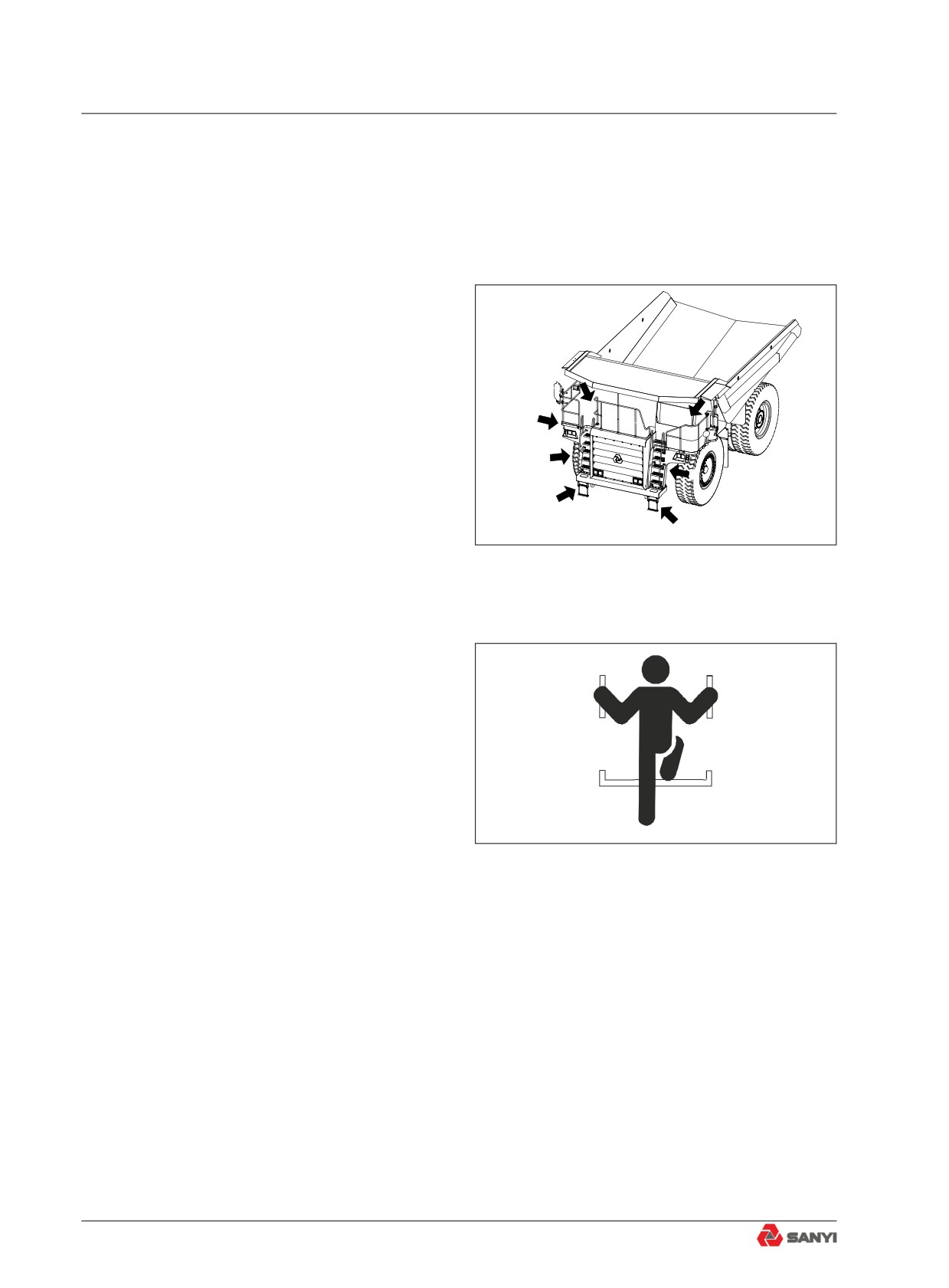
To avoid risk of injury when getting on or
off the machine.
●
Always face the machine and maintain at
least three-point contact (both feet and
one hand, or both hands and one foot)
with the handrail and steps to ensure that
A
you support yourself.
B
●
Always check the handrails and steps
A
for oil, grease, or mud. Wipe them clean
before using.
A
●
Repair any damage and tighten any loose
B
bolts.
A
●
Never get on or off the machine while
B
holding tools in your hand.
Fig. 2.2-7
●
Never climb onto the engine hood, covers,
or other places where there are no anti-
slip pads.
●
When entering the operator’s
compartment, never hold the dump control
lever. If the dump control lever is gripped,
it may move.
●
Never jump onto the machine. There is
danger that your feet will slip, and you will
fall and be seriously injured.
●
Never jump off the machine. There is
danger that you will break a bone or suffer
other serious injury when landing.
Fig. 2.2-8
●
Never get on or off a moving machine.
You may be unable to support yourself
with the handrail or steps, and fall from
the machine, suffering injury. Even if the
machine starts off with no operator on it,
do not jump on the machine and try to
stop it.
2-12
Safety
2.2.10 Preventing burns
2.2.10.1 Hot coolant
● To prevent burns caused by hot coolant or
steam when checking or discharging the
coolant, wait until the engine coolant is
cool enough before proceeding.
● Never open the cap of radiator before the
engine cools down. Loosen the cap of the
radiator slowly before removing it. Internal
pressure of radiator must be relieved to
avoid serious burns.
Fig. 2.2-9
2.2.10.2 Hot oil
● To prevent scalds caused by hot oil when
checking or discharging the oil, always
wait for the engine oil to cool down before
you proceed.
● When the engine has cooled down,
loosen the cover or screw plug slowly to
relieve internal pressure.
Fig. 2.2-10
Fig. 2.2-11
2-13
Safety
2.2.11 Preventing fire and explosion
2.2.11.1 Fire caused by fuel or oils
● Engine oil and fuel must be stored in
designated place, where unauthorized
persons cannot enter.
● Never smoke or use fire near fuel or
engine oil.
● Check for missing or loose pipe clamps,
twisted hoses, hoses rubbing against
pipeline,damaged oil cooler, and loose
bolts in flange of oil cooler, so as to avoid
Fig. 2.2-12
oil leakage.
● Tighten, repair or replace any
missing,loose or damaged pipe clamps,
pipelines,hoses, oil coolers or other flange
bolts.
● Refuel or store oils in a place with good
ventilation.
Fig. 2.2-13
Fig. 2.2-14
2-14
Safety
2.2.11.2 Fire caused by flammable materials
● Remove at any time dry leaves, wood
chips, paper pieces, dirt and other
flammable materials built up or stuck
on engine, exhaust manifold, battery or
interior of engine hood to prevent fire.
2.2.11.3 Fire caused by electric lines
● Short circuit of electrical system can
cause fire.
● Keep electric terminals clean and
fastened.
● Check power cables and electric lines for
looseness, entanglement, hardening or
break each day after operating for 8-10
hours. Check the presence or damage of
wiring terminal cover.
● In case of slack or entangled power cables
or electric wires, tighten the connections
or wire clips, and repair or replace broken
wires.
2.2.11.4 Fire caused by hydraulic lines
● Check the clamps, guards and gaskets of
all hoses and pipes to see whether they
are tightened in position.
● In case of loosening, their vibration in
operation may lead to friction against
other components, resulting damage
of hose, ejection of high-pressure oil,
disastrous fire or serious injury.
2-15
Safety
2.2.11.5 Fire caused by illumination
equipment
● Anti-blast illumination equipment shall
be used to avoid explosion when fuel,
oil,electrolyte, window cleaning detergent
or cooling fluid is being checked.
● Instructions in this manual must be
followed when power outlet on the
machine is used for illumination.
2.2.12 In the event of fire
When a fire breaks out, leave the machine
immediately by the following steps.
● Turn start switch to the OFF position to
shut down the engine.
● Leave the machine with the help of hand-
holds and steps.
2.2.13 Windshield cleaning detergent
● Use alcohol based detergent. Never use
methanol based detergent as it irritates
eyes.
2-16
Safety
2.2.14 Precautions when using
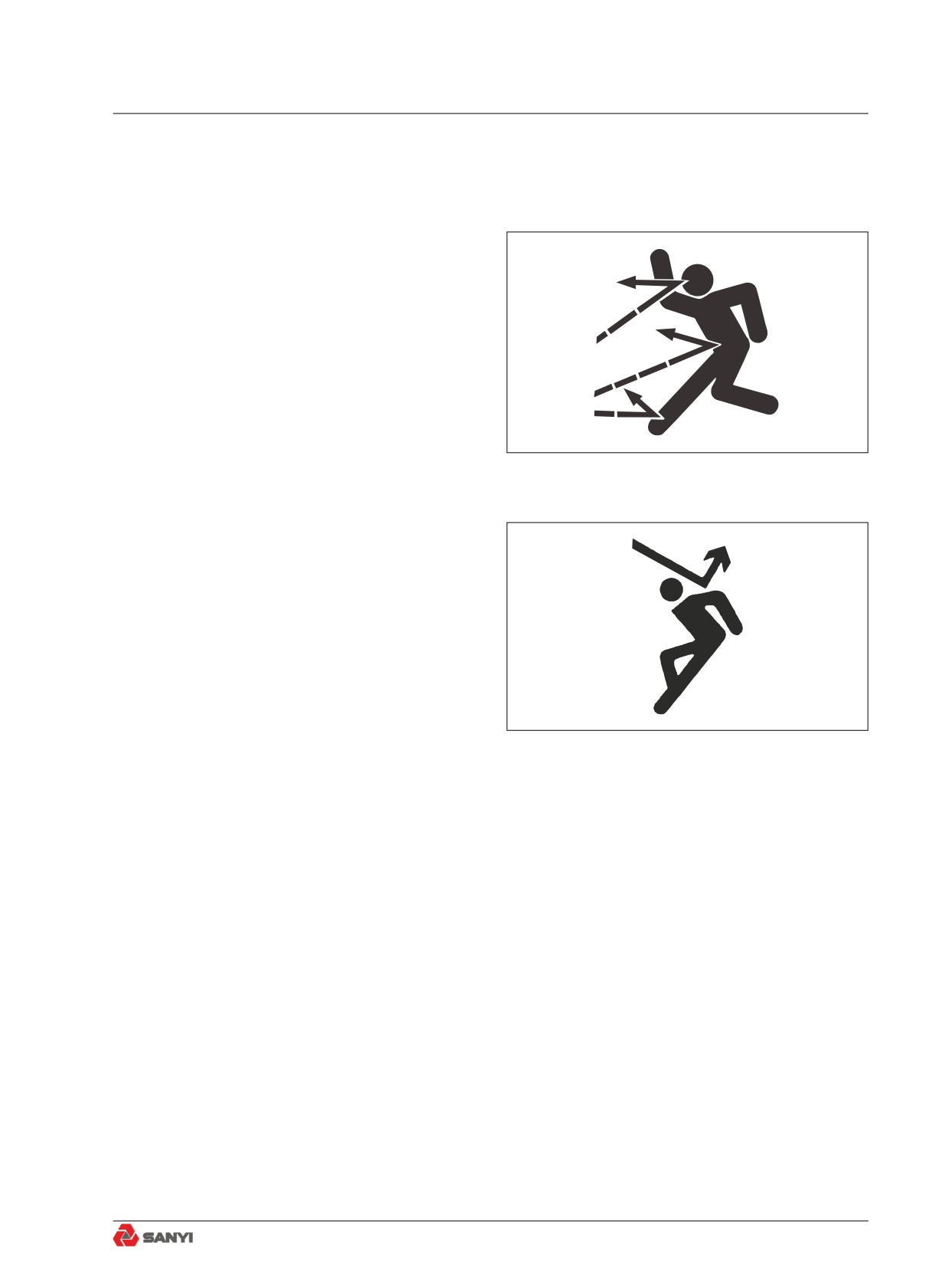
ROPS(Roll over protective structure)
● The operator’s cab has a ROPS structure.
In addition to supporting of the load if the
machine tips over, it also absorbs the
impact energy and protects the operator.
If the function of ROPS is reduced, it
cannot protect the operator and he may
be injured.
● Always do the following. Do not weld, drill
holes, or make any other modification to
the operator’s cab structure.
Fig. 2.2-15
● Repair or replace the operator’s cab if it
is deformed by falling objects or when the
machine tips over. For details of repair,
please consult your SANY distributor.
Fig. 2.2-16
2.2.15 Attachment installation
● Installation of optional parts or
attachments may involve safety issues or
be limited by the law. In this case, contact
your Sany distributor in advance.
● Sany assumes no responsibility for the
injury,accidents and product failure caused
by the use of unauthorized attachments
and parts.
● Before installing and using machine
attachments,read related instructions
regarding the attachment and general
precautions on attachment in this manual.
2-17
Safety
2.2.16 Cab windows glasses
● Broken cab windows at the side of the
work equipment may expose the operator
in direct contact with the work equipment.
In this case, stop operation immediately
and replace the glasses.
● Broken or damaged window provides
no protection to the operator. When
the roof window is damaged, replace it
immediately with a new one.
2.2.17 Unauthorized modification
Any modification unauthorized by Sany
may lead to safety problems, personal injury
or death. Improper modification can affect
machine's strength and operator's view.
Contact your Sany distributor before making
any modification.
Sany assumes no responsibility for the
accidents, failure or damage caused by
unauthorized modification.
2.2.18 Examination and confirmation of
worksite
Before starting operations, check first if
there is any danger on the jobsite. If you do
not understand the dangers of the jobsite
before starting operations, the machine may
tip over, or the ground may collapse, or rocks
may fall,causing injury to the operator. Always:
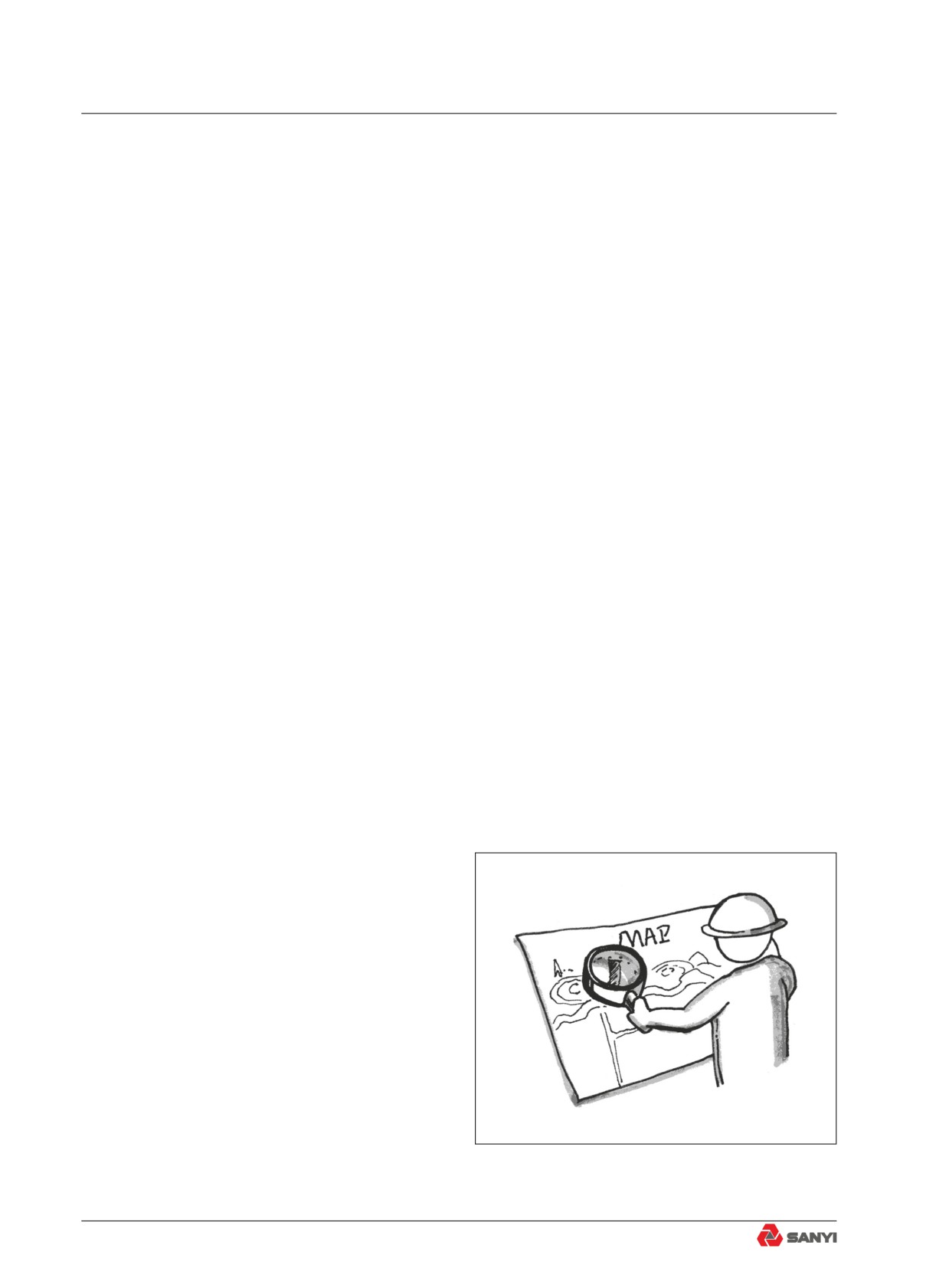
● Check the terrain and condition of the
ground at the worksite, and determine
the safest method of operation. Do
not operate where there is a hazard of
landslides or falling rocks.
● Prevent any unauthorized person from
entering the operating area.
Fig. 2.2-17
● Before operating in shallow water or on
2-18
Safety
soft ground, check the depth of the water,
speed of the current, and the firmness
and shape of the ground. Avoid any area
where there is any obstruction to travel
operations.
● Maintain the travel path on the jobsite
so that there is no obstruction to travel
operations.
Fig. 2.2-18
2.2.19 Operation on soft ground
● Avoid traveling or operating your machine
near cliffs, road shoulders or trenches.
The soft ground plus machine weight
and vibration can cause your machine to
sink or tip over. The ground may become
even softer after heavy rain, explosion or
earthquake.
● When operating on a dam or near an
excavated ditch, vibration and machine
weight may trigger a landslide. Before
operation, take protective measures to
prevent your machine from tipping over or
falling.
2-19
Safety
2.2.20 Overhead power cables
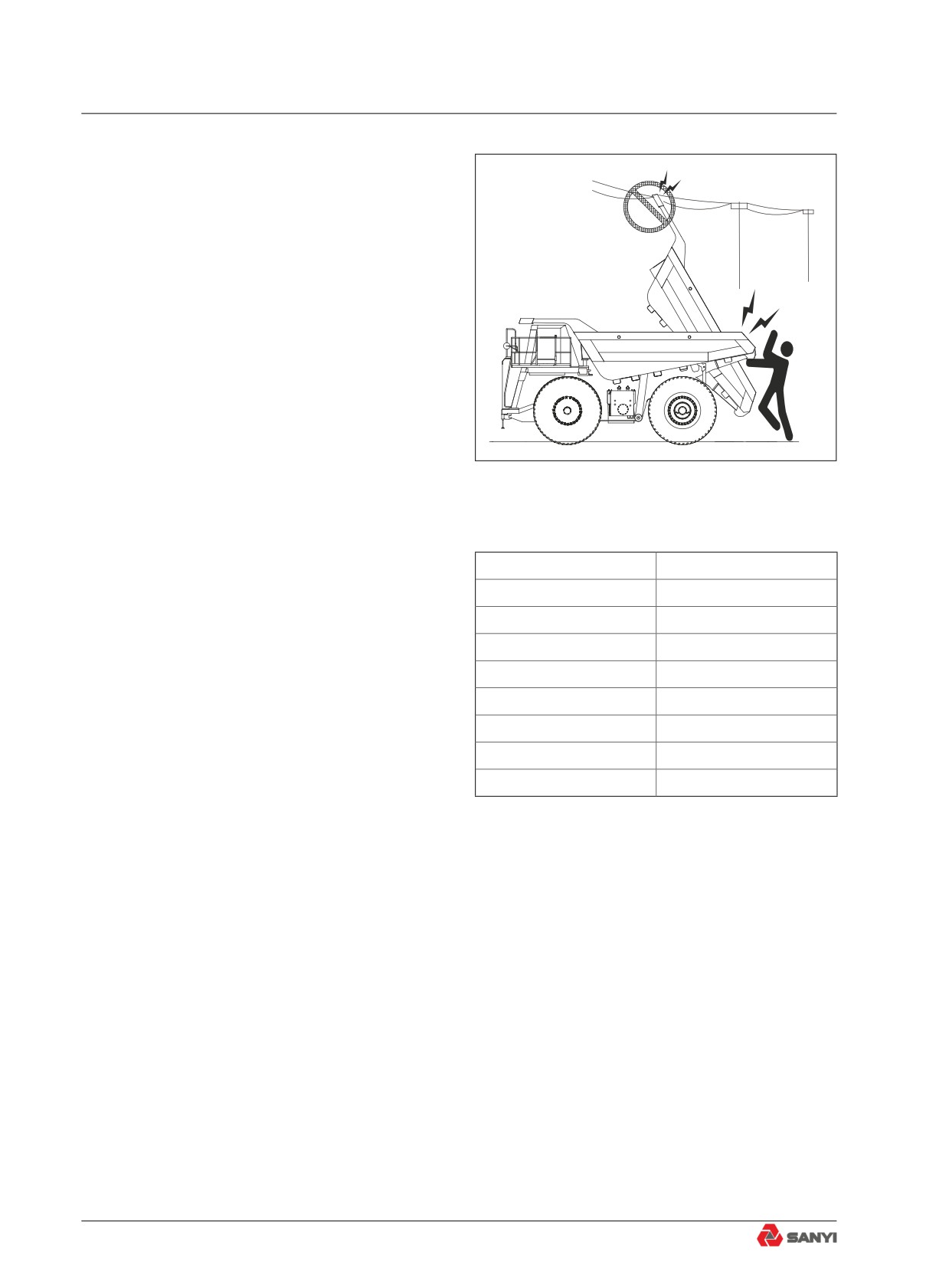
Never drive or operate your machine near
power cables, which may bring electrocution
hazard and cause machine damage, personal
injury or death. The following steps are to be
followed while working at where power cables
could be nearby.
●
Before operation in the vicinity of power
cables, inform local power company of the
coming operation and ask them to take
necessary measures.
●
If your machine is too close to power
cable, electrocution is most likely to occur
Fig. 2.2-19
and cause burns or death. A safe distance
must be kept between machine and power
cable (See Table 1-1). Before operation,
communicate with local power company
Cable Voltage
Safe Distance
regarding safety measures.
100V - 200V
2 m ( 7 ft) or above
●
A signalman is to be designated to give
6,600V
2 m ( 7 ft) or above
signals if your machine is too close to
22,000V
3m(10 ft)or above
power cables.
66,000V
4m(14 ft)or above
●
Nobody is allowed to approach the
154,000V
5m(17 ft)or above
machine when it is operated near high-
187,000V
6m(20 ft)or above
voltage cables.
275,000V
7m(23 ft)or above
●
If your machine is too close to the
cable or touches the cable, to prevent
500,000V
11m(36 ft)or above
electrocution, operator shall not leave
Table 1-1
the cab until machine power is surely
cut off. In addition, Nobody is allowed to
approach the machine.
●
To prevent accidents, wear rubber shoes
and rubber gloves during operation. Cover
the operator’s seat with rubber sheet and
pay attention to exposed part of body
that should not touch the lower part of
machine.
2-20
Safety
2.2.21 Alternate exit
● If you are unable to open the cab door
in case of emergency, use the safety
hammer to break the rear window to
escape.
● Remove the pieces of glass from the
window frame before escaping. Be
careful not to be cut by broken glass.
Pay attention to the broken glass on the
ground, which may cause you to slip and
fall.
Fig. 2.2-20
2.2.22 Ensure good visibilty
This machine is equipped with mirrors to
improve the visibility, but even with mirrors,
there are places, which cannot be seen from
the operator’s seat, so always be careful when
operating.
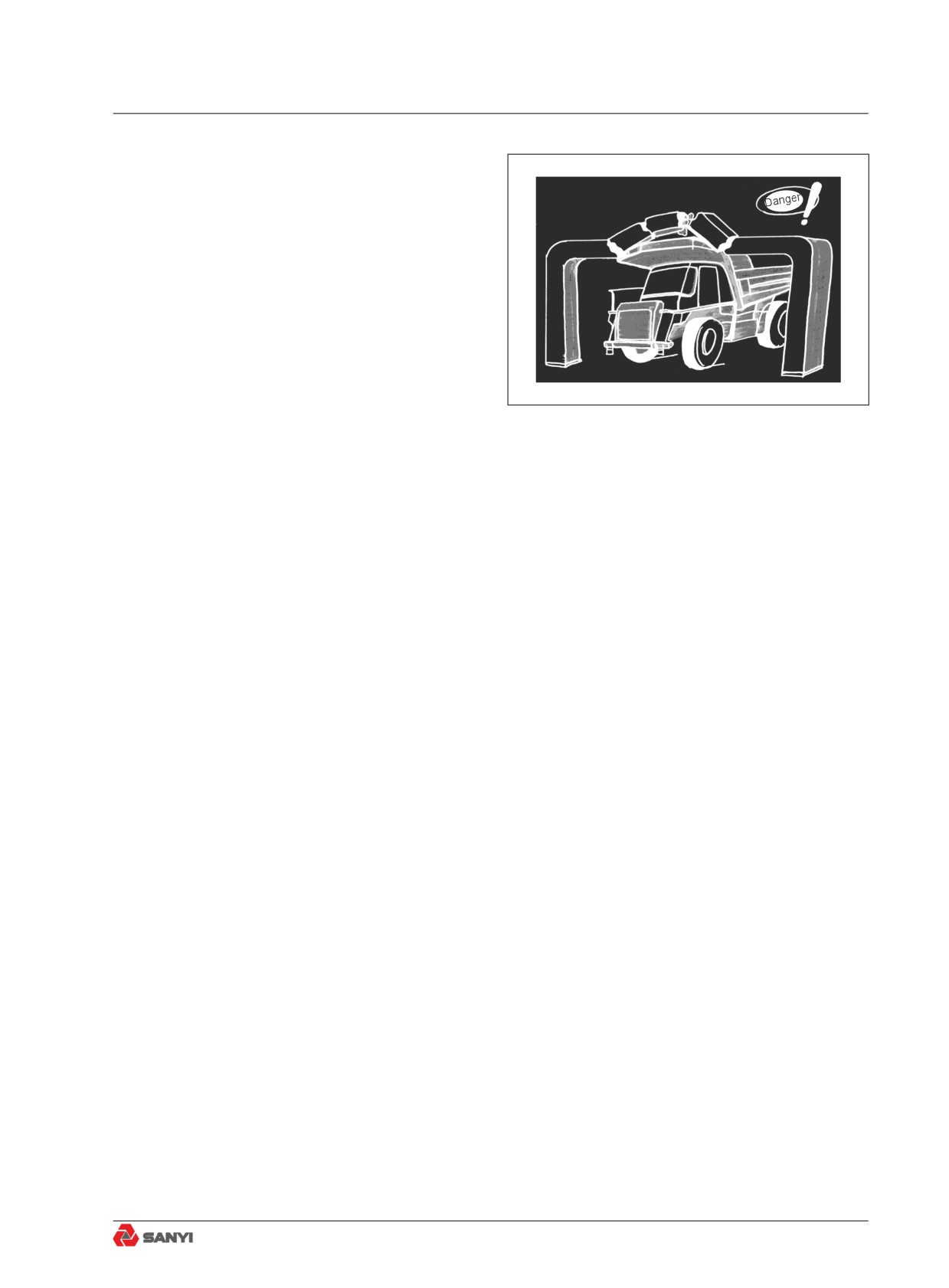
When operating or traveling in places
with poor visibility, if it is impossible to confirm
the condition of the job side or obstacle is in
the area around the machine, there is danger
that the machine may suffer damage or the
Fig. 2.2-21
operator may suffer serious personal injury.
Whenoperating or traveling in places with poor
visibility, always observe the following items
strictly.
● If the visibility cannot be sufficiently
assured, position a flagman if necessary.
The operator should pay careful attention
to the signs and follow the instructions of
the flagman.
● The signals should be given only by one
flagman.
● When working in dark places, turn on
the working lamps and front lamps of
the machine, and if necessary, set up
additional lighting in the area.
● Stop operations if there is poor visibility,
2-21
Safety
such as in fog, snow, rain, or sand storms.
● Check the mirrors on the machine before
starting operations every day. Clean off
any dirt and adjust the view to ensure
good visibility.
● In areas where it is impossible to confirm
the area behind the machine and
observation cameras have been set
● up, clean off any dirt from the lens and
make sure that the camera gives a clear
view of the rear.
2.2.23 Asbestos hazard
Inhalation of asbestos dust can cause
WARNING
lung cancer. It is possible to inhale asbestos
dust when performing tear-down operation
No asbestos is used in this machine.
or handling industrial wastes at job site. The
But aftermarket parts could contain
following rules must be followed.
asbestos. Therefore,use only the parts
● Use water, instead of compressed air, to
and components supplied by Sany.
remove the dust.
● If the air contains asbestos dust, operate
the machine following the wind. All
persons shall wear acceptable filter mask.
● Nobody is allowed to approach the
machine during operation.
● The regulations, rules and environment
criterion at job site shall be observed.
2-22
Safety
2.3 Safe Operation Precautions
2.3.1 Safe starting
2.3.1.1 Safe mounting
When you mount or dismount the
machine:
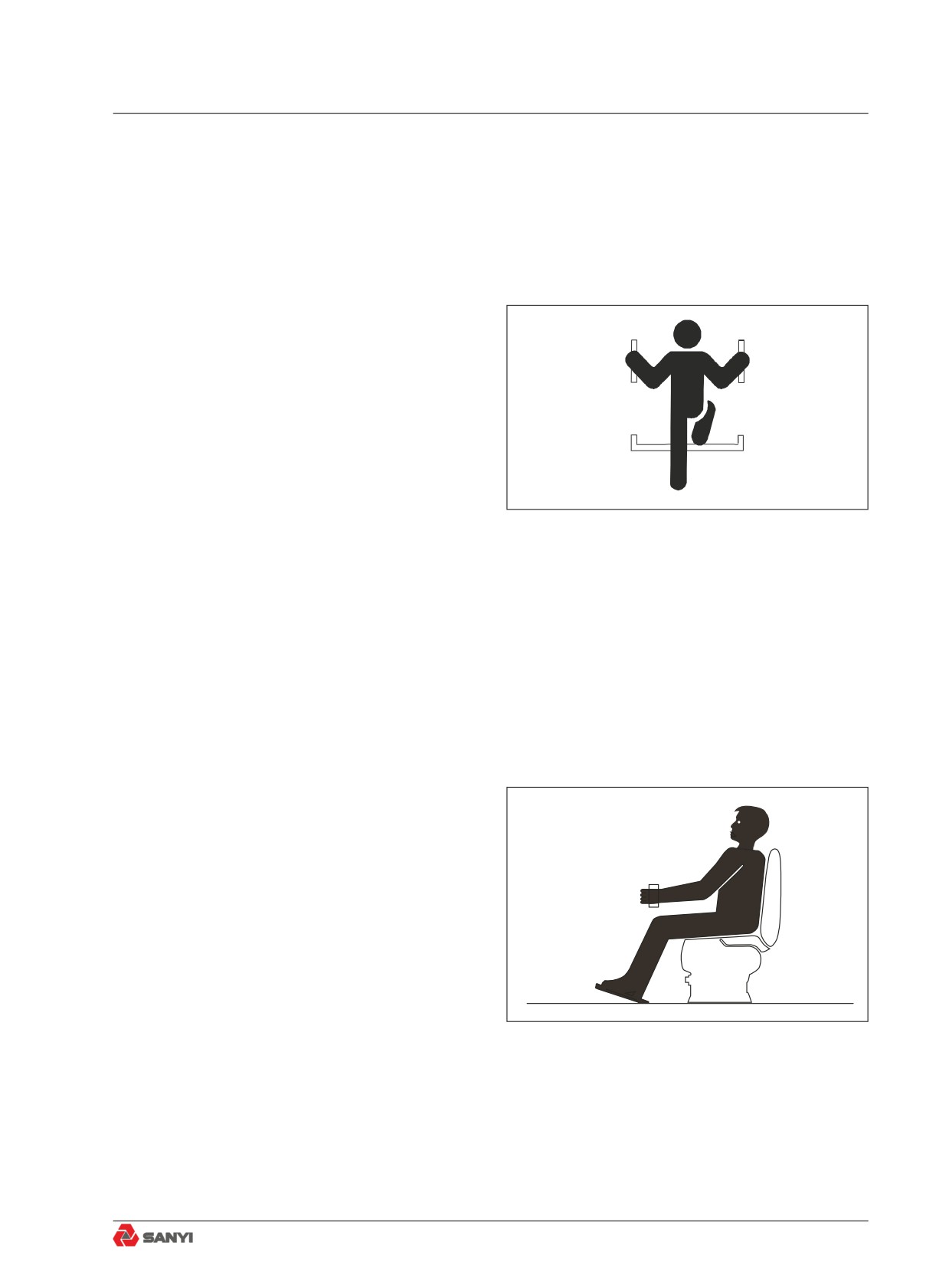
● Always face the machine and maintain
a three-point contact (one hand and two
feet or two hands and one foot).
● Never jump on/off the machine. Never
mount a moving machine.
● Never use any control lever as handhold.
Remove the mud, oil dirt and water from
the pedals, handholds and your soles at
Fig. 2.3-1
all times.
● The cab must be aligned with the
undercarriage centerline before you enter
or exit the cab.
2.3.1.2 Seat adjustment
● Uncomfortable seat position can easily
lead to operator fatigue and mistakes.
The seat position should be adjusted
upon change of operator. Leaning against
the back of seat, operator shall be able
to push the pedal to its limit with his foot,
and operate the control lever properly.
Otherwise, the seat should be readjusted
by moving it forward or backward.
Fig. 2.3-2
2-23
Safety
2.3.1.3 Seat belt
● The operator may get seriously injured or
killed when the machine tips over. Before
operating the machine, check carefully
your seat belt, the buckles and the anchor
point. Replace the seat belt if damage or
excessive wear is observed. When the
machine is being operated, keep your
seat belt buckled up.
● The seat belt must be replaced every
three years regardless of its condition.
Fig. 2.3-3
2.3.1.4 Before starting the engine
Before starting your daily work, the
following items must be observed before
starting the engine.
●
Clean the windows to ensure a good
visibility.
●
Clean the head lamps and work lamps,
and check if they are in good condition.
●
Check coolant level, fuel level and engine
oil level.
●
Check for blocked air filter and damaged
electrical wires.
Fig. 2.3-4
●
Check that there is no mud or dust
accumulated around the movable parts of
the accelerator pedal or brake pedal, and
check that the pedals work properly.
●
Adjust the operator’s seat so that it is
easy to see to the front, and check that
there is no damage or wear to the seatbelt
or seatbelt mounts.
●
Check that the instruments and gauges
are working properly, that the gear shift
lever is at the Neutral position, and that
the dump control lever is at the FLOAT
position.
2-24
Safety
● Adjust the mirrors so that the rear of the
machine can be seen clearly from the
operator’s seat.
● Check that there are no persons or
obstacles above, below, or in the area
around the machine.
● Check that the parking brake switch is in
the PARKING position.
2.3.1.5 Engine starting rules
● Before starting the machine, make
sure nobody is on, under or around the
machine. Sound the horn to warn people
around.
● Always start and operate the machine
from the operator seat.
● No one is allowed to stay on the machine
except the operator.
● Never start the engine by shorting the
start motor circuit, which is dangerous and
may cause machine damage.
Fig. 2.3-5
2.3.1.6 Starting engine in cold season
● Sufficient warm-up operation is necessary.
Incomplete warming up may result in slow
reaction and accidents.
● Before starting, check the battery
electrolyte.In case of frozen electrolyte,
never charge the battery or use alternative
power source to start the engine; instead,
melt the electrolyte first. Otherwise, fire
may break out on the battery.
2-25
Safety
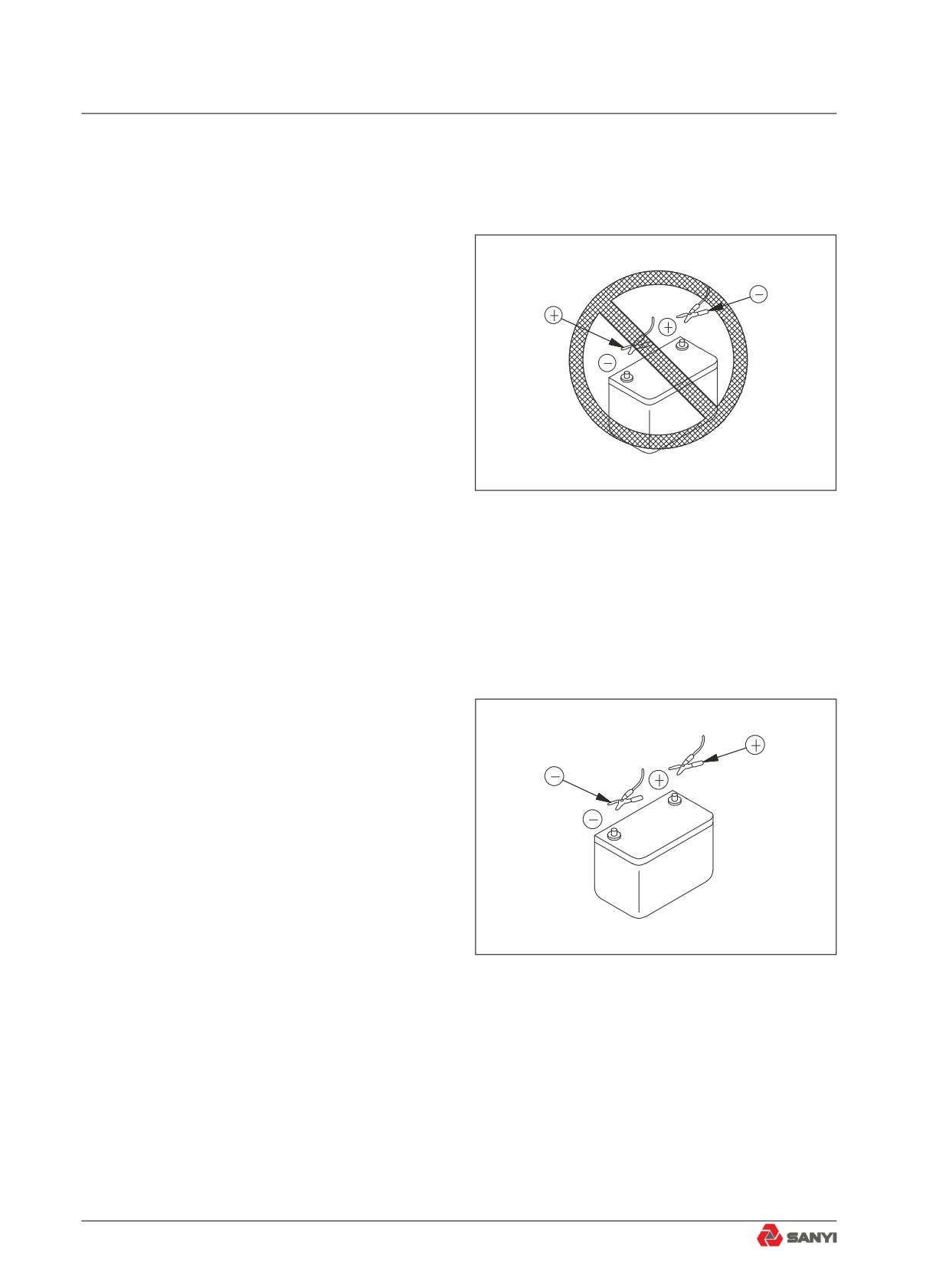
2.3.1.7 Engine starting aid
Follow procedures in the Operation
sectionwhen using jumper cables to start the
engine. Improper handling may cause battery
explosion or loss of machine control, resulting
in personal injury and death. Never use jumper
cables to start the engine unless necessary.
Contact your Sany distributor before such an
attempt.
●
Using jumper cables to start the engine
needs two persons working together with
one seated in the operator seat and the
other handling the battery.
●
Wear goggles and rubber gloves before
Fig. 2.3-6
starting the engine with jumper cables.
●
When connecting a normal machine with
a faulty machine with jumper cables,
battery voltage of the two machines shall
be the same. Be careful not to allow the
two machines to contact with each other.
●
Turn both start switches to OFF position
when connecting the two machines.
Otherwise, the machine may move and
cause danger when it is powered on.
●
Start with the positive terminal when
connecting the jumper cable. Start with
the ground or negative terminal when
disconnecting the jump cable.
●
When disconnecting the jumper cable,
take care not to allow the clips of jumper
cable to contact with each other or with
the machine.
●
Ether is a liquid used for cold start, which
Fig. 2.3-7
is extremely flammable and explosive.
Read the instructions on the ether
container before application.
●
Never use ether if the engine is equipped
with spark-plug preheater or other forms
of preheater.
2-26
Safety
2.3.1.8 After starting the engine
● Run the engine at low idle for 3 to 5
minutes after engine startup, and check
the running parameters and make sure
they are normal and all readings are
within normal working range.
2.3.2 Operation
2.3.2.1 Inspection before operation
● When conducting inspection, move the
machine to a spacious area without
barriers and operate slowly. Any other
person is not allowed to approach the
machine.
● Be sure to buckle the seat belt. Check
the gauges and machine operation for
abnormality; check the swivel system and
steering system for abnormal operation.
● Check for abnormal noise, vibration,
heating, odor or gauge reading; check oil
or fuel for leakage.
● In case of any abnormality, stop
operation and take corrective measures
immediately.
2.3.2.2 Prior-operation precautions
To prevent serious injury or death, follow
the items below before moving the machine.
● It is dangerous to stay in the working
range during machine operation. Sound
the horn to warn people within the working
range before operating your machine.
● Nobody is allowed to stay on and near the
machine, or within the working range.
● To improve the visibility in the travel
Fig. 2.3-8
direction, you may turn the cab if
necessary.
2-27
Safety
● Assign a signalman at where visibility is
poor.
2.3.2.3 Precautions when traveling
● Do not load the dump body above the
maximum payload. The brakes will lose
their effect.
● Never turn the starting switch key to
the OFF position when the machine is
traveling. If the engine stops when the
machine is traveling, the steering will
become heavy. There is danger that
this may cause mistaken operation of
the steering wheel and lead to serious
personal injury. If the engine stops,
depress the brake pedal immediately and
stop the machine.
● Lower the dump body, setting the dump
lever at FLOAT position, then travel.
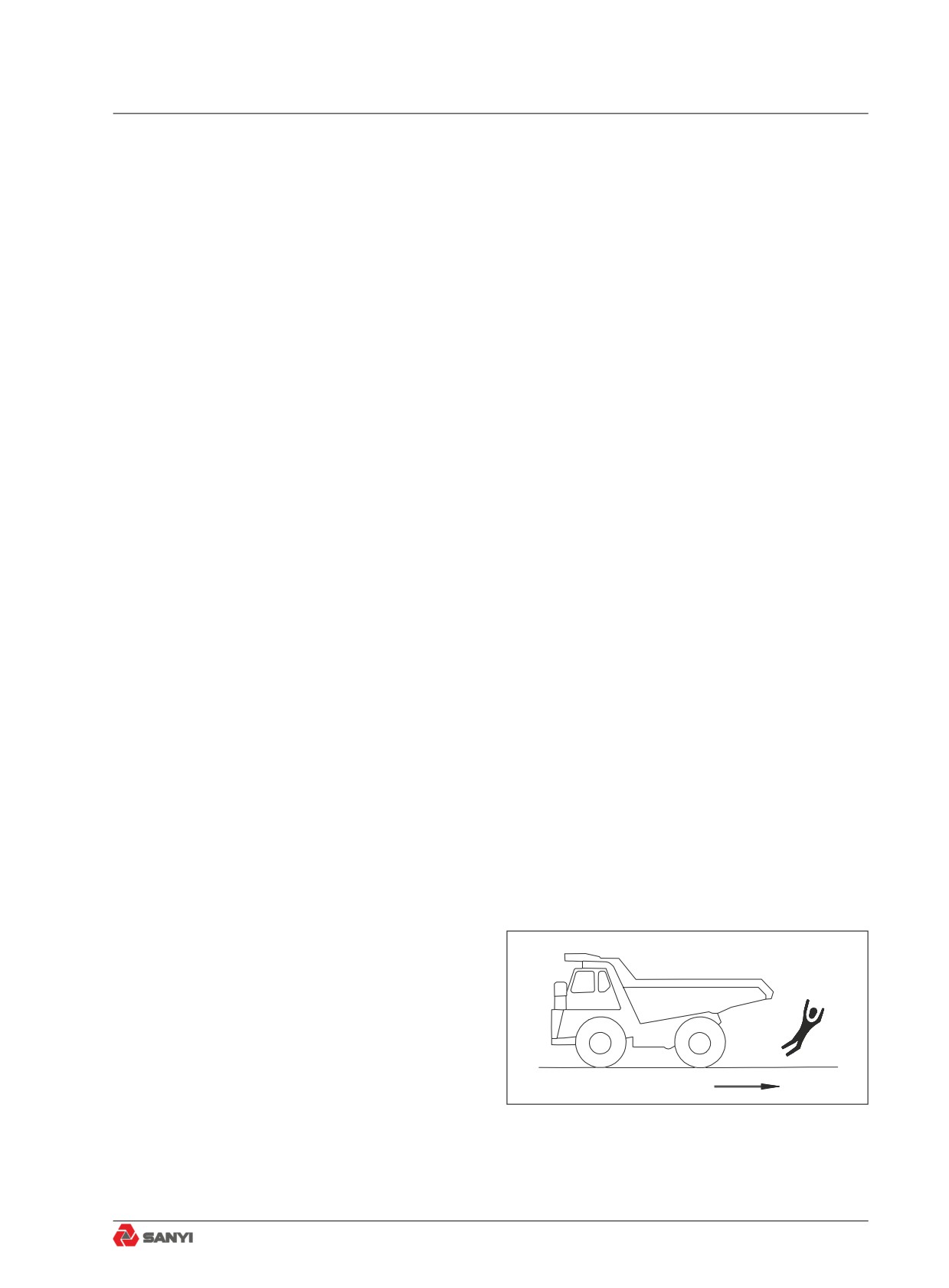
● Never transport anyone riding on the body
Fig. 2.3-9
or carry out any other operation besides
the main use for the machine. This is
dangerous.
● To avoid accidents caused by coming in
contact with people, structures, and other
machines, always maintain the proper
distance when traveling.
● When traveling on rough ground, travel
at low speed and avoid sudden changes
in direction to prevent the machine from
turning over.
● When operating in tunnels, inside
buildings, or under bridges or electric
wires, or other places where the height is
Fig. 2.3-10
2-28
Safety
limited, operate slowly and be extremely
careful not to let the machine or dump
body contact anything.
●
Continuous long time traveling at high
speed may cause tires to heat up,
abnormally increasing the inflation
pressure inside the tires, and to blow
up. The explosion of the tire is very
destructive, and it can lead to serious
injury or death.
●
Contact with SANY before doing long
continuous traveling.
Fig. 2.3-11
●
Do not move the gear shift lever to the N
position when the machine is traveling or
when it is traveling down a slope. Always
place the transmission in gear before
traveling.
●
If the transmission is in Neutral, the engine
cannot provide any braking effect and the
steering wheel will become heavier. In
addition, there will be lack of cooling oil for
the retarder, so there is danger that it will
overheat or that the actuation of the brake
will be poor.
●
There may also be damage to the
transmission or other parts of the power
train, and there is danger of unexpected
accidents.
2-29
Safety
2.3.2.4 Precautions when traveling on
slopes
To prevent the machine from tipping over
or slipping to the side, always do as follows.
● When traveling downhill, use the retarder
brake to reduce speed. Do not turn the
steering wheel suddenly.
● Travel on grass, fallen leaves, or wet steel
plates with low speed. Even with slight
slopes there is a hazard that the machine
may slip.
● If the engine should stop on a slope, apply
the brakes fully and apply the parking
brake also to stop the machine.
2.3.2.5 Precautions when operating
● Before starting the dumping operation,
check to be sure there is no person or
object behind the machine.
● Stop the machine in the correct position,
and check again that there is no person
or object behind the machine. Give the
determined signal, then slowly operate the
dump body.If necessary, use blocks for
the wheels or position a flagman.
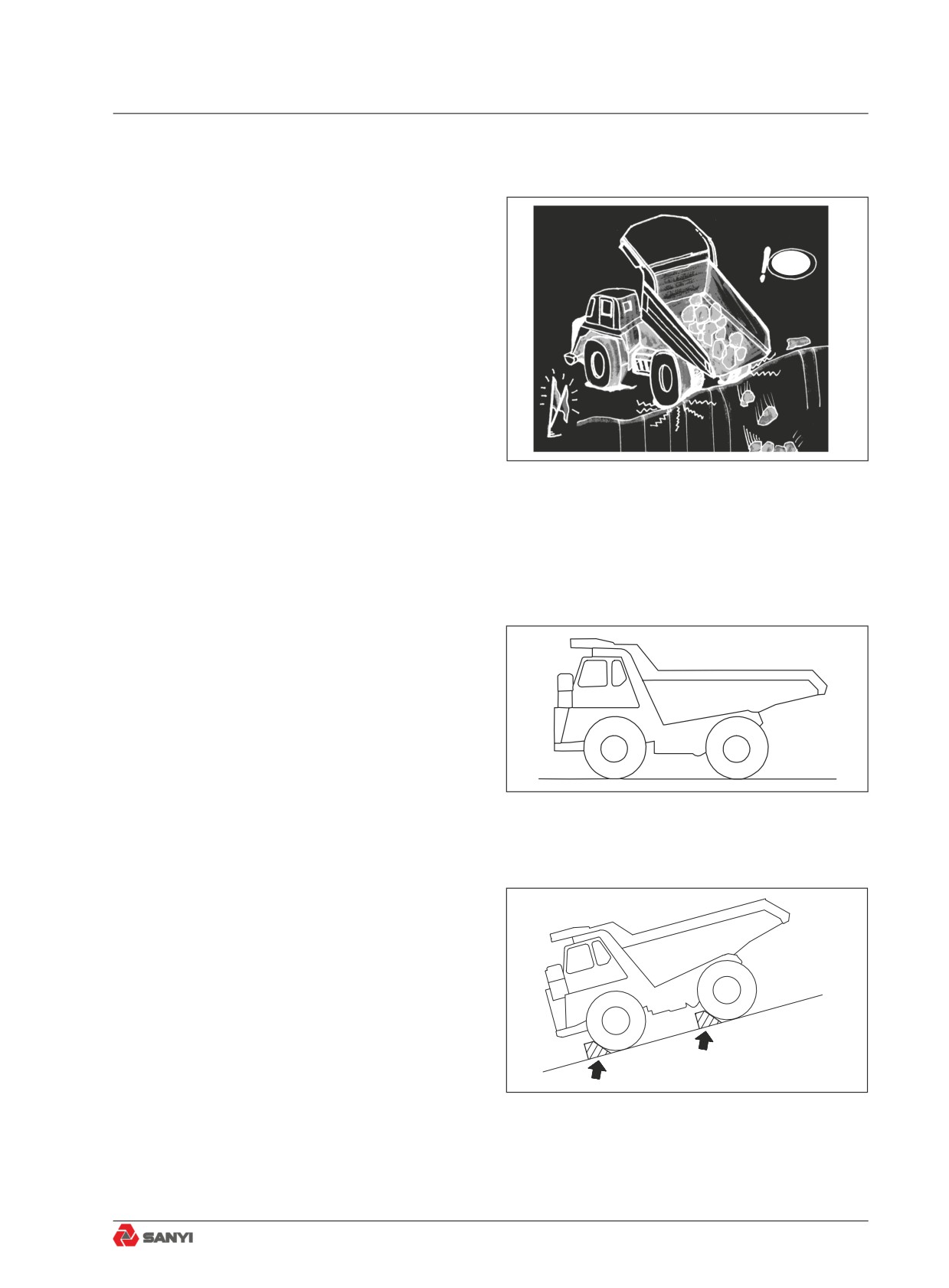
● Do not carry out dumping operations on
slopes. The machine stability will become
poor and there is the danger that it could
tip over.
Fig. 2.3-12
● Do not travel with the body raised.
● Do not leave or return to the operator’s
seat during loading work.
2.3.2.6 Precautions for accumulated snow,
and ice
● When traveling on snow-covered or icy
roads, there is danger that the machine
may slip when traveling and tip over or
2-30
Safety
fall off the road. This may lead to serious
personal injury and damage. Always do as
follows.
● Fit tire chains.
● Do not apply the brake suddenly on
Danger
slopes. Reduce the speed and use the
braking force of the engine together with
the foot brake (depress the foot brake
repeatedly; do not keep it depressed) to
stop the machine.
● Do not enter areas where the snow is
deep. There is danger of driving off the
road.
Fig. 2.3-13
2.3.2.7 Parking the machine
Select a parking place
● Park your machine on a solid and flat
surface.
● Park the machine in an ares free of such
hazards as falling stones or landslide.
If the terrain is low, park it in a relatively
higher place.
● Never park your machine on a road
undergoing construction. If you have to
Fig. 2.3-14
park your machine in such a place, flags
are to be used on daytime and signal
lamps at night to warn other people or
vehicles according to local regulations.
● Chock the wheels to prevent unexpected
movement.
Fig. 2.3-15
2-31
Safety
2.3.2.8 Preparing the machine
Before maintaining the machine:
●
Place the parking switch to "Park"
position.
●
Move the transmission to Neutral position.
●
Raise the hand lever to "Float" position.
●
Run the engine at idle speed for 3 to 5
minutes to cool the engine.
●
Move the steering wheel back and forth
to release the residual pressure in the
accumulator.
●
Turn the start switch to OFF position and
stop the engine.
●
Close the windows and the cab door.
●
Lock all access doors, boxes and
chambers.
●
When leaving your machine, face the
machine and maintain a three-point
contact with it. Never jump off the
machine.
●
Be careful with slippery aisle and ladder
when dismounting the machine.
2-32
Safety
2.3.3 Transportation
This machine must be disassembled
for transportation. When transporting the
machine, please consult your Sany distributor.
2.3.3.1 Loading and unloading the machine
Improper loading and unloading of the
machine may cause it to fall or tip over. Follow
the procedures below:
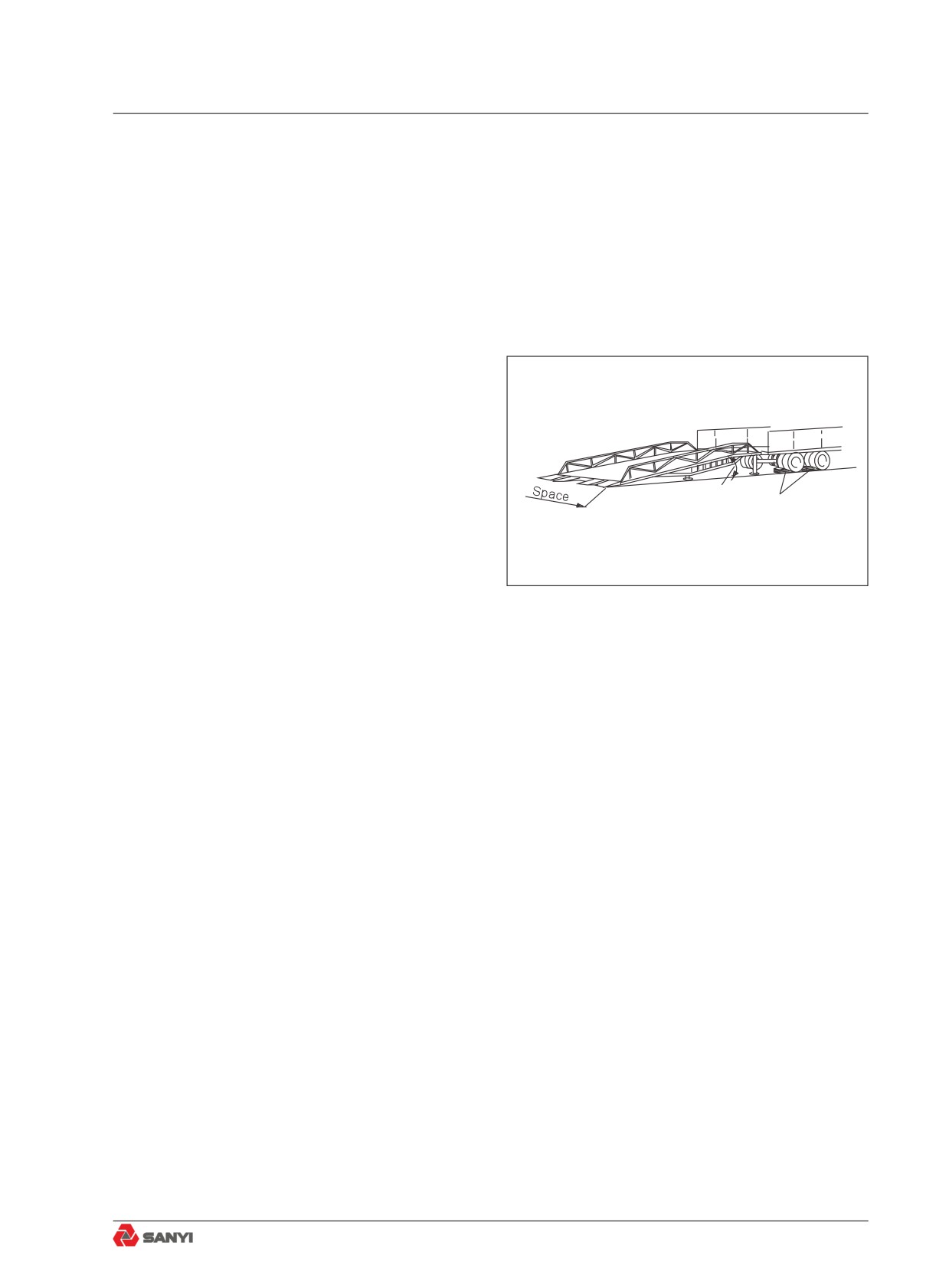
●
Load or unload the machine only on
a solid and flat surface.Keep it a safe
distance away from road sides or a cliff.
Max. Angle15°
●
Keep on-lookers away.
Blocks
●
Use an access ramp with enough
strength.Make sure that the width, length
and thickness of the access ramp is
capable of providing a safe loading/
Fig. 2.3-16
unloading operation(at an angle ≤ 15°).
●
Make sure the access ramp is free from
grease, oil, water and debris. Clean the
track if necessary. Be extremely careful
when loading or unloading the machine in
rainy or snowy weather.
●
Run the engine at low speed and operate
slowly.
●
Gravity center of the machine may alter
when it passes the jointing area between
the ramp and the trailer. The machine may
tilt at this moment. Travel slowly when the
machine is on the joint area.
●
Never reposition the machine on the
access ramp. If necessary, drive it off the
ramp, reposition, and get on the ramp
again.
●
When loading or unloading the machine
on a platform, make sure the platform has
adequate width, strength and a proper
grade.
●
Once the machine is loaded, lock the cab
door. Otherwise, it may swing open during
transportation.
2-33
Safety
● Secure the machine with chains and
chocks.
2.3.3.2 Transporting the machine
Observe the following items when
transporting
the machine:
● Note the dimension of the trailer and the
machine, especially the height. Watch
outfor barriers overhead and in narrow
passages
● Check the structure and strength of a
bridge before crossing it. Obey local traffic
regulations and traffic police directions
when transporting the machine on
highways.
2-34
Safety
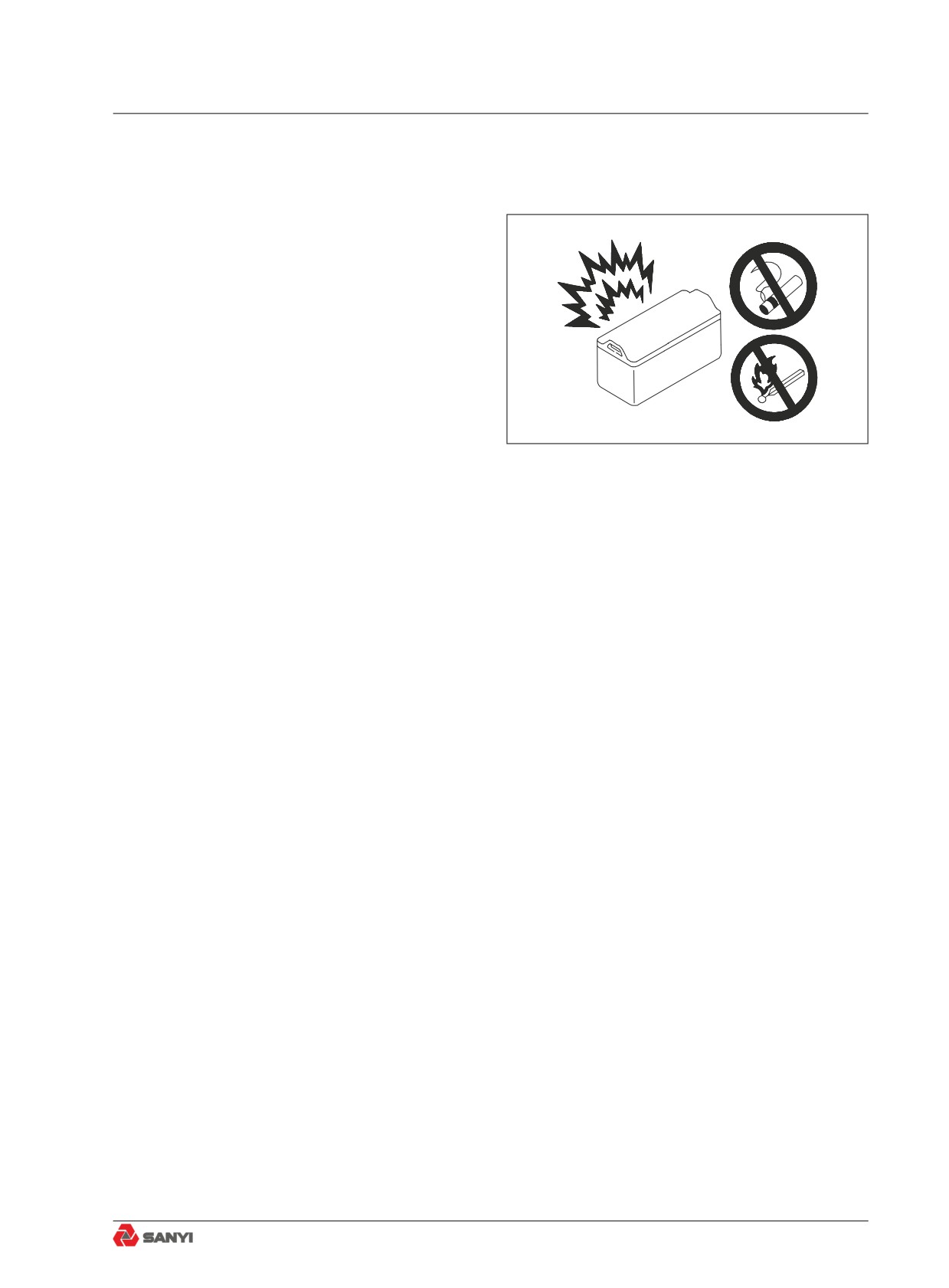
2.3.4 Battery
Electrolyte contains sulfuric acid, which gives
off flammable and explosive gases. Improper
handling may cause personal injury or fire. Observe
the instructions below when handling battery:
● Never smoke or use fire near a battery.
● Turn the engine ignition key to the OFF
position before working on the battery.
● Wear safety glasses and rubber gloves
when handling battery.
● Electrolyte is a strong acid. If electrolyte
contacts your clothing or skin, flush
Fig. 2.3-17
immediately with plenty of water.
Electrolyte may cause blindness if it
contacts your eyes. Flush immediately
with plenty of clean water under such
circumstances and seek medical
treatment.
To avoid battery-induced explosion,
observe
the following precautions:
●
Never allow tools and other metal parts to
contact with battery terminals. Keep tools
or metal parts away from batteries.
●
Stop the engine and wait for one minute
before you proceed. Always disconnect
the grounding terminal (negative(-) ) first.
To connect battery cables, always begin
with the positive (+) terminal, and then
connect the negative (-) terminal. Ensure
all terminals are securely connected.
●
Battery temperature rises when it is being
charged. When battery temperature
exceeds 45°C, stop charging and wait till
it is at ambient temperature. Reduce the
charging current by half and continue the
charging process.
●
A battery being charged may give off
flammable gases. Before charging a
battery, remove it from the undercarriage,
put it in well-ventilated area and remove
the cap.
2-35
Safety
● A battery being charged may give off
flammable gases. Before charging a
battery, remove it from the undercarriage,
put it in well-ventilated area and remove
the cap.
● If acid squirts out of battery vent during
charging, stop charging immediately.
● Never smoke and keep flames or sparks
out when charging.
● When the battery has been fully charged,
a green indicator will be on. Stop the
charging process at this time.
● Restore the battery cover after charging.
● Put the battery back to its original position.
2-36
Safety
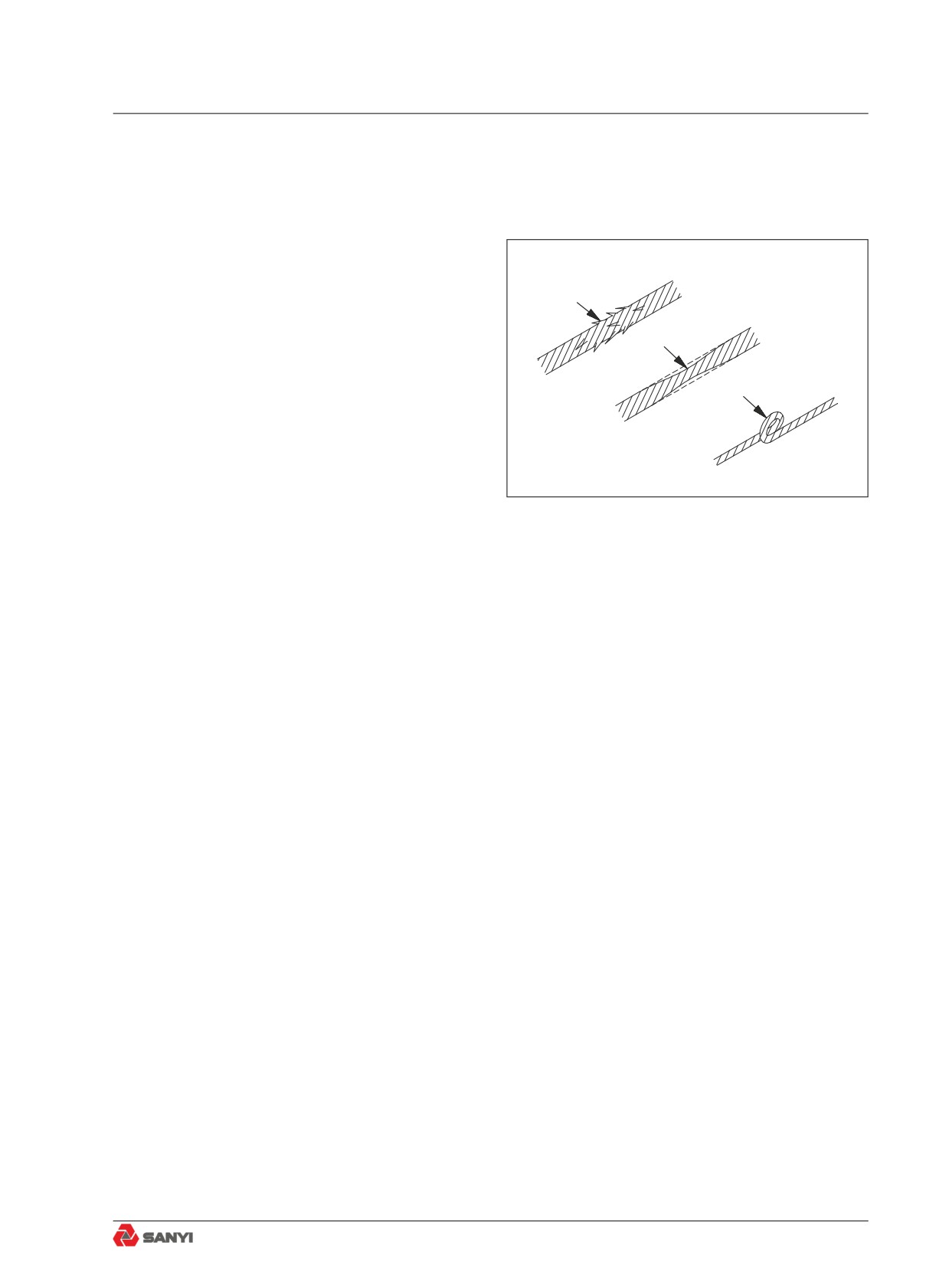
2.3.5 Towing
● When towing a damaged machine, improper
operation or use of unacceptable wire cable
could lead to serious accident:
● Never tow the machine on a slope.
● Wear protective gloves and a had hat when
A
using wire ropes.
● Check the strength of wire cable and make
B
sure it could bear the weight of machine.
● Never use ropes with broken wires (A),
C
reduced diameter (B) and twisting (C). Such
ropes may break when towing.
● Never stand between the towing machine and
the towed machine during towing operation.
● Operate the machine slowly. Never add load
to the wire cable suddenly.
Fig. 2.3-18
2-37
Safety
2.4 Precautions for Maintenance
2.4.1 Lock-out and tag-out
● Before maintenance, attach a Never
1
OPERATE tag or similar sign to the cab's
retarder lever to warn others that this
machine is under maintenance.
● Attach other warning tags around the
machine if necessary.
● When maintenance is underway, starting
the engine or moving the control levers or
pedals could lead to serious accident.
Fig. 2.4-1
DANGER
Never OPERATE !
When this tag is not being used keep it in the
2.4.2 Select a working area
storage compartment.Still more,when there
is no storage compartment,keep it in the
● For maintenance work, select a clean flat
operation manual case.
area with plenty of space, ample sunlight
and good ventilation.
● Clean the working area by removing fuel,
lubricant and water, and covering slippery
ground with sand or other absorptive
materials.
● Never leave your hammer or other tools at
the working area.
● If a clean, tidy working area cannot be
guaranteed, there would be danger of
tipping, thus resulting in personal injury.
2.4.3 Prior-maintenance precautions
To prevent accidents:
● Understand maintenance procedure
before operation.
● Keep a clean and dry working area.
● Never spray water or steam in the cab.
● Never add lubricant and carry out other
maintenance work when your machine is
2-38
Safety
moving.
● Keep your hands, feet and clothing away
from rotating parts.
2.4.4 Preparing yourself
Only approved personnel can maintain
or repair the machine. An observer may be
assigned if necessary.
● Wear protective clothing and shoes
necessary for the job.
Fig. 2.4-2
● Wear rubber apron and rubber gloves
when handling corrosive materials. Wear
heavy gloves when handling wooden
materials,wire ropes or sharp-edged
metals.
● Wear a face shield when removing spring
or elastic parts, or adding acid to battery.
Wear safety hat and goggles when you
weld or cut with a torch.
● Never carry out grinding, flame cutting
or welding without an aspirator and
ventilation equipment.
Fig. 2.4-3
Fig. 2.4-4
2-39