UNCTAD REVIEW OF MARITIME TRANSPORT (2021) - page 4
4. Key performance indicators for ports and the shipping fleet
Figure 4.12
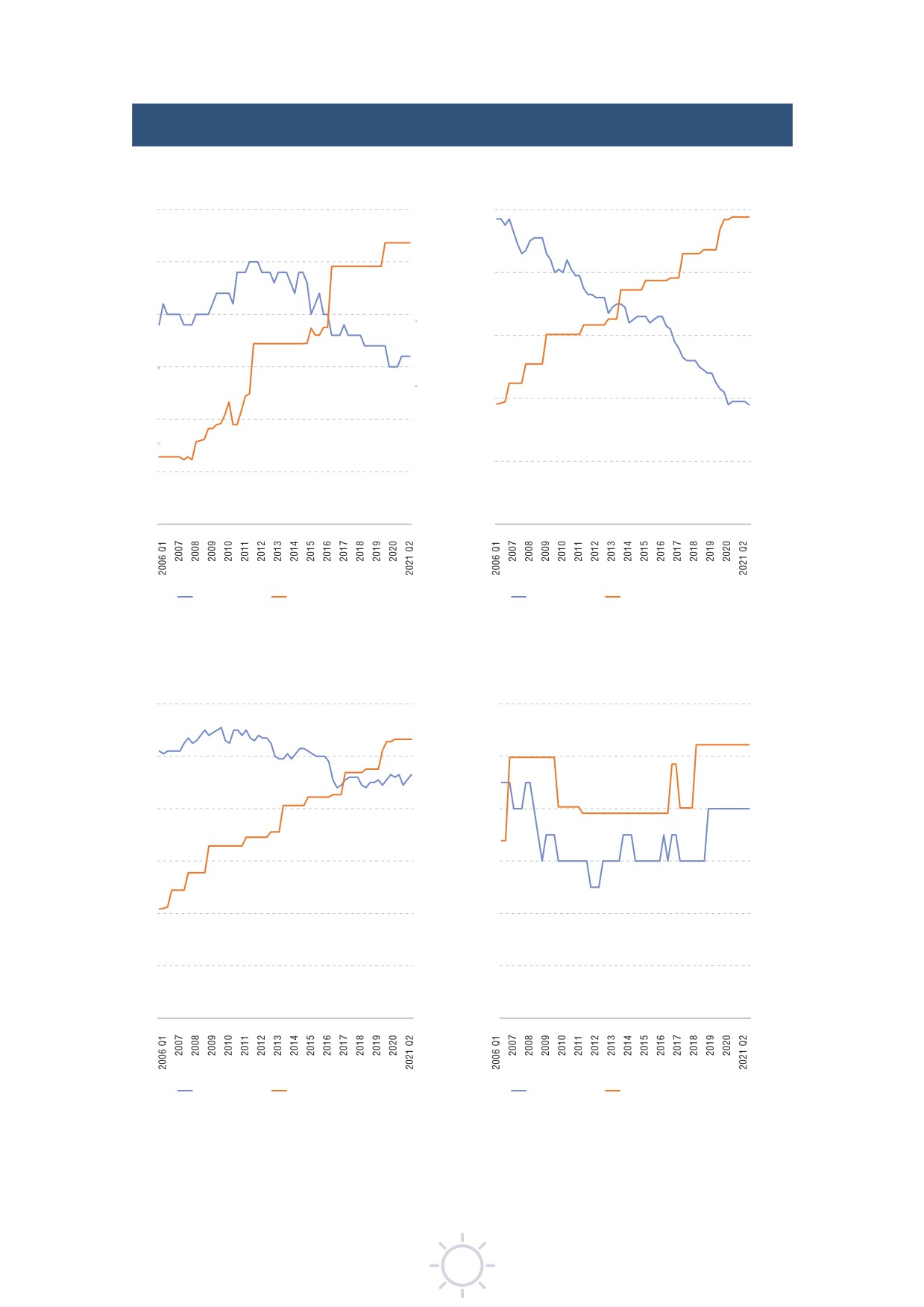
Trends in vessel sizes and number of companies providing services, selected
countries, first quarter 2006 to second quarter 2021
Companies
Maximum vessel size (TEU)
Companies
Maximum vessel size (TEU)
Chile
Chile
Germany
Germany
30
16 000
100
25 000
14 000
25
80
20 000
12 000
20
10 000
60
15 000
15
8 000
40
10 000
6 000
10
4 000
20
5 000
5
2 000
0
0
0
0
Companies
Maximum vessel size
Companies
Maximum vessel size
Companies
Maximum vessel size (TEU)
Companies
Maximum vessel size (TEU)
China
China
Samoa
Samoa
120
12
2 000
25 000
1 800
100
10
1 600
20 000
1 400
80
8
1 200
15 000
60
6
1 000
800
10 000
40
4
600
5 000
400
20
2
200
0
0
0
0
Companies
Maximum vessel size
Companies
Maximum vessel size
Source: UNCTAD, based on data provided by MDS Transmodal.
a country - increases with maximum vessel size. For each country, however, there is a trade-off between
accommodating more companies or receiving larger ships: moving horizontally in the chart, for a given
deployed capacity, the bigger ships are in countries with fewer companies in their markets.
97
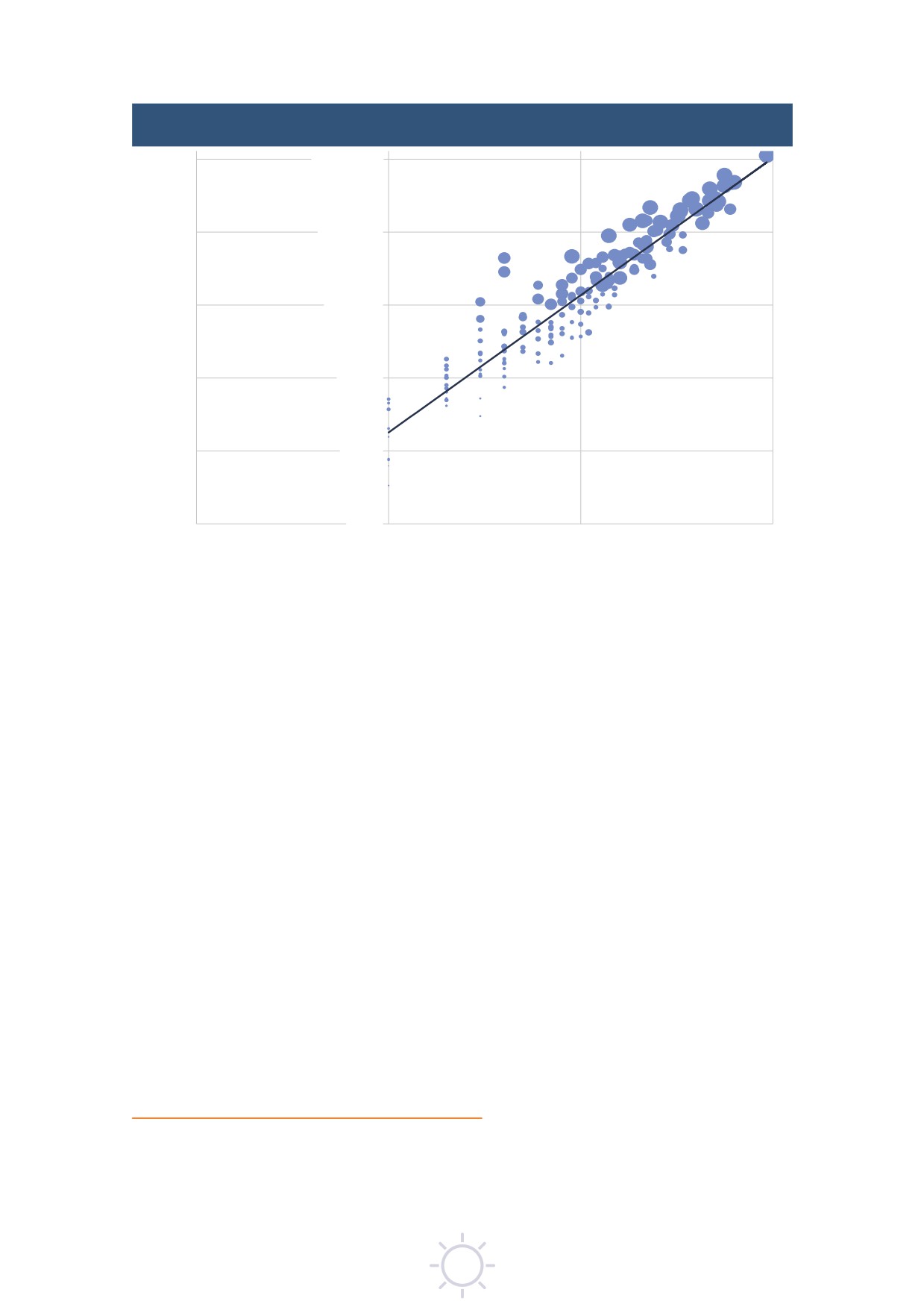
Figure 4.13
Relationship between maximum vessel sizes, deployed capacity, and the number
of companies, second quarter 2021
100 000 000
Total deployed capacity
annual, TEU
Bubble size: proportional to
maximum vessel size, TEU
10 000 000
1 000 000
100 000
10 000
Companies
1 000
0
1
10
100
Source: UNCTAD, based on data provided by MDS Transmodal.
3. Bilateral liner shipping connectivity
In addition to the country- and port-level LSCI, UNCTAD also produces a connectivity index for country
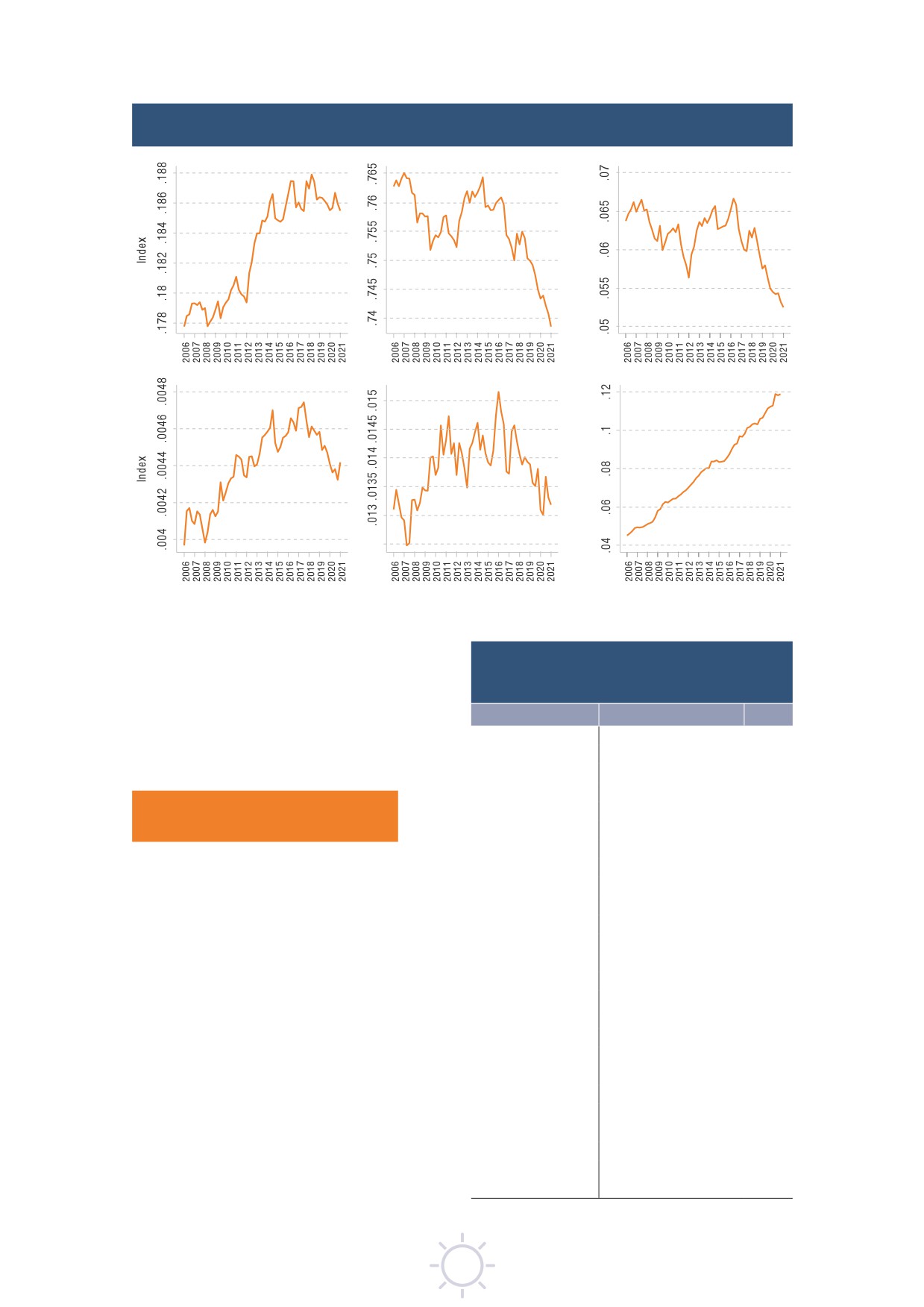
pairs, the Liner Shipping Bilateral Connectivity Index (LSBCI).3 Progress in the LSBCI, along with its five
component indicators, is illustrated in figure 4.14. Since 2006, on average the LSBCI has increased but
there have been a few disruptions - notably the global financial crisis of 2008, and the pandemic from 2020.
The financial crisis had an almost immediate impact, but the pandemic impact came in waves - delivering
a supply shock that then translated into a demand shock along with differences between countries in the
local impact and propagation of the virus.
In addition to these disruptions, since the last quarter of 2018 the LSBCI has shown a downward trend
which is more a consequence of ongoing structural transformations. One is the increase in ship size.
Between 2006 and 2019 the maximum capacity component of the index more than trebled. Between 2014
and 2019 this was largely offset changes in the other four components, all of which have been declining.
These trends for the component indicators are interlinked. Companies that have invested in larger ships
are aiming for economies of scale which should reduce unit costs. Other companies unable to make these
investments, and to compete, will either withdraw from unprofitable routes or leave the industry altogether.
This reduces the number of operators, which has been happening in all regions - in East Asia for the last
seven years, but also in Latin America, and in Sub-Saharan Africa which in addition has fewer operators
offering intra-regional connections.
With fewer companies, there are likely to be fewer direct connections. This is confirmed by the evolution
of the transhipment component and consequently of the common direct component. Nevertheless, as
direct connections are mainly on historical maritime routes the main adjusting variable on those routes is
likely to be the number of competing companies.
Increasing ships size also affects the hosting capacity of ports especially those that have improved their
infrastructure. This could explain the downward trend since 2017 for the frequency component which
reflects the number of port-to-port connections between countries.
3
The Liner Shipping Bilateral Connectivity Index
(LSBCI), which is publicly available in its annual form at
http://stats.unctad.org/lsbci, is made of five components: the number of transhipments needed to connect two countries
(transhipment variable), the number of common direct connections between two countries (common direct variable), the
number of port-to-port connections between two countries (frequency variable), the number of liner shipping companies
operating between two countries (operators variable) and, the maximum ship size in TEU deployed between two countries
(max. capacity variable). When no direct connection exists between two countries the latter three components correspond
to connection (option) with the best (highest) value when taking the lowest connecting segment.
98
4. Key performance indicators for ports and the shipping fleet
Figure 4.14
Liner Shipping Bilateral Connectivity Index (LSBCI) and its components, first
quarter 2006 to second quarter 2021
LSBCI
Transhipment
Common Direct
Frequency
Operators
Max. Capacity
Source: UNCTAD, based on data provided by MDS Transmodal.
All in all, the LSBCI trend reflects a worsening
Table 4.3
Top 25 ports under the World
situation for remote and already poorly
Bank IHS Markit Container
connected countries. Added to this is the
Port Performance Index 2020
general increase in freight costs which could
Port name
Economy
Rank
have severe consequences for international trade
Yokohama
Japan
1
(UNCTAD, 2021a).
King Abdullah port
Saudi Arabia
2
Chiwan
China
3
Guangzhou
China
4
C. PORT CARGO HANDLING
Kaohsiung
Taiwan Province of China
5
PERFORMANCE
Salalah
Oman
6
Hong Kong
Hong Kong, China
7
Qingdao
China
8
1. Container port performance
Shekou
China
9
In April
2021, to provide stakeholders with a
Algeciras
Spain
10
Beirut
Lebanon
11
reference point for maritime trade and transport
Shimizu
China
12
the World Bank and IHS Markit published a new
Tanjung Pelepas
Malaysia
13
index, the Container Port Performance Index
Port Klang
Malaysia
14
(CPPI) (World Bank 2021, IHS Markit 2021). This
Singapore
Singapore
15
index combines data on vessels, their port calls
Nagoya
Japan
16
and the cargos they load and unload, as well as
Colombo
Sri Lanka
17
the time they spend in ports.
Sines
Portugal
18
The first version had data for 2019 and the first half
Kobe
Japan
19
of 2020 (table 4.3), and was dominated by ports in
Zhoushan
China
20
East Asia, led by Yokohama in Japan, which was
Jubail
Saudi Arabia
21
ahead of King Abdullah Port in Saudi Arabia and
Yosu
Republic of Korea
22
Fuzhou
China
23
Qingdao in China. In Europe, the highest-ranked
Ningbo
China
24
port was Algeciras in Spain at
10; in South
Lazaro Cardenas
Mexico
25
Asia, it was Colombo in Sri Lanka at 17; and
in the Americas, Lazaro Cardenas in Mexico at 25.
Source: World Bank and IHS Markit Port Performance Program.
99
The only other North American port in the top 50 was Halifax in Canada. In Africa, the top-ranked port
was Djibouti.
UNCTAD has used the raw data from the CPPI to analyse the relationship between the performance of
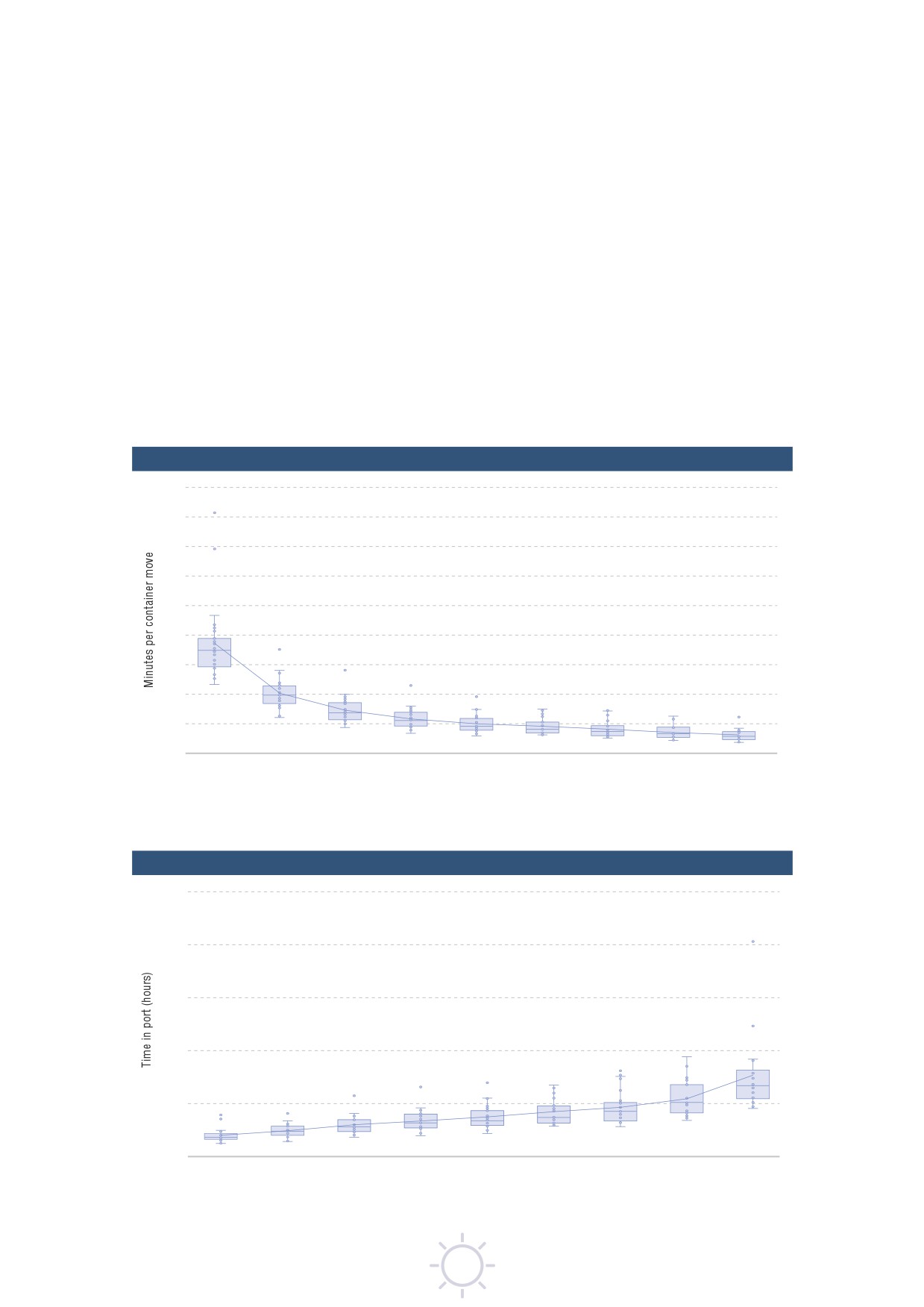
ports and the time ships spend in them. As indicated in figure 4.15 there are clear economies of scale:
the more containers there are to load and unload - a larger ‘port call size’ - the fewer minutes it takes
to load or unload a container. Nevertheless, total time in port increases with call size (figure 4.16), so it is
reasonable to compare ports or countries within the same range of call sizes.
Port calls where more containers are loaded or unloaded will need longer to handle them, but also be faster
for each individual container move, so the correlation between hours in port and speed of handling a slightly
negative (figure 4.17). But limiting the analysis to one port call range confirms the expected high positive
correlation between the time it takes to move a container and the time it takes to handle a ship (figure 4.18).
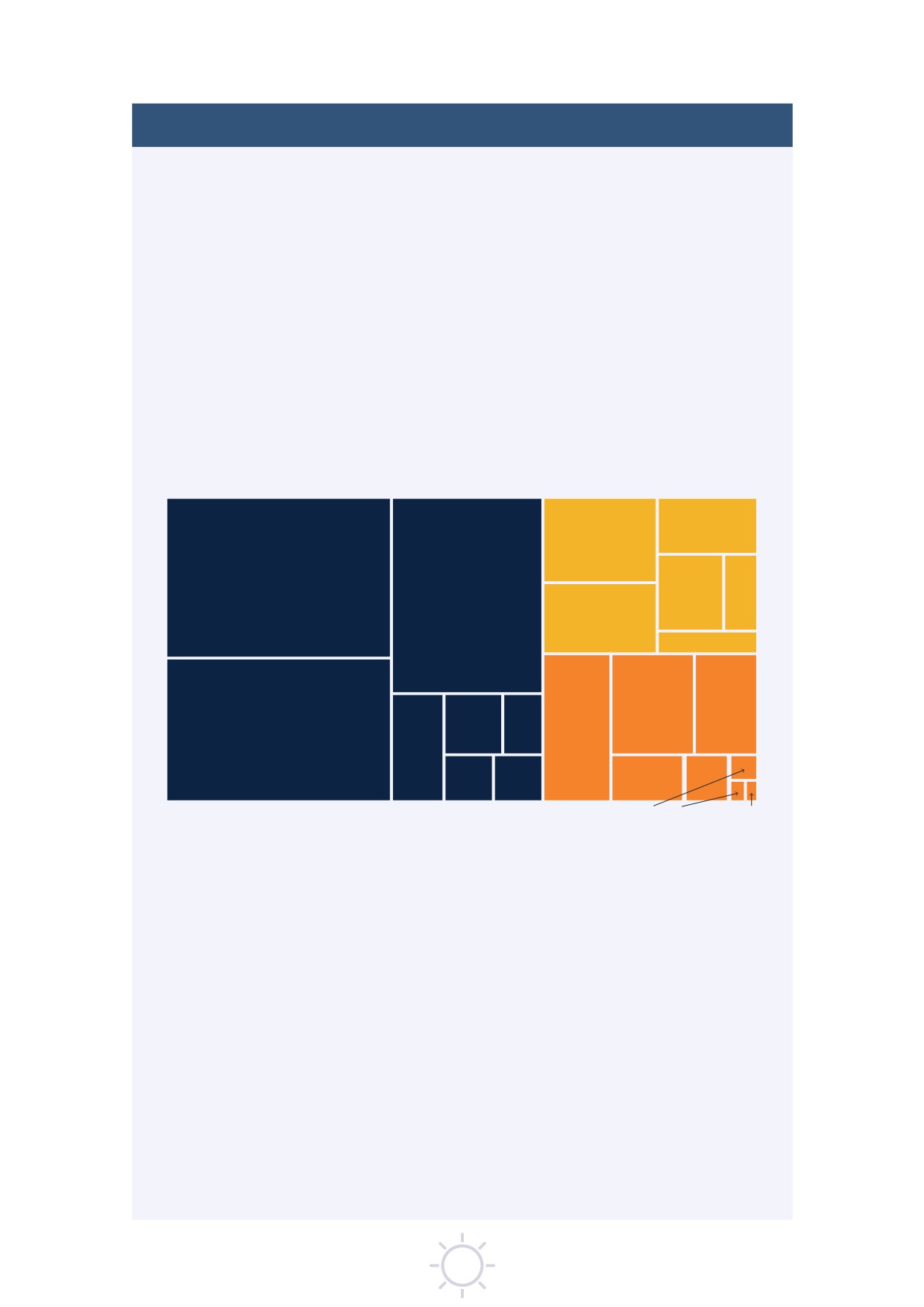
For the top 25 economies, table 4.4 summarizes the speed of container handling. For five of the nine
call-size ranges the fastest handling is in Taiwan Province of China, followed by Japan for two ranges, and
Malaysia and Hong Kong, China for one range each. The ranking per country roughly follows that of the
leading individual ports in table 4.3.
Figure 4.15
Minutes per container move for container ships, by range of port call size
9
8
7
6
5
4
3
2
1
0
500 and below
501-1000
1001-1500
1501-2000
2001-2500
2501-3000
3001-4000
4001-6000
6000 and above
Call size (moves)
Source: UNCTAD, based on data provided by IHS Markit Port Performance Program.
Figure 4.16
Time in port (hours) for container ships, by range of port call size
250
200
150
100
50
0
500 and below
501-1000
1001-1500
1501-2000
2001-2500
2501-3000
3001-4000
4001-6000
6000 and above
Call size (container moves)
Source: UNCTAD, based on data provided by IHS Markit Port Performance Program.
100
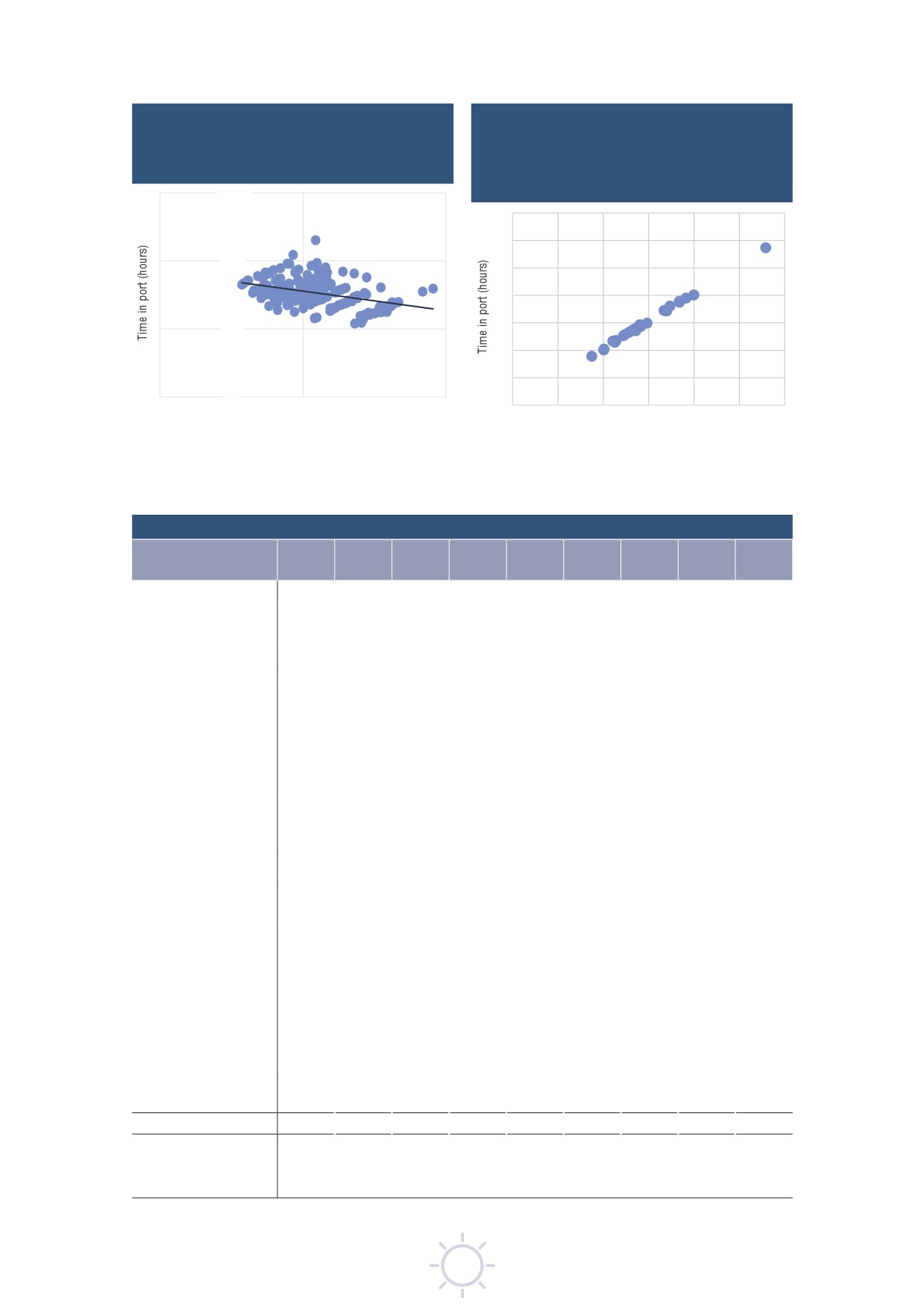
4. Key performance indicators for ports and the shipping fleet
Figure 4.17
Correlation between time
Figure 4.18
Correlation between time
in port (hours) and minutes
in port (hours) and minutes
per container move,
per container move, only
all call sizes
calls with 1001 to 1500
1000
containers per call
70
60
100
50
40
30
10
20
10
1
0.1
1
10
0
0.50
1.00
1.50
2.00
2.50
3.00
Minutes per container move
Minutes per container move
Source: UNCTAD, based on data provided by IHS Markit Source: UNCTAD, based on data provided by IHS Markit Port
Port Performance Program.
Performance Program. Coefficient of determination (R2) 0.99.
Table 4.4
Minutes per container move, by range of call size, top 25 countries by port calls
501-
1001-
1501-
2001-
2501-
3001-
4001-
Country\call size
<500
1000
1500
2000
2500
3000
4000
6000
>6000
Australia
3.44
2.27
1.84
1.57
1.47
1.31
1.28
1.25
0.81
Belgium
3.71
2.08
1.40
1.10
0.91
0.80
0.73
0.70
0.54
Brazil
3.01
1.96
1.48
1.30
1.16
1.07
0.92
China
2.92
1.68
1.14
0.92
0.77
0.66
0.57
0.49
0.42
Hong Kong, China
3.21
1.60
1.01
0.79
0.77
0.63
0.58
0.45
Taiwan Province of China
2.31
1.25
0.87
0.67
0.58
0.69
0.51
France
3.33
2.21
1.70
1.38
1.27
1.23
1.08
0.89
Germany
4.13
1.92
1.31
1.13
0.96
0.82
0.73
0.65
0.58
India
2.52
1.55
1.22
0.91
0.79
0.75
0.65
0.55
Indonesia
4.22
2.35
2.00
1.45
1.04
1.00
0.80
0.67
Italy
3.55
2.41
1.91
1.54
1.46
1.48
1.44
1.14
Japan
2.57
1.21
1.01
0.80
0.66
0.75
0.70
Republic of Korea
2.88
1.63
1.14
0.89
0.78
0.75
0.65
0.56
0.70
Malaysia
3.83
2.03
1.38
0.98
0.79
0.69
0.55
0.46
0.37
Netherlands
8.14
2.70
1.67
1.44
1.23
0.99
0.80
0.67
0.62
Panama
4.33
1.86
1.36
1.04
0.94
0.96
0.78
0.88
1.23
Philippines
4.67
3.51
2.79
2.29
1.91
1.43
1.42
Singapore
3.87
1.81
1.24
0.95
0.76
0.67
0.59
0.47
0.39
Spain
3.87
1.87
1.29
0.98
0.85
0.72
0.63
0.67
0.48
Thailand
2.69
2.79
1.11
0.94
0.79
0.69
0.70
0.66
0.58
Turkey
3.47
2.03
1.42
1.16
1.09
1.06
0.94
0.64
0.57
United Arab Emirates
6.89
2.41
1.74
1.18
0.85
0.70
0.59
0.52
0.41
United Kingdom
3.79
2.18
1.84
1.53
1.28
1.22
1.27
0.93
0.78
United States
3.16
1.77
1.34
1.16
1.06
1.01
0.93
0.90
0.85
Viet Nam
2.64
1.55
1.13
0.78
0.67
0.64
0.58
0.54
0.52
Average
3.73
2.02
1.45
1.16
0.99
0.91
0.82
0.70
0.62
Median
3.47
1.96
1.36
1.10
0.91
0.80
0.73
0.66
0.57
Minimum
2.31
1.21
0.87
0.67
0.58
0.63
0.51
0.45
0.37
Maximum
8.14
3.51
2.79
2.29
1.91
1.48
1.44
1.25
1.23
Source: UNCTAD, based on data provided by IHS Markit Port Performance Program.
101
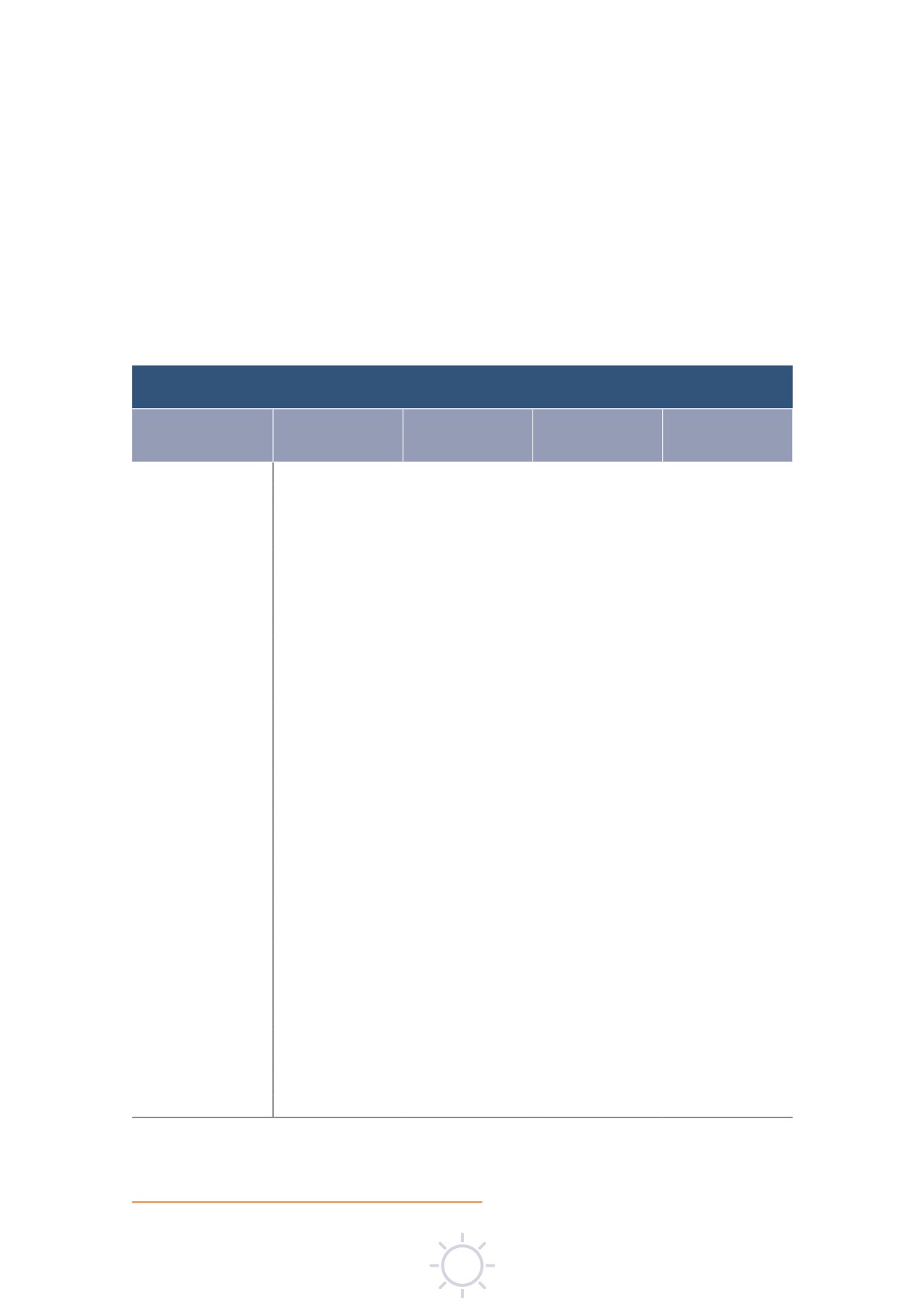
Box 4.1
Port performance in Latin America and the Caribbean - differences between
types of terminals
In Latin America and the Caribbean across 50 countries and territories, logistics and port services are
provided through 1,967 port facilities. Of these, 1,259 are certified as compliant with the International
Ship and Port Facility Security (ISPS) Code, including 982 facilities that handle cargo or passenger
transfer services, and 277 that provide other services, such as shipyards, docks, and others.
Nonetheless, according to an intensive survey of port facilities in the entire region carried out by the
Economic Commission for Latin America and the Caribbean (ECLAC), there are also another 708, of
which 590 are port terminals and 118 are related to other types of service.
Port terminals, including those that are ISPS certified and those that are not, represents a widely
diverse geographical distribution. The top ten countries according to the number of port terminals
are: Brazil, 306; Mexico, 171; Argentina, 143; Chile and Peru, 97 each; Colombia, 88; Paraguay, 65;
Bolivarian Republic of Venezuela, 63; Panama, 48 and Cuba, 45. These 10 countries, out of 50, make
up 74 per cent of the region’s port facilities.
At the opposite end of the ranking, 15 countries or territories have five or fewer facilities each, and
almost all have no more than one terminal by port specialty: Antigua and Barbuda, Bermuda, Belize,
Barbados, Turks and Caicos Islands, El Salvador, Aruba, Bonaire, Cayman Islands, Dominica, Anguilla,
Montserrat, Sint Eustatius, Saint Barth, and Sint Maarten.
A high proportion of these facilities, 470 in total, are multipurpose terminals. The following chart exhibits
the distribution by zones and specialties:
South America
Caribbean
Passenger
Terminal
49
Multipurpose
83
Con-
tainer
Dry Bulk
Termi-
Terminal
nal
43
21
Multipurpose
Liquid Bulk Terminal
ND
303
68
20
Dry Bulk Terminal
Central America and Mexico
250
Bulk
Passenger
Terminal
Liquid Bulk
Dry Bulk
(Liquid
Terminal
Terminal
Terminal
+ Dry)
Container
30
20
70
53
Terminal
49
Multipurpose
Passenger
Container
Ro-Ro
Liquid Bulk Terminal
84
Terminal
Terminal
Terminal
ND
19
273
29
20
20
Bulk Terminal (Liquid + Dry)
ND
Ro-Ro Terminal
6
3
2
This region is very diverse - in terms of composition, languages, economies, cultural identities, and
modes of adaptation to international instruments. The ports systems too differ in terms of maturity
and productivity. In the liquid and dry bulk categories, in the most specialized countries, productivity
is higher - as in Argentina, Brazil, and Colombia, which move annual volumes close to 600 million mt.
In the last few years region has seen enormous growth in terms of containers, though only four
specialized terminals yet have semi-automated processes. Progress in digitalization and paperless
transactions has also been slow, and regulatory procedures are not very transparent, making it difficult
to promote effective competition. Long-term planning has shown a lack of foresight for ports and
connectivity with hinterland infrastructure
Some areas have weakly regulated quasi-monopolistic markets, while others have excessive
competition, which may prove harmful. Systems for the design, granting and monitoring of concessions
are hampered by institutional weaknesses. These reduce prospects for investment and better
multimodal connections and efficient access to markets and ports. The result is often inefficiency and
low productivity.
Increasing vertical integration between shipping lines, port terminals and inland logistics heightens
the risk of monopoly. In certain areas there are also tensions between management, security, and
facilitation. Better security standards would improve development, efficiency, and competitiveness.
Nonetheless, there is some optimism that these problems can be solved - with considerable potential
for more containerization and automation of procedures, as well as for improvements in facilitation.
Source: ECLAC, Maritime and Logistics Profile.
102
4. Key performance indicators for ports and the shipping fleet
2. Dry bulk port performance
VesselsValue4 has produced a new dataset that combines AIS data on ship movements with data on cargo
transfers. This can be used to calculate interesting performance indicators for dry bulk port operations
(table 4.5). During the period 2018 to mid-2021, among the top 30 countries in terms of ship arrivals, the
average speed of loading ranged from just six ton per minute in Romania and Turkey to 48 ton in Australia.
For dry bulk cargo, unloading tends to be slower than loading, as the operations cannot use the same
combination of gravity and conveyer belts. The fastest unloading was in China, at 23 tonnes per minute,
and the slowest in Russian Federation, at just 4 tonnes per minute, and in Norway, at just 6 tonnes
per minute. These differences partly reflect port performance and economies of scale; Chinese dry bulk
terminals are highly mechanized and handle the world’s largest iron ore carriers, while Russian Federation
and Norway have a long coast with many smaller ports.
Table 4.5
Cargo and vessel handling performance for dry bulk carriers. Top 30 economies
by vessel arrivals, average values for 2018 to first half of 2021
Average waiting to
Average waiting to
Ton per minute,
Ton per minute,
load duration
discharge duration
loading
discharge
(hours)
(hours)
China
19
23
66
56
Australia
48
11
101
50
United States
14
11
101
49
Brazil
25
9
174
131
Russian Federation
12
4
64
71
Canada
17
10
117
70
Argentina
16
7
45
28
South Africa
20
9
83
30
Japan
9
18
43
41
India
14
16
73
63
Ukraine
10
11
55
48
United Arab Emirates
18
10
50
32
Indonesia
10
8
58
54
Republic of Korea
10
16
37
62
New Zealand
10
8
56
26
Chile
11
9
94
94
Turkey
6
9
45
50
Viet Nam
9
11
53
54
Colombia
28
7
39
25
Malaysia
11
13
73
90
Mexico
12
9
68
61
Taiwan Province of China
12
18
34
48
Peru
18
11
82
49
Oman
16
20
80
52
Norway
20
6
84
78
France
10
12
52
55
Saudi Arabia
8
6
49
80
Morocco
8
6
78
127
Romania
6
7
64
29
Mozambique
15
6
94
123
Source: UNCTAD, based on data provided by VesselsValue.
Note: Ranked by number dry bulk carrier arrivals for loading.
4
Data provided electronically by VesselsValue; https://www.vesselsvalue.com, June 2021.
103
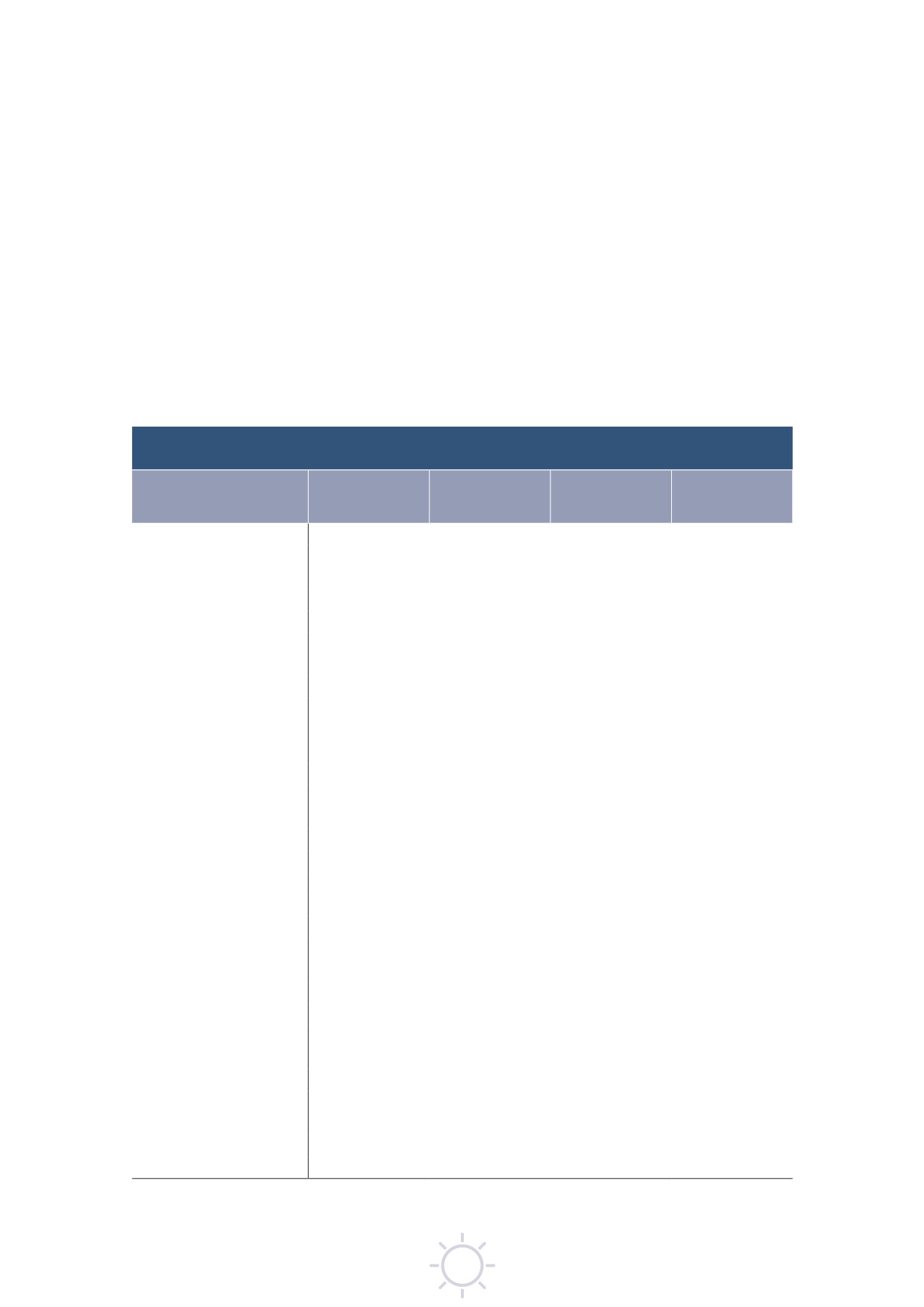
Ships generally wait longer to load than to unload, though there are significant differences between
countries. In Colombia, the average waiting time for unloading is one day while in Brazil it is five and a half
days. Brazil also has the highest waiting times for loading - on average more than a week. This is partly
a consequence of large vessel sizes and longer distances from the main markets. The shortest waits for
loading cargo are in Taiwan Province of China at 34 hours. Some countries encourage owners to arrive
early to minimize the risk of missing a scheduled port call.
3. Tanker port performance
For tanker port operations too, loading tends to be faster than unloading or ‘discharge’. Among the top
30 countries in terms of tanker arrivals, the fastest loading was by the major oil exporters, reaching up
to 113 tons per minute for Angola, followed by 95 in Qatar, 90 in Kuwait, and 86 in Saudi Arabia. For
unloading oil, the fastest average speeds were in Japan at 83 tons per minute, followed by Republic of
Korea at 67 (table 4.6). As regards waiting times, the lowest average time for loading was in Qatar at
26 hours, and for discharge in Japan at 28 hours.
Table 4.6
Cargo and vessel handling performance for tankers. Top 30 countries by vessel
arrivals, average values for 2018 to first half of 2021
Average waiting to
Tons per minute,
Tons per minute,
Average waiting to
discharge duration
loading
discharge
load duration (hours)
(hours)
United States
24
33
54
69
Russian Federation
38
27
46
36
China
23
43
45
77
Brazil
46
29
62
66
Saudi Arabia
86
31
37
47
United Arab Emirates
66
25
65
89
Republic of Korea
29
67
50
48
Singapore
26
39
47
43
India
26
50
54
68
Malaysia
28
33
47
65
Netherlands
14
29
59
56
Indonesia
19
20
50
62
Italy
15
32
47
48
Mexico
25
17
77
83
Nigeria
43
9
53
129
Kuwait
90
54
32
37
Iraq
50
8
42
96
Canada
37
39
47
62
Spain
15
27
39
37
Qatar
95
48
26
63
Japan
37
83
35
28
United Kingdom
36
26
53
51
Turkey
54
30
36
37
Norway
63
36
46
72
Angola
113
25
37
84
Belgium
12
16
75
42
Bolivarian Republic of Venezuela
20
13
105
79
Taiwan Province of China
22
48
36
40
Argentina
20
20
39
38
Greece
15
30
55
43
Source: UNCTAD, based on data provided by VesselsValue.
Note: Ranked by number tanker arrivals for loading.
104
4. Key performance indicators for ports and the shipping fleet
E. GREENHOUSE GAS EMISSIONS BY THE WORLD FLEET
1. Shipping is missing its greenhouse gas emissions targets
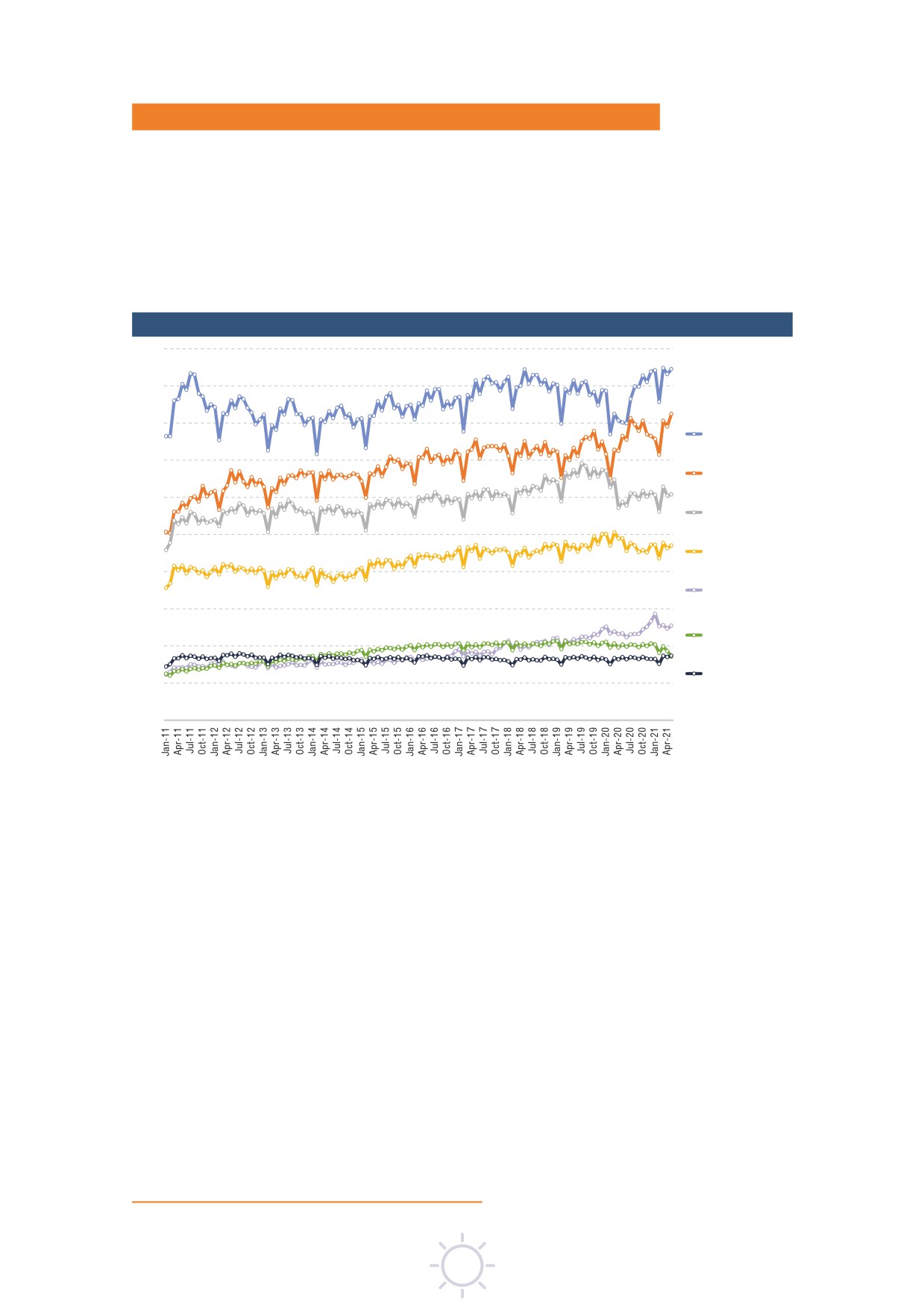
Over the last decade shipping has become more energy efficient so total emissions have grown slower
than the total number of vessels (figure 4.19). Nevertheless, this improvement will not suffice to meet the
emissions targets and the agreed objective of the International Maritime Organization (IMO) “to reduce the
total annual greenhouse gas emissions by at least 50 per cent by 2050 compared to 2008” as part of the
“Initial IMO Strategy on reduction of greenhouse gas emissions from ships” (IMO, 2018).
Figure 4.19
Carbon dioxide emissions by vessel type, monthly, million tons, 2011-2021
20
18
16
Container
14
Dry bulk carrier
12
Other
10
Oil and product
tanker
8
Lique ed gas
6
tanker
Offshore
4
General cargo
2
0
Source: UNCTAD, based on data provided by Marine Benchmark.
The trends for the world’s fleet over the last decade reflect its changing composition, with a declining
proportion of journeys for general cargo ships and an increasing one for LNG carriers, with correspondingly
higher greenhouse gas (GHG) emissions. In figure 4.19 it is also possible to see the annual downturn in
traffic around February in line with the Chinese New Year especially in the dry bulk and container sector.
More recently this chart also shows the impact of the pandemic. ‘Other’ ships include primarily passenger
ships, including ferries and cruise ships which were worst affected. Container ships, also saw an initial
decline at the outset of the pandemic but subsequently recovered.
2. Assigning emissions to flag states
Emissions by flag state mostly correspond to market shares for tonnage. But because the fleets have
different compositions the ranking is not identical. Liberia, for example, has a larger market share than
Marshall Islands in terms of total tonnage (table 2.5), but a far smaller share for CO2 emissions because it
has a higher proportion of dry bulk carriers, which produce lower emissions per dwt than other ship types.
Germany, on the other hand, is ranked only 29 in the world fleet, but 6 in terms of emissions because
a high proportion of its fleet is container ships which tend to go faster than other ship types and emit
more CO2 per dwt.5
5
Data provided electronically by Marine Benchmark; https://www.marinebenchmark.com, June 2021.
105
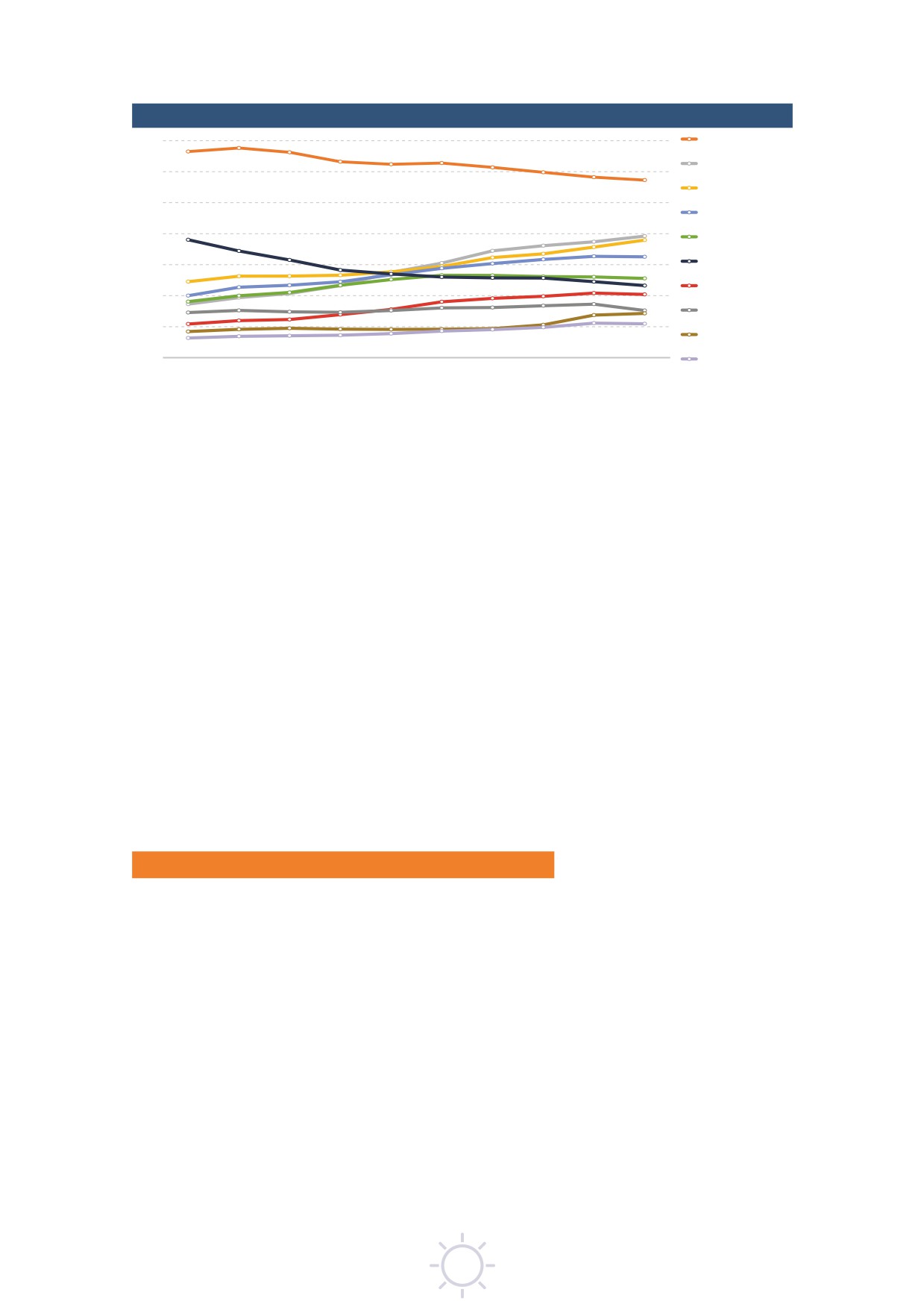
Figure 4.20
Carbon dioxide emissions by flag state, annual, 2011-2020, million tons
140
Panama
Marshall Islands
120
Liberia
100
Hong Kong, China
80
Singapore
60
Germany
Malta
40
Bahamas
20
China
0
Japan
2011
2012
2013
2014
2015
2016
2017
2018
2019
2020
Source: UNCTAD, based on data provided by Marine Benchmark.
3. Reducing greenhouse gas emissions may reduce connectivity and
increase costs
In June 2021 the IMO’s Marine Environment Protection Committee approved a new short-term measure
for GHG emissions, with both technical and operational requirements.
Earlier that year, UNCTAD undertook a Comprehensive Impact Assessment of the proposed measure,
setting out scenarios for 2030 with or without the measure, across three levels of emission reduction
ambition. The aim was to quantify the changes in maritime logistics costs including shipping and time
costs. All three indicated an increase in maritime logistics costs.
The IMO subsequently agreed the low scenario, for which the UNCTAD study suggested the following
outcomes for 2030:
• A reduction in average speed of 2.8 per cent.
• An increase in average maritime shipping costs by 1.5 per cent.
While significant, these changes are relatively small when compared to typical variations in freight rates.
They will also have a very small impact on global GDP and certainly far smaller than the disruption caused
by the pandemic or climate change factors, or the costs of not acting in the face of climate change.
However the IMO measures will have a greater impact on some countries than others, notably on SIDS
or LDCs, which may need support to mitigate the increased costs and alleviate the consequent fallout on
their incomes and trade flows (UNCTAD 2021c).
F. SUMMARY AND POLICY CONSIDERATIONS
This chapter has detailed several aspects of port and shipping performance, including fleet deployment
and the time ships spend in port, and port performance. It has highlighted persistent differences between
ports and countries, and shown how these are shaped by human, institutional, and technological factors.
Developing countries generally perform worse, with higher costs and lower connectivity - a consequence
of diseconomies of scale, greater distances from overseas markets, and lower levels of digitalization.
These and other countries should be aiming for more competitive commercial environments for port and
shipping operations, ensuring that external costs are accounted for.
Costs are likely to increase slightly as a result of measures needed for decarbonization of maritime
transport. Smaller and most vulnerable economies may need support to mitigate the increased costs and
lower connectivity.
GHG emissions can also be reduced by improving port and shipping performance. If ports can optimize
their availability, ships can plan their voyages so as to arrive in port the moment their berth becomes
available, thus reducing unnecessary speed and fuel consumption.
Maritime transport will also be transformed by the global energy transition which will increase maritime
transport costs and reduce average shipping speeds. Logistics costs increases will be greater for
developing than for developed countries.
106
4. Key performance indicators for ports and the shipping fleet
REFERENCES
IHS Markit (2021). New Global Container Port Performance Index (CPPI) Launched by the World Bank
and IHS Markit.
IMO (2018). Initial IMO Strategy on Reduction of GHG Emissions from Ships. MEPC 72/17/Add.1 Annex
11. April. Available at https://wwwcdn.imo.org/localresources/en/OurWork/Environment/Documents/
ResolutionMEPC.304(72)_E.pdf (accessed 24 May 2020).
MDST (2020). Available at https://www.portlsci.com/index.php (accessed 5 July 2020).
UNCTAD (2017). Review of Maritime Transport 2017 (United Nations publication. Sales No. E.17.II.D.10.
New York and Geneva).
UNCTAD (2021a). Container Shipping in Times of COVID-19: Why Freight Rates Have Surged and
Implications for Policy Makers. Policy Brief No. 84. Geneva.
UNCTAD (2021b). Small Island Developing States: Maritime Transport in the Era of a Disruptive Pandemic.
Policy Brief, No. 85. UNCTAD. Geneva.
UNCTAD (2021c). UNCTAD Assessment of the Impact of the IMO Short-Term GHG Reduction Measure
on States, UNCTAD/DTL/TLB/2021/2, UNCTAD. Geneva.
World Bank (2021). Asian Ports Dominate Global Container Port Performance Index.
107
This chapter has been prepared in response to a
request by the UN General Assembly in its resolution
on “International cooperation to address challenges
faced by seafarers as a result of the COVID-19
pandemic to support global supply chains”
(A/RES/75/17), at para. 7.
The shipping industry has played a vital role in the
global response to the COVID-19 pandemic - delivering
food, medical supplies, fuel, and other essential goods,
and helping keep global supply chains and commerce
running. This is to a large extent due to the world’s 1.9
million seafarers, who through these extraordinary times
have demonstrated great professionalism and dedication.
5
But their work has come at some risk to the seafarers
themselves, many of whom have been unable to leave their
ships. This chapter considers issues related to seafarers’
health, safety, security and welfare. It highlights areas where
The COVID-19
industry, governments, and international organizations can
cooperate to protect seafarers’ human and legal rights and
seafarer crisis
implement relevant labour standards, including those agreed
in the Maritime Labour Convention 2006, and in particular,
alleviate their plight resulting from the COVID-19 pandemic.
Such support should be part of the implementation of the
broader 2030 Agenda - in particular, SDG 8, which aims to
ensure decent work and economic growth. Beyond protecting
the rights and welfare of seafarers and their families, this
would also support the economies of their home countries,
help maintain world trade and ensure the flow of goods
across supply chains.
Key shipping stakeholders, including international bodies,
governments, and industry, have issued guidance and
recommendations for ensuring that seafarers are medically fit
and have access to medical care, with mechanisms to prevent,
and respond to, COVID-19 emergencies at sea - and that ships
and port facilities meet international sanitary requirements.
They have also argued that seafarers should be recognized as
key workers and vaccinated as a matter of priority. However,
as the pandemic continues for a second year the crew change
crisis appears to be worsening, with continuing logistical
obstacles to the repatriation of seafarers. Stakeholders will
need to redouble their efforts while also regularly updating
their guidance and recommendations in line with the latest
scientific insights.
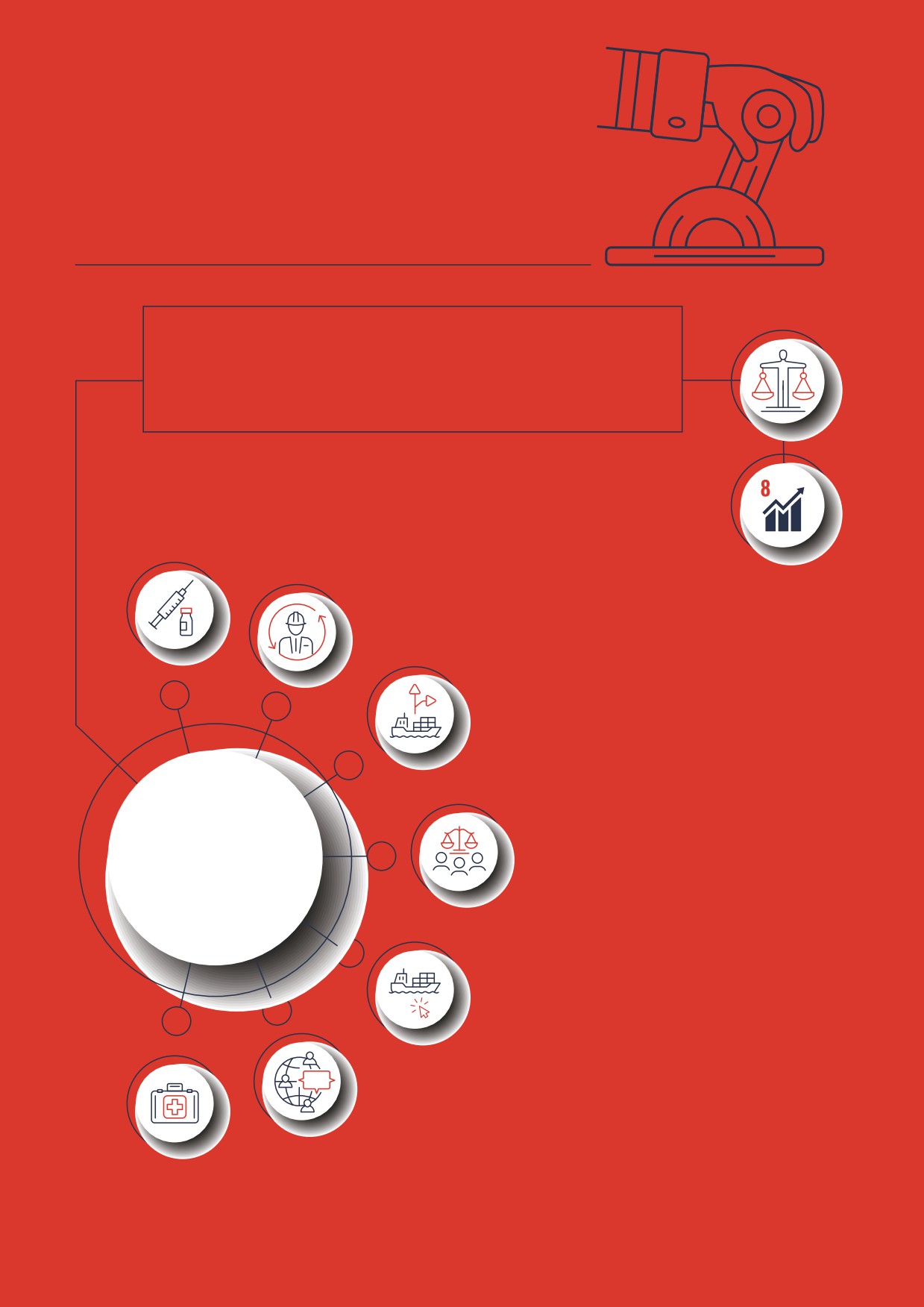
The COVID-19
seafarer crisis
Seafarers, many of whom from developing countries, are playing a vital
role in ensuring the ow of critical goods across supply chains and
keeping the world trade moving.
All should be working together to implement relevant labour standards, protect
seafarers’ human rights and advance the objectives of SDG 8 of decent work
and economic growth for sustainable development.
Vaccination
Concerted collaborative efforts by industry, governments and
international organizations should ensure that seafarers are
designated as key workers and are vaccinated as a matter of priority
Crew changes
Governments and industry should continue to work together,
including through the Neptune Declaration initiative, and in
collaboration with relevant international organizations, to facilitate
crew changes, in accordance with international standards and in
line with public health considerations
Route deviations
1
2
Charterers and other industry stakeholders should
be exible in accepting requests from shipping
companies for route deviation to facilitate crew
changes
3
Despite important
International legal framework
international efforts and
States and other relevant stakeholders should
support, the crew change
keep under review the relevant legal
crisis has worsened and
4
framework and ensure that international
seafarers are still facing
obligations are respected and implemented
serious problems which
need to be addressed:
5
Maritime single windows
Port community systems should implement the
Single Window concept to cover all the information
and formalities resulting from FAL and other
6
7
relevant instruments
Information exchange
Relevant public and private sector stakeholders should continue
their regular exchange of views and best practices on seafarers’
situation and needs
Outbreaks and emergencies at sea
Speci c guidance on measures to prevent and deal with COVID-19
and other outbreaks at sea should be updated regularly, in line with
developing scienti c insights
5. The COVID-19 seafarer crisis
A. SEAFARERS CRISIS - RECENT DEVELOPMENTS
Shipping and seafarers are vital to global supply chains and the world economy - transporting over
80 per cent of world trade by volume. Around 1.9 million seafarers work to facilitate the way we live,
and during the COVID-19 pandemic seafarers have continued to demonstrate great professionalism and
dedication, helping to deliver food, medical supplies, fuel, and other essential goods, and keep supply
chains active and global commerce running.
Recognizing this, key shipping stakeholders, including international bodies, governments, and industry,
have issued guidance and recommendations to support seafarers during the pandemic.1 The aim is to
ensure that seafarers are protected from COVID-19, are medically fit and have access to medical care;
that ships and port facilities meet international sanitary requirements; that seafarers are recognised as key
workers; and that they are vaccinated as a matter of priority.
However, the pandemic has seriously disrupted crew changes. Each month, a large number of seafarers
need to be changed over - to prevent fatigue and to comply with international maritime regulations
for safety, crew health and welfare. Aiming to protect public health, as variants of the virus emerge,
governments are continuing to impose border closures, lockdowns and preventative measures
which include suspending crew changes and prohibiting crews from disembarking at port terminals.
Due to these restrictions, and the shortage of international flights, even one year into the pandemic
hundreds of thousands of seafarers remain stranded at sea, far beyond the expiration of their contracts
(De Beukelaer, 2021). As yet, there is no global consensus on uniform measures that may allow for
efficient crew changes and transfer.
The social partners, international organizations, and industry bodies have expressed concern about this
humanitarian crisis. IMO, ILO, ICS, ITF, and UNCTAD have urged member States to designate seafarers
and other marine personnel as key workers and accept their identity documents as evidence of this
status. They have also asked for greater flexibility for ship owners and managers to divert ships and
to call in ports where crew change is possible, without imposing penalties. See IMO 2020a, ITF 2020,
IMO 2020b, and UNCTAD 2020d.
On 1 December 2020, the UN General Assembly unanimously adopted a resolution on ‘International
cooperation to address challenges faced by seafarers as a result of the COVID-19 pandemic to support
global supply chains’ (A/RES/75/17).2 Indonesia, which supplies much of the maritime labour force,
facilitated the negotiation, supported by UNCTAD, ILO and IMO. Co-sponsored by 71 countries, the
resolution urges member States to designate seafarers and other marine personnel as key workers and
encourages governments and other stakeholders to implement the “Industry recommended framework of
protocols for ensuring safe ship crew changes and travel during the Coronavirus (COVID-19) pandemic”,
the importance of which was recognized by the Maritime Safety Committee of the IMO (IMO, 2021a).3 The
resolution also calls upon governments to facilitate maritime crew changes by enabling them to embark
and disembark and expediting travel and repatriation efforts, while also ensuring access to medical care.
In addition, on 8 December 2020, the Governing Body of the International Labour Organization adopted
a ‘Resolution concerning maritime labour issues and the COVID-19 pandemic’ (ILO, 2020b). This urges
all Members, to collaborate to identify obstacles to crew changes; designate seafarers as “key workers”,
for the purpose of facilitation of safe and unhindered movement for embarking or disembarking a vessel,
and the facilitation of shore leave. Members should also accept seafarer’s internationally recognized
documentation, including seafarers’ identity documents delivered in conformity with ILO Conventions
Nos 108 and 185, and also consider temporary waivers, exemptions or other changes to visa or
documentary requirements that might normally apply to seafarers. In addition, they should ensure access
1
See further UNCTAD,
2020a, Chapter
5.E. See also COVID-19-related IMO circulars, https://www.imo.org/en/
MediaCentre/HotTopics/Pages/Coronavirus.aspx. For a list of COVID-19 related communications on measures taken by
IMO Member states/Associate Members (updated weekly), see http://www.imo.org/en/MediaCentre/HotTopics/Pages/
COVID-19-Member-States-Communications.aspx, as well as weekly updates from BIMCO on implementation measures
imposed by governments and UN bodies, for sea transport including for crew changes https://www.bimco.org/news/
ports/20210528-bimco-covid-19-weekly-report. For calls for action by UNCTAD, see UNCTAD, 2020b, 2020c, 2020d.
Also see UNCTAD, 2020e, and 2020f, ILO, 2020, WHO, 2020a, and INTERTANKO, 2020. For a roadmap to improve and
ensure good indoor ventilation in the context of COVID-19, see WHO, 2021a. For policy and technical considerations for
implementing a risk-based approach to international travel in the context of COVID-19, including for seafarers, see WHO,
2021b and 2021c.
2
https://undocs.org/en/A/RES/75/17. Inter alia, the Resolution also requests IMO and UNCTAD to report on issues related
to the resolution.
3
Subsequently revised in April 2021, to include reference to vaccination.
111
to medical facilities ashore, emergency medical treatment and, where necessary, emergency repatriation
for seafarers regardless of nationality.
On 21 September 2020, another relevant resolution was adopted by the Maritime Safety Committee of
the IMO - ‘Recommended action to facilitate ship crew change, access to medical care and seafarer
travel during the COVID-19 pandemic’ (IMO, 2020c). The IMO urged governments and relevant national
authorities to engage nationally and internationally in discussions on the implementation of the industry
protocols and consider applying them to the maximum extent possible; designate seafarers as “key
workers” providing an essential service,in order to facilitate safe and unhindered movement for embarking
or disembarking a vessel; consider temporary measures including (where possible under relevant law)
waivers, exemptions or other relaxations from any visa or documentary requirements that might normally
apply to seafarers; encourage the use of prevention measures, such as tests on crews before embarkation
and provide seafarers with immediate access to medical care ashore.
In response, echoing the above calls, in January 2021, more than 600 companies and organizations
signed the
‘Neptune Declaration on Seafarer Wellbeing and Crew Change’
(Global Maritime
Forum, 2021a).4 The declaration recognizes their shared responsibility to resolve the crew change crisis
and calls for the implementation of the industry protocols. For this purpose, it defines four main actions:
recognize seafarers as key workers and give them priority access to COVID-19 vaccines; establish
and implement gold-standard health protocols based on existing best practice; increase collaboration
between ship operators and charterers to facilitate crew changes; and ensure air connectivity between
key maritime hubs for seafarers. Subsequently, the signatories developed a set of best practices that
serve as a framework for charterers to facilitate crew changes and work with ship owners to minimize
the disruptions to operations (Global Maritime Forum, 2021b). In addition, they developed a Neptune
Declaration Crew Change Indicator which aggregates data from 10 leading ship managers covering about
90,000 seafarers, to estimate the number affected by the crisis (Global Maritime Forum, 2021c).5 At
the peak of the crisis, more than 400,000 crew were trapped on board their ships. As of March 2021,
around 200,000 seafarers remained on board commercial vessels beyond the expiry of their contracts
(IMO, 2021b, Aljazeera, 2021).
In March 2021, IMO, ICAO, ILO, WHO and IOM, issued a joint statement on priority vaccination of seafarers
and aircrews (IMO, 2021c, IMO, 2021d; ILO, 2021a). Around that time, there were other important
documents published, including an industry paper ‘COVID-19: Legal, liability and insurance Issues arising
from vaccination of seafarers’ (ICS et al, 2021a), and a ‘Practical guide on vaccination for seafarers and
shipowners’ (ICS et al, 2021b). A further publication by the ICS in May 2021 was ‘Coronavirus (COVID-19):
Roadmap for vaccination of international seafarers’ (ICS et al, 2021c).
The ILO has a Special Tripartite Committee established under the 2006 Maritime Labour Convention
(MLC). In April 2021, the Committee adopted a ‘Resolution concerning the implementation and practical
application of the MLC, 2006, during the COVID-19 pandemic’ which called on Members to designate
and treat seafarers as key workers, and take other necessary steps to ensure their rights (ILO, 2021b).
This would mean providing them with access to COVID-19 vaccination at the earliest opportunity and
promoting the mutual acceptance of vaccine certificates. The Committee also adopted a ‘Resolution
concerning COVID-19 vaccination for seafarers’ (ILO, 2021c), and recommendations concerning the
review of maritime-related instruments (ILO, 2021d). In addition, the ILO, following formal requests from
shipowner and seafarer organizations, has intervened with member States that have ratified MLC 2006, to
remind them of their obligations, notably the obligation of port States to grant access to seafarers in need
of medical care in foreign ports (ILO, 2021e).
In May 2021, the IMO Maritime Safety Committee adopted Resolution MSC.490 (103): ‘Recommended
action to prioritize COVID-19 vaccination of seafarers’ (IMO, 2021e), recommending that member States
and relevant national authorities prioritize their seafarers, as far as practicable, in their national COVID-19
vaccination programmes, taking into account the WHO SAGE Roadmap (WHO, 2020b). And, while
bearing in mind their national vaccines supplies, they should also consider extending COVID-19 vaccines
to seafarers of other nationalities.
Seafarers should also be designated as “key workers” and since they frequently travel across borders
member States should consider exempting them from requiring proof of COVID-19 vaccination as a
condition for entry. In addition, the 109th Session of the International Labour Conference in June 2021
4
Signed by more than 800 companies and organizations, as of June 2021.
5
Anglo- Eastern, Bernhard Schulte, Columbia Shipmanagement, Fleet Management (FLEET), OSM, Synergy Marine,
Thome, V.Group, Wallem, and Wilhelmsen Ship Management.
112
5. The COVID-19 seafarer crisis
adopted a ‘Global call to action for a human-centred COVID-19 recovery’ which prioritizes the creation of
decent jobs for all and addresses the inequalities caused by the crisis (ILO, 2021f; ILO, 2021g).
According to IMO, as of the end of June 2021, 60 member States and two associate members had
signed on to designate seafarers as key workers (IMO, 2021f). However, despite a gradual easing, many
countries still maintain restrictions on crew changes based on nationality or travel history. Problems are
also being created in certain contracts of carriage, preventing crew changes while the charterer’s cargo is
onboard and not allowing the ship to deviate to ports where crew changes could take place (ILO, 2021h;
IMO, 2020d). Seafarers also have problems in obtaining visas or travel permits to transit countries.
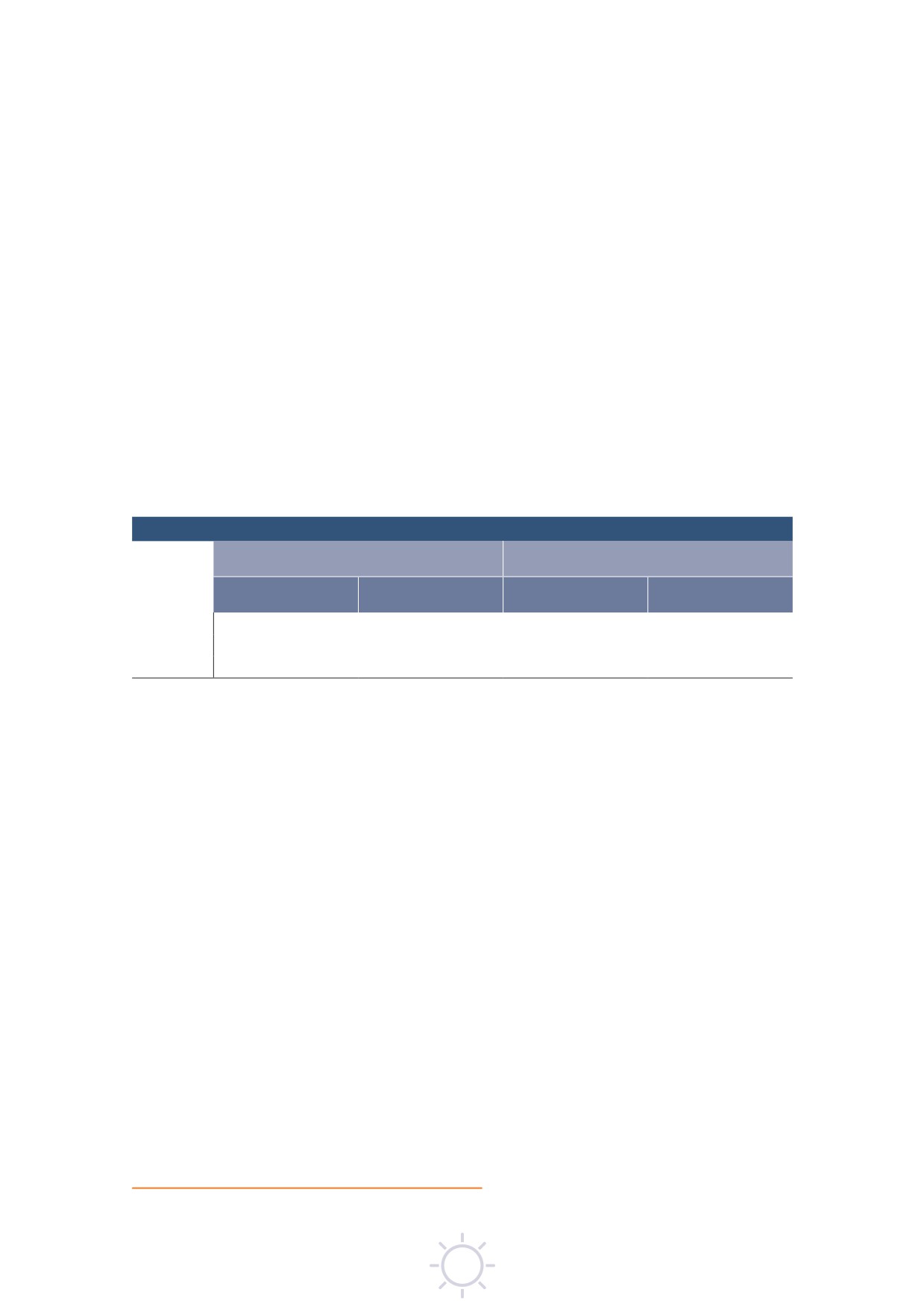
Despite the above efforts, the crew-change crisis appears to be getting worse. The latest Neptune
Declaration Crew Change Indicator published in July 2021 shows that the number of seafarers on board
beyond the expiry of their contracts continued to rise in June 2021, as did the number of seafarers on
board for over 11 months (table 5.1) (Global Maritime Forum, 2021d). Since the launch of the Indicator in
May 2021, the proportion of seafarers on board vessels beyond the expiry of their contract had increased
from 5.8 to 8.8 per cent - an increase of over 50 per cent. The number of seafarers on board for over
11 months had increased from 0.4 to 1 per cent - an increase of 150 per cent. According to the MLC 2006,
the default maximum period of service on board, following which a seafarer is entitled to repatriation, is
11 months (Regulation 2.5 and Regulation 2.4). In July 2021, the International Chamber of Shipping
estimated that, the number of seafarers remaining on board beyond the expiry of their contract, was
around 250,000.
Table 5.1
Neptune Declaration Crew Change Indicator, July 2021
Percentage of seafarers on board beyond
Percentage of seafarers on board
the expiry of their contracts
for over 11 months
Monthly percentage
Percentage point change
Monthly percentage
Percentage point change
from previous month
from previous month
May 2021
5.8
-
0.8
-
June 2021
7.2
+1.4
0.4
-0.4
July 2021
8.8
+1.6
1.0
+0.6
Source: Global Maritime Forum 2021.
As part of the reporting for the Neptune Declaration Crew Change Indicator, contributing ship managers
also highlighted the following key developments:
“Continual high infection rates and subsequent
domestic lockdowns are still challenging crew changes and causing disruption to crew movements; a
decrease of daily inbound flights to the Philippines as well as the travel ban announced by the Philippine
Government for seafarers traveling from United Arab Emirates, Oman, Nepal, Bangladesh, Sri Lanka,
Pakistan are causing a general disruption to crew movements; travel restrictions continue to prevent
seafarers from going back home and many flights have been cancelled; and leading maritime crew
nations continue to have low vaccination rates and seafarers continue to have limited vaccine access.”6
(see also box 5.1).
Crew changes and repatriation of seafarers thus still entail serious logistical challenges. Moreover, seafarer
access to medical care and priority vaccination remains inadequate, with important repercussions for their
health and safety, as well as for public health (DevPolicy, 2021).
In June 2021, it was reported that a cargo ship’s captain, who developed COVID-19 symptoms shortly
after the vessel set sail, died on board after 11 days (CNN, 2021). Successive ports refused to allow the
vessel to call, and no medical evacuation measures were taken. For six weeks, despite repeated pleas for
assistance, the ship was stranded offshore, unable to find a port that would take the corpse. As a result,
the crew was stuck at sea for weeks, with a potential COVID-19 outbreak on its hands.
This state of affairs is clearly unacceptable. Seafarers should not just be designated as key workers and
vaccinated but also provided with speedy and effective emergency medical assistance in the event of a
COVID-19 outbreak at sea.
It will also be important to keep abreast of the latest guidance, which should be updated in line with
the latest scientific insights on transmission pathways, variants, vaccine efficacy, and related risks.
6
According to ICS, informal industry survey data about vaccinations by nationality of seafarers suggests that, with some
notable exceptions, only a small proportion of the world’s seafarers has been currently vaccinated.
113
The latest industry guidance for ship-operators (ICS et al., 2021d), draws on sector-specific WHO
guidance published in August 2020 (WHO, 2020a).7 A good model is that of Belgium which in July 2021,
started a vaccination programme for all seafarers arriving in a Belgian port, regardless of their nationality
(Safety4Sea, 2021). Other countries have seafarer vaccination programmes, including Australia, Cyprus,
Germany, the Netherlands, and the United States. In India the National Union of Seafarers has started a
programme to offer 5,000 doses to seafarers and their families (TradeWinds, 2021).
Addressing the complex issues arising in the context of facilitating global trade in times of a pandemic
while protecting the health of seafarers and the public at large will require the continued engagement of all
stakeholders, including in the negotiations of legal instruments, guidelines and recommendations under
the auspices of UN bodies, including ILO, IMO, and UNCTAD, and in respect of relevant national and local
implementation. Reflecting the continued need to raise awareness and alleviate the plight of seafarers,
while recognizing their vital role in world trade, it is worth noting that “Seafarers: at the core of shipping’s
future” was selected as the World Maritime theme for 2021.8
According to the BIMCO/ICS Seafarer Workforce Report 2021 (BIMCO/ICS 2021), in 2021 around the
world there were 1,892,720 seafarers, of whom 857,540 were officers and 1,035,180 were ratings - skilled
seafarers who carry out support work for officers. The largest supplier for both officers and ratings was
the Philippines followed by the Russian Federation, Indonesia, China, and India (table 5.2). Together, these
countries supplied 44 per cent of the global seafarer workforce. These numbers are growing.
Box 5.1
The case of the Philippines
Seafarer supply
The Philippines is now the world’s largest source of seafarers, with an estimated 700,000 deployed
on domestic or foreign-flagged seagoing vessels. Over a quarter of all global merchant shipping crew
members come from the Philippines. As of 2019, there were 380,000 Filipino seafarers overseas.
By mid-2020, over the three months after the onset of the COVID-19 pandemic and the quarantine
imposed in the country, 50,000 Filipino seafarers had been repatriated, but only 17,845 outbound
or deployed seafarers were recorded by the authorities. As reported by Business Mirror, during
July-September
2020, according to the Philippine Overseas Employment Administration, the
deployment of Filipino seafarers started to return to normal, with over 136,000 sailors able to board
ships traveling in international waters.
Seafarer remittances
In
2019, the Philippines earned more than $30.1 billion from overseas Filipino workers, including
$6.5 billion from seafarers. In
2019, the remittances of overseas Filipino workers constituted
9.3 per cent of the Philippines’ GDP and 7.3 per cent of gross national income. By the end of 2020,
total remittances of overseas foreign workers amounted to $29.9 billion a 0.8 per cent decline that year.
Of this amount, $6.3 billion was remitted by sea-based workers - a 2.8 per cent decline.
Seafarer vaccination
When it comes to vaccination against COVID-19, seafarer-supplying nations are at a disadvantage.
According to the New York Times vaccination tracker, as of the beginning of August 2021, globally
on average 53 doses of the COVID-19 vaccines had been administered for every 100 people, but the
Philippines had delivered only 18 doses for every 100 people. Among the world’s five-largest seafarer
providers every country except China (117) had delivered less than the global average: Russian
Federation, 42; Indonesia, 25; and India, 34.
Sources: Maritime Industry Authority (2020). A Letter to All Filipino Seafarers Around the World.13 April.
https://marina.gov.ph/2020/04/13/a-letter-to-all-filipino-seafarers-around-the-world. The World Bank.
ofwstat/ofwstat.html. Global Maritime Forum (2020). S.E.A.F.A.R.E.R. 30 September.
https://www.globalmaritimeforum.org/news/s-e-a-f-a-r-e-r. Business Mirror (2020). 136,000 Filipino seafarers
deployed aboard international vessels overseas since July’. 1 October. https://businessmirror.com.ph/2020/
10/01/136000-filipino-seafarers-deployed-aboard-international-vessels-overseas-since-july. Bangko Sentral ng
Pilipinas (2021). Statistics. Overseas Filipinos’ Cash Remittances. https://www.bsp.gov.ph/statistics/external/
ofw2.aspx. Philippine Statistics Authority. https://psa.gov.ph/national-accounts/base-2018/data-series.
7
The industry guidance also refers to non-sector specific guidance for the general public (WHO, 2020c).
8
114
5. The COVID-19 seafarer crisis
Table 5.2
Five largest seafarer-supply countries, 2021
All Seafarers
Officers
Ratings
1
Philippines
Philippines
Philippines
2
Russian Federation
Russian Federation
Russian Federation
3
Indonesia
China
Indonesia
4
China
India
China
5
India
Indonesia
India
Source: BIMCO/ICS, Seafarer Workforce Report 2021, London, 2021.
The 1978 International Convention on Standards of Training, Certification and Watchkeeping for Seafarers
(STCW) establishes basic requirements on training, certification and watchkeeping. Between 2015
and 2021 the supply of STCW -certified officers increased by 11 per cent and that of STCW-certified
ratings by 19 per cent (BIMCO/ICS 2015).
B. SEAFARER CRISIS - IMPLEMENTATION OF THE ILO MARITIME
LABOUR CONVENTION, 2006, AS AMENDED (MLC 2006)
The ILO Maritime Labour Convention 2006, entered into force on 20 August 2013 and, as of July 2021,
had been ratified by 98 of the 187 ILO member States. The Convention comprehensively sets out rights
and responsibilities, as well as minimum standards for seafarers’ working and living conditions. It covers a
wide range of issues, including minimum age, employment agreements, hours of work or rest, payment of
wages, paid annual leave, repatriation at the end of contract, and onboard medical care. It also addresses
licensed private recruitment and placement services, accommodation, food and catering, health and
safety protection and accident prevention and complaint handling. In addition, the Convention introduces
compliance and enforcement components for flag State inspection and for port State control. The MLC
2006,9 taken together with other instruments, thus helps guarantee the health, safety, security and welfare
of seafarers as well as their human rights.10
Nevertheless, as result of COVID-19 restrictions many seafarers have been stranded. As a recent UN
report highlights, “hundreds of thousands of seafarers are trapped on ships as routine crew changes
cannot be carried out, while hundreds of thousands are stranded on land, prevented from re-joining
ships. Those stranded on ships are being denied their human rights, including their rights to physical
and mental health, to family life, and to freedom of movement, and are often forced to work beyond the
default 11-month maximum period of service on board, as established by MLC 2006. This is resulting
in cases that could amount to forced labour” (UN Global Compact, et al., 2021). The report addresses
seafarers’ rights, and offers cargo owners, charterers and logistics providers guidance and a checklist for
conducting due diligence across their supply chains. The aim is to identify, prevent, mitigate and address
adverse human rights impacts for seafarers affected by the ongoing COVID-19 crisis.
On 12 December 2020, the ILO Committee of Experts on the Application of Conventions and
Recommendations, adopted a document entitled ‘General observation on matters arising from the
application of the MLC, 2006, during the COVID-19 pandemic’ (ILO, 2021i). The Committee noted with
deep concern the impact that COVID-19 restrictions have had on the protection of seafarers’ rights as laid
out in the Convention. The Committee also took note of the observations of the International Transport
Workers’ Federation received on 1 October 2020 and of the International Chamber of Shipping on
26 October 2020 that ratifying States had failed to comply with major provisions of the Convention during
the COVID-19 pandemic - notably regarding cooperation among Members, access to medical care and
repatriation of seafarers. In addition, they noted the risk that fatigue and other health issues could lead to
serious maritime accidents.11 It therefore, strongly encouraged ratifying States in their different capacities
as flag States, port States or labour-supplying States that have not yet done so, “to recognize seafarers
as key workers without delay and to draw in practice the consequences of such qualification, in order to
restore the respect of their rights as provided for in the MLC, 2006.”
9
10
The protection of human rights is a cross cutting issue for the 2030 Agenda for Sustainable Development, which seeks
to realize the human rights of all (see A/RES/70/1, Preamble). Thus, the 2030 Agenda and human rights are interwoven
and inextricably tied together (OHCHR, 2015).
11
For further information on the labour rights and standards involved, see ILO, 2020c, 2020d.
115
In February 2021, ILO, through a revised information note, published guidance, on how best to address
the complexities of the current crisis in light of the provisions of MLC, 2006. This was updated to reflect the
observations of the ILO Committee of Experts on the Application of Conventions and recommendations
(ILO, 2021j), and also made reference to the MLC, 2006 and previous work of ILO bodies12, as well as to
recommendations from the IMO and WHO, and related work by the ICS and the ITF.
The Committee advises that the notion of ‘force majeure’, i.e., unforeseen or unforeseeable circumstances
making it impossible to comply with the MLC 2006, may no longer be invoked from the moment that options
are available to comply with the provisions of the Convention, although more difficult or cumbersome, and
urged ratifying States which have not yet done so, to adopt all necessary measures without delay to
restore the protection of seafarers’ rights and comply to the fullest extent with their obligations under the
MLC 2006.
The note urges all ratifying States to:
• Adopt the necessary measures or reinforce existing ones without delay to ensure that, in no case,
are seafarers forced to continue working on extended contractual arrangements without their
formal, free, and informed consent.
• Recognize seafarers as key workers without delay and to draw in practice the consequences of
such qualification, in order to restore the respect of their rights as provided for in the MLC, 2006.
• Adopt necessary measures, in consultation with relevant seafarers’ and shipowners’ organizations,
to further enhance cooperation with each other to ensure the effective implementation and
enforcement of the Convention, in particular during the COVID-19 pandemic.
Flag States are urged to ensure that:
• The ships that fly their flags fully comply with the provisions of the Convention and adopt the
necessary measures and/or reinforce the existing ones without delay, including through more
frequent inspections, if necessary.
• Seafarers on ships that fly their flags are covered by adequate measures for the protection of their
health and have access to prompt and adequate medical care whilst working on board, including
access to vaccination (Regulation 4.1).
• Seafarers are provided with occupational health protection and live, work and train on board ship in
a safe and hygienic environment (Regulation 4.3).
• The prohibition to forgo minimum annual leave with pay is strictly enforced, with the limited exceptions
authorized by the competent authority (Regulation 2.4 and Standard A2.4, paragraph 3).
• Seafarers are repatriated at no cost to themselves in the circumstances specified in the Convention,
with strict respect of the default 11 months maximum period of service on board derived from the
provisions of the Convention (Regulation 2.5 and Regulation 2.4).
• Ships that fly their flag have sufficient of seafarers employed on board to ensure that ships are operated
safely, efficiently and with due regard to security under all conditions, taking into account concerns
about seafarer fatigue and the particular nature and conditions of the voyage (Regulation 2.7).
• No fees or other charges for seafarer recruitment or placement, including the cost of any quarantine
obligations before joining the ship, are borne directly or indirectly, in whole or in part, by the seafarer,
other than the cost authorized under Standard A1.4, paragraph 5.
• Seafarers are granted shore leave for their health and well-being and consistent with the operational
requirement of their positions, subject to the strict respect of any public health measures applicable
to the local population.
Port States are urged to:
• Ensure that seafarers on board ships in their territory who are in need of immediate medical care,
are given access to medical facilities on shore (Regulation 4.1).
• Facilitate the repatriation of seafarers serving on ships which call at their ports or pass through their
territorial or internal waters (Standard A2.5.1, paragraph 7).
12
Including the CEACR and the Special Tripartite Committee of MLC 2006.
116
5. The COVID-19 seafarer crisis
• Allow and facilitate the replacement of seafarers who have disembarked and consequently ensure
the safe manning of ships, by providing an expeditious and non-discriminatory treatment of new crew
members who enter their territory exclusively to join their ships (Standard A2.5.1, paragraph 7).
Labour-supplying States which have not yet done so, are called upon to:
• adopt the necessary and immediate measures to ensure that the required facilities are put in place
in relation to transport, testing and quarantine of seafarers.
• While encouraging a pragmatic approach regarding certificates in respect of training and
qualifications since the beginning of the pandemic, all ratifying States are urgently called upon
to adopt all necessary measures without delay to restore the protection of seafarers’ rights and
comply, to the fullest extent, with their obligations under the MLC 2006.
• With respect to maritime labour certificates and inspections, while recognizing challenges since
the outbreak of COVID-19, in respect of conducting the inspections required in accordance with
MLC 2006, all ratifying countries with responsibilities as flag States and port States are urged to
adopt the necessary measures without delay, to ensure compliance with the Convention.
In addition, the guidance notes that the measures adopted to contain the pandemic are creating additional
challenges in resolving the cases of abandonment that occurred before the outbreak of COVID-19.
The IMO/ILO database on reported incidents of abandonment of seafarers, shows a dramatic increase in
cases of abandonment in the second part of 2020, with some of those cases linked to COVID-19-related
measures.13 It was recalled that, even in the context of the COVID-19 pandemic, flag States, port
States and labour-supplying States remain bound by the requirements concerning repatriation set out in
Regulation 2.5 of the MLC 2006, and the relevant provisions of the Code of the Convention.
Member States must undertake all necessary action to promptly resolve situations of abandonment
and ensure that affected seafarers are repatriated as soon as possible and receive the payment of
outstanding wages, in accordance with the relevant provisions of the MLC 2006 (ILO, 2021j). According
to ILO, as of mid-July 2021, 60 cases had been reported for 2021, which, if that rate continued,
would surpass the number of cases in 2020. Also, resolution of a number of abandonment cases had
been delayed due to the pandemic (e.g., not being able to repatriate seafarers due to restrictions on
disembarkation and travel).
C. CREW CHANGES AND KEY WORKER STATUS - OTHER RELEVANT
INTERNATIONAL LEGAL INSTRUMENTS
In addition to the MLC 2006, a number of other international conventions and instruments contain
provisions aiming to reduce the formalities and documents required, and to facilitate and simplify crew
changes. These cover issues such as seafarers’ repatriation, transit and joining ships, and the issuance
and harmonization of seafarers’ identity documents, while enhancing border and port security. Adopting
and implementing these instruments would ease the situation of seafarers during the COVID-19 pandemic
and beyond.
ILO Convention No. 108 on Seafarers’ Identity Documents, 1958
It has been a longstanding common practice to allow seafarers shore leave to access medical,
communications and other onshore welfare facilities. In addition, to join or change ships seafarers may
need to transit or transfer through countries, which requires border facilitation at seaports and airports.
For this purpose, they have traditionally been issued with a seafarers’ identity document (SID). Although
a SID is not considered a travel documents per se, like a passport or visa it may be subject to the same
national laws.
The Seafarers’ Identity Documents Convention, 1958 (No. 108) entered into force on 19 February 1961,
and has been ratified by 64 States.14 The Convention specifies the minimum mandatory details that should
be contained in the SID but does not require any security features, or specific form of the document.
As a result, various countries subsequently developed their own, making it difficult for border and port
authorities to determine whether a document is legitimate.
13
https://www.ilo.org/dyn/seafarers/seafarersbrowse.home. For more information on work by IMO/ILO in cooperation
with ITF, on the issue of abandonment of seafarers, see https://www.imo.org/en/OurWork/Legal/Pages/Seafarer-
abandonment.aspx.
14
117
ILO Convention No. 185 on Seafarers’ Identity Documents (Revised)
2003, as amended
Following the terrorist attacks of 11 September 2001, the Seafarers’ Identity Documents Convention
(Revised), 2003 (No. 185), was adopted.15 It included innovations that related to the form of the SID, which
addition to a photograph and other details could include biometric security features such as fingerprints as
well as verification options for uniformity and machine readability. The Convention also contains minimum
requirements for the SID’s issuance processes and procedures, including quality control, national
databases, and national focal points to provide information to border authorities. In particular, article 6,
paragraph 7, of the Convention, provides: “Each Member for which this Convention is in force shall, in the
shortest possible time, also permit the entry into its territory of seafarers holding a valid seafarers’ identity
document supplemented by a passport, when entry is requested for the purpose of: (a) joining their ship
or transferring to another ship; (b) passing in transit to join their ship in another country or for repatriation;
or any other purpose approved by the authorities of the Member concerned.”
Convention No.185 entered into force in February 2005, but so far has been ratified by only 36 out of
187 ILO member States, including only few port States. Although some countries have made considerable
investment to properly implement this Convention, they can therefore only count on only a few other
countries to recognize their SIDs. Moreover, only a few ratifying countries are in a position to issue SIDs
that conform with the Convention, while 64 countries still remain Parties only to the 1958 Convention.
Implementation has been slow partly because the specified fingerprint technology and biometric features
were soon considered out of date. Instead, since 2003 many border authorities have been using the
standards of the International Civil Aviation Authority, namely, ICAO Doc 9303 on Machine Readable Travel
Documents.16 This is now universally followed for travel and similar documents and includes the facial
image in a contactless chip - as in electronic passports.
In 2016, ILO Convention No.185 was subsequently amended to align its biometric requirements with
those of ICAO Doc 9303.17 This way, the SID should look and function like an e-passport, booklet, or card
and can be issued, read, and verified with the same equipment - enhancing security while simplifying the
processes for seafarers when they arrive in ports, or transit or cross international borders.
The amended version entered into force in June 2017, and the amendments are applicable to all member
States to the original Convention No.185, except for Marshall Islands. Authorities issuing SIDs, were
given a five-year transition period to update their systems, i.e., until 2022, although individual countries
may issue the new SIDs as soon as they are able to. All the 1.9 million seafarers could benefit from the
new SIDs, which would allow them to travel without a visa to join their ships and to disembark in ports.
Unfortunately, implementation appears to have slowed due to the COVID-19 pandemic.
IMO Convention on Facilitation of International Maritime Traffic, 1965
(FAL Convention)
The IMO Convention on Facilitation of International Maritime Traffic, 1965 (FAL Convention) entered into
force on 5 March 1967, and has been ratified by 125 out of 174 IMO member States.18 Its objective
is “to facilitate maritime traffic by simplifying and reducing to a minimum the formalities, documentary
requirements and procedures on the arrival, stay and departure of ships engaged in international voyages.”
Rather than address trade-related aspects of shipping, it focuses on the formalities and procedures for
ships calling in ports, including those related to the arrival and departure of seafarers.
The FAL Convention contains standards and recommended practices and rules for simplifying formalities
and documentary requirements. Customs and immigration officials and port authorities should ask for
the minimum of information at the appropriate time, and offer documents to be completed in a standard
format, while those providing information, should provide accurate data, at the appropriate time and in
the agreed format.
15
ENG.pdf.
16
17
18
as-amended-FAL-Convention-2.7.4-Recommended-Practice.pdf. For more information on the FAL Convention, see
Chapter 5, Review of Maritime Transport 2021.
118
5. The COVID-19 seafarer crisis
•
2009 amendments to the FAL Convention19 - These entered into force on 15 May 2010 and include
changes related to the contents and purpose of documents: “A passport or an identity document
issued in accordance with relevant ILO conventions, or else a valid and duly recognized seafarer’s
identity document, shall be the basic document providing public authorities with information relating
to the individual member of the crew on arrival or departure of a ship.”
•
2016 amendments to the FAL Convention20 - These entered into force on 1 January 2018 and
provide for additional guarantees. Any discrimination is prohibited, and shore leave should be
granted to crew members, irrespective of the ship’s flag State. Since 2019, ships and ports have
had to exchange FAL data electronically and are encouraged to use a “single window”, in which
all the many agencies and authorities exchange data via a single point of contact. Following the
expected adoption of further amendments in 2022, and their subsequent entry into force, the single
window could become obligatory from January 2024.
The IMO Compendium on Facilitation and Electronic Business21
This is an important IMO instrument for accelerating digitalization and connectivity in the maritime industry.
It facilitates the exchange of information ship to shore and enables interoperable single windows - reducing
port formalities by harmonizing the data elements required and standardizing electronic messages. Its
key components are the IMO Data Set and the IMO Reference Data Model which provide common
semantics and representation of the data needed to fulfil ship reporting requirements. The IMO data
elements are mapped across the main models (e.g., UN/CEFACT, WCO Data Model and ISO) ensuring full
interoperability between standards for ship clearance. Since 2019, the Compendium has been extended
beyond FAL forms and is now connected to several IMO instruments, such as MARPOL for advance
notification of waste delivery to port reception facilities. From 2020, the Compendium also included the
Maritime Declaration of Health (MDH), a requirement of the WHO International Health Regulations.
IMO Guidelines for setting up a maritime single window
The IMO has developed guidelines for setting up a maritime single window (MSW).22 These offer information,
advice and guidance along with examples of the experience and knowledge gained by some member
States in introducing an MSW. Single windows, mainly for cargo, are currently being developed under
various technical assistance projects in developing countries, including in cooperation with ASYCUDA.23
MSW and port community systems can smooth formalities, (e.g., data elements included in the crew list,
the passenger list and the maritime declaration of health).24
D. THE WAY FORWARD
Despite important international support, seafarers are still facing serious problems as a result of the
COVID-19 pandemic. This requires urgent action in a number of important areas.
• Vaccination
- Concerted collaborative efforts by industry, governments and international
organizations should ensure that seafarers are designated as key workers and are vaccinated as a
matter of priority.
• Crew changes - Governments and industry should continue to work together, including through
the Neptune Declaration initiative, and in collaboration with relevant international organizations, to
facilitate crew changes, in accordance with international standards and in line with public health
considerations. They should also ensure the availability and access to related seafarer data.
• Route deviations - Charterers and other industry stakeholders should be flexible in accepting
requests from shipping companies for route deviation to facilitate crew changes and should refrain
from using “no crew change” clauses in charterparties.
19
20
21
22
23
https://asycuda.org/en/. Also see Chapter 6, part on trade facilitation.
24
For further information on Single Windows, see Chapter 5 of the Review of Maritime Transport 2021. Also see Premti A.,
Asariotis R., 2021.
119
• International legal framework - States and other relevant stakeholders should, in consultations and
meetings on seafarers’ issues at ILO and IMO, keep under review the relevant legal framework and
ensure that international obligations are respected and implemented.
• Maritime single windows - Port community systems should implement the Single Window concept,
similarly to the customs-centric Single Window powered by ASYCUDA, to cover all the information
and formalities resulting from FAL and other relevant instruments.
• Information exchange - Relevant public and private sector stakeholders should continue their regular
exchange of views and best practices on seafarers’ situation and needs, and lessons learned,
including from the COVID-19 pandemic, and promote further harmonization and standardization.
• Outbreaks and emergencies at sea - In line with developing scientific insights, governments,
international organizations and all stakeholders should regularly update specific guidance
on measures to prevent and deal with COVID-19 and other outbreaks at sea and ensure that
mechanisms are in place to reduce, and respond to medical emergencies at sea.
Public and private stakeholders must continue to work together to implement relevant labour standards
and address health, safety, security, welfare, and other challenges faced by seafarers. All should be
working to protect seafarers’ human rights and advance the objectives of SDG 8 of decent work and
economic growth for sustainable development.
120
5. The COVID-19 seafarer crisis
REFERENCES
Aljazeera
(2021). Abandoned: The seafarers stuck at sea for two years.
6 July. Available at
years.
Bangko Sentral ng Pilipinas
(2021). Statistics. Overseas Filipinos’ Cash Remittances. Available at
BIMCO/ICS (2015). Manpower Report: The Global Supply and Demand for Seafarers in 2015. Available
at
summary.pdf.
BIMCO/ICS (2021). Seafarer Workforce report. The Global Supply and Demand for Seafarers in 2021.
Business Mirror (2020). 136,000 Filipino seafarers deployed aboard international vessels overseas since
July.
1 October. Available at https://businessmirror.com.ph/2020/10/01/136000-filipino-seafarers-
deployed-aboard-international-vessels-overseas-since-july.
CNN (2021). This cargo ship’s captain died aboard. Then the crew was stuck at sea for weeks - CNN.
21 June. Available at https://edition.cnn.com/2021/06/19/europe/italy-captain-capurro-intl-hnk-dst/
index.html.
De Beukelaer (2021). COVID-19 border closures cause humanitarian crew change crisis at sea. Marine
Policy. June. Available at https://www.sciencedirect.com/science/article/pii/S0308597X21002724?
via%3Dihub.
DevPolicy,
2021. Stranded seafarers: an unfolding humanitarian crisis.
3 June. Available at
Global Maritime Forum (2020). S.E.A.F.A.R.E.R. 30 September. Available at https://www.globalmaritime
forum.org/news/s-e-a-f-a-r-e-r.
Global Maritime Forum (2021a). The Neptune Declaration on Seafarer Wellbeing and Crew Change.
Seafarer-Wellbeing-and-Crew-Change.pdf.
Global Maritime Forum (2021b). Best Practices for Charterers. Available at https://www.google.com/
url?sa=t&rct=j&q=&esrc=s&source=web&cd=&ved=2ahUKEwj80t-Rpf_wAhXqAWMBHQ
OiBREQFnoECAgQAA&url=https%3A%2F%2Fwww.globalmaritimeforum.org%2Fcontent
%2F2021%2F05%2FThe-Neptune-Declaration-Best-Practices-for-Charterers.pdf&usg=
AOvVaw3DEFTUi6CcR8t570J4DvEn.
Global Maritime Forum
(2021c). The Neptune Declaration Crew Change Indicator. Available at
Indicator-Data-collection-and-processing.pdf.
Global Maritime Forum (2021d). The Neptune Declaration Crew Change Indicator. July 2021. Available
Indicator-July-2021.pdf.
ICS et al (2021a). Coronavirus (COVID-19): Legal, Liability and Insurance Issues arising from Vaccination of
Seafarers. March. Available at https://www.ics-shipping.org/publication/coronavirus-covid-19-legal-
liability-and-insurance-issues-arising-from-vaccination-of-seafarers/.
ICS et al (2021b). Coronavirus (COVID-19) Vaccination for Seafarers and Shipping Companies: A
Practical Guide. March. Available at https://www.ics-shipping.org/publication/coronavirus-covid-19-
vaccination-practical-guide/.
ICS et al (2021c). Coronavirus (COVID-19): Roadmap for Vaccination of International Seafarers. May.
of-international-seafarers/.
ICS et al (2021d). Coronavirus (COVID-19): Guidance for Ship Operators for the Protection of the Health of
Seafarers, Fourth Edition. 7 June. Available at https://www.ics-shipping.org/publication/coronavirus-
covid-19-guidance-fourth-edition/.
121
ILO
(2020a). COVID-19 and maritime shipping & fishing. Briefing note.
15 May. Available at
ILO (2020b). Resolution concerning maritime labour issues and the COVID-19 pandemic. 8 December.
meetingdocument/wcms_760649.pdf.
ILO (2020c). COVID-19 and the world of work: Impact and policy responses 18 March. Available at
wcms_738753.pdf.
ILO (2020d). New Statement of the Officers of the STC 1 on the coronavirus disease (COVID-19). 1
October. Available at https://www.ilo.org/wcmsp5/groups/public/---ed_norm/---normes/documents/
statement/wcms_756782.pdf.
ILO
(2021a). Seafarers and aircrew need priority COVID-19 vaccination.
26 March. Available at
ILO (2021b). Resolution concerning the implementation and practical application of the MLC, 2006 during
the COVID-19 pandemic. Available at https://www.ilo.org/wcmsp5/groups/public/@ed_norm/@
normes/documents/genericdocument/wcms_782881.pdf.
ILO (2021c). Resolution concerning COVID-19 vaccination for seafarers. Available at https://www.ilo.org/
wcmsp5/groups/public/@ed_norm/@normes/documents/genericdocument/wcms_782880.pdf.
ILO (2021d). Recommendations concerning the review of maritime-related instruments. Available at
wcms_783227.pdf.
ILO (2021e). Background paper for discussion. Fourth meeting of the Special Tripartite Committee
established under Article XIII of the Maritime Labour Convention, 2006, as amended - Part I (Geneva,
19-23 April 2021). Available at https://www.ilo.org/wcmsp5/groups/public/---ed_norm/---normes/
documents/genericdocument/wcms_774787.pdf.
ILO (2021f). Resolution concerning a global call to action for a human-centred recovery from the
COVID-19 crisis that is inclusive, sustainable and resilient. 17 June. Available at https://www.ilo.org/
ilc/ILCSessions/109/reports/texts-adopted/WCMS_806092/lang--en/index.htm.
ILO (2021g). Work in the time of COVID Report of the Director-General International Labour Conference
documents/meetingdocument/wcms_793265.pdf.
ILO (2021h). Statement of the Officers of the STC on the coronavirus disease (COVID-19) regarding
increased collaboration between shipowners and charterers to facilitate crew changes. 15 December.
Available
at
committee/WCMS_764724/lang--en/index.htm.
ILO (2021i). General observation on matters arising from the application of the Maritime Labour Convention,
2006, as amended (MLC, 2006) during the COVID-19 pandemic. Available at https://www.ilo.org/
wcmsp5/groups/public/---ed_norm/---normes/documents/publication/wcms_764384.pdf.
ILO (2021j). Information note on maritime labour issues and coronavirus (COVID-19). Revised version
3.0.
3 February. Available at https://www.ilo.org/wcmsp5/groups/public/---ed_norm/---normes/
documents/genericdocument/wcms_741024.pdf.
IMO (2020a). Coronavirus (COVID-19) - Joint Statement calling on all Governments to immediately
recognize seafarers as key workers, and to take swift and effective action to eliminate obstacles to
crew changes, so as to address the humanitarian crisis faced by the shipping sector, ensure maritime
safety and facilitate economic recovery from the COVID-19 pandemic. Circular Letter No.4204/Add.30.
11 September. Available at https://wwwcdn.imo.org/localresources/en/MediaCentre/HotTopics/
Documents/COVID%20CL%204204%20adds/Circular%20Letter%20No.4204Add.30%20Joint%20
Statement%20Seafarers.pdf.
IMO (2020b). Coronavirus (COVID-19) - Outcome of the International Maritime Virtual Summit on Crew
Changes organized by the United Kingdom. Circular Letter No.4204/Add.24. 13 July. Available at
4204%20adds/Circular%20Letter%20No.4204-Add.24%20-%20Coronavirus%20(Covid-19)%20
122
5. The COVID-19 seafarer crisis
-%20Outcome%20Of%20The%20International%20MaritimeVirtual%20Summit%20On%20Crew-
%20Change.pdf.
IMO (2020c). Recommended action to facilitate ship crew change, access to medical care and
seafarer travel during the COVID-19 pandemic. Resolution MSC.473. 21 September. Available at
Change.pdf.
IMO (2020d). Coronavirus (COVID-19) - “No crew change” clauses in charterparties. Circular Letter
No.4204/Add.36/Rev.1.
23 December. Available at https://wwwcdn.imo.org/localresources/en/
MediaCentre/HotTopics/Documents/COVID%20CL%204204%20adds/CL.4204-Add.36%20no%20
crew%20change%20clause.pdf.
IMO (2021a). Industry Recommended Framework of Protocols for ensuring safe ship crew changes and
travel during the Coronavirus (COVID-19) pandemic. MSC.1/Circ.1636/Rev.1. 22 April. Available at
protocols/MSC.1-Circ.1636%20-%20Industry%20Recommended%20Framework%20Of%20
Protocols%20For%20Ensuring%20Safe%20Ship%20Crew%20Changes%20And%20Travel.pdf.
IMO (2021b). COVID-19 crew change crisis still a challenge - IMO Secretary-General. 19 March. Available
IMO (2021c). Coronavirus
(COVID-19)
- Joint Statement calling on all Governments to prioritize
COVID-19 vaccination for seafarers and aircrew. Circular Letter No.4204/Add.38. 25 March. Available
No.4204-Add.38%20-%20Coronavirus%20(Covid-19)%20-%20Joint%20Statement%20Calling%20
On%20All%20GovernmentsTo%20Prioritize%20Covid-19...%20(Secretariat).pdf.
IMO (2021d). Seafarers and aircrew need priority COVID-19 vaccination.
26 March. Available at
IMO (2021e). Report of the Maritime Safety Committee on its 103rd session. MSC 103/21/Add.1, Annex 15.
14 June.
IMO (2021f). Coronavirus (COVID-19) - Designation of seafarers as key workers. Circular Letter No.4204/
Add.35/Rev.7
20 May. Available at https://wwwcdn.imo.org/localresources/en/MediaCentre/
HotTopics/Documents/COVID%20CL%204204%20adds/Circular%20Letter%20No.4204-
Add.35%20-%20Coronavirus%20%28Covid-19%29%20-%20Designation%20Of%20Seafarers%20
As%20Key%20Workers.pdf.
INTERTANKO (2020). Outbreak Management Plan: COVID-19 (version 3). September. Available at
ITF (2020). ITF and JNG Joint Statement: On Seafarers’ Rights and the Present Crew Change Crisis. 5
October. Available at https://www.itfglobal.org/en/news/itf-and-jng-joint-statement-seafarers-rights-
and-present-crew-change-crisis.
Maritime Industry Authority (2020). A Letter to All Filipino Seafarers Around the World. 13 April. Available
OHCHR (2015). OHCHR, 2015, Human Rights in the 2030 Agenda for Sustainable Development. Available
Philippine Statistics Authority. Available at https://psa.gov.ph/national-accounts/base-2018/data-series.
Premti A, Asariotis R (2021). Facilitating crew changes and repatriation of seafarers during the COVID-19
pandemic and beyond. 2 March. Available at https://unctad.org/news/facilitating-crew-changes-and-
repatriation-seafarers-during-covid-19-pandemic-and-beyond.
Safety4Sea
(2021). Belgium vaccinates foreign seafarers onboard ships.
27 July. Available at
The World Bank. Available at https://data.worldbank.org. Philippines Overseas Employment
Administration. Available at https://www.poea.gov.ph/ofwstat/ofwstat.html.
TradeWinds (2021). Lack of international vaccination strategy is failing seafarers. 30 June. Available
seafarers/2-1-1032040.
123
UN Global Compact, et al. (2021). Maritime human rights risks and the COVID-19 crew change crisis:
a tool to support human rights due diligence. Available at https://ungc-communications-assets.
s3.amazonaws.com/docs/publications/Maritime-Human-Rights-Risks-and-the-COVID-19-Crew-
Change-Crisis.pdf.
UNCTAD (2020a). Review of Maritime Transport 2020. UNCTAD/RMT/2020. Available at https://unctad.org/
system/files/official-document/rmt2020_en.pdf.
UNCTAD (2020b). Coronavirus: Let’s keep ships moving, ports open and cross-border trade flowing.
25 March. Available at https://unctad.org/news/coronavirus-lets-keep-ships-moving-ports-open-and-
cross-border-trade-flowing.
UNCTAD (2020c). COVID-19: A 10-point action plan to strengthen international trade and transport
facilitation in times of pandemic - UNCTAD Policy Brief No. 79. Available at https://unctad.org/
webflyer/covid-19-10-point-action-plan-strengthen-international-trade-and-transport-facilitation.
UNCTAD (2020d). UNCTAD-IMO Joint Statement in support of keeping ships moving, ports open and
cross-border trade flowing during the COVID-19 pandemic. 8 June. Available at https://unctad.org/
system/files/official-document/osg_2020-06-08_stat01_en.pdf.
UNCTAD (2020e). Technical Note on Port Responsiveness in the fight against the “invisible” threat:
COVID-19. Available at https://tft.unctad.org/ports-covid-19/.
UNCTAD (2020f). UNCTAD - Repositories of measures on cross-border movement of goods and
persons. Available at https://etradeforall.org/news/unctad-repositories-of-measures-on-cross-border-
movement-of-goods-and-persons/.
WHO (2020a). Promoting public health measures in response to COVID-19 on cargo ships and fishing
vessels.
25 August. Available at https://www.who.int/publications/i/item/WHO-2019-nCoV-Non-
passenger_ships-2020.1.
WHO (2020b). WHO SAGE Roadmap For Prioritizing Uses Of COVID-19 Vaccines In The Context Of
Limited Supply.
13 November. Available at https://www.who.int/publications/i/item/who-sage-
roadmap-for-prioritizing-uses-of-covid-19-vaccines-in-the-context-of-limited-supply.
WHO (2020c). Public health surveillance for COVID-19: interim guidance. 16 December. Available at
WHO (2021a). Roadmap to improve and ensure good indoor ventilation in the context of COVID-19.
1 March. Available at https://www.who.int/publications/i/item/9789240021280.
WHO (2021b). Policy considerations for implementing a risk-based approach to international travel in the
context of COVID-19. 2 July. Available at https://apps.who.int/iris/handle/10665/342235.
WHO (2021c). Technical considerations for implementing a risk-based approach to international travel in the
context of COVID-19: interim guidance: annex to: Policy considerations for implementing a risk-based
approach to international travel in the context of COVID-19. 2 July. Available at https://apps.who.int/
iris/handle/10665/342212.
124
This chapter summarizes important recent international
legal and regulatory developments. It also covers maritime
trade and transport facilitation issues, particularly those
related to COVID-19 which has created many problems
for clearing goods through ports, but also created
opportunities for new and smart solutions.
Many of the latest innovations in maritime transport involve
online and automated systems that raise concerns about
cybersecurity. However, shipowners and operators can
also take advantage of recently adopted guidelines on how
to maintain cybersecurity in their companies and onboard
ships, taking into account the requirements of IMO, and other
relevant guidelines.
The COVID-19 pandemic has highlighted many systemic
weaknesses, including delays in documentation and related
problems, which could provide an impetus for the more
6
widespread use of secure electronic solutions that are
already available and accepted by the market. Related work
at UN bodies, including the United Nations Commission on
International Trade Law (UNCITRAL), is also underway, to
explore the possibility of developing a negotiable transport
Legal and regulatory
document or electronic record.
developments and
In addition, the industry is conducting trials on maritime
autonomous surface ships (MASS). In May 2021, the IMO
the facilitation of
Maritime Safety Committee (MSC) completed a regulatory
scoping exercise. A number of high-priority issues, cutting
maritime trade
across several legal instruments, remain to be addressed at a
policy level to determine future work.
In June
2021, the IMO adopted amendments to Annex
VI of the MARPOL Convention aimed at reducing carbon
intensity of ships and including targets for energy efficiency,
to further reduce GHG emissions from shipping. The industry
is also planning an International Maritime Research and
Development Board, a non-governmental body funded by a
$2-per-ton-levy on shipping fuel. Other important regulatory
developments relate to the ship-source pollution control and
environmental protection measures, including shipping and
climate change mitigation and adaptation; air pollution, in
particular sulphur emissions; oil pollution from ships; ballast
water management; and biofouling.
Finally, the chapter addresses maritime trade and transport
facilitation. This includes the Trade Facilitation Agreement of
the World Trade Organization and recent amendments to the
FAL Convention related to digitalization, concluding with a
section on UNCTAD’s ASYHUB Maritime system.
Legal and regulatory
developments and the
facilitation of maritime trade
Development of maritime autonomous surface ships
(MASS) technology and trials, as well as related regulatory
responses, are advancing
With increasing automation and digitalization, there is a
growing need to effectively protect shipping assets and
technology from cyber threats
Climate-change adaptation and resilience-building for
seaports is becoming an increasingly urgent challenge,
especially for vulnerable developing countries that are
at high and growing risk of climate change impacts
IMO Member States agree on new mandatory
regulations to further reduce GHG emissions from
international shipping
Digitalization and automation of trade procedures such
as Maritime Single Windows are catalysts for more
ef cient and paperless compliance processes at ports
Multilateral Agreements such as the WTO TFA and the
IMO FAL Convention provide solid international standards
to build automated systems while ensuring interconnectivity
and interoperability
Building resilient and ef cient logistic supply chains requires
public-private dialogue. Cooperation from businesses involved
in maritime trade and port operations through National Trade
Facilitation Committees foster successful trade reforms
6. Legal and regulatory developments and the facilitation of maritime trade
A. TECHNOLOGICAL DEVELOPMENTS IN THE MARITIME INDUSTRY
1. Ensuring maritime cybersecurity
The maritime sector is increasingly structured around online and automated systems. These are appearing
in shipping, port operations, offshore infrastructure, and digital commercial transactions. Online platforms
and information systems have many advantages but also expose the industry to new and unforeseen
threats and vulnerabilities, notably the risk of cyberattacks (British Ports Association, 2020). In response,
in recent years the IMO has adopted number of international instruments and developed tools for
assessing the cybersecurity risks and vulnerabilities of the international maritime sector and strengthening
the resilience of vital systems of shipping companies, ships and ports.1
More recently, the industry organization BIMCO issued
‘Guidelines on Cyber Security on board
Ships - fourth version’ (BIMCO et al., 2021).2 Taking account of IMO guidelines and the US National
Institute of Standards and Technology (NIST) framework, the guidance specifies, for example, that
company plans and procedures for cyber-risk management should be incorporated into existing security
and safety risk management requirements contained in the International Safety Management Code (ISM)
Code and International Ship and Port Facility Security (ISPS) Code.
According to the BIMCO guidelines, enterprises should:
• Identify cybersecurity threats - to the ship, both external and internal, including those posed by
inappropriate use, and poor cybersecurity practices.
• Identify vulnerabilities of assets within the company - and develop inventories of onboard systems
with direct and indirect communications links. Everyone concerned should understand the
consequences of cybersecurity threats and the capabilities and limitations of existing protection
measures.
• Assess risk exposure, and vulnerabilities - and the potential for such vulnerabilities being exploited.
• Develop protection and detection measures - to reduce the likelihood of vulnerabilities being
exploited and the potential impact.
• Establish response plans - including contingency plans to respond to cyber-risks, and tackle the
effects of potential attacks on ship safety and security.
• Respond and recover - from any cyber security incidents using the contingency plan, then report on
the effectiveness of the response plan, update it, and reassess threats and vulnerabilities (BIMCO
et al., 2021).
The maritime industry is increasingly taking action against these threats, but much remains to be done.
Maintaining effective cybersecurity is not easy. It requires collaborative, top-down approaches that
engage senior management, combined with bottom-up approaches working with other staff to identify
vulnerabilities and risks unique to each operational environment - all the while balancing and managing
such risks within acceptable limits.
Implementing cybersecurity helps to protect shipping assets and technology from cyber-threats and
makes economic sense. But inaction could also result in consequences. Shipowners who fail to comply
with the IMO requirements risk having their ships detained by port control authorities - though enforcement
should be uniform and equitable.
Failure to address cybersecurity may also result in potential contractual liability. Cyberattacks can cause
damage, loss or misappropriation of cargos, with implications for liability in the context of contracts for
the carriage of goods by sea. Arguably, a shipowner’s obligation to exercise due diligence, and provide
a seaworthy vessel before and at the beginning of the voyage (see Art. III, r. 1 and IV, r. 1, Hague-Visby
Rules3), may also include an obligation to conduct regular cybersecurity risk assessments, and address
1
For further information, and an overview of IMO, ISO, EU, US and industry cybersecurity guidance, see UNCTAD, 2020a,
chapter 5. See also IMO, 2021a.
2
Other available guidelines include the Digital Container Shipping Association’s Implementation Guide for Cyber Security
on Vessels v1.0 (DCSA, 2020), based on version 3 of the industry guidelines (BIMCO et al., 2018), and the US NIST
framework (NIST, 2018). While their target audience is the container industry, other segments of shipping may also find
them useful. In addition, the International Association for Classification Societies (IACS) has issued a recommendation
(IACS 2020), which applies to newbuild ships only, but can also serve as guidance for existing ships.
3
127
risks and reduce vulnerabilities through safety management systems, in accordance with IMO and industry
guidance.
For ports, BIMCO and other maritime NGOs have invited public and private stakeholders to help create
global digital ISO standards to facilitate the digital exchange of data, particularly in light of the new urgency
brought about by the COVID-19 pandemic and increasing demand (BIMCO, 2021).
2. Maritime autonomous surface ships
The use of maritime autonomous surface ships (MASS) could increase safety and improve environmental
performance, and accelerate decarbonization. Various countries are moving ahead fast with this
technology and currently have MASS commercial projects at the stage of advanced testing and trialling
(Gard, 2020; Yara, 2020).
To enable the safe, secure, and environmentally sound operation of MASS within the existing IMO
instruments, the IMO has been considering amending its regulatory framework (IMO, 2017, para. 20.2).
These issues are also being considered by the academic community, industry, and governments. In 2017
the IMO Maritime Safety Committee (MSC), embarked on a regulatory scoping exercise which it completed
in May 2021. This should also help progress related discussions in other IMO Committees namely LEG,
MEPC and FAL (see also UNCTAD, 2019).
For each provision under its purview the MSC considered whether MASS could be regulated by either:
equivalences as provided by the instruments or developing interpretations; and/or amending existing
instruments; and/or developing a new instrument; or none of the above.4
The committee highlighted high-priority issues that cut across several instruments. An immediate concern
is terminology - including the definition of a MASS and clarifying terms such as “master”, “crew” and
“responsible person” which should be agreed internationally in cooperation with the ISO. The MSC has
also considered the function and operations of the remote-control station or centre, and the possible
designation of a remote operator as a ‘seafarer’. The committee has identified other issues across several
safety treaties related to: manual operations and alarms on the bridge; actions by personnel, such as
firefighting, cargo stowage and securing and maintenance; watchkeeping; search and rescue; and the
information required to be on board for safe operation.
The MSC noted that the best way to address these gaps and themes would be to proceed in a holistic
manner. This should result in a MASS instrument/Code whose goals, functional requirements, and
corresponding regulations, are suitable for all four degrees of autonomy. For further work it will be important
to establish a joint MSC/LEG/FAL working group, but in the meantime these committees can liaise on
common issues and align any future work (IMO, 2021b).
In July 2021, the IMO Legal Committee completed its scoping exercise, concluding that MASS could be
accommodated within the existing LEG conventions without the need for major adjustments or a new
instrument. Some conventions can accommodate MASS as drafted, though others may require additional
interpretations or amendments (IMO, 2021c).
B. REGULATORY DEVELOPMENTS RELATING TO INTERNATIONAL
SHIPPING, CLIMATE CHANGE AND OTHER ENVIRONMENTAL ISSUES
1. IMO action on greenhouse gas emissions
In April 2018 the IMO adopted its initial strategy on reducing greenhouse gas (GHG) emissions from ships
(see IMO, 2018, annex 1; UNCTAD, 2019). This envisages emissions peaking as soon as possible and
by 2050 falling to at least 50 per cent below the 2008 level, with the aim of being phased out entirely.
By 2030 the target is to reduce the carbon intensity of international shipping by at least 40 per cent of
the 2008 level (IMO, 2020a).
In June 2021, in line with the IMO initial strategy, the MEPC adopted new mandatory regulations as
amendments to Annex VI of the MARPOL Convention. These build on earlier efficiency requirements and
aim to cut the carbon intensity of existing ships, and further reduce GHG emissions from shipping - requiring
operators to measure the energy efficiency of all ships and meet specified targets.
4
The outcome of the MSC’s regulatory scoping exercise, as approved by the Committee, including the full analysis of
treaties, can be found as an annex to the report on its 103rd session (IMO, 2021b).
128
6. Legal and regulatory developments and the facilitation of maritime trade
For this purpose, operators can use a new Energy Efficiency Existing Ship Index (EEXI), along with a new
operational carbon intensity indicator (CII) - a dual-track approach that will enable them to address both
technical and operational measures. The EEXI measures the energy efficiency of the ship compared to a
baseline and should be calculated for ships of 400 GT and above, in accordance with values set for ship
types and size categories. Ships are required to reduce the EEXI by a specified percentage of the baseline.
Ships of 5,000 GT are already required to collect data on fuel oil consumption. Now they must also bring
their operational carbon intensity within a specific level, document and verify their CII against the required
value, and record this in the Ship Energy Efficiency Management Plan (SEEMP). This should result in
a performance rating of A, B, C, D or E - corresponding to major superior, minor superior, moderate,
minor inferior, or inferior. A ship rated D for three consecutive years, or E, would have to submit a plan for
corrective action, to show how the required rating (C or above) would be achieved. Administrations, port
authorities and other stakeholders are encouraged to provide incentives to ships rated A or B.
These amendments are expected to enter into force on 1 November 2022, with the requirements for
EEXI and CII certification coming into effect from 1 January 2023. This will allow the first annual reporting
on carbon intensity to be completed in 2023, with the first rating given in 2024. For its part, the IMO is
to review the effectiveness of the implementation by 1 January 2026 and, if necessary, adopt further
amendments. To support the implementation, the MEPC has also adopted related guidelines.
The GHG reduction candidate measures considered at IMO need to undergo an initial assessment of their
impact on States, based on the procedure adopted in 2019 (MEPC.1/Circ.885). The procedure also states
that proposed measures, including the latest measures adopted, need to undergo a comprehensive impact
assessment before adoption if required by the Committee. To support this process, UNCTAD has been
collaborating with the IMO on an expert review of the impact assessments submitted to ISWG-GHG 7, as
well as the final comprehensive impact assessment of the short-term combined measures submitted to
the 76th session of MEPC (UNCTAD, 2021a; see also chapters 2 and 4 for a discussion of the outcomes).
The 75th and 76th sessions of the MEPC also discussed an industry-led proposal for a non-governmental
International Maritime Research and Development Board (IMRB), funded by a mandatory $2 per-tonne
levy on ship fuel. The MEPC also considered mid- and long-term measures, including market-based
measures, and a work plan for further cutting GHG emissions from shipping, in line with the initial IMO
strategy (IMO, 2021d). Further consideration of the proposals should take place during ISWG-GHG 10 in
October 2021.
2. Adapting transport infrastructure to the impacts of climate change
In August
2021, less than three months before COP26 in Glasgow in November
2021, the
Intergovernmental Panel on Climate Change issued its 6th Assessment Report (AR6) (IPCC, 2021). This
was the first comprehensive review of the science of climate change since 2013 and gave clear warnings
of increasingly extreme heatwaves, droughts, and flooding that could have devastating consequences,
making effective adaptation action a matter of increasing urgency. AR6 projects that, depending on
scenario, the mean global temperature increase of 1.5°C relative to pre-industrial times is likely to be
reached by 2040; and if emissions are not slashed in the next few years this threshold may be reached
even earlier. Nevertheless, these impacts can be avoided if the world acts quickly with essential measures
for adaptation and mitigation (IPCC 2018; IPCC 2019; IPCC 2021).
Adaptation will be particularly important for seaports. Ports are exposed to various climate hazards,
including heat waves, extreme winds and precipitation, as well as a rise in mean sea level and associated
extreme sea-levels
(IPCC,
2019). This consideration, which is of particular importance from the
perspective of developing countries, was highlighted again in October 2020, at the eighth session of the
UNCTAD Multi-year Expert Meeting on Transport, Trade Logistics and Trade Facilitation which focused on
“Climate change adaptation for seaports in support of the 2030 Agenda for Sustainable Development”
(UNCTAD, 2020c) (UNCTAD, 2020d). Effective adaptation will need to be underpinned by strong legal and
regulatory frameworks, along with strategies, policies and plans to reduce vulnerability. For this purpose,
stakeholders will need the appropriate standards, guidance and tools.
One of the outcomes of COP22 was the Marrakech Partnership for Global Climate Action5, which is
designed to provide a strong foundation for how the UNFCCC process will catalyse and support climate
action. This has produced the ‘Climate Action Pathway for Transport’ which includes recommendations
for ‘Resilient transport systems, infrastructure and vehicles’, with milestones towards 2050 (for 2025, 2030
5
129
and 2040) (UNFCCC, 2021a and 2021b). By 2025, all new transport infrastructure, systems and, where
necessary vehicles, should be climate-resilient to at least 2050; by 2030, that should extend to all
critical transport infrastructure and systems. By 2040, all critical infrastructure and systems should be
climate-resilient to at least 2100 (UNFCCC, 2021b).
Translating this timely ambition into action will require a major acceleration of efforts. For its part, in 2021
the EU issued its Climate Change Adaptation Strategy, which aims for a climate-resilient EU by 2050 - “by
making adaptation smarter, more systemic, swifter, and by stepping up international action” (European
Commission, 2021). The EU has also adopted a new Climate Law, which entered into force on 29 July 2021
(European Union, 2021). This aims for EU climate neutrality by 2050 and by 2030 to reduce domestic net
greenhouse gas emissions by at least 55 per cent of their 1990 levels. In addition, the new law envisages
“continuous progress in enhancing adaptive capacity, strengthening resilience and reducing vulnerability
to climate change in accordance with Article 7 of the Paris Agreement” and related stocktaking, starting
in 2023.
Guidance for action has also been produced by the World Association for Waterborne Transport
Infrastructure (PIANC). In 2020 PIANC issued a revised version of ‘Climate Change Adaptation Planning
for Ports and Inland Waterways’ (PIANC 2020). This covers priority actions such as: inspection and
maintenance; monitoring systems and effective data management; and risk assessments, contingency
plans and warning systems. It also focuses on flexible and adaptive infrastructure, systems and operations
and better resilience through engineered redundancy.
Also worth noting is the new ISO standard ISO 14091:2021 - Adaptation to climate change-Guidelines
on vulnerability, impacts and risk assessment (ISO, 2021). This covers vulnerability to climate change,
and highlights the importance of risk assessments and of monitoring and evaluating for any organization,
regardless of size, type, or nature.
In
2020 during the COVID-19 pandemic, there was a significant fall in investment in transport
infrastructure.6 However, major scaling up of investment and capacity building for developing countries
will be critical to ‘building back better’ after the pandemic. The OECD estimates that meeting the SDGs
by 2030 will require $6.9 trillion in infrastructure investment annually, (OECD, 2017). At a recent UNCTAD
dialogue, SIDS representatives highlighted the urgent need for better availability/access to green and
blue infrastructure financing (UNCTAD, 2021b and c). This could bring enormous economic benefits: the
World Bank estimates that investing in resilient infrastructure in developing countries could bring returns
of $4.2 trillion over the lifetime of new infrastructure - a $4 benefit for each dollar invested (Hallegatte S.
et al., 2019).
3. Protecting the marine environment and biodiversity
Recent regulatory actions for the protection of the marine environment and conservation and the
sustainable use of marine biodiversity,7 include the following:
a) Implementing the IMO 2020 sulphur limit
Limiting SOx emissions from ships is important to improve air quality and protect both human health
and the environment. On 1 January 2020 an IMO regulation entered into force that reduces the limit
on the sulphur content in ship fuel oil from 3.5 to 0.5 per cent. In designated emission control areas,
the limit remained even lower, at 0.1 per cent.8 To further support enforcement, in December 2020, the
MEPC adopted several amendments to MARPOL Annex VI, which will enter into force on 1 April 2022.
These mainly relate to definitions and onboard sampling of the sulphur content of fuel oil, fuel verification
6
According to UNCTAD, investment in transport infrastructure, power generation/distribution (except renewables) and
telecommunications was down 60 per cent compared to 2019, https://unctad.org/programme/covid-19-response/
impact-on-trade-and-development-2021#aTransport.
7
As regards negotiations on a new international legal instrument under the UNCLOS on the Conservation and Sustainable
Use of Marine Biological Diversity of Areas beyond National Jurisdiction, discussions on a broad range of issues, including
marine genetic resources; area-based management tools, including marine protected areas; environmental impact
assessments; and capacity-building and marine technology transfer, were expected to continue during the fourth session
of the Intergovernmental conference on an international legally binding instrument, scheduled to be held from 23 March
to 3 April 2020, but were postponed due to COVID-19 crisis (for information on discussions at earlier sessions, see
UNCTAD, 2019, 2020a). The next session of the conference was scheduled to take place from 16 to 27 August 2021, but
due to the COVID-19 situation, it was again postponed to the earliest possible available date in 2022, preferrably during
the first half of the year (see A/75/L.96).
8
The four emission control areas are: the Baltic Sea area; the North Sea area; the North American area (covering designated
coastal areas of Canada and the United States); and the United States Caribbean Sea area (around Puerto Rico and the
United States Virgin Islands).
130
6. Legal and regulatory developments and the facilitation of maritime trade
procedures, and consequent related amendments to the International Air Pollution Prevention (IAPP)
certificate.
From 1 January 2020, Flag and Port State controls have had to make sure that ships comply with the
0.5 per cent sulphur limit. To do so, shipowners and charterers can adopt three different approaches:
a) Use a compliant fuel which is low enough in sulphur such as VLSFO or MGO;
b) Use alternative fuels such as liquefied natural gas (LNG), methanol, liquefied petroleum gas (LPG),
hydrogen fuel cells, or biofuels which emit very small amounts of SOx; or
c) Use equivalent methods, including fitting or retro-fitting their ships with exhaust gas cleaning
systems, also known as scrubbers. Scrubbers may be open loop -discharging wash water into the
sea - or closed loop discharge residues to adequate reception facilities ashore.
During 2020 and the first half of 2021, implementation, primarily with the use of VLSFO, was relatively
smooth, and compliant fuel oil was widely available globally (IMO, 2021e). There was some disruption by
COVID-19, and several more ports and countries banned open-loop scrubber wash water discharge.
Global enforcement of the new regulation was facilitated, however, by a ban on the carriage of
non-compliant fuel.
Liability for compliance mainly rests with shipowners - who typically supply the fuel. In the case of
charterparties, usually voyage charters, the contract may require the shipowner to warrant that the
vessel complies with international rules and regulations. For time charters, on the other hand, it is
the charterers who usually purchase and provide the fuel; therefore contractual provisions may shift
responsibility for compliance with applicable Sulphur Content Requirements to the charterers, so
the liability and the associated risk is divided between them and the shipowners, who warrant that
the vessel itself is compliant. Examples of relevant clauses include the BIMCO’s Marine Fuel Sulphur
Content Clause for Time Charter Parties (BIMCO, 2018), and INTERTANKO’s Bunker Compliance Clause
(INTERTANKO, 2018). In order to increase clarity, contracting parties should consider incorporating such
clauses in charterparties.
Further special regulation has been agreed for the environmental protection of Arctic waters. In June 2021,
the MEPC adopted amendments to MARPOL Annex I that prohibit the use, and carriage for use of heavy
fuel oil by ships in Arctic waters on and after 1 July 2024. Ships that meet certain standards on oil fuel tank
protection would need to comply on and after 1 July 2029.
However, up to 1 July 2029 a Party with a coastline bordering Arctic waters may temporarily waive the
requirements for ships flying its flag and operating in waters that are subject to that Party's sovereignty or
jurisdiction. After that date, exemptions and waivers would no longer apply. Currently, MARPOL Annex I
regulation 43 prohibits the use or carriage of heavy-grade oils on ships in the Antarctic; and under the
Polar Code9 ships are encouraged not to use or carry such oil in the Arctic. The new regulation will help
protect these fragile areas further. However, its impact could be significantly reduced by the waivers and
exemptions for contracting States with a coastline bordering Arctic waters, until 2029.
b) Ballast water management
One of the greatest threats to the world’s oceans and a major threat to biodiversity is ships discharging
untreated ballast water. This has severe consequences for public health and has environmental and economic
implications for fisheries and the exploration of marine genetic resources (see also UNCTAD 2011, 2015b).
In December 2020. the MEPC adopted amendments to the International Convention for the Control and
Management of Ships' Ballast Water and Sediments, 2004 (the BWM Convention) which aims to prevent
the introduction and proliferation of non-native species following the discharge of untreated ballast water
from ships. These amendments, which are expected to enter into force on 1 June 2022, relate to the
commissioning and testing of ballast water management systems and to the form of the International
Ballast Water Management Certificate. As of 31 July 2021, the BWM Convention had 86 Contracting
States representing 91 per cent of the GT of the world’s merchant fleet.10
c) Biofouling
A prominent, but underestimated, source of microplastic pollution is antifouling coatings on ships (Dibke C.
et al., 2021). In June 2021, the MEPC adopted amendments to the IMO Convention for the Control
9
For more information, see UNCTAD, 2015a.
10
https://wwwcdn.imo.org/localresources/en/About/Conventions/StatusOfConventions/StatusOfTreaties.pdf.
131
of Harmful Anti-fouling Systems on Ships, 2001 (AFS Convention)11, to prohibit anti-fouling systems
containing cybutryne. This would apply from 1 January 2023 or, for ships already using such a system, at
its next scheduled renewal after 1 January 2023, but no later than 60 months following the last application
to the ship of such an anti-fouling system.12
d) Oil-pollution from shipping
An important risk of pollution is oil spills from ships, not just from oil tankers, but also from other maritime
transport - container ships, chemical carriers, general cargo ships and passenger or cruise vessels. Oil
spills, and the resultant clean-up operations, can seriously affect marine and coastal environments, from
both physical smothering and the effects of toxins. There are also costly and wide-ranging economic
implications (Asariotis R., Premti A., 2020). The risks are particularly high for vulnerable coastal developing
states and ocean economies such as SIDS that rely heavily on fisheries, aquaculture and tourism, and are
being heightened by bigger vessels carrying high volumes of bunker fuel oil.
The ‘Wakashio’ bunker oil spill off the coast of Mauritius in
2020 demonstrated the devastating
consequences of oil spills for the economies and tourism industries of coastal countries, as well as for
ecosystems and biodiversity, further endangering corals, fish, and other marine life (IPCC 2018). This spill
also highlighted the need for international legal instruments in this field and for all States to adopt the latest
of these.
Oil spills raise serious issues of liability and of compensation, including for the costs of reinstating the
environment. In this respect there is a comprehensive international regime in place on liability and
compensation for oil pollution damage caused by persistent oil spills from tankers (CLC-IOPC Fund regime)
(UNCTAD, 2012).13 Unfortunately, this did not apply in the Wakashio case, as the spill was of bunker oil
from a bulk-carrier, not from an oil tanker (Asariotis R., Premti A., 2020; UNCTAD 2020b).
Bunker oil spills from ships other than oil tankers are covered by the International Convention on Civil
Liability for Bunker Oil Pollution Damage, 2001 (Bunkers Convention).14 This Convention aims “to ensure
that adequate, prompt, and effective compensation is available to persons who suffer damage caused by
spills of oil, when carried as fuel in ships' bunkers”. Modelled after the International Convention on Civil
Liability for Oil Pollution Damage, 1992 (CLC), the Bunkers Convention has many similar provisions but
the amount of liability may be limited (Art. 6), in accordance with any applicable national or international
regime such as the Convention on Limitation of Liability for Maritime Claims (LLMC), 1976, as amended
in 1996. As a result, the compensation available to claimants is significantly lower than that available under
the CLC-IOPC Fund regime for oil pollution from tankers.15 Given the continuing growth in sizes of ships
of all types, the issue of liability for bunker oil spills from ships other than tankers may need to be revisited.
A Claims Manual for the Bunkers Convention
For the IOPC FUNDS, there is a Claims Manual but there is no corresponding manual for the Bunkers
Convention. During its 107th session in December 2020, the IMO Legal Committee supported the
development of an ‘IMO Claims Manual for the Bunkers Convention’ to guide national courts, claimants,
shipowners and insurers in their interpretation of the Convention (IOPC FUNDS, 2019). This manual would
differ from the 1992 Fund Claims Manual but should be consistent with it. The Committee agreed that, in
cooperation with protection and indemnity clubs, a more detailed proposal would be taken forward on an
intersessional basis, (IMO, 2020b, pg. 27). Then in July 2021 at its 108th session the Legal Committee
expressed its broad support for the development of dedicated and authoritative guidance for claimants
within the scope of the Convention (IMO, 2021c). Such a manual would assist claims under the Convention,
but it should also reflect the needs of vulnerable coastal developing countries and SIDS, particularly on the
question of limitation of liability.
11
For some background information, see Review of Maritime Transport 2020.
12
The Convention, which as of 31 July 2021, was in force for 91 Contracting States representing 95.93 per cent of the GT of
the world’s merchant fleet, defines “anti-fouling systems” as “a coating, paint, surface treatment, surface or device that is
used on a ship to control or prevent attachment of unwanted organisms”. It already prohibits the use of harmful organotin
compounds in anti-fouling paints used on ships and establishes a mechanism to prevent the potential future use of
other harmful substances in anti-fouling systems. These harmful substances include the biocide chemical compound
cybutryne, for which scientific data has indicated it causes significant adverse effects to non-target organisms and the
environment, especially to aquatic ecosystems, and therefore needs to be controlled.
13
1992 Civil Liability Convention (CLC), 1992 Fund Convention and 2003 Supplementary Fund Protocol. See further
14
15
(LLMC).aspx.
132

6. Legal and regulatory developments and the facilitation of maritime trade
Limitation of liability under IMO conventions
In certain circumstances a shipowner may lose the statutory right to limitation of liability under some
international conventions. The IMO Legal Committee has also been discussing a unified interpretation
on the relevant test for breaking the shipowner's right to limit liability (see IMO, 2019a, 2019b). In
December 2020, the Committee established a remote intersessional group to draft such a unified
interpretation and consider the vehicle for its adoption - which would be either the Conference of States
Parties, the Assembly, or the Legal Committee. Drawing on this work, a related draft Assembly Resolution
has since been finalized by the IMO Legal Committee at its 108th session and submitted for consideration
by the Assembly at the end of the year (IMO, 2021c).
C. LEGAL AND REGULATORY IMPLICATIONS OF THE COVID-19
PANDEMIC
The COVID-19 pandemic is causing delays and unprecedented supply-chain disruptions that affect the
performance of a wide range of contractual obligations and can lead to the need for costly litigation,
involving complex jurisdictional issues in a global context. This could be on such a scale as to overwhelm
some legal and administration of justice systems, with implications for global governance and the rule
of law.16
Avoiding this outcome will require collective and coordinated action by governments and industry. This
could involve, for example agreeing contractual extensions, showing restraint in pursuing legal rights and
claims, and resolving disputes through mediation and arbitration, as well as strengthening formal and
informal dispute resolution mechanisms and institutions. It could also involve commercial risk-allocation
through standard clauses drafted to address contractual rights and obligations in the light of the
circumstances associated with the pandemic.
As part of UN action in response to the COVID-19 pandemic, UNCTAD and the UN regional Commissions
are currently implementing a joint technical assistance project: “Transport and trade connectivity in the
age of pandemics: Contactless, seamless and collaborative UN solutions”.17 UNCTAD is leading several of
these components, including work on the international commercial transport and trade law implications of
the pandemic, and has already published two briefing notes: one on Cargo Claims, (UNCTAD, 2021d; the
other on International Sale of Goods (UNCTAD, 2021e)). These highlight some of the complex commercial
law issues and implications to encourage discussions between the affected parties and consider
appropriate measures for future agreements.
One issue which has clearly come to the market’s attention is that of delays in documentation. This may
provide an impetus for more commercial parties to adopt secure electronic solutions that are already available
and have been accepted by the market. However, with increasing reliance on electronic interactions, they
will also have to manage any associated cyber-risks and enhance their cybersecurity systems.
Lessons learnt from the global pandemic should generally encourage carriers, insurers, and cargo interests
to take leaps forward and make the best use of technology, both to minimize disruption, and to allocate
fairly any commercial risks that arise from unforeseen events beyond the control of the contracting parties.
Trade associations can help in this respect by devising standard form terms for inclusion into commercial
contracts. In addition, governments and policymakers should consider temporary financial support to
avoid widespread business failure and protect the essential flow of goods across all trade routes.
D. OTHER LEGAL AND REGULATORY DEVELOPMENTS AFFECTING
TRANSPORTATION
1. Combating fraudulent registration and registries
In
2019, following reports by several members on the fraudulent use of their flags, the IMO Legal
Committee, agreed on measures to prevent fraudulent ship registration and registries (UNCTAD, 2019).
The Committee supported the development of a comprehensive database of registries to be held on
the publicly available contact points module of the IMO Global Integrated Shipping Information System.
16
Note in this context also SDG 17, which focuses on partnership for the goals, and SDG 16 on peace, justice, and strong
institutions.
17
133
This would contain the names and contact details of national governmental bodies or authorized/delegated
entities in charge of the registration of ships, as well as other relevant information. The Committee also
approved best practices to combat fraudulent registration and registries of ships, and established an
intersessional correspondence group to consider various proposals in greater detail (IMO, 2019b). This
group, in which UNCTAD participated, has since prepared a draft Resolution on “Encouragement of
Member States and all relevant stakeholders to promote actions for the prevention and suppression of
fraudulent registration and fraudulent registries, and other fraudulent acts in the maritime sector”. This
was finalized by the IMO Legal Committee at its 108th session in July 2021 and submitted to the IMO
Assembly, for consideration in December 2021 (IMO, 2021c). The intersessional group had also proposed
future work on a corresponding IMO study, which was agreed upon by the IMO Legal Committee. It should
be noted that there is already an International Convention on the Registration of Ships, 1986,18 which
provides some safeguards against fraudulent ship registration, and was adopted under the auspices of
UNCTAD, but it has not entered into force.
2. Multimodal transport discussions at UNCITRAL and ESCAP
Multimodal transport can be a key driver of sustainable development, by enabling existing capacities and
infrastructure to be used more effectively and promoting a better balance between transport modes across
supply-chains. However, the international legal framework is lagging behind. Despite numerous attempts,
no uniform legal regime on multimodal transport has entered into force internationally (UNCTAD, 2003).
Instead, the existing framework consists of a complex jigsaw of international conventions designed for
unimodal carriage, regional and sub-regional agreements, national laws, and standard term contracts.
This is associated with a lack of legal certainty and a need for costly evidentiary enquiries and litigation.
ESCAP - Harmonizing multimodal legal frameworks in Asia
and the Pacific
In August 2020, a ESCAP Expert Group Meeting, in which UNCTAD participated, discussed options for
harmonizing the legal framework for multimodal transport at the regional level. The Expert Group requested
a more detailed analysis of the advantages, disadvantages and specificities of each option - including
the level of commitment needed, the timelines for completion and the potential for causing additional
fragmentation or legal conflicts. (ESCAP, 2020).
In March 2021 this analysis was discussed by a second Expert Group Meeting (ESCAP, 2021). Several
participants highlighted the value of a single comprehensive legal instrument, but the meeting concluded
that would be more practical to take a step-by-step approach. This included consideration of the following
possibilities:
i. Tailor-made legal solutions addressing specific modal interfaces.
ii. A single transport document that could serve as evidence of a contract.
iii. Digitalization of consignment notes.
iv. A framework agreement together with soft law solutions.
v. Solutions building on existing infrastructure networks and agreements, such as an instrument on
multimodal transport operations envisaged under the Intergovernmental Agreement on Dry Ports.
The secretariat was requested to take these elements into account and to provide relevant background
material for the next meeting.
UNCITRAL - Negotiable multimodal transport documents
In July 2019, at the 52nd session of UNCITRAL, the Government of China presented a proposal on
possible future work by UNCITRAL to develop a legal framework for railway consignment notes. This
noted that railway transportation had some advantages, such as shorter distances, greater speed, and
less vulnerability to weather. However, unlike ocean bills of lading which were used for maritime transport,
international railway consignment notes did not serve as documents of title and were not used for the
settlement and financing of letters of credit. UNCITRAL considered that the proposal could be of practical
significance for world trade, and particularly for the economic growth of developing countries. However,
given the complexity of the issues, the Commission decided, as a first step, to request the Secretariat to
coordinate with other relevant organizations and conduct research on the legal issues related to the use
of railway or other consignment notes, (UNCITRAL, 2019, paras. 216 -217).
18
Text is available at UNCTAD’s website, https://unctad.org/topic/transport-and-trade-logistics/policy-and-legislation.
134
6. Legal and regulatory developments and the facilitation of maritime trade
Expert Group meetings were held in 2019 and 2020, and in May 2020 their conclusions were presented
to the 53rd annual session of UNCITRAL (UNCITRAL, 2020a). The Commission recognised the value
of electronic transport documents, particularly for the new supply chain and logistics models expected
to develop following the COVID-19 disruption and requested the secretariat to start preparatory work,
in close coordination and cooperation with relevant international organizations, on a new international
instrument on multimodal negotiable transport documents that could be used for contracts not involving
carriage by sea (UNCITRAL, 2020b, para.16(e)).
In February 2021, there was a Third Expert Group Meeting on a ‘New International Instrument on Negotiable
Multimodal Transport Documents’, with the participation of international organizations, including UNCTAD,
as well as practitioners and academia. In April 2021, an open webinar on ‘International experiences with the
dematerialization of negotiable transport documents’ was held (UNCITRAL, 2021a). At its 54th session in
July 2021, UNCITRAL welcomed the preparatory work and confirmed its strong interest in the project. The
Commission agreed that “the primary purpose of a new international instrument should be to ensure legal
recognition of a medium neutral negotiable transport document in different modes of transport and that, for
that purpose, it was desirable to focus first on negotiable transport documents and subsequently consider
whether other types of transport documents accepted by banks for documentary credit should also be
encompassed”. The Commission also agreed on the need for proper coordination and interface with the
liability regimes provided under existing conventions on international carriage of goods by various modes
and invited the secretariat to continue its preparatory work in close coordination with other organizations
currently working on or exploring solutions to enable the use of a negotiable transport document in the rail
plus or other multimodal context, as well as other organizations with relevant expertise, or representing
relevant industries (UNCITRAL, 2021b).
Given the broad substantive scope of the proposed future legal instrument, public and private stakeholders
both in multimodal transport and in all the different modes are encouraged to participate in any related
further work. For small traders in developing countries, a key concern will be adequate liability for cargo
loss or damage. UNCTAD will continue to participate in any related work under the auspices of UNCITRAL.
3. Status of conventions
A number of international conventions in the field of maritime transport have been prepared or adopted
under the auspices of UNCTAD. During the current reporting period, only the status of the Hamburg
Rules changed, with one additional accession
transport-2021). For additional information, see https://unctad.org/ttl/legal. For official status information,
see the United Nations Treaty Collection, available at https://treaties.un.org.
E. MARITIME TRANSPORT WITHIN THE WTO TRADE FACILITATION
AGREEMENT
Implementing trade and transport facilitation procedures efficiently, and in line with international guidelines
reduces time and costs, and makes for more agile logistics supply chains. This will involve simplifying
maritime and trade procedures, and integrating new technologies in trade and transport facilitation so as
to standardize and harmonize for cross border trade in goods.
The COVID-19 crisis has highlighted the many national regulations and administrative bottlenecks involved
in the emergency supply of medical equipment, drugs - as exemplified by the ongoing vaccine supply
chain. Minimizing disruption in the logistics supply chains, including maritime transport, will mean extending
international frameworks, building more public-private partnerships, and further digitalizing trade facilitation.
Such reforms will rely on harmonized international frameworks such as the WTO TFA and the IMO FAL
Convention. These instruments, which provide governments with guidance and incentives in reforming
trade facilitation measures, are paving the way for digitalization, transparency, and rationalization of
administrative formalities. They already serve as the bases for many bilateral and regional trade facilitation
agreements, and other initiatives are emerging as complementary building blocks.
1. Implementation of the WTO TFA
The WTO Trade Facilitation Agreement aims to boost the speed and efficiency of cross-border trade
procedures through 36 measures and covers four areas: transparency, fees and formalities, customs
cooperation, and transit. As of July 2021, 154 WTO members have ratified the TFA, meaning that 94 per
cent of WTO Members apply the agreement on a most-favoured-nation basis.
135
However, the agreement is not being implemented by all members - only by 71 per cent of developing
countries and by 36 per cent of LDCs. The reality on the ground may even be less positive, as it is not sure
that countries fully comply in practice with their notified implementation schedules.
Trade facilitation makes ports and shipping more efficient. Those developing countries and LDCs that
implement the TFA tend to have a higher turnover of container ships at port. This is evident from the
UNCTAD Liner Shipping Connectivity Index, which shows that 13 per cent of the variance of the time
that container ships spend in port can be statistically explained by differences in TFA implementation
(UNCTAD, 2016).
To help developing countries and LDCs implement the agreement, the TFA provides for Special and
Differential Treatment (SDT) through which those countries can acquire the necessary capacity. To benefit
from SDT, developing countries and LDCs need to define their needs for technical assistance and capacity
building (TACB). As of July 2021, 119 developing and least developed members had notified their intention
to use the SDT provisions.
Recipients of TACB have made progress in implementing TFA commitments. For LDCs that have received
TACB support, OECD indicators and WCO-Time Released Study data reveal substantial reductions
in customs clearance times. The progress is especially evident in transparency on customs rules and
regulations, customs automation, and in the timely release and clearance of goods (OECD/WTO, 2019).
2. Measures related to maritime transport
The TFA presents the regulatory requirements for the release and clearance process of export, import and
transit operations and covers procedures linked to customs clearance and to standards and controls from
other border agencies (Bureau of Standards, Ministry of Agriculture, etc.). Article 7 of the TFA addresses
the Release and Clearance of goods, including customs operations such as pre-arrival processing,
risk management, and trade facilitation measures for authorized operators. Article 10 on Formalities
connected with Importation, Exportation and Transit, addresses the relations between border agencies
and the business community, and includes provisions for single window implementation, and the use
of international standards and of customs brokers. Finally, articles 8 and 12 cover Border Agency and
Customs Cooperation.
Some provisions are more fully implemented than others (WTO, 2021). The higher implementation rates
are those for the use of customs brokers at 87 per cent, for pre-arrival processing at 74 per cent and
electronic payments at 69 per cent but other provisions involving IT infrastructure such as the single
window are lower at 45 per cent. Only 59 per cent implement Article 8 on Border Agency Cooperation.
The value of the TFA is demonstrated by the World Bank Logistics Performance Index (LPI) which shows
that implementation of trade facilitation measures is positively correlated with logistics performance, with
the greatest benefits from Article 1 on Publication, Article 6 on Fees and Charges, Article 8 on Border
Agency Cooperation and Article 10 on Formalities (UNCTAD, 2016).
3. The value of public-private dialogue
Any successful trade reform relies on cooperation between public administrations and the business
community. With trust and dialogue among stakeholders, the trade ecosystem can develop sustainably,
and public reforms can respond to the needs of the trader community. This principle is embedded in a
number of measures in the TFA - on border agency cooperation, customs cooperation, consultations,
and the opportunity for the private sector to comment before adopting a legal text.
The most important component in this context is article 23.2 on the obligation to set up in each
country a National Trade Facilitation Committee (NTFC). The NTFC should comprise public and private
stakeholders who can devise a coherent and coordinated strategy and champion and drive the trade
facilitation agenda. NTFCs may gather all border agencies, business associations, freight forwarders
associations, as well as the port authorities, agencies and private sector stakeholders working on
maritime trade. According to an UNCTAD survey, 40 per cent of the NTFC members come from the
private sector (Ugaz, 2019).
In Kenya, for example, the NTFC has set up a Technical Working Group on the Mombasa Port Charter
which includes the Kenya Port Authority. In Namibia, the NTFC comprises the Namibia Port Authority
as well as the Walvis Bay Port users’ association. This public-private dialogue proved useful for defining
policies, improving consultations, and resolving conflict, and during the COVID-19 crisis has been used to
coordinate emergency guidelines for supplies coming through ports.
136