Physics For Scientists And Engineers 6E - part 160
Problems
637
exchange of energy with the surroundings. As soon as the
sphere and ring reach thermal equilibrium, the sphere
barely falls through the ring. Find (a) the equilibrium tem-
perature, and (b) the initial temperature of the sphere.
57.
A flow calorimeter is an apparatus used to measure the spe-
cific heat of a liquid. The technique of flow calorimetry in-
volves measuring the temperature difference between the
input and output points of a flowing stream of the liquid
while energy is added by heat at a known rate. A liquid of
density - flows through the calorimeter with volume flow
rate R. At steady state, a temperature difference #T is es-
tablished between the input and output points when en-
ergy is supplied at the rate !. What is the specific heat of
the liquid?
58.
One mole of an ideal gas is contained in a cylinder with a
movable piston. The initial pressure, volume, and tem-
perature are P
i
, V
i
, and T
i
, respectively. Find the work
done on the gas for the following processes and show
each process on a PV diagram: (a) An isobaric compres-
sion in which the final volume is half the initial volume.
(b) An isothermal compression in which the final pres-
sure is four times the initial pressure. (c) An isovolumet-
ric process in which the final pressure is three times the
initial pressure.
59.
One mole of an ideal gas, initially at 300 K, is cooled at
constant volume so that the final pressure is one fourth of
the initial pressure. Then the gas expands at constant pres-
sure until it reaches the initial temperature. Determine the
work done on the gas.
60.
Review problem. Continue the analysis of Problem 60 in
Chapter 19. Following a collision between a large space-
craft and an asteroid, a copper disk of radius 28.0 m and
thickness 1.20 m, at a temperature of 850°C, is floating in
space, rotating about its axis with an angular speed of
25.0 rad/s. As the disk radiates infrared light, its tempera-
ture falls to 20.0°C. No external torque acts on the disk.
(a) Find the change in kinetic energy of the disk. (b) Find
the change in internal energy of the disk. (b) Find the
amount of energy it radiates.
61.
Review problem. A 670-kg meteorite happens to be com-
posed of aluminum. When it is far from the Earth, its tem-
perature is & 15°C and it moves with a speed of 14.0 km/s
relative to the Earth. As it crashes into the planet, assume
that the resulting additional internal energy is shared
equally between the meteor and the planet, and that all of
the material of the meteor rises momentarily to the same
final temperature. Find this temperature. Assume that the
specific heat of liquid and of gaseous aluminum is
1170 J/kg $ °C.
62.
An iron plate is held against an iron wheel so that a kinetic
friction force of 50.0 N acts between the two pieces of
metal. The relative speed at which the two surfaces slide
over each other is 40.0 m/s. (a) Calculate the rate at which
mechanical energy is converted to internal energy. (b) The
plate and the wheel each have a mass of 5.00 kg, and each
receives 50.0% of the internal energy. If the system is run
as described for 10.0 s and each object is then allowed to
reach a uniform internal temperature, what is the resul-
tant temperature increase?
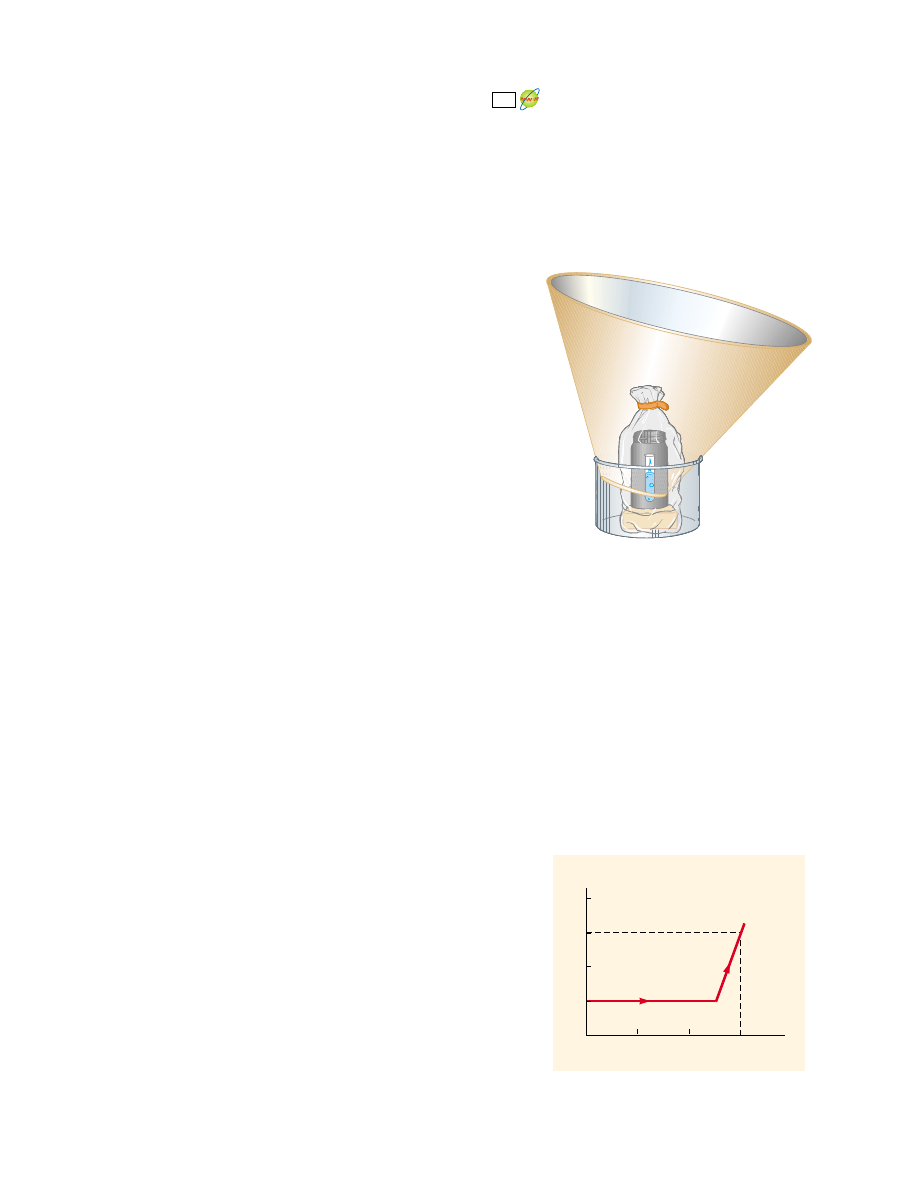
A solar cooker consists of a curved reflecting surface
that concentrates sunlight onto the object to be warmed
(Fig. P20.63). The solar power per unit area reaching the
Earth’s surface at the location is 600 W/m
2
. The cooker
faces the Sun and has a diameter of 0.600 m. Assume that
40.0% of the incident energy is transferred to 0.500 L of
water in an open container, initially at 20.0°C. How long
does it take to completely boil away the water? (Ignore the
heat capacity of the container.)
63.
64.
Water in an electric teakettle is boiling. The power ab-
sorbed by the water is 1.00 kW. Assuming that the pres-
sure of vapor in the kettle equals atmospheric pressure,
determine the speed of effusion of vapor from the ket-
tle’s spout, if the spout has a cross-sectional area of
2.00 cm
2
.
65.
A cooking vessel on a slow burner contains 10.0 kg of wa-
ter and an unknown mass of ice in equilibrium at 0°C at
time t ! 0. The temperature of the mixture is measured at
various times, and the result is plotted in Figure P20.65.
During the first 50.0 min, the mixture remains at 0°C.
From 50.0 min to 60.0 min, the temperature increases to
2.00°C. Ignoring the heat capacity of the vessel, determine
the initial mass of ice.
Figure P20.63
0
1
2
3
20
40
60
T (
°C)
t (min)
0
Figure P20.65